
Higgins M.D. Quantitative textural measurement in igneous and metamorphic petrology
Подождите немного. Документ загружается.

processes. Obviously this can only be investigated completely in three dimen-
sions. Unfortunately, with most 3-D analytical methods it is difficult to separate
touching crystals and hence there has been no work on this subject. If the surface
of contact between two grains is not parallel to the section plane, as is usually the
case, then some, but not all, touching grains will be identified in sections.
Clusters of touching grains are frequently observed in volcanic rocks. In
some cases the touching grains are sub-parallel (synneusis). Although it is
possible to quantify this effect by looking at grain edge distance against
differences in orientation, this has yet to be done.
Some rocks contain a touching network of plagioclase crystals that are
visible in sections as a collection of crystal chains (Philpotts et al., 1998). In
three dimensions these chains must be projections of foam-like surfaces of
crystals, but it is easier to continue the use of the term chain. The crystal chains
are revealed most clearly when a block of basalt is melted: the block retains its
shape even when 70% is liquid. Philpotts et al.(1998) identified the chains
manually from reconstructed serial sections and X-ray tomography. There are
many aspects of the chains that can be quantified, but so far the most useful
has been the number density of the chains (Philpotts et al., 1999). This was
determined by counting the number of chains intersected along various ran-
dom straight lines in sections. The number density can be transformed easily
into the mean chain spacing, also called the network mesh size. The orientation
of such chains is discussed in Section 5.8.3.1.
0
–1.0
–0.5
0.5
Sphene
0
residual distance
1.0
10 20 30 40
cluster frequency (%)
50 60 70 80 90 100
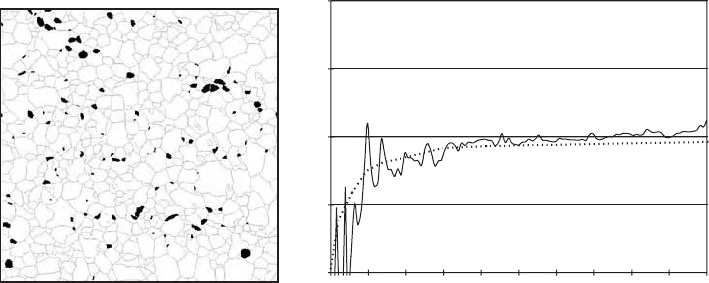
Figure 6.4 Complete linkage cluster analysis of sphene in a granulite sample
(Jerram & Cheadle, 2000). Here the distance between the crystal centres is
compared to that expected for a random distribution (residual distance). The
dotted line is the random variation tolerance limit. Sphene crystals are more
closely spaced than expected in the frequency 5–15%, which corresponds to
cluster size of 1.5 to 5.1 mm.
6.3 Methodology 209

6.3.3.4 Wavelet transform and Fourier analysis
The wavelet transform is a powerful method to identify ordered structures in
rocks (Gaillot et al., 1997, Gaillot et al., 1999). It can be used to identify the
orientation and spacing of ordered structures and has been discussed in the
section on grain orientation (see Section 5.4.3.3). Fourier analysis of grain
sections has been used to look at grain distribution in sandstones (Prince et al.,
1995). Both these methods examine an image of the distribution of a mineral or
grains, not individual grains.
6.3.4 Extraction of mineral association parameters
6.3.4.1 Mineral point correlations
Morishita and Obata (1995) proposed a rather different way of looking at the
spatial distribution of grains and the relationship between grains of different
minerals. It is based on the frequency of occurrence of pairs of points in a
section with the same or different minerals versus distance. It uses a classified
mineral map, but it is not necessary to define individual mineral grains. The
method can only be applied where there is more than one phase in the rock.
The method could also be applied in three dimensions.
We will consider first a homogeneous, bimineralic rock, for simplicity. If
two points are randomly selected then the unconditional probability that both
are mineral 1 is V
1
2
, where V
1
is the volumetric abundance of phase 1.
Similarly, the probability that both are mineral 2 is V
2
2
. The probability that
we have chosen a mixed pair is 2V
1
V
2
. We next consider the conditional
probability of occurrence of mineral pairs at a specified distance D. These
depend on the grain size and spatial distribution of the grains and are denoted
P
11
(D) for a pair of points of mineral 1, P
12
(D) for a pair of points of mineral 1
and mineral 2, etc. For D ¼ 0 the points are coincident and the probability is
equal to the volumetric abundance: P
11
(D) ¼ V
1
. Similarly the probably that
the points are different is zero: P
12
(D) ¼ 0. Where D is very large the probabil-
ities become equal to the unconditional probability, that is P
11
(D) ¼ V
1
2
and
P
12
(D) ¼ 2V
1
V
2
. The difference between the unconditional and conditional
probabilities expresses the grain size, degree of order and degree of association
of the mineral pairs. It is useful to define textural parameters that express these
differences and extend the treatment to more than two minerals. For each
mineral i a parameter s
i
(D) is defined for a distance D:
s
i
ðDÞ¼
P
ii
ðDÞV
2
i
V
i
V
2
i
210 Grain spatial distributions and relations

For each mineral pair i, j a parameter t
ij
(D) is defined for a distance D:
t
ij
ðDÞ¼
P
ij
ðDÞ
2V
i
V
j
At D ¼ 0 all s ¼ 1 and t ¼ 0; at D ¼1all s ¼ 0 and t ¼ 1.
Morishita and Obata (1995) examined a granite and a hornfels using these
methods. They found that s values tend to decrease exponentially with dis-
tance and the slope is a measure of mean crystal size. If the rock was ordered
strongly then the s values should peak at that distance, but this behaviour has
not been recorded. They also found that t values tend to increase monotoni-
cally with distance. Some mineral pairs rise to a peak and then go down,
expressing a spatial association of those two minerals and giving a typical
mineral spacing.
Morishita (1998) developed these measurements further by comparing
s and t values of an ‘ideal rock texture’. In this all crystals are randomly
( uniformly) distributed in the rock. He showed that if a number of assump-
tions are made then the crystal size distribution can be calculated from the
variation in the probability that a point lies within a crystal against the distance
from the crystal centre. However, it is not clear if this technique has any practical
use, as it is not obvious how close natural rocks lie to this ideal texture.
This technique could certainly give interesting information on mineral
associations, data which are not given by other methods. However, the lack
of a readily available computer program to calculate the textural parameters
has hampered the application of the method.
6.3.4.2 Box-counting method
Mineral associations can also be detected using a box-counting method
(Saltzer et al., 2001). This starts with a classified mineral image of a section
of a rock. The image is first divided into four square areas each with an area
of 2
2n
pixels where n is the largest integer possible allowed by the image size.
The value of n is decreased to zero, where each box contains one pixel. For
each value of n the numbers of boxes dominated by two minerals are
tabulated for each mineral pair. This is compared with a synthetically
derived random distribution. A significant difference in the distributions
indicates that the mineral pair is associated. This method does not quantify
the correlation, but just indicates significant associations. The method
does not seem to have any advantages over the method of Morishita and
Obata (1995) and suffers from the same lack of an easy tool for doing the
measurements.
6.3 Methodology 211
6.4 Typical applications
One of the problems with this subject is that there is a large amount of
theoretical and modelling work that produces patterns that resemble rocks
(e.g. Ortoleva, 1994, Jamtveit & Meakin, 1999), but few actual measurements
of the rocks themselves. Therefore, commonly, it has not been possible to
verify if the proposed pattern-making processes actually occurred. In addition,
many of the techniques presented in papers have not been taken up by other
workers; hence the only example is the original paper. In some cases this is
clearly a result of a lack of an easy-to-use computer program. A clear exception
to this trend is the ‘R’ parameter of Jerram et al.(1996).
6.4.1 Metamorphic rocks
Kretz (1966a) examined both the size distribution and position of garnet and
biotite in a schist, and phlogopite, pyroxene and titanite in a marble. He
measured the 3-D position of the crystals by disintegrating the samples with
a small chisel. He found that the spatial distribution of garnet crystals was
random and their size did not correlate with the distance to their nearest
neighbour. Three years later he examined a section of pyroxene–scapolite–
titanite granulite in more detail (Kretz, 1969). He divided up the section into
sub-areas and measured the number density of crystals in each sector. By
comparing the data to the expected abundance he was able to use a chi-squared
test to show that the crystals were distributed randomly. He also showed that
titanite was not associated preferentially with any of the major phases. He
concluded that nucleation of all phases was random. The same section was
re-analysed by Jerram and Cheadle (2000) using their cluster-analysis method.
They found that the larger crystals of scapolite and pyroxene act as ‘domains
of order’ – that is, there are fewer small nearest-neighbour distances than
expected (see Figure 6.4). This method also showed that titanite is clustered.
6.4.2 Igneous rocks
Jerram et al.(2003) have reviewed data on clustering using a graph of their R
parameter against per cent porosity (Figure 6.5). They find that crystals from a
rhyolite laccolith are distributed randomly (see below; Mock et al., 2003), but
that all other examples are clustered. They established a field on this graph for
touching frameworks by the inspection of samples. A good number of clus-
tered examples with known touching frameworks have been used to define this
region, but few non touching frameworks have been analysed, so perhaps
212 Grain spatial distributions and relations
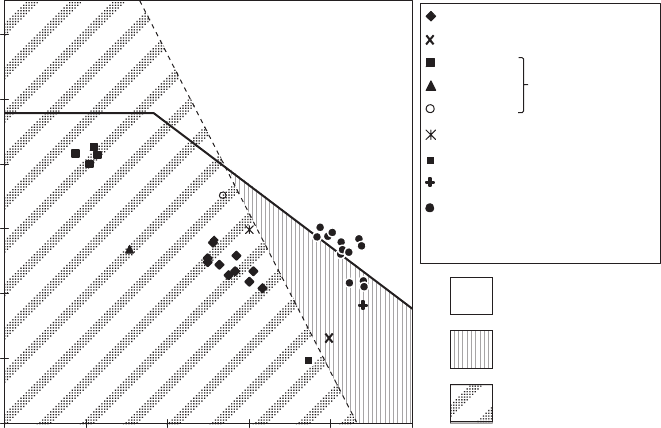
more data are needed to establish this field more securely. Ikeda et al.(2002)
examined two samples of different granites using the method of Jerram et al.
(1996) and concluded that all minerals were clustered, except for biotite in one
sample.
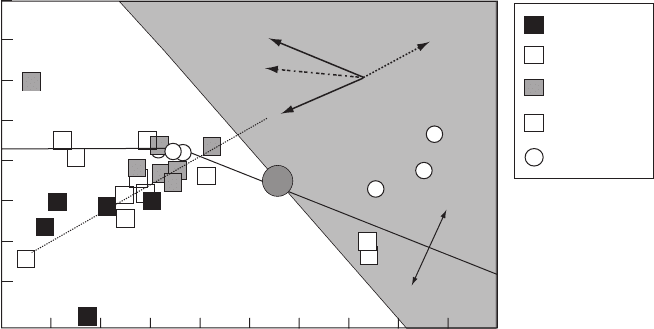
Boorman et al.(2004) examined the positions of orthopyroxene and plagio-
clase crystals in mafic rocks from the lower part of the Bushveld complex using
the nearest-neighbour approach of Jerram et al.(1996). The R against porosity
diagram was developed for spheres, but despite this limitation Boorman et al.
(2004) considered that it could be applied to tabular crystals, such as those
measured here (Figure 6.6). The vector defined by their samples could be the
result of sorting, but does not correlate with the aspect ratio of the grains or the
slope of the CSD, as would be expected. Instead, Boorman et al.(2004) suggest
that this vector represents deformational compaction, similar to that proposed
by Meurer and Boudreau (1998).
The spatial distribution of plagioclase, orthoclase and quartz in a rhyolite
laccolith were examined by Mock et al.(2003). The more tabular feldspars
seemed to show greater variation than the more equant quartz (Figure 6.5).
There was a trend to clustering towards the top of the laccolith, and internal
pulses of magma were distinguished.
0.7
0.9
1.1
1.3
1.5
1.7
1.9
0 20 40 60 80 100
Belingwe komatiite (Joe’s Flow)
Alexo
Kambalda
Vammala
Campbell et al. (1978) experiment
Holyoke Colonnade
Holyoke Entablature
RSDL
Belingwe komatiite
Alexo
Kambalda
Vammala
Campbell
Entablature
Touching framework
CLUSTERED
ORDERED
Non-touching crystals
(random to ordered
away from the RSDL)
Non-touching crystals
(random to clustered
away from the RSDL)
R
porosity (φ) (% melt)
Belingwe basal chill (Joe’s Flow)
Belingwe
chill
Komatiites
Mock et al. (2003) data
?
?
RSDL = Random sphere
distribution line
Holyoke Colonnade
Figure 6.5 Porosity (%) or percent age melt against R value (from Jerram
et al., 2003).
6.4 Typical applications 213
The more complex cluster analysis method of Jerram and Cheadle ( 2000)
was applied by them to two samples. They showed that in a komatiite sample
olivine crystals are clustered with diameters of 0.3–2.5 mm. In the scapolite–
pyroxene–titanite rock examined by Kretz (1969) they found that titanite was
clustered on a scale of 1.8–5.1 mm.
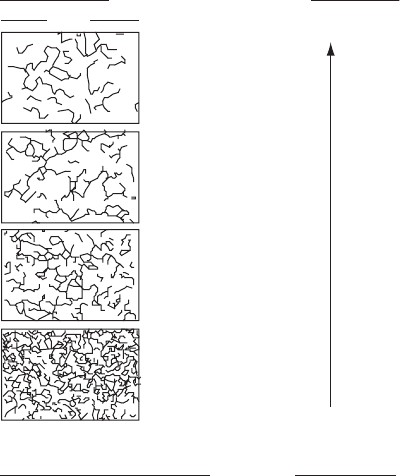
Chains of plagioclase crystals appear to be an important petrological struc-
ture in the thick Holyoke basalt lava flow and other slowly cooled bodies of
similar composition (Philpotts et al., 1999). The chains are a few crystals wide
and consist of crystals up to 0.5 mm long attached in random orientations.
They have been traced by hand from thin sections (Figure 6.7). They have been
quantified by counting the number of intercepts per unit length and appear to
be most numerous at the base of the flow and diminish upwards. The chains
appear to originate in the upper part of the flow as groups of plagioclase
crystals embedded in and surrounding pyroxene oikocrysts (Philpotts &
Dickson, 2000). These crystal ensembles descend by convection to the lower
part of the flow where the pyroxene exsolves and recrystallises into masses of
granular pyroxene surrounded by the plagioclase chains. An investigation of
the chains with a view to determining anisotropy produced by compaction is
discussed in Section 5.8.3.1 (Grey et al., 2003).
Igneous layering is commonly observed and has been the subject of numer-
ous theoretical and qualitative studies (Parsons, 1987, Naslund & McBirney,
1996). However, so far there has been little quantitative work on crystal
% porosity
R-value
Better
sorting
Mechanical
compaction
Deformational
compaction
Overgrowth
RSDL
1
2
Aging
Ordered
Clustered
100500
Group 1 opx
Group 4 plag
Group 4 opx
Group 2 opx
Group 3 opx
Figure 6.6 Spatial distribution patterns of orthopyroxene (squares) and
plagioclase (circles) in the lower part of the Bushveld complex (Boorman
et al., 2004). Shaded region is for touching frameworks.
214 Grain spatial distributions and relations
positions in layered plutonic rocks. A good example is the inch-scale layering
in the Stillwater intrusion. Boudreau (1987, 1995) has done a fine job of
modelling the origin of the layering by self-organisation, but there are no
quantitative studies of the grain positions and sizes in the rock.
There have been few studies of mineral associations: all are by the authors
that originated the method and all just indicate significant associations with-
out giving a value to this parameter. The spatial association of garnet and
clinopyroxene in a sample of mantle peridotites was considered to be produced
by mineral breakdown: orthopyroxene reacted to form garnet and clinopyr-
oxene (Saltzer et al., 2001). This was used to reconstruct a pressure–temperature
history for these samples. Morishita and Obata (1995) examined two samples
of hornfels and granite and found that biotite and quartz were spatially asso-
ciated in the granite.
Flow base
Centre of 174 m-thick flow
No chains present in first few metres
2 cm
74.2 m
58.7 m
40.9 m
19.9 m
Increasing mesh size
compacted dilated
Vertical sections
Figure 6.7 Plagioclase crystal chains in the Holyoke basalt flow (Philpotts
et al., 1999). Chains were traced by hand from thin sections.
6.4 Typical applications 215
7
Textures of fluid-filled pores
7.1 Introduction
Many igneous and metamorphic rocks contain a fluid component or evidence
of the former existence of such a fluid.
1
Fresh lavas and pumice blocks
commonly contain vesicles, formed by the exsolution of gas from the silicate
fluid. Metamorphic rocks may preserve evidence of partial melt pockets. The
term ‘pore’ is used here to indicate space filled, or formerly filled, with fluid
surrounded by a more viscous fluid (e.g. silicate melt, glass) or crystals. Pores
may be considered as the fluid equivalent of grains or crystals in solid phases.
Fluid inclusions in crystals are excluded here as their textures have yet to be
studied quantitatively.
Pores do not always stay filled with their original fluid during lithification.
For instance, vesicles may be filled with other minerals to become amygdules.
In partially molten silicate rocks the fluid may quench to a glass, or a mixture
of minerals, whose textures pseudomorph the original pores. Hence the por-
osity of a rock, as discussed here, is the original volume proportion of fluid at
the time of interest. For example, the porosity of a lava sample is the volu-
metric proportion of vesicles at the moment of solidification; the porosity of a
partially molten rock is the volumetric proportion of fluid when the texture is
preserved and such a melt may have gas bubbles. Clearly, it is important to
specify what feature is being examined. The porosity is characterised at a first
approximation by the total volumetric proportion of fluid, but like grain size,
it is also possible to quantify the size distribution of pores.
Surfaces are important in many geological processes, as sites of chemical or
mechanical processes. The pores define an internal surface area in a rock. The
outside of grains defines the external surface area, which may be significant for
loose materials. Clearly some materials, such as pumiceous pyroclastic depos-
its will have significant internal and external contributions to the total surface
216
area. In natural materials surfaces are complex, hence the actual value of the
total surface area depends partly on the scale of the analysis and the measure-
ment method (Brantley et al., 1999, Brantley & Mellott, 2000).
Another important associated property is the permeability of the rock. In
many ways it is much more important than the porosity, as this parameter
measures how readily a fluid can flow through a rock. The total permeability
can be measured, in addition to the size distribution of pore channels and
‘throats’ that control fluid flow. Rocks with a high porosity tend to be highly
permeable, but the porosity–permeability relationships diverge as the porosity
goes down.
7.2 Brief review of theory
7.2.1 Permeability
The permeability of a rock is used qualitatively to describe the ability to
conduct fluid: a more permeable rock conducts fluid more easily that a less
permeable rock. Hence the permeability expresses the connectedness of the
pores. The original development of the subject considered the flow of water in
a rock and is expressed as Darcy’s law:
DP=l ¼ m=k
where DP is the pressure drop over a length l, is the specific discharge or filter
velocity, m is the dynamic viscosity of the fluid and k is the permeability. The
permeability is sometimes expressed in Darcy units, which are equal to about
10
8
cm
2
. The permeability of a rock is not necessarily the same in all
directions.
Darcy’s law is only applicable in low Reynolds number (ratio of inertial
forces to viscous forces) flow where energy loss is due to viscous effects. At
higher flow rates the fluid inertia becomes important and another term must be
added to Darcy’s law (see review in Rust & Cashman, 2004):
DP=l ¼ m=k
1
þ
2
r=k
2
where k
1
is the viscous (Darcian) permeability, r is the fluid density and k
2
is
the inertial (non-Darcian) permeability.
7.2.2 Magmas and partially molten rocks
Movement of fluid with respect to solids is a fundamental process in the
solidification of igneous rocks and the melting of metamorphic rocks. It may
7.2 Brief review of theory 217
occur by compaction (McKenzie, 1984), porous-media convection or in
response to shear. It is especially important in the production of monominera-
lic rocks, such as anorthosite or dunite. The final porosity is commonly
expressed as the ‘trapped liquid’ component and can be determined by chemi-
cal or textural methods. The key property is clearly the variation in perme-
ability during solidification or melting: if the permeability is finite for all
values of porosity, then all the silicate fluid can leave the rock. However, it is
commonly proposed that there is a percolation threshold, below which the
permeability falls to zero. The actual value of such a threshold may be partly
controlled by the interfacial angles of the fluid with the solid phases, which in
turn express differences in interfacial energy (see Section 4.2.3).
Cheadle et al.(2004) have reviewed and investigated the relationship
between textural equilibrium, dihedral angles and permeability using a
geometrically simple numerical model. The simplest models are for settled or
random rigid shapes. These are termed non equilibrated as their shape is
unchanged after accumulation. For these materials the percolation threshold
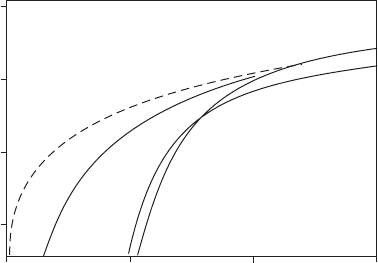
varied with crystal shape – it was about 3% for spheres and 10% for
cubes (Figure 7.1). This means that there will always be a minimum of 3 to
10% melt trapped in the cumulate. For texturally equilibrated samples, with
dihedral angles less than 408, the percolation threshold was close to zero.
That is, all interstitial fluid (silicate liquid) can escape and monomineralic
rocks can form.
porosity (%)
permeability, k, (mm
–2
)
0102030
10
–14
10
–12
10
–10
10
–8
E
q
u
i
l
i
b
r
a
t
e
d
(
θ
<
4
0
°
)
S
e
t
t
l
e
d
s
p
h
e
r
e
s
S
e
t
t
l
e
d
c
u
b
e
m
o
d
e
l
R
a
n
d
o
m
c
u
b
e
m
o
d
e
l
Figure 7.1 Melt permeability against porosity for a crystal–liquid system.
For the settled and random models the porosity is the space betw een crystals
represented as simple geometrical form s. The crystals are allowed to interact
in the equilibrated model, giving dihedral angles, , of less than 408.From
Cheadle et al.(2004).
218 Textures of fluid-filled pores