
Higgins M.D. Quantitative textural measurement in igneous and metamorphic petrology
Подождите немного. Документ загружается.

6
Grain spatial distributions and relations
6.1 Introduction
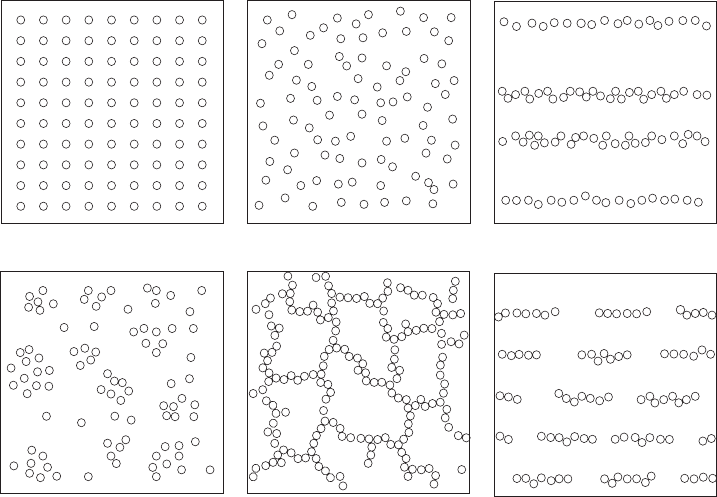
Grains in many rocks are not distributed randomly in space, but organised
into clusters, layers and chains (Figure 6.1). Such spatial patterns can be
defined in a number of ways: by the presence of grains as well as by their
size, shape, orientation and mineral associations. Such non-random distribu-
tions of grains, termed patterns or packings, have been observed in meta-
morphic, igneous and sedimentary rocks (Rogers et al., 1994, Jerram et al.,
2003). Despite the fact that quantitative investigation of such structures in a
rock was started in 1966 (Kretz, 1966a), there have been relatively few quanti-
tative studies since that time. Many terms have been used to describe nonuni-
form grain distributions: in igneous rocks grain clusters are referred to as
clumps, clots or glomerocrysts, whereas in metamorphic petrology other
textural terms are used. Another important textural aspect of a rock is the
spatial association of minerals, or lack thereof. This may reflect nucleation,
growth or mineral breakdown processes, but has been much less studied than
the actual crystal positions.
Patterns can be imposed on a rock during its formation by externally
varying conditions or can develop spontaneously. For instance, during deposi-
tion of sediments variations in the flow regime or sediment source can produce
layers; these are clearly imposed externally. Some layering in igneous rocks
may result from similar sedimentary processes (Naslund & McBirney, 1996).
Layering in metamorphic rocks can reflect layering of a sedimentary protolith,
and deformation of dykes and enclaves. Layers or other structures are referred
to as templates (Ortoleva, 1994). In some homogeneous materials patterns can
arise spontaneously, or existing templates can be amplified and modified.
These effects are called ‘geochemical self-organisation’ (Ortoleva, 1994).
A classic example of this effect is Liesegang layering. Hence, grain clusters,
199
chains and layers appear to be common phenomena, with varying origins, and
should yield petrogenetic information.
6.2 Brief review of theory
6.2.1 Nucleation of crystals
Nucleation occurs when it is energetically favourable to create a new phase, or
more crystals of an existing phase (see Section 3.2). If nucleation occurs
spontaneously within a phase it is termed homogeneous nucleation. The posi-
tion of the nuclei will be random, provided that the temperature and composi-
tion of the liquid are constant. If, however, a region of the liquid is depleted
in the crystal components, for example by crystallisation of an adjacent crystal,
then nucleation may be suppressed there. This may produce megascopic
patterns by geochemical self-organisation (Ortoleva, 1994).
Nucleation can also occur on existing phases, termed heterogeneous nuclea-
tion. The position of the nuclei of the new crystals will obviously depend on the
Ordered
Random Layered
Clustered Chains/Foams Broken la
y
ers
Figure 6.1 Schematic grain spatial distributions in two dimensions. Such
patterns may be defined by the presence of grains of a phase, their orientation
and mineral associations or by differences in grain size.
200 Grain spatial distributions and relations
location of the host materials. It is unlikely to be random, unless the host
grains are very small and initially randomly distributed. It is more likely that
the nuclei will be clustered. If the crystals do not move significantly during
solidification, this may be visible in the final rock. It is debatable if any magma
is ever completely free of crystals, hence heterogeneous nucleation may be the
normal situation.
Minerals can also form by the breakdown of other solid phases. If two
minerals are formed by such reactions in the solid state then they will be
spatially associated.
6.2.2 Geochemical self-organisation
Many periodic geological structures are thought to originate by variations in
externally controlled parameters. For example, sedimentary layering may
form by variations in the mineralogy and/or size of the particles being depos-
ited. The variation in externally controlled parameters is considered to be a
‘template’ which forces the structure on the rocks. However, patterns can also
arise spontaneously without the intervention of a template: this vast subject is
termed geochemical self-organisation (Ortoleva, 1994, Jamtveit & Meakin,
1999). A number of patterned structures in geology may be produced by this
effect (Ortoleva, 1994):
*
layers and spots in igneous rocks
*
metamorphic diff erentiation and layering
*
oscillatory zoning in crystals
*
Liesegang banding and layering
*
diagenetic patterns
*
geodes, concretions, agates and orbicules
Geochemical self-organisation may seem to violate the second law of thermo-
dynamics: that all systems evolve spontaneously towards a state of increased
disorder. However, although geochemical self-organisation is clearly a local
increase in order, it must be compensated by a greater decrease in order of the
whole system.
Self-organised patterns originate by the dissipation of free energy and are
hence called dissipative structures. The initial unordered system is subject to
random variations of thermal origin. This ‘noise’ can be decomposed into
periodic fluctuations of all possible symmetries, in the same way that any wave
can be Fourier transformed into an infinite number of harmonic waves. When
the system is close to equilibrium none of these patterns dominates and the
system appears completely unordered. However, when the system evolves
6.2 Brief review of theory 201
away from its equilibrium state certain patterns may be amplified by positive
feedback loops and an ordering developed. If the structure is observable and
stable it is termed a dissipative structure. Such patterns may be comprised of
layers, spots, spirals, etc. The patterns form by reaction–transport: this
involves solution of some grains, transport of material and growth of other
grains. Some patterns are only maintained by a continuous supply of free
energy; however, the occurrence of dissipative structures in old rocks indicates
that they can be frozen in place and observed long after the activity of the
system has ceased. It should be emphasised that dissipative structures can form
only in systems that are maintained away from equilibrium.
A classic example of patterning is Liesegang banding. In the simplest
situation this consists of bands richer in a phase in a two-dimensional
system. Three-dimensional Liesegang layers also occur, but have been little
studied (Boudreau, 1995). Two different origins have been proposed
(Chacron & L’Heureux, 1999). In the pre-nucleation model, nucleation and
growth of a crystal depletes the surrounding area in that component, inhibit-
ing nucleation of further crystals. As the reaction front moves away, higher
concentrations are encountered and nucleation is enabled again, starting
the production of a new layer. However, Liesegang bands can also form
after nucleation from a homogeneous material by competitive particle
growth and coarsening (see Section 3.2.4). If a small region has a local
increase in crystal size, then the concentration of the component in the liquid
will decrease. As material diffuses in from adjacent regions the concentration
there will decrease and hence the crystals will dissolve. The process can
produce a series of bands with different crystal sizes and abundances. Both
processes have been combined in a one-dimensional model by Chacron
and L’Heureux (1999). However, observations of the actual formation of
Liesegang bands and layers suggest the post-nucleation model is more
important (John Ross, quoted in Boudreau, 1995). The post-nucleation
process has been proposed for the origin of the famous ‘inch-scale’ layering
of pyroxenes in anorthosite in the Stillwater intrusion (Boudreau, 1995).
Philpotts and Dickson (2002) have observed millimetre-scale layering in
the roof zone of a thick basalt flow. It consists of sheets of ophitic
plagioclase–pyroxene clusters separated by sheets of residual liquid. They
suggest an origin by cycles of nucleation and that such crystal sheets are
separated by gravity along planes of weakness. It is also possible that the
whole structure originates from self-organisation. I have observed that in
some igneous rocks well-developed layering passes laterally into broken layers
and finally clusters. Such behaviour is also predicted by self-organisation
processes (Krug et al., 1996).
202 Grain spatial distributions and relations
6.2.3 Grain aggregation and agglutination
Ideally, a grain will sink or rise in a Newtonian fluid at a speed that is related to
the density contrast and size by Stokes’ law. However, in most geological situa-
tions the concentration of grains is sufficiently high that grains interact and will
gather into clusters, if there is sufficient time (see the review in Schwindinger,
1999). Such clusters will move as if they were made of a single, larger grain, and
will hence descend faster than each of the original grains. The c lusters can form by
vertical and horizontal grain convergence: a large grain will descend faster than
smaller grains and sweep such grains from in front of it. Grains may move
laterally to reduce differences in liquid velocity on either side of the grain – this
is similar to the ‘Bagnold effect’ that produces a concentration of particles in the
centre of a conduit. Grain aggregates may be preserved in volcanic rocks, but it
seems unlikely that such structures can be observed in cumulate plutonic rocks.
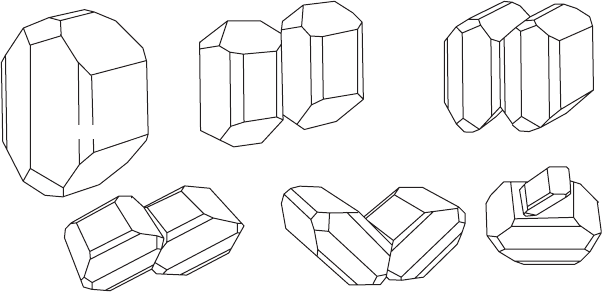
In some aggregates euhedral crystals touch along crystal faces (Vance,
1969). One of the best-known examples is that of olivine crystals from the
1959 Kilauea Iki eruption (Figure 6.2; Schwindinger & Anderson, 1989). Most
crystal pairs are united by faces with the same indices, and larger faces are
more commonly in contact than smaller ones. The whole structure resembles a
twinned crystal except that it is not a growth form. The term synneusis
(‘swimming together’) has been used to refer both to nonoriented aggregates
of crystals, and such aligned crystal groups. Schwindinger (1999) considered
that such aligned groups cannot agglutinate during settling, but must be pro-
duced during shear flow or turbulence. The driving force of this process is the
reduction of the total surface (interfacial) energy of the mineral grains: contacts
{021}-{010}
{110}-{110}
{021}-{021}
{010}-{010}
021
110
010
101
001
120
Figure 6.2 Synneusis of olivine grains from the 1959 Kilauea Iki eruption
(from Schwindinger 1999).
6.2 Brief review of theory 203
between similar grains will have a lower surface energy than crystal–magma
contacts. This process has also been proposed for the origin of some garnet
porphyroblasts in metamorphic rocks (Prior et al., 2002).
6.2.4 Magma mixing
If several magmas or crystal mushes are introduced into a conduit or chamber
they will have a tendency to mix. The vigour and duration of the mixing will
determine if the resulting material appears to be homogeneous on a micro-
scopic scale or if the two magmas can still be recognised in blocks and out-
crops: the two cases are commonly referred to as magma mixing and magma
mingling. If the original magmas differ in their crystal contents then the
resulting magma may have a non-random distribution of crystals. Of course,
measurements of crystal positions must be done at a higher resolution than
that of the expected structure. In some rocks the results of mixing are clearly
revealed by compositional or isotopic studies. However, if mineral composi-
tions are constant for all grains, then an origin of crystal clusters by incomplete
mixing may not by easy to determine.
6.2.5 Grain packing
Grains in some sedimentary rocks, and crystals in some cumulate igneous
rocks, are packings of hard particles (Rogers et al., 1994). Theoretical packing
of different sized and shaped particles is very complex; hence this subject has
been explored using numerical models of simple shapes, commonly spheres.
These studies have been concerned mainly with the overall packing density,
that is its efficiency, rather than the actual positions of the particles. Jerram
et al.(1996) used one such study to establish a reference texture for nearest
neighbour distances.
6.3 Methodology
The position of a grain has several measurable parameters.
*
The simplest is its centre, which can be approximated by the centre of mass and
specified by a single triplet of x, y and z values.
*
The position of the surface of the grain must also be considered: for instance, two
large grains may be distant, but touching . Many more data are needed to specify the
grain surface – many x, y, z triplets.
*
The nature of a grain’s neighbours: certain mineral pairs may be touching or
spatially associated more frequently than would be expected for a random texture.
204 Grain spatial distributions and relations
Most analytical methods assume that the sample is homogeneous. It is parti-
cularly important to avoid materials like vesicular lavas, which do not meet
this criterion.
6.3.1 Three-dimensional analytical methods
The centre and surface of a grain can be determined precisely using three-
dimensional methods, if the surface of the grain can be separated from adjoining
grains by physical or analytical means. In the earliest study of crystal positions a
sample was dismantled using a chisel and the crystal positions measured with a
ruler (Kretz, 1969). However, such a laborious study has not been repeated. The
extent of individual grains can be determined by serial sectioning, if their
concentration is low enough that few crystals are touching, or if grain bound-
aries are clear (see Section 2.2.1). In transparent materials, such as volcanic
glasses, the extent of crystals can be measured directly with a regular or confocal
microscope (see Section 2.2.2). X-ray tomography can be used to determine the
extent of grains if adjoining grains can be separated (see Section 2.2.3).
These direct methods are the only ones that can be used for grains with
complex shapes. They are also the only ones that can be used to identify
‘chains’ of crystals (e.g. Philpotts et al., 1999). However, it is not always
possible to separate grains using current 3-D methods. Some two-dimensional
methods are much better at separating adjoining crystals and hence may have
to be used (see Section 2.7).
6.3.2 Section and surface analytical methods
In a section the centre of the grain intersection is not the true centre of the
grain, and is therefore referred to as the centroid. For simple shapes the
centroid is the projection of the centre of the grain onto the section. This is
not the case for grains with complex shapes and they cannot be examined
successfully in two dimensions.
Grain outlines can be acquired easily from rock surfaces, slabs and sections,
using a variety of techniques described in Section 2.5. Such images can be
processed manually or automatically to produce classified mineral images (see
Section 2.6). Some methods require that the grain outlines are obtained from
the classified images. The centroid of the grain intersection can be determined
as the centre of mass.
If two grains touch in a section, then clearly they touch in three dimensions.
However, it is not possible to determine from a section if adjacent, but
separate, grains actually touch out of the section plane.
6.3 Methodology 205
6.3.3 Extraction of spatial distribution parameters
6.3.3.1 Nearest-neighbour distance (‘big’ R)
One of the simplest ways of describing spatial distribution patterns uses the
mean nearest-neighbour distance calculated from the centres of the grains
(Jerram et al ., 1996, Jerram et al., 2003). This is compared to the mean
nearest-neighbour distance from a random distribution of points with the
same population density. This is a method that can be applied to any 2-D
textures where a grain or crystal can be defined by a grain centre co-ordinate.
In principle, the method could be extended into 3-D, where the 3-D nearest
neighbour is compared to a random 3-D distribution of points, but as yet very
few 3-D data-sets of rock textures exist and this has not been tested. However,
it is possible to compare the 2-D spatial distribution pattern to existing known
reference textures where their 3-D spatial pattern is known (Jerram et al., 1996,
Jerram et al., 2003). So far this has been limited to isotropic, homogeneous
materials and it is not clear if strongly foliated rocks, or sections with a
significant porosity, can be analysed in the same way.
The positions of grain centres are generally determined when the other
textural parameters are determined. A simple procedure goes through the list
of N crystal centroid positions and finds the distance to the nearest neighbour,
r (see Appendix). The mean nearest-neighbour distance is
r
A
¼ð1=NÞ
X
r
The mean nearest neighbour for a random distribution of points with the same
population density (number of crystals per unit area), N
A
r
E
¼ 1=ð2
ffiffiffiffiffiffiffi
N
A
p
Þ
The ratio of these parameters, ‘big’ R describes the distribution of the grains.
R ¼ r
A
=r
E
In principle, for a distribution of random points R ¼ 1. For clustered points
R < 1 and for ordered points R > 1. However, crystals are not points: each
occupies a certain volume in space and area in a section. Hence, crystals
cannot be coincident like points. To enable the comparison of ‘big’ R values
Jerram et al.(1996) calculated the random sphere distribution line (RSDL,
Figure 6.3). This represents the 2-D ‘big’ R values calculated from 2-D sections
taken through 3-D random distributions of spheres with different porosities
up to the minimum porosity: that for random close packed spheres with a
porosity of 37%. The RSDL is calculated using a combination of computer
206 Grain spatial distributions and relations
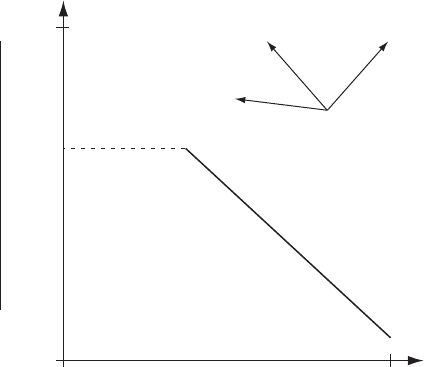
generated sphere models and a naturally generated model for random close
packing (Jerram et al., 1996). Vectors for common processes have been estab-
lished, like mechanical compaction, grain overgrowth and better sorting.
This method has considerable advantages as it is simple to apply. However,
the validity of the reference models for more realistic crystal shapes and
variable crystal sizes has not been tested. Also, the method gives only a single
parameter that does not describe cluster size. More elaborate methods will be
described in the following section.
If many or all crystals touch in three dimensions then the resulting frame-
work will have an important effect on the rigidity of the material. Hence there
is much interest in determining the minimum amount of crystals that is neces-
sary to make such a framework. Jerram et al.(2003) used nearest-neighbour
diagrams to determine if crystals in a rock form a touching framework. This
technique has the advantage that it can be applied to sections; however, more
data are needed before the method can be verified fully.
6.3.3.2 Cluster analysis
The goal of cluster analysis is to quantify the size and characteristics of clusters
of grains in a rock. Clustering can reflect packing processes, the distribution of
abundance of matrix (porosity) (%)
R =
mean distance to nearest-neighbour
distance for random distribution
0
1.0
2.0
Ordered
Clustered
Random sphere distribution line
Better
sorting
Mechanical
compaction
Overgrowth
100
Figure 6.3 Nearest neighbour distance determined from sections through
materials (Jerram et al., 1996). The porosity is eq ual to 100 abundance in %
of the phase analysed. The random sphere dist ribution line is indicated on the
graph representing the spatial distributions of randomly packed spheres up to
37% porosity which is the minimum possible for random close packed
spheres.
6.3 Methodology 207
original nucleation sites or other processes (Jerram & Cheadle, 2000). The
first attempt to quantify clustering sizes and distributions used the nearest-
neighbour distance technique (see Section 6.3.3.1; Jerram et al., 1996). More
recently two, more complicated, techniques have been developed: complete
linkage hierarchical cluster analysis (CLHCA) and density linkage cluster
analysis (DLCA). These methods are ideally applied to the materials in
which the complete, 3-D position of each grain is known. Jerram and
Cheadle (2000) applied these methods to sections and tested performance
with comparative 2-D sections through known 3-D synthetic textures (SAS
package – see Appendix).
CLHCA was found to give the clearest results. It uses the distance between
the grain centres. These are agglomerated to give the most compact groups.
The result is a dendrogram (tree diagram) that links the grains and groups with
lines. The distance between groups gives the ‘height’ in the tree. However, it is
difficult to get direct quantitative information from a dendrogram – any
distribution will give a dendrogram, including a random distribution.
Another way of presenting the data is a graph of cluster frequency (number
of clusters) against cluster size (number of grains in the cluster). At a cluster
number of one all grains are included; at a cluster size of one grain the number
of clusters equals the number of grains. This is a smooth curve for a random
distribution, but has gentle steps for a clustered distribution. A further refine-
ment can be made by normalising the data to a random distribution; devia-
tions are then easier to see. This can be done by calculating the distance
between clusters and subtracting the expected distance for a random distribu-
tion. A graph of this residual distance against cluster frequency gives the
characteristics of the dominant clusters (Figure 6.4).
DLCA uses a different approach: clusters are defined on the basis of the
amount of material within a certain radius. Hence this method considers the
whole volume of the grain, and n ot just its centre. Clearly, this is a better approach
if grains have a high concentration and many are touching. The technique can be
applied easily to images with pixels or voxels. In many studies we can only observe
grains in section, hence we are faced with the problem of calculating a 3-D
parameter from 2-D data. Jerram and Cheadle (2000) tested this problem with
a synthetic 3-D distribution, as before. They did not achieve good results, but this
may reflect the weakness of the test distribution and not the method.
6.3.3.3 Touching crystals
Analytical methods discussed so far are only concerned with the position of the
grain centre. They are used to reveal processes that acted early on grains.
Conversely, the distance between the edges of the grains will reflect later
208 Grain spatial distributions and relations