
Higgins M.D. Quantitative textural measurement in igneous and metamorphic petrology
Подождите немного. Документ загружается.

‘intermediate magnetic fabric’. Finally, the magnetic axes may have no rela-
tion to the structure.
In some situations reverse or intermediate magnetic fabrics may have been
identified on structural, rather than mineral fabric criteria. Hence, it is possible
that the magnetic fabrics are in fact normal and the complexity of the structure
has been underestimated (Rochette et al., 1992). Reverse and intermediate
magnetic fabrics can be identified by rock and magnetic fabric measurements
(Geoffroy et al., 2002); however, in these cases the magnetic measurements are
made redundant by the fabric analyses. A more useful way of detecting reverse
and intermediate fabrics is by identification of the magnetic minerals that
produce the susceptibility. A number of minerals, such as single-domain
magnetite and tourmaline, can produce an inverse fabric (Rochette et al.,
1992). The magnetic mineralogy can be identified using optical means, but
commonly many magnetic minerals are present. In these cases other magnetic
methods can be used (see Section 5.6.2).
5.6.2 Anisotropy of (partial) anhysteretic remanent magnetisation
Many rocks have complex histories which are reflected in more than one
fabric. In many situations a weak, late, geologically insignificant magnetic
fabric can dominate over fabrics developed in response to more impor-
tant geological events. The AMS of a sample is contributed by all iron-
rich minerals. However, anisotropy of anhysteretic remanent magnetisation
(AARM ¼ ARM ¼ anisotropy of isothermal remanent magnetism) and the
related method anisotropy of partial anhysteretic remanent magnetisation
(ApARM ¼ pARM) respond only to ferrimagnetic minerals, essentially mag-
netite, hematite and pyrrhotite (Jackson et al ., 1988, Jackson, 1991).
Remanent magnetism is the magnetic field produced by a sample in the
absence of an applied field. It is produced by the ferrimagnetic minerals and
can be used in two different ways. The direction of the natural remanent
magnetism of samples (NRM) is used in palaeomagnetic studies to establish
the direction of the magnetic poles with respect to the sample. Similarly, if other
data are known then the NRM can be used to correct for tilting and rotation of
the unit since the fabric was produced (e.g. Palmer & MacDonald, 2002). The
NRM of a sample can be erased by thermal or alternating field demagnetisation
and a new magnetism induced. This magnetic field will be related to the aniso-
tropy of the ferrimagnetic minerals in the rock. AARM examines the total
anisotropy of remanence in a rock, produced by all ferrimagnetic grains. The
strength of remanence is different for each grain and this can be used in ApARM
to separate populations of grains and examine their fabric independently.
5.6 3-D bulk fabric methods 179
The strength of remanence is measured by the coercivity, which is the
intensity of the magnetic field required to reduce the magnetisation of that
material to zero after the magnetisation of the sample has reached saturation.
‘Hard’ materials have a high coercivity and ‘soft’ materials a low coercivity.
The coercivity depends mostly on the nature of the mineral, its size and shape.
The fabrics of grains with different coercivities can be determined by applying
a weak, constant magnetic field at the same time as a stronger alternating field
is allowed to decay (Jackson et al., 1988). Alternatively the sample can be
magnetised completely and then low coercivity fractions removed progres-
sively by alternating field demagnetisation (Trindade et al., 2001). The aniso-
tropy of remanent magnetism within different coercivity intervals is called the
partial anhysteretic remanent magnetisation. It has proved to be particularly
useful for isolating fabrics produced by late secondary alterations (e.g.
Trindade et al., 2001).
5.6.3 Other integrated (bulk) analytical methods
Neutrons are diffracted by atoms and can therefore be used to determine the
lattice parameters and orientation of crystals. Neutron beams cannot be
focused; hence the method uses a broad beam that illuminates many crystals
and gives bulk properties. The weak interactions between neutrons and most
rocks mean that large samples must be used. Hence, the method is attractive
for rocks with large grain sizes. Almost no sample preparation is needed: some
workers shape their samples into 1 cm-diameter spheres (Xie et al., 2003);
others just use irregular blocks (Schafer, 2002).
Pulsed neutron sources enable the use of time-of-flight in addition to
angular position information for analysis (Schafer, 2002, Xie et al., 2003).
Recent developments in software have enabled the method to analyse
low-symmetry minerals such as plagioclase. The method is limited by the
small number of neutron sources and detector arrays that can be used for
these analyses. Sample analysis time is generally long and demand for these
facilities intense, hence few samples can be analysed. Synchrotron X-rays can
also be used and this may be the source of choice in the future (Wenk &
Grigull, 2003).
X-ray diffractometry can also be used to determine the orientation of
mineral grains in a limited class of materials. It is usually only practicable
for minerals with an orthorhombic or higher symmetry. Mixtures of many
minerals may also cause problems, as the diffraction lines cannot always be
separated and identified. The low penetration power of X-rays in most rocks
means that only the surface of a sample is examined. Despite these restrictions
180 Grain orientations: rock fabric
the low cost of the apparatus, when used on an existing X-ray diffractometer,
can make the method attractive (Rodriguez-Navarro & Romanek, 2002).
5.7 Extraction of grain orientation data and parameters
The methods described above give a variety of different types of data: some
techniques measure the bulk properties of the sample, whereas others give
information on individual crystals in a rock. Individual crystal data are much
richer but may not always be simple to interpret. Hence, individual data are
commonly reduced to an orientation ellipsoid ( second rank tensor), which is
very useful for treating large numbers of samples or comparing data with
methods that measure bulk properties (see below and Mardia & Jupp, 2000).
The orientation ellipsoid should be distinguished from the strain ellipsoid,
which is a measure of the deformation required to produce the orientation
ellipsoid from a population of randomly oriented lines. In a 2-D section the
two are identical, but in 3-D they may differ: the directions of the axes are
identical, but their relative lengths may be different (Gee et al., 2004). If we
have 3-D data, such as EBSD, then we can calculate the orientation ellipsoid
directly from these data. However, many popular methods can only be applied
to sections: here we must integrate data from several non-parallel sections to
get the 3-D ellipsoid (see below).
5.7.1 Individual grain orientation display
Individual crystal data are commonly displayed graphically so that they can be
interpreted in terms of geological processes. Three angular parameters are
needed to express the three-dimensional orientation of each independent
crystallographic (lattice) axis or shape axis of a crystal. This can only be
expressed in a three-dimensional diagram, such as the orientation distribution
function diagram (ODF) (Schmid et al., 1981, Bunge, 1982). Because of the
obvious difficulties of ODF diagrams geologists commonly use projections of
polar diagrams of pole figures. The most popular is the equal-area net
(Schmidt or Lambert net). SPO can be displayed as the directions of major
and minor (longest and shortest) axes of each crystal with respect to specimen
reference directions. LPO can be displayed in a similar way by plotting poles to
lattice planes, crystallographic axes or zone axes with reference to some
geologically relevant orientation. For uniaxial crystals one net gives most of
the useful fabric information, but two nets are needed for the complete
specification of the orientations of all crystals. Three nets may make some
fabric symmetry more evident. In some studies the inverse pole diagram is used
5.7 Extraction of grain orientation data and parameters 181
(Randle & Caul, 1996). Here, the crystal axes are the reference frame and the
orientation of the lineation plotted for each crystal.
Two-dimensional orientation data can be readily displayed as we require only
two parameters. The simplest diagram is a conventional histogram of crystal
numbers against angle. Data bins must be chosen with regard to the number of
data points: more detail is possible if more data are available. A variation on
this theme is the rose diagram, which is a polar histogram of the number of
crystals against real angle. Such a diagram is symmetric, because crystal orien-
tations do not have a distinct direction. Such a rose of orientations is a periodic
function that can be analysed by the Fourier method. This can have as many
terms as the number of data points, but for real data it is best to truncate it
(Launeau & Robin, 1996). The size and shape of the data window analysed may
be important if few grains are present. In this case edge effects must be con-
sidered; that is grains that lie across the boundary of the analysed area. The
simplest solution is either to increase the area measured or to use a circular
section. However, the latter assumes that the fabric is not strongly developed.
Orientation data can also be displayed without dividing into bins in the
cumulative distribution function against angle diagram. This is a plot of the
number of crystals with an orientation angle less than a certain value against
the angle. It is easy to apply some statistical tests to this function as it increases
monotonically from zero to n, the number of samples. It is also used by Gee
et al.(2004) to combine sectional data into an orientation ellipsoid (see
Section 5.7.3).
The variation in crystal orientation across a surface can be coloured accord-
ing to a ‘look-up’ table. The table contains various bins with their correspond-
ing colours. The colours are then applied to a map of the surface or volume.
These diagrams are sometimes called AVA diagrams.
5.7.2 Mean orientation from individual data
The statistics of 3-D orientations are complex, but have been well developed
and described (e.g. Mardia & Jupp, 2000). For AMS studies the accepted best
way to calculate mean orientations is that of Hext (1963) and Jelinek (1978).
Such statistical methods are commonly incorporated into the programs that
reduce AMS data.
The statistics of 2-D data are simpler but present a few complexities, hence
are briefly described here (see also review in Capaccioni et al., 1997). We are
usually interested in the mean and degree of dispersion of the orientation data.
The mean grain orientation angle,
Y, cannot be calculated as a simple mean
because the orientation variable is circular, that is 08 ¼ 1808. Note that this
182 Grain orientations: rock fabric

method is slightly different from that for direction data, which varies from 0 to
3608. The simplest method uses the sum of the direction vectors, with the
angles doubled so that the data vary from 0 to 3608:
x
r
¼
X
sin 2Y
i
and y
r
¼
X
cos 2Y
i
where Y
i
is the orientation
of the ith outline:
Y ¼ tan
1
ðx
r
=y
r
Þ=2
Note that tan
1
must be corrected for the quadrant. The length of the sum of
the direction vectors divided by the number of measurements can be used as a
test of significance, or departure from random distribution, or can be a
measure of the geological dispersion:
R ¼
1
n
ffiffiffiffiffiffiffiffiffiffiffiffiffiffiffiffiffiffiffiffiffiffiffiffiffiffiffiffiffiffiffiffiffiffiffiffiffiffiffiffiffiffiffiffiffiffiffiffiffiffiffiffiffiffiffiffiffiffi
X
sin Y
i
2
þ
X
ðcos Y
i
Þ
2
r
Statistical tables are available to test if the distribution is significant (Swan &
Sandilands, 1995).
Another approach is to use the eigenvalue associated with the first eigen-
vector of the direction cosine tensor, T (Harvey & Laxton, 1980, Launeau &
Cruden, 1998):
T ¼
1
N
P
sinðY
i
Þ
2
P
sinðY
i
Þ cosðY
i
Þ
P
sinðY
i
Þ cosðY
i
Þ
P
cosðY
i
Þ
2
where N ¼ number of crystals and Y ¼ orientation of crystals. The dispersion
of the orientations is derived from the eigenvalues, e
1
and e
2
. For no alignment
e
1
¼ e
2
¼ 0.5; for perfect alignment e
1
¼ 1.0 and e
2
¼ 0. Several parameters are
used: one is the ratio of the axes of the orientation ellipse ¼
ffiffiffiffiffiffiffiffiffiffiffi
e
1
=e
2
p
. For this
measure massive rocks have a value of one and perfectly foliated rocks have a
value of zero. Another is the alignment factor ¼ 2(e
1
0.5), (or 100 times this
value). In this case massive rocks have a value of zero and perfectly foliated
rocks have a value of one.
5.7.3 Integration of 2-D section data into a 3-D orientation ellipsoid
Some of the techniques described above give information on sections through a
rock. Data from at least three non-coplanar sections are needed to give a three-
dimensional orientation ellipsoid that summarises the data (Launeau, 2004).
Ideally, one section should be parallel to the foliation, a second orthogonal to
the foliation and parallel to the lineation and the third orthogonal to the
lineation. However, if the foliation or lineation is weak then this is difficult.
5.7 Extraction of grain orientation data and parameters 183
The sectional ellipse method starts with the reduction of the data from each
section to a 2-D orientation ellipse (see above). If simple orientation data are
measured, such as crystal lattice or shape orientations, then the orientation of
the major axis of the ellipse is clear but the absolute size is unknown: instead,
we just know the ratio of the major and minor axes. Robin (2002) has devel-
oped a robust method that gives the best-fit ellipsoid from three or more
sections and a quality-of-fit parameter (see Appendix). However, Gee et al.
(2004) consider that this method does not give an accurate ellipsoid for strong
fabrics, especially where the sections are not cut accurately along the signifi-
cant planes of the ellipsoid.
The approach of Gee et al.(2004) is stochastic. They initially reduce the
orientation data in each section to the cumulative distribution function (CDF;
see above). The contribution of each measurement to the CDF can be weighted
by the crystal length or area. They then take a population of randomly
oriented vectors (representing the crystals), apply a strain tensor to their
orientations (equivalent to deformation) and calculate a CDF for each section.
The resulting CDFs are compared to the data CDFs for all the sections and the
total misfit calculated. The parameters of the strain tensor are then varied to
minimise the misfit between the CDFs. The orientation ellipsoid can be
calculated from the strain tensor that gives the smallest misfit (see
Appendix). The uncertainties in the orientation ellipsoid parameters were
also calculated. The method was tested on two samples and appears to give
an orientation ellipsoid that conforms closely to that calculated from indivi-
dual crystal measurements by EBSD. It was much better than the sectional
ellipse method for a sample with a strong fabric.
5.8 Typical applications
Applications were chosen because they illustrate what people are doing, or
because they show interesting approaches. AMS has been used for a large
number of studies in all branches of petrology. Recent collections include a
special issue of Tectonophysics (307, 1–234), a book (Martin-Hernandez et al.,
2005) and a review article (Borradaile & Henry, 1997).
5.8.1 Flow in lavas
Although movements of the exterior of lava flows can be observed easily, it is
generally necessary to determine the directions of movements within the flow,
so that the exact mechanism of flow may be established. A number of models
are possible: plug, Bingham or Newtonian flow, similar to flow in an enclosed
184 Grain orientations: rock fabric
conduit; glacier type flow; or rolling of the lava front beneath the flow. Some
of these possibilities have been explored for various lava compositions.
5.8.1.1 Mafic and intermediate lavas
A short, crystal-rich dacite lava flow on Monte Porri, Salina, Italy was
investigated by Ventura et al.(1996). A single detailed section through the
central 2.2 m-thick massive part of the flow was examined with 19 samples.
The authors measured tabular plagioclase crystals with axial ratios of 4 and
quantified their orientations and sense of imbrication from oriented thin
sections. Crystals with lengths of 0.2–1.0 mm had orientations that varied
consistently through the flow section: at the base and top the crystals were
aligned parallel to the base and top with the strongest fabric. Towards the
interior, the fabric became more inclined, up to 408, and weaker. In the central
part of the flow the fabric was not evident. Imbrication directions agreed
statistically with the flow sense indicated by the crystal orientations, but
30%–40% of individual data were in the opposite direction. Crystals from
0.04 to 0.2 mm long were randomly oriented and appear to have grown in place
after flow finished. The authors conclude that the textures accord with a plug
flow model between two rigid walls. This is a bit surprising as the upper part of
the flow is not confined. Maybe the scoriaceous breccia zone acts as a brake on
movements within the flow or perhaps magma continued to move in the flow
after the upper surface had solidified.
Many lava flows and plutonic rocks contain ellipsoid bodies of contrasting
composition, which can also be used to determine flow directions and mechan-
isms. These enclaves result from mixing of magmas and it is important to
determine if the enclaves have deformed internally during magma movement
or if they have merely rotated as rigid bodies. A number of factors intervene,
but the most important are probably the viscosity contrast with the host
magma and the yield strength of the enclave and host magma (Ventura,
2001). The Monte Porri dacite lava flow was used as an example (Ventura,
2001) because crystal orientations had already been used to determine the flow
regime (Ventura et al ., 1996). Enclave orientation and shape were measured in
vertical sections near the base of the flow and used to establish the proportion
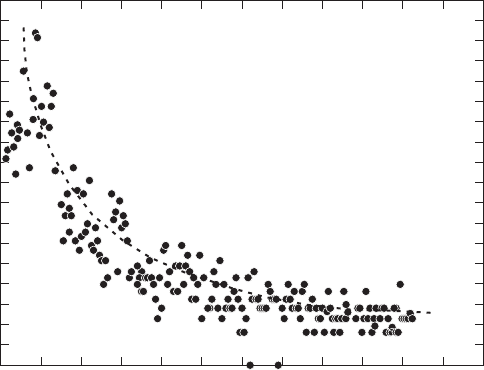
of pure shear (compaction) to simple shear. Near the vent flow was hyperbolic,
reflecting a mixture of spreading of the flow and gliding (Figure 5.6). The
component of simple shear increased with distance along the flow indicating
an increase in the gliding component.
Egmont volcano is a fairly typical stratovolcano covered with andesite
flows. Most are thin, and have commonly almost drained away, but there
are a number of much thicker flows. The bases of two flows were examined by
5.8 Typical applications 185
Higgins (1996a): the Kokowai Valley flow is about 10 m thick, and
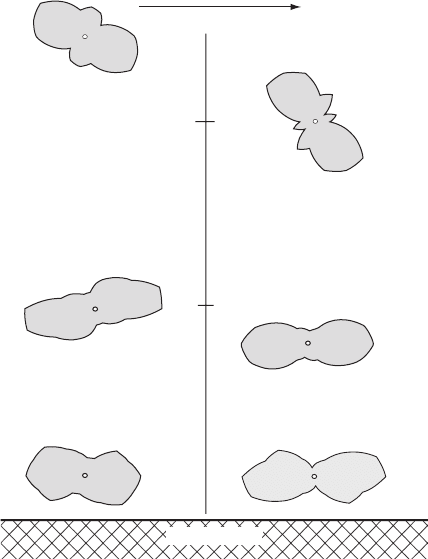
Humphries’ Castle is over 100 m thick. The SPO of plagioclase was determined
optically using thin sections (Figure 5.7). In both cases the preferred orienta-
tion direction showed a consistent pattern: near the base the crystals are
oriented parallel to the slope of the flow, but above a height of 1–2 m the
preferred orientation dips at about 308 in a downstream direction. This is
opposite to the direction indicated in the Monte Porri dacite flow (Ventura
et al., 1996). The significance of the intermediate sample from the Kokowai
Valley flow that dips upstream at about 208 is not clear. The quality of
plagioclase orientation does not appear to correlate strongly with sample
position. These orientations suggest that the flow advanced with a rolling
motion: crystals were aligned during flow further upstream and then rolled
over the stagnant zone close to the base of the flow. However, more data is
needed to confirm this.
Traditionally, only the surface topology of lava was used to classify the flow
as a’a, pahoehoe or toothpaste. However, the differences between these types
are more fundamental and continue into the interior of the flows: differences in
CSDs have been noted in Section 3.4.1.2. The transition from pahoehoe to
toothpaste to a’a is related to both the melt viscosity and the strain rate.
0
10
20
Θ (°)
30
40
50
60
70
80
90
100
distance from the vent (m)
300 500 700 900 1100 1300
Pure shear flow
(compaction)
Hyperbolic
flow
Simple shear
flow
Figure 5.6 Nature of shear in the Monte Porri dacite lava derived from
measurements of the orientation and shape of ellipsoid enclaves (Ventura,
2001). The angle Y is the angle between the streamlines and the base of the
flow. It is 908 for pure shear (compaction), 458 for hyperbolic shear and 08 for
simple shear.
186 Grain orientations: rock fabric
Canon-Tapia et al.(1997) investigated these differences in a series of basalt
flows from Hawaii using AMS. They surmised that the magnetic character-
istics of the lavas can be explained by the distribution of the magnetic particles
in the lava and post-emplacement crystallisation. However, the orientation
and degree of anisotropy of magnetic susceptibility is defined by shear of the
magma during consolidation. Although some authors have suggested that k
2
is
parallel to the flow direction, Canon-Tapia et al.(1997) consider that here it is
k
1
. In all the flows the shear rate was found to be most intense at the base of the
flow, as is to be expected. However a’a flows were in general more sheared than
pahoehoe flows. The directions of AMS within the flows seem to be distributed
more regularly in a’a as compared to the pahoehoe flows. This suggests that
a’a continues to flow until it is stopped by high viscosity. In contrast, pahoehoe
flows appear to cease flowing when the magma is still fluid. This enables late
Kokowai Valley
Humphries' Castle
Flow direction
2.0 m
1.0 m
height above flow base (m)
Base of flow
Figure 5.7 Orientations of plagioclase crystals in basaltic andesites from
Egmont Volcano (Mt Taranaki), New Zealand (Higgins, 1996a). Two
different flows were sampled, each at three heights. SPOs are displayed as
rose diagrams.
5.8 Typical applications 187
flow and/or endogenous growth after the flow has stopped and dispersed AMS
directions.
5.8.1.2 Felsic lavas
Some microlites are prismatic and hence provide almost ideal markers for
determining the amount of simple shear and pure shear (compaction) in lava
flows and domes (Manga, 1998). Some glassy felsic volcanic rocks are trans-
parent enough that the 3-D orientation of microlites can be measured directly.
Obsidian Dome, USA, is a rhyolite flow about 3 km is diameter: orientations
of pyroxene microlites show that the flow developed by radial flow followed by
flattening: pure shear increases from 0.3 at the vent to 1.1 at the flow front
(Castro et al., 2003).
AMS measurements were also made on the same rocks (Canon-Tapia &
Castro, 2004). Although the bulk susceptibility of the rocks is low the degree of
magnetic anisotropy is extremely high. Directions of the maximum axis
accorded with the lineation direction of the microlites and showed the local
direction of flow. The authors caution that their results may not be applicable
elsewhere if the susceptibility is not caused by the same minerals with similar
prismatic forms.
5.8.2 Flow in dykes
The textural fabric of dykes is of immense importance as it can be used to
determine the direction of flow of the magma (Blanchard et al., 1979). Hence,
it is possible to locate the position of the original magma chambers, which can
in turn tell us about regional geodynamics. Many studies have used AMS to
determine flow directions (e.g. Ernst & Baragar, 1992), but there are signifi-
cant problems in the interpretation: it is not always clear how the magnetic
vectors correspond to the magmatic deformation field. In some cases k
2
appears to be parallel to flow direction, whereas in others it is k
1
(Geoffroy
et al., 2002). There are a number of ways in which this uncertainty can be
resolved.
Optical methods can be used to determine the flow direction of magma in
phyric dykes. Oriented thin sections are cut from lateral positions on either
side of the dyke and the imbrication of magmatic foliation can be used to
determine the flow direction (Figure 5.8). In one of the earliest studies a section
was cut parallel to the dyke walls and the orientation of tabular plagioclase
crystals determined using a universal stage (Shelley, 1985). Such LPO mea-
surements are very tedious hence more recent studies tend to examine only the
SPO of phenocrysts. This is readily done directly from a thin section using the
188 Grain orientations: rock fabric