
Holik H. (ed.) Handbook of Paper and Board
Подождите немного. Документ загружается.


10
Environmental Aspects
Udo Hamm
10.1
Wastewater
The paper industry has a high fresh water demand. At the beginning of the 20th
century, about 500 to 1000 m
3
of water was required for the production of one
ton of paper. Today the specific fresh water demand is much lower. The German
paper industry, for instance, has succeeded in reducing the specific fresh water
consumption to 13 m
3
(t paper)
–1
which corresponds to a wastewater volume
of about 11 m
3
(t paper)
–1
. In an international comparison, the performance
in sustainable use of water resources of the German paper mills is very good.
In the following mainly data from the German pulp and paper industry is pre-
sented, because of the high technical standard of wastewater treatment in this
country.
10.1.1
Characterization of Untreated Wastewater
The pollution in the wastewater of a paper mill depends on the type of raw mate-
rial, the type and amount of fillers and chemical additives applied, and on the
degree of circuit closure. Effluents from mills that largely or exclusively process
chemical pulps have a lower degree of pollution than those from mills in which
mechanical pulp or recovered paper is employed. The use of starch or other or-
ganic additives results in a marked increase in oxidizable effluent compounds,
measured as BOD
5
(biological oxygen demand) or COD (chemical oxygen de-
mand).
Dyes and fillers can lead to discoloration and/or turbidity of effluents. Effluents
from paper mills have a low content of nitrogen and phosphorus compounds. For
this reason, these elements must be added as nutrient salts (e.g. urea and phos-
phoric acid) to feed micro-organisms during treatment in biological purification
plants. The closure of the water circuit within the mill results in an increase in the
concentration of the effluent components. On the other hand, the inorganic and
Handbook of Paper and Board. H. Holik (Ed.)
Copyright © 2006 WILEY-VCH Verlag GmbH & Co. KGaA, Weinheim
ISBN: 3-527-30997-7
422
organic load is reduced owing to its partial elimination via the paper produced. For
this reason, the specific load in kg per t of paper (specific load = concentration V
specific amount of effluent) is a more suitable parameter for quantifying the efflu-
ent pollution. Information on the specific COD and BOD
5
loads, classified accord-
ing to product groups, is given in [1].
10.1.2
Wastewater Treatment
Most of the wastewater from German pulp and paper mills is treated biologically,
either in municipal treatment plants (18% of production volume) or in in-mill
plants (74% of production volume). 4 % of the annual paper volume is produced in
mills with a totally closed water circuit which means that these mills are absolutely
effluent free [2].
10.1.2.1 Suspended Solids Removal
Effluents from paper mills contain solids and dissolved substances. Solids (fibers,
fillers) are mostly removed from the effluent in a chemo-mechanical clarification
process by the use of flocculants. The degradation of dissolved organic substances
is performed in aerobic and anaerobic biological treatment plants.
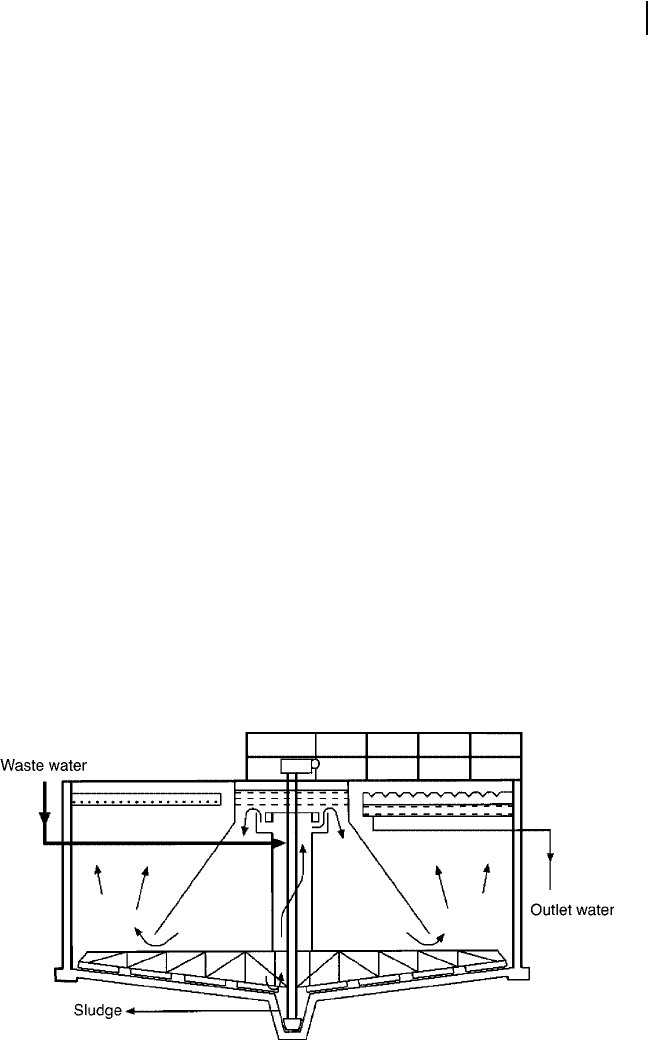
Chemo-mechanical clarification of effluents is carried out almost exclusively in
sedimentation plants (round and rectangular basin with bottom sludge removal)
as shown in Fig. 10.1. Only in a few cases it is necessary to neutralize the effluents.
Rakes for the separation of coarse material and sand traps are seldom used. The
clarifying efficiency of sedimentation plants is increased considerably by the use of
flocculants. Undissolved substances are removed with an efficiency exceeding
90%.
Fig. 10.1 Scheme of a sedimentation clarifier.
10.1 Wastewater
423
10.1.2.2 Biological Treatment
Primarily, activated sludge processes and, less often, trickling filter processes are
employed for aerobic biological treatment. In North America and Northern Eu-
rope, effluent purification is frequently carried out in aerated oxidation ponds.
Recently, anaerobic treatment has become established, especially in paper mills
processing recovered paper.
10.1.2.2.1 Aerobic Treatment
The activated sludge processes applied are single-stage processes, systems with
recycled sludge aeration, cascade systems, and two-stage processes. Atmospheric
oxygen transfer is employed, using surface aerators (roll aerator, gyratory aerator)
or pressure aerators. Pure oxygen processes with pressure aeration are also used
occasionally. It is possible to improve the purification efficiency of activated sludge
plants by using pulverized brown coal or foamed plastic carriers in the activated
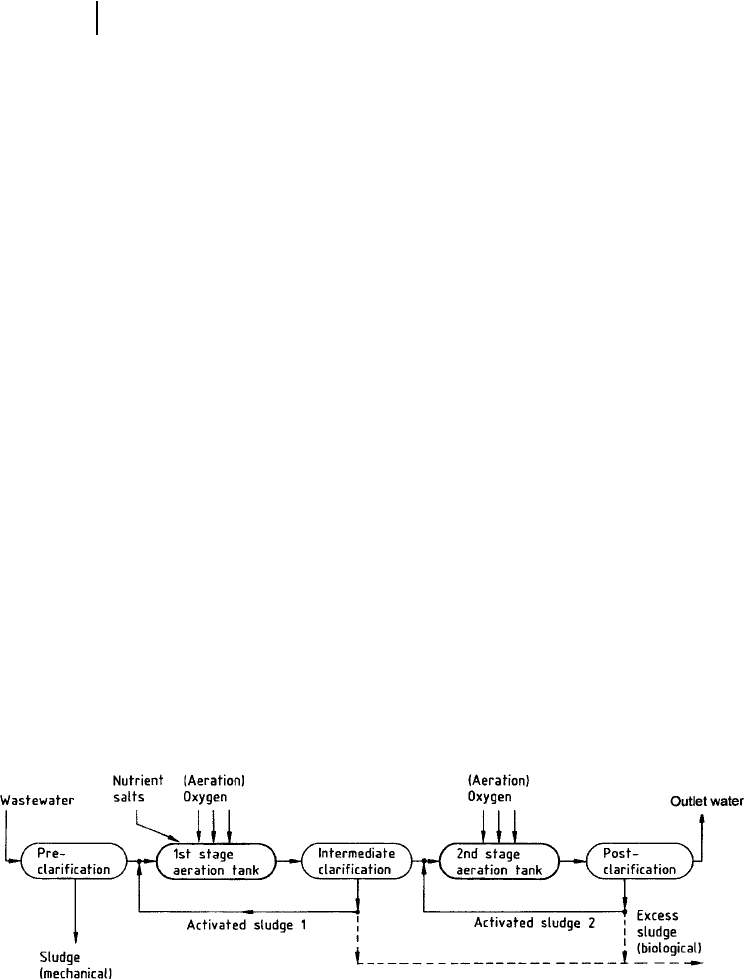
sludge tank. Biological treatment with a two-stage activated sludge process is
shown schematically in Fig. 10.2. The trickling filter system usually operates in
combination with an activated sludge process. The trickling filter can be either the
first stage (in high-load operation) or the second stage (in low-load operation).
Combination processes also include activated sludge processes with fixed-bed in-
ternals and submerged disk filters. Activated sludge plants and trickling filter
plants are almost exclusively fed with mechanically pre-clarified wastewater. The
addition of nitrogen and phosphorus compounds is required. The BOD
5
efficiency
attainable with activated sludge processes is usually in the range of 90–98%, and
the COD efficiency between 80 and 95%. For final clarification after the aeration
tank, horizontal (rectangular and round basin) or vertical-flow (hopper basin) sed-
imentation basins are preferred. Biofilters are occasionally employed as a further
purification stage. Third-stage purification processes for the elimination of nitro-
gen and phosphorus compounds are not usually required.
Fig. 10.2 Scheme of biological effluent treatment with a two-
stage activated process.
10 Environmental Aspects
424
10.1.2.2.2 Anaerobic Treatment
Anaerobic processes have been employed recently for the treatment of more highly
polluted effluents (COD > 2000 mg L
–1
). Effluents from paper mills processing
recovered paper are most commonly treated in anaerobic contact systems with
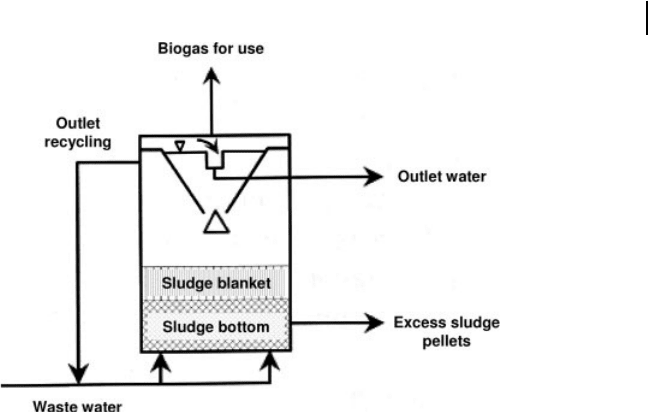
sludge recycling and in UASB (upflow anaerobic sludge blanket) reactors. Fig-
ure 10.3 shows schematically an UASB-reactor which is used in the German paper
industry for treatment of highly polluted effluents. Information on plants installed
up to now and on operational experience is given in [3]. Fixed-bed reactors, flui-
dized-bed reactors, and other anaerobic reactor concepts are of minor importance.
Anaerobic effluent purification is almost exclusively operated as a preliminary step
to the aerobic treatment.
The sludges generated in effluent treatment must be dewatered and disposed of
if they cannot be returned to the papermaking process. Screen belt presses, cham-
ber presses, vacuum filters, or centrifuges are used for dewatering. The dewatering
behavior can be improved by the addition of chemicals (polymers, trivalent metal
salts, lime). Machines and plants for sludge treatment and their dewatering effi-
ciencies are described in [11].
Most dewatered sludges (solid content 20–60%) are disposed of in landfills.
Thermal utilization (combustion) is becoming increasingly important. The
sludges can also be composted together with bark, applied to agricultural land, and
used as a porousing agent in the production of bricks, as additives for fiberboard,
and in making cat litter.
Fig. 10.3 Upflow anaerobic sludge blanket (UASB) reactor
[11].
10.1 Wastewater
425

10.1.3
Characterization of Treated Wastewater
Biological processes can eliminate nearly 100% of biologically degradable organic
substances in the wastewater of paper mills. Considering the amount of organic
substances determined as COD, the level of elimination is 80 to 95%. A distinction
must be made between a genuine biological degradation and a physico-chemical
elimination, e.g. adsorption to anaerobic biosludge or activated sludge. COD and
BOD concentrations and loads in biologically treated wastewater of paper mills
producing different paper grades are given in [1].
Treated wastewater of paper mills is not normally toxic to water-borne organ-
isms, as evidenced by the results of fish and other biological tests. Due to the low
nitrogen and phosphorus concentration in the treated effluents only a small risk of
extensive growth of water plants in surface waters exists. The wastewater has very
low heavy metal content.
The additives used in paper production generally contribute only slightly to the
load of the treated wastewater. For example, some starches, soaps or surfactants
are easily biologically degradable. Others, and especially higher molecular weight
additives such as retention agents, wet strength agents or coating binders, adsorb
strongly to the biosludge. Detailed research on the subject is described in [4]
and [5].
10.1.4
Closed Water Circuit
A closed water circuit is achieved when no wastewater leaves the paper mill. The
process water is then almost 100% utilized. Only evaporation and vaporization
losses and the water content in the paper and in the residual matters must be
replaced by fresh water (1–2 L (kg paper)
–1
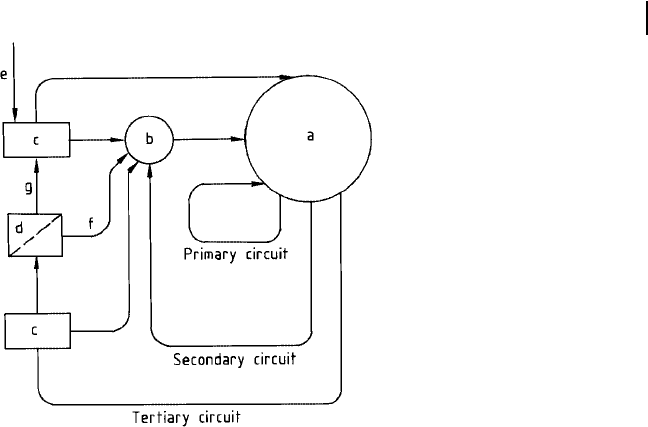
). A closed water circuit is shown sche-
matically in Fig. 10.4. The essential requirement for reusing circulating water in
the tertiary circuit is adequate save-all clarification. The quality of the clarified
water must be suitable for the operation of sensitive systems (e.g. showers, trim
showers). There must be enough storage capacity to compensate for variations in
quality caused by disturbances and interruptions in production. Until now, closed
circuits have been realized only in paper mills processing recovered paper. In
Germany about ten recovered paper processing mills have closed the process water
circuit totally. Most are small paper mills producing corrugating medium and test-
liner [6]. In the middle of the 1990s a German paper mill applied a biological in-
line treatment plant to control the demanding conditions of the effluent-free proc-
ess water loop. The biological treatment uses two UASB reactors as anaerobic
stages followed by two activated sludge basins, a sedimentation basin and a sand
filter. The process water volume treated in this plant corresponds to about 4 m
3
t
–1
of paper produced. Before installation of the process water treatment plant, the
COD concentration of the process water amounted to 35 000 mg L
–1
. After the
start-up of the treatment plant the COD decreased to 8000 mg L
–1
[7].
10 Environmental Aspects426
In a new development the aerobic activated sludge plant was replaced by a com-
pact aeration reactor, in order to reduce the odor of the anaerobic treated process
water and to eliminate CaCO
3
, which might cause problems when the biologically
treated water is led back into the papermaking process [8, 9].
10.2
Solid Waste
The different processes within the pulp and paper industry result in the formation
of different solid and sludge-like residues. In terms of volume, the largest are those
from the deinking of recovered paper and from the treatment of effluents. Wood
residues are also produced in large quantities, mainly in the pulp production.
Other wastes arising at pulp mills are green liquor, lime sludge and ashes from
energy generation and flue gas treatment.
Table 10.1 shows the solid wastes encountered in paper mills. Besides material
removed from the pulper or ejected from a drum pulper, solids separated by
screening and cleaning are all rejects. Among the sludges encountered there are
deinking sludges, solids removed during the mechanical clarification of fresh wa-
ter, process water and wastewater, and sludges from biological effluent treatment
plants. Classified as incineration residues are ashes and slags from internal power
plants and waste incineration plants including fly ashes. In the category of other
waste are chemical residues, used oil, wire and felts and hazardous waste, such as
Fig. 10.4 Scheme of a closed water circuit [6].
(a) Paper machine, (b) stock preparation plant,
(c) storage, (d) save-all, (e) fresh water,
(f) high density stock, (g) clarified water.
10.2 Solid Waste
427
certain laboratory chemicals, batteries or transformer fluids. Wood residues such
as bark and sawdust occur where mechanical pulp is also produced at the paper
mills concerned.
In Germany the most recent survey on residues from pulp and paper mills dates
back to 2001 [10]. According to the data gathered by the German Paper Industry
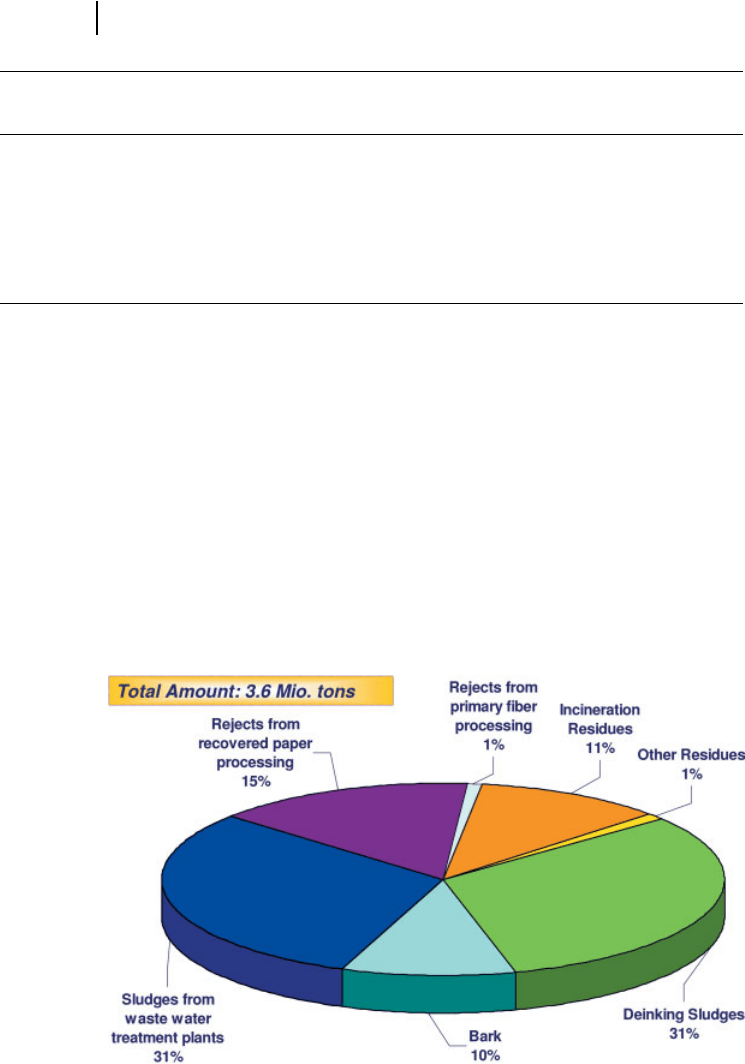
Association a total of 3.6 million tons of residues was produced. This volume re-
fers to the residues in their original state. The calculated mean dry content of all
residues was 57%. Figure 10.5 shows that deinking sludges and sludges from
process water and effluent treatment account for the largest proportion of residues
with 30% each. Rejects from recovered paper processing contribute 15%, followed
by incineration residues (11%) and bark (10 %). Rejects from primary fiber proc-
Fig. 10.5 Wastes of the German pulp and paper industry in
2001.
Table 10.1 Solid wastes of paper mills.
Wood residues Stock preparation
rejects
Sludges Incineration
waste
Other waste
Bark Ragger tails Deinking sludges Ashes Chemicals
Sawdust etc. Drum rejects Clarifier sludges Cinders (slags) Used oils
Screening rejects Biological sludges Flue ashes Wires
Rejects of cleaner Gypsum etc. Felts
Hazardous waste etc.
10 Environmental Aspects428

essing and other residues e.g. chemical waste, used wires and felts, and used oil
account for only a small share.
10.2.1
Solid Waste Composition and Characteristics
As shown in Fig. 10.5 most of the German paper industry’s waste is generated in
recovered paper processing. To produce recycled fiber pulp suitable for use in the
manufacture of different paper and board grades all substances likely to disturb
the processing of recovered paper or the quality of the final product must be re-
moved as far as possible from the disintegrated recycled stock. Depending on the
contamination of the recovered paper with non-paper components and the paper
grade produced, larger or smaller volumes of waste result. The volume also de-
pends on the amount of effort invested in separation at the different process
stages. Table 10.2 shows the percentages of waste amounts related to the recovered
paper used and dependent on the paper and board grades produced.
Table 10.3 shows the composition of waste that occurs at different stages of
recovered paper processing [11]. The waste from disintegration, cleaning and
screening is reject material or rejects. The wastes that occur during flotation deink-
ing and the cleaning of process water from wash deinking are sludges. Because
Table 10.2 Amount of rejects and sludges dependent on the
recovered paper grade and the paper produced [11].
Produced
paper
Recovered paper Amount of waste
[% by dry weight]
Total Rejects Sludges
Rejects and
sludges
Heavy-weight
and coarse
Light-weight
and fine
Flotation
deinking
White water
clarification
graphic
paper
news, magazines
high grades
15–20
10–25
1–2
<1
3–5
) 3
8–13
7–16
2–5
1–5
hygienic
paper
files, office paper,
ordinary, medium
grades
28–40 1–2 3–5 8–13 15–25
market DIP office paper 32–40 < 1 4–5 12–15 15–25
liner,
fluting
sorted mixed
recovered paper,
supermarket corrugat-
ed paper and board
4–9 1–2 3–6 – 0-(1)
board sorted mixed
recovered paper,
supermarket corrugat-
ed paper and board
4–9 1–2 3–6 – 0-(1)
10.2 Solid Waste 429

today’s processing methods are selective only to a limited degree, both rejects and
deinking sludges continue to contain a certain proportion of fiber and fiber
fines.
Sludges also result from process water clarification and biological treatment of
wastewater. The sludge from wastewater treatment plants can be divided into pri-
mary sludge from mechanical treatment and bio-sludge from biological treatment.
It is technically possible to return these sludges to the production process in man-
ufacturing paper grades as corrugating medium or testliner. Because the in-mill
reuse may affect product quality and process runnability the use as raw material in
production processes must always be considered on a mill-by-mill basis.
The amount and characteristics of ash resulting from energy generation and flue
gas cleaning depend on the fuel and the combustion technology used. In the Ger-
man paper industry the total amount of ashes in 2001 was 400000 tons. Like all
other wastes from pulp and paper processing, the ashes are non-hazardous and
were mainly used in the construction material industry.
10.2.1.1 Rejects
The amount of rejects produced during recovered paper processing and their com-
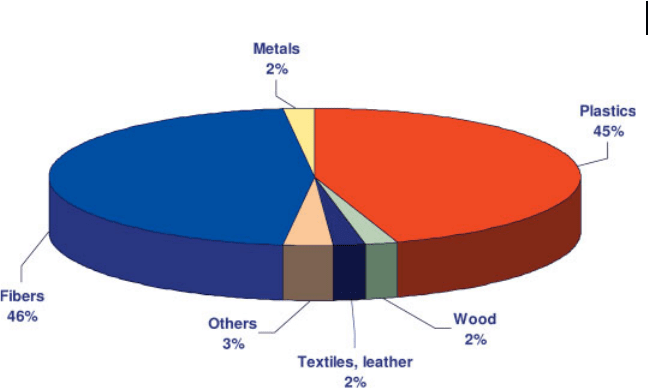
position depends largely on the recovered paper grades. Figure 10.6 shows the
composition of a reject sample as a mixture of rejects from six paper mills produc-
ing newsprint. Pulper and drum pulper are used for slushing of the recovered
paper (old newspapers and old magazines). The proportion of the reject fractions
as dry solids was 4 to 6% related to air-dried recovered paper.
Due to the high proportion of plastic materials the heating value of rejects is
more than 20 GJ t
–1
of dry substance. The use of rejects as an energy source such
as secondary fuels for cement production can be limited by a rather high chlorine
Table 10.3 Solid waste from different stages in recovered paper
processing.
Source of waste Composition of waste
pulper, drum pulper larger objects such as plastic bags, bookbinding backs, textiles,
bottles, shoes, strings, tools, wires, wood pieces, wet strength
paper…
high-density cleaning glass, nails, paper clips, textiles, pins, staples
pre-screening long, thin and wide contaminants
flotation deinking fillers, fibers, fines, printing ink, stickies
low-density cleaning small compact particles with high density such as sand, shives,
hard particles from UV-colours, coating colours, varnish …
fine screening plastic fragments, light-weight contaminants, hot melts, stickies
process water clarification colloidal material, fillers, fibers, fines, ink particles
10 Environmental Aspects430
content. It can amount to 3% by weight of rejects on a dry basis. Polyvinylchloride
(PVC)-containing materials such as self-adhesive tapes, foil laminates, carrier han-
dles and PVC products thrown in error into recovered paper containers are the
main sources of this chlorine content.
10.2.1.2 Deinking Sludges
Deinking sludges consist of fillers and coating pigments, fibers, fiber fines, print-
ing inks (black and colored pigments), and adhesive components. Figure 10.7
shows that more than 55% of the solids removed by flotation are inorganic com-
pounds. They are primarily fillers and coating pigments such as clay and calcium
carbonate. The proportion of fiber material at 7% is low. Materials extractable with
methylene chloride have an average proportion of 8%. They contain wood compo-
nents from the fibers such as resins, fats and resin acids as well as extractable
printing ink and adhesive components and flotation deinking chemicals. The re-
maining 29% comprises fibers fines, nonextractable ink components (mainly car-
bon black and colored pigments) and nonextractable adhesive components.
Table 10.4 provides a summary of ash contents, heating values, elemental con-
tents and levels of different contaminants of deinking sludges. It shows mini-
mum, maximum and average values for sludges from different German paper
mills. A characteristic for deinking sludges is their high ash content, 70%. The
heating value depends on the ash content and is 4.7–8.6 GJ t
–1
of dry substance.
The sulfur, fluorine, chlorine, bromine, and iodine contents are low. For this rea-
son, no costly flue gas purification systems are necessary when incinerating deink-
ing sludge. Compared with sludges from biological effluent treatment plants, the
nitrogen and phosphorus contents are very low. This is something that requires
Fig. 10.6 Composition of a mixture of reject samples from the
production of newsprint based on recycled fibers related to dry
substances (Germany) [12].
10.2 Solid Waste
431