
Johnson Michael. North American Indian Tribes of the Great Lakes
Подождите немного. Документ загружается.

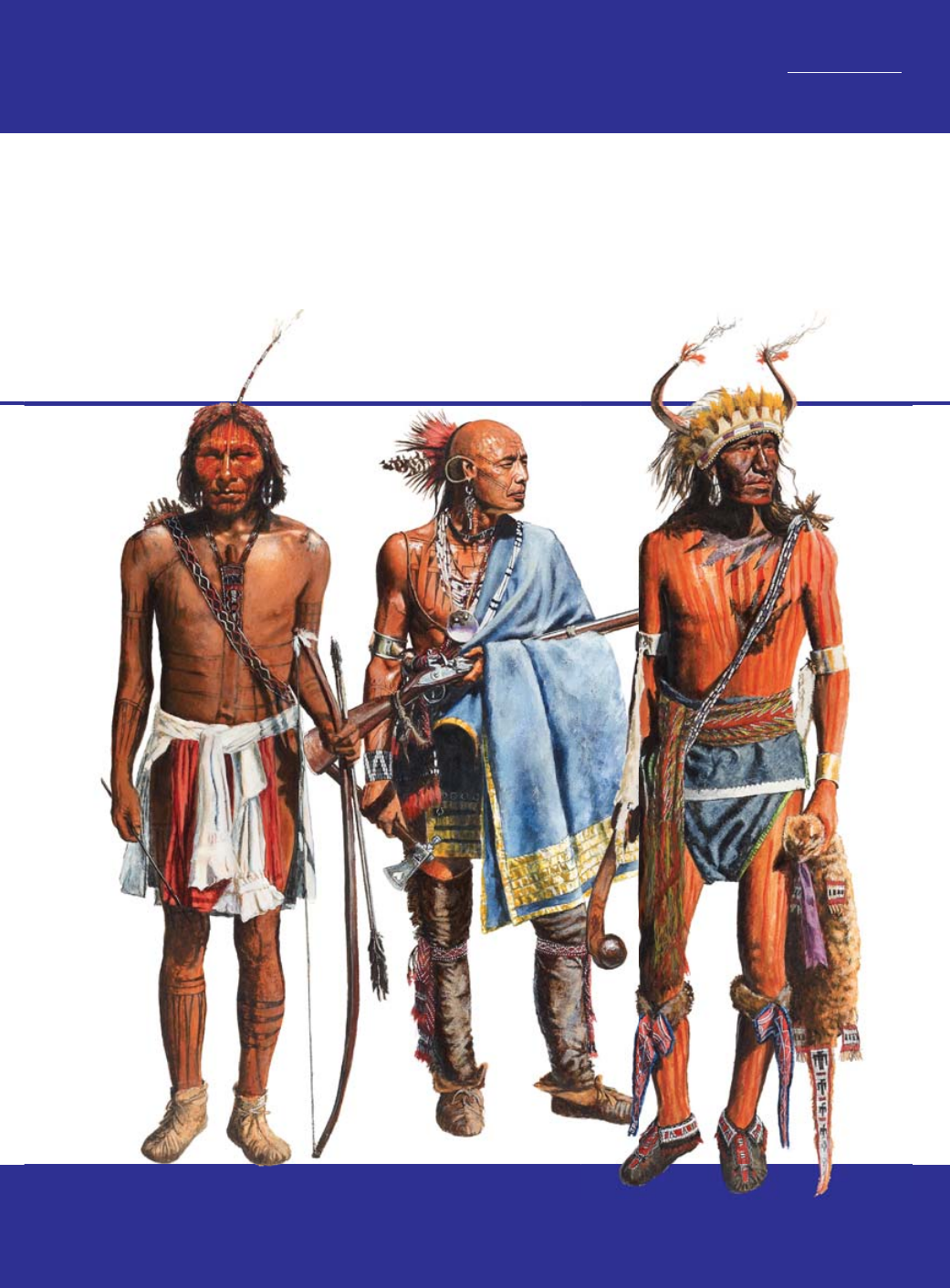
North American Indian
Tribes of the Great Lakes
Men-at-Arms
OSPREY
PUBLISHING
Michael G. Johnson • Illustrated by Jonathan Smith
© Osprey Publishing • www.ospreypublishing.com
Men-at-Arms • 467
North American Indian
Tribes of the Great Lakes
Michael G. Johnson
•
Illustrated by Jonathan Smith
Series editor Martin Windrow
© Osprey Publishing • www.ospreypublishing.com
NORTH AMERICAN INDIAN
TRIBES OF THE GREAT LAKES
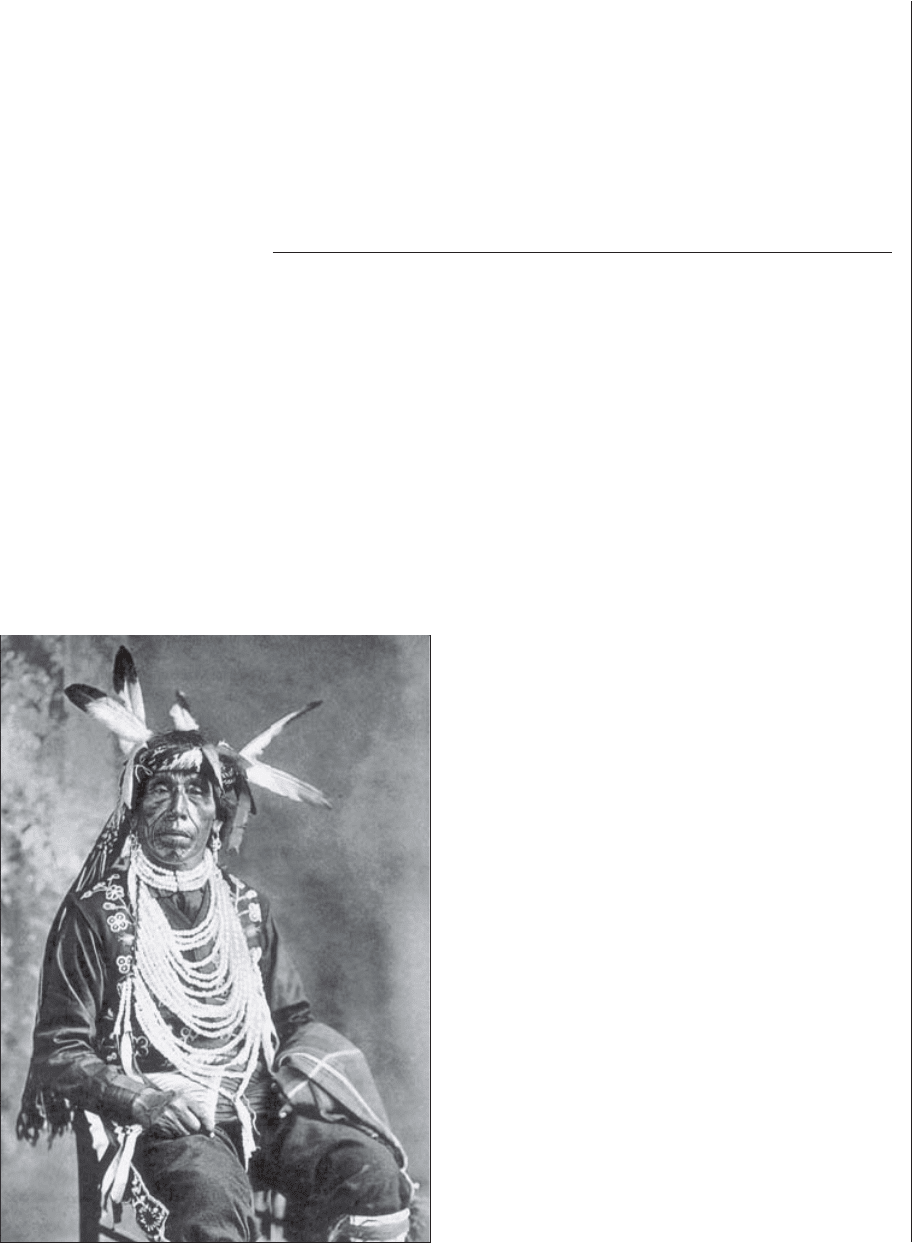
Photographed c.1900, this
mature man is probably an
Ojibwa (Chippewa). His
headdress is a braided woollen
turban with eagle feathers and
V-cut ribbons. His multiple bead
necklace is of Plains style; his
woollen leggings are bound with
woven beaded garters with
fringed ties.
3
THE GREAT LAKES REGION
T
he Great Lakes Region was dominated by water and forest. The
thousands of interconnected lakes and rivers afforded the Indians
the means to travel long distances by canoe, with short land
journeys between by “portage” (the French term for carrying canoes from
water to water). While the five Great Lakes drain the huge water system
from the north and west, south of them tributaries drain into the two
major river valleys of the Mississippi and Ohio.
Natural vegetation varies throughout the area. In the north, on the
now-Canadian side, coniferous forests of spruce, fir, jack pine, tamarack
and cedar gradually give way southward to mixed coniferous and
deciduous woodland, adding maple, beech, birch, hemlock, and finally
basswood, oak, hickory, cottonwood, willow and elm, with deciduous
species predominating in the Ohio valley. Before European contact
small tracts were no doubt cleared by burning, particularly on the
Prairie-Woodland borders where indigenous
peoples practiced agriculture. From the early
17th century the ecology was increasingly
disturbed by the arrival of Europeans, with the
selective trapping of fur-bearing animals, and
from the 18th century there was major and
increasing forest clearance and drainage of land
for lumber and European agriculture. The river
and lake travel systems were also used by
European explorers, missionaries and fur-traders,
and by the early years of the 18th century the
French had already linked their Canadian and
Gulf of Mexico colonies by regular routes.
In the Great Lakes region four major
subsistence patterns are identified: domesticated
plants, hunting, fishing, and gathering wild rice.
Domesticated Indian corn (maize), beans, and
squashes were the basic foods of the tribes of the
Ohio valley, lower Ontario (the Huron), New York
(the Iroquois), southern Wisconsin and southern
Michigan. Nevertheless, all the agricultural Indians
also hunted, fished and collected wild plant foods.
The major subsistence pattern was hunting. In the
north, Indians were completely dependent upon
moose, caribou, bear, beaver and fish. In the south,
various deer, elk, buffalo (bison), bear, turkey and
other species were important sources of food,
© Osprey Publishing • www.ospreypublishing.com
along with the storage of corn. The Ojibwa, Ottawa and some Iroquoian
groups living around the periphery of the Great Lakes developed a food
economy centered on fishing, with occasional gardening and maple sugar
production. Finally, west and southwest of lakes Michigan and Superior
wild rice provided a major food source for the Menominee, some
Winnebago and Dakota (Eastern Sioux), although hunting, and for some
the cultivation of corn, were also important.
Archaeologists have identified three broad cultural traditions among
the late prehistoric Northeastern Indians, which manifest themselves in
ceramic remains from at least AD 1000. These are the Woodland culture
of the Atlantic coastal area and upper Midwest; the Upper Mississippian
culture of the upper Ohio and upper Mississippi river valleys; and the
Mississippian culture of southern Illinois and Indiana. In general terms
the Woodland tradition divides into two subgroups, which approximate
to the Algonquian- and Iroquois-speaking peoples. The Upper
Mississippian culture also separates into those of Algonquian and those
of Siouan background, including the probable ancestors of the historic
Shawnee. The Mississippian cultural tradition which predominated in
the Gulf and lower Mississippi valley is marginal to Great Lakes
prehistory, but some influential centers did exist in the southern
Midwest and southern Wisconsin.
In the early historic period, c.1600, the Indian population in the
region of the upper, western three Great Lakes – Superior, Michigan
and Huron – was about 130,000. Perhaps 60,000 were Huron and their
related Iroquoian tribes of Ontario; the other, mostly Algonquian-
speaking tribes included the closely related Ojibwa, Potawatomi and
Ottawa. (The Winnebago, however, are Siouan in speech.) The Hurons
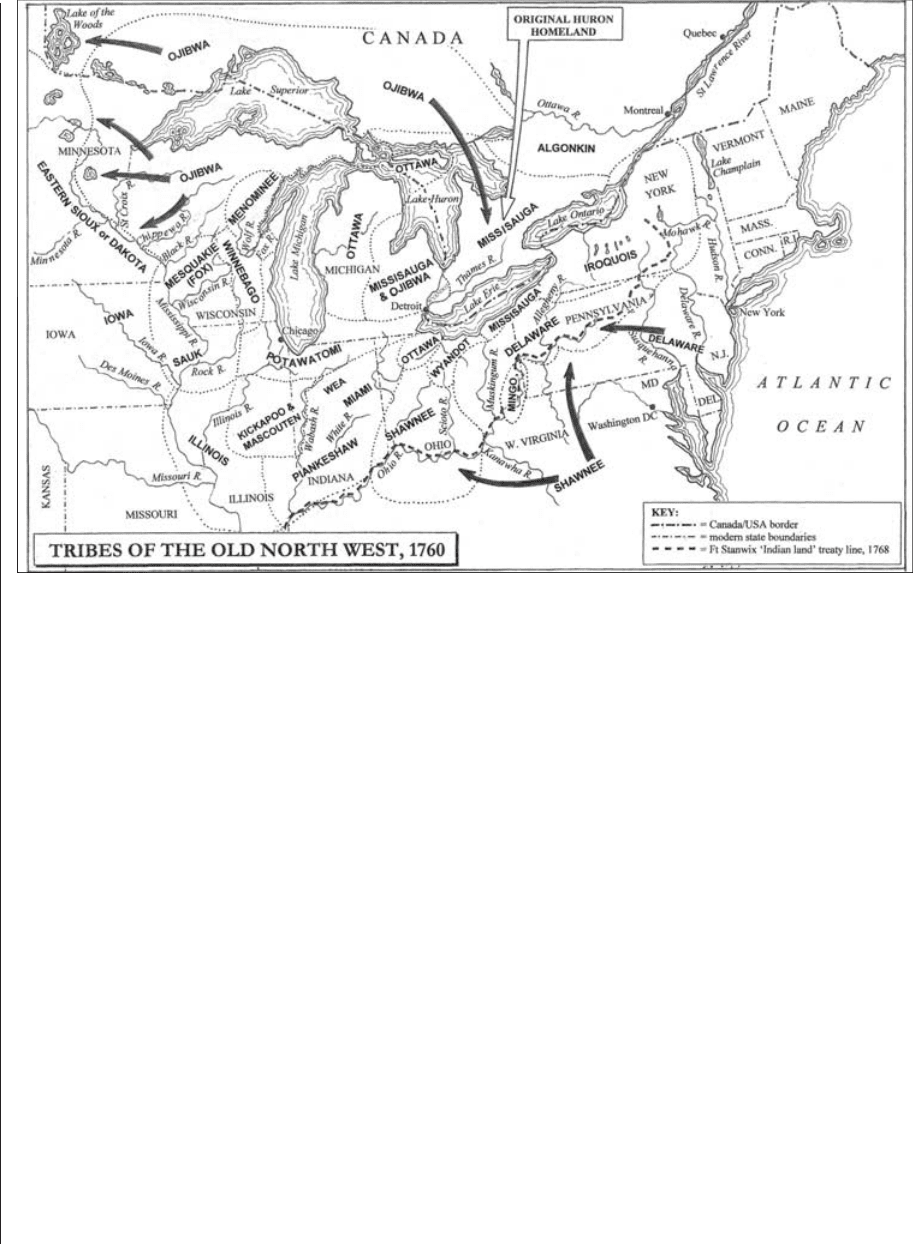
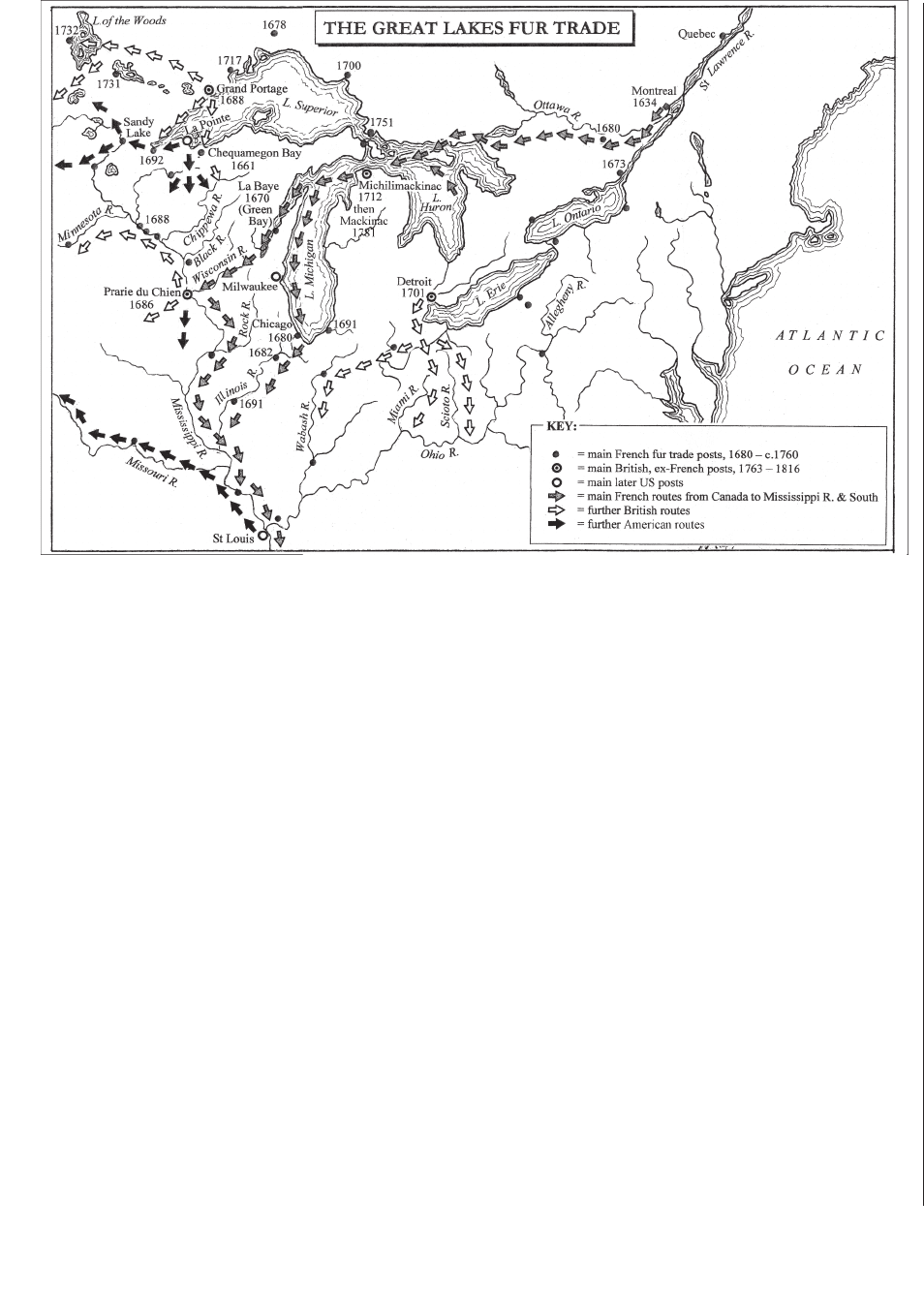
ABOVE RIGHT In 1673 the French
reached the Mississippi via the
Fox and Wisconsin rivers. By
the mid-1700s French fur posts
lined the Mississipi valley down
to Louisiana, and extended out
onto the Parklands and Prairies.
However, control of the upper
Mississippi was delayed during
1712–38 by war with the
Mesquakie (Fox), who struggled
unsuccessfully to unite the
tribes of the region to oppose
French passage across
Wisconsin and trade with the
Sioux.
After Britain acquired French
Canada in 1760, many French
fur traders – both licensed
(voyageurs) and illegal (coureurs
du bois) – remained active,
scattered throughout the Great
Lakes and upper Mississippi
regions, but the management
and major profits of the trade
were taken over by English,
Scottish and New England
merchants. Pelts and trade
goods flowed through the main
centers at Michilimackinac (from
1781, Mackinac), Grand Portage
and Detroit, while Prairie du
4
© Osprey Publishing • www.ospreypublishing.com
were extensive farmers, the Ojibwa primarily hunters, and Menominee
subsistence was based upon wild rice to a greater degree than other
groups. The Ottawa and Potawatomi tended to hunt in small family
groups, while the Sauk, Mesquakie (Fox) and southern tribes undertook
communal hunts on the prairies; the Winnebago and Menominee seem
to have been intermediate between these patterns.
Eu ro pe a n co n ta ct
The arrival of European explorers, missionaries and fur-traders brought
changes in native technology, with the introduction of metal weapons,
tools and utensils, blankets and other trade cloth, porcelain and glass
beads, to replace native buckskin clothing decorated with shell and bone
beads and dyed porcupine quills. But trade goods never completely
eliminated native technology, and such Indian items as moccasins,
snowshoes and canoes were adopted in their turn by Europeans. By
c.1750 firearms had largely replaced the bow and arrow and, importantly,
colonial wars and the fur trade had also rearranged tribal locations.
From their bases in Montreal and Quebec the French were quick
to make use of Indian trails and canoe routes. By the end of the
17th century they had a route from New France to the Mississippi, via
the Ottawa and French rivers to lakes Huron and Michigan, then
via Green Bay, the Fox and Wisconsin rivers to the Mississippi, with few
portages on the way. This opened up the whole core area of the Great
Lakes to French missionaries and traders, and, in the early 18th century,
opened the Illinois region to permanent French settlements.
By contrast, the British colonies along the Atlantic seaboard faced
a natural barrier to westward exploration on the same scale as their 5
Chien was established to trade
with western tribes such as
the Sioux.
The United States purchased
the Louisiana Territory in 1803,
and with it St Louis, key to
the Missouri River and Rocky
Mountains. After the War of
1812 with Britain the USA
established control of the
Northwest, and St Louis became
the leading center for the fur
trade – though this declined
steadily, and traders shifted
their investments to land,
lumber and mining as settlers
poured westward. (Maps by
John Richards)
002-048.qxb:MAA440mono.qxd 5/12/11 14:20 Page 5
© Osprey Publishing • www.ospreypublishing.com

Early 1820s: Ojibwa family
in birchbark canoe arriving
near Red River, Manitoba, after
traveling from their homelands
around Lake Superior to trade
for British goods. Note the
distinctive prow and stern shape
of the Ojibwa canoe. (Detail from
painting by Peter Rindisbacher;
West Point Museum Art
Collection, US Military
Academy, West Point, NY)
6
French competitors: the
Appalachian chain, and in
particular the Allegheny
Mountains, barred the way
to the “Ohio country.” This
area – also sometimes
referred to as the “Old
Northwest” – was largely the
present-day states of Ohio
and Indiana. During the
17th century, Iroquois war
parties criss-crossed this
area in an attempt to hijack the burgeoning fur trade between the French
and the Algonquian nations who, consequently, seem largely to have
vacated the region for parts of Wisconsin and Michigan. Iroquois war
parties reached the Illinois Indians and the Mississippi River, and perhaps
even beyond. It was not until after the “Great Peace” brokered by the
French at Montreal in 1701 that these Iroquois forays decreased, and
the historic tribes of the Ohio region returned to settle there once more.
The Ohio country also became home for disaffected Delawares and
Munsees from New York and New Jersey, and Mohicans from New
England, who had suffered the devastating effects of the first waves of
European settlement further east. The Miami relinquished their eastern
territory to the predatory Shawnee from the Cumberland River region
to the south, and to re-grouped Huron (now called Wyandot) and
Ottawa from the north. A number of tribes vaguely reported in the
17th century were perhaps integrated into Iroquois groups who lived
permanently in the area, such as the Mingoes, or the 19th-century
Seneca of Sandusky. The Iroquois league continued to exert control
over the affairs of some tribes and villages during the 18th century by
appointing “half-kings” – a sort of ambassadors – to the Ohio Indians.
In the west, the Sioux were at one time actively engaged in the
collection of wild rice in parts of northern Wisconsin and Minnesota,
which brought them into conflict with those Ojibwa who were moving
west in promotion of the fur trade. The Ojibwa, who already possessed
firearms, expelled the Sioux totally from the Wisconsin area, and
eventually from the northern two-thirds of Minnesota, including their
traditional homeland around Mille Lacs. After the Sioux war of 1862 only
four small Eastern Sioux communities remained in southern Minnesota.
1
The principal peoples of the region around the three upper Great
Lakes were as follows.
PRINCIPAL INDIAN NATIONS
Huron, Tionontati (Petun), and Wyandot (Wendat)
The Huron, and their close relatives the Tionontati or Tobacco Nation,
inhabited present-day Ontario on the peninsula formed by lakes Huron
and Erie. The name Huron apparently derives from the French
description of the warriors’ hairstyles (French priests visited them from
1
For further details of Iroquois, Delaware and Sioux history, see Men-at-Arms Nos. 395, Tribes of the Iroquois
Confederacy; 428, Indian Tribes of the New England Frontier; & 344, Tribes of the Sioux Nation.
© Osprey Publishing • www.ospreypublishing.com
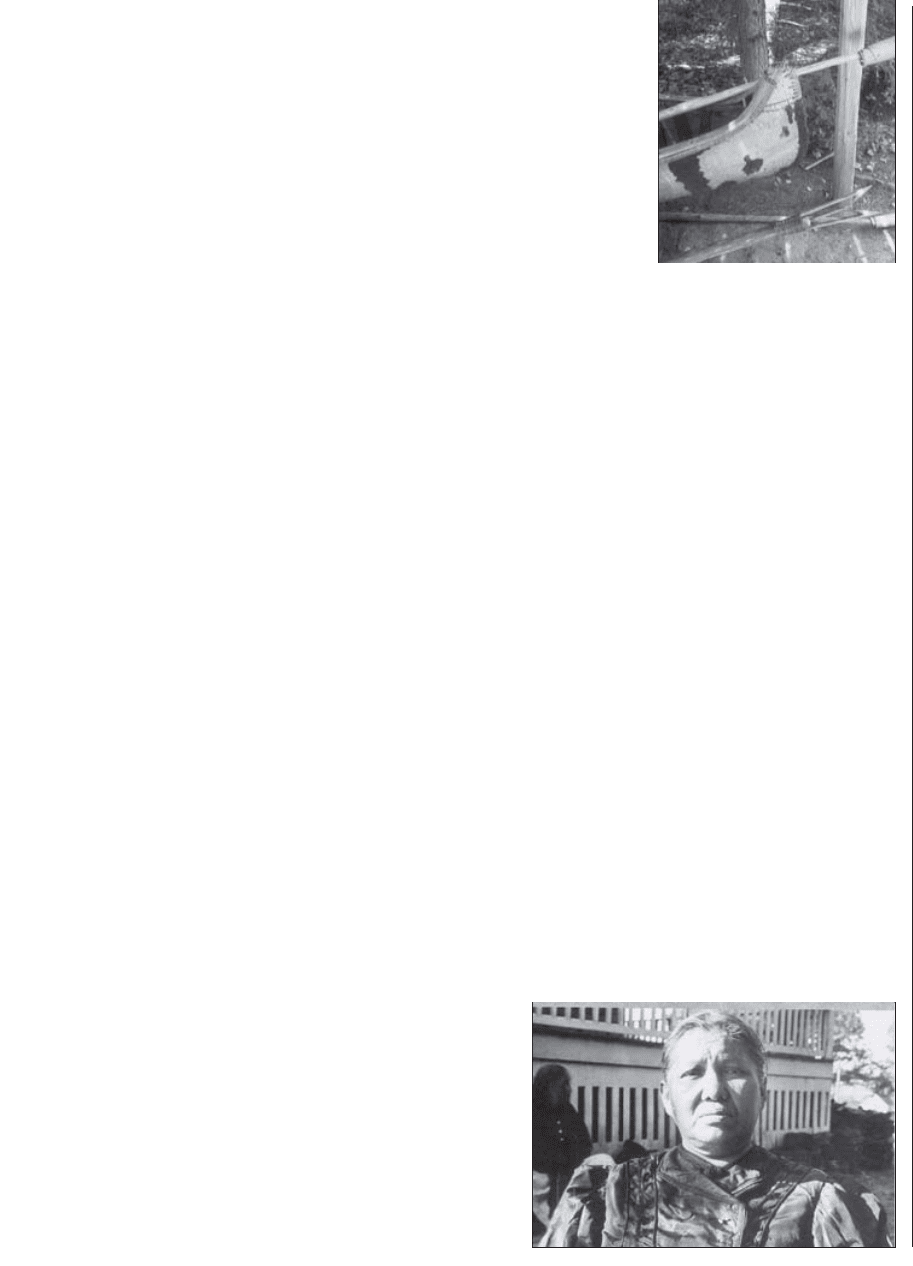
About 190 years after
Rindisbacher made his painting,
the author photographed the
stern of this Ojibwa canoe at
Waswagoning Indian Village, Lac
du Flambeau, Wisconsin. Note
too the birchbark torch on a
pole, used for night fishing, and
the three-point fishing spear.
Mary Kelley, a Wyandot woman
photographed in c.1911. The
Wyandot were descended from
the Huron; once the largest
tribe in the western Great Lakes
region and the most important
ally of the French, they were
drastically weakened and driven
from their lands by Iroquois
invasions as early as the middle
decades of the 17th century.
1615, and permanent Jesuit missions began in 1626). They probably had
a combined population of 60,000 at the beginning of the 17th century;
however, within not much more than 50 years their numbers had been
reduced drastically by disease, famine, and war, and the remaining
people had been driven from their homeland.
The Huron were an Iroquoian-speaking nation related to the Iroquois
of New York, the Neutral of southern Ontario, the Wenro on the Niagara
River, and the Erie (Raccoon Nation) on the southern shore of Lake
Erie. Many Huron villages were protected by palisades up to 30ft high,
made of poles in three rows, with galleries and watchtowers. Inside were
rows of longhouses of elm, ash and cedar bark up to 150ft long, 30ft wide
and 20ft high, with sleeping platforms on either side of central passages.
Each longhouse could be home for up to 24 related women of the same
clan; it was divided into family compartments with woven mats, and
accommodated cooking utensils and a supply of corn and firewood for
winter. The Hurons and Tionontati obtained most of their food by
farming, but also gathered wild foods, hunted and fished. Village sites
were usually moved about every 10 years, when cropland and local
sources of firewood were exhausted. There were three Huron clans,
tracing descent through the female line, and – as in most tribes –
intermarriage within a clan was forbidden. When French Jesuits reported
their culture in their early 17th-century annual “Relations,” there were
four subtribes of the Huron: the Rock, Cord, Bear and Deer each had
their own chief and council. At the death of a clan chief his name and
position passed to his sister’s son, a male of his own clan.
Because of the Hurons’ advantageous position with the French as
middlemen in the beaver-fur trade, the Iroquois first invaded Huron
country in 1648 and sacked St Joseph, and in March 1649 they destroyed
St Ignace and St Louis, thus breaking the Hurons’ monopoly. Hundreds
were carried into captivity, and others fled north or west; those
remaining were completely demoralized, turning against and killing
the French priests whom they blamed for their misfortunes. In turn
the Tionontati, Erie and Neutral nations all suffered the same fate.
A few Hurons escaped to the French settlements near Quebec, where
a number of their descendants have survived until the present day.
Other Huron and Tionontati fugitives sought refuge on Christian Island
in Georgian Bay, and it is from these survivors that the Wyandot of later
history descended. From here they moved west to Michilimackinac,
then to Manitoulin Island, Green Bay, Chequamegon Bay (along with
some Ottawas) during the 1660s, and even to Illinois tribal country
on the Mississippi. By 1670 they returned to
Michilimackinac, and later to the Detroit area, to sites
near Sandwich, Ontario, and by 1745 to the Sandusky
River in Ohio.
Under the leadership of Orontory or Nicholas (“War
Pole,” q.v.), in 1748 the Wyandot conspired with warriors
from other tribes to destroy the French posts at Detroit
and elsewhere, but his plot was revealed to the French,
his confederacy collapsed, and his villages along the
Sandusky River were destroyed. Nevertheless, Wyandots
became an important element in the new multi-tribal
groups now in the Ohio country alongside Delaware and
7
© Osprey Publishing • www.ospreypublishing.com
8
Shawnee, and they supported the British in the War of 1812.
They gradually sold their lands around Detroit and Sandusky,
and in 1842 the tribe, now largely acculturated, moved to
Kansas. In 1867 the majority moved again, to Indian Territory
(now Oklahoma), where a reservation was provided in the
northeastern corner of the future state. A small Wyandot band
survived near present-day Amhurstburg, Ontario, until 1896,
becoming enfranchised; they have descendants in Trenton
near Detroit. In 2000, 1,850 mixed Wyandot descendants were
reported. Those whose ancestors fled to Quebec in 1649 are
still counted at the village of Lorette, and 3,012 “Wendat” were
reported in 2005. Their language is extinct.
Ojibwa (Chippewa, or Anishinabe)
The Ojibwa first encountered by French travelers were living
on abundant year-round fishing in the area where lakes
Superior and Huron adjoin at Sault Ste Marie; the French called them
Saulteurs. The total population of the Ojibwa, Ottawa and Potawatomi
of the central Great Lakes may originally have been around 50,000 at
the time of first contact, of which at least 35,000 were probably Ojibwa,
the remainder being split about equally between the other two tribes.
The popular names Ojibwa or Ojibwe, and in the US Chippewa,
apparently derive from “to roast till puckered up,” referring to the
puckered seam on their moccasins. The earliest known Ojibwa bands at
the Sault were the Amikwa (Beaver), Nokwet (Bear), and Marameg
(Catfish).
Ojibwa living north of Lake Superior were divided into bands each of
about 500 people, living by hunting alone over an area of at least
1,200 square miles. To survive the harsh winters, the bands divided into
smaller hunting units. Moose, caribou, bear, beaver and many other
animals were hunted with bow and arrows and spears, or trapped. In
summer family units gathered at good fishing places, where whitefish
and sturgeon were taken in huge quantities. During the 17th century
the Ojibwa seem to have begun an expansion to the south shore of
Lake Superior, where some corn was raised, but this was less important
than hunting and fishing; by the 1730s some bands were gathering the
wild rice that grew in abundance around many lakes and marshes.
An important spring activity for some bands was the collection of maple
sap for making maple sugar.
By about 1692 the Ojibwa had replaced the refugee Huron and
Ottawa as the principal Indian people at Chequamegon Bay on the
south shore of Lake Superior, which became an important center for
the fur trade, and also for the reformation of their religious rituals;
they adapted to the new conditions brought by white contact, while
remaining in continued isolation in the general Great Lakes area.
Because of their largely hunting and trapping traditions the Ojibwa
perhaps fitted more comfortably into the changes brought by the fur
trade, since they occupied lands least suitable for farming, and remote
from the increasing pressure of white settlement. Their continued
southern drift from Lake Superior was probably hastened by white
traders’ demand for beaver, which were disappearing from the northern
and eastern Ojibwa domains. The establishment of villages in the Lac du
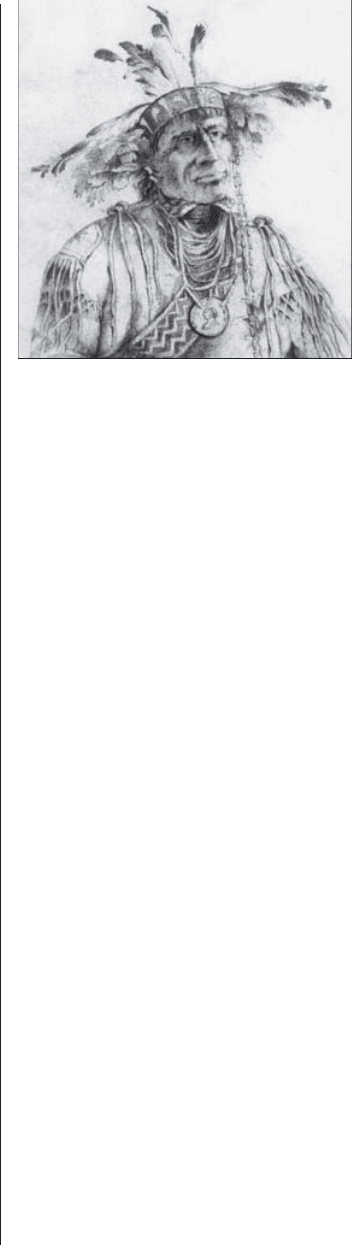
Shingwaukonce, “Little Pine”
(1773–1854), Ojibwa chief of
the Garden River band at the
eastern end of Lake Superior
on the Canadian shore. After
fighting with the British in
the War of 1812, he repaired
relations with the Americans.
He was succeeded by his son
George Shingwauk (1839–1920),
who successfully promoted
harmony between traditionalists
and Christian converts, many
of whom had been forcibly
removed from Sault Ste Marie.
(Drawing by Martin Somerville,
Montreal, c.1840)
© Osprey Publishing • www.ospreypublishing.com

9
Flambeau, Lac Court Oreilles and Fond du Lac areas of present-day
Wisconsin and Minnesota brought the Ojibwa into contact with the
Eastern Sioux (Dakota); they defeated the Dakota at Flambeau Lake
and later at Mole Lake in 1745, forcing the Sioux beyond the Mississippi
River and ultimately into southern Minnesota. During the 18th century
they also compelled the Fox (Mesquakie) to leave northern Wisconsin,
making the interior safe for their own villages and hunting camps.
By the end of the 18th century the Ojibwa had reached the
Wisconsin, Chippewa and St Croix rivers, and as far southwest as Mille
Lacs. By this time European firearms, metal spear- and arrowheads, tools
and utensils, traps and fish hooks had made subsistence much easier –
but the fur-traders also brought alcohol and European diseases, which
had devastating effects. While many Ojibwa moved south and west,
another body of their people overran the Ontario peninsula between
lakes Huron and Erie – land long claimed by the Iroquois by right of
conquest; these Ojibwa bands are usually referred to as Mississauga.
The social and political organizations of the Ojibwa were much less
elaborate than those of the Huron, although there were clan and band
chiefs. There was no Ojibwa “tribe” as such, since this people were
scattered over a huge area. In time the Ojibwa settled through much
of the northern two-thirds of Minnesota, at Red Lake, Leech Lake, along
the Rainy River and Lake of the Woods, and into the Parklands of North
Dakota, Manitoba and Saskatchewan, with one band even reaching
British Columbia. However, there was a tribal unity of sorts, based upon
language, kinship, and clan membership, which allowed individual
families to move great distances to join relatives. The kinship system and
social organization was based on patrilineal clans similar to those of the
Ottawa and Potawatomi (who by native accounts were all descended
from the same people). The clans carried animal totemic titles – the
Crane, Loon, Hawk, Gull, Pike, Otter, Moose, Caribou, Wolf, Lynx,
and so forth. Later, during the fur-trade period, the mixed-blood clans
of part-British descent adopted the Lion as their symbol, and those of
American descent the Eagle.
Some bands and warriors took part with other tribes in all the wars
along the old Northwest frontier, including the Pontiac Rebellion of
1763 and the War of 1812. Over the years that followed they made
several land cessions in Michigan (1819–36), Wisconsin (1826–42) and
Minnesota (1847–63) to the US, and in Canada to the British Crown
between 1850 and 1929. One small band of Swan Creek and Black River
Ojibwa from southern Michigan left the Great Lakes area to join a small
group of Munsee Delawares in Kansas, but most bands remained on
fractions of their old lands. Over the years they have intermarried freely,
at first with French and then with British and Americans, leaving few
families entirely free of European blood.
During the 19th century and after the establishment of the
reservations their traditional lifestyle, largely based on seasonal
movements for subsistence, faded rapidly. More than 400 Wisconsin
Ojibwa died while attempting to collect their annuities from far-off
Sandy Lake, Minnesota. After 1887 some reservations were “allotted” –
i.e. communal lands were broken up; their economy moved to logging,
and ultimately to tourism and off-reservation employment. In 2000
the US census reported 105,907 “Chippewa” in the United States;
Ju-ah-kis-gaw, an Ojibwa woman
painted by George Catlin,
c.1834. She wears a black strap-
dress with red shoulder straps
and multi-colored separate
sleeves; note the head-bow of
the cradleboard, and its multi-
colored beaded cloth wrapping.
Her face is painted red down
to the bottom of the nose.
© Osprey Publishing • www.ospreypublishing.com
in 2005, 91,685 were listed in
Canada as Ojibwa, with many
more listed as mixed with Cree
or regarded as Métis (mixed-
bloods). They are therefore one
of the largest tribes of North
America, and are famous for
their canoe-building, birch-bark
utensils, and the floral-pattern
beadwork that adorned their
ceremonial regalia. Culturally,
the Ojibwa have maintained
until recent times elements
of traditional culture, such
as the Medicine Lodge and Drum or Dream Dance (see under “Beliefs
and Rituals,” and Plate E), and Pan-Indian events are held on most
present-day reservations.
Ottawa (Odawa) and Potawatomi
These tribes were culturally similar. The Ottawa (Odawa) name comes
from a generic northern Algonquian verb, “to trade,” and was applied to
four large autonomous groups who signed the peace treaty at Montreal
in 1701; before then they had often lived with the Hurons in various
locations around the Great Lakes. The name Potawatomi derives from
“people of the place of the fire.” The Ottawa were located principally in
what is now northeastern Michigan and on islands in Lake Huron, while
the Potawatomi lived in western Michigan, although by 1634 at least
some Potawatomi were living on the southern shore of Lake Michigan,
and by 1700 along the Wisconsin shore and in the vicinity of Chicago
in northern Illinois. After 1650 the Ottawa began to move westward to
escape the Iroquois, who were extending their fur-gathering domain at
the expense of their neighbors. At least one band of Ottawa and Huron
refugees occupied a village in the Chequamegon Bay area, while others
lived around Green Bay, and later on the upper peninsula of Michigan
and parts of the lower peninsula; in their later history this group became
particularly associated with Manitoulin Island on the Canadian shore
of Lake Huron, where they mixed with Ojibwa and Potawatomi. Others
moved as far south and east as Ohio, and Beaver Creek, Pennsylvania.
The Ottawa and Potawatomi were semi-sedentary; in summer they
lived in villages and practiced agriculture, separating into family groups
in the fall and departing for their winter hunting grounds, where they
remained until spring. Hunting and fishing were male occupations,
while women planted crops, gathered the harvest, and collected wild
nuts, berries and rice. Both men and women collected maple sap and
converted it into sugar. Their villages consisted mainly of dome-shaped
wigwams of saplings covered with cattail mats and bark, or larger bark-
covered lodges; some villages, usually located along a river or lake with
access via canoes, were protected by circular log palisades.
The Ottawa and Potawatomi were subdivided into a number of bands
that possessed their own territories and were politically independent,
though with connections through family, clan and kinship ties. A clan
was a group who traced their blood ancestors to a single male, and
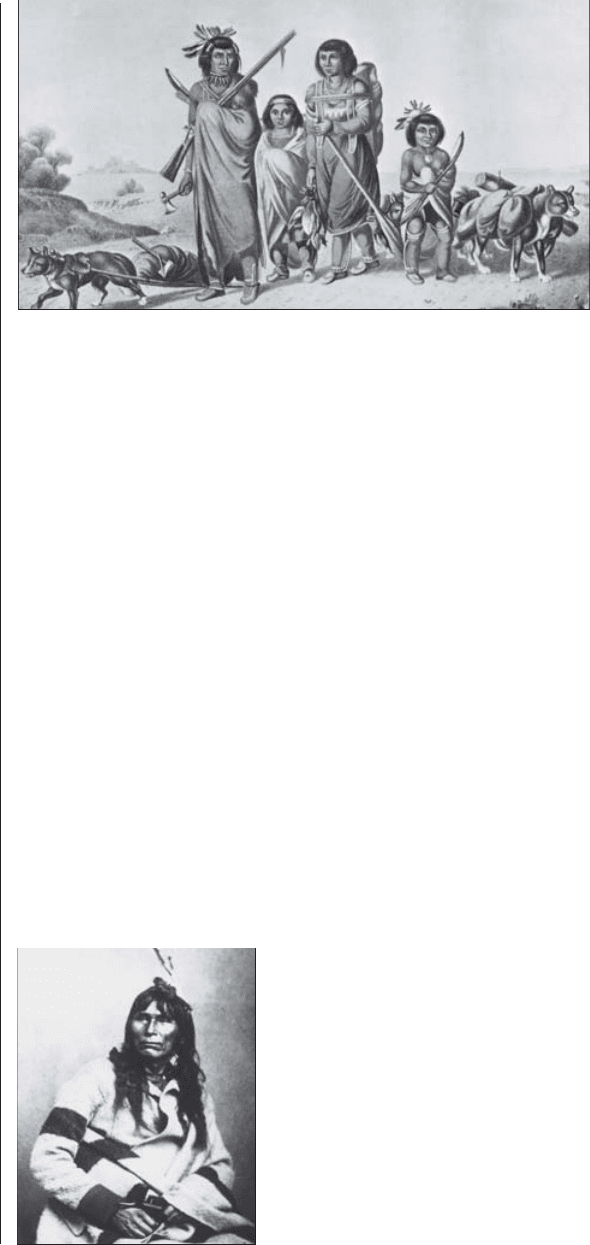
ABOVE: Ojibwa family traveling
in summertime, Red River,
Manitoba, early 1820s; by this
date bands of Ojibwa were living
permanently on the borders of
the Parklands and Prairies.The
woman wears a strap-dress of
blue trade-cloth, and beaded
red sleeves and leggings; the
warrior wears a natural-color
blanket, and carries a bow,
musket and tomahawk. Note
that one of the dogs pulls a
Plains-style travois, while others
are loaded with bundles and
mats. (Detail from painting by
Peter Rindisbacher; West Point
Museum Art Collection, US
Military Academy, West Point, NY)
BELOW: Mah-we-do-ke-shiek,
“Spirit of the Skies,” an Ojibwa
chief photographed in the
1860s; apparently he was noted
for his courage. His capote
appears to be made from a
Hudson’s Bay blanket. (Photo
Whitney & Zimmerman)
10
© Osprey Publishing • www.ospreypublishing.com