
Johnson, Norman A. Darwinian detectives
Подождите немного. Документ загружается.


the effect of genetic drift on genes transmitted only by males is greater than
the effect of drift on genes that are transmitted only by females. Lineages
transmitted only through males should die out sooner than lineages transmitted
solely through females. Thus, it is not a surprise that the Y-chromosome
Adam lived more recently than the mitochondrial Eve.
In the Underhill study and in other studies of both Y chromosomes and
mtDNA, researchers consistently find more variants at rare frequency than
would be expected under the neutral theory. This is the opposite of the
pattern found in the regulatory region of the chemokine receptor CCR
(chapter ) wherein the excess of variants of intermediate frequency was
taken as evidence of long-lasting balancing selection. In contrast, the excess
of rare variants is consistent with a model of a rapid expansion of population
size. There are other possible reasons for an excess of rare variants, so we
should not say that these results prove that the human population size
exploded in the past, just that these results are consistent with a population
explosion. Moreover, we have many other independent lines of evidence for
such a population explosion.
As with the “seven daughters of Eve,” geneticists have traced back inter-
mediate ancestors for Y-chromosome types between Adam and us. The vast
majority, and perhaps all, men with European and Asian genetic backgrounds
can trace their Y-chromosome lineage back to a particular male (named
M, after the marker that defines these chromosomes). M thus can
be considered the Eurasian Adam. Although the Y-chromosome Adam and
the mitochondrial Eve did not meet, it is quite possible that the Eurasian
“Adam” M could have met his equivalent, the Eurasian Eve (known as L).
The estimates of their dates overlap (around fifty thousand years ago) and
they both probably lived in northeast Africa. Africa? Yes, Africa. Although
nearly all Eurasian mtDNA and Y chromosomes currently existing can be
traced back to L and M respectively, M and L also had African
descendants.
Some differences exist between the Y chromosome genealogies and those
obtained from tracing other genetic entities. For instance, the Y chromosome
from the Welsh population is distinct from those from the rest of British Isles,
but the mtDNA is the same. The Welsh Y chromosome appears to be quite
similar to the Y chromosome from the Basques. The origin of the Basques,
who reside in the area between Spain and France, is still disputed. Some argue
that they arrived as part of the group of Indo-Europeans who invaded Europe
four or five thousand years ago; others put forth that Basque history predates
the Indo-European invasion by many millennia. Either way, the Basques have
been isolated for a considerable time and are quite distinct from the Welsh,
so the similarity of their Y chromosomes is surprising.
The larger picture is that a gene genealogy is not necessarily equivalent to
individual-based genealogy; in fact, genealogy can and does vary among
different genes. Variation in genealogy means that the environments that
genes experience will not be the same.
DARWINIAN DETECTIVES

Out of Africa Again and Again
One of the most heated recent controversies in evolutionary anthropology has
been the “out of Africa” versus “multiregional” debate. The out-of-Africa
proponents, bolstered by the results from the mtDNA and the Y chromosome,
claim that modern human beings emerged from Africa roughly a hundred
thousand years ago, replaced the populations living elsewhere, and populated
the globe. In contrast, the multiregionalist hypothesis is the proposition that
modern humans arose in several geographical regions (not just Africa), and
that these populations have been exchanging genes for several hundreds
of thousands of years. This debate actually had been raging in the journals and
the conferences of the paleontology community—sometimes quite heatedly—
for years before Rebecca Cann and her colleagues published the first Eve
paper.
The out-of-Africa and multiregional models for the origin of modern
humans are but two extreme viewpoints of a continuum; intermediate
positions are possible. Although the mtDNA and Y chromosome data
have essentially rejected strong multiregional positions, these results may not
be incompatible with weaker versions of the multiregional hypothesis.
In recent years, gene genealogies from X-linked and autosomal genes have
informed the debate. A Japanese group led by Naoyuki Takahata re-analyzed
data already published from ten X-linked and five autosomal genes, as well as
the mtDNA and Y chromosome data sets.
17
In nine of the ten informative
cases, the most recent common ancestor was located in Africa. Takahata’s
group also performed computer simulations to determine whether weaker
versions of the multiregional hypothesis are consistent with the data. To
explain the empirical results under a multiregional framework, one would
need to posit that the number of breeding individuals in the African popula-
tion was much larger than in the other populations. Other populations could
have been contributors to our current gene pool, but the African population
must be the major source.
Alan Templeton, one of the critics of the initial Cann and Wilson studies,
has re-analyzed data that partially overlaps with the data set from Takahata’s
group and includes genes that are X-linked, autosomal, Y-chromosome, and
mtDNA.
18
Templeton argues for a model of human evolution consisting of at
least two expansions out of Africa, one that occurred between ,
and , years ago (as reflected by nuclear genes) and a more recent one
, to , years ago (as reflected by mtDNA and Y). He goes on to
suggest that the most recent out-of-Africa expansion was not a replacement
event, in which the invading population wiped out an existing one. Instead,
it represented interbreeding and genetic assimilation.
This chapter, and much of this book, has focused on what we can learn
about the genealogies of genes. As we saw earlier, the genealogies determined
from tracing one particular gene could be very different from those obtained
from a different gene. The mitochondria and the Y chromosome, representing
Finding Our Roots

female lineages and male lineages, respectively, are but two of myriad genes
for which we could trace genealogies. But what about genealogies of people?
19
Joseph Chang, a mathematician at Yale, posed the question as follows:
“How far back in time do we need to trace the full genealogy of mankind in
order to find any individual who is a common ancestor to all present-day
individuals?”
20
The answer is quite different from what we saw in the case of
gene genealogies.
Thomas Jefferson is the ancestor of many people alive today, including
some of the descendants of Eston Hemmings. Kunte Kinte, of Jefferson’s
generation but very different circumstances, also has many descendants. Only
a very small fraction of people currently around, however, could claim either
Jefferson or Kinte as an ancestor. As we go back further in time, the potential
increases for one person to be an ancestor of a large fraction of contemporary
humanity. Indeed, at some point, a person could be the demographic
ancestor of all of humanity. The actual proportion of his or her genome that
is in the genomes of people alive today could be very low; he or she may not
have had passed on any genes to some people alive now. Still more distant in
the past, a certain point is reached where all people alive at a given time are
either the ancestors of everyone living on Earth now or the ancestors of none.
There ceases to be an in between. The work by mathematical demographers
shows that that point is surprisingly early—well after the lives of the genetic
Eve and Adam, and perhaps only a few thousand years ago. The exact time
of that depends upon many factors, including how much gene flow has
occurred in populations. Another fascinating conclusion of this work is that
any given time prior to an “ancestor of all or ancestor of none” point, about
of those who had children are the ancestors of everyone alive now.
DARWINIAN DETECTIVES

The Neanderthal Puzzle
If you were to look head-on at a skull of a Neanderthal, what would you see
first in that face?
1
Those big brow ridges? That humongous, projecting nose?
The absence of a chin? Would you see a human, or something else?
Turning the Neanderthal skull around, you’d see a prominent bulge at its
base. This feature is called the occipital bun because it arises from the pro-
jection of the occipital bone, a saucer-shaped bone located at the lower part
of the cranium. Occipital buns are relatively rare in contemporary human
populations, although they are found more frequently in some populations
(including Lapps, Finns, Bushmen, and Australian Aborigines). Does the
occipital bun, or the lack thereof, have a function? Could the bun just be a
consequence of possessing a large brain but a narrow head? Nobody knows.
Yes, Neanderthals had large brains. Unlike the relatively small-
brained australopithecines and even the early members of the genus Homo,
Neanderthals didn’t lack cranial capacity. In fact, on average, their brains
were slightly larger than our own.
Winston Churchill once said that Russia was “a riddle wrapped inside a
mystery in an enigma.”
2
The same can be said for the Neanderthals. So many
questions surround the nature of Neanderthals:
Were they human? Did we evolve from Neanderthals? Are they a miss-
ing link, or an offshoot? Are they our father or our uncle?
Who Were the Neanderthals?
. . . recent research is finally establishing that the
Neanderthals were fully human, but were also quite
different from Homo sapiens.
—Chris Stringer (Stringer, , p. )
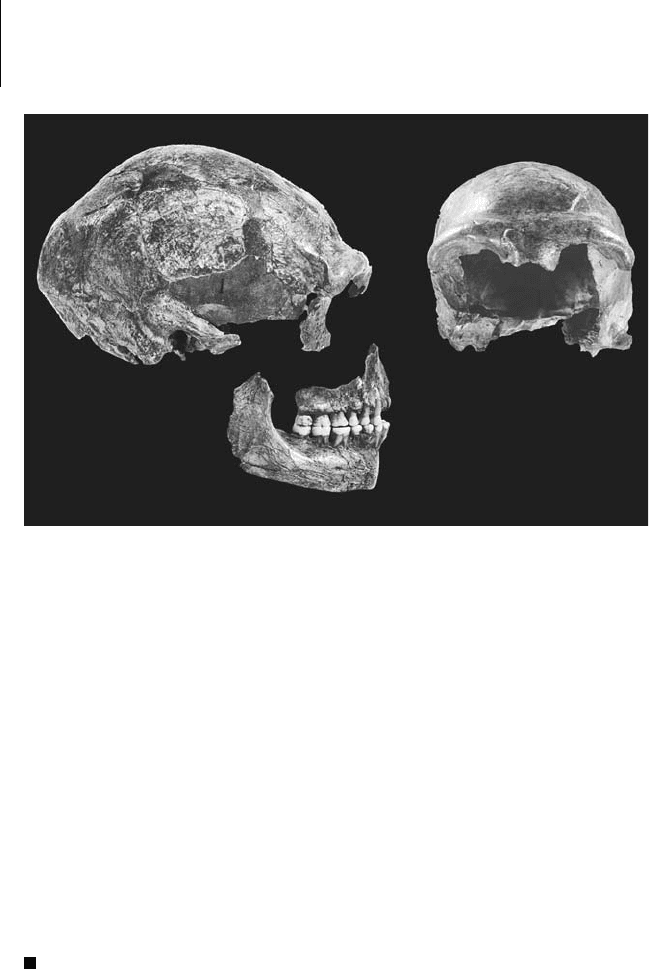
Figure .
Two views of a Neanderthal skull. This fossil was found in the town of Spy in
Belgium. Courtesy of Frank Williams.
DARWINIAN DETECTIVES
Should we consider Neanderthals to be a separate species from us,
Homo neanderthalis, leaving us as the only beings to carry the title
Homo sapiens? Or should they be given subspecies rank, Homo
sapiens neandethalis, leaving us as Homo sapiens sapiens?
What led to their decline? Did modern humans wipe out the
Neanderthals as they advanced out of Africa into Europe?
Is enigma even the right word to describe the Neanderthal? The term
“enigma” connotes something that cannot be explained. Puzzle may be a
better word to describe the challenge Neanderthals present to those interested
in our evolutionary history; puzzles, though baffling, have correct solutions.
The Cooking Hypothesis
In , three years prior to Darwin’s publication of The Origin of Species,
workers digging in a cave near Dusseldorf and the Neander River in southern
Germany discovered a skullcap and other human-like bones. The individuals
to whom these bones belonged soon became known as Neanderthals; “thal”
means valley in German, so Neanderthal is literally the valley of the Neander
River. Though the word “thal” in the German language was shortened to “tal”
at the end of the nineteenth century, Neanderthal remains the preferred
spelling, though some use Neandertal. My spell checker wants to use

Who Were the Neanderthals?
Neanderthal, and thus that’s how it will be spelled here. In actuality,
Neanderthal bones had been found prior to those located in the Neanderthal
site; the first Neanderthal skull was discovered eight years previously in
Gibraltar, though its significance was not recognized at the time.
The scientific community of the s was not sure what to make of
Neanderthals. Some saw Neanderthals as being modern humans whose bones
had become pathologically deformed. Others would emphasize ape-like
characteristics of the specimens, even to the extent of denying the obvious fact
that Neanderthals were fully bipedal. During the century after the Neanderthal
finding, Neanderthals would become neglected as anthropologists became
enraptured by other fossils of “early man.”
About a century after their discovery, Neanderthals would regain promi-
nence in the eyes of anthropologists. Starting in the early s, the renowned
anthropologist Loring Brace
3
at the University of Michigan would promote
Neanderthals as our ancestor, as the last “missing link” between ape-like
organisms and us. Brace, born in , was an avid follower of the modern
synthesis of evolutionary genetics and had been interested in applying those
ideas (the ideas of Ernst Mayr and Theodosius Dobzhansky) into evolutionary
anthropology. Brace’s ideas had been particularly influenced by the competitive
exclusion principle, which says that two species that share the same niche
cannot persist for long periods of time; they will either divide up the niche or
one species will drive the other to extinction. For this reason, Brice thought
that for most of the history since humans diverged from other apes, there was
one species of proto-humans.
Brace proposed “the cooking hypothesis” to explain how we could have
evolved directly from Neanderthals. The gist of this hypothesis is that
Neanderthals, in the process of becoming better able at taming fire, started
cooking more. The increased use of cooking led to less need for big teeth and
powerful jaws. Because such structures are energetically costly, selective
pressure existed to minimize them in the new environment—an environment
brought on by cultural advances. These changes led to anatomically modern
humans.
Starting around , a new generation of evolutionary biologists and
anthropologists challenged Brace’s views about Neanderthals being our direct
ancestor. Prompted by observations of the bushiness of the early stages of our
lineage, these “Young Turks” wondered whether bushiness remained in the
more recent stages of our evolutionary lineage. In other words, given that
several species of Australopithecus and early Homo simultaneously coexisted,
why couldn’t Neanderthal and humans coexisted simultaneously? During
the s, researchers found compelling evidence for anatomically modern
humans and Neanderthals being in the same general region for thousands
of years.
The Neanderthals were around for a considerable period. Depending upon
the authority, Neanderthals first appeared in Africa somewhere between
, and , years ago. They moved into the Middle East, and by

DARWINIAN DETECTIVES
, years ago were in Europe. At the peak, the Neanderthals had an
impressive range. They were all over Europe, except for the northernmost
parts (such as the Scandinavian regions); they occupied large regions of
southwestern Asia, from Turkey to the lands around the Caspian Sea to what
is currently Iraq and Iran. Although the dates of their appearance remain
controversial, less doubt remains about the timing of their disappearance.
Starting around , years ago, they became less frequent, co-incident with
the arrival of anatomically modern humans in Europe. By , years ago,
they were gone.
Morphology
The morphological differences between humans and Neanderthals are strik-
ing; surely, we must be different species. Not so fast! Appearances can be
deceiving. Although modern humans from different geographical regions
look different, those differences are the result of a relatively small number of
genes upon which different local selective pressures have operated. At the
genetic level, much more variation exists within local populations than
among populations.
So how do the differences between humans and Neanderthals compare
with differences within humans? Sophisticated morphological studies of brain
and face features find that humans and Neanderthals do differ much more
than do geographic populations of modern humans.
4
These studies also took
care to deliberately avoid including features that previously distinguished
modern humans from Neanderthals. Moreover, the morphological difference
between humans and Neanderthals was greater than those observed within
species of other primates.
The morphological differences between humans and Neanderthals may be
due to patterns of growth. The emerging consensus is that Neanderthals grew
very quickly, much faster than modern humans do. For instance, Fernando
Ramirez Rozzi and José Bermudez De Castro studied patterns of teeth devel-
opment from Neanderthals as well as several other species of the genus
Homo. Teeth grow in daily and yearly patterns; just as one can determine the
age of a tree by observing its rings, researchers can examine tooth patterns
under the microscope to determine the age of the teeth. Ramirez Rozzi and
Bermudez De Castro found that Neanderthals formed tooth crown at a rate
faster than that of modern humans. The pattern seen in Neanderthals is
not found in ancestral species of Homo or in modern humans. Ramierz Rozzi
and Bermudez De Castro state that their findings not only support the notion
of Neanderthals as a separate species but also provide clues about the ecolog-
ical context of Neanderthals. They view Neanderthals “as a species of Homo
adapted to particular environmental conditions, when a high-calorie diet and
a high metabolic rate were able to fuel fast somatic growth, as well as to grow
and sustain a large brain.”
5

Who Were the Neanderthals?
Although biologists often use morphological characteristics to make infer-
ences about whether two populations are separate species, the key criterion
for species status is reproductive compatibility, the extent to which males
and females from the different species will recognize each other as mates and
produce successful, fertile hybrids. If the populations are more or less fully
reproductively compatible, then they are considered part of the same species. If
they lack reproductively compatibility and are thus reproductively isolated,
then biologists generally recognize them as two separate species. There are gray
areas, and not all biologists agree with basing species decisions on reproductive
compatibility, but most do.
In , there was a highly provocative claim of a hybrid between a
Neanderthal and a modern human.
6
This claim was based on a partial skele-
ton of a four-year-old boy, which appeared to have a mosaic of Neanderthal
and modern human features. Specifically, the body proportions and a few
other characters appear Neanderthal whereas other features, including the
mandible area and the teeth, resemble those of early modern humans.
Another interesting feature of this specimen is its age—, years, at
least a couple millennia after the disappearance of the Neanderthals. If this is
a hybrid, either the Neanderthals lasted far longer than commonly believed
and/or the hybrid is not a first generation (F) hybrid but an admixture that
had been maintained for a considerable period of time. The claim for this
individual being a hybrid has not been confirmed. Moreover, as Tattersall
and Schwartz in an accompanying commentary to the original paper point
out,
7
morphological traits should not appear so dichotomous after tens or
hundreds of generations of hybridization. They suggest that it is still quite
possible that the fossil is just a chunky modern human child, who had
descended from the invaders that kicked the Neanderthals off the Iberian
Peninsula.
On the basis of morphology, Neanderthals and humans differ markedly;
their differences are sufficiently large that they should be considered at least
different subspecies, if not distinct species. But what can we say about the
relationship between humans and Neanderthals based on DNA studies?
Where do we think the Neanderthal ancestor split off the human family tree?
Eve and Adam and the Neanderthals
At first glance, the data from the studies of mitochondrial Eve and the
Y-chromosome Adam would seem to rule out any possible affinity between
modern humans and the Neanderthals. Eve and Adam’s location, Africa, and
timing, well after the Neanderthals’ appearance in Europe, would imply that
Neanderthals and modern humans didn’t interbreed. But is this really the
case? No, not necessarily. They still could have interbred. The Y-chromosome
and mtDNA studies alone do not prove that humans and Neanderthals aren’t
part of one interbreeding species. It is still possible that mitochondrial variants

DARWINIAN DETECTIVES
descending from Eve and Y-chromosome variants descending from Adam
got into the Neanderthal gene pool. Neanderthal genes may have entered into
the gene pool of modern humans and still could be with us today. By our best
estimates from the genetic data, the descendants of Adam and Eve left Africa
around , years ago, well before the presence of the appearance of anatom-
ically modern human beings in Europe. We could have been exchanging genes
with Neanderthals for more than t, years. Also recall that most recent
common ancestors of genes from the autosomes and the X chromosome are
much older than the Y-chromosome Adam or the mitochondrial Eve.
What if we could get DNA from Neanderthals? Would data from
Neanderthal DNA inform us as to whether we should include Neanderthals
together with us as one species, or place humans and Neanderthals in
separate species? These questions are now past the realm of science fiction or
philosophical musing; researchers can actually extract and sequence small
fragments of DNA from Neanderthals.
A Primer on Primers and PCR
Before discussing the studies of Neanderthal DNA, we need to examine PCR,
the polymerase chain reaction, because understanding how ancient DNA is
recovered, and thus the potential problems associated with the process,
requires knowledge about how PCR works. PCR is appropriately named; it is
a chain reaction. In nuclear physics, chain reactions occur when more particles
are created in every cycle of a reaction. This results in an exponential increase
in the number of particles. PCR is a chain reaction in the same way; in each
cycle of PCR, there are more DNA molecules than existed before. PCR is also
selective in that it amplifies only specific DNA sequences. We will see the
basis for the selectivity of PCR’s amplification when we discuss its stages.
Three distinct stages compose each cycle of the chain reaction of PCR. In
the first stage, the DNA is exposed to temperatures near the boiling point of
water. This causes the two strands of double-stranded DNA to separate
because the hydrogen bonds that normally hold the two strands together are
relatively weak and will break apart at high temperatures. Ordinarily, DNA is
kept at this high temperature for only a minute or two during each cycle—
just long enough to ensure that all of the DNA molecules are single stranded.
We come to a critical step in the next phase of the cycle when temperature
is reduced. At the lower temperature, the two strands of DNA could come
together (reanneal is the technical term) because hydrogen bonds tend to
form between cytosine and guanine and between adenine and thymine. If the
two strands of DNA are allowed to come together, no chain reaction ensues.
We would be left with the same number of DNA molecules as before. So how
can we amplify the DNA we choose and only amplify that DNA?
The answer is primers; these are very short, single-stranded pieces of
known DNA sequence that are added to the PCR mix before the reaction
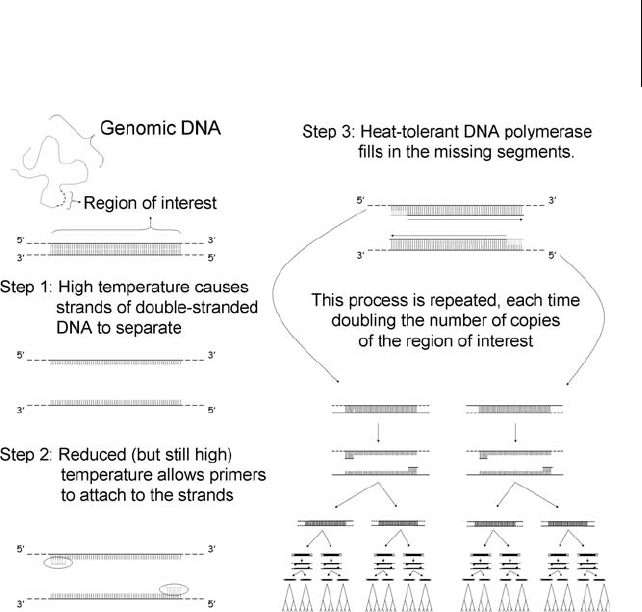
Figure .
The polymerase chain reaction (PCR). The repetition of the three steps of PCR—
denaturation, annealing to primers, and elongation by DNA polymerase—allows
doubling of specified DNA sequences every cycle.
Who Were the Neanderthals?
starts. Annealing is dependent upon the length of the DNA; short pieces
anneal faster than longer ones. When a primer comes into contact with a
sequence that is close to its complement (A pairs with T, C pairs with G), the
nucleotides in these primers form hydrogen bonds with their complements;
for instance, a primer that is AGTCTTCGGTATCGA will anneal with a
sequence that contains TCAGAAGCCATAGCT. This primer is annealed to
the DNA much faster than the DNA molecules can reanneal. One primer
annealed to a DNA fragment wouldn’t allow for amplification of the fragment.
What researchers do is to use two primers at opposite ends of the DNA
fragment that they want to amplify. How that amplification works is the
subject of the third phase in the PCR cycle.
After sufficient time has passed for the two primers to anneal at opposite
ends of the desired DNA fragment, the temperature is raised to a point
high enough to stop unwanted annealing but low enough to keep the
primers attached to the desired DNA fragment. Then DNA polymerase,
8
an
enzyme that cells use to replicate DNA, comes in and fills in the missing
DNA nucleotides between the two primers. This results in an intact, doubled-
stranded DNA fragment with the desired sequence. In actuality, there are two