
Johnson, Norman A. Darwinian detectives
Подождите немного. Документ загружается.


detect the changes that occurred on our lineage and which have been driven
by positive selection. They also are increasingly adept at determining
the genetic changes that have affected our brain size and linguistic capacity
during our evolution.
A large part of the problem in detecting such changes is that our genome
is so vast in size. From the perspective of the genome as a whole, the genetic
differences between humans and chimps are overwhelming. If one examines
just single nucleotide changes, million nucleotides differ between humans
and chimps! (Even more genetic divergence between these species arises from
small deletions and insertions of DNA.) We have no reason to assume that one
lineage changed considerably more than the other; thus, roughly half of these
changes occurred in each lineage, so that means approximately million
nucleotide substitutions occurred on one lineage since we split from chimps
six million years ago. If one were to devote hours a day to just counting
the single nucleotide differences between humans and chimpanzees, this task
would take months (assuming one could count one nucleotide difference
per second). The vastness of the genome means that humans and chimps
differ at a huge number of sites, even though only a small proportion of our
genome has changed.
Out of these tens of millions of nucleotide differences, what were the
ones responsible for the “important” differences between humans and
chimpanzees? The DNA differences that are responsible for changes in
brain size, changes in skull shape, use of language, gait, the ability to think
in abstractions, and other traits of interest are but a vanishingly small sub-
set of the total change that has accumulated. Even if these differences were
due to as many as , nucleotides that changed along our lineage, that
would still be much less than one thousandth of the total changes.
Evolutionary geneticists use two approaches to find the genes involved in
the important differences between humans and nonhuman apes. The first
begins by considering genes with known effects on these traits of interest.
Through examination of the evolutionary history of each of these particular
genes, researchers can determine whether positive selection has driven
changes in their sequence in our lineage. As you might suppose, such an
approach is laborious; it requires intensive study of one gene at a time.
Possessing the genomic sequences of humans and chimpanzees allows
evolutionary geneticists to take a second approach in which they do their
detective work at the “wholesale,” rather than the “retail,” level. In this second
and complementary approach, geneticists start with a culled list of genes
taken from the whole (or nearly whole) genome; these culled genes all show
the footprints of the action of positive selection along the human lineage.
Geneticists then can match these genes with functions.
We begin with an example of the first approach and an unusual genetic
pedigree.
DARWINIAN DETECTIVES

A Complex Language Defect with a Simple Genetic Basis
The discovery aspect of science at times seems to work in mysterious ways,
with serendipity playing an important role. For instance, I’m sure that the
researchers studying a language disorder that was passed on as a simple
Mendelian trait in one family never dreamed that their work would help in
discoveries about the evolution of linguistic abilities in humans, and yet that
appears to have happened.
The story begins with the finding of a language and motor disorder passed
on for three generations in one British family.
1
This family (known as the KE
pedigree) and their disorder came to the attention of Faraneh Vargha-
Khadem, an Iranian-born neurologist at the Institute of Child Health in
London, and a group at Oxford University led by Anthony Monaco and
Simon Fisher. These researchers noted that the disorder appeared to be inher-
ited like a textbook case of a single gene, where the variant that caused the
affliction was dominant. Contrary to popular belief, most disorders that are
prevalent in the population, even those that “run in families,” do not exhibit
simple patterns of inheritance (e.g., one gene with a variant that is either
recessive or dominant). Instead of behaving like the traits Mendel studied in
peas, most traits that affect the length and quality of human life have com-
plicated patterns of inheritance. For most common disorders—coronary
heart disease, Alzheimer’s, schizophrenia, diabetes, and several others—no
one-to-one relationship exists between a genetic variant and the disease.
Possessing certain genetic variants can affect one’s propensity for acquiring a
disorder and sometimes the severity of the disease, but whether one acquires
a disease is influenced by a complex relationship of the actions of several
genes, as well as several environmental factors. For the most part, human
geneticists have nearly exhausted unraveling the causes of the “easy” cases,
such as sickle cell anemia and phenylketonuria (PKU), which do follow
simple patterns of inheritance; most remaining traits display more complex
patterns. So the defect found in the KE family is unusual in the simplicity of
its genetic basis. The apparent simplicity of the genetic basis gave the
researchers hope that they would be able to quickly pin down the gene or
genes that caused the defect. Before discussing the genetic details of this
disorder, let’s take a closer look at its manifestations.
This language defect found in the KE family, although simple in its genetic
basis, is complex in the suite of characters it affects. Individuals with the
disorder struggle with articulating words because they lack proficiency in
performing the correct movements of the mouth and face (particularly of the
upper lip) needed to produce intelligible speech. The troubles they face are not
just with making the correct muscular movements, but also with producing
these movements in the proper sequence. Affected individuals also are defi-
cient in understanding grammar and in processing language; in particular,
they have trouble breaking words down into individual sounds. In addition
to severe defects in verbal intelligence, these individuals appear to have more
What Are the Genetic Differences That Made Us Human?
subtle impairments in nonverbal intelligence, as indicated by the nonverbal
IQs of most of the affected individuals tested being in the low-average
(–) range.
One diagnostic trait of this condition is that afflicted individuals score far
worse than nonafflicted individuals on tests involving repeating words (or
nonword sounds) back to the instructor immediately after the instructor
speaks them. The range of scores of affected individuals falls outside the range
of that of nonaffected individuals. Affected individuals had particular difficulty
in repeating words with more than one syllable. This lack of facility with
multisyllabic words is further evidence that the defect involves difficulty in
coordination and in making the correct movements in the proper sequence.
The syndrome seen in the KE family has some similarities to patients with
a well-known disorder: adult-onset Broca’s aphasia. Right around the time
Darwin published The Origin of Species, a French physician named Pierre Paul
Broca was examining people who had had strokes or other brain damage that
limited their ability express words. Their language would be halting, often
reduced to simple monosyllabic words. Sound familiar? Broca found that this
inability to speak (technically called aphasia) in these patients arose due to
defects in a region of their frontal lobes on the left sides of their brains. The
brain region affected in these patients is now known as Broca’s area.
The brains of affected individuals are also different. Positron emission
tomography (PET)
2
scans testing the brain activities of subjects when they
were engaged in tasks involving word repetition revealed clear functional
brain abnormalities. It is interesting that in the affected subjects, certain brain
DARWINIAN DETECTIVES
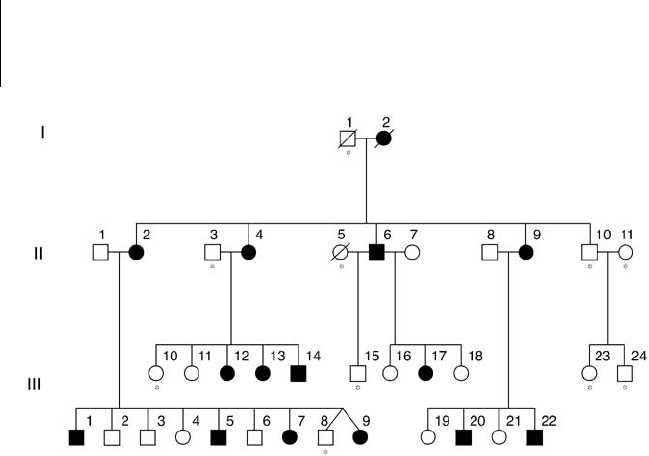
Figure .
The KE family pedigree. Circles and squares represent females and males, respec-
tively. Shaded individuals are affected by the severe language disorder, whereas
unshaded individuals are not. Figure courtesy of Simon Fisher.

regions were overactive as compared with controls, but other regions were
underactive. Even more intriguing, one of the overactive brain regions in
affected individuals was Broca’s area, the paradigmatic “language center” of
the brain. It is possible that hyperactivity in Broca’s area reflects overcompen-
sation of affected individuals struggling to repeat words correctly. Structural
magnetic resonance (MRI) tests revealed no clear-cut pathologies, but statis-
tically significant differences exist between affected and control individuals.
For instance, affected individuals tend to have less gray matter in Broca’s area
than do control individuals. Moreover, functional MRI
3
tests, in contrast with
the PET scans, show less activity in Broca’s area in affected individuals.
Through molecular genetic analysis, researchers mapped the disorder in the
KE family to a defect in a single gene that maps to chromosome . In addition,
the researchers came across a case study of an individual unrelated to the KE
family but who had a similar language syndrome. It turned out that this indi-
vidual had a translocation involving the region of chromosome corresponding
to chromosomal position to which the trait in the KE family mapped.
Subsequent work in characterizing the gene involved in this syndrome
revealed that the gene was part of the Forkhead-wing-helix gene family (FOX),
and was thus designated FOXP. FOX genes play a number of roles by regu-
lating other genes. The proteins of these FOX genes contain what is known as
a “forkhead box”—a region of to amino acids that binds to DNA.
The syndrome seen in the KE family arises from a single nucleotide change
(G to A) that causes an amino acid change in position of the protein.
Notably, this nucleotide change is present in all affected individuals of the KE
family, and all unaffected individuals from that family lack the nucleotide
change. This mutation has not been detected in the general population,
thereby implying that it is either absent or very rare. The affliction is domi-
nant because two functional copies of the gene are needed for proper language,
and hence the defect shows up when there is only one functional copy.
FOXP interacts with a number of downstream genes in regulatory path-
ways. By binding to regulatory sites of these genes, FOXP reduces the rate at
which the genes are transcribed into RNA. In humans and probably other
vertebrates, FOXP itself is expressed in the brain and several other organs
during several stages of fetal development. Although its exact role in gene
regulation is still being deciphered, biologists know that FOXP interacts with
several related proteins of the forkhead family. Some scientists speculate that
speech development and language abilities require having the proper balance
of expression of these forkhead genes.
FOXP and Human Evolution
One of the striking aspects of the evolution of FOXP is its evolutionary
conservation. Within mammals, the FOXP protein is one of those evolving
at among the slowest rates. In humans and mice alike this protein contains a
What Are the Genetic Differences That Made Us Human?

total of amino acids, but only three amino acid sites changed between
humans and mice, which are about million years divergent. This conser-
vation isn’t limited to just mammals; the human and bird (zebra finch)
FOXP proteins are only different.
4
This means that in the million
years of evolution since birds and mammals split, the sequence of this protein
has diverged only in each lineage.
Svante Pääbo’s group has investigated the evolution of FOXP in humans
and other apes. They found that two of the three amino acid differences
between humans and mice occurred on the human lineage after humans split
from chimpanzees.
5
Note that neither of these changes is the mutation that
was found in the KE family. One change along the human lineage could be
happenstance; the presence of two changes along the human lineage just by
chance is improbable, especially when one considers that the split of humans
from chimpanzees is less than one-tenth the split between the human/chimp
and the mouse lineages. One could argue that such changes are just due to
the relaxation of constraint, but as we will see, further evidence rules out this
hypothesis of the relaxation of negative selection.
In humans, FOXP has more rare genetic variants than would be expected
under a neutral model in which the population size is constant and individ-
uals mate at random. Population growth would lead to an excess of rare
genetic variants, but this effect should be the same across the whole genome
and not limited to a single gene. Although most genes in the human genome
do show a small increase in these rare variants, the deviation seen at FOXP
is unusually large. This suggests that something in addition to the increase in
population size is occurring at FOXP. That something else is likely to be a
recent selective sweep.
Pääbo’s group estimates that this positively selected variant was fixed
sometime in the last , years. The estimate is based on a model that
assumes random mating and no population growth. With the inclusion of
population growth, the window of the estimate can be pushed back in time
somewhat, but only to not more than , years ago. Even with this
consideration, it seems likely that this gene was fixed in the human lineage
after the split of humans and Neanderthals.
Several popular science accounts of this finding have called FOXP “the
language gene” or “the speech gene.” For instance, cnn.com’s account on
August , , of the finding by Pääbo’s group bore the subheading, “Apes
lack gene for speech.”
6
This statement is problematic for several reasons.
First, FOXP is not the only gene involved in speech or language; we do not
even know whether it is the most important gene affecting speech that has
changed on the lineage. It’s just the first gene of its kind to be discovered.
Second, apes don’t lack the gene; they have a perfectly functioning FOXP
gene; it just differs somewhat from our human version of that gene. Finally,
it isn’t clear whether the change in FOXP that occurred in our ancestors had
anything to do with speech per se. Positive selection certainly operated on the
gene, but for what, we just don’t know.
DARWINIAN DETECTIVES

As anthropologists, cognitive scientists, linguists, and others have observed,
language is not a unitary quantity. As Ray Jackendoff puts it, we shouldn’t be
asking whether apes or “hominids” had language, but rather what components
of language they possessed.
7
We know that trained apes, especially chimpanzees
and bonobos, have shown considerable success at learning some aspects of
language but fail to learn others. We also know from our own experiences
that developing children do not acquire language in one step, or even two
steps. Why should the evolutionary development of language come about in
a single leap? This isn’t to say, to paraphrase Ernst Haeckel, that the ontogeny
of language recapitulates its phylogeny; there is no reason to suspect that the
steps in which babies learn language will necessarily match the steps by which
human ancestors evolved language. Still, it is likely that in the course of our
evolution, we acquired language in a stepwise manner.
Shrunken Brains
Aside from our enhanced speech and linguistic abilities, the other most
striking difference between humans and other apes is the size of our respec-
tive brains. Human brains are three to four times larger than those of our
closest living relatives; the size difference is the result of several episodes of
expansion occurring in the human lineage. Most notably, brain size showed
a fairly steady size increase from just under two million years ago until about
, years ago. In the last half a million years, brain size remained at a
plateau; indeed, Neanderthal brains were slightly larger than our own.
Microcephaly—literally “small head”—can arise from a number of environ-
mental insults during development (including exposure to harmful chemicals,
poor nutrition, or maternal diabetes). This condition can also arise from the
loss of function of any one of at least six genes. Although people with genetic
microcephaly have drastically smaller brains (typically one-third the normal
size at adulthood), as well as significant to severe mental retardation, their
brains are relatively normal in overall structure. This suggests that the genes,
whose lack of function results in microcephaly, play some role in regulating
brain size. Could positive selection have acted on these genes to lead to larger
brains in humans?
Bruce Lahn and his colleagues at the Howard Hughes Medical Institute at
the University of Chicago have been investigating the evolution of genes; they
found that positive selection has operated on at least two of the six known
“microcephaly” genes: ASPM and Microcephalin. The stories that these two
genes tell are similar: positive selection has been acting on these genes for a
long time in primates and has acted in the very recent past of humans. We’ll
start with Microcephalin.
In primates, Microcephalin exhibits a high ratio of replacement site
changes to silent site changes.
8
Led by Lahn’s graduate student Patrick Evans,
these researchers found that throughout the last million years of primate
What Are the Genetic Differences That Made Us Human?

evolution, the replacement to silent changes ratio has been particularly high
along the lineage that led to humans as compared with sister lineages that did
not lead to humans. Recall that to definitively ascribe positive selection as the
cause of a high replacement to silent ratio, the ratio has to be statistically larger
than one. Because this ratio turns out not to be consistently statistically
larger than one along the human lineage, the formal possibility remains that
the increased number of replacement site changes are due to the relaxation of
constraints in the human lineage, and not the action of positive selection.
To rule out the lifting of constraints hypothesis, Lahn’s group also
collected polymorphism data from human populations, which enabled them
to perform McDonald-Kreitman tests. Recall that in the absence of positive
selection, the ratio of replacement to silent site polymorphisms within species
should be statistically indistinguishable from the ratio of replacement to silent
changes between species. In actuality, these ratios were very different; positive
selection has driven an estimated excess of amino acid changes at this gene
in the last million years of primate evolution along the branch that led to
humans.
The polymorphism data that Lahn’s lab collected for the previous study
led to another conclusion: one haplotype of human Microcephalin was found
to be at a much higher frequency than that of the others.
9
By looking at the
chimpanzee gene, the researchers could infer that this common haplotype
differed from what had been present in the common ancestor of chimps and
humans. Evolutionary biologists call such a change a derived one. This
derived haplotype is nearly fixed in populations indigenous to the Americas,
is very high in frequency throughout most of Europe (including the Middle
East) and Asia as well as in New Guinea, but is low to moderate in frequency
in sub-Sahara Africa.
Lahn and colleagues then calculated that the probability of observing a
derived haplotype at such a high frequency simply by chance was extraordi-
narily low. Their calculations also showed that this haplotype went from
being present in only one copy (as a new mutation) to a high frequency in a
relatively short time—a period too short for the frequency rise to be due
solely to random genetic drift. Thus, the authors conclude, positive selection
must have operated on this variant. The estimated age of this variant was
, years, with a range between , and , years. This estimate is
right within the range of the “Great Leap Forward,” the cultural explosion
that Jared Diamond proposed (see Interlude II). The variant’s high frequency
in New Guinea, which was settled around , years ago, and the Americas
would be difficult to explain if the mutation arose toward the more recent end
of the range. Other data also support the recent age of the haplotype, as well
as the action of positive selection.
The ASPM gene tells a similar tale. Based on the McDonald-Kreitman test,
this gene also has had an excess of amino-acid changing substitutions
along the human lineage. In fact, the test suggests that of the sites that
change the amino acid between humans and our common ancestor with
DARWINIAN DETECTIVES

chimps have been adaptive.
10
This would imply, given a six-million-year
divergence time, that there has been an amino acid change that has been
driven by positive selection once every , years on average. Other tests
suggest that adaptive evolution has been operating on this gene on our line-
age for almost million years.
One haplotype of ASPM in humans is also much more common than all
of the others and is also a derived state.
11
It is at highest frequency in
European and Middle Eastern populations, relatively high in Central Asia,
and rare to very rare elsewhere. This haplotype appears to be even younger
than the one found in Microcephalin, with an estimated age of less than ,
years (the range of this estimate is between years and , years). By
population genetic standards, that’s overnight. By paleontological standards,
that’s a blink of an eye. By the same reasoning used with the Microcephalin
haplotype, the researchers conclude that positive selection has driven this
variant to high frequency.
So what does this mean? One phrase that is often used in scientific papers
is “it’s tempting to speculate.” I usually loathe this phrase because authors
using it most often really mean “we speculate that, but we don’t want to come
out and say that we speculate it.” In this case, the phrase is warranted. It is
tempting to speculate about the implications of these findings. Does it mean that
humans with those haplotypes have bigger brains and/or are smarter than
those who lack those haplotypes? In addition, the nonrandom distribution of
these haplotypes across the globe poses huge ramifications.
Let’s resist the urge to speculate wildly, lest we lead ourselves into tempta-
tion. Let’s consider what we do know. The inference is that recent positive
selection drove the increase in frequency of these genetic variants. But we
don’t know much more. Human brain size is not increasing and hasn’t
increased for hundreds of thousands of years. In fact, it’s possible that our
brains have decreased somewhat in size during that time; Neanderthal brains
were bigger, on average, than those we possess. Could it be that selective
pressure has operated to reduce our brain size, and that these haplotypes at
ASPM and Microcephalin actually lead to smaller brains? We don’t know.
Moreover, as Gould has pointed out in The Mismeasure of Man, no solid
evidence supports a large correlation between brain size and intelligence
within the normal range of brain size.
12
Let’s be careful out there.
Lose a Gene, Grow a Brain?
Although most of this change is likely to be due to changes in genes, one
intriguing hypothesis is that the growth of our brain has been assisted by the
fortuitous loss of function of a gene. How could losing a gene help make
brains larger?
Sialic acids are a major component of chemicals that coat the surfaces of
cells. These chemicals play diverse roles in a large number of functions,
What Are the Genetic Differences That Made Us Human?

including immune defense, cell signaling, differentiation of cell types, and the
transport of ions. Unlike all other apes (and probably all other mammals),
humans lack one of these sialic acids, N-glycolylneuramic acid (NeuGc).
Humans don’t have this chemical because an Alu insertion inactivates
the gene that produces the enzyme (CMAH) that converts the precursor
Neu-Ac to Neu-Gc. In contrast, Neu-Gc coats the cells of other apes,
including both species of chimps, because the enzyme CMAH is functional in
these species. Because we lack CMAH, we humans also have an increase
in the content of NeuAc, the precursor sialic acid.
Brain growth ceases soon after birth in most primates. In humans,
however, brain growth continues on. One hypothesis is that brain growth is
inhibited by the presence of NeuGc. In nonhuman mammals, the expression
of the CMAH gene is reduced in the brain, leading to less CMAH enzyme.
The consequence of this down-regulation is that in nonhuman mammals, the
surfaces of cells in the brain have less (but still have some) NeuGc as compared
with cells elsewhere.
Two methods were used to date when the Alu insertion inactivated the
CMAH gene.
13
The results from both of these methods support the insertion
and inactivation of CMAH occurring about . million years ago, shortly
before the rapid expansion of our brains.
So did Neanderthals have a functional version of this gene? Because this
gene is nuclear and not from the mitochondria, it would be exceedingly
difficult to obtain enough DNA in order to sequence it. It is not necessary to
sequence their DNA to find out whether Neanderthals had the functional
CMAH enzyme; researchers can use another method—by looking at the
Neanderthal’s sialic acids. NeuGc was not detected in Neanderthals, but
researchers did find NeuAc, its precursor, in Neanderthals.
14
This is strong
evidence that Neanderthals also have an inactive CMAH gene, as we would
expect, given what we know of the timing of the inactivation.
The weakest link in this chain of argument about the inactivation leading
to increased brain size is whether NeuGc indeed inhibits brain growth. The
inactivation of the enzyme dating to around the same time that our brain size
exploded is intriguing. But remember the old adage, “post hoc, propter hoc.”
Just because event X occurs before event Y doesn’t mean that X caused Y.
The loss of NeuGc and subsequent increase in NeuAc in humans
appears to have another consequence: changing our susceptibility to malarial
parasites.
15
Plasmodium falciparum, the major malarial parasite in humans,
does not cause severe infection in chimpanzees. Conversely, Plasmodium
reichenowi causes malaria in chimpanzees but apparently not in humans. The
protein from Plasmodium falciparum involved in binding to red blood cells
prefers to bind to cells with NeuAc; it is actually inhibited by NeuGc. But the
binding protein from Plasmodium reichenowi prefers NeuGc. Manipulations
of the sialic acid content of human cells in cell cultures show that it is indeed
the composition of sialic acid that alters the binding preferences of the
proteins.
DARWINIAN DETECTIVES

Taking It to the Genome
Instead of taking the “candidate gene” approach—starting with genes of
known function and then examining the molecular evolution of the genes—
one could start with all or most of the genes, find those with the signatures
of selection, and then look at the functions of those genes. Because this
genomic approach is the reverse of the standard genetic approach, it is
sometimes referred to as reverse genetics.
Prior to the publication of the chimpanzee genome by the publicly funded
consortium, the private company Celera had sequenced the genome of this
species. Cornell University evolutionary geneticist Andrew Clark and some of
his colleagues collaborated with scientists from Celera in the first genome-
wide analysis with the aim of finding genes whose evolution was accelerated
along the human lineage by positive selection.
The approach taken by the Cornell and Celera researchers allowed for
variation in the ratio of replacement to silent sites across the gene; this way,
they could detect positive selection even if the overall gene did not have an
excess of replacement changes, if regions of the gene did. In their first report,
they also used the mouse sequence as an outgroup to look at changes that
occurred only along the human lineage. If humans have a G at a site, chimps
have C, and also mice have C, one can infer that the change was in the human
lineage. Through this method, Clark and his colleagues found that hundreds
of genes showed signatures of the action of positive selection—namely, more
than the expected number of replacement site changes in at least some
regions of the gene.
16
Clark and his colleagues could infer that positive selection had operated on
FOXP, the gene involved in language, as well as many other “brain” genes.
Although genes that played a role in the brain (particularly neurogenesis, the
generation of new neurons in development) were disproportionately overrep-
resented in the genes that were accelerated by positive selection, this was not
the only overrepresented category of genes. Genes involved in the breakdown
of amino acids and genes involved in hearing were also highly represented on
the list. Amino acid breakdown could be under selection due to dietary
changes that occurred in our evolution.
The “hearing genes” category is an interesting case. One of the hearing
genes, alpha tectorin, is involved in the development of the tectonal mem-
brane in the inner ear. Mutations in this gene can impair hearing, particularly
at frequencies in the range at which words are often spoken. This gene may
have been under selection because the development of language also places
demands on hearing and processing of particular sounds.
In , months after their first paper, the Cornell-Celera team
published a second.
17
In this study, they had a larger number of genes and
they did not use an outgroup to determine the direction of the change
between humans and chimps. Instead of investigating the changes that hap-
pened just on the human lineage, they looked at all changes between humans
What Are the Genetic Differences That Made Us Human?