
Johnson, Norman A. Darwinian detectives
Подождите немного. Документ загружается.

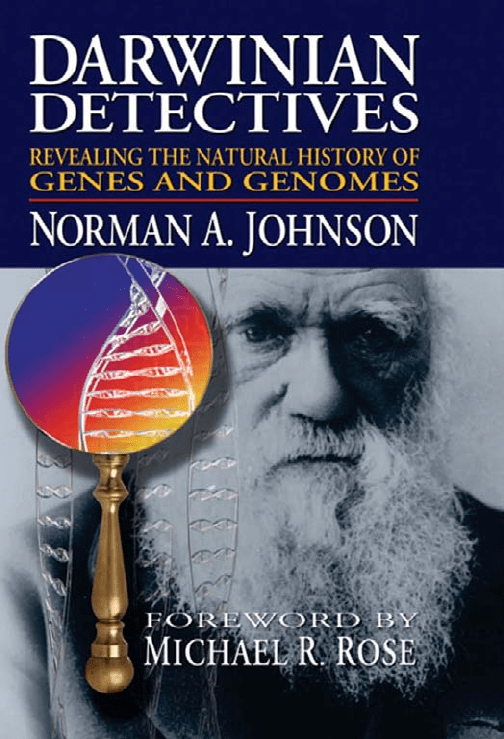

DARWINIAN DETECTIVES
This page intentionally left blank

DARWINIAN
DETECTIVES
Revealing the Natural History
of Genes and Genomes
Norman A. Johnson
1
3
Oxford University Press, Inc., publishes works that further
Oxford University’s objective of excellence
in research, scholarship, and education.
Oxford New York
Auckland Cape Town Dar es Salaam Hong Kong Karachi
Kuala Lumpur Madrid Melbourne Mexico City Nairobi
New Delhi Shanghai Taipei Toronto
With offices in
Argentina Austria Brazil Chile Czech Republic France Greece
Guatemala Hungary Italy Japan Poland Portugal Singapore
South Korea Switzerland Thailand Turkey Ukraine Vietnam
Copyright © by Oxford University Press, Inc.
Published by Oxford University Press, Inc.
Madison Avenue, New York, New York
www.oup.com
Oxford is a registered trademark of Oxford University Press
All rights reserved. No part of this publication may be reproduced,
stored in a retrieval system, or transmitted, in any form or by any means,
electronic, mechanical, photocopying, recording, or otherwise,
without the prior permission of Oxford University Press.
Library of Congress Cataloging-in-Publication Data
Johnson, Norman A., –
Darwinian detectives: revealing the natural history of genes
and genomes/Norman A. Johnson.
p. ; cm.
Includes bibliographical references and index.
ISBN ––––
. Evolutionary genetics. . Natural history. . Molecular genetics. I. Title.
[DNLM: . Selection (Genetics) . Evolution. . Genetics. . Genomics.
. Natural History. QU Jd ]
QH.J
.’—dc
Printed in the United States of America
on acid-free paper

Dedicated to Julie Froehlig, just for being
This page intentionally left blank

Foreword
Imagine that the theory of evolution had never been discovered. Suppose that
we are at the start of the twenty-first century without it. Biology remains
based on some type of creationism, as it was before Darwin published his
theory of evolution, but all of modern biotechnology is in place.
A bizarre fossil is discovered in an Ethiopian desert, bones that no one has
seen before, part way between a chimpanzee and a human. The skull is small,
smaller than that of any grown human, but the rest of the skeleton suggests that
this man-ape monstrosity could walk upright with ease. An ayatollah declares
it a creation of a Satan, a long dead minion of evil.
Sub-Saharan African children die of sickle-shaped red blood corpuscles in
great numbers, but there is no contagious disease that explains the disorder, not
even the endemic parasite Plasmodium that causes malaria. Molecular biologists
work out that the sickling is usually due to a single amino acid change in the
string of amino acids that makes up part of the hemoglobin molecule, but they
have no idea why it is so frequent. An ancient curse is suspected by practitioners
of voodoo.
It has been established that all known cases of inheritance are due to nucleic
acids, overwhelmingly deoxyribonucleic acid (DNA), but sometimes its close
chemical cousin, ribonucleic acid (RNA). The pope declares that the efficiency
of these molecules shows God’s Providence at work in the world.
A world where biologists only document the details of God’s Creation has
no mysteries. Every feature of life can be attributed to the action of this
unknown, but supremely powerful, gaseous vertebrate. Yes, biologists will

still work on the details, but whatever these details turn out to be, the “guilty
party” is always the same: God.
Now imagine a scientific field that is devoted to finding other causes
for the panoply of life, a field that invokes material causation in place of an
all-powerful Creator. Then there are mysteries.
How could organs so much like video cameras have been placed on the
front of our faces, giving almost all members of the species Homo sapiens
binocular color vision?
Why is there so much variation in the amino acids making up important
proteins? Why are the genes that code for proteins interrupted by noncoding
DNA, of no apparent purpose? Why is more than of the human genome
apparently noncoding junk DNA? Why do some genes hop around, while
others stay in the same place?
We can either suppose God to be perverse or look for other guilty parties.
If we choose the latter alternative, further choices arise. Perhaps the causes of
living diversity are secular instruments of a more subtle Creator, or the work-
ings of a Godless universe. We don’t need to decide that question right away,
as biologists. But if we suppose that the living world conforms to decipherable
laws, beyond those of physics and chemistry alone, though not in violation of
them, then we have to work out these laws. Having worked out these lawful
mechanisms, we will perforce seek out their applications to the particulars of
the living world, in part to understand that living world better and in part to
test these laws of life themselves.
Then and only then can we consider biologists scientists in their own right,
rather than the “natural historians” of God’s Creation, or the less intelligent
handmaidens to chemists and physicists. It is this challenge that has been
taken up by evolutionary biologists above all other biologists.
Exploring secular forces behind the machinery of life is a relatively new
enterprise. For the general public, this endeavor is less than years old,
even though the natural history of life is one of mankind’s earliest interests.
And this natural history work continues at a steadily accelerating pace. Most
of molecular and cellular biology is that natural history project continuing
down to the level of organic chemistry, with new facts of life discovered every
hour in a laboratory somewhere around the globe. But they are only creating
new mysteries to be solved. For all their dazzling machinery, most cell
biologists are the policemen on the beat, arresting the obvious “perps” and
discovering the dead bodies, sequencing the genes and showing how the
proteins fold and interact.
It is the evolutionary biologists who are the detectives, the Columbos, the
Miss Marples, often older or eccentric, driving ancient vehicles and muttering
to themselves about things that the cops on the molecular biology beat find
baffling.
This engaging volume introduces Darwinian detective work, how we go
about unraveling the guilty parties that remain behind the scenes until they
are apprehended.
Forewordviii

Many people have little interest in this enterprise. Others question its
validity. Sometimes our work turns up little or nothing at first. Cases go cold,
sometimes for decades. Then a new piece of evidence is turned up by a cell
biology patrolman or a fossil bounty hunter, and we have a new theory
explaining a mystery of life. Sometimes this theory is shot down soon after it
is proposed, the victim of some ugly fact. But we work on, convinced that
there has to be some underlying cause, some explanatory key that would have
tickled Darwin himself, our first great evolutionary detective, and still an
unrivaled master at the level of pure intuition.
But our detective work has been greatly aided by new quantitative tools,
tools to which Darwin did not have access. Unbeknownst to many cursing
statistics students in college, the variances and regressions that they struggle
with are tools of data analysis first brought to maturity in pursuit of evolu-
tionary mysteries. Quantitative analysis of data has grown in tandem with
evolutionary biology. Now much of the evolutionary genetics that Norman
Johnson describes for us is based on massive computation. (I have myself
donated a successful doctoral student in evolutionary theory, Michel Krieber,
to the world of stock market analysis, a forbiddingly sophisticated application
of mathematics.) Modern-day evolutionary biologists can solve problems that
Darwin couldn’t, because our field has advanced far beyond the solid
foundations that he hammered into the ground of biology; it is the most
dauntingly mathematical part of biology. But not to fear. You will be spared
mathematical heavy-lifting here.
There is a literal intersection of criminology and Darwinian detective
work: genetic forensics. My closest colleague, Larry Mueller, serves as an
expert witness in cases that involve the use of DNA from blood, semen, and
other crime-scene tissues. The very fact that this technology has value in
courts of law is one of the mysteries that evolutionists have been most inter-
ested in: the abundant genetic variation within our species, and most others.
Without copious genetic variation, forensic DNA would be of little value. The
riddle of that variation is one of the most important themes of this book.
As in many other respects at this moment in history, Western civilization
has a choice between an increasingly awkward obscurantism and science. You
can suppose that global warming is fanciful, that God made our bodies in His
Image, that one or another ancient book contains all that a decent person
should know. Or you can embrace a world that has many obscure secular
causes, a world with real mysteries that take some care to figure out. Many
people accept the triumphant working out of the great mysteries of physics,
though there are still those who believe that the Sun revolves around the
Earth, as the Bible proposes. Most people also already accept that the Earth is
ancient, though few have an intuitive sense of its enormous age. It is now
time for reasonably informed people to add biological evolution to their
repertoire of general knowledge.
Norman Johnson introduces the educated reader, one who knows perhaps
a smattering of science, to some of the most exciting mysteries in biology,
Foreword ix