
Johnson, Norman A. Darwinian detectives
Подождите немного. Документ загружается.


frequencies. Strong linkage disequilibrium also persists for considerable
distances in this complex.
Not only does convincing evidence exist that HLA variants are actively
maintained by selection, but there is also strong support for the notion that
this balancing selection has been operating at HLA for a long time. Bolstering
this claim is the extent to which haplotypes at HLA genes differ considerably
from one another; for instance, the average difference between haplotypes at
the HLA-A locus is nucleotides.
14
This finding is a strong signal that
balancing selection has been maintaining genetic variants for a very long
time. How long? Well, some human HLA genetic variants are more similar
to some chimpanzee variants than they are to other human variants. Balancing
selection most probably has been going on since before chimpanzees and
humans diverged from our common ancestor six million years ago!
What is the nature of the balancing selection that has been operating on
HLA/MHC? This is less clear than the existence of balancing selection, but
there is support for reproductive aspects of biology being agents of the
balancing selection. In humans, the risk of spontaneous miscarriages
increases as progressively more genetic variants are shared between the
mother and the father. In addition, MHC appears to be involved in mate
choice in mice. Some evidence suggests a similar role in humans, but that link
is not as well established as it is in mice. Balancing selection on HLA also
appears to be pathogen driven, but the casual mechanisms are less well known.
Perhaps having two variants at a particular HLA locus would increase the
range of pathogens that one’s immune system could detect. Plausible argu-
ments can be made for the proposition that possessing rare variants would
be advantageous. The problem is that heterozygote advantage and rare variant
advantage make exactly the same predictions with respect to how they would
affect patterns of genetic variation.
Balancing selection is certainly much more rare than negative selection
and is also likely to be considerably more rare than positive selection. Yet
balancing selection does appear to be more common than once thought. By
examining patterns of DNA data with various statistical tools, evolutionary
geneticists are able to implicate (with varying degrees of certitude) that
balancing is or has acted in quite a few examples. Although these cases are
not limited to disease in humans, such cases appear to be disproportionately
abundant. The large number of human cases probably reflects the intensity of
focus in human evolutionary genetics. One possibility is that the high pro-
portion of cases of putative balancing selection being associated with disease
reflects the fact that human geneticists are particularly interested in disease.
Nevertheless, there are biological reasons that we should expect balancing
selection to be associated with disease. Parasites and pathogens, with their
short generation times and high reproductive excess, have great opportunity
for rapid evolution. Humans and other large animals would be under
continual selective pressure just to keep up with these rapidly evolving
pathogens and parasites. Being heterozygous for genetic variants would allow
DARWINIAN DETECTIVES

an individual to be able to respond to a wider array of pathogens and parasites.
As we saw in sickle-cell anemia and perhaps in cystic fibrosis, however, adap-
tations to the natural enemy may involve responses that work well in one
dose (in heterozygotes) but have deleterious consequences in two doses (in
homozygotes). Natural selection does not “think” ahead; when such variants
are rare, those latter negative consequences in homozygotes would not
matter. Finally, mathematical theoretical studies examining the evolution of
resistance to parasites and pathogens suggest that such evolution may often
involve balancing selection of the sort whereby rare genetic variants are
advantageous. Although the story is far from settled, my hunch is that
balancing selection more frequently operates in cases involving disease.
Balancing Selection and Disease
This page intentionally left blank

Human Origins and Evolution
Though he lived in the century before television and blockbuster movies,
Darwin had mastered the art of the cliffhanger. His only remarks about
human evolution in The Origin of Species were “much light will be thrown on
the origin of man and his history.” While Victorian society waited, Darwin
took years—almost as long as the gap between the two Star Wars
trilogies—before writing The Descent of Man and Selection in Relation
to Sex.
1
Whereas Darwin was content to take his time and to be a quiet revolu-
tionary, others were not. Known as Darwin’s bulldog for his passionate
defense of Darwin and evolution, Thomas Huxley was among the first to
discuss human origins and evolution within the scope of Darwinian evolu-
tion. In his essay “On Relations of Man to the Lower Animals,” Huxley
spoke of the gap between humans and other animals: “It would be no less
wrong than absurd to deny the existence of this chasm, but it is at least
equally wrong and absurd to exaggerate its magnitude, and, resting on
the admitted fact of its existence, refuse to inquire whether it is wide or
narrow.”
2
When he finally came to discussing humans in the light of evolution,
Darwin presented argument after argument (with varying degrees of suc-
cess) that this chasm was much smaller than commonly believed. Darwin
pointed to numerous cases of animals appearing to display traits that had
been considered the province of human emotions, including sympathy
toward others, loyalty, and an appreciation for beauty and music. Darwin’s
INTERLUDE II

DARWINIAN DETECTIVES
point was that our differences—though they may be great—were ones of
degree, and not of kind.
What can genetics tell us about our species and the differences between
us humans and our closest relatives? The chapters that follow in this section
will focus mainly on what we can learn about our origin and history from
studies of patterns of DNA sequences, but first some words on the fossil
record are in order.
Thanks to a century and a half of work by dedicated paleontologists, we
can point to an almost seamless fossil record that begins very near the time
of our common ancestor with chimpanzees and continues to just about the
present day. Some of the fossils are so close to the chimp–human split that
the paleontologists have difficulty determining whether the fossil is in fact
on the human lineage. Lest a creationist twist the preceding words around,
let me say clearly: the paleontologists’ struggle with deciding whether a
fossil is or is not on the human lineage reflects the progress they have made
in coming so close to the actual point where proto-humans and proto-
chimps split. It is a success, not a failing, of paleontology.
The fossil record very clearly demonstrates that our family tree is not
like the ladder of popular myth, but rather like a bush. To say that a
chimp-like organism begat Australopithecus begat Homo erectus begat
Neanderthals begat us, grossly oversimplifies the true history of our lineage.
Indeed, throughout most of this six million year history, often two or three
(and sometimes more) “species” of ancient human lived at the same time. I’ve
put the word species in quotes because one obviously could not test whether
these contemporaneous forms could interbreed (the common standard of
determining species status). Paleontologists continue to argue about what
constitutes a species, both in general terms and with respect to our lineage.
It is clear, however, that rather different organisms lived side by side during
most of our history.
Of course, the bushiness of our family tree is no longer apparent; we
are the sole surviving species of our genus, and we are separated by a
rather considerable gulf from our closest relatives. A fascinating discovery
published in late October , however, shows that some bushiness
remained in our lineage until very recently—far more recently than previ-
ously thought. In , researchers discovered an almost complete, ,
year-old skeleton in a cave in Flores, a remote Indonesian island.
3
This
skeleton not only was far smaller than modern humans (a little over three
feet tall), but also had a brain size that was small even for its diminutive
body. Parts of six other individuals, which were also very small and ranged
in age from , to , years old, were also discovered, along with
stone tools. Formally known as Homo floresiensis, this species has been
dubbed “Hobbit Man” due to its similarity to J.R.R. Tolkien’s creatures.
Dwarfism is a common feature of mammals that dwell exclusively on a
small island. The most notable case is the dwarf elephants that are consi -
derably smaller than thoroughbred horses.
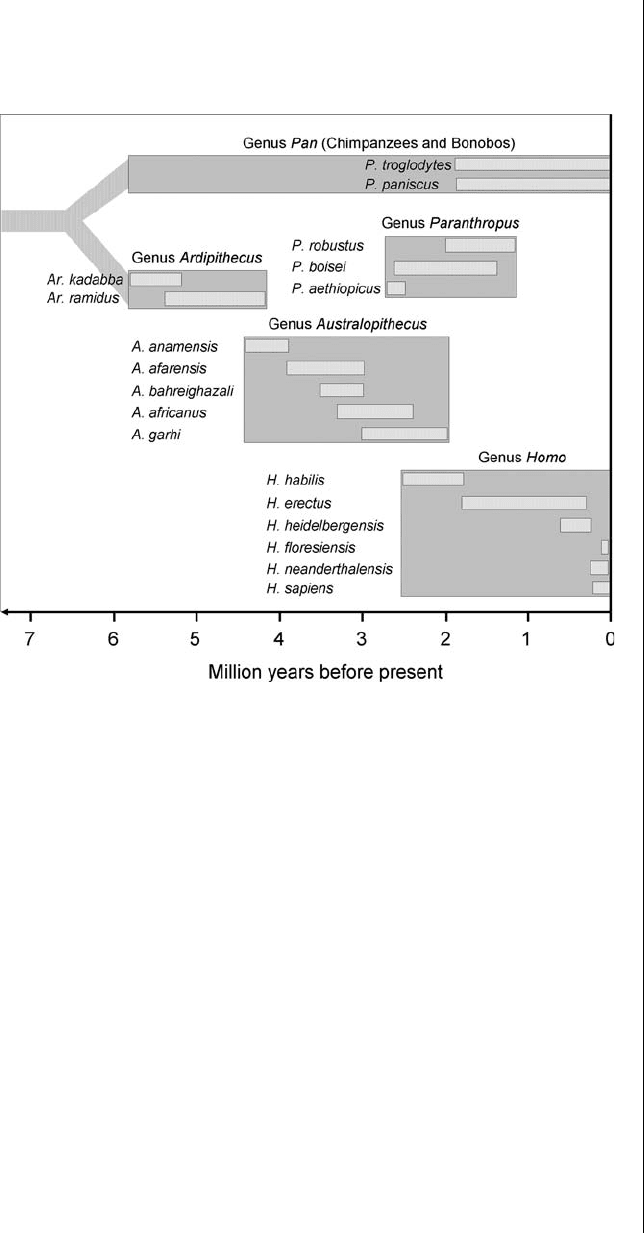
INTERLUDE II
At cubic centimeters (cc) in size, the brain of Homo floresiensis has
less volume than a half-liter bottle of soda and is roughly the same size as
that of chimps. Smaller organisms tend to have smaller brains, so an adjust-
ment should be made for Homo floresiensis’ small stature. When body size
is taken into account, the Flores skull is comparable to that of Homo erectus.
Most of the other characteristics of Homo floresiensis, including skull pro-
portions and teeth shape, also support placement of this unusual skeleton
within our own genus, Homo.
A common device used to capture the immense periods of time involved
in evolution is to consider the age of earth to be a single year, and then plot
events by such a calendar. Using that scale, the Cambrian explosion—the
Figure H.
The human “family tree.” Dotted bars represent the approximate dates of the
existence of species. Some disagreement exists among different authorities regarding
the names and dates of some of the species (particularly within the more ancient
species of the genus Homo). The evolutionary relationships among these fossil
species are not specified. Note that Homo neanderthalensis and Homo floresiensis
went extinct in the very recent past; if you look closely, you can see that their
representative bars do not continue on to the present.

time when numerous forms of multicellular life made their first recorded
appearance—occurred around Thanksgiving. The meteor that killed the
dinosaurs million years ago, marking the K/T boundary, occurred the
day after Christmas, which the British celebrate as Boxing Day. By this
scale, the branch of life (which biologists call a lineage) that led to us split
from the branch that led to chimpanzees sometime shortly after noon on
the last day of the year. The entire six million (give or take a million) year
history of human separation from chimpanzees and the other apes is thus
reduced to less than hours!
But this scale soon becomes too grand for our purposes. By this reckon-
ing, we poor (human) players don’t even get a full second to strut and fret
upon the stage. Let’s be a little less ambitious in our use of scale; what if we
were to collapse just those six million years since humans split from the
chimpanzees into a single year, with January as the date the lineages
separated and December as the present time? Here an -year lifespan
becomes seven minutes, about half of what Andy Warhol promised us.
We’ll return to this device, the “human calendar,” many times throughout
this section.
Bipedalism, the habitual walking on two legs, evolved soon after we split
from chimpanzees. Fossils that are over four million years old (early spring
on the “human calendar”), on or close to our lineage, bear convincing signs
of being bipedal. In fact, some biologists have speculated that the common
ancestor was bipedal, and chimps subsequently lost bipedalism.
4
The evidence
supporting this claim is far from solid, but it is an intriguing idea. Why did
our precursors become bipedal so early on? There is no shortage of opinion
regarding this question. Actually, we seem to suffer from an embarrassment
of hypotheses regarding the selective advantage of bipedalism. Some hypothe-
ses for the adaptive significance of bipedalism include the freeing of the
hands to carry food, minimizing exposure to the sun, increased height
associated with bipedalism, and the display of male genitalia coupled with
the concealment of female genitalia!
Regardless of why we evolved bipedalism, our brains were not much
bigger than those of chimpanzees when we started walking on two legs.
Over the six million years of separation from chimps, our brains quadru-
pled in size. If this rate had been constant, it would mean an increase of
only . every hundred thousand years. Obviously, our brains did not
increase at a constant rate; there were jumps and starts, stalls, and perhaps
even reversals. Nevertheless, when observed at a coarse scale, the rate of
change of our brains appears almost linear. At no particular period of time
in the history of the human lineage, can one say, “This is where our brains
became human.” Moreover, considerable variation exists within the brain
sizes of living humans; some have brains with volumes comparable to a
liter bottle of soda, while the brains of others are twice the size. Aside, from
gross pathologies, little (at best) correlation exists between brain size and
intelligence in modern humans (see chapter ).
DARWINIAN DETECTIVES

Even though our brain size continued to increase, our technology stalled
about a million years ago. Jared Diamond has described this stagnation:
“For most of the millions of years since our lineage diverged from that of
apes, we remained little more than glorified chimpanzees in how we made
our living.”
5
Diamond proposed that we took a “Great Leap Forward”
around fifty thousand years ago—a mere three days before the present on
our human calendar. This was a time when sophisticated cave paintings,
extensive use of wood tools, harpoons, bows and arrows, boats and trade
routes, and beads and pendants were all added to our culture. All of these
artifacts did not emerge at precisely the same time, nor did peoples of
different geographical regions acquire the same level of culture simulta -
neously. Still, a dramatic change occurred within a few thousand years
sometime around fifty thousand years ago.
We begin in chapter with a discussion of how evolutionary geneticists
traced our lineage by using a variety of genetic markers. We will focus on
the mitochondrial DNA, which is transmitted only through the female line,
and the Y chromosome, which is transmitted only through the male lines.
We will see that the most recent common ancestor of all existing variants of
this mitochondrial DNA—who must have been a woman—probably lived
many thousands of years before the most recent common ancestor of
Y chromosome types. Both of these individuals, and their progenitors,
probably lived in Africa.
Most paleontologists think that the Neanderthals were a side branch of
our tree; they view Neanderthals as our “aunts” and “uncles” rather than
our “fathers” and “mothers.” Much speculation has centered on whether the
Neanderthal disappearance roughly , years ago was due to competi-
tion from, or even warfare with, our ancestors. Another contentious issue is
whether Neanderthals passed along any DNA into our gene pool, and if
they did, how much? These questions are addressed in chapter .
The discussion then turns to our closest living relatives, the common
chimpanzee and the bonobo (previously known as the pygmy chimpan zees).
We encounter the evidence showing that humans and chimpanzees are each
other’s closest relatives in chapter . This sets the stage for chapter , an
account of recent studies that have detected positive selection upon the
genetic changes along our lineage. What can these studies tell us about what
has made us human?
We then return to comparatively recent history. Considerable debate
exists as to when language evolved along the human lineage. For instance,
Diamond has suggested that full-blown language may not have appeared
until “The Great Leap Forward” , years ago. If this is so, perhaps we
could trace back all languages to their common progenitor. The aims of
chapter are less ambitious. Here, we’ll discuss how genetic and linguistic
patterns do and do not correspond, focusing on peoples of Africa.
Although some species of ants will “farm” aphids in the production of a
sweet substance called honeydew, and there are other examples of
INTERLUDE II

nonhuman agriculture, no other organism has used other animals and
plants to the extent that we humans have. Moreover, in the process of using
these animals, we also modified them considerably. Darwin, himself a
pigeon fancier, made the analogy between the artificial selection we humans
have imposed upon animals and plants and the natural selection imposed
on organisms by natural forces. Evolutionary geneticists are increasingly
able to determine the origins of domesticated animals and plants and to
detect the signature of the artificial selection that we imposed on them
through domestication. In chapter , we will see examples of such studies,
focusing on the examples of dogs and maize.
Recommended Reading
There are several excellent general references on human evolution, which
have been published within the past years. A sample of these includes the
following:
Dawkins, R. . The Ancestor’s Tale: A Pilgrimage to the Dawn of
Evolution. Houghton Mifflin.
Diamond, J. . The Third Chimpanzee: The Evolution & Future of the
Human Animal. HarperCollins.
Diamond, J. . Guns, Germs, and Steel: The Fates of Human Societies.
W. W. Norton & Co.
Ehrlich, P. R. . Human Natures: Genes, Cultures, and the Human
Prospect. Penguin Books.
Marks, J. . What It Means to Be Chimpanzee. University of
California Press.
Miller, G. . The Mating Mind: How Sexual Choice Shaped the Evolution
of Human Nature. Doubleday.
Relethford, J. H. . Reflections of Our Past: How Human History is
Revealed in Our Genes. Westview Press.
DARWINIAN DETECTIVES

Finding Our Roots
Did “Eve” Know “Adam”?
When you start about family, about lineage and ancestry, you
are talking about every person on earth.
—Alex Haley (in Marmom, , p. )
Roots
Alex Haley traced back his ancestors to Africa, specifically Gambia, and to
Kunta Kinte, his great-great-great-great-grandfather, who lived in the latter
half of the eighteenth century. At age , Kinte was kidnapped, brought over
to America, and sold into slavery. The recounting of his genealogical tale
became the best-selling book Roots
1
in and, the following year, one of
the most-watched television miniseries ever. The book and the miniseries
(and its sequel) helped launch renewed interest in tracing family histories,
especially among African Americans. Traditionally, genealogies were recon-
structed by tracking census records, immigration records at places such as
Ellis Island, slave-ship holdings, and so forth. In recent years, the Internet,
both as a tool for communication and as a repository for data, has supple-
mented these traditional methods.
Yet people have always been interested in their family trees and history.
Across virtually every culture, stories about ancestors abound. This passion,
however, varies among cultures. In Iceland genealogy is practically a national
obsession; the typical Icelander can trace her or his ancestry back several
centuries further than the typical American. Kari Stefansson,
2
an Icelander
geneticist who claims the tenth-century warrior and poet Egill Skallagrimsson
as an ancestor, and his biotech company DeCode took advantage of such
extensive genealogical records. With these records and DNA samples from a
, Icelanders (more than a third of the entire population), Stefansson’s