
Johnson, Norman A. Darwinian detectives
Подождите немного. Документ загружается.


genes in Europe. For instance, Cavalli-Sforza and his colleagues found genetic
signatures of the spread of agriculture across Europe.
Cavalli-Sforza showed that many of the language families that Greenberg
had postulated—including those for the Native American languages—corre-
spond with genetic patterns. For instance, genetic data support Greenberg’s
claim of only three distinct migrations colonizing the Americas.
10
Greenberg, like Darwin, was interested in determining whether all
languages were derived from one common language, with the eventual goal
of reconstructing it. In support of such a common language of all, Greenberg
noted the existence of some apparent similarities across nearly all languages.
For instance, in nearly all languages, the root word “trik” is used for the
words “one,” “finger,” “point,” or “indicate.” The exceptions happen to be the
Khoisan and Niger-Kordofanian families.
Back to Click Languages
Joanna Mountain, a former graduate student of Cavalli-Sforza who returned
to Stanford as a member of the faculty, has continued the work of her mentor
of linking language and genetic evolution. With Alec Knight, a postdoctoral
fellow in her lab, Mountain has investigated the evolution of the click
languages in Africa. Mountain and Knight were particularly interested in the
extent to which different populations of click language speakers are geneti-
cally differentiated. The geographical distribution of Khoisan languages
suggested that some click speakers might be quite distinct from others.
Although the speakers of these languages are mainly concentrated in the
Kalahari Desert, some Khoisan speakers—the Hadzabe, for instance—live in
Tanzania, several hundred miles to the north and east. To explore this possi-
bility, Knight, Mountain and their colleagues sequenced mitochondrial DNA
and Y chromosome DNA from several groups in central and southern Africa,
including some click language speakers.
Knight, Mountain, and their colleagues found that the click speaking
!Kung and the Hadzabe are genetically as distant or more than any other pair
of African populations.
11
This finding was based on both mtDNA and Y
chromosome data, and thus both the all-paternal and the all-maternal line-
ages support an ancient split between these two groups. The upper bound of
the split between the Hadzabe and the !Kung is , years (plus or minus
,), but this estimate is based on problematic assumptions. Regardless
of the exact date, we can say with confidence that the separation is tens of
thousands of years old.
So how can we explain the existence of clicks in languages spoken by
populations that split so long ago? It seems very unlikely that clicks were
invented independently in the languages spoken by various peoples in the
Kalahari and by the Hadzabe in Tanzania. First, clicks are very rare in general,
and thus we would not expect their invention to be a frequent occurrence.
DARWINIAN DETECTIVES

Another argument against both groups acquiring their assemblages of clicks
independently is that repertoires are rather complex, and complex inventions
are also not likely to be frequent events. Moreover, click repertoires of these
geographically distinct groups overlap considerably.
Several other hypotheses remain that explain the similarity of clicks in
these languages spoken by people with substantial genetic differentiation.
Suppose that the Hadzabe population had actually diverged only fairly
recently from the other Khosian-speakers, such that their languages were
fairly similar and retained the clicks. Further suppose that after the split, the
genes of the Hadzabe had been replaced by those of another population, but
that the Hadzabe language remained mostly intact. Such a process of gene
replacement without language replacement is possible and would account for
the discrepancy between the linguistic and the genetic patterns that Knight
and Mountain found. The problem with this scenario is that it is not very
parsimonious (chapter ); it rests upon several assumptions.
Another possibility is that the Hadzabe acquired clicks from another
Khoisan-speaking population. Such linguistic borrowing isn’t that far fetched;
recall that the Bantu language Xhosa acquired clicks from one of the Khoisan
languages.
The most intriguing possibility is that the Hadzabe and the !Kung really
did diverge tens of thousands years ago, and that the clicks have remained all
this time. This scenario raises the question: why have clicks been maintained
in a small group of languages for so many thousands of years?
It’s possible that clicks are neutral characters, neither advantageous nor
harmful. We have seen that genetic drift can cause neutral variants of genes
to be lost in some populations but become fixed in others. A similar process
could have occurred with respect to language; clicks have been fixed in
the Khoisan languages, but lost in virtually all other languages simply due to
random processes.
More intriguing is the notion that clicks are adaptive in certain circum-
stances. When stalking prey, the !Kung speak almost exclusively in whispered
clicks. Thus these clicks may have had adaptive value in hunting societies,
and the selective pressure would have maintained them in the lexicon. In
contrast, pastoral societies would have little use for the clicks, and over time,
they would erode.
Recommended Reading
Here are several excellent recent books that provide general background on
language evolution. The books by Cavalli-Sforza also discuss the relation-
ship between genetic and linguistic evolution. Pennock’s book, though
mainly about the rise of Intelligent Design creationism, discusses language
evolution in detail. Pennock draws several analogies between the two types
of evolution.
Clicks, Genes, and Languages

Cavalli-Sforza, L. L. . Genes, Peoples, and Languages. University of
California Press.
Cavalli-Sforza, L. L., and F. Cavalli-Sforza. . Great Human Diasporas:
The History of Diversity and Evolution. Helix Books.
McWhorter, J. . The Power of Babel: A Natural History of Language.
W. H. Freeman.
Pennock, R. T. . Tower of Babel: The Evidence Against the New
Creationism. The MIT Press.
DARWINIAN DETECTIVES

Who Let the Dogs in?
The Domestication of Animals and Plants
The first and chief point of interest in this chapter is, whether
the numerous domesticated varieties of the dog descended
from a single wild species, or from several.
—Charles Darwin (Darwin, [], p. .)
The History of Domestication
Until about , years ago, nearly all of human groups were nomadic
hunter-gatherers. Environmental changes, including the retreat of glaciers
and the diminishing supply of large mammals, led to some human groups
becoming more sedentary. The persistence of human populations was a
necessary but not sufficient step in the development of agriculture. But even
prior to the practice of full-scale agriculture, people were beginning to
domesticate animals and plants.
Agriculture first developed in the Fertile Crescent, a region that extends
from the Sinai Peninsula past the Tigris-Euphrates River valley in present-day
Iraq. Archaeological evidence from the Abu Hureyra site in Syria establishes
that the earliest farmers probably started cultivating wheat and rye after a
severe drought approximately , years ago. Although agriculture did
spread within and out of the Fertile Crescent, it also was later independently
established in several other places across the globe.
The reasons behind why humans adopted agriculture are fascinating in
their own right, but they are not the primary focus of this chapter. Instead we
explore questions related to what DNA markers and the application of pop-
ulation genetics principles can tell us about the animals and plants that were
domesticated. When were particular animals and plants domesticated? What
were the wild progenitors of the domesticated species, and how many origins
were involved? Did the domesticated species undergo a genetic bottleneck

during the process of domestication? What were the effective population
sizes? Is each domesticated species one big randomly-mating population, or
is there genetic structure in those species? These are the types of questions
that can be addressed by Darwinian detectives applying molecular genetic
markers and evolutionary theory.
Discussion of these questions for all or even just the most important
domesticated species could well fill several books. Thus, this chapter will
focus on a few aspects about the domestication of dogs and corn.
Just What Is a Dog?
Darwin, as shown in the quotation that opens this chapter, was not sure from
how many species dogs had originated. Perhaps overly pessimistic, Darwin
also stated, “We shall probably never be able to ascertain their origin with
certainty.”
1
The great diversity in size, shape, color, temperament, and other
characteristics among dog breeds led Darwin, and many others since, to sus-
pect that dogs had multiple origins. Could Newfoundlands and Chihuahuas,
Pit Bulls and Cocker Spaniels, Whippets and Australian Shepherds, and all of
the other breeds really come from a single species? Moreover, the fact that
dogs can produce hybrids with a number of species—wolves, coyotes, and
jackals—also suggests that dogs had multiple origins.
As we shall see, molecular studies strongly support a single species—the
wolf—as the progenitor of the domestic dog, but they also suggest that dogs
came from multiple populations of wolves that were widely separated in space
(and probably time).
Before we consider in detail what the molecular data tells us about dog
domestication, let’s discuss two alternative views pertaining to how dogs were
domesticated. The traditional view is that dogs are domesticated wolves;
humans tamed wild wolves, then subjected these tamed wolves to artificial
selection and in the process created the Poodle, the Collie, and all other
breeds we know and love.
Ray Coppinger, who in addition to being a biologist at Hampshire College
is also dog sled trainer, put forth a most intriguing alternative hypothesis
about the evolution of dogs.
2
In contrast to the view that humans domesti-
cated dogs, Coppinger argues that dogs domesticated themselves.
Coppinger’s hypothesis begins on well-established grounds that starting
around , years ago humans began living in permanent or semiperma-
nent villages in greater numbers. He argues that such settlements created a
new niche—the garbage dump! At these dumps, wolves would hang around
and scavenge for food. Wolves tend to be nervous and skittish—qualities that
would not benefit them as garbage-seekers. Those wolves, however, that were
somewhat less skittish than others would be favored in the garbage dump;
and to the extent that this trait had a genetic component, natural selection
would favor less skittish wolves. As they became more tolerant of and less
DARWINIAN DETECTIVES
nervous around humans, these wolves—now proto-dogs—were spending
more time with humans. In the course of time and further natural selection,
the resulting animals became like the village dogs that still haunt dumps
across the world. These dogs were then in a position to be subject to artificial
selection. Most of the variation in breeds that we see is obviously the result
of artificial selection that we have imposed, but the bulk of this artificial selec-
tion occurred recently; the initial domestication did not involve artificial
selection.
Definitive proof of Coppinger’s hypothesis has not been found, nor has the
traditional explanation been refuted. Nonetheless, a couple lines of evidence
seem more compatible with the Coppinger’s hypothesis than with the tra -
ditional explanation.
Coppinger presents as evidence for his view the dogs in Pemba, an isolated
island off the East Coast of Africa. The Pemba people dwell figuratively at the
Who Let the Dogs in?
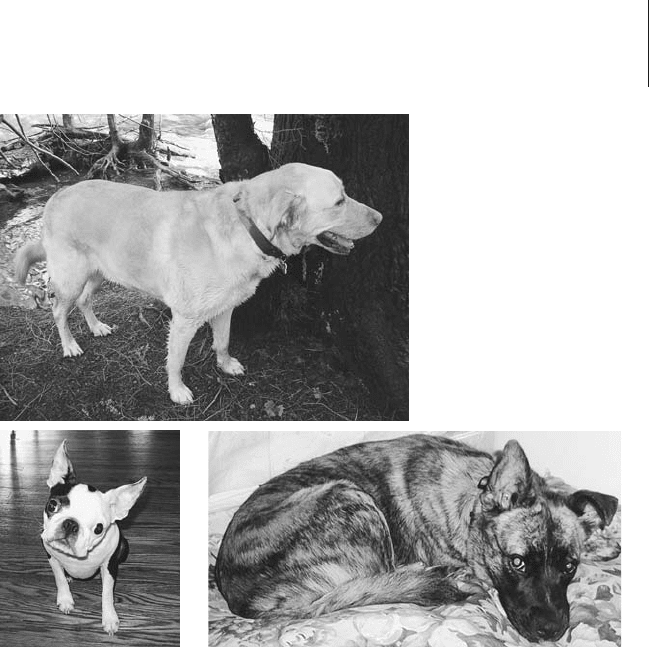
Figure .
Examples of modern domesticated dogs. Top: A Labrador retriever (yellow), named
Cousteau. Courtesy of Sharlene Santana. Bottom left: A Boston terrier, named
Jenkins. Courtesy of Kate Wells and Chad Hoefler. Bottom right: Lucy, described by
her owner (Kara Belinsky), as “a complete mutt—mostly pit bull, and Australian
cattle dog with some chow chow and German shepherd.” Courtesy of Kara Belinsky.
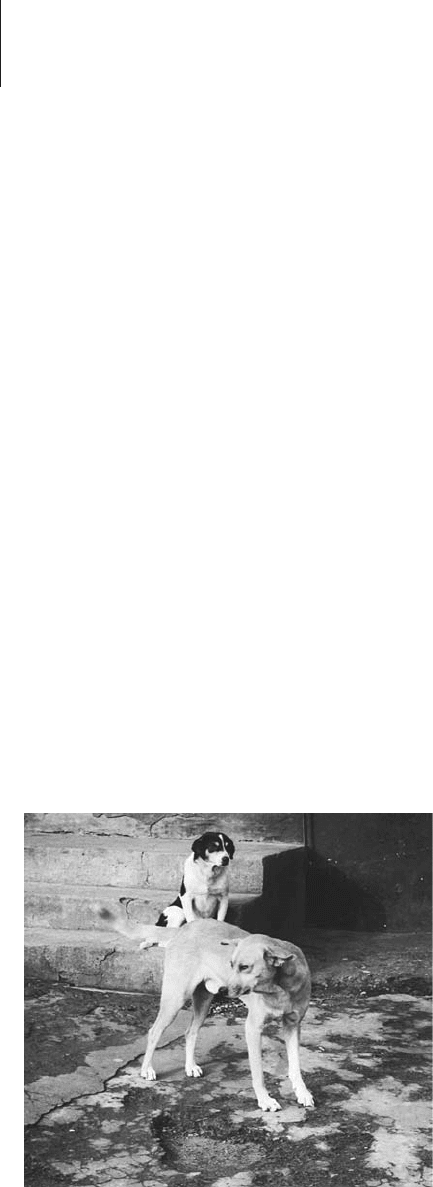
edge of the Agricultural Revolution; although they subsist mainly as hunters
and gathers, they also fish and raise cattle and chickens, as well as various
vegetables. These people don’t keep dogs as pets; in fact, they have a dislike
of dogs based on religious taboos. Yet dogs run through Pemba villages, eat-
ing scraps, much as pigeons do in American parks.
Coppinger describes these dogs:
They all looked just about the same—thirty or so pounds, slender, with
short, smooth variegated colors, some with large spots, some with mark-
ings on their heads, ears, legs, or tails. Their ears are pendant, or erect
but bent over slightly at the tips.
3
It is dogs like these found in Pemba that Coppinger sees as the “missing
link” between wolves and dogs. Such village dogs, Coppinger points out, can
be found in “undeveloped” areas all over the world.
Though suggestive, the Pemba dogs do not prove Coppinger’s hypothesis.
We should keep in mind a couple caveats. First, the fact that Pembans don’t
keep dogs now doesn’t mean they didn’t in the past. Moreover, many peoples
don’t keep pets as we in the west do—and a dislike of dogs is hardly unique
to Pemba.
Coppinger also points to a demonstration experiment examining correlated
responses in morphology that arose in response to selection for behaviors
associated with domestication in foxes that mirror the differences between
dogs and wolves. Darwin, who knew nothing of genes but understood the
essence of heredity, knew that characters do not exist in a vacuum and that
selection on one character can often affect multiple characters. He called this
the “law of correlation.” Modern evolutionary quantitative geneticists, who
DARWINIAN DETECTIVES
Figure .
Village dog from
Senegal. Such village
dogs can be found all
over underdeveloped
regions of the world.
Courtesy of Ray
Coppinger.

speak of genetic and phenotypic correlations, have built theoretical frame-
works to describe and predict such correlated responses.
This experiment came from an unlikely source: a Siberian scientist named
Dimitry Belyaev, during the tail end of Lysenkoism. Recall that under
Lysenko, Mendelian genetics had been essentially outlawed and a generation
of Soviet geneticists had been purged in favor of political orthodoxy. Belyaev,
at the Institute of Cytology and Genetics in Novosibirsk, would initiate an
experiment (under the subterfuge of studying fox physiology) selecting for
tame behaviors in foxes, a species that had never been completely domesticated.
This experiment, which has continued many years since Belyaev’s death, would
eventually demonstrate dramatic morphological changes arising as correlated
responses to selection for tameness.
4
Belyaev and his associates collected foxes ( vixens and males) from
a commercial farm in Estonia and performed a selection experiment on them.
Although these foxes were somewhat tamer than the typical wild fox, they
were certainly not tame. Only one criterion was used in the selection process:
how tame the foxes were. The researchers assessed tameness by subjecting
pups to a battery of tests to see how they responded to humans and to other
pups. No other factors were considered in choosing which foxes would con-
tribute to the next generation and which would not. Selection was very
intense—usually only the most tame of male offspring and of female
offspring would be selected in any generation.
Of special interest is the most-tame category (Class IE), described as “the
domesticated elite.” Foxes in this category “are eager to establish human
contact”; they engage in “whimpering to attract attention ..., sniffing and
licking experimenters like dogs.”
5
None of the initial population, nor any of
the foxes from the first five generations of selection, fit into this category.
Even after generations of selection, only of fox pups were classified as
domesticated elite.” By the late s (after between and generations),
however, to of the foxes were considered elite. This is yet another
example of the power of selection to transform populations in a relatively
short period of time.
The “domesticated” foxes in Belyaev’s experiment changed in numerous
ways. In addition to reaching sexual maturity about a month earlier than
wild foxes, the “domesticated” foxes also produce litters that exceed those
of wild foxes by one pup on average. Sexual dimorphism is reduced in the
foxes, and the males seem to have been “feminized”; that is they look more
like wild vixens. In both sexes, the heads are smaller, both in width and
height, and they tend to have shorter and wider snouts. The changes in the
head size as well as the feminization are consistent with changes that occurred
in other species that have been domesticated, including dogs.
One of the most striking changes in the “domesticated” foxes is the
presence of a piebald coat, in which regions of the coat lack pigmentation,
resulting in pure white fur and pink skin underneath. Piebald coat color is
often found in domesticated animals, including dogs, horses, pigs, and cows.
Who Let the Dogs in?

Floppy ears and shorter tails—as found in dogs—also appeared in some of the
“domesticated” foxes.
So what can molecular data tell us about the when, where, and how of dog
domestication? In addition, do these data support or contradict Coppinger’s
hypothesis?
Did Dogs Arise , Years Ago?
An early mitochondrial DNA study of dog origins shocked the scientific
community because it proposed that dogs as a separate lineage were far older
than anyone had previously thought. Robert Wayne’s group at UCLA analyzed
mitochondrial DNA data, and concluded that dogs could have originated as
much as , years ago—a date ten times as old as the archeological
evidence had suggested.
6
How did Wayne’s group arrive at that date, and
what else did their study find?
Wayne’s group had obtained sequence from a rapidly evolving region of
the mitochondrial DNA from a total of dogs from breeds, as well as
wolves from different populations found in Europe, Asia, and North
America. They found that dogs and wolves had strikingly similar levels of
genetic diversity, both in terms of numbers of different haplotypes and the
average distance between any pairs of haplotypes.
The data from Wayne’s group showed that wolves are unambiguously the
ancestors—and the only ancestors—of dogs. This inference was reached from
data showing that the DNA sequence of dogs is far closer to that of wolves
than it is to the sequence from any other wild animal. Any given dog was
separated from any given wolf by a maximum of , and often many fewer,
nucleotide changes. In contrast, dogs and coyotes were separated by more
than changes in the sequence; the same is true with dogs and jackals.
Wayne’s group was unable to assign these mitochondrial DNA haplotypes
to breeds; many breeds shared haplotypes, and several haplotypes were main-
tained within a few single breeds, including German Shepherds and Golden
Retrievers. Haplotypes, however, did cluster into four distinct clades. The
largest cluster (Clade ), comprising of the haplotypes, included many
common breeds as well as a few ancient breeds, such as the Basenji and the
Greyhound.
Wayne’s group obtained the estimate of the age of dogs by observing that
the furthest distance between dogs within Clade was . times the diver-
gence of wolves and coyotes. Assuming that wolves and coyotes diverged one
million years ago and applying the molecular clock, this yields , years.
This estimate is an upper limit, and it rests on a number of assumptions.
First, it assumes that the dogs in Clade came from a single ancestral popu-
lation that had little or no variation, and that all the existing variation within
Clade arose from new mutations and not from variation preexisting in the
founding population. If the dogs in Clade had actually come from several
DARWINIAN DETECTIVES

populations of wolves, this would make dogs appear older than they really
are. Variation within the founding population would have a similar effect.
Wayne’s estimate also assumes constancy in the rate of evolution among
the different nucleotide sites. If substantial heterogeneity of evolutionary rates
exists among the sites, then the clock assumption would be violated—the age
of dogs would be younger than the estimate.
A third concern about this estimate is that it is based on a single gene that
has the unique characteristic of being transmitted only through maternal
lines. Remember that different genes can have different histories, and the
genealogy determined by a single gene may not reflect the true history of
the lineage. We’ll soon see that autosomal genes give a different picture of the
genealogy of dogs than does the mitochondrial DNA.
The results of a follow-up study do point to a much lower age for the
divergence of wolf and dog, as well as point to southeast Asia as the most
likely site for dogs’ first origin. This study was led by Peter Savolainen, whose
original interest in dog genetics arose as a way to assist crime-scene investi-
gators in their analysis of hairs. His group found that four major groups of
dog haplotypes and one isolated dog haplotype are interspersed with the wolf
haplotypes.
7
These data allow us to infer that dogs are derived from at least
five female wolf lines.
In each of the major clades, more haplotypes are found in East Asia than
from any of the other regions. This is consistent with a hypothesized East
Asian origin of dogs, because we expect more diversity to accumulate in the
geographical region where dogs have been around the longest. By that same
logic, we would expect the cluster with the most diversity to be the oldest. If
we were to assume just a single origin of this cluster (Clade A), then its most
likely age is , years. The problem is that the genealogical structure of
this cluster suggests that it probably had multiple origins. Had it but one
origin, it would have had a genealogical structure that resembles a starfish,
with unique and rare haplotypes branching off from one center haplotype
that is most frequent. In actuality, Clade A lacks a well-defined center
haplotype. With the assumption of multiple origins, Clade A probably
originated about , years ago. This latter date is in accordance with the
archaeological data.
Beyond Mitochondrial DNA
A team at Seattle’s Fred Hutchinson Cancer Research Center headed by
Elaine Ostrander has been examining the genetic structure of dog breeds, in
part as a means to find DNA variations in dogs that are associated with
diseases. This group has been particularly interested in malignant histiocytosis,
a form of cancer of white blood cells. Although generally very rare in dogs, this
cancer is much more common in Bernese Mountain Dogs and Flat Coated
Retrievers than in other breeds.
Who Let the Dogs in?