
Johnson, Norman A. Darwinian detectives
Подождите немного. Документ загружается.


Heidi Parker, then Ostrander’s graduate student, initiated a study using
microsatellite DNA markers to investigate genetic variation in dogs.
8
Microsatellites, which are very short repetitive sequences of DNA, have often
been used to examine genetic variation of a variety of organisms. One major
advantage of microsatellites is that they quickly provide information from
many different regions of the genome.
Parker, Ostrander, and their colleagues surveyed purebred dogs
representing breeds at microsatellites. They found that purebreds, if
treated as a single population, have an overall genetic diversity that is com-
parable to that of humans. Unlike humans, however, dogs are highly struc-
tured genetically. That is, the vast majority of the variation in humans is
among individuals within populations; in contrast, of the genetic varia-
tion in dogs based on the microsatellite data is among-breed differences, far
higher than so-called “racial” differences among humans.
Remarkably, enough structure is present among purebred breeds such that
a computer program, into which just the DNA profile was fed, could assign
dogs to breeds with remarkable accuracy. Only of the dogs were incor-
rectly assigned to breeds based on their microsatellite profile.
A phylogenetic tree of the microsatellite data indicates that the deepest
split included four African spitz-type breeds: the Shar-Pei, the Shiba Inu, the
Akita, and the Chow Chow. The inference to be drawn from this tree is that
these breeds are the oldest of existing breeds. This result suggests that dogs
originated in Africa, in contrast to the results from the mitochondrial DNA
study. Because the microsatellites reflect the genome as a whole, and not just
a single gene, the inferences drawn from the microsatellites are likely to be
better supported than those based on the data from the mitochondrial DNA.
Thus, dogs probably had an African origin.
The Dog Genome
According to the Chinese calendar, the most-recent year of the dog began in
late January . The previous month, the complete sequence of the dog
genome was published in Nature.
9
Chosen for the project was Tasha, a female
Boxer. Samples of the genome from a variety of other dog breeds were also
sequenced to obtain information about patterns of genetic variation and
linkage disequilibrium (LD), the correlations of genetic variants, in dogs.
At . billion nucleotides, the overall genome size of dogs is somewhat
lower than that of humans and just slightly smaller than the mouse genome.
The differences in genome size are probably due to loss of genetic material in
the dog lineage. Along the dog lineage, genes have evolved slightly faster than
in the human lineage, but much slower than the rate in the mouse lineage.
One likely reason for these differences is the longer generation times—human
generations are longer than those of dogs, which in turn are far longer than
those of mice. Another possible explanation is that mice have faster metabolic
DARWINIAN DETECTIVES

rates than do dogs, which have faster metabolisms than do humans. Still
another possibility is that parts of their genome were lost as dogs were
domesticated.
Inferences about the evolutionary history of dogs can be obtained from
examinations of the correlations of genetic variants—linkage disequilibrium
(LD)—seen in dogs. LD is a measure of the extent to which knowledge of
which genetic variant a particular dog has at a particular location provides
predictive power about what genetic variants that dog will have at a different
site in the genome. Recall that in humans, LD values for sites that are within
a few thousand nucleotides are quite high, meaning that knowing what
variant an individual has at one site is a good predictor of what variants that
individual will have at other nearby locations. Beyond a few tens of thousands
of nucleotides, LD usually rapidly declines in humans when the correlations
among more distantly located genetic variants approach zero. The extent to
how far apart on the chromosome LD persists is influenced by the extent of
the effective population size of the species. LD should remain high longer in
species with high effective population sizes than in ones that have had their
effective population sizes reduced by genetic bottlenecks.
When dogs of all breeds are examined as a whole, the patterns of their LD
are similar to those of humans. In fact, the LD of dogs drops off somewhat
faster with genetic distance than does the LD of humans. This suggests that
as a species as a whole, humans have experienced more intense genetic
bottlenecking than have dogs. When individual breeds are examined, however,
a different pattern emerges: LD drops sharply for the first , nucleotides
or so, but then remains high for several million nucleotides.
The patterns of LD support the scenario of two major bottlenecks in the
genetic history of most dogs, one upon the domestication of dogs and a sub-
sequent one upon the strong selection that occurred during the creation of
most breeds. The short-range LD is the signature of the early bottleneck, and
the longer-range LD reflects the bottlenecks associated with the creation of
the specific breeds. Different breeds show different extents of long-range LD,
with, for instance, Akitas and Rottweilers having high long-range LD and
Irish Wolfhounds having lower long-range LD. These differences probably
reflect differences in the extent of the bottleneck in the creation of the breeds.
Labrador retrievers, which have far less long-range LD than the other breeds
of dogs, have maintained a large population size and are probably the result
of considerable mixing.
A decade of molecular evolutionary research on dogs and their relatives
has already provided us with a rich understanding of their origin and evolu-
tion. The molecular data are consistent with the picture of wolves evolving
around the time humans started living in semipermanent villages and in
several different localities. The signatures of this bottleneck and the bottle-
necks associated with the formation of separate breeds can be found in the
patterns of DNA sequences. Further studies and advances will almost
certainly reveal much about “man’s best friend” over the next few years.
Who Let the Dogs in?
Dogs are far from the only domesticated species for which molecular
evolutionary studies provide information about the natural history of their
wild progenitors and the unnatural history they have had under domestica-
tion. We turn next to maize, a plant that has changed from its wild ancestor
almost as dramatically as breeds of dogs differ from wolves and one another.
How Was Corn Domesticated?
Maize (Zea mays, colloquially referred to as corn; I will use the terms maize
and corn interchangeably) is perhaps the most striking case of genetic
modification associated with domestication. Although one can clearly see the
resemblance of dogs to wolves, and other domesticated animals and plants as
being related to their wild progenitors, it is much harder to discern that corn
came from teosinte, a wild grass native to the Americas.
The question of maize’s origins has interested biologists for many decades.
Nikolai Vavilov, the Russian geneticist, who died in prison in after being
repressed by Lysenko, was among the first to propose a hypothesis for maize
origins. He argued that maize probably arose near Guadalajara, Mexico
because, in this species, more variation is located in that region than elsewhere
in the world.
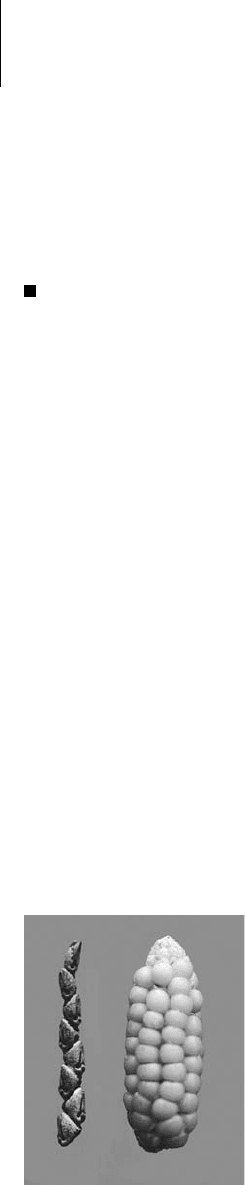
Perhaps the most striking difference between corn and its wild relatives is
in the floral architecture. Each individual plant of corn has but a single stalk
and ear, but wild teosinte plants have multiple stalks and ears. The change
was probably to concentrate effort into one single product.
Other important changes between teosinte and corn are also evident. For
instance, think of the part of corn from corn on the cob that sticks to your
teeth. This part, which surrounds the kernel, is called the glume. Teosinte
produces a much larger and much harder glume than does domesticated
corn. The glume is an adaptation in teosinte; it evolved to protect seeds when
they passed through the digestive tracts of mammals. Such a hard glume,
DARWINIAN DETECTIVES
Figure .
Domesticated maize and teosinte. Courtesy of
John Doebeley.

however, is not advantageous in a seed crop because it makes it difficult for
humans to chew and digest the kernel. Thus, in the process of domestication,
artificial selection was imposed to reduce the glume.
Maize comes from teosinte, but what is teosinte? In fact, teosinte is not a
single entity, but rather several species of these grasses, which are all in the
genus Zea. Included in the teosintes are two widespread annuals; in addition
to Zea mays, which will we come back to in a minute, there is also Zea
luxurians, found in Central America. Two other teosintes are perennial
species isolated to what is now Jalisco, Mexico: Zea diploperennis and Zea
perennis. The latter species is interesting in that its cells contain four sets of
chromosomes, instead of just the typical two.
Complicating the situation further, four recognized subspecies exist within
the species Zea mays. In addition to domesticated maize (Zea mays mays),
two Mexican subspecies are known: Zea mays mexicana, which lives at higher
elevations and has large spikeletes (the small flowers that make up the male
inflorescence), and Zea mays parviglumis, which lives at lower elevations and
has small spikeletes.
Domesticated maize also varies considerably in morphology, as well as in
its number and form of chromosomes. This variation has led many to
speculate that corn may have had multiple origins. But as we shall see, DNA
evidence rules out the hypothesis of multiple origins for maize.
John Doebley at the University of Wisconsin has been applying molecular
markers and the principles of population genetics to studies of maize and its
wild relatives.
10
To address the question of the origin of maize, Doebley and
his colleagues collected maize plants from all over its pre-Columbus
range (southeastern Canada to Chile). They also collected a total of plants
from both mexicana and parviglumis, plus smaller numbers of the other
teosinte plants to be used as outgroups. Their next step was to ascertain the
genotypes for all of these plants at a total of microsatellite loci more or less
randomly placed across the genome.
The results from this study strongly support corn’s being derived from
parviglumis and parviglumis alone. This conclusion rests upon the fact that all
haplotypes from domesticated maize plants cluster together within the
parviglumis clade. Not only does this result support a parviglumis origin
for corn, but it also suggests that the domestication originated in a single
population of parviglumis.
The phylogeny also provides clues to the probable first place where maize
was domesticated. The earliest lineages of domesticated maize are from the
Mexican highlands, so it appears that first domestication occurred there. This
technology then spread to the lower elevations, and then throughout the
eastern part of the Americas.
You may have noticed a possible inconsistency; although maize was
probably first domesticated in the Mexican highlands, parviglumis (its most
likely ancestor) is a lowland species. How can this be? One possible explanation
is that parviglumis once had a larger range, which became restricted with time.
Who Let the Dogs in?

It is also possible that the first people to domesticate maize actually moved
parviglumis to the highlands when they domesticated it.
Doebley’s group was also able to estimate the date of the domestication.
Some of these microsatellite markers with known mutation rates evolve in a
fashion that makes them suitable to be used for dating. Analysis of the data
from these markers reveals that the divergence between Mexican maize and
teosinte probably occurred , years ago, but could have been as recently
as , years ago or as long ago as , years. Although the oldest known
fossil maize dates to , years ago, some archaeological evidence points to
maize domestication beginning considerably earlier.
This study and a subsequent one also provided evidence of a current or
very recent gene flow among mexicana, parviglumis, and maize. This gene
flow, although detectable by using population structure analyses, is at a low
level. Of particular interest, genes from mexicana are getting into the maize
of the Mexican highlands.
Morphology, Genes, and Domestication
Starting in the s, biologists interested in the evolution of morphology
made substantial progress in determining the actual genes involved in the
morphological change, as well as their evolutionary trajectories. For these
biologists, domesticated species offer advantages because within them a con-
siderable amount of change has occurred in a relatively short time. The list of
specific genes that influence morphology in a number of different domesti-
cated species, including maize, continues to grow.
Teosinte Branched (Tb) is a gene that affects the morphology of maize.
Mutations that knock out its function cause maize to look more like teosinte.
In particular, these mutant plants have longer lateral branches with tassels
at the ends, instead of the typical short branches that end in ears. At the
biochemical level, the Tb protein acts to repress growth of the organs
wherein it is expressed. Plants that carry the maize variant of Tb express it
heavily in the precursors to the lateral branches, thus stunting their growth.
In contrast, plants with the teosinte variant express less of the Tb gene in
their branches, allowing them to grow longer.
John Doebley’s group found several lines of evidence for a selective sweep
occurring in the regulatory region of the Tb gene, one of which is the pattern
of genetic variation observed.
11
In this region, little genetic polymorphism
exists within maize plants, but teosinte plants display much higher levels of
variation, suggesting a selective sweep in maize. Moreover, the part of the
gene that codes for the protein shows normal levels of variation in both maize
and teosinte, thus suggesting that the selection involved concerned not the
structure of the protein but the regulation of its expression. The data collected
by Doebley’s group also enabled them to estimate that the selection at the Tb
DARWINIAN DETECTIVES

gene’s regulatory region took place during a period that lasted between
and , years.
Agriculture’s Effect on Human Social Structure
The introduction of agriculture was not an unmixed blessing. For instance,
Jared Diamond and others have argued that one consequence of agriculture has
been the proliferation of disease epidemics that had been virtually unknown in
hunter-gatherer societies. The advent of agriculture has also probably affected
human social structure. Can we see the impact of the shift to agriculture in
patterns of human genetic variation? Apparently so. An Italian group led by
Giovanni Destro-Bisol finds genetic evidence that hunter- gatherer and agricul-
tural societies in Africa exhibit different sex-linked patterns of migration.
12
Destro-Bisol’s group examined Y-linked and mitochondrial DNA markers
in both African hunter-gatherer populations such as the !Kung, whom we
discussed in the previous chapter, and in agricultural populations in sub-Sahara
Africa. Among the !Kung and the other hunter-gatherer societies, far less
geographic clustering of variation is observed in the Y-linked markers than is
observed from the mitochondrial DNA markers. The extent of geographic
clustering is negatively correlated with the expected migration rates. The infer-
ence to be drawn from this result is that the estimated migration rate of males
(as determined by the patterns seen in the Y chromosome) was much greater
than the estimated migration rate of females (determined by patterns seen in
the mitochondrial DNA). In fact, males migrated an estimated nine times
more than females in these groups. The farmer societies, by contrast, exhibited
slightly more geographic clustering in the Y-linked markers than the mito-
chondrial DNA markers; the estimated female migration rate was . times
greater than that of the males. Thus, there is a -fold difference in the ratios
of male to female migration rates between hunter-gatherer and agricultural
societies. It appears that at least in African populations, the advent of agricul-
ture altered the patterns of migration from male-biased to female-biased. One
plausible explanation for this change is that the inheritance of territory from
father to son reduced male migration in the agricultural societies.
Recommended Reading
General information about domestication can be found below.
Diamond, J. . Guns, Germs, and Steel. W. W. Norton.
Diamond, J. . Evolution, consequences and future of plant and animal
domestication. Nature : –.
Smith, B. D. . The Emergence of Agriculture (paperback edition).
Scientific American Library.
Who Let the Dogs in?
This page intentionally left blank

Size Matters
Toward Understanding the Natural
History of Genomes
Although full-genome sequencing has revealed numerous
patterns of variation in genomic architecture among major
taxonomic groups, a formidable, remaining challenge is to
transform the descriptive field of comparative genomics into a
more mechanistic theory of evolutionary genomics.
—Michael Lynch (Lynch, , p. )
Deciphering how genomes come to acquire their
characteristics, and how these in turn affect the evolution of
features at higher levels of organization, will demand a
broadly integrative approach that synergies insights from
various disciplines.
—T. Ryan Gregory (Gregory, , p. )
Variation in Genomes—A Survey
Throughout the course of this book, we have focused on genes and their
natural histories. We have explored what can be inferred from patterns of
variation in DNA sequences about the evolutionary forces that have acted on
those genes and the organisms that harbor them. Here, in the final chapter,
we turn our attention away from particular nucleotide sequences of genes to
the properties and natural histories of genomes as whole entities.
Perhaps the most puzzling feature of genomes is the sheer variation in
their size across the different lineages of life. The largest known genome is
more than , times larger than the smallest known genome of any free-
living organism. Some general trends do emerge: bacteria, which lack true
membrane-bound nuclei and hence are considered prokaryotes, generally
possess small, streamlined genomes. By contrast, organisms with true nuclei
enclosed by membranes—the eukaryotes—have larger cells and larger
genomes. Genomes of multicellular eukaryotes tend to be larger than those of
single-celled eukaryotes. Although there are many exceptions, genomes are
larger in vertebrates than in insects and other invertebrate animals. But, as we
shall see, the relationship between genome size and complexity of an organism
is at best weak and muddy.
Let’s start with our own genome. The human genome contains just over
billion nucleotides. This figure is actually the size of the genome found

in the gametes (sperm and eggs), and is known as the haploid number. In
contrast, the cells in the rest of the body contain twice as much genetic
material—one haploid set from both the mother and father; this is the diploid
number. Except when mentioned otherwise, the genome sizes discussed here
will be of the haploid number. To put this and other large numbers in per-
spective, let’s consider genomes as genetic libraries filled with books that each
consist of one million nucleotides. For the sake of comparison, the book you
are reading has about , characters. By this analogy, the human genome
would contain slightly over , books filled with a million characters
each—comparable to a very large, but not outrageously so, personal library.
A person reading a book a week from age to age would read the equiva-
lent of the human genome.
Not much variation exists within mammals for genome size, at least
not the same extent that we will see in some other groups; for instance, the
mouse and rat genomes both are about the size of that of humans. Nor
is the range of genome sizes in birds large, at least not when it is compared
with the extraordinary variation seen in the genomes of fish, or especially
amphibians.
The smooth pufferfish (Fugu rubripes) is a popular Japanese delicacy, but
if prepared incorrectly it can cause lethal poisoning because its liver and
ovaries contain the neurotoxin tetrodotoxin. The genome of this pufferfish is
also remarkable. At million nucleotides—that is, only books—Fugu
rubripes and its closest relatives have the smallest vertebrate genome. The
prolific science fiction and science writer Isaac Asimov published more than
books in his lifetime.
1
Granted that most of the books Asimov wrote each
contained fewer than a million characters, but if one includes all of the short
stories and other material Asimov also published, his collective works would
almost certainly include more characters than the pufferfish genome. We’ll
discuss in more detail the extremely small size of the pufferfish genome, but
there is no obvious reason that the pufferfish genome should be seven times
smaller than the mouse genome.
On the other end of the scale, genomes of some fish and some amphibians
exceed billion nucleotides. One example of a fish with a gigantic genome
is the lungfish. Closely related to coelacanths, lungfish are remarkable because
they can breathe air through a modified air bladder in addition to through
their gills. Limb-like appendages replace fins in these fish. As we will see later
in this chapter, genomes of some salamanders approach this size. These
genomes contain the equivalent of more than , volumes, comparable
to the sizes of many libraries in small cities. Again, there is no obvious reason
that the genomes of these salamanders and lungfish should be times
the size of the human genome and nearly times the size of the smooth
pufferfish genome.
The variation in genome size across vertebrates, for the most part, is not
due to variation in the number of genes that characterize these animals. Only
. of the DNA ( million nucleotides—or only books!) in the human
DARWINIAN DETECTIVES

genome codes for proteins. Within vertebrates, the amount of coding DNA
remains relatively constant; somewhere between and books are reserved
for coding DNA in almost all species of vertebrates. The same types and
numbers of genes are present in vertebrates, including smooth pufferfish,
humans, and salamanders. Instead, the variation in genome size relates to the
extent of noncoding DNA.
Most insects have genomes that are smaller than most vertebrates. In
most orders of insects, the genome size is between million and .
billion nucleotides, or between and of the human genome. Yet some
insects contain comparatively large genomes. Genomes of many grasshopper
species, for instance, can be as large as billion nucleotides (, genome
books), five times larger than human genomes. Other exceptionally large
insect genomes are found in stick insects (up to billion nucleotides, or
, books). The typical size of genomes in dragonflies is between . and
billion nucleotides, intermediate between the grasshoppers and most other
insects in genome size.
Within flowering plants, genome size varies by at least a thousand-fold.
The genome of the mustard plant Arabidopsis thaliana is only million
nucleotides ( books), somewhat smaller than the Drosophila genome. This
small genome has been fortuitous because it has made completion of the
genome project for Arabidopsis thaliana, a plant so extensively studied by
geneticists that it has been called the “green Drosophila.” On the other end of
the scale, genome size can be as large as billion nucleotides (,
books) in lilies in the genus Fritillaria. Certainly lilies are not , times as
complex as mustard plants; in fact, one would be hard pressed to say which
of these plants was the more complex. As a general rule, genomes of annual
plants are smaller than in the longer-lived perennials.
2
Genome size is almost always essentially constant within species
in both animals and plants, but there are exceptions. One exception is
domesticated corn (Zea mays), wherein genome size varies by among
different individuals.
3
This variation can be seen in the chromosomes.
Some individual corn plants carry extra small chromosomes, called B chro-
mosomes, and/or extra pieces of DNA at the ends of chromosomes (called
knobs). Perhaps this intraspecific variation is a remnant of corn’s recent
increase in genome size. The genome of domesticated corn is much larger
than that of its wild relatives, and some biologists speculate that the larger
genome (and an associated larger cell size) helped corn better respond
to the colder climates and thus facilitated its spread northward during
domestication. The increase in genome size as corn was domesticated is
counter to the typical pattern; in most cases of domestication, genome size
shrinks.
Outside of animals and plants, we find still more variation. Although
genome size is usually smaller in single-celled organisms than in multicellular
ones, many exceptions exist. Indeed, genomes of some single-celled amoebas
are times larger than the human genome!
Size Matters