
Johnson Sherry. Climate and Catastrophe in Cuba and the Atlantic World in the Age of Revolution
Подождите немного. Документ загружается.

144
•
in a common catastrophe
del Río, destroying all of the subsistence crops before continuing toward
the Gulf Coast, where it did signicant damage to Spanish preparations to
move against the British.131 Anticipating shortages because of the rigors
of war, the merchants in the town of Santa Clara raised their prices, earn-
ing them a quick reprimand.132 Desperation was still the rule in the Brit-
ish islands, resulting in raiding parties coming ashore on the north coast
of Cuba, where the men stole cale and small boats and oen took local
residents hostage.133 On the south coast of the island, the citizens of Trini-
dad maintained their time-honored tradition of relying on contraband to
provide for their needs.134
Guiding the war from Spain, the counselors chose Bernardo de Gálvez
to lead the military assault against the British, a decision that did not meet
with the approval of his fellow ocers in Havana. Many senior ocers,
including Captain General Navarro and the head of the naval squadron,
Juan Bautista Bonet, were jealous of the Gálvez clan’s rise to power. Begin-
ning in 1779, Navarro and Bonet began oering excuses as to why they
could not send reinforcements from Cuba to support the strategists’ plans
along the Gulf Coast.135 In spite of their obstructionism, made worse by
the hurricane that came ashore near New Orleans and seriously compro-
mised the eectiveness of his forces, Gálvez went ahead with a surprise
aack on British selements upriver, with stunning success.136 The vic-
tories expelled the British forces from the eastern shore of the Mississippi
River, and aerward, Bernardo de Gálvez hoped to strike quickly against
Mobile and Pensacola, while a secondary force in alliance with Patriot
forces would move against East Florida.137 Early in 1780, Gálvez sent his
trusted comrade and friend Estéban Miró to Havana to arrange for mili-
tary units to be transferred from Cuba to aid in the conquest of Mobile.
Instead of receiving a warm welcome and complete support, Miró was
forced to confront the problems caused by the dissension in the Spanish
forces.138
For all combatants, 1780 was a pivotal year, not for military victories
but for the sequential disasters caused by extraordinarily bad weather.
Historical climatologists rank the hurricane season of 1780 as the deadli-
est in terms of the loss of human life, estimating that over 20,000 people
perished in the hurricane of 10–16 October in just one landfall in the
Leeward Islands.139 Yet the nightmare that spanned the Caribbean basin
by November was but a continuation of the disastrous weather that per-
sisted from the previous year. On the night of 22 February, a rare winter
in a common catastrophe
•
145
storm began pounding the north coast of Cuba near Havana. The furious
storm continued its destruction for most of the next day, only subsiding
at sundown. At the height of the storm, naval commander Bonet and the
men under him struggled to save the ships from the damaging eects of a
storm surge exceeding eighteen feet.140 Bernardo de Gálvez’s envoy, Miró,
recorded in his diary that on the nights of 22 and 23 February the strong
wind made departure impossible; Bonet observed that in his y-three
years of service he had never experienced such a strong gale in the winter.
The naval commander went on to opine that if they had been at sea, all
aboard would have perished.141
Daybreak on 24 February brought a realization of the extent of the
destruction; virtually every structure in town had suered at least minor
damage. The signature fortress in Havana, ElMorro, and the barracks
for the mounted cavalry inside the fort were among the casualties of the
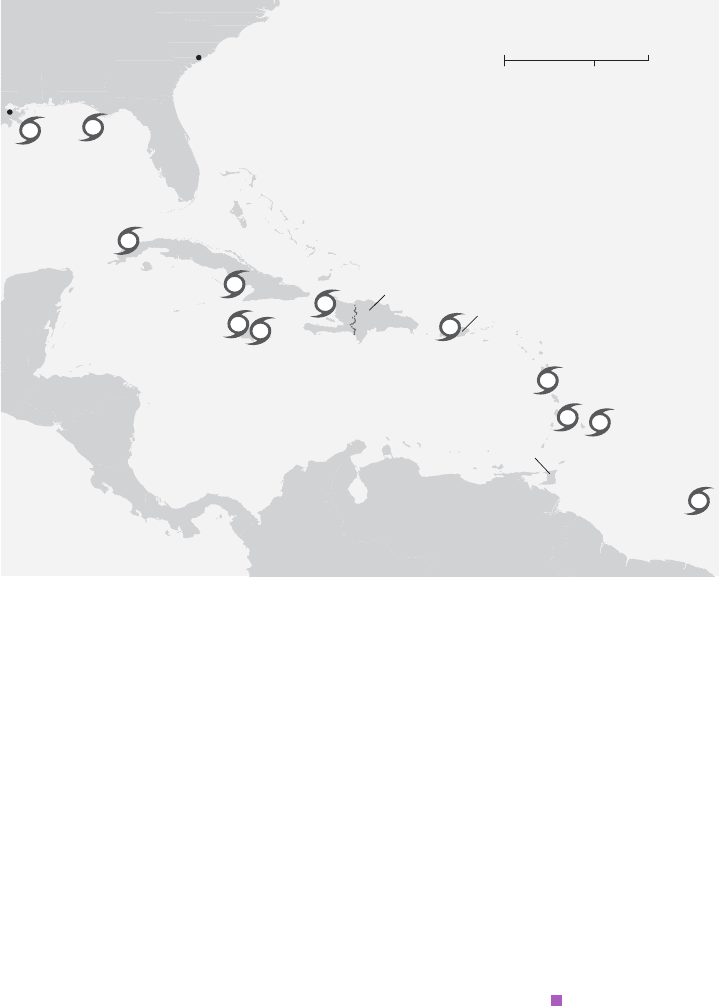
Map 5.1 Hurricane strikes in the Caribbean basin, February 1780 and from July to
October 1780. Sources: see appendix 2.
Barbados
Jamaica
Saint
Domingue
Cuba
Charleston
New Orleans
Trinidad
500 KM0
500 Miles0
Puerto
Rico
Santo
Domingo
5
4
3
11
10
9
2
8
7
6
12
1
Atlantic Ocean
Caribbean Sea
Lesser
Antilles
146
•
in a common catastrophe
storm.142 The most impressive new fortication was the recently com-
pleted Castillo dela Cabaña. The hurricane-force winds blew in the doors
of the artillerymen’s barracks, and ying debris shaered the beautiful
stained glass windows over the altar in the chapel.143 Wooden barracones
(barracks), built on the military parade ground just outside the city wall
(Campo de Marte) to accommodate the transient units, sustained con-
siderable damage.144 Likewise, the responsibility for repairing damaged
barracks and stables in the villages rested with the commanders of the
local forces.145 At the height of the storm, the eighteen-foot storm surge
pounded into the bay, damaging three large ships that were being prepared
to join the planned convoy to Mobile.146 And of course, the precious pro-
visions intended to feed the troops were in danger of spoiling from the
torrential rain that leaked through holes in the roofs.147 By some good
fortune, on 24 February, a lieutenant of the volunteers appeared at the
doors of ElMorro with eight tercios of salted beef, vegetables, and hard-
tack, which would carry the troops over until regular provisions could be
secured.148
Given the extent of the damages, the recovery eorts were nothing
short of miraculous. Within a week, feverish eorts had xed all three
boats and replaced the provisions that the troops had consumed on the
days that they waited on land for their ships to be readied.149 Still, the
senior commanders in Havana delayed sending reinforcements, citing
the “inconstant” weather that threatened any ship that put out to sea.150
A small force under Miró’s command nally le Havana to reinforce
Bernardo de Gálvez’s forces, and on 14 March, Mobile fell to the Span-
iards.151 When the ocial notication of the young man’s victories ar-
rived in Spain, the exultation was tangible. The correspondence between
uncle and nephew reects their jubilation: “His Majesty has received the
news with the greatest satisfaction,” wrote José de Gálvez.152 On the other
hand, the senior leaders in Havana received a stern reprimand for their
dilatory tactics.153 The disruptive atmosphere in Havana jeopardized the
success of future military campaigns along the Gulf Coast, and in June
1780, Charles III decided to send José de Gálvez’s protégé, Francisco de
Saavedra, to Havana as his personal representative to Cuba, with the direct
authority to implement the monarch’s wishes.154
In spite of its positive eect on the morale of the Spanish forces, the
capture of Mobile created additional problems for the war planners. Now
the already-burdened army had to care for the British prisoners of war
in a common catastrophe
•
147
taken in the action.155 In April, Navarro issued a circular leer to all of
his commanders ordering that “all prisoners are to be treated with all the
humanity and gentility that is possible within the context of the security
of the island.”156 The following month, Bernardo de Gálvez requested that
the authorities in Havana mobilize all their resources to send our and
other provisions to his forces. He also suggested that once the ships ar-
rived in Mobile, the prisoners of war be transferred to Veracruz, presum-
ably to shi the burden for feeding them onto the viceroy of New Spain.157
Now Miralles’s assignment became even more vital, and together with his
business partner, Robert Morris, he redoubled eorts to send provisions
to Cuba. In early March 1780, the two men purchased another ship, the
Golden Rule, to increase the volume of trade to the island.158 Shortly there-
aer, Miralles le for the countryside in Morristown to join a group of his
friends who were visiting Commander-in-Chief Washington and enjoying
the hospitality of his camp. Misfortune struck when Miralles contracted
a fever. He died suddenly on 28 April. His death was an immense setback
to the careful measures put in place to provide food for the troops in Gulf
Coast expeditions, but in the ensuing months, Miralles’s partner, Robert
Morris, continued to send provisions as per his agreement with his late
friend.159 Four of Philadelphia’s ships, the Fox, the Buckskin, the Lincoln,
and the Havana, maintained the commercial links between Havana and
Philadelphia, bringing vital provisions for the troops and civilians.160
The “Common Catastrophe”
Summer 1780 began poorly for the garrison, ocers, commanders, and
civilians, who sought to make the best of the bad situation. As late as April,
New Orleans still struggled to recover from the extraordinary storm in
February. Most important, the warehouses that stored arms, ammunition,
and provisions remained inadequate, in spite of the eorts of the new gov-
ernor, Martín de Navarro, to rebuild the structures.161 Meanwhile, just as
the war council in Cuba was burdened with additional mouths to feed—
the prisoners of war from the Mobile campaign— the central region of
Cuba that supplied fresh beef for the garrison was stricken with a severe
drought. In late April, local ocials in Puerto Príncipe and Santa Clara
were notied that the increased number of troops necessitated that each
town make “the strongest eorts” to send as many head of cale as possi-
ble. Puerto Príncipe’s leaders responded that it would be dicult because
148
•
in a common catastrophe
of the severe and extensive drought that had descended on the region.162
Urriza sent an emissary and a stern warning to the lieutenant governor to
facilitate the purchase of 8,000 head of cale, and ten days later, 58 steers
le the country on their way to Havana.163 Then, without warning, in
July conditions reversed, hurricane season began anew, and continuous
rainfall throughout the summer and fall plagued the local populations. In
July, Navarro sent three carts to the rural region near Managua to purchase
palm thatch to reinforce the roof on the leaky barracks on the Campo de
Marte.164 By August, the continuous rainfall once again threatened to
wash away roads and bridges, so the residents of Arroyo Arenas petitioned
the captain general for permission to build a bridge over the river so that
they could bring their produce to town.165
On 4 October, at six o’clock in the morning, the telltale steady winds of
an approaching storm began to blow in Puerto Príncipe. The wind came
rst from the southeast. Around noon the direction shied to coming in
from the northeast, and it continued to blow until midnight. Drenching
rain soaked the province until the morning of 6 October. As soon as it was
humanly possible, the lieutenant governor, Ventura Díaz, le his residence
to survey his jurisdiction. He began by posting a declaration that detailed
the “usual measures [to be implemented] for the common relief.”166 Pre-
dictably, all of the crops in the ground were ruined because the heavy
rain fell on a parched landscape suering the eects of a severe drought,
a worst-case scenario, and property losses were estimated at over 100,000
pesos.167 Soon aer the hurricane, a series of fevers descended upon a
population that had endured so much over the previous year.168 As late as
January of the following year, the residents were only surviving because
of the provisions and other help sent to the province from Bayamo and
Holguín.169
Less than a week later, the most destructive hurricane to impact the
Caribbean in recorded history made its rst landfall in the Lesser Antilles.
In Barbados, more than 4,000 slaves died immediately, and perhaps 1,000
more perished of disease in the aermath.170 To the surprise of eyewit-
nesses, even well-built houses of stone could not withstand the winds.171
The British navy suered signicant casualties because its eet had just ar-
rived in the Caribbean and had stopped over in St.Lucia before continuing
on to Jamaica. Numerous other ships, both military and merchant, were
caught at sea in the storm. A Spanish vessel, the Diana, carrying Francisco
de Saavedra to Cuba, had sailed with a convoy of French warships, but the
in a common catastrophe
•
149
Diana’s captain chose to part company with the convoy near Tenerife in
the Canary Islands. The French eet sailed on to Martinique, where the
entire eet was lost in the hurricane. The Diana, sailing a more southerly
course, was also caught up in the storm. The captain and crew fought for
forty-eight hours to save the vessel, and ultimately they made their way
safely to Margarita.172 In total, the hurricane of 10–16 October caused over
20,000 deaths and resulted in incalculable property losses.173
Meanwhile, in Havana, preparations were under way for an assault on
Pensacola. On 10 October, the expedition under the command of José de
Solano, the former president of Santo Domingo, sailed out of Havana and
into the full force of yet-another hurricane, which likely developed in the
northern Gulf of Mexico.174 By 1 November, the absence of information
warned military planners in Havana that something drastic had occurred
to the eet en route.175 A week later, the junta de guerra still had no de-
nitive news of the fate of the expedition, so contingency plans began
to be formulated.176 By the end of the month, reports of the disaster had
made their way to Havana. Solano’s eet had almost made it to Pensacola
when the hurricane scaered the ships throughout the Gulf of Mexico.
Several vessels were thrown ashore on the coast of the Yucatán peninsula.
Some survivors were picked up at sea and taken to New Orleans; others
were never seen or heard from again.177 One survivor spoke of his ordeal,
clinging to debris among “fragments of ships and cadavers oating in the
water.”178 In Havana, military planners scrambled to outt the few remain-
ing ships in drydock to send on a rescue mission to search for survivors.179
For the second time in a year, the shipyard of Havana worked feverishly to
patch together careened ships to provide emergency relief aer a devastat-
ing storm.
In spite of the disaster, the business of war could not be suspended,
and the forces now occupying Mobile still needed to be supplied.180 The
loss of all the provisions for the Pensacola expedition was a serious set-
back, and in November, Urriza passed on the bad news that the supplies
of hardtack, our, and meat were completely inadequate for the demand.
Flour posed a particular problem, in spite of a shipment that had just been
secured from the “Ingleses Americanos del Norte.”181 Military ocers were
charged with scraping together anything that they could spare, while at the
same time notices arrived that the provisioning grounds in Puerto Prín-
cipe had been destroyed a week before.182 Unaware of the disaster that had
just devastated the neighboring islands, the junta de guerra worried that
150
•
in a common catastrophe
the British would take advantage of their weakened and vulnerable posi-
tion.183 Extra watches were ordered at all of the towers on the island aer
the lieutenant governor of Pinar del Río reported that he had spoed a
ship with ten or twelve bronze cannon that appeared to be British.184 The
weather, of course, did not cooperate with military strategists. Continu-
ous rainfall ruined all of the scarce remaining gunpowder in the armory
inside ElMorro.185 Their French allies in Saint Domingue were also hurt
by the bad weather. In one coastal city, Mole San Nicolás, it had been rain-
ing continuously for een days.186 Misfortune had also befallen Charles
III’s personal emissary, Saavedra, who was captured at sea and made a
prisoner of war in Jamaica for two months. In spite of the hostilities be-
tween the two nations, he was well treated by his captors and was allowed
to roam freely throughout Kingston upon his promise of good behavior.
English soldiers from the doomed British eet who had been shipwrecked
on Martinique also were treated humanely. The governor of Martinique
wrote to his superiors that he had freed the English sailors who had been
shipwrecked on that island because, “in a common catastrophe, all men
should be brothers.”187
To royal ocials taking stock in Madrid at the end of 1780, the outlook
for 1781 was bleak.188 With the exception of the victory at Mobile, Spain’s
forces could only count failures, not successes. The severe winter stormin
February, the near-mutiny of senior ocers in Havana, Miralles’s death
in April, and the horrible weather throughout the summer— culminating
inthe hurricanes in October that hit Puerto Príncipe and the expedition
to Pensacola— all had drained precious resources with no benet to show
for all of the eorts. Nevertheless, as early as November, preparations were
being made to organize another expedition against Pensacola.189 In Janu-
ary, the troops that were scaered throughout the Gulf Coast returned
to Havana for regrouping.190 Throughout the western end of the island,
from Matanzas to Cabañas, local constables were ordered to conscript
caulkers, ship’s carpenters, and axmen for transfer to Havana.191 At the
same time, the island’s militia units were put on alert, while the regular
forces prepared to depart on the second expedition against Pensacola.192
By the end of February, even the remotest hamlet on the island knew that
hostilities were imminent, when a circular order arrived announcing that
as of 6 March, “no boat, large or small would be allowed to put out to sea
until further notice.”193 Bernardo de Gálvez’s second aempt to capture
Pensacola had begun.
in a common catastrophe
•
151
The result was a resounding success that eliminated the British threat in
the Gulf of Mexico and turned the tide of war in Spain’s favor.194 Buoyed
by victory, the Spanish government chose to press the war eort on sev-
eral fronts. In Central America, the father of Bernardo, Matías, led an
expeditionary army against British interlopers in present-day Nicaragua.
Another front was opened against the Bahamas, also British territory, and
a planned expedition against Jamaica was organized in Saint Domingue
in 1782.195 Rewards for Bernardo’s bravery and audacity followed on the
heels of each victory. Aer the Mississippi River valley victories, his post
as governor and captain general of Louisiana was separated from the au-
thority of the viceroyalty of Mexico and granted complete autonomy.196
Aer Mobile and Pensacola, he was awarded the title of Conde de Gálvez
and made captain general of Cuba. His brief tenure in Cuba preceded
more honors, when, upon the death of his father, Matías, in Mexico City,
Bernardo was chosen to succeed the older man as viceroy of New Spain,
in 1785.197
“To Supply That City with Everything That It Needs”
The Spanish capture of Pensacola gave a dierent atmosphere to the war,
and the decision to expand the conict made securing provisions for the
troops even more important. The denitive declaration arrived in Cuba
in early 1781, charging the military strategists with securing whatever re-
sources they needed to ensure the success of the expedition against Pen-
sacola.198 The expedition in Central America led by Matías de Gálvez
received the same concession.199
By April, the question about where the provisions would be purchased
was seled. Because of the “eects of the shortages,” Havana harbor was
thrown open to North American boats with the charge from José de
Gálvez “to supply that city with everything that it needs.” In addition, mer-
chants received tax concessions on imports and exports. Each shipment
arriving would be assessed at half the regular import duties, and outgoing
cargoes would also be taxed at half their value. José de Gálvez also relayed
Charles III’s sincere gratitude to “the honorable Robert Morris,” who,
in the uncertainty aer Miralles’s death, had sent his ships in ballast to
the Danish islands to purchase our for the Spanish troops.200 Through-
out spring and summer 1781— to the “complete satisfaction of His Maj-
esty”— an increasing number of North American vessels sailed south-
152
•
in a common catastrophe
ward to Havana bringing vital our, rice, and lumber to supply the war
eort.201
By late summer 1781, the commercial atmosphere in Havana was trans-
formed into the festival-like conditions that had prevailed in Cap Français
just a few years previous. Like weeds in a eld, North American trading
houses sprang up overnight. The head of one such business was Joseph
Graon, of Salem, Massachuses, who, in summer 1781, decided to inves-
tigate the potential for “protable ventures” in Havana. Prior to his depar-
ture, he secured leers of introduction to people in Cuba and throughout
the Atlantic world. Graon arrived in Havana onboard the brigantine
Romulus on Sunday, 1 September 1781. Obviously well aware of the protocol
required to conduct business, he came with the appropriate “gis” for the
town constable— a yard of calico fabric and three pairs of silk stockings.202
The protable ventures that Graon had hoped for materialized almost
immediately, and by the end of the summer, he and his family were fully
engaged in the Cuba trade. In 1781, Havana became the staging ground for
the French eet in its preparations for the expedition against Yorktown,
and Graon’s and other American merchant ships unloaded barrel aer
barrel of our, rice, potatoes, and other comestibles. On 12 November,
they received the news of Lord Cornwallis’s surrender to Washington.
Two days later, the Americans staged a victory party, aended by over y
people, including French ocers and Irishmen in Spanish service. With
each toast that was drunk, the brigantine Schuylkill discharged its cannon
in celebration.203 Their unqualied welcome was assured because the
weather remained treacherous. In February 1782, a Philadelphia brigantine
was wrecked o the coast of Matanzas in a winter storm that pounded the
north coast of the island, and in July, a relatively weak hurricane passed
over the western end of the island, causing considerable losses to livestock
and crops but, miraculously, no loss of human life.204
Graon’s commercial success in Havana would last for three years, but
on Friday, 23 April 1784, North American commercial activities came to
an abrupt halt.205 That morning, he was conducting routine business on-
board the schooner Betsy when the town constable came with ve soldiers
to tell him to leave the city. Graon rst appealed to Oliver Pollock, Mor-
ris’s former agent and now the commercial representative for the United
States in Cuba, who secured permission for him to stay, but the soldiers
on the ship refused to allow him to leave. The next morning, the Betsy set
in a common catastrophe
•
153
sail with Graon on board. He had not even been granted permission to
retrieve his laundry from his washerwoman’s house.206
Aer the expulsion of foreigners in 1784, savvy merchants simply
shied their centers of operation and created international trading net-
works reminiscent of the 1760s and 1770s. By the mid-1780s, Philadelphia,
Baltimore, and New York had replaced London as the hub where deals
were made and cargoes were loaded for shipment to Havana. Geing
around the prohibition against foreigners in Havana proved less of a prob-
lem than it appeared to be at rst, especially since the miserable weather
conditions of the previous four decades showed no signs of abating into
the laer half of the 1780s and the 1790s. Still desperate for provisions, in
the interim, the returned province of East Florida provided an opportu-
nity to comply with the spirit and the leer of the law. Aer the expulsion
of 1784, the merchants of St.Augustine capitalized upon their heritage and
serendipitous geographic location to become the conduit through which
North American provisions continued to ow to the consumers of Cuba.
Their success and the subsequent solidifying of commercial relations with
North America will be explored in the following chapter.