
Johnson Sherry. Climate and Catastrophe in Cuba and the Atlantic World in the Age of Revolution
Подождите немного. Документ загружается.

164
•
the tomb that is the almendares river
is punctuated by gullies and ravines in which rivulets and seasonal streams
carry runo northward to the ocean. Villages and hamlets in the interior
from Havana were particularly vulnerable because they were located along
the margins of these streams and rivulets.74 Equally important, the rains
of June fell on terrain that had been eroded by the twin processes of de-
forestation to provide trees for the shipyard and urbanization caused by
explosive population growth, which had doubled the number of residents
in a lile over one generation.75
In weak storms, the worst damage was done to the plantains, which
were blown from the trees, lending the name “banana wind” (viento plata-
nero) to the spectacle of thousands of plantains liering the countryside.
Normally, residents could salvage some of the crop, but aer days of ood-
ing, the plantains on the ground were ruined by contamination from the
decaying bodies of dead animals. Such was the case in the village of Cal-
vario, located directly to the south of Havana. Calvario stood at the head
of a steep ravine cut by the Luyanó River, which emptied into Havana bay.
Among the losses to livestock were two hundred domesticated fowl and a
mule that died on the potrero of Antonia Gonzáles; the estancia of Agustín
García lost eighty-six chickens and a cow. Two weeks aer the passage
of the storm, seven families in Calvario still had nowhere to go. Josef de
Mena struggled to survive with his wife and eight children.76 Downstream
in the village of Jesús del Monte, the rst casualty reports were submied
by Constable Félix Gonzáles, who wrote that forty logs of an extremely
hard wood called “breakaxe” (quiebrahacha) had undermined the pilings
of the bridge in the village of nearly 2,500 people.77
The greatest number of deaths occurred in the small selements to the
west of Havana located within the drainage basin of the Almendares River.
The headwaters of the river began in the same hills south of town, and
like the Luyanó River, the Almendares coursed out of the hills, owing
north and emptying into the Straits of Florida. Steep sides of a gorge had
been carved out of the terrain, which funneled the rainwater into a raging
torrent that bore down on the Almendares basin selements, which were
home to nearly 4,000 people. The rst village in the oodwaters’ path was
Santiago de las Vegas, and in its aermath, the constable, Vicente de Soría,
anguished over how he could help the hundreds of victims in his town and
the nearby hamlets.78 Farther downstream, 600 logs were stacked along
the banks of the river in Jubajay (Wajay) waiting for transportation to the
sawmill.79 In their path lay hundreds of modest wale-and-daub houses
the tomb that is the almendares river
•
165
clustered near a bridge across the river near the village of Prensa on the
east bank of the river. Without warning, the churning wall of water and
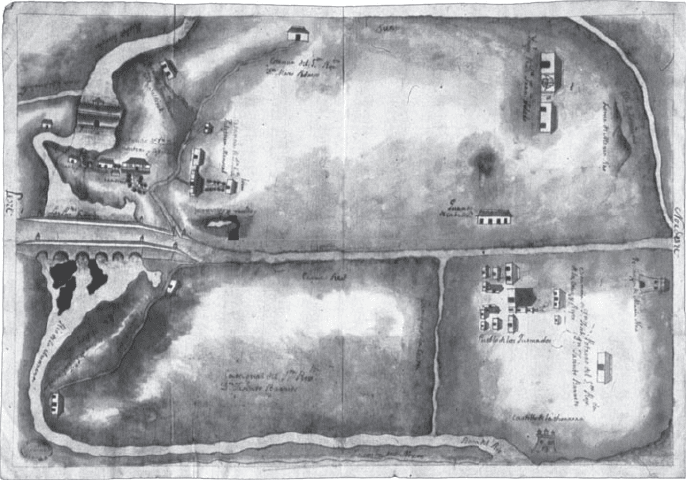
debris crashed into the villages in its path. Where Barreto’s house once
stood, a crater sixty feet deep was all that remained.80
For the survivors of the catastrophe, the horror had just begun. Families
who owned small boats rushed into service, rescuing people who clung to
the roofs of their houses.81 Vicente de Castilla, the constable of Prensa,
was overwhelmed with the task of retrieving the hundreds of cadavers
oating in the receding waters, suspended in trees, or entangled in fences.
On the third day aer the catastrophe, Castilla asked for a large boat to
intercept the bodies oating down the river, which were intermingled
with the carcasses of dead animals and debris from destroyed houses—
furniture, windows, and beams from roofs.82 Castilla’s counterpart on
the west side of the river, the constable of Quemados, Cristóval Pacheco,
faced equally dire conditions.83 Entire families were carried away by the
torrent, including María Guadalupe, a free woman of color, whose body
Figure 6.1 View of the Chorrera River basin prior to the storm of 1791. Note
JacintoBarreto’s riverside property in the lower le-hand corner. Source: Mapas
y Planos, number 527, Audiencia de Santo Domingo, Archivo General de Indias,
Seville, Spain.
166
•
the tomb that is the almendares river
was found on 27 June so decomposed that the rescuers could only bury
her where she laid. The bodies of her ve children were not found until six
days later.84 Elsewhere, constables in inland areas that escaped the worst
of the devastation coped with the expected ight of slaves taking advan-
tage of the distractions of the disaster. It took three weeks to recapture one
fugitive who had hidden himself in the woods surrounding the village of
Guayabal. For three weeks, he had commied various assaults and robber-
ies, including killing a horse for food, until captured by civilian patrols and
returned to his owner.85
Among the hardest hit were the transportation networks. The three
most important bridges had pilings undermined by the unceasing rain-
fall and rising waters, which seriously compromised geing products
to market. Especially important was the bridge at Puentes Grandes, the
“esophagus” of the city; other bridges on the main arteries into the city,
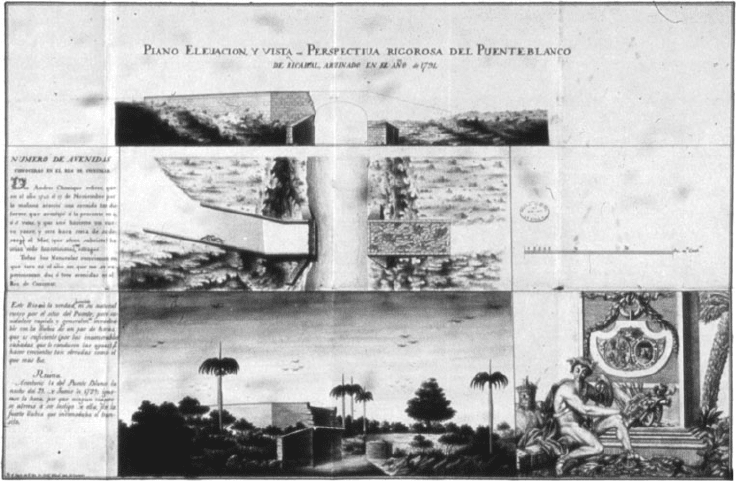
the Pastrana bridge in Luyanó and the Ricabal bridge over the Cojímar
River east of town, had been washed into the sea.86 The June storm also
Figure 6.2 Bridge over the Cojímar River built by the Marqués dela Torre in 1774
and destroyed in the storm of 1791. Source: Mapas y Planos, number 561, Audiencia
de Santo Domingo, Archivo General de Indias, Seville, Spain.
the tomb that is the almendares river
•
167
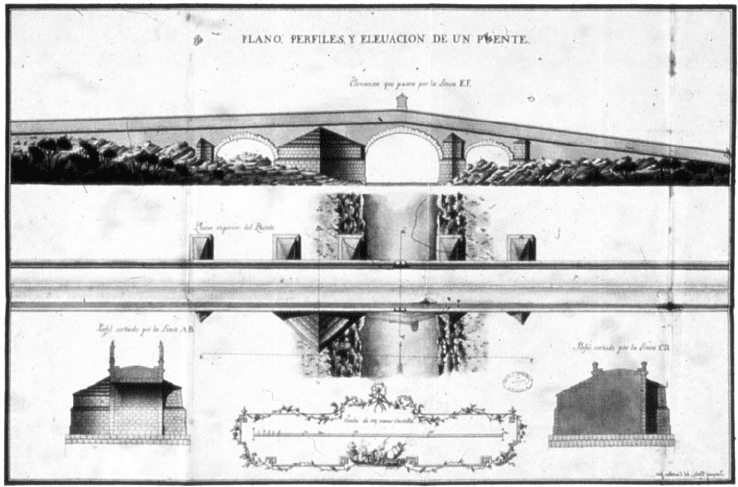
Figure 6.3 Plans for the new bridge over the Cojímar River aer the storm of
1791. Source: Mapas y Planos, number 562, Audiencia de Santo Domingo, Archivo
General de Indias, Seville, Spain.
caught the shipping industry unaware. Because the early summer was still
considered to be a safe time to sail, no warnings were issued as Alcántara
steered the Santa Catalina northward. The schooner, her captain, and her
crew became casualties of the rare early-season storm, but the crew and
passengers of the brigantine ElGallo, bound for New Orleans with mail,
lumber, and tar, which le on 20 June, were more fortunate. The ship en-
countered the hurricane 120 miles south of the mouth of the Mississippi
River. Four passengers and four crew members were lost in the shipwreck,
but the survivors were rescued by a passing French vessel and brought
into Havana on 6 July.87 For the remainder of hurricane season, the ad-
ministrator of the mail system, José Fuertes, took precautions to minimize
any losses from what portended to be a dicult year. As a consequence
ofthe wreck of ElGallo, Fuertes grudgingly allowed one mail ship, the
Cortes, to leave for Spain in mid-August. Aerward, no ship was permit-
ted to sail until well into October, aer the dangerous period around the
equinox had passed.88
168
•
the tomb that is the almendares river
In the rst test of the new regime, Las Casas responded in a manner
completely opposite from the humanitarian concerns to which Cuban
sensibilities had become accustomed. The horric reports from his sub-
ordinates of famine, sickness, and universal misery failed to move him.
Even though local rescuers worked against time and under the worst of
circumstances, the captain general was not pleased with their eorts.
Upon receiving reports on the ground from the Almendares River basin,
Las Casas criticized the constable of Quemados for burying the victims’
bodies in place, admonishing him that he should have made every eort
to recover the bodies and bury them in the cemetery.89 Instead of imple-
menting a program of disaster mitigation designed to lessen the burden on
the people, the captain general held the villagers responsible not just for
their own recovery and cleanup but also for the reconstruction of the is-
land’s infrastructure. Meanwhile, Las Casas ordered the constables of each
urban and extra-urban barrio near Havana to go house-to-house “solicit-
ing donations” from ordinary people to help aid the stricken residents of
the ood.90
The cavalier aitude of the new governor, coupled with his demands to
rebuild the roads and bridges on both sides of the city, became the ash-
point for confrontation between the ordinary people (el pueblo) and royal
ocials, especially since the policies were so alien to previous policy. The
damages in 1791 were no more serious than aer the hurricane of 1768, yet
the captain general during the earlier hurricane, Antonio María Bucareli,
set the example for the behavior of subsequent leaders on the island. Aer
the storm, Bucareli paced in the portico of his residence waiting for the
tempest to pass. Aerward, he personally took to his horse and made the
rounds of victims. Under Bucareli’s mandate, a taxation schedule for re-
building was implemented under which owners of small parcels paid far
less than owners of large plantations. Urban dwellers were assessed based
on their ability to pay, with everyone paying at least a token payment. Dur-
ing the crisis of the early 1770s, the Marqués dela Torre used the model
formulated by Bucareli in raising money to rebuild the bridge over the
Cojímar River from 1772 to 1774; only three individuals resisted paying
the taxes, which were applied in an equitable manner.91 In the wake of
the catastrophes in the 1780s, local citizens stepped forward to assume the
duties normally assigned to military members, volunteering without coer-
cion to rebuild the damaged infrastructure without complaint.92
the tomb that is the almendares river
•
169
The hurricane of 1791 struck a population that expected similar con-
sideration and that received none. The constables in the small villages of
Quemados and Luyanó were ordered to assess the damage and, more im-
portant, to mobilize their male residents to begin cleaning up the roads.93
Las Casas also demanded that Guanabacoa’s leaders mobilize their citi-
zens and begin rebuilding the bridge.94 The town leaders responded with
an absolute rejection of his demand, and they suggested that the captain
general call upon the towns that would derive the most benet, Río Blanco
del Norte, Río Blanco del Sur, and Jaruco to the east toward Matanzas.95
San José de las Lajas echoed Guanabacoa’s suggestion to call on sugar pro-
ducers and sent a list of ingenios and the numbers of workers each could
contribute.96 Similarly, the captain of Arroyo Arenas reported that the rain
prevented the residents of his jurisdiction from repairing the road through
that town.97
Faced with popular resistance, in addition to having to cope with the
aermath of disaster, Las Casas temporarily backed away from his hard-
line position and sent a conciliatory missive to the leaders of Guanabacoa
in which he “invited” them to hop on the bandwagon and “contribute” as
many workers as they could spare.98 He also took seriously the demand
that the burden be shared by all, and he ordered the captain of Gibacoa,
at the eastern terminus of the road from Guanabacoa, to mobilize his citi-
zens to that end. On the western side of the bay, the constables of Govea,
San Antonio, Wajay, and San Luis dela Seiba del Agua were commanded
to convene the leading residents of their area to decide the “most equita-
ble” way to divide the responsibility for road maintenance. Las Casas sug-
gested that the best place to announce his order was as the parishioners
exited from Mass on Sunday morning.99
Shortly aer the meeting was to have taken place, angry leers arrived
at his residence from the captains of San Antonio and Govea complaining
that they were the only leaders who had obeyed his decree— the truant
leaders blamed the foul weather for their absences.100 Their disobedience
was replicated in the behavior of other constables who neglected to tally
the number of able-bodied citizens who were liable for road repair. Felipe
Núñez Villavicencio, the captain of San Pedro, was one such ocial, and
his deance earned him a rebuke from an angry Las Casas.101 The cap-
tain general responded with a furious tirade in the Papel Periódico dela
Havana, which asked the rhetorical question: “What has the city done for
170
•
the tomb that is the almendares river
itself lately?” The editorial criticized the people because they had no in-
centive to work.102 A month later, in June 1792, Las Casas issued a decree,
the Bando de Buen Gobierno, targeting the lower classes by sentencing the
“vagos y mal entretenidos” to the public works projects.103
For months aer the catastrophe, residents struggled to recover under
the most dicult of circumstances. The extensive ooding, lled with the
carcasses of thousands of dead animals, had created a sanitation nightmare,
and predictably, two weeks aer the hurricane, a wave of fevers swept over
the region, further debilitating the survivors.104 In many villages, condi-
tions remained hazardous for weeks aerward. Before the storm, the vil-
lage of Jesús del Monte could boast that it contained 170 houses, including
the summer homes of the Conde de Lagunillas and María de Jesús Aróste-
gui. Aer the “horrible event,” which washed away the bridge at Puentes
Grandes, many families had ed the jurisdiction.105 Thomas Borrego was
even more graphic about the consequences that befell his village, Wajay.
Before the storm, Wajay was a prosperous agricultural community of more
than thirty homesteads; aerward Borrego wrote of houses full of mud
and homeless families eeing for their lives. In response to Las Casas’s call
to mobilize the able-bodied men for road duty, Borrego responded that
“he could not nd a living soul in the region.... Now they will only be
found in the tomb that is the Almendares River.”106
Las Casas’s indierence to the suering of the common folk contrasts
sharply with the preferential treatment he aorded the ayuntamiento
members, who were also aected by the uncharacteristically early storm.
Economic disaster threatened if the planters could not get their sugar to
market, and from all accounts, the roads leading into Havana were washed
away by the ood. The ayuntamiento’s leaders oered a solution in a pro-
posal to change the toll schedule on the bridge that would replace the one
that had been destroyed at Puentes Grandes. Instead of the current toll
schedule, which put the burden on the wealthy who owned carriages, the
ayuntamiento suggested that all who used the bridge should contribute to
its rebuilding. Las Casas accepted the ayuntamiento’s suggestion enthusi-
astically, and he thanked the citizens for their initiative in oering a solu-
tion that “extended the spirit of sharing the burden [repartimiento].”107 As
a further reward for its civic responsibility, he oered relief from its obliga-
tion to maintain the public theater with a loan of 4,000 pesos “borrowed”
from the militia uniform fund.108 At the same time that they struggled
the tomb that is the almendares river
•
171
to recover from their losses, the new toll schedule fell heavily upon the
small producers to the west, who used the bridge to bring their cale to
market.109
Let Them Eat Casabe
In the towns and villages surrounding the capital, agricultural production
was severely disrupted, both in the primary foodstus and in the economic
mainstays of tobacco and sugar.110 Perhaps, then, it was simply a lack of
good judgment for the ayuntamiento and the governor to celebrate the
decree expelling foreigners from the island, which could only result in a
further reduction in food supplies. To make maers worse, the Consulado
introduced a novelty in provisioning procedures. It proposed to substi-
tute locally grown and less costly yuca made into casabe for the traditional
bread made from white our. The measure had a dual purpose: to limit
the amount of North American our that was brought into Cuba and to
curb the inuence of the greatest consumers of the our, the garrison and
the military bureaucracy, who were also the most outspoken adversaries
of the governor and the planters in the Junta de Fomento.111 During the
winter of 1791–92, the ayuntamiento informed the intendant that “it would
serve the common good” if he would substitute casabe for white bread in
the daily rations of the troops, sailors, low-ranking administrators, hos-
pital patients, and king’s slaves.112 The ayuntamiento hoped to justify its
suggestion by enlisting the aid of the Protomédico (chief physician) of
Havana, who concluded that casabe was “just as nutritious and just as deli-
cious as white bread,” especially when its bier taste was disguised by pre-
paring it with broth or piling it high with scrambled eggs and lard.113 The
ayuntamiento’s scheme to substitute casabe for bread made from wheat
our was a great insult to the European and Europeanized Cuban people,
who adamantly refused to change their diet to that of the lower ranks.114
Hurricane season of 1792 began within the context of the escalating
conict between the Cuban people and the captain general in alliance
with the Consulado. The people resented the forced and wholly unnec-
essary shortages resulting from the elites’ insistence on limiting the sup-
ply of U.S. our brought to Cuba. Meanwhile, the bad weather continued
without respite, manifested rst in a severe spring drought and followed
by torrential rain. Santa Clara was particularly hard-hit. Beginning in
172
•
the tomb that is the almendares river
June, one by one, desperate property owners appeared before the town
council begging for relief from their obligation to provide cale: tenant
farmer Hilario de León for the hacienda Caguaguas; Manuel de Ayala for
the hacienda Maleras; Joaquín Moya for his hacienda Minas Bajas; Juan
Antonio for his potrero; and José Montenegro for his estancia.115 Seven
months later, the owner of the hacienda Calabazas, Tomás Honorio Pérez
de Morales, still suered the eects, which had reduced the number of his
pigs by half (from 600 to 309) and le him with only nine head of cale
from his once-large herd.116
In the middle of the summer, the drought subsided and the hurricane
season began. From far and wide, reports from the local captains detailed
how the copious rains made their jobs dicult if not impossible.117 The
season culminated with a storm of moderate intensity that struck the en-
virons of Havana on 29 and 30 October. It brought less rain than its prede-
cessor, but it came with higher winds, and it interrupted or undid the work
that had already been accomplished in rebuilding the roads and bridges
destroyed in 1791.118 In addition, the storm created a second set of infra-
structure problems. The previous year’s hurricane had caused only minor
damage to public buildings because they were out of the ood zone, but
in 1792, structures that escaped harm the year before sustained consider-
able wind damage. In Havana, 500 houses that were spared in the previ-
ous hurricane were destroyed in this October storm.119 Heavily damaged
were the two primary hospitals in Havana, Pilar, located outside the city
walls near the shipyard, and the military hospital, San Ambrosio, in the
southern portion of the city.120 Especially hard-hit were buildings that
were used to lodge remote military detachments. Matanzas lost its militia
barracks, and Calvario, Güines, Cano, and Managua lost the buildings that
served each town as barracks and stables for the mounted cavalry compa-
nies assigned to their areas.121 Finally, even though this was a moderate
hurricane, it came on the heels of a month of continuous bad weather,
thus compounding the destruction. For example, early in the month of
October, the church at Hanábana was hit by a lightning bolt generated
by an ordinary aernoon thunderstorm, and it burned to the ground.122
Two weeks later, the hurricane came ashore, and the rising waters swept
away many head of cale, thereby destroying the economic mainstay of
the area.123 The eastern end of the island did not escape the environmen-
tal crisis. In Santiago de Cuba, in November, the town council met in an
emergency session to determine how to respond to “the torrent of rainfall
the tomb that is the almendares river
•
173
that makes walking the city streets impossible” and the related problems
in the countryside caused by the impassable roads.124
“I Am the Pastor of My Sheep”
By November 1792, all of Cuba had suered from over two years of sum-
mer deluge and winter drought that brought misery, scarcity, disease, and
death and heightened tensions within the community. In an eort to calm
domestic unrest, the newly installed bishop of Havana, Félix José de Tres-
palacios, entered the dispute by taking the side of the Cuban people. In
a series of published edicts and public pronouncements, he rebuked the
captain general and the ayuntamiento for their unreasonable demands.
The captain general responded with his own rebuke of the bishop, in ef-
fect telling the prelate to conne his activities to ecclesiastical maers and
leave the business of government to the secular ocials. Las Casas sug-
gested that the bishop could help by saying the customary Mass asking for
divine clemency that marked the end of the period of penance.125 Angered
at the governor’s interference in traditional ecclesiastical prerogatives,
Trespalacios refused to say the Mass. The ayuntamiento, enraged by the
delay and eager to get on with the reconstruction, found the friars at the
Church of San Francisco to be willing accomplices, but San Francisco did
not have any pews to accommodate the worshipers. The ayuntamiento
members solved the problem by raiding the Cathedral of Havana (the for-
mer Jesuit church), and the people of Havana witnessed the ignominious
sight of their leading citizens stealing benches and carrying them through
the streets of the city to the Church of San Francisco, where the Mass took
place. The outraged bishop red an angry protest o to the Council of the
Indies, but the reply would be delayed at least four months in the trans-
atlantic passage.126
During the winter of 1792–93, while the ElNiño/LaNiña cycle deep-
ened its hold on Cuba, the public war between church and state raged in
Havana. In the absence of a ruling from Spain, neither man would bow
to the other’s authority. Meanwhile, the Cuban people faced food short-
ages and rising prices for the few commodities that were available. Spring
brought another dimension to the dispute with the approach of Lent, dur-
ing which the faithful were prohibited from eating meat on certain days.
Shortages of the primary provisions, especially salted sh, however, meant
that substitutes for meat were unavailable, so in early February the captain