
Kasper C., van Griensven M., P?rtner R. (Eds.) Bioreactor Systems for Tissue Engineering II: Strategies for the Expansion and Directed Differentiation of Stem Cells
Подождите немного. Документ загружается.

185. Macias D, Gan
˜
an Y, Rodriguez-Leon J, Merino R, Hurle JM (1999) Regulation by members
of the transforming growth factor beta superfamily of the digital and interdigital fates of the
autopodial limb mesoderm. Cell Tissue Res 296:95–102
186. Dickman S (1998) Growing joints use their noggins. Science 280:1350
187. Storm EE, Kingsley DM (1996) Joint patterning defects caused by single and double
mutations in members of the bone morphogenetic protein (BMP) family. Development
122:3969–3979
188. Dealy CN, Clarke K, Scranton V (1996) Ability of FGFs to promote the outgrowth and
proliferation of limb mesoderm is dependent on IGF-I activity. Dev Dyn 206:463–469
189. Dealy CN, Kosher RA (1995) Studies on insulin-like growth factor-I and insulin in chick
limb morphogenesis. Dev Dyn 202:67–79
190. Dealy CN, Kosher RA (1996) IGF-I and insulin in the acquisition of limb-forming ability by
the embryonic lateral plate. Dev Biol 177:291–299
191. Matsumoto T, Gargosky SE, Iwasaki K, Rosenfeld RG (1996) Identification and characteri-
zation of insulin-like growth factors (IGFs), IGF-binding proteins (IGFBPs), and IGFBP
proteases in human synovial fluid. J Clin Endocrinol Metab 81:150–155
192. Dore
´
S, Pelletier JP, DiBattista JA, Tardif G, Brazeau P, Martel-Pelletier J (1994) Human
osteoarthritic chondrocytes possess an increased number of insulin-like growth factor 1
binding sites but are unresponsive to its stimulation. Possible role of IGF-1-binding proteins.
Arthritis Rheum 37:253–263
193. Olney RC, Tsuchiya K, Wilson DM, Mohtai M, Maloney WJ, Schurman DJ, Smith RL
(1996) Chondrocytes from osteoarthritic cartilage have increased expression of insulin-like
growth factor I (IGF-I) and IGF-binding protein-3 (IGFBP-3) and -5, but not IGF-II or
IGFBP-4. J Clin Endocrinol Metab 81:1096–1103
194. Tavera C, Abribat T, Reboul P, Dore
´
S, Brazeau P, Pelletier JP, Martel-Pelletier J (1996) IGF
and IGF-binding protein system in the synovial fluid of osteoarthritic and rheumatoid
arthritic patients. Osteoarthr Cartil 4:263–274
195. Spagnoli A, Longobardi L, O’Rear L (2005) Cartilage disorders: potential therapeutic use of
mesenchymal stem cells. Endocrine development 9:17–30
196. McQueeney K, Dealy CN (2001) Roles of insulin-like growth factor-I (IGF-I) and IGF-I
binding protein-2 (IGFBP2) and -5 (IGFBP5) in developing chick limbs. Growth Horm IGF
Res 11:346–363
197. Takigawa M, Okawa T, Pan H, Aoki C, Takahashi K, Zue J, Suzuki F, Kinoshita A (1997)
Insulin-like growth factors I and II are autocrine factors in stimulating proteoglycan synthe-
sis, a marker of differentiated chondrocytes, acting through their respective receptors on a
clonal human chondrosarcoma-derived chondrocyte cell line, HCS-2/8. Endocrinology
138:4390–4400
198. Spagnoli A, Hwa V, Horton WA, Lunstrum GP, Roberts CT, Chiarelli F, Torello M,
Rosenfeld RG (2001) Antiproliferative effects of insulin-like growth factor-binding
protein-3 in mesenchymal chondrogenic cell line RCJ3.1C5.18. relationship to differentia-
tion stage. J Biol Chem 276:5533–5540
199. Niswander L, Jeffrey S, Martin GR, Tickle C (1994) A positive feedback loop coordinates
growth and patterning in the vertebrate limb. Nature 371:609–612
200. Pei M, He F, Kish VL, Vunjak-Novakovic G (2008) Engineering of functional cartilage
tissue using stem cells from synovial lining: a preliminary study. Clin Orthop Relat Res
466:1880–1889
201. Fukumoto T, Sperling JW, Sanyal A, Fitzsimmons JS, Reinholz GG, Conover CA, O’Dris-
coll SW (2003) Combined effects of insulin-like growth factor-1 and transforming growth
factor-beta1 on periosteal mesenchymal cells during chondrogenesis in vitro. Osteoarthr
Cartil 11:55–64
202. Yaeger PC, Masi TL, de Ortiz JL, Binette F, Tubo R, McPherson JM (1997) Synergistic
action of transforming growth factor-beta and insulin-like growth factor-I induces expression
Cartilage Engineering from Mesenchymal Stem Cells 199
of type II collagen and aggrecan genes in adult human articular chondrocytes. Exp Cell Res
237:318–325
203. Pei M, Seidel J, Vunjak-Novakovic G, Freed LE (2002) Growth factors for sequential
cellular de- and re-differentiation in tissue engineering. Biochem Biophys Res Commun
294:149–154
204. Loeser RF, Pacione CA, Chubinskaya S (2003) The combination of insulin-like growth
factor 1 and osteogenic protein 1 promotes increased survival of and matrix synthesis by
normal and osteoarthritic human articular chondrocytes. Arthritis Rheum 48:2188–2196
205. Im H, Pacione C, Chubinskaya S, van Wijnen AJ, Sun Y, Loeser RF (2003) Inhibitory effects
of insulin-like growth factor-1 and osteogenic protein-1 on fibronectin fragment- and
interleukin-1beta-stimulated matrix metalloproteinase-13 expression in human chondro-
cytes. J Biol Chem 278:25386–25394
206. Chubinskaya S, Hakimiyan A, Pacione C, Yanke A, Rappoport L, Aigner T, Rueger DC,
Loeser RF (2007) Synergistic effect of IGF-1 and OP-1 on matrix formation by normal and
OA chondrocytes cultured in alginate beads. Osteoarthr Cartil 15:421–430
207. Toh WS, Liu H, Heng BC, Rufaihah AJ, Ye CP, Cao T (2005) Combined effects of
TGFbeta1 and BMP2 in serum-free chondrogenic differentiation of mesenchymal stem
cells induced hyaline-like cartilage formation. Growth Factors 23:313–321
208. Niswander L, Martin GR (1993) FGF-4 and BMP-2 have opposite effects on limb growth.
Nature 361:68–71
200 C. Goepfert et al.

Adv Biochem Engin/Biotechnol (2010) 123: 201–217
DOI: 10.1007/10_2009_65
#
Springer-Verlag Berlin Heidelberg 2010
Published online: 18 February 2010
Outgrowth Endothelial Cells: Sources,
Characteristics and Potential Applications in
Tissue Engineering and Regenerative Medicine
Sabine Fuchs, Eva Dohle, Marlen Kolbe, and Charles James Kirkpatrick
Abstract Endothelial progenitor cells from peripheral blood or cord blood are
attracting increasing interest as a potential cell source for cellular therapies aiming
to enhance the neovascularization of tissue engineered constructs or ischemic
tissues. The present review focus on a specific population contained in endot helial
progenitor cell cultures designated as outgrowth endothelial cells (OEC) or endo-
thelial colony forming cells from peripheral blood or cord blood. Special attention
will be paid to what is currently known in terms of the origin and the cell biological
or functional characteristics of OEC. Furthermore, we will discuss current concepts,
how OEC might be integrated in complex tissue engineered constructs based on
biomaterial or co-cultures, with special emp hasis on their potential application in
bone tissue engineering and related vascularization strategies.
Keywords Bone tissue engineering, Co-culture models, Endothelial progenitor
cells, Vascularization
Contents
1 Introduction . . . . . . . . . . . . . . . . . . . . . . . . . . . . . . . . . . . . . . . . . . . . . . . . . . . . . . . . . . . . . . . . . . . . . . . . . . . . . . . 202
2 Endothelial Progenitor Cells in the Neovascularization Process .............................202
3 Diversity of Endothelial Progenitor Cell Populations . . . . . . . . . . . . . . . . . . . . . . . . . . . . . . . . . . . . . 203
4 Origin of OEC and Enrichment Strategies . . . . . . . . . . . . . . . . . . . . . . . . . . . . . . . . . . . . . . . . . . . . . . . . 205
5 In Vivo Evaluations of Angiogenic Potential of OEC . . . . . . . . . . . . . . . . . . . . . . . . . . . . . . . . . . . . 208
6 OEC for Vascularization of Complex Tissue Engineered Constructs . . . . . . . . . . . . . . . . . . . . . 209
7 Self-Endothelialization Strategies . . . . . . . . . . . . . . . . . . . . . . . . . . . . . . . . . . . . . . . . . . . . . . . . . . . . . . . . . 212
8 Conclusions . . . . . . . . . . . . . . . . . . . . . . . . . . . . . . . . . . . . . . . . . . . . . . . . . . . . . . . . . . . . . . . . . . . . . . . . . . . . . . . 213
References . . . . . . . . . . . . . . . . . . . . . . . . . . . . . . . . . . . . . . . . . . . . . . . . . . . . . . . . . . . . . . . . . . . . . . . . . . . . . . . . . . . . 213
S. Fuchs (*), E. Dohle, M. Kolbe, and C.J. Kirkpatrick
Institute of Pathology, Universita
¨
tsmedizin der Johannes Gutenberg-Universita
¨
t, Langenbeck-
strasse 1, Mainz, Germany
e-mail: fuchss@uni-mainz.de
1 Introduction
The creation of adequate tissue equivalents and other therapeutical products in tissue
engineering and regenerative medicine is, for several reasons, a highly challenging
task. First of all, tissues reveal a highly complex structure, usually consisting of more
than a single cell type and a cellular organization in an individual, tissue specific
manner. In addition, tissue function is regulated by a close interaction of the individ-
ual cell types controlled via matrix components and cell to cell communication
mechanisms also underlying the control through physiological conditions such as
oxygen tension, state of inflammation, or mechanical stimulation. Last but not least,
tissues are integrated into the body and linked to central body functions, such as
vascularization, ensuring the supply with oxygen and nutrients, as well as the removal
of waste products. Furthermore, adequate vascularization is an essential prerequisite
allowing stem cells to approach the sites of tissue repair [1–4]. The development of
new therapies leading to a fast and successful vascularization is therefore one of the
most central and highly discussed subjects in tissue engineering and regenerative
medicine. In this context, the use of endothelial progenitor cells for proangiogenic
cell therapies has been proposed as a potential means to overcome the current
problems in the neovascularization of bioengineered or harmed tissues [4, 5]. Despite
high expectations, the use of endothelial progenitor cells is currently not yet feasible
for broad clinical applications, due to a series of open questions regarding the
definition of the relevant cell types and the transfer into practicable approaches,
which meet the clinical requirements.
2 Endothelial Progenitor Cells in the Neovascularization Process
For many years angiogenesis, the generat ion of blood vessels from the existing
vasculature through activation of proliferation and sprouting mechanisms in adult
endothelial cells, was considered as the exclusive pathway for blood vessel forma-
tion in an adult organism.
The understanding of blood vessel formation has changed in recent years,
mainly due to the discovery of so-called endothelial progenitor cells by Asahara
et al. [6]. They postulated that in the adult organism endothelial progenitor cells
contribute to de novo formation of blood vessels in a process described as vascu-
logenesis. Since then, vasculogenesis, the contribution of stem cells or endothelial
progenitor cells to de novo vascularization, has been discussed as a collateral
mechanism in neovascularization. Although t he definition clearly differenti ates
the two processes in the academic sense, both mechanisms seem to work hand
in hand in blood vessel formation and remodeling. Both pathway s are coupled
through a series of mostly unknown signaling mechanisms guiding endothe-
lial progenitor cells to the sites of repair and inducing their differentiation and
functional integration into the vasculature [7].
202 S. Fuchs et al.
A significant number of studies on endothelial progenitor cells have been
published over the last decade, defining endothelial progenitor cells by surface
markerssuchasCD133andCD34[8–10], and a series of other characteristics
such as low density lipoprotein (LDL)-uptake [4] and binding of ulex europaeus
agglutinin (UEA) [6, 11]. The ability to form vascular structures in proangiogenic
matrices in vit ro, as well as the pot ential to contribute to t he v ascularization
in vivo have been defined as functional key elements of endothelial progenitor
cells. Several sources, isola tion procedure s, and sugges ted marke r profiles for
endothelial progenitor cells have been de scribed, although there is still a lack of
consensus on which cell type would resemble the “true endothelial progenitor
cell” or might be preferred in t erms of a therapeutical application. From a
practical point of view, suchacellwouldhavetofulfillaseriesofprerequisites
including: (1) origin from an easy obtainablesourceinconnectionwithaminimal
invasive procedure and (2) a good expansion capability not interfering with the
therapeutical potential. Accordi ng to these requirements, endothelial progenitor
cells, in particular from peripheral blood or cord blood, have raised significant
interest.
3 Diversity of Endo thelial Progenitor Cell Populations
Experimental evidence from studies by Lin [12], Gulati [13], Hur [14], and
Ingram [15] suggested that endothelial progenitor cells from the peripheral
blood are a heterogeneous population of cells. Endothelial progenitor cells
from peripheral blood were classified by several groups according to their
order of appearance and morphological characteristics in early or late endothe-
lial progenitor cells [ 14]. Other synonyms for late endothelial progenitor
cells include outgrowth endothelial cells (OEC) [12], late OEC, blood OEC,
and endothelial colony forming endothelial cells. Although the i solation proce-
dure or the nomination of these subsets differs slightly amongst the individual
studies, the phenotypic and functional key features described for those cells are
more or less identical and are summarized in Table 1. This rather simple classifi-
cation was at least a basis for the definition of blood derived endothelial progenitor
cells for subsequent studies using these cells for applications in tissue engineering
and regenerative medicine as described in this review.
The isolation of mononuclear cells from the blood by ficoll gradient centrifuga-
tion followed by culture in a commercial available cell culture medium resulted in
cellular colonies with cobble stone-like morphology showing remarkable simila-
rities to endothelial cells in terms of the marker profile and functional key elements
(Table 1).
Those cells appear at relatively low frequency in the peripheral blood [15, 27,
28]. In contrast to these cells, so-called early endothelial progenitor cells make up
the majority of mononuclear cells derived from the peripheral blood and show a
more or less rounded to fibroblast-like morphology. Although they express to some
Outgrowth Endothelial Cells: Sources, Characteristics and Potential Applications 203
Table 1 Overview of characteristics and functions
EPC OEC
Morphology Spindle shaped morphology [12, 16, 17]
Cobblestone-like morphology [13, 15, 18, 19]
Order of appearance After 7 days in culture [14, 16] After 2–3 weeks in culture [12–14]
Marker profile CD31+ [6, 11, 17]
CD45+ [17, 20]
CD34+ [6, 11, 16]
CD14+ [13, 16, 17]
CD146 [21]
CD133+ [8, 9, 22]
Flt-1 [14]
eNos[14]
vWF [ 14, 19, 23]
VE-Cadherin [11, 14, 17]
KDR [11, 14, 23]
CD36+ [12]
Tie2+ [6, 13]
CD31+ [13, 19, 24]
CD45 [20]
CD34+ [8, 16, 20]
CD14 [13, 16]
CD146+ [21, 24]
CD133 [20]
Flt-1 [14]
eNos [13, 14]
vWF [ 14, 19, 24]
VE-Cadherin [12, 14, 24]
KDR [14, 16, 20]
CD36+ [12]
Tie-2+ [13]
Caveolin-1 [13, 24]
Characteristics
In vitro Low proliferative potential [14, 16, 17]
No tube formation on matrigel [16, 25]
High proliferative potential [14, 16]
Tube formation on matrigel [16, 25]
In vivo Vasculogenic potential through paracrine mechanisms [13]
Secretion of proangiogenic molecules [16]
High vasculogenic potential [13, 14, 26]
204 S. Fuchs et al.
extent relevant endothelial markers such as CD31 (compare Table 1), these cells do
not show the full marker profile of endothelial markers or the functional features
typical for endothelial cells. Most of these cells still carry hematopoietic markers
such as CD45 (compare Table 1). Different studies have compared the early vs late
endothelial progenitor cells in terms of their characteristics. The isolation of OEC
has been reported from different sources such as human cord blood as well as adult
peripheral blood or from different species such as porcine [29], murine [30], and
canine [31].
Surprisingly, although only OEC showed the characteristics and angiogenic
potential of endothelial cells in vitro, both cell types contributed to the de novo
vascularization in vivo [14]. In a following study the same group provided addi-
tional data potentially explaining the discrepancies in the angiogenic potential of
early EPC in vitro and in vivo. In this study early EPC supported the angiogenic
activity of OEC in vitro [16] probably through paracri ne mechanisms based on the
production of IL-8 and VEGF by early EPC. This cytokine production improved the
angiogenic activity of OEC in vitro. In addition, the invasion of OEC into angio-
genic matrices in vitro was positively influenced when both cell type s were applied
mediated through activation of matrix metalloproteinases such as MMP-2 in OEC
and MMP-9 in early EPC. In the same study a synergistic effect was also docu-
mented for the neovascularization process in vivo by the application of both
populations in a hindlimb model. Subsequently, data from these studies are ques-
tioning the contribution of early endothelial progenitor cells to the neovasculariza-
tion process as a result of a true progenitor function in a strict sense including the
differentiation towards mature endothelial cells. It seems to be more adequate to
assume that only a small subset contained within this mixed population constitutes a
true endothelial stem progenitor cell with the ability to differentiate towards an
endothelial cell. On the other hand, the improvement of the vascularization pro-
cess by so-called early endothelial progenitor cells seems to be mainly the result of
other mechanism s such as the support of mature endothelial cells or true stem
cells by paracrine factors and other mechanisms which still need to be defined
further.
4 Origin of OEC and Enrichment Strategies
Although it has been widely accepted that peripheral blood contains stem cells with
the potential to differentiate towards cells with endothelial phenotype there are still
a series of difficulties identifying their distinct origin. Several markers have been
suggested in attempts to define the origin of OEC or to isolate them in a more
specific manner from diverse mono nuclear cell fractions. Nevertheless, most of
these surface markers result only in an enrichm ent of cell populations containing
OEC. In addition, some of these applied surface markers are not suitable to
distinguish progenitor derived endothelial cells from mature endothelial cells
circulating in the blood stream, as discussed in the following section.
Outgrowth Endothelial Cells: Sources, Characteristics and Potential Applications 205
Gulati et al. [13] isolated and identified OEC from the CD 14 negative fraction of
mononuclear cells from the peripheral blood. Other approaches used CD146 to isolate
cells with the characteristics of OEC from the cord blood and adult peripheral blood
[12, 21]. The adhesion molecule CD146 is expressed in different types of endothelial
cells throughout the vascularization and is often used to identify circulating mature
endothelial cells (CEC) [32]. Delorme et al. used a combination of an adhesion step
in order to separate mature endothelial cells from the mononuclear fraction followed
by a magnetic separation step for CD146 positive cells. Using this approach they
identified two distinct populations in cord blood and in peripheral blood forming OEC
in culture CD146 positive EPC (CD146+, CD34+, CD45+, CD133+, or CD117+)
and CD146 CEC (CD146+, CD34+, CD45, CD133,orCD117).
The complexity of the problem of how to differentiate between endothelial cells
from the circulation and from cells which have been mobilized from the bone
marrow was highlighted by a study of Lin et al. [12]. This group investigated
OEC from recipients of gender-m ismatched bone marrow transplantations. By in
situ hybridization, Lin et al. were able to identify endothelial cells from the
recipient making up the major ity of endothelial cells in the early phases of the
culture. On the other hand, the donor derived endothelial cells constitute the major
population after 1 month of the cultures which was due to their high expansion
capacity (over 1,000-fold over 2 months). It was not possible to distinguish donor or
recipient derived OEC on the basis of a mark er profile, whereas the capability of
expansion was one of the remar kable differences of the two endothelial cell
populations found in the peripheral blood. Both endothelial cell types were positive
for CD36, indicating their microvascular endothelial phenotype. This microvascu-
lar phenotype of OEC was also supported by findings from other groups. Microvas-
cular characteristics of OEC were recently also supported by microarray data,
indicating that OEC are different from macrovascular cells, share similarities
with microvascular cells or might be even considered as an individual subclass of
endothelial cells [33].
Although CD133 is one of the markers suggested for endothelial progenitor
groups, cell sorting experiments provided evidence that OEC are not derived from
CD133 or CD45 positive cells but seem to be enriched in the CD34 positive, CD45
negative fraction [20].
Besides these surface marker based isolation strategies, another approach to
enrich OEC from the mononuclear fraction has been described recently [28]. By
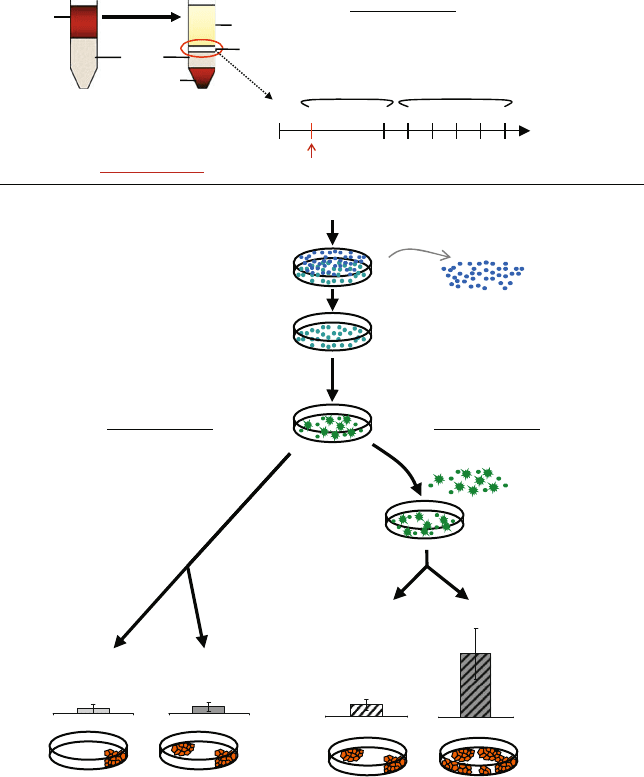
including a passaging step (Fig. 1a) in the early phase of the culture of mononuclear
cells, the formation of OEC colonies was significantly improved in one group of
cultures classified as high colony forming cultures. This simple protocol modifica-
tion resulted in a significant enrichment of OEC (Fig. 1b) and in a higher number of
OEC gained per individual donor. Although the reason for this effect has to be
further defined, the protocol modification might exert a positive effect, specifically
on such OEC with a high clonogenic potential, which have been describ ed by
several groups as stated above.
Other groups modified the isolation protocols by using full blood preparations
omitting widely used centrifugation steps which resulted in an improved OEC
206 S. Fuchs et al.
colony formation. For the further expansion of these cells the same group estab-
lished culture conditions designed for a potential therapeutical use of OEC in
humans [34].
Isolation of OEC
blood
plasma
Centrifugation
Standard protocol
Ficoll
erythrocytes
Mononuclear cells
p1 p2… px
Appearance
of OEC Expansion
day 0
7 x28
Discard non-
adherent cells
Mononuclear cells
Modified protocol
Passaging step
Passaging step
Standard protocol Modified protocol
*of seeded MNC
generate OEC
colonies
0,0131 %*
Low colony-
forming culture
1
High colony-
forming culture
2
0,0010 %* 0,0014 %* 0,0024 %*
Low colony-
forming culture
1
High colony-
forming culture
2
1
Low colony-forming culture: < 0,004 %
of seeded MNC generate OEC colonies in
culture with passa
g
in
g
step (n = 23)
2
High colony-forming culture: > 0,004 %
of seeded MNC generate OEC colonies in
culture with passa
g
in
g
step (n = 23)
a
b
Fig. 1 (a) Schematic overview of the standard and the modified culture protocol according to
Kolbe et al. (b) Schematic overview on the effects of protocol modification on the enrichment of
OEC from adult peripheral blood
Outgrowth Endothelial Cells: Sources, Characteristics and Potential Applications 207
Nevertheless, despite the advances in the understanding of endothelial progeni-
tor cell biology, the identification and specific isolation of OEC from heterogeneous
peripheral blood cell populations remai ns also a technical problem due to their very
low frequencies in heterogeneous cell populations isolated from the peripheral
blood. Steurer et al. [35] recently compared real time PCR and flow cytometry to
detect circulating endothelial cells and endothelial progenitor cells. Using defined
numbers of circulating endothelial cells added to heterogeneous blood mononuclear
cells, detection limits were in the range of 0.001% for quantitative real time PCR or
0.01% for flow cytometry. Despite the ten-times higher sensitivity of real time
PCR, the specificity of the real time PCR was lower due to the methodological
problems associated with this technology also due to the lack of markers exclu-
sively expressed on the relevant cell types.
5 In Vivo Evaluations of Angiogenic Potential of OEC
A series of studies investigated the in vivo potential of OEC for vascularization
strategies in tissue engineering and regenerative medicine. From these studies we
have learned that the successful formation of blood vessels depends strongly on the
experimental settings and the source of OEC as described in the following sectio n.
Melero-Martin et al. [36] co-implanted OEC from the cord blood or adult peripheral
blood together with smooth muscle cells in matrigel plugs. Only in co-implantion
approaches blood vessel formation by OEC was observed, reflecting an active role
of the smooth muscle cells in the blood vessel formation or stabilization. The
angiogenic activity of the blood derived cells reduced with increasing numbers of
passages that the cells underwent during their expansion in vitro. Consistent with
the finding that the therapeutical potential correlates with cellular aging, cord blood
derived endothelial cells had a higher angiogenic potential then those derived from
adult blood. This observation was also confirmed by Au et al. [37] although this
group used different experimental settings and co-implanted the endothelial cells
with 10T1/2 mouse embryonic fibroblasts as stabilizing perivascular-like cells in
collagen gels. In this study, co-implantation with other cell types such as 10T1/2 had
no effect on the blood vessel formation itself. Nevertheless, the stability of newly
formed blood vessels formed by adult peripher al blood derived cells was relatively
impaired, so that these vessels regressed within the 3 weeks. Compared to this cord
blood cell derived vessels revealed a stability lasting over months. In another study
by Au et al. the critical role of stabilizing cells for the in vivo outcome of
transplanted endothelial cells was proven in another experimental set up based on
HUVEC as endothelial cell source and on bone marrow mesenchymal stem cells
functioning as cells with perivascular potential. Using collagen gels based
approaches, the blood vessel formation without mesenchymal cells (MSCs) was
negligible whereas the addition of those or of 10T1/2 fibroblasts leaded to blood
vessels with a long-term stability [38].
208 S. Fuchs et al.