
Kasper C., van Griensven M., P?rtner R. (Eds.) Bioreactor Systems for Tissue Engineering II: Strategies for the Expansion and Directed Differentiation of Stem Cells
Подождите немного. Документ загружается.

stem cel ls serve as cell source to maintain tissue and organ mass during normal cell
turnover in adult individuals. There fore, the focus of attention in veterinary science
is currently drawn to adult stem cells and their potential in regenerative medicine.
Also experience gained from the treatment of animal patients provides valuable
information for human medicine and serves as precursor to future stem cell use in
human medicine.
Compared to human medicine, haematopoietic stem cells only play a minor role
in veterinary medicine because medical conditions requiring myeloablative chemo-
therapy followed by haematopoietic stem cell induced recovery of the immune
system are relatively rare and usually not being treated for monetary as well as
animal welfare reasons.
In contrast, regenerative medicine utilising MSCs for the treatment of acute
injuries as well as chronic disorders is gradually turning into clinical routine.
Therefore, MSCs from either extra embryonic or adult tissues are in the focus of
attention in veterinary medicine and research. Hence the purpose of this chapter is
to offer an overview on basic science and clinical application of MSCs in veterinary
medicine.
Keywords Animal models, Clinical stem cell applications, Embryonic stem cells,
Immunogenicity, Induced pluripotent stem cells, Mesenchymal stem cells, Regen-
erative medicine, Stem cell sources, Veterinary medicine
Contents
1 Basic Research: Origin, Functionality and Capacities of Mesenchymal Stem Cells . . . . . . 221
2 Stem Cell Sources . . . . . . . . . . . . . . . . . . . . . . . . . . . . . . . . . . . . . . . . . . . . . . . . . . . . . . . . . . . . . . . . . . . . . . . . 222
2.1 Bone Marrow . . . . . . . . . . . . . . . . . . . . . . . . . . . . . . . . . . . . . . . . . . . . . . . . . . . . . . . . . . . . . . . . . . . . . 222
2.2 Peripheral Blood . . . . . . . . . . . . . . . . . . . . . . . . . . . . . . . . . . . . . . . . . . . . . . . . . . . . . . . . . . . . . . . . . . 224
2.3 Umbilical Cord Blood . . . . . . . . . . . . . . . . . . . . . . . . . . . . . . . . . . . . . . . . . . . . . . . . . . . . . . . . . . . . 225
2.4 Stem Cell Recovery from Solid Mesenchymal Tissues . . . . . . . . . . . . . . . . . . . . . . . . . . . 226
2.5 Adipose Tissue . . . . . . . . . . . . . . . . . . . . . . . . . . . . . . . . . . . . . . . . . . . . . . . . . . . . . . . . . . . . . . . . . . . . 227
2.6 Umbilical Cord . . . . . . . . . . . . . . . . . . . . . . . . . . . . . . . . . . . . . . . . . . . . . . . . . . . . . . . . . . . . . . . . . . . 228
2.7 Synovial Membrane . . . . . . . . . . . . . . . . . . . . . . . . . . . . . . . . . . . . . . . . . . . . . . . . . . . . . . . . . . . . . . . 230
2.8 Periodontal Ligament . . . . . . . . . . . . . . . . . . . . . . . . . . . . . . . . . . . . . . . . . . . . . . . . . . . . . . . . . . . . . 231
2.9 Skin . . . . . . . . . . . . . . . . . . . . . . . . . . . . . . . . . . . . . . . . . . . . . . . . . . . . . . . . . . . . . . . . . . . . . . . . . . . . . . . 232
2.10 Other Potential MSC Sources . . . . . . . . . . . . . . . . . . . . . . . . . . . . . . . . . . . . . . . . . . . . . . . . . . . . . 233
3 Immunogenicity . . . . . . . . . . . . . . . . . . . . . . . . . . . . . . . . . . . . . . . . . . . . . . . . . . . . . . . . . . . . . . . . . . . . . . . . . . . 233
4 Clinical Applications of Stem Cells in Veterinary Medicine . . . . . . . . . . . . . . . . . . . . . . . . . . . . . 234
4.1 Tendon Injuries . . . . . . . . . . . . . . . . . . . . . . . . . . . . . . . . . . . . . . . . . . . . . . . . . . . . . . . . . . . . . . . . . . . . . 236
4.2 Osteoarthritis . . . . . . . . . . . . . . . . . . . . . . . . . . . . . . . . . . . . . . . . . . . . . . . . . . . . . . . . . . . . . . . . . . . . . . . . 242
4.3 MSCs in Bone Regeneration . . . . . . . . . . . . . . . . . . . . . . . . . . . . . . . . . . . . . . . . . . . . . . . . . . . . . . . . 247
4.4 Spinal Cord Injuries . . . . . . . . . . . . . . . . . . . . . . . . . . . . . . . . . . . . . . . . . . . . . . . . . . . . . . . . . . . . . . . . . 250
4.5 Liver Disease . . . . . . . . . . . . . . . . . . . . . . . . . . . . . . . . . . . . . . . . . . . . . . . . . . . . . . . . . . . . . . . . . . . . . . . 252
5 Future Prospects and Outlook . . . . . . . . . . . . . . . . . . . . . . . . . . . . . . . . . . . . . . . . . . . . . . . . . . . . . . . . . . . . . 253
6 Embryonic Stem Cells and Induced Pluripotent Stem Cells . . . . . . . . . . . . . . . . . . . . . . . . . . . . . . 254
7 Animal Models . . . . . . . . . . . . . . . . . . . . . . . . . . . . . . . . . . . . . . . . . . . . . . . . . . . . . . . . . . . . . . . . . . . . . . . . . . . 255
References . . . . . . . . . . . . . . . . . . . . . . . . . . . . . . . . . . . . . . . . . . . . . . . . . . . . . . . . . . . . . . . . . . . . . . . . . . . . . . . . . . . . 256
220 I. Ribitsch et al.
1 Basic Research: Origin, Functionality and Capacities
of Mesenc hymal Stem Cells
Mesenchymal stem cells (MSCs) are a population of undifferentiated multipot ent
cells isolated from adult tissue (e.g. bone marrow or fat), with the capacity to
differentiate into mesodermal lineages such as bone, cartilage, fat, and muscle
tissue [1–4] and the ability of self-renewal through replication [5].
MSCs participate in tissue regeneration b y two distinct mechanisms. They
directly contribute to tissue repair by differentiating into specific cellular pheno-
types such as tendon or ligament fibroblasts. Of equal importance to the direct
differentiation and production of matrix is the production of bioactive proteins by
adult stem cells. These factors include various growth factors, anti-apoptotic factors
and chemotactic agents that have profound effects on the local cellular dynamics,
producing anabolic effects, stimulating neovascularisation, and recruiting addi-
tional stem cells to the site of injury. Recruited stem cells may in turn differentiate
and/or produce additional biologically active peptides [6].
MSCs can be isolated and expanded with high efficiency (Fig. 1) and induced to
differentiate into multiple lineages under defined culture conditions in vitro [2, 7].
MSCs are typically spindle shaped resembling fibroblasts [8].
Due to the lack of specific MSC markers which would allow an exclusive
definition of cells as completely undifferentiated stem cells or as lineage committed
cells [5], MSCs are identified through their ability to differentiate into multiple
lineages, their property to adhere to plastic in vitro and, in human medicine, through
a combination of positive expression (CD 105, CD 73, CD 90) or distinct lack (CD
34, CD 45) of typical cell surface markers [9]. However, in veterinary medicine the
characterization of stem cells is a bit more difficult because most of the commonly
available cell surface markers do not cross react with the animal cells. Thus it is not
clear if results indicating a lack of specific surface marker s are based on a true lack
of these markers or if the human directed markers simply do not cross-react with
animal cells [10]. Currently, adherence to plastic and trilineage differentiation
potential are the only way to identify MSCs in veterinary medicine [11].
Within the last few years the name “mesenchymal stem cells” has been used
very generally for any sort of mesenchymal progenitor cells. Recently the term
“mesenchymal stem cells” has been reviewed by the International Society of
Cellular Therapy who suggested to rather use the name “multipotent mesenchymal
stromal cells” in order to ensure an accurate denomination in scientific literature.
The term “mesenchymal stem cells” should be exclusively used for cells with
proven in vivo potential of long-term survival with self-renewal ability and the
capacity to repopulate multilineage tissue. A precise nomenclature of cell popula-
tions will enable a much more accurate comparison of results from different
investigators [11]. This is of particular importance in veterinary medicine since
differences between species always need to be considered. However, this distinc-
tion has not yet been generally accepted and therefore the term used by each author
has been maintained in this article.
Basic Science and Clinical Application of Stem Cells in Veterinary Medicine 221

2 Stem Cell Sources
In animals, and in humans, a lot of different tissues representing potential sources of
adult stem cells have been identified. Currently, bone marrow (BM) is certainly the
best researched source. Even though a lot of alternative sources of MSCs have been
described and investigated, bone marrow is still the most commonly used source to
recover stem cells [12, 13].
In veterinary medicine not only the potential stem cell yield is important for the
definition of a good cell source but also species specific difficulties regarding
the process of stem cell recovery and the associated costs certainly need to be
taken into consideration. Therefore, the practicability of different stem cell sources
in veterinary clinical practice does not always correlate with the theoretically best
source from a cell yield and quality perspective. Nevertheless it has repeatedly been
described that there are significant differences in MSCs from different tissue sources
and that findings from one species cannot necessarily be extrapolated to another [14].
In future the identification of the optimal mesenchymal tissue as a source of
MSCs depending on the intended use and the animal species will play an important
role. Also the cell source to treat best a particular clinical condition is yet to be
discovered.
Until proven otherwise, bone marrow remains the most reliable source of
progenitor cells in veterinary medicine [15].
2.1 Bone Marrow
Isolation of bone marrow derived MSCs, also known as marrow stromal cells or
mesenchymal stromal cells [16, 17], has been described in several animal species
[18] such as rabbits, mice and rats, horses [3], dogs [9, 19], cats [20], pigs [21] and
cattle [22].
Bone marrow contains not only mesenchymal fibroblast-like stem cells but also
a high amount of haematopoi etic stem cells. The MSCs can easily be separated
from the haematopoietic cell fraction by culture and adherence to plastic dishes.
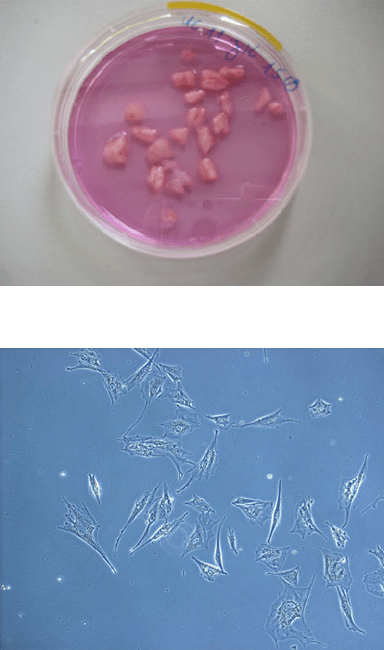
Fig. 1 Different stages of MSC culture (immediately after seeding, 30%, 70% and 100% con-
fluency)
222 I. Ribitsch et al.
Primary bone marrow derived nucleated cells vary in morphology and include large
widespread, occasionally multi-nucleated cells and spindle shaped mononuclear
cells. With subsequent passages this degree of heterogeneity decreases and the
small spindle shaped fibroblast like cells predominate [16 ]. In contrast, Giovannini
et al. [18] reported that MSCs obtained from equine bone marrow always display
the same fibroblastic morphology.
Opinions regarding the quality of bone marrow as MSC source are controversial,
as there seem to be significant differences between different species.
Even though it is reported that in matur e individuals bone marrow is generally
the richest source of stem cells presently known in humans as well as animals [15],
Yoshimura et al. [14] found that the colony formation rate of primary bone marrow
derived MSCs in rats and humans seems to be lower than that of MSC derived from
other mesenchymal tissues. The number of primary colonies per nucleated cell from
synovium, periosteum, adipose and muscle tissue seems to be much higher [14].
An advantage of bone marrow derived stem cells is that they can easily be
passaged many times and over long time periods [15, 23]. They also show good
differentiation potential. How ever, Vidal et al. [16] showed that adipogenesis of
equine bone marrow MSC is satisfying only after adding 5% rabbit serum to the
culture medium.
In bone marrow the achievable MSC yield also varies between different species:
canine and feline BM-derived MSC frequency, for example, is about 1 in 2.5 10
4
and 1 in 3.8 10
5
respectively, whereas in murine bone marrow MSC frequencies
range between 1 in 10.8 10
3
and 1 in 3.45 10
4
. In horses an MSC frequency of
1 in 4.2 10
3
is reported [16].
Ultimately, bone marrow is not an optimal source for MSC, because the collec-
tion procedure is painful and contains a non-negligible risk of haemorrhage and
infection as well as sepsis [18]. Additionally, in veterinary medicine there is a
relatively high safety risk for the veterinarian due to the collection modality in
particular collecting bone marrow from horses, which is either performed from the
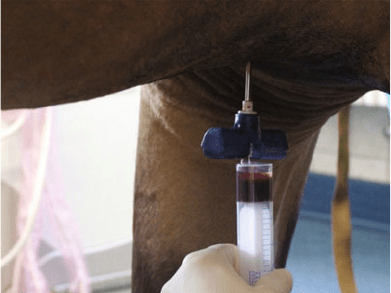
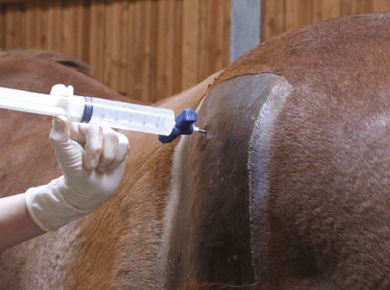
patient’s sternum or tuber coxae (Fig. 2 and 3).
Fig. 2 Bone marrow
collection from a horse’s
sternum
Basic Science and Clinical Application of Stem Cells in Veterinary Medicine 223
Bone marrow collection in a horse is usually conducted u nder standing sedation.
If bone marrow is collected from the tuber coxae the veterinarian is standing right
next to the patients hind leg and can easily be kicked. If the bone marrow is
aspirated from the horse’s sternum the operating veterinarian is kneeling under
the sedated horse and can therefore easily be kicked as well. Some horses also tend
to fall down either due to the relative ly heavy sedation or in an attempt to hinder the
veterinarian from puncturing their sternum. This is associated with some risk for the
veterinarian (who might get caught underneath the horse) and the patient itself,
because the needle might be pushed further into the sternum when the horse’s chest
touches the ground.
In rodents, who play a major role in animal experiments, using MSCs we are
facing a different problem, as the collection and isolation of sufficient amounts of
bone marrow MSCs is quite difficult due to the small body size of the animals,
resulting in a limitation of the feasible number of in vivo experiments [14].
2.2 Peripheral Blood
Peripheral blood (PB) compared to bone marrow and solid tissue displays a safe and
virtually pain-free source for stem cell recovery.
Unfortunately, isolation and proliferation of fibroblast like cells from PB
requires very sophisticated techniques. Only in mice, guinea pigs and rabbits can
standard isolation protocols as known for bone marrow derived MSCs be used [15].
In horses, Smith et al. [24] processed blood samples using a slightly modified
method as for equine bone marrow, but were not able to isolate fibroblastoid cells.
This is in agreement with data obtained in human medicine and in canines,
where it was reported that the isolation and propagation of PB derived fibroblast
like cells from mature individuals is difficult [25]. A study on equine PB derived
stem cells performed by Koerner et al. [15] revealed that only 36.4% of the samples
Fig. 3 Bone marrow
collection from a horse’s
tuber coxae
224 I. Ribitsch et al.
gave rise to fibroblastoid cells. In these samples only 1–5 cell colonies were
observed after 14 days. Giovannini et al. [18] used more sophisticated isolation
techniques and were able to isolat e successfully fibroblast like cells from 8 out of 12
PB samples (75% success rate).
Both Giovannini et al. [18] and Koerner et al. [15] found cells of different
morphologies in the initial culture. One group of colony forming units (CFUs)
consisted of cells with a more fibroblastic shape whereas other cells in other CFUs
showed a more distinct polygonal morphology. Nonetheless, similar to bone mar-
row, the morphologic differences observed in the initial culture were lost aft er the
first passage [18].
Another interesting finding was that, as a consequence of continued passaging,
equine PB derived stem cells either stopped proliferating or grew in a side by side
primary structure and a net-shaped secondary structure. After about five passages
the proliferation capacities of PB progenitors seem to cease [15].
In addition, the differentiation potential of blood derived MSCs seems to be
inferior compared to other stem cell sources as Koerner et al. [15] were not able to
induce chondrogenic differentiation. In contrast, Giovannini et al. [18] were able to
show that equine PB derived fibroblast like cells do have the potential to differenti-
ate into the three common mesodermal lineages but only under specially optimised
differentiation conditions.
Moreover, equine PB progenitor cells proved very sensi tive to trypsinisation as
well as cryostorage in liquid nitrogen and thawing [15], which significantly alters
their usefulness in regenerative medicine in the long run. In addition, the limited
differentiation potential observed by Koerner et al. [15] as well as the slower
differentiation response towards cartilage and bone observed by Giovannini et al.
[18] indicate that PB derived fibroblastoid cells might not be the same cells as bone
marrow MSCs.
2.3 Umbilical Cord Blood
Compared to human medicine, umbilical cord blood (UCB) collection has only
recently moved into the focus of interest in veterinary medicine. Therefore, experi-
ence in this field is still very limited and mainly restricted to the horse. According to
our knowledge, UCB banking is only commercially available for horses.
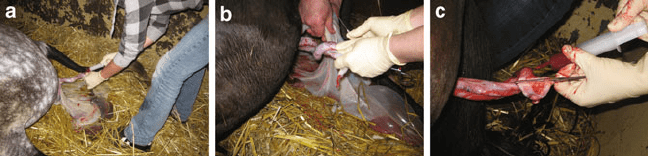
In equine medicine it was shown that UCB can be collected without complica-
tions for either the foal or the mare at the time of foaling (Fig. 4a, b, c). The only
downside is that UCB can only be collected if a veterinarian or somebody else who
is capable of drawing blood is present at the birth, which often is not the case.
UCB stem cells show slight ly different characteristics when compared to other
adult stem cells. They are proven to differentiate into cell types characteristic for
mesodermal and endodermal origins. Their ability to form hepatocyt es suggests
that UCB derived cells may be more plastic than MSC s derived from other adult
Basic Science and Clinical Application of Stem Cells in Veterinary Medicine 225
tissues. In addition, Oct4 – a characteristic embryonic stem (ES) cell marker protein –
was identified in over 90% of the cell nuclei of equine UCB derived cells [26].
Compared to other cell sources like bone marrow and fat, the achievable MSC
yield from UCB is relatively low. Only in four out of seven UCB samples could
colonies with MSC morphology be detected. Additionally, and similar to humans,
the achievable number of primary cultures (between one and five) is relatively low
[13]. This was also confirmed by Reed and Johnson [26] who reported that the yield
of adherent cells was poor.
Similar to PB and bone marrow, the morphology of cultured UCB cells varies
[13, 26]. The recovered cell population was heterogeneous with typical slender and
elongated spindle shaped cells and cell clusters of cuboidal cells with shorter
cytoplasmatic extensions. It is not yet clear why undifferentiated cells show differ-
ent morphology and if they display different stem cell phenotypes [13, 26].
Equine UCB derived MSCs can be successfully differentiated towards the
osteogenic, chondrogenic and adipogenic cell fate [13, 26]. However, formation
of adipogenic [13, 26] and muscle cells was not efficient [26]. It was only possible
to induce adipogenic differentiation after adding rabbit serum to the culture
media [13].
In contrast to PB derived MSCs, it was reported that cryo preservation, thawing
and post thawing expansion had no negative influence on either cell morphology,
proliferation potential or differentiation capacity of UCB derived MSCs [13].
Based on that knowledge, and simi lar to human medicine, commercial storage of
equine UCB derived stem cells for later use for autologous stem cell transplantation
is available and might offer the same potential as in humans [13].
2.4 Stem Cell Recovery from Solid Mesenchymal Tissues
Sakaguchi et al. [27] reported that the colony forming efficiency of suspended cells
from solid mesenchymal tissues following collagenase digestion is about 100-fold
higher than that of bone marrow. This was confirmed by Yoshimura et al. [14] who
reported that the yield and proliferation capacity of MSCs from solid tissues was
much better than from bone marrow.
Fig. 4 (a, b, c): Collection of equine umbilical cord blood
226 I. Ribitsch et al.
2.5 Adipose Tissue
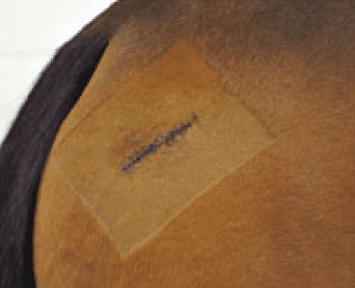
Together with bone marrow, fat, which is more abundant and more easily accessible
than bone marrow [28] (Fig. 5), is the most frequently used stem cell source in
veterinary medicine. Unfortunately, evidence that fat derived stem cells are quali-
tatively and quantitatively comparable to bone marrow derived stem cells is still
missing. Regardless of that, stem cell therapies for animals (dogs and horses) using
fat derived cells for the treatment of osteoarthritis (OA) as well as tendon and
ligament injuries are already on the market. However, commercially available
“stem cell therapies” usin g fat derived stem cells cannot always be referred to as
real stem cell therapy. The MSC rate in the nucleated cell fraction of fat is very low
and only culture purification and expansion leads to a sufficient MSC yield. Hence
the application of the nucleated cell fraction without prior cell purification and
expansion cannot be referred to as true stem cell therapy.
However, fat might be a useful alternative to bone marrow because it can easily
be obtained from subcutaneous tissue which is less invasive than a bone marrow
aspiration [13] and therefore associated with less risk and pain to the patient. In
addition it is usually available in large amounts [29].
Recently studies comparing MSCs from fat and bone marrow regarding their
quality and quantity performing FACS- and PCR-analysis as well as differentiation
and proliferation experiments were carried out in horses. It was confirmed that the
differentiation potential of fat derived stem cells is similar to bone marrow derived
MSCs [30, 31]. Comparing the yield of adherent cells, growth kinetics, cell
senescence and efficiency of gene transduction between MSCs from bone marrow
and MSCs from adipose tissue, it has been reported that there is no difference
between the cells derived from these two sources [32]. Interestingly, more recently
Conrad et al. [30] and Mundle et al. [31] in contrast demonstrated that MSCs
derived from fat show a twofold faster proliferation compared to bone marrow
MSCs in vitro. This was lately confirmed by Dahlgren [6] who reported about a
higher frequency of stem cells in fat compared to bone marrow (2% vs 0.002%)
with an average cell yield of 450.000 per gram of fat and a higher proliferation rate.
Also Reich et al. [28] found a shorter population doubling time and faster migration
into an artificial wound area when comparing fat with bone marrow derived stem
cells.
Interestingly, this seems to be in contrast to humans as Sakaguchi et al. [27]
reported that MSCs derived from human adipose tissue had a lower proliferation
potential than other mesenchymal tissue derived MSCs. On the other hand, Kern
et al. [33] demonstrated a higher proliferation potential of human adipose tissue
derived MSCs. Regarding the number of colony-forming units [33] and population
doublings [29], fat is reported to be a better source of progenitor cells as well.
Comparing the MSC differentiation potential from different sources in vitro and
in vivo, MSCs from adipose tissue of rodents seem to have the lowest chondrogenic
potential [14, 34] based on their reduced expression of bone morphogenetic protein
(BMP)-2, -4, -6 and lack of TGF-b receptors, which was also found in human adipose
Basic Science and Clinical Application of Stem Cells in Veterinary Medicine 227
tissue [35]. Also, canine adipose derived MSCs seem to have a lower chondrogenic
differentiation potential compared to bone marrow MSCs whereas the osteogenic
potential appeared to be comparable [28].
As expected, the adipogenic differentiation potential is obviously higher in
adipose derived MSCs than in MSCs from other sources [14].
2.6 Umbilical Cord
The umbilical cord (UC) matrix or Wharton’s jelly of humans and animals is
reported to be a particularly rich source of very young MSCs with high proliferation
ability (Fig. 6). The gelatinous connective tissue of the u mbilical cord consists of
myofibroblast like stromal cells, collagen fibres and proteoglycans [10, 36].
Umbilical cord MSCs have so far only played a minor role in veterinary science
and no clinical applications are known to date. However, promising results in
human medicine are already available and have prompted the first veterinary
medical in vitro studies (mainly in equine medicine), which might serve as basis
for future studies and possible first clinical applications.
Stem cell isolation from umbilical cord tissue (Wharton’s jelly) is easy and
practicable as a simple collagenase digestion of small, blood vessel free matrix
pieces is performed [36]. The average number of cells and CFUs calculated at the
end of the primary culture and the population doubling as well as fold increase of
umbilical cord derived stem cells are reasonably high [36].
In addition, they can be cryogenically stored and brought back into culture without
obvious changes regarding their growth or phenotypic characteristics [10, 36].
Umbilical cord matrix cells show functional similarities to MSCs from other
sources [10, 36]: It could be shown that the fibroblast like cells can differentiate into
the three major mesenchymal lineages bone, cartilage and fat [36]. Interestingly,
again three morphological types of cells in the primary culture were observed
Fig. 5 Fat recovery location
in horses [145]
228 I. Ribitsch et al.
(Fig. 7): Large and occasionally multi-nucleated cells, small, spindle-shaped,
mononucleated cells and stellate cells. The large and occasionally multi-nucleated
cells disappeared after the first passage and the small, spindle-shaped fibroblastoi d
cells predominated [36].
It was reported that UC MSCs express embryonic marker proteins like Oct-4,
SSEA-4 and c-Kit [10, 36]. Therefore, it is hypothesised that they represent a
primitive phenotype between embryonic and adult stem cells [10, 36]. This hypothesis
was supported by the findings of Mitchell et al. [37] who demonstrated that cells
isolated from porcine umbilical cord matrix are able to differentiate into cells that
morphologically resemble neurons and express proteins specific for neurons and
glia cells. In addition, Weiss et al. [38] showed that porcine umbilical cord matrix
cells express markers of mature neurons when transplanted into rat brain. Rat
umbilical cord matrix cells show similar properties and equine umbilical cord
matrix cells were also demonstrated to adopt a morphology typical for neurons
with axon and dendrite like processes upon culture in the right medium [10]. These
findings confirm that MSCs from extraembryonic tissues are able to differentiate
Fig. 6 Isolation of MSC from
umbilical cord tissue via
migration onto culture dish
Fig. 7 Different MSC
morphology in primary
culture
Basic Science and Clinical Application of Stem Cells in Veterinary Medicine 229