
Kelly J.J. Graduate Mathematical Physics, With MATHEMATICA Supplements
Подождите немного. Документ загружается.


246 7 Sturm–Liouville Theory
now takes the form
Ψx
1
k Sink
Sinkx
x
0
SinkΞfΞ Ξ Sinkx
x
SinkΞ f Ξ Ξ
(7.174)
Notice that the Green function does not exist when
k !
nΠ
Sink0 (7.175)
for integer n. Thus, the Green function does not exist when k k
n
is one of the eigenvalues
of the homogeneous problem.
The present solution does, of course, agree with the general formula. Identifying
p 1 ,q 0 ,w 0 , Λk
2
(7.176)
and
y
a
Sinkx
y
b
Sinkx W
k
xkSinkx Coskx Sinkx Coskx
k Sink
(7.177)
we would have written
G
k
x, Ξ
y
a
x
<
y
b
x
>
pΞW
Λ
Ξ
Sinkx
<
Sinkx
>
k Sink
(7.178)
without being the wiser for it. Once the method is familiar, one can usually apply it rather
quickly and in so doing may notice important special features of a particular problem –
it is usually better to apply the method to each problem rather than simply plug into the
formula.
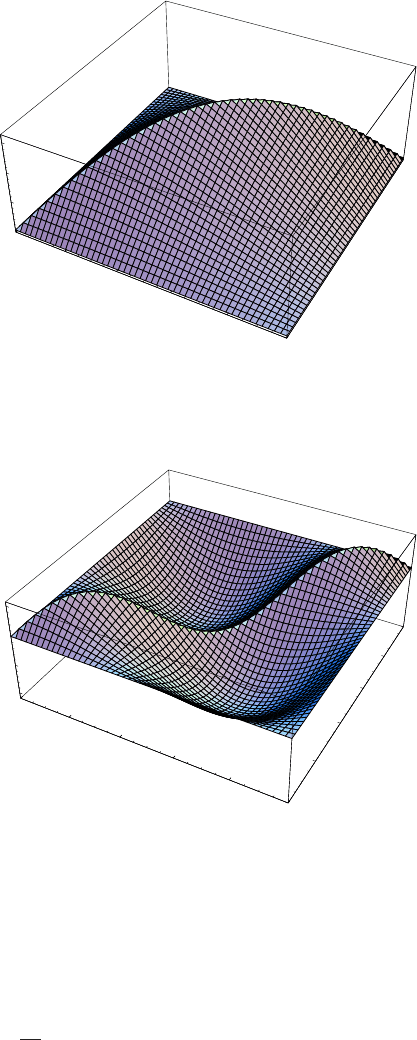
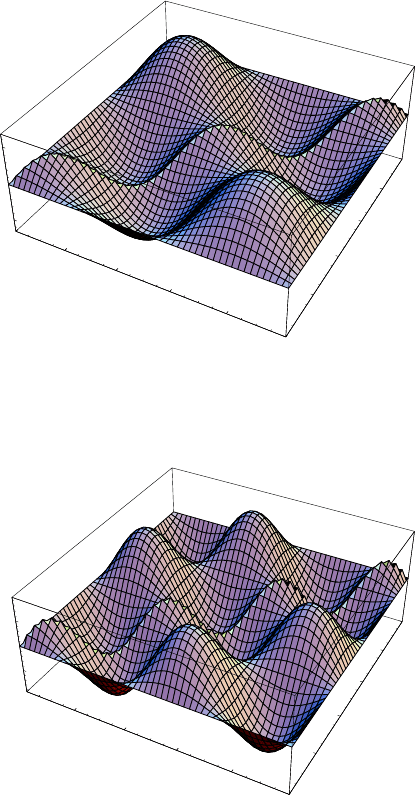
It is instructive to examine the evolution of G
k
as k increases. Figures 7.1–7.4 display
G
k
x, Ξ for several values of k midway between adjacent eigenvalues. The cusp along the
x Ξdiagonal is responsible for the characteristic G ∆x Ξbehavior that defines a
Green’s function and is clearly evident for small k. In fact, in that limit we obtain
k ! 0 G
k
x, Ξ !
x
<
x
>
(7.179)
However, as k increases, oscillations off the main diagonal become important also.
7.4.2 Eigenfunction Expansion of Green Function
Suppose that
x
px
x
qx (7.180)
with suitable boundary conditions is self-adjoint with respect to the weight function wx
on the interval a x b and let Ξ represent a source point within that interval. The
7.4 Green Functions 247
0
0.2
0.4
0.6
0.8
1
0
0.2
0.4
0.6
0.8
1
0
0.1
0.2
0.3
0
0.2
0.4
0.6
0
.
8
Figure 7.1. G
k
x, Ξ for the vibrating string with k Π/ 2and 1 (arbitrary units).
0
0.2
0.4
0.6
0.8
1
0
0.2
0.4
0.6
0.8
1
0.2
0.1
0
0.1
0
0.2
0.4
0.6
0.8
Figure 7.2. G
k
x, Ξ for the vibrating string with k 3Π/ 2and 1 (arbitrary units).
response of a Sturm–Liouville system to a point source is described by a Green func-
tion G
Λ
x, Ξ that satisfies the differential equation
ΛwxG
Λ
x, Ξ ∆x Ξ (7.181)
x
pxG
'
Λ
x, Ξ ΛwxqxG
Λ
x, Ξ ∆x Ξ (7.182)
248 7 Sturm–Liouville Theory
0
0.2
0.4
0.6
0.8
1
0
0.2
0.4
0.6
0.8
1
0.1
0
0.1
0
0.2
0.4
0.6
0.8
Figure 7.3. G
k
x, Ξ for the vibrating string with k 5Π/ 2and 1 (arbitrary units).
0
0.2
0.4
0.6
0.8
1
0
0.2
0.4
0.6
0.8
1
0.05
0
0.05
0
0.2
0.4
0.6
0.8
Figure 7.4. G
k
x, Ξ for the vibrating string with k 7Π/ 2and 1 (arbitrary units).
with the same self-adjoint boundary conditions. Here Λ is treated as a fixed parameter. Let
F
n
x represent a complete orthonormal set of eigenfunctions that satisfy
Λ
n
wxF
n
x0 (7.183)
F
n
w F
m
∆
n,m
b
a
F
n
x
F
m
xwxx ∆
n,m
(7.184)

7.4 Green Functions 249
subject to appropriate boundary conditions. If we substitute an eigenfunction expansion of
the Green function
G
Λ
x, Ξ
n
c
n
F
n
x (7.185)
into its defining differential equation, we obtain
n
c
n
ΛwxF
n
x∆x Ξ (7.186)
This can be simplified considerably by using the Sturm–Liouville equation for F
n
x to
write
n
c
n
ΛΛ
n
wxF
n
x∆x Ξ (7.187)
Provided that Λ does not coincide with any of the eigenvalues Λ
n
, we can isolate the
coefficient c
m
by multiplying both sides by F
m
x
and integrating over the interval a, b
to obtain
b
a
n
c
n
ΛΛ
n
F
m
x
F
n
xwxx F
m
Ξ
(7.188)
such that
ΛΛ
m
c
m
F
m
Ξ
ΛΛ
m
(7.189)
Therefore, the Green function takes the form
ΛΛ
n
G
Λ
x, Ξ
n
F
n
xF
n
Ξ
ΛΛ
n
(7.190)
where eigenfunctions F
n
with Λ
n
near Λ tend to contribute most strongly. As a sanity check,
we apply the operator Λw to both sides
ΛwxG
Λ
x, Ξ
n
F
n
Ξ
ΛΛ
n
ΛwxF
n
x
n
F
n
Ξ
ΛΛ
n
Λ Λ
n
wxF
n
x
n
wxF
n
xF
n
Ξ
∆x Ξ
(7.191)
and recover the completeness relation expressed as an eigenfunction expansion of the delta
function.
Notice that the reciprocity condition, G
Λ
x, Ξ G
Λ
Ξ,x, is apparent in this represen-
tation also. It is sometimes convenient to include a symmetric function of x, Ξ related

250 7 Sturm–Liouville Theory
to the weight function on the right-hand side of the equation for the Green function. For
example, in spherical coordinates one might employ ∆r Ξ/rΞ on the right-hand side.
Other times it is useful to include normalization factors, such as 4Π for electrostatics. As
always, it is better to learn the method and to apply it to each particular problem rather
than to employ the general formulas derived here.
Now consider the more general situation in which Ψx satisfies an inhomogeneous
equation of the form
ΛwxΨxwx f x (7.192)
where the boundary conditions for Ψx make self-adjoint with respect to wx on the
interval a, b. It is useful to expand both f and Ψ in terms of the eigenfunctions F
n
of
according to
f x
n
f
n
F
n
x f
n
F
n
w f
b
a
F
n
x
f xwxx (7.193)
Ψx
n
Ψ
n
F
n
xΨ
n
F
n
w Ψ
b
a
F
n
x
Ψxwxx (7.194)
such that
n
Ψ
n
ΛwxF
n
xwx
n
f
n
F
n
x (7.195)
Use of the eigenfunction equation then gives
F
n
xΛ
n
wxF
n
x
n
Ψ
n
ΛΛ
n
wxF
n
xwx
n
f
n
F
n
x (7.196)
and we project the expansion coefficient Ψ
n
by multiplying both sides by F
m
x
and inte-
grating over a, b to obtain
ΛΛ
n
Ψ
n
1
ΛΛ
n
b
a
F
n
x
f xwxx
F
n
w f
ΛΛ
n
f
n
ΛΛ
n
(7.197)
where the coefficient of F
n
should be recognized as the overlap (inner product) of the
driving term f x with the normal mode F
n
. This result can be represented in the form of a
convolution integral
ΛΛ
n
Ψx
b
a
G
Λ
x, Ξf ΞwΞ Ξ
n
F
n
x
ΛΛ
n
b
a
F
n
Ξ
f ΞwΞ Ξ
(7.198)
where G
Λ
x, Ξ describes the response at x produced by a source at Ξ. Notice that it is
not necessary to add a solution to the homogeneous equation because the Green function

7.4 Green Functions 251
already incorporates the boundary conditions. To verify this solution, we simply apply the
operator Λw to both sides
ΛwxΨx
b
a
ΛwxG
Λ
x, Ξf ΞwΞ Ξ
b
a
∆x Ξf ΞwΞ Ξ f xwx
(7.199)
and recover the original equation. Therefore, the Green function G
Λ
x, Ξ offers a simple
and insightful solution to practically any inhomogeneous equation of this kind provided
that Λ is not one of the eigenvalues of .
More care is needed when Λ does match one of the eigenvalues because the Green
function does not exist under those circumstances. If Λ is close to one of the eigenvalues,
such that Λ*Λ
m
, the eigenfunction expansion can be approximated by a single dominant
term
Λ*Λ
m
Ψx*
f
m
ΛΛ
m
F
m
xBx (7.200)
that diverges as Λ!Λ
m
and a smooth background contribution. In fact, for fixed x it is
useful to think of Ψ as a function of Λ. The eigenvalues of then correspond to the poles
of Ψ with residues f
m
F
m
x. Often these poles represent resonances or normal modes of
the dynamical system and the coefficients f
n
represent the coupling of the driving term to
those resonances; in other words, f
n
measures the strength with which the driving term can
excite mode n. The nonresonant background
Λ*Λ
m
Bx
nm
f
n
Λ
m
Λ
n
F
n
x (7.201)
represents the contributions from all other more distant resonances and is usually much
weaker. The response of the system is very strong near its resonances unless the driving
term is orthogonal to the normal mode, such that f
m
0. Thus, if ΛΛ
m
and f
m
0, we
can write a formal solution
ΛΛ
m
, F
m
f 0 Ψxc
m
F
m
x
nm
f
n
Λ
m
Λ
n
F
n
x (7.202)
where c
m
is an arbitrary constant. However, solutions of this type are inherently unstable
and probably not very useful because we cannot determine c
m
or keep it constant – any
perturbation of the physical system or any numerical error in the mathematical computa-
tion, no matter how small, would permit an uncontrollably large contamination by F
m
x.
A small perturbation ∆ f yields a small but finite overlap Ε
f B f ∆f, Λ*Λ
m
ΨBΨ
Ε
m
ΛΛ
m
F
m
x (7.203)
where
Ε
m
b
a
F
m
x
∆ f xwxx (7.204)

252 7 Sturm–Liouville Theory
The values of Ε
m
or Λ
m
often exhibit small but random fluctuations in time, leading to large
unstable fluctuations of the output when Λ is nearly resonant. Alternatively, numerical
methods may amplify round-off errors when Λ is near an eigenvalue. Therefore, although
the eigenfunction expansion of the Green function provides a valuable formal solution,
considerable care must be exercised near any of the eigenvalues.
7.4.3 Example: Vibrating String
The Green function for a vibrating string clamped at both ends satisfies
2
x
2
Λ
Gx, Ξ ∆x Ξ,G0, Ξ G, Ξ 0 (7.205)
The eigenfunctions for the corresponding homogeneous equation
2
x
2
Λ
n
F
n
x0 , F
n
0F
n
0 (7.206)
are
F
n
x
2
Sink
n
x ,k
n
nΠ
(7.207)
with eigenvalues Λ
n
k
2
n
. Thus, the eigenfunction expansion of the Green function takes
the form
G
k
x, Ξ
n0
F
n
xF
n
Ξ
ΛΛ
n
2
n0
Sink
n
x Sink
n
Ξ
k
2
k
2
n
(7.208)
It is not immediately obvious that this result is consistent with our earlier findings using
interface matching, Eq. (7.172). To demonstrate equivalence, we perform an eigenfunction
expansion of the previous result. It is convenient to factor out the normalization factors,
such that
G
k
x, Ξ
2
n1
c
n
Sink
n
x with c
n
0
Sink
n
xG
k
x, Ξx (7.209)
The integrals can be evaluated by hand using various trigonometric identities in a tedious
but straightforward manner, with a result
Sink Ξ
k Sink
Integrate
Sin
n Π
x
Sinkx, x, 0, Ξ
Sink Ξ
k Sink
Integrate
Sin
n Π
x
Sink x , x, Ξ,
//
Simpli fy#, n Integers&
2
Sin
n ΠΞ
n
2
Π
2
k
2
2
that agrees with the present result. (Don’t try this at home!)

7.5 Perturbation Theory 253
7.5 Perturbation Theory
Often one wishes to investigate the effect of a small change in the dynamics or one can
divide a differential operator into a solvable part and a small correction or perturbation.
Suppose that
0
Ε
1
(7.210)
where
0
represents a dominant and solvable part while
1
represents a correction scaled
by the small parameter Ε.LetF
0
n
represent a complete set of eigenfunctions for
0
satisfying
0
Λ
0
n
wxF
0
n
0 (7.211)
F
0
m
w F
0
n
∆
m,n
(7.212)
and let F
n
represent the eigenfunctions for the complete system, such that
Λ
n
wxF
n
0
0
Λ
n
wxF
n
Ε
1
F
n
(7.213)
Treating Ε
1
F
n
as an inhomogeneous term, this equation can be solved, at least formally,
by using the Green function for
0
, such that
F
n
xΕ
b
a
G
0
Λ
n
x, Ξ
1
ΞF
n
Ξ Ξ (7.214)
where
0
Λ
n
wxG
0
Λ
n
x, Ξ ∆x ΞG
0
Λ
n
x, Ξ
m
F
0
m
xF
0
m
Ξ
Λ
n
Λ
0
m
(7.215)
expresses the unperturbed Green function G
0
Λ
n
in terms of unperturbed eigenfunctions F
0
n
and eigenvalues Λ
0
n
. Note that we assume implicitly that
1
shifts the eigenvalues slightly
so that Λ
n
Λ
0
n
-Εand does not vanish. We can now write this formal solution as
F
n
xΕ
m
F
0
m
x
F
0
m
1
F
n
Λ
n
Λ
0
m
(7.216)
where
F
0
m
1
F
n
b
a
F
0
m
x
1
F
n
xx (7.217)
represents a matrix element of
1
that couples F
n
to F
0
m
. However, this formal result is
not especially useful because F
n
appears in the right-hand side as part of an infinite series
of integrals that we cannot evaluate without already having the solution we seek. Nor do
we know Λ
n
yet.

254 7 Sturm–Liouville Theory
The fundamental assumption of perturbation theory is that changes in the eigenvalues
and eigenfunctions can be developed as power series with respect to the small parameter Ε,
such that
F
n
m0
Ε
m
F
m
n
, Λ
n
m0
Ε
m
Λ
m
n
(7.218)
Thus, the first-order eigenfunction can be expanded in terms of unperturbed eigenfunctions
as
F
n
*F
0
n
Ε
mn
c
1
n,m
F
0
m
(7.219)
such that
Ε!0 F
n
!F
0
n
(7.220)
provided that the expansion coefficients c
n,m
remain finite, as expected. Notice that it is
convenient to employ the normalization
F
0
n
w F
n
1 (7.221)
and to exclude F
0
n
from the correction term; attempting to maintain unit normalization
leads to unnecessary complications. Substituting this approximation into the eigenvalue
equation gives
0
Ε
1
Λ
n
wxF
n
0 (7.222)
Ε
1
Λ
n
Λ
0
n
wxF
0
n
*Ε
mn
c
1
n,m
Ε
1
Λ
n
Λ
0
m
wxF
0
m
(7.223)
or
1
Λ
1
n
wxF
0
n
mn
c
1
n,m
Λ
n
Λ
0
m
wxF
0
m
(7.224)
where terms of order Ε
2
have been dropped. Multiplying both sides by F
0
n
and integrating,
we obtain the first-order correction to the eigenvalue
Λ
1
n
F
0
n
1
F
0
n
(7.225)
in terms of a diagonal matrix element of
1
that uses the unperturbed eigenfunctions. This
can be evaluated because the F
0
n
are presumed known. Similarly, we substitute the first
approximations for the eigenfunctions and eigenvalues into the formal solution to obtain
mn
c
1
n,m
F
0
m
*
kn
F
0
k
x
Λ
0
n
Λ
0
k
3
4
4
4
4
4
5
F
0
k
1
F
0
n
Ε
mn
c
1
n,m
F
0
k
1
F
0
m
6
7
7
7
7
7
8
(7.226)
Once again we drop higher-order terms and use orthogonality to isolate the coefficient
m n c
1
n,m
F
0
m
1
F
0
n
Λ
0
m
Λ
0
n
F
n
*F
0
n
Ε
mn
F
0
m
F
0
m
1
F
0
n
Λ
0
m
Λ
0
n
(7.227)
in a form that is also calculable directly.

7.5 Perturbation Theory 255
It should be clear that this procedure can be iterated indefinitely, substituting the cur-
rent approximation back into the formal solutions to obtain corrections to the eigenfunc-
tions and eigenvalues to one higher power of Ε. However, the procedure becomes more
complicated if some of the unperturbed eigenvalues are degenerate because the denomina-
tors involving differences between eigenvalues will vanish. The problem can be handled
by forming, in degenerate subspaces, linear combinations that are diagonal with respect
to
1
, but we will not pursue degenerate perturbation theory here.
7.5.1 Example: Bead at Center of a String
Suppose that a string of length L under tension Τ with mass density Σ carries a small bead
of mass m at its center. The normal-mode equation takes the form
2
x
2
k
2
n
1 Μ∆
x
L
2
F
n
x0 , F
n
0F
n
L0 (7.228)
where Μm/Σ is a small parameter with dimensions of length; hence, we apply pertur-
bation theory when ΜIL. Obviously, we identify the unperturbed solutions as
2
x
2
k
0
n
2
F
0
n
x0 , F
n
0F
n
L0 F
0
n
x
2
L
Sink
0
n
x (7.229)
where
k
0
n
Ω
0
n
Σ
Τ
nΠ
L
(7.230)
The first-order corrections to the eigenvalues are given by
k
1
n
2
F
0
n
Μ∆
x
L
2
F
0
n
!
2Μ
L
Sin
nΠ
2
2
2Μ
L
Modn, 2 (7.231)
where Modn, 2 is the remainder for n divided by 2 and has the values of 1 for odd n and
0 for even n. Notice that the bead does not affect the frequencies for even n because those
eigenfunctions have a node at L/2 anyway – if the bead is stationary, it might as well be
absent. Combining with the zeroth-order eigenvalue and expanding with respect to Μ,we
find
k
n
*
nΠ
L
Μ
L
Modn, 2 (7.232)
Similarly, the perturbed eigenfunctions take the form
F
n
*F
0
n
mn
F
0
m
F
0
m
Μ∆
x
L
2
F
0
n
Λ
0
m
Λ
0
n
F
0
n
2Μ
Π
mn
F
0
m
Sin
mΠ
2
Sin
nΠ
2
m n
(7.233)