
Kelly J.J. Graduate Mathematical Physics, With MATHEMATICA Supplements
Подождите немного. Документ загружается.


236 7 Sturm–Liouville Theory
Next consider the eigenfunction expansion of a delta function
∆x Ξ
n
a
n
F
n
x (7.92)
a
n
b
a
F
n
x
∆x Ξwxx wΞF
n
Ξ
(7.93)
whereby
∆x Ξ
n
F
n
xwΞF
n
Ξ
(7.94)
Given that the weight function wx is positive-definite within the relevant interval, this is
sometimes written in the more symmetric form
∆x Ξ
n
F
n
x
wxwΞF
n
Ξ
(7.95)
This somewhat peculiar expansion represents the completeness of the eigenfunction expan-
sion. If we take a sufficiently large number of terms, the oscillations of F
n
x and F
n
Ξ
delicately conspire, with the aid of the density function wx, to assemble a good approx-
imation to a delta function that vanishes everywhere except at the single point x Ξbut
still has unit area. Thus, any function
f x
b
a
∆x Ξf Ξ Ξ (7.96)
represented as a convolution over a delta function can be expanded as
f x
b
a
n
F
n
xwΞF
n
Ξ
f Ξ Ξ
n
a
n
F
n
x (7.97)
where
a
n
F
n
w f
b
a
F
n
Ξ
f ΞwΞ Ξ (7.98)
Notice that these properties apply to any self-adjoint operator – nowhere did we use the
specific Sturm–Liouville form. Therefore, any self-adjoint operator has real eigenvalues
and a complete orthonormal set of eigenfunctions.
7.3.4.1 Example: Fourier Series
The Fourier series is represented by
2
x
2
,wx1 , F0FL (7.99)

7.3 Properties of Sturm–Liouville Systems 237
such that
Λ
n
wF
n
0 F
n
xL
1/ 2
Expik
n
x , Λ
n
k
2
n
,k
n
2nΠ
L
(7.100)
where n is an integer. The orthonormality and completeness relations take the form
F
n
F
m
1
L
L
0
Expk
m
k
n
xx ∆
n,m
(7.101)
∆x Ξ
1
L
n
Expk
n
x Ξ (7.102)
Thus, an arbitrary piecewise smooth function f x satisfying periodic boundary conditions,
f 0 f L, can be represented by the discrete Fourier series
f x
1
L
n
a
n
Expk
n
x (7.103)
a
n
1
L
b
a
Expk
n
x f xx (7.104)
7.3.5 Parseval’s Theorem
Suppose that
Ψx
n
a
n
F
n
x (7.105)
a
n
F
n
w Ψ
b
a
F
n
x
Ψxwxx (7.106)
is expanded in a complete orthonormal set of eigenfunctions. The normalization of Ψ is
given by
Ψw Ψ
b
a
Ψx
Ψxwxx
b
a
m,n
a
m
a
n
F
m
x
F
n
xwxx (7.107)
such that
Ψw Ψ
n
a
n
2
n
Ψw F
n
F
n
w Ψ (7.108)
represents a generalization of Parseval’s theorem for Fourier series to general Hermitian
systems.

238 7 Sturm–Liouville Theory
7.3.6 Reality of Eigenfunctions
Although the coefficient functions for the Sturm–Liouville operator are real, one should
not assume that the eigenfunctions are necessarily real. For example, the complex func-
tions
F
n
xL
1/ 2
Expk
n
x ,k
n
2nΠ
L
(7.109)
are eigenfunctions of
d
2
x
2
k
2
n
F
n
x0 , F0FL (7.110)
even though the eigenvalue equation is real. On the other hand, the conjugate functions
F
n
x
are also solutions to the same equation
d
2
x
2
k
2
n
F
n
x
0 , F0
FL
(7.111)
with the same eigenvalues. The linearity of the equation permits one to form the real com-
binations
u
n
x
F
n
xF
n
x
2
L
1/ 2
Cosk
n
x ,
v
n
x
F
n
xF
n
x
2i
L
1/ 2
Sink
n
x
(7.112)
that also satisfy the same equations
2
x
2
k
2
n
u
n
x0 ,u
n
0u
n
L (7.113)
2
x
2
k
2
n
v
n
x0 ,v
n
0v
n
L (7.114)
with the same eigenvalues. Therefore, we may construct real orthogonal eigenfunctions for
any self-adjoint differential operator with real coefficients. This property is often helpful
in analyzing Sturm–Liouville systems.
7.3.7 Interleaving of Zeros
Consider two real eigenfunctions satisfying
Ψ
1
xΛ
1
wxΨ
1
x0
Ψ
2
x
x
pxΨ
1
x
qxΨ
1
x
Λ
1
wxΨ
2
xΨ
1
x
(7.115)
Ψ
2
xΛ
2
wxΨ
2
x0
Ψ
1
x
x
pxΨ
2
x
qxΨ
2
x
Λ
2
wxΨ
1
xΨ
2
x
(7.116)

7.3 Properties of Sturm–Liouville Systems 239
where Λ
1
Λ
2
. Subtract these equations and integrate from a to x, such that
Ψ
2
tpt
Ψ
1
t
t
Ψ
1
tpt
Ψ
2
t
t
x
a
Λ
2
Λ
1
x
a
Ψ
2
tΨ
1
twtt (7.117)
Self-adjoint boundary conditions ensure that the lower limit of integration does not con-
tribute to the left-hand side, such that
px
Ψ
2
x
Ψ
1
x
x
Ψ
1
x
Ψ
2
x
x
Λ
2
Λ
1
x
a
Ψ
2
tΨ
1
twtt (7.118)
Suppose that we choose Ξ to be a zero of Ψ
1
, such that
pΞΨ
2
ΞΨ
'
1
Ξ Λ
2
Λ
1
Ξ
a
Ψ
2
tΨ
1
twtt (7.119)
Both p and w are positive in a, b. Further suppose that Ξ is the root of Ψ
1
which is nearest
to the lower endpoint a and that we choose the sign of Ψ
1
to be positive for a<x<Ξ,
such that Ψ
'
1
Ξ < 0. The sign of the left-hand side is then opposite to the sign of Ψ
2
Ξ.If
Λ
2
> Λ
1
there must be a sign change in Ψ
2
x for a<x<Ξ in order to obtain a negative
value for the integral on the right-hand side. Therefore, larger eigenvalues produce stronger
oscillations and a smaller spacing between roots of the corresponding eigenfunctions.
This argument can be extended by integrating in the subinterval x
1
,x
2
between two
consecutive roots of Ψ
1
, such that
Ψ
2
tpt
Ψ
1
t
t
Ψ
1
tpt
Ψ
2
t
t
x
2
x
1
Λ
2
Λ
1
x
2
x
1
Ψ
2
tΨ
1
twtt (7.120)
Integrating the original eigenvalue equation over a subinterval gives
ΨxΛwxΨx0
pt
Ψt
t
x
2
x
1
x
2
x
1
ΛwtqtΨtt (7.121)
It is useful to define
g
Λ
xΛwxqx (7.122)
such that
pt
Ψt
t
x
2
x
1
x
2
x
1
g
Λ
tΨtt (7.123)
Suppose that x
1
and x
2
are two consecutive roots of Ψ.Ifg
Λ
x > 0inx
1
,x
2
, the slope
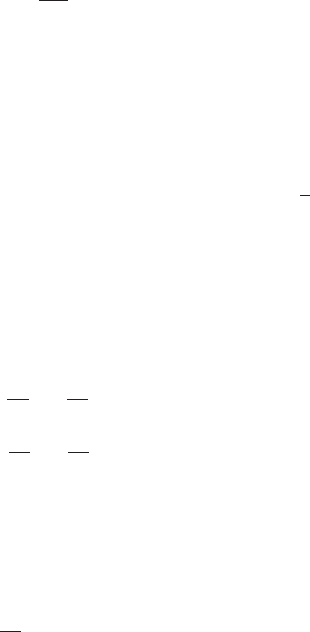
increases in the interval such that Ψx has an approximately exponential behavior. On
the other hand, if g
Λ
x < 0inx
1
,x
2
, the slope decreases, and Ψx has an oscillatory
behavior.
Λwx >qx
1
Ψ
2
Ψ
x
2
!
> 0 (7.124)
Λwx <qx
1
Ψ
2
Ψ
x
2
!
< 0 (7.125)
240 7 Sturm–Liouville Theory
7.3.7.1 Example: Fourier Series
The differential operator
2
x
2
,f0 f Π 0 (7.126)
is self-adjoint and the eigenvalue equation has solutions
Λ
n
u
n
x0 u
n
Sinnx , Λ
n
n
2
(7.127)
which satisfy the orthonormality condition
u
n
u
m
Π
0
Sinnx Sinmxx
Π
2
∆
n,m
(7.128)
The roots are obviously interleaved.
7.3.8 Comparison Theorems
Suppose that ux and vx satisfy
x
px
x
g
1
x
ux0 (7.129)
x
px
x
g
2
x
vx0 (7.130)
where px > 0 and g
1
xg
2
x in the interval a x b. One can then show that there
is at least one root of vx between any two roots of ux in this interval, such that vx
oscillates more rapidly than ux. To prove this result, known as Sturm’s first comparison
theorem, we argue by contradiction. First observe that
x
pu
'
v uv
'
uvg
2
g
1
(7.131)
Next, suppose that x
1,2
are two successive zeros of ux such that a x
1
<x
2
b.
Integration of the preceding equation between the roots of u gives
pu
'
v uv
'
x
2
x
1
x
2
x
1
uvg
2
g
1
x (7.132)
or
px
2
u
'
x
2
vx
2
px
1
u
'
x
1
vx
1
x
2
x
1
uvg
2
g
1
x (7.133)
If v does not have a root within this interval, we may assume without loss of generality
that it is positive throughout the interval. Similarly, we may also assume that u is positive
between its roots because the differential equations are linear and we are free to multiply

7.3 Properties of Sturm–Liouville Systems 241
solutions by a constant that will achieve the desired sign. Thus, the right-hand side is
nonnegative because g
2
2 g
1
in this interval and vanishes if and only if g
2
g
1
over the
entire interval. However, the assumption that u is positive between roots at x
1,2
requires
that u
'
x
2
< 0 and u
'
x
1
> 0, such that the left-hand side is negative. Therefore, the
assumption that vx does not change sign in this interval leads to a contradiction and we
can conclude that vx must have at least one root in the interval x
1
<x<x
2
.More
generally, Picone’s modification states that if
x
p
1
x
x
g
1
x
ux0 (7.134)
x
p
2
x
x
g
2
x
vx0 (7.135)
where 0 p
2
p
1
and g
1
g
2
in a x b, then Sturm’s first comparison theorem still
applies.
Recognizing that the Sturm–Liouville eigenvalue equation can be expressed in the
form
x
px
x
gx
yx0 (7.136)
where gxΛwxqx with wx > 0, we immediately see that increasing Λ makes the
solution yx more oscillatory. Suppose that yx satisfies
x
px
x
Λwxqx
yx0 ,ya0 (7.137)
and that ux satisfies
x
p
max
x
Λw
min
q
max
ux0 ,ua0 (7.138)
where the weight functions are replaced by their maximum or minimum values within the
interval a x b, as indicated. The solutions for u are simply sine functions with period
T
max
2Π
p
max
Λw
min
q
max
(7.139)
and, according to Picone’s modification, there is at least one root of y between successive
roots of u. However, because the period T
max
decreases as the eigenvalue Λ increases, it is
clear that the spacing between roots of y decreases as Λ!. The maximum separation
between zeros of y is T
max
/ 2. By applying a similar analysis to
x
p
min
x
Λw
max
q
min
vx0 ,va0 (7.140)
we find that the minimum separation between zeros of y is given by T
min
/ 2 where
T
min
2Π
p
min
Λw
max
q
min
(7.141)

242 7 Sturm–Liouville Theory
Therefore, if x
n
is the n-th zero of y it must be found in the interval
nΠ
p
min
Λw
max
q
min
<x
n
a<nΠ
p
max
Λw
min
q
max
(7.142)
The interval we found for x
n
can be used to deduce bounds upon the corresponding
eigenvalue. Suppose that the boundary conditions require yayb0 and let x
n
! b
and Λ!Λ
n
> 0. Simple manipulations then provide the bracketing conditions
1
w
max
nΠ
b a
2
p
min
q
min
< Λ
n
<
1
w
min
nΠ
b a
2
p
max
q
max
(7.143)
Although the numerical factors may be different, similar brackets can be deduced for more
general boundary conditions and often provide useful bounds when exact eigenvalues are
difficult to obtain or when very precise results are not needed. Such bounds can also pro-
vide limits and starting conditions for numerical methods of computing eigenvalues. Fur-
thermore, for large n one finds
n !
p
min
w
max
nΠ
b a
2
< Λ
n
<
p
max
w
min
nΠ
b a
2
(7.144)
and concludes that Λ
n
scales with n
2
for large n. This scaling is a general property of
Sturm–Liouville systems that is independent of the specific boundary conditions. Notice
that the spacing between eigenvalues cannot be made infinitesimal unless the interval is
infinite. Thus, the spectrum of eigenvalues might be continuous for an infinite interval,
but is discrete for a finite interval. Nevertheless, the eigenvalues increase without limit,
eventually scaling with n
2
. The lowest eigenvalue has the smallest number of nodes within
a x b that is consistent with the boundary conditions and increasing n increases the
number of nodes. Therefore, one can index the eigenfunctions according to the number
of nodes. When several eigenvalues are degenerate, a second index might be required to
distinguish between orthogonal eigenfunctions with the same number of nodes.
7.4 Green Functions
We have already seen that Green functions provide a powerful method for solving linear
inhomogeneous equations in which the output of a system can be expressed as a con-
volution of the input with its response to a point source. Many physical systems can be
represented in terms of self-adjoint operators. Therefore, it will often be useful to develop
representations of the Green function in terms of the eigenfunctions for self-adjoint sys-
tems. In this section we develop a couple of these methods.
7.4.1 Interface Matching
Suppose that
x
px
x
qx (7.145)

7.4 Green Functions 243
with suitable boundary conditions is a Sturm–Liouville operator that is self-adjoint with
respect to the density function wx on the interval a x b. We seek a Green func-
tion G
Λ
x, Ξ that satisfies
ΛwxG
Λ
x, Ξ ∆x Ξ
x
px
x
qxΛwx
G
Λ
x, Ξ ∆x Ξ
(7.146)
with the same boundary conditions. The subscript acknowledges the parametric depen-
dence of the Green function upon Λ. We expect G
Λ
x, Ξ to be continuous in value, but the
delta function produces a discontinuity in slope. The magnitude of this discontinuity is
determined by integrating the differential equation across the interface
b
a
x
px
x
qxΛwx
G
Λ
x, Ξx 1 (7.147)
such that
lim
!0
pΞG
'
Λ
Ξ , Ξ G
'
Λ
Ξ , Ξ 1 (7.148)
where p, q, and w are continuous. These conditions can be expressed more compactly as
$G
Λ
x, Ξ 0 , $G
'
Λ
x, Ξ
1
pΞ
(7.149)
where $ represents the change across the interface.
Further, suppose that we possess two independent solutions to the simpler homoge-
neous problems
Λwxy
a
x0 ,
a
y
a
x0 (7.150)
Λwxy
b
x0 ,
b
y
b
x0 (7.151)
with a common parameter Λ such that the Wronskian
W
Λ
xy
a
xy
'
b
xy
b
xy
'
a
x (7.152)
is nonzero throughout the region a x b. Notice that these solutions do not need to
satisfy both boundary conditions simultaneously; y
a
satisfies the lower and y
b
the upper
boundary condition. The equation for the Green function is also homogeneous in the
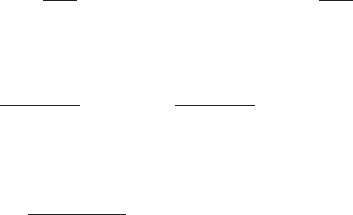
two separate regions x<Ξ and x>Ξ. Thus, we seek a Green function with piecewise-
continuous representation
x<ΞG
Λ
x, Ξ AΞy
a
x (7.153)
x>ΞG
Λ
x, Ξ BΞy
b
x (7.154)
244 7 Sturm–Liouville Theory
that automatically satisfies both boundary conditions. The coefficients are determined by
applying the matching conditions
$G
Λ
x, Ξ 0 BΞy
b
Ξ AΞy
a
Ξ 0 (7.155)
$G
'
Λ
x, Ξ
1
pΞ
BΞy
'
b
Ξ AΞy
'
a
Ξ
1
pΞ
(7.156)
at the interface, such that
AΞ
y
b
Ξ
pΞW
Λ
Ξ
,BΞ
y
a
Ξ
pΞW
Λ
Ξ
(7.157)
Therefore, we finally obtain the Green function in the form
G
Λ
x, Ξ
y
a
x
<
y
b
x
>
pΞW
Λ
Ξ
(7.158)
where x
<
is the smaller and x
>
is the larger of x and Ξ. One can show that the product
pΞW
Λ
Ξ is actually independent of Ξ for Sturm–Liouville systems; that exercise is left to
the reader. It is then clear that a Sturm–Liouville Green function satisfies the reciprocity
condition
G
Λ
x, Ξ G
Λ
Ξ,x (7.159)
showing that the effect of a point source at Ξ on the response at x is the same as the effect
of a point source at x on the response at Ξ.
The solution to a more general inhomogeneous problem of the form
ΛwxΨxwx f x (7.160)
with the same boundary conditions can now be expressed in the convolution form
Ψx
b
a
G
Λ
x, Ξf ΞwΞ Ξ (7.161)
where it is not necessary to include a solution to the homogeneous equation because the
Green function incorporates the boundary conditions automatically in its very construc-
tion. If we divide the convolution into lower and upper regions, the convolution integral
takes the form
ΨxpxW
Λ
x
1
y
b
x
x
a
y
a
Ξ f ΞwΞ Ξ y
a
x
b
x
y
b
Ξ f ΞwΞ Ξ
(7.162)
where pW
Λ
can be extracted because it is constant.
This method fails if W
Λ
Ξ 0. A Wronskian vanishes when two solutions are not lin-
early independent. Suppose that y
1
and y
2
satisfy the boundary conditions at both endpoints

7.4 Green Functions 245
simultaneously. Under those circumstances, ΛΛ
n
actually represents one the eigenvalues
of the Sturm–Liouville problem represented by
Λ
n
wxF
n
x0 , F
n
x0 (7.163)
and the Green function G
Λ
n
does not exist. We will return to this problem again later.
Similarly, the method also fails if px0 within the interval. The roots of px are
singular points for the underlying differential equation. Hence, Sturm–Liouville methods
are generally limited to the intervals between singular points and it can be difficult to
connect adjacent intervals. Although special care may also be needed if px vanishes at
one or both of the endpoints, we will assume that px is nonzero in the interior.
7.4.1.1 Example: Vibrating String
The Green function for a vibrating string clamped at both ends satisfies
2
x
2
k
2
G
k
x, Ξ ∆x Ξ,G0, Ξ G, Ξ 0 (7.164)
Rather than apply the general formula, let us apply the method of interface matching
directly. On the two sides of the interface we write
x<ΞG
k
x, Ξ a Sinkx (7.165)
x>ΞG
k
x, Ξ b Sinkx (7.166)
and identify the discontinuity in first derivative as
lim
!0
G
'
k
Ξ , Ξ G
'
k
Ξ , Ξ 1 (7.167)
to form the equations
0 b SinkΞ a SinkΞ (7.168)
1 kb CoskΞ a CoskΞ (7.169)
Thus, we obtain
x<ΞG
k
x, Ξ
Sinkx SinkΞ
k Sink
(7.170)
x>ΞG
k
x, Ξ
SinkΞSinkx
k Sink
(7.171)
These expressions can be combined into the more compact form
G
k
x, Ξ
Sinkx
<
Sinkx
>
k Sink
(7.172)
where x
<
is the smaller and x
>
is the larger of x and Ξ. The solution to the more general
inhomogeneous problem
d
2
x
2
k
2
Ψx f x, Ψ0Ψ0 (7.173)