
Kelly J.J. Graduate Mathematical Physics, With MATHEMATICA Supplements
Подождите немного. Документ загружается.

216 6 Analytic Continuation and Dispersion Relations
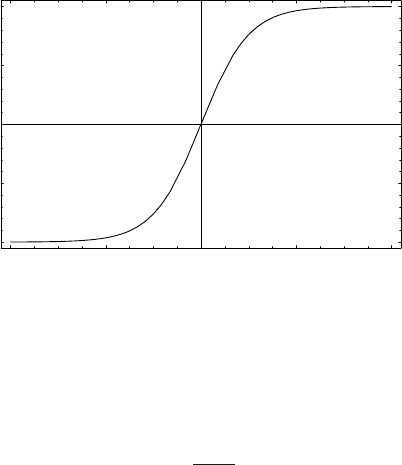
4 2 0 2 4
Ξ xvt
1
0.5
0
0.5
1
Ψ
Figure 6.12. A soliton solution to Eq. (6.110).
with Λ!0 approach the asymptotic speed c while weak kinks with Λ!Λ
0
propagate very
slowly. In fact, the existence of this type of solution with real v requires
Λ < Λ
0
Β< 2Ξ
2
Ξ>
A/2Τ (6.121)
The soliton velocity is also shown in Fig. 6.11.
Solitons are commonly found in systems described by nonlinear equations; in fact,
linear equations are often just an approximation for small amplitudes. However, if the
compensation between dispersion and nonlinearity needed for solitons to propagate with-
out changing shape were too delicate, it could be destroyed by external disturbances or by
imperfections or impurities in real systems. In fact, stability is crucial to the observation
of solitons, which otherwise would be little more than mathematical curiosities. Although
it is beyond the scope of this course, one can often demonstrate explicitly that solitons are
stable with respect to perturbations and propagate over long distances with little distortion
even under nonideal circumstances. When analytical techniques fail, numerical simula-
tions can be used to show that suitable initial profiles evolve into one or more solitons
which then propagate stably.

Problems for Chapter 6 217
Problems for Chapter 6
1. Analytic continuation of simple functions
The following functions are defined by definite integrals which converge in domain D.
For each, specify the original domain D, construct an analytic continuation into the largest
possible region of the complex plane, and specify the analytic domain for the parent func-
tions.
a) f z
0
zt
Sintt (6.122)
b) f
n
z
0
zt
t
n
t for integer n 2 0 . (6.123)
2. Euler transformation
Suppose that f z is represented as an alternating series of the form
f z
n0
n
a
n
z
n
(6.124)
that converges for z <R. In this problem we explore a procedure for analytic continua-
tion that uses differencing of coefficients to rearrange a power series in order to obtain a
representation that converges more rapidly and in a larger domain. Additional variations
of this method are omitted for the sake of brevity.
a) Show that
1 z f za
0
z
n0
n
∆a
n
z
n
(6.125)
where ∆a
n
a
n
a
n1
. Continuing this process, show that
1 z f za
0
Ζ∆a
0
Ζ
2
n0
n
∆
2
a
n
z
n
(6.126)
where
Ζ
z
1 z
, ∆
m
a
n
∆∆
m1
a
n
(6.127)
and obtain thereby a series expansion for gΖ 1z f z. Find an explicit expression
for ∆
m
a
n
.
b) To demonstrate the usefulness of the Euler transformation, demonstrate that the Euler
series for gΖ converges much more rapidly near Ζ*
1
2
than does the Taylor series
for f zLog1 z near z * 1. In fact, show that gΖ converges for Rez >
1
2
independent of Imz, which is a much larger region than for the original Taylor series.

218 6 Analytic Continuation and Dispersion Relations
3. High-frequency response
The temporal response of a dielectric medium to an applied electric field was expressed in
the form
DtEt
ΤEt ΤGΤ (6.128)
GΤ
1
2Π
Ω
ΩΤ
ΕΩ 1 (6.129)
Express ΕΩ in terms of a Fourier transform and perform a Taylor series of GΤ applicable
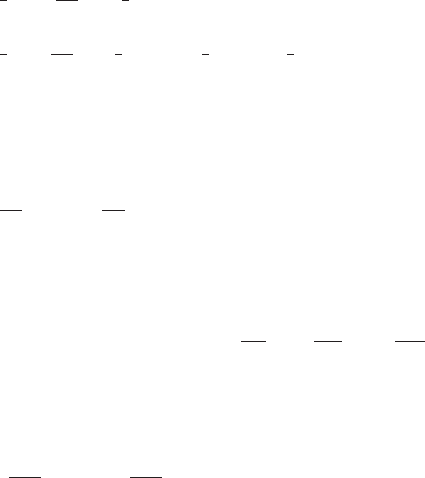
for Τ!0
. Note that this is a somewhat unusual series because GΤ 0forΤ0, so
that derivatives at Τ0 are understood as limits for Τ!0
. How is the high-frequency
behavior of ΕΩ related to the time dependence of G? Compare your results with those of
the semiclassical oscillator model.
4. Absorption band
Suppose that a material absorbs electromagnetic radiation only in the band Ω
1
< Ω < Ω
2
.
For simplicity assume that Im ΕΗis constant within, and vanishes outside, the absorption
band. Use the Kramers–Kronig model to evaluate Re Ε. Sketch this function and compare
with the single-mode model.
5. Subtracted dispersion relations
If f z does not vanish as z !, or does not diminish rapidly enough to ensure good
convergence of the dispersion integrals, one can apply the technique to the function z
1
f z
instead. More generally, dispersion relations for a function of the form gz
f z
f x
0
/ z x
0
will converge more rapidly than for f z itself, especially if an optimum
choice of x
0
is made. Derive dispersion relations for gx, assuming that gz is analytic in
the upper half-plane and vanishes on a great semicircle, using a contour with detours on
the real axis around both x and x
0
. Then deduce the dispersion relations for f x.
6. Hilbert transforms
Given
vx
Π
us
s x
s
1
1 x
2
(6.130)
determine ux and construct the corresponding analytic function f zux, yvx, y.
Then verify that f z satisfies the necessary requirements for u, v to constitute a Hilbert
transform pair. Note that ux[ux, 0 and vx[vx, 0.
7. Dispersion of a Gaussian wave function
Suppose that at time t 0 an electron is represented by a wave packet of the form
˜
Ψk
4ΠΣ
2
0
1/ 4
Exp
S
T
T
T
T
T
T
T
T
T
T
U
Σ
2
0
k k
0
2
2
V
W
W
W
W
W
W
W
W
W
W
X
(6.131)
where k
0
and Σ
0
are constants. Assume that the velocity is nonrelativistic, such that the
kinetic energy is given by Ωk
2
/ 2m.
Problems for Chapter 6 219
a) Evaluate the wave function in space and show that it is normalized properly.
b) Find expressions for the phase and group velocities.
c) Evaluate the time dependencies for the mean position, ¯x, and root-mean-square (rms)
width, Σ, where
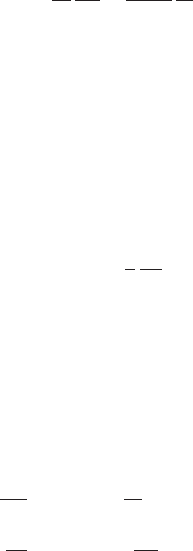
¯xt
Ψx, txΨx, t
Ψ
x, tΨx, tx x (6.132)
Σ
2
t
Ψx, t
x ¯x
2
Ψx, t
Ψ
x, tΨx, tx ¯x
2
x (6.133)
d) Suppose that an electron with 10 keV kinetic energy is initially confined to Σ
0
1Å,
about the size of an atom. How much time is required for appreciable spreading of the
wave packet? How far does it travel in that time? How much time does it take for the
wave function to become broader than a typical laboratory?
8. Plane electromagnetic waves in conducting media
One can show that electromagnetic waves satisfy a wave equation of the form
+
2
ΕΜ
c
2
(
2
(t
2
4ΠΣΜ
c
2
(
(t
E 0 (6.134)
when the permittivity Ε, permeability Μ, and conductivity Σ are constant. The electric field
for a plane wave with frequency Ω is the real part of
E
r,t
E
0
Exp
k ,
r Ωt
(6.135)
a) Separate the wave number k n ΓΩ/cinto real and imaginary parts. Discuss the
dependence of n and Γ upon frequency for both low and high conductivity.
b) The electric and magnetic fields are related by
+
E
1
c
(
B
(t
(6.136)
Evaluate and discuss the dependencies of the relative magnitude and phase of the
magnetic and electric fields for plane waves upon frequency.
9. Signal transmission in coaxial cable
A coaxial transmission line consists of two concentric cylindrical conductors separated by
a dielectric. The voltage and current changes across a length $z of the inner conductor are
described by
$V
$z
RI L
(I
(t
(6.137)
$I
$z
GV C
(V
(t
(6.138)
where R, L, and C are the resistance, inductance, and capacitance per unit length and G
is the conductance per unit length for leakage current between the conductors. R, L, G
usually vary relatively slowly with frequency.
220 6 Analytic Continuation and Dispersion Relations
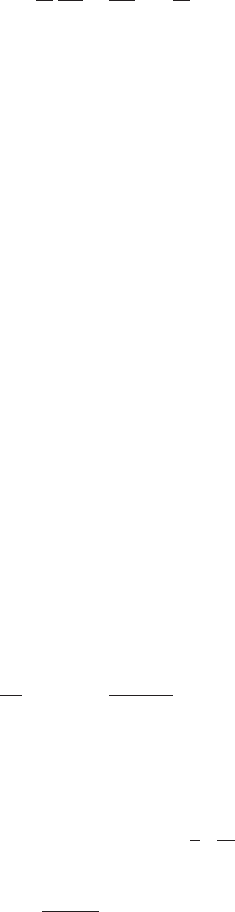
a) Show that both the voltage and the current satisfy decoupled equations of the form
1
v
2
0
(
2
(t
2
(
2
(z
2
Α
(
(t
Β
V
I
0 (6.139)
Determine the phase velocity for an ideal lossless cable with R ! 0, G ! 0. Under
what conditions do signals propagate without dispersion?
b) Using plane-wave solutions of the form V z, t-Expkz Ωt, evaluate the dis-
persion relation kΩ Κ Γ and determine the frequency dependencies of the wave
number, Κ, and attenuation coefficient, Γ. Also determine the phase velocity. Discuss
the limiting cases of
(i) an ideal lossless cable,
(ii) high frequencies, and
(iii) G ! 0.
c) Express the characteristic impedance Z V/Ifor sinusoidal solutions in terms of the
parameters (R, L, C, G) and the frequency Ω. Determine the phase difference between
the voltage and the current for high frequencies.
d) A logic pulse
V0,tV
0
<tV
0
<t T (6.140)
is injected at z 0 and propagates on the cable for z>0. Produce a Fourier represen-
tation for the wave form at later times; however, do not waste much time attempting
to evaluate the integral, which is very difficult.
10. Landau damping
One can show that longitudinal density waves in plasma described by nx, tn
0
Exp
kx
Ωt
satisfy a dispersion relation of the form
k
Ω
p
2
( f/(v
v Ω/k
v (6.141)
where Ω
p
n
0
e
2
/
0
m is the plasma frequency, n
0
is the average electron density, m is the
electron mass, and
f v2Πv
2
T
1/ 2
Exp
S
T
T
T
T
T
T
T
T
T
U
1
2
v
v
T
2
V
W
W
W
W
W
W
W
W
W
X
(6.142)
is the Maxwell velocity distribution expressed in terms of the characteristic thermal veloc-
ity v
T
k
B
T/m. Treat the wave number k as a real variable and Ωk as a complex-valued
function of k to be obtained as a solution to this integral equation. Assume that Ω
p
D kv
T
.
a) Notice that the integrand would have a pole on the integration path if Ω were real, but
Ω may actually be complex. Alternatively, we can assume that the pole is practically
Problems for Chapter 6 221
upon the real axis and use a semicircular detour to avoid it. Show that the dispersion
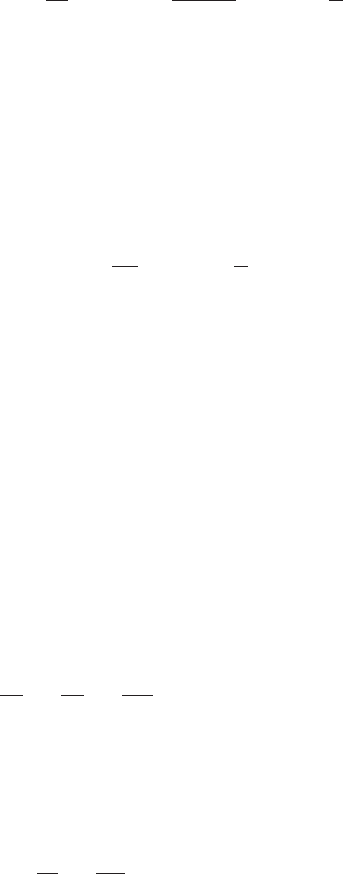
relation takes the form
k
Ω
p
2
f
'
v
v Ω/k
v Πf
'
Ω
k
(6.143)
depending upon the choice of detour and provide a physical criterion for selection of
the proper sign.
b) Approximate the principal-value integral using the assumptions Ω*Ω
p
and Ω
p
D
kv
T
.
c) Find an approximate solution for Ωk. Which contour deformation is required?
11. Faster than light?
Suppose that a one-dimensional electromagnetic wave is described by
Ψx, t
Ω
2Π
˜
ΨΩ Exp
Ω
c
nΩx ct
(6.144)
where nΩ is the complex refractive index and that
Ψx>0,t <00 (6.145)
Thus, the spectral amplitude is given by
˜
ΨΩ
0
tΨ0,t ExpΩt (6.146)
where the frequency Ω is real. It is useful to extend
˜
ΨΩ !
˜
Ψz into the complex plane.
On physical grounds we expect nΩ ! 1 for very large frequencies and we assume that
nz is analytic in the upper half-plane with nz!1 when z!. Evaluate the signal
Ψx, t for x>ct. Many systems have frequency bands where the phase velocity exceeds
light speed because nΩ < 1; how does that situation affect the result?
12. KdV equation
Water waves on the surface of a shallow channel satisfy the Korteweg–deVries equation
(Ψ
(t
Ψ
(Ψ
(x
Α
(
3
Ψ
(x
3
0 (6.147)
where the variables have been scaled conveniently and where certain approximations that
are needed for the derivation remain implicit. This equation nicely illustrates how a suit-
able balance between dispersion and nonlinearity can produce a soliton.
a) Suppose that the amplitude is sufficiently small to omit the nonlinear term, such that
(Φ
(t
Α
(
3
Φ
(x
3
0 (6.148)
Show that there exist solutions of the form
Φx, t
˜
Φk Expkx Ωt k (6.149)
and deduce Ωk for this linear approximation.

222 6 Analytic Continuation and Dispersion Relations
b) Next, suppose that Α is small, such that
(Η
(t
Η
(Η
(x
0 (6.150)
Show that there exist traveling waves of the form Ηx, tΗx vt where v depends
upon the amplitude Η. Describe qualitatively the time development of Η given that
Ηx, 0 initially has a bell shape. You will not be able to construct a familiar single-
valued function, but this method does provide an algorithm suitable for numerical
evaluation.
c) Next, show that if we assume a traveling wave solution of the form Ψx, tΨx vt,
the KdV equation can be integrated once. Evaluate the constant of integration when
Ψx, t0fort !.
d) Finally, show that there exist solitons of the form
Ψx, tA SechBx vt
2
(6.151)
for suitable choices of A and B. Provide a physical description of this solution.
13. Sine–Gordon equation
The sine–Gordon equation
(
2
Ψx, t
(t
2
(
2
Ψx, t
(
2
x
2
Sin
Ψx, t
(6.152)
arises in models of systems with periodic potentials. In this form all variables are dimen-
sionless.
a) Deduce the potential V Ψ for which the inhomogeneous term is given by (V/(Ψ.
Identify the stable and unstable equilibrium states of the field. Show that there exist
position-independent solutions that describe small-amplitude oscillations about a sta-
ble equilibrium state of the field.
b) Construct approximate solutions that describe traveling waves of small-amplitude
oscillations about the stable states and deduce the corresponding dispersion relation.
c) Show that there exist soliton solutions of the form
Ψ
2nΠ4ArcTan
Exp
x vt
1 v
2
(6.153)
Sketch and provide a physical interpretation of these solitons. (It is sufficient to verify
the solutions by substitution and to use or equivalent software to per-
form the algebra.)
7 Sturm–Liouville Theory
Abstract. The Sturm–Liouville operator with suitable boundary conditions provides
a self-adjoint system with real eigenvalues and a complete set of orthogonal eigen-
functions. We explore the general properties of such systems and their role in con-
structing Green functions for physical systems. Perturbative and variational methods
are also introduced.
7.1 Introduction: The General String Equation
The displacement \x, t of a finite, but not necessarily uniform, string can be described
by a Lagrangian of the form
L
b
a
x (7.1)
where the Lagrangian density takes the form
(7.2)
1
2
Σx
(\
(t
2
1
2
Σx\
2
t
(7.3)
1
2
Τx
(\
(x
2
1
2
Κx\
2
1
2
Τx\
2
x
1
2
Κx\
2
(7.4)
Here Σ is the linear mass density, Τ is the tension, and Κ is the stiffness parameter for an
additional linear restoring force that might be produced by the coupling of the string to
another system. It is useful to define generalized velocities
\
t
(\
(t
, \
x
(\
(x
(7.5)
based upon the generalized coordinate \. The equation of motion is determined by mini-
mizing the action, whereby
∆
t
2
t
1
L t 0
t
2
t
1
t
b
a
x
(
(\
∆\
(
(\
t
∆\
t
(
(\
x
∆\
x
0 (7.6)
where the endpoints in both space and time are held constant, as are coupling functions Σ,
Τ, Κ. Substituting
∆\
t
(∆\
(t
, ∆\
x
(∆\
(x
(7.7)
Graduate Mathematical Physics. James J. Kelly
Copyright © 2006 WILEY-VCH Verlag GmbH & Co. KGaA, Weinheim
ISBN: 3-527-40637-9

224 7 Sturm–Liouville Theory
into
t
2
t
1
t
b
a
x
(
(\
∆\
(
(\
t
∆\
t
(
(\
x
∆\
x
t
2
t
1
t
b
a
x
(
(\
∆\
(
(\
t
(∆\
(t
(
(\
x
(∆\
(x
(7.8)
and using the boundary conditions
x a, b or t t
1
,t
2
∆\0 (7.9)
to integrate by parts, we find
∆
t
2
t
1
L t 0
t
2
t
1
t
b
a
x
(
(\
(
(t
(
(\
t
(
(x
(
(\
x
∆\ 0 (7.10)
This equation must be satisfied for independent variations ∆\, which then requires that
the coefficient of ∆\ vanishes anywhere in the spacetime interior. Thus, the continuum
Euler–Lagrange equations take the form
(
(t
(
(\
t
(
(x
(
(\
x
(
(\
0 (7.11)
Therefore, using
(
(\
Κx\ (7.12)
(
(\
t
Σx\
t
(7.13)
(
(\
x
Τx\
x
(7.14)
we finally obtain the general string equation
(
(x
Τx
(\
(x
Σx
(
2
\
(t
2
Κx\ 0 (7.15)
The normal modes of vibration can be analyzed by hypothesizing the sinusoidal time
dependence
\x, tΨx ExpΩt (7.16)
such that
x
Τx
Ψx
x
Ω
2
ΣxΨxΚxΨx0 (7.17)
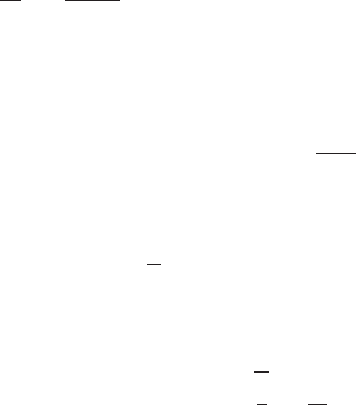
7.1 Introduction: The General String Equation 225
represents the spatial dependence. In addition, one must impose boundary conditions on
the normal modes. For example, if the string is clamped at both ends one would require
clamped ΨaΨb0 (7.18)
while if the string were free at either end we would require the derivative to vanish there
instead. In general, nontrivial solutions that are consistent simultaneously with two sepa-
rate boundary conditions are possible only for particular characteristic values of the fre-
quency. These characteristic frequencies, Ω
n
, are called eigenvalues and the corresponding
spatial functions, Ψ
n
, are called eigenfunctions or normal modes. Thus, the nonuniform
string is described by an eigenvalue problem of the form
x
Τx
Ψ
n
x
x
ΚxΨ
n
xΩ
2
n
ΣxΨ
n
x0 (7.19)
This equation reduces to the familiar case of a vibrating string in the special case of
constant Τ, constant Σ, and vanishing Κ, such that
Τx!Τ, Σx!Σ, Κx!0
2
Ψ
n
x
2
k
2
n
Ψ
n
(7.20)
where
Ω
n
! k
n
c, c
2
Τ
Σ
(7.21)
Finally, if a string of length is clamped at both ends, the eigenvalues are simply k
n
nΠ/
where n is an integer. The solutions
Ψ0Ψ0 Ψ
n
x
2
Sin
nx
(7.22)
form a complete orthonormal set with
0
Ψ
n
xΨ
m
xx ∆
n,m
(7.23)
and can be used to represent the spatial dependence of any piecewise continuous function
f x
n1
a
n
Ψ
n
xa
n
0
Ψ
n
x f xx (7.24)
as a Fourier sine series. These familiar and useful properties can be generalized to the
nonuniform string, with suitable modifications to accommodate variations of tension or
density. (Note: the term orthonormal means orthogonal and normalized.)