
Kelly J.J. Graduate Mathematical Physics, With MATHEMATICA Supplements
Подождите немного. Документ загружается.


366 9 Boundary-Value Problems
a) Show that ΨΞ is related to a Bessel function with complex argument and normalize the
solution to total current I.
b) Express the solution for a good conductor with 4ΠΣ/ ΕΩ D 1 as a function of Γ a where
Γ
4ΠΣΜΩ/c
2
. Plot and discuss
ΨΞ/Ψa
2
for both large and small values of Γa.
c) Evaluate the impedance Z V/Iwhere V is the voltage drop over a length measured
at the surface of the wire. The impedance can be expressed in the form Z R ΩL
where R is the resistance and L is the inductance for frequency Ω. Evaluate R and L for a
good conductor in both small and large Ω limits. Sketch and interpret RΩ and LΩ for
a good conductor. It is useful to express these quantities in terms of the skin thickness
∆
2/ Γ.
d) Express the solution for a good conductor in terms of the Kelvin functions, ber
Ν
x and
bei
Ν
x, defined by
J
Ν
Π/ 4
x[ber
Ν
xbei
Ν
x (9.267)
for positive real x where J
Ν
is the regular Bessel function of order Ν. (Hint: compare the
differential equations for J
Ν
Π/ 4
x with the present equation.) This representation is
sometimes seen in electrical engineering.
22. Evolution of line vortex
The vorticity distribution Ωx, y, t in a viscous fluid satisfies a diffusion equation of the
form
(Ω
(t
v+
2
Ω (9.268)
where the kinematic viscosity v is a positive constant. Suppose that at t 0thereisaline
vortex
Ωx, y, 0A∆x∆y (9.269)
where A is constant and assume that Ω!0 when r !. Determine the subsequent
behavior of Ω using each of the following methods.
a) Use a Laplace transform with respect to time and look up the required inverse transform.
b) Use a two-dimensional Fourier transform with respect to position.
c) Assume a similarity solution of the form Ω
A
vt
f
r
2
vt
and determine f. (Hint: examine
the behavior of the differential equation for f Ξ to show that the substitution f Ξ
gΞ
Ξ / 4
provides an integrable equation for gΞ.)
23. Scattering by separable s-wave potential
Often the interaction between two particles is nonlocal, for which the time-independent
Schrödinger equation takes the form
k
2
+
2
Ψ
k,
r
2Μ
V
r,
r
'
Ψ
k,
r
'
3
r
'
0 (9.270)
where k is the wave number in the center of mass and Μ is the reduced mass.

Problems for Chapter 9 367
a) Develop an integral equation for scattering solutions and identify the scattering ampli-
tude.
b) A separable s-wave potential is defined by
2ΜV
r,
r
'
ΛΝrΝ
r
'
(9.271)
where Λ is a strength parameter and Νr depends only upon the distance r
r. Obtain
an exact solution for the scattering amplitude in terms of
˜
Νk, where
˜
Νk
0
Νr j
0
krr
2
r (9.272)
Under what conditions does the Born series converge? (Hint: solve first for the quantity
A
k
ΝrΨ
k,
r
3
r.)
c) Evaluate the scattering amplitude for the specific case of a Yamaguchi potential with
˜
Νk
0
2
0
2
k
2
(9.273)
where 0 is a positive range parameter. Express the phase of the scattering amplitude in
terms of the dimensionless parameters Γ2ΠΛ0 and Κk/0. Under what conditions
does the potential support a bound state? For neutron–proton scattering there is a low-
energy bound state in the
3
S
1
channel but the potential for the
1
S
0
channel is not quite
strong enough to produce a bound state. Compare the phase shifts for these channels as
functions of Κ assuming that Γ is either 5% stronger or 5% weaker than the minimum
strength for a bound state. (Note: for the phase shift it is best to use the quadrant-
sensitive version of the inverse tangent function.)
d) Express k Cot
∆
0
k
, where ∆
0
k is the phase shift, in terms of
˜
Νk. Obtain general
expressions for the scattering length and effective range assuming that
˜
Νk can be
expanded in even powers of k. Then evaluate the scattering length and effective range
for the specific case of a Yamaguchi potential. Describe the behavior of the scattering
length for Γ near the critical value for a bound state.
24. Scattering by a soft cylinder
Plane waves with wave number k are incident upon an infinitely long cylinder of radius R
with the direction of propagation perpendicular to the axis of the cylinder. The surface
of the cylinder is soft, such that the total wave (incident plus scattered) vanishes at R.
Construct a formal expansion for the scattered field and then examine the leading term in
the long-wavelength limit kR I 1.
10 Group Theory
Abstract. Group theory provides powerful methods for analyzing the consequences
of symmetries. We begin with the basic concepts for finite groups and their matrix
representations, including orthogonality theorems and methods for constructing and
analyzing irreducible representations. These concepts are then extended to continu-
ous Lie groups. The irreducible representations of the quantum mechanical rotation
group and their direct products are analyzed in detail. Finally, the application of uni-
tary groups to particle theory is discussed briefly.
10.1 Introduction
Many of the general features of the dynamics of physical systems are determined or
largely constrained by their symmetries, and symmetries are often associated with con-
served quantities. For example, momentum conservation is a consequence of translational
symmetry, angular momentum conservation originates in rotational symmetry, and parity
embodies reflection symmetry. By classifying the states of a system according to irreduc-
ible representations of its symmetry group, one can deduce general selection rules that
forbid certain transitions or can deduce patterns among the allowed transitions. These and
other implications of symmetries can be studied using the mathematical theory of groups
in which the symmetry operators are treated as elements of an algebraic system. For exam-
ple, the symmetries of an equilateral triangle in a plane consist of an identity element, two
rotations, and three reflections. These operators are described as elements of a group that
obeys algebraic rules similar to those of ordinary algebra, except that the group elements
are more abstract than the natural numbers. Thus, one can often deduce important prop-
erties of the physical system by applying the theorems of group theory to its symmetry
operators instead of by solving the differential equations that describe its dynamics. The
early development of group theory was largely motivated by crystallography, but its most
important applications are now in quantum mechanics, field theory, and particle physics.
The symmetries of global gauge transformations determine the conserved quantities while
the symmetries of local gauge transformations of quantum fields determine, up to coupling
constants, the types of interactions among the particles represented by those fields. In fact,
so important has group theory become to particle theory that an early theory of grand uni-
fication using supersymmetry is generally referenced by its symmetry group, SU(5), rather
than by either its dynamical principles or its authors’ names (Georgi and Glashow).
The theory of groups is a very large and highly developed subject in both mathematics
and physics. A comprehensive treatment would require at least one semester and a dedi-
cated textbook. Nevertheless, this topic is sufficiently important to modern physics that we
include a synopsis even though it diverges from the main topic of this book. We begin with
Graduate Mathematical Physics. James J. Kelly
Copyright © 2006 WILEY-VCH Verlag GmbH & Co. KGaA, Weinheim
ISBN: 3-527-40637-9
370 10 Group Theory
the theory of finite groups and their matrix representations. We include proofs of most of
the theorems; these proofs presume familiarity with linear algebra. Our primary examples
study small amplitude vibrations of highly symmetric configurations of masses. We then
generalize these results to continuous groups, especially Lie groups, but do not always
provide proofs – many of the results are analogous to those for finite groups but the proofs
are often more technical. We discuss several types of representations, including matri-
ces, differential operators, and eigenfunction multiplets, emphasizing that general results
depend upon the abstract structure of the associated Lie algebra instead of the particular
representation at hand. These techniques are then used to analyze the quantum mechanical
rotation group in considerable detail. Finally, we give a brief discussion of the application
of unitary groups in particle physics.
10.2 Finite Groups
10.2.1 Definitions
Consider a finite set of objects, S
a
a
i
,i 1,N.Atransformation M is a one-to-one
mapping of S
a
! S
a
described by Ma
i
a
j
. For example, the permutation
Ma
1
a
2
,Ma
2
a
3
,Ma
3
a
1
(10.1)
is one example of a one-to-one mapping of a
1
,a
2
,a
3
upon itself. A set of such transfor-
mations, G M
i
,i 1,m, is described as a group with respect to a law of composition,
figuratively described as multiplication, if it satisfies the following conditions.
1. If M
i
and M
j
are elements of the group, then their product M
i
M
j
is also a member of
the group.
2. Multiplication of group elements is associative, such that M
i
M
j
M
k
M
i
M
j
M
k
.
3. The group must contain an identity element, labeled I, such that IM
i
M
i
I M
i
for
every M
i
G.
4. For every M
i
G, there exists an inverse element M
1
i
G such that M
1
i
M
i
M
i
M
1
i
I.
The number of elements in a group is called its order. Groups may be finite, countably
infinite, or continuous in order. The present section develops some of the general properties
of finite groups but many will apply, with obvious generalizations, to infinite groups also.
Note that “multiplication” means composition of successive transformations, which
is not necessarily multiplication in the conventional sense. For example, the set of inte-
gers constitutes a countably-infinite group with respect to addition: the set is closed with
respect to addition (even though the number of elements is infinite); addition of integers is
associative; the identity element is 0 because 0 x x 0 x; and for each x the inverse
x belongs to the group. Similarly, the integers 0, 1,...,m1 constitute a finite group of
order m under addition modulo m. Ordinary multiplication of integers, on the other hand,
does not constitute a group because there is no inverse element for 0.
10.2 Finite Groups 371
The structure of a finite group can be exhibited by its multiplication table. Consider,
for example, addition of integers modulo three. There are then three elements that we will
label abstractly by I 0, a 1, b 2 such that ab Moda b, 30 I. The complete
“multiplication” table is shown in Table 10.1.
Table 10.1. Group multiplication table for cyclic group of order 3.
C
3
Iab
I Iab
a
abI
b
bI a
Notice that each element occurs exactly once in every row and every column and that
each element has an inverse. One often omits the labels from a group multiplication table
because they simply repeat the first row and column when the identity element is placed
in the upper left interior corner. This particular group has order 3 and is identified as C
3
,
the cyclic group of order 3. Observe that each row or column is a cyclic permutation of
the group elements. Later we will prove that any group of prime order is cyclic. Two
elements commute if M
i
M
j
M
j
M
i
. A group is described as abelian if its multiplication
law is commutative, such that M
i
M
j
M
j
M
i
, for any i, j and as nonabelian otherwise.
The group multiplication table for an abelian group is symmetric about its diagonal. The
addition of integers is abelian, but most groups are nonabelian.
Two groups that can be arranged to have the same multiplication table are isomorphic.
For example, the symmetric group S
n
consists of all permutations of n distinguishable
objects. Thus, S
3
is of order 6 and its elements
P
1,2,3
A, B,C A, B,C (10.2)
P
1,3,2
A, B,C A,C, B (10.3)
P
2,1,3
A, B,C B, A,C (10.4)
P
2,3,1
A, B,C B,C, A (10.5)
P
3,1,2
A, B,C C, A,B (10.6)
P
3,2,1
A, B,C C, B,A (10.7)
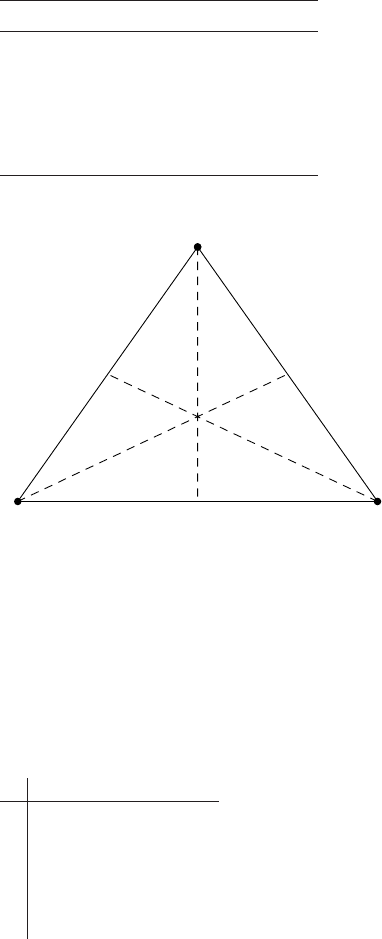
can be enumerated by considering their transformation of a generic set of three objects,
denoted A, B,C. Alternatively, there are six symmetry operations that leave an equilateral
triangle invariant, consisting of rotations through 120°, 240°, 360°, and three reflections
about bisectors. The entire set of symmetries can be constructed from the identity ele-
ment I, the basic 120° counterclockwise rotation R, and the reflection P (for parity) across
the vertical bisector. The elements of these two groups can be placed in a one-to-one cor-
respondence that makes their multiplication tables identical. Therefore, these groups are
isomorphic and their formal properties are identical. In Fig. 10.1 we compare the symme-
tries of an equilateral triangle with the elements of S
3
and assign generic labels for use in
composing the multiplication Table 10.2.
The permutation notation may be transparent, but the group properties would be the
same whatever the context in which S
3
emerges. Therefore, it is customary to employ
372 10 Group Theory
Table 10.2. Isomorphism between symmetries of an equilateral triangle and permutations of three
objects (vertices).
Generic Triangle Permutation Order
II [123] 1
aR[312] 3
bR
2
[231] 3
cP[132] 2
dPR[321] 2
ePR
2
[213] 2
A
BC
Figure 10.1. The symmetries of an equilateral triangle include the identity I, 120° counterclockwise
rotation R, reflection across the vertical bisector P, and the combinations R
2
, PR,andPR
2
.
more abstract labels, such as I, a, b, c, d, e, and to display the group multiplication table
in the form in Table 10.3. Notice that this group is nonabelian. Some find assembly of
the multiplication table easier using permutations and others using geometrical reasoning.
(Make sure that you can reproduce this table using both methods!)
Table 10.3. Group multiplication table for S
3
.
S
3
I abcde
I I abcde
a
abI ecd
b
bI adec
c
cdeIab
d
decbIa
e ecdabI
Successive applications of the same transformation is represented by a power of the
group element, such that
10.2 Finite Groups 373
M
n
i
M
i
M
n1
i
,M
0
i
I (10.8)
where I is the identity element. A transformation is described as order k if each M
n
i
is
distinct for 0 n<k. In the case of S
3
, we find that I is order 1, P, PR, PR
2
are order 2,
and that R, R
2
are order 3. The powers of an element of order k form a cyclic group of
order k, defined by
CC
i
C
i1
,C
k
C
0
I (10.9)
Cyclic groups are abelian.
Finally, we mention a trivial result that is so useful that it is often called the rearrange-
ment theorem. Suppose that g is any element of the group G G
i
. The product gG
gG
i
,i 1,n contains every element of G exactly once but probably in a new order.
Thus, any complete sum over functions of a group element can then be rearranged by mul-
tiplying the argument by an arbitrary group element according to
hG
f gh
hG
f h (10.10)
without affecting its value.
10.2.2 Equivalence Classes
An element b is described as conjugate to element a if there exists an element u G
such that uau
1
b. In other contexts this relationship might be described as similarity,
so we will employ the same symbol a G b. Obviously, every element is conjugate to
itself, a G a, and this relationship is commutative, a G b b G a. It is also transitive:
a G b, b G c a G c.Anequivalence class consists of the set of all elements that are
conjugate to each other. The identity element forms a class unto itself and each element of
an abelian group also constitutes its own class; hence, the notion of classes is most useful
for nonabelian groups. Note that all elements of a class must have the same order. If we
construct b
n
using
b uau
1
b
n
uau
1
,,,uau
1
ua
n
u
1
(10.11)
we find a
k
I b
k
I.
Let us return to S
3
. Recognizing that there are three elements of order 2, consisting of
c, d, e or P, PR, PR
2
, we wonder whether they constitute an equivalence class. By direct
calculation using Table 10.3, we find
aca
1
acb eb d c G d (10.12)
beb
1
bea ca d e G d (10.13)
and use transitivity to conclude that c G d G e forms an equivalence class. Similarly, a G b
or R G R
2
also form a class.
374 10 Group Theory
10.2.3 Subgroups
A subset H of the elements of G that forms a group with respect to the same composition
law is described as a subgroup of G. This relationship is denoted using the notation of sets,
H G. Every group G contains two trivial subgroups, one consisting of just the identity
element I and the other consisting of G itself; these are described as improper.One
of the main problems of group theory is the construction and classification of all proper
subgroups of a specified group. The relevant criteria are that H be closed with respect to
multiplication and that inverses are present for each element; the associative property is
satisfied automatically and every subgroup must contain the identity element.
If K is a subgroup of H and H is a subgroup of G, then K is a subgroup of G. Because
every group must contain its subgroups, one can construct the sequence G c H c K c I.
We now derive Lagrange’s divisor theorem, which states that the order of a subgroup
must be a divisor of the order of its parent. This theorem is obviously true for improper
subgroups containing either one or all elements. Suppose that H is a proper subgroup of
G and label its elements H
i
,i 1,h where h is the order of H and H
1
I is the identity
element. Consider an element a G that does not belong to H and construct the left coset
aH aH
i
,i 1,h containing the products of a with each H
i
. This set is not a group
because it does not contain the identity element. Each element of aH is distinct and none
are included in H. (Note that aH
i
H
j
a H
j
H
1
i
H, contrary to the assumption
that a/ H.) If the union of H and aH, both of order h, is not G itself, we select another
element b and construct a new left coset bH of order h that has no overlap with either H or
aH. (If bH
i
aH
j
then b aH
j
H
1
i
aH because H
j
H
1
i
H.) Thus, we can divide G
into a subgroup H and its cosets according to
G H aH bH (10.14)
where each subset contains h elements. If g is the order of G and h is the order of H, then
g mh where m is the index of the subgroup and equal to the number of independent
cosets plus one. Therefore, h is a divisor of g, as stipulated by Lagrange’s theorem.
Once again consider S
3
, where 3 and 2 are divisors of its order. There is one subgroup
of order 3, namely I,a,b, that is isomorphic to the group of invariant proper rotations of
an equilateral triangle, and there are three subgroups of order 2, namely I,c, I,d, I,e
based upon reflections across a bisector.
If a G is an element of order k, we can construct a cyclic group I,a,a
2
,...,a
k1
where a
k
I. This cyclic group, called the period of a, is the smallest subgroup of G that
contains a and its order must be a divisor of the order of G. Therefore, all groups with
prime order must be cyclic and can be generated from one of its elements other than the
identity.
Although our derivation of the divisor theorem employed left cosets aH, we could just
as easily have chosen right cosets Ha. Left and right cosets need not be the same, but the
argument still works. In the special case that aH Ha H aHa
1
for any a G,we
describe H as an invariant subgroup of G. Invariant subgroups clearly must contain one
or more complete equivalence classes. More generally, if H is a subgroup of G, and a is
any element of G, then aHa
1
is also a subgroup of G described as conjugate (or similar)
10.2 Finite Groups 375
to H. Thus, invariant subgroups are self-conjugate with respect to any element of its parent
group. A group that contains no proper invariant subgroups is described as simple. Cyclic
groups are simple by that criterion.
Invariant subgroups have some very important properties. Consider the multiplication
of two cosets, aH and bH, of an invariant group H. Such a product is defined as the set
of all products of pairs of elements from the two sets, taking care not to assume that
multiplication commutes. We find
aHbHaHbH abHH abHHabH (10.15)
where HH H because H must be closed to form a subgroup. Thus, the product of two
cosets of H is itself a coset of H. In fact, we can identify the cosets constructed from an
invariant subgroup H as the elements of a new factor group, denoted F G/H, such that
F H,g
1
H,g
2
H,... (10.16)
where the g
i
are elements of G that are not contained in H. (If g
i
were a member of H,the
coset would simply be a re-ordering of H itself.) Proving that F actually is a group is an
instructive exercise. First, we test for closure. Assuming that both g
i
and g
j
belong to G
but not to H, we find that the product
F
i
F
j
g
i
Hg
j
Hg
i
g
j
H F
i
F
j
F (10.17)
is indeed an element of F because the product g
i
g
j
belongs to G but not H. Second, we
verify that the associative property
F
i
F
j
F
k
g
i
H
g
j
Hg
k
H
g
i
Hg
j
H
g
k
H F
i
F
j
F
k
(10.18)
is simply inherited from G. Third, we identify H as the identity element of F because
HF
i
Hg
i
Hg
i
HHg
i
H F
i
(10.19)
F
i
H g
i
HH g
i
H F
i
(10.20)
using associativity and H
2
H. Finally, we verify that F contains an inverse
F
1
i
g
i
H
1
F
i
F
1
i
g
i
Hg
1
i
H
1
g
i
g
1
i
HH
1
I (10.21)
for every element because the inverses for each g
i
belong to G and not H while H
1
is the
list of inverses for each member of H, all of which belong to H. Therefore, F is indeed a
group.
10.2.4 Homomorphism
Consider a mapping G ! G
'
where a in G is mapped onto the image a
'
in G
'
. A mapping is
described as homomorphic when: (1) each element of group G is mapped onto an element
of G
'
; (2) the mapping preserves multiplication rules such that ab c a
'
b
'
c
'
;