
Kelly J.J. Graduate Mathematical Physics, With MATHEMATICA Supplements
Подождите немного. Документ загружается.

376 10 Group Theory
and (3) some of the mappings are several-to-one. As a trivial example, suppose that all
elements of the cyclic group C
n
are mapped onto G
'
I containing only the identity
element. G
'
obviously meets the requirements of a group and the multiplication rule for C
is preserved by the mapping because the C
k
C
i
C
j
! I. Therefore, this mapping satisfies
the requirements of homomorphism.
Suppose that G ! G
'
is a homomorphism. The image of the identity element I in G
must be the identity element I
'
in G
'
, such that I ! I
'
. If any element g
1
! I
'
is mapped
onto I
'
, then g
1
1
! I
'
is also needed to preserve the multiplication rules. Furthermore,
if g
1
! I
'
then all members of its class must also be mapped onto I
'
. Thus, all elements
H g
1
,g
2
,...,g
m
of G that are mapped onto I
'
constitute an invariant subgroup of G.
All elements of the coset aH, where a/ H, are mapped onto the same image a ! a
'
I
'
in G
'
. Therefore, G
'
is isomorphic to the factor group G/H.
10.2.5 Direct Products
A group G H
1
P H
2
P P H
n
is described as a direct product of its subgroups if:
(1) elements in different subgroups commute; and (2) each g G is uniquely expressible
in the form g h
1
h
2
h
n
where h
i
H
i
. These conditions require that each H
i
be an
invariant subgroup and that these subgroups, described as direct factors, share only the
identity element.
Similarly, the direct product G P G
'
of two different groups is formed by taking all
pairs (g
i
,g
'
j
), where g
i
G and g
'
j
G
'
, and evaluating the products
g
i
,g
'
j
g
k
,g
'
l
g
i
g
k
,g
'
j
g
'
l
(10.22)
It is then a simple matter to verify that G P G
'
satisfies all the requirements of a group and
that its order is the product of the orders of its factors.
10.3 Representations
10.3.1 Definitions
Suppose that
Ψ
n
i1
Ψ
i
u
i
, Φ
n
i1
Φ
i
u
i
(10.23)
are vectors in an n-dimensional linear vector space where the basis vectors u
i
are ortho-
normal with respect to the scalar product
ΨΦ
n
i1
Ψ
i
Φ
i
,
u
i
u
j
∆
i, j
(10.24)
and suppose that L is a linear operator satisfying
LaΨbΦaLΨbLΦ (10.25)
10.3 Representations 377
where a, b are complex numbers. The complex coefficients Ψ
i
or Φ
i
are described as
coordinates with respect to basis u and are obtained using
Ψ
i
u
i
Ψ (10.26)
Further suppose that T is a linear transformation that effects an invertible one-to-one map-
ping between old basis vectors u
i
and new basis vectors v
i
, such that
v
i
Tu
i
n
j1
T
i, j
u
j
(10.27)
Such a transformation is described as unitary if it preserves scalar products, whereby
TΨTΦ ΨΦ T
T I (10.28)
for any Ψ, Φ.Let
Ψ
'
TΨ
n
i1
Ψ
i
Tu
i
n
i, j1
Ψ
i
T
i, j
Ν
j
n
j1
Ψ
'
j
Ν
j
(10.29)
represent the vector Ψ in terms of the new basis Ν, whereby
Ψ
'
j
n
i1
Ψ
i
T
i, j
(10.30)
It is important to recognize that the coordinates and the basis vectors transform differ-
ently under T – notice the ordering of the indices. These transformations are sometimes
described as cogredient for basis vectors and contragedient for coordinates. The vector Ψ
is physically the same whatever basis (or coordinate system) we choose. Therefore, matrix
elements of the linear operator L should be independent of basis, whereby
ΨL Φ ΨT
TLT
T Φ Ψ
'
L
'
Φ
'
(10.31)
shows that matrix representations of operators in the two bases are related by the unitary
similarity transformation
L
'
TLT
(10.32)
An operator L is described as invariant with respect to the transformation T if TLT
L. Assuming that T is unitary, the condition TLT
1
L implies that L and T commute,
such that LT TL 0. Thus, it is useful to define the commutator of two operators by
L, TLT TL (10.33)
The symmetry group for L consists of the set of all unitary transformations that leave L
invariant.
378 10 Group Theory
The effect of a symmetry operation R upon the basis vectors is described by a unitary
matrix DR defined by
Ru
i
n
j1
u
j
D
j,i
R (10.34)
where the ordering of indices is designed to preserve the correspondence between matrix
representations and group elements. Thus, successive application of transformations gives
R
1
R
2
u
i
R
1
n
j1
u
j
D
j,i
R
2
n
k1
n
j1
u
k
D
k,j
R
1
D
j,i
R
2
n
k1
u
k
D
k,i
R
1
R
2
(10.35)
such that
R
1
R
2
R
3
DR
1
DR
2
DR
3
(10.36)
Therefore, group multiplication is homomorphic to multiplication of matrices and the cor-
responding matrices are described as a representation of the group and the underlying basis
vectors are described as belonging to that representation. Naturally we require the repre-
sentation to obey the same properties as the group with respect to closure, existence of an
identity element, associativity, and existence of inverse transformations. Both the symme-
try group R and the representation DR are groups, but the former is defined in abstract
terms while the latter is a realization that applies to a specific physical system. Even if
the symmetry of the physical system is only approximate, the analysis of its dynamical
properties can often be simplified by use of group theoretical techniques. These methods
also provide insight – sometimes very different physical systems are described by the same
abstract symmetry group.
A set of nonsingular square matrices M
i
,i 1,N
G
is a representation of the group
G g
i
,i 1,N
G
if
g
i
g
j
g
k
M
i
M
j
M
k
(10.37)
for all i, j, k N
G
. Clearly any representation is itself a group under matrix multiplication.
A representation that maps each element of G onto a distinct matrix is isomorphic to G
and is described as a faithful representation, while homomorphic several-to-one mappings
onto matrices are described as unfaithful. Every group has a trivial one-dimensional repre-
sentation with all M
i
1 and a trivial n-dimensional representation with all M
i
I
n
where
I
n
is the n-dimensional unit matrix. Let Dg denote the matrix associated with element g in
representation D. Using any nonsingular matrix of the same dimensionality, the similarity
transformation
D
'
gSDgS
1
(10.38)
produces a new representation D
'
that is equivalent to D. Clearly there are an infinite
number of equivalent representations of G. We can also form new representations simply

10.3 Representations 379
by arranging two known representations, D
1
and D
2
, in block-diagonal form
D D
1
d D
2
D
1
0
0 D
2
(10.39)
where the diagonal blocks usually have different dimensions and the off-diagonal blocks
indicate null matrices with the appropriate dimensions. This construction obviously sat-
isfies the group multiplication rules of G required of a representation and the other prop-
erties required of a group. Reducible representations can be cast in block-diagonal form
by a well-chosen similarity transformation and each block is itself a representation of G.
Any block that cannot be reduced further is described as an irreducible representation.
Irreducible representations are so important, and the term is used so frequently, that the
abbreviated neologism irrep finds common usage. The construction of irreps of specified
dimension is one of the central problems of group theory.
Before we tackle general theorems perhaps it would help to exhibit a couple of the
irreps of S
3
, our prototypical group. A trivial irrep assigns 1 to the reflections P, PR, PR
2
and 1 to the rotations I,R,R
2
. Direct calculation would show that this representation is
consistent with the multiplication table for S
3
, although the representation is unfaithful
because it uses only two elements to represent six. A faithful two-dimensional irreduc-
ible representation is provided below. Notice that the determinants are 1forI,a,b[
I,R,R
2
and 1forc, d, e[P, PR, PR
2
.
I !
10
01
,a!
1
2
1
3
3 1
,b!
1
2
1
3
3 1
,
c !
10
01
,d!
1
2
1
3
3 1
,e!
1
2
1
3
3 1
(10.40)
If you take the time to spot-check some of the products, you should find that they conform
with the S
3
multiplication table. Alternatively, we can use to check the
entire set as follows. We construct a list of matrices and copy the multiplication table into
a matrix whose elements are representations of the group elements. The function Outer
forms all pairs of elements of G and uses Dot to multiply the matrices. The final argument
of Outer instructs Dot to use objects at level 1, a structural device for handling lists of
matrices. Finally, an equation is formed and simplified to verify that the left- and right-
hand sides are equal, element by element. It is certainly a lot easier to let a machine perform
these tedious calculations using instructions formulated at a more conceptual level!

380 10 Group Theory
i
10
01
a
1
2
1
3
3 1
b
1
2
1
3
3 1
c
10
01
d
1
2
1
3
3 1
e
1
2
1
3
3 1
G i, a, b, c, d, e
S3table
iabcde
abiecd
biadec
cdeiab
decbia
ecdabi
Simpli fyOuterDot, G, G, 1S3table
True
10.3.2 Example: Vibrating triangle
Suppose that, in equilibrium, three equal masses are found at the vertices of an equilateral
triangle and that those masses are coupled by three identical springs k along the sides of
the triangle. For small displacements, changes in the lengths of the springs depend upon
displacements parallel to the sides of the triangle; transverse motions contribute only in
second order. Thus, we can approximate the energy for small-amplitude motions as
T
m
2
3
i1
˙x
2
i
˙y
2
i
(10.41)
V
k
2
3
4
4
4
4
4
5
x
1
x
2
2
3
4
4
4
4
5
1
2
x
1
3
2
y
1
1
2
x
3
3
2
y
3
6
7
7
7
7
8
2
3
4
4
4
4
5
1
2
x
2
3
2
y
2
1
2
x
3
3
2
y
3
6
7
7
7
7
8
2
6
7
7
7
7
7
8
(10.42)
The kinetic energy is obviously invariant with respect to permutation of the mass indices
or any orthogonal transformation of the coordinates. The potential energy can be expressed
in the form
V
k
2
i, j
Ν
i, j
Ξ
i
Ξ
j
(10.43)
where Ξx
1
,y
1
,x
2
,y
2
,x
3
,y
3
is the coordinate vector and
Ν
1
4
3
4
4
4
4
4
4
4
4
4
4
4
4
4
4
4
4
4
4
4
4
4
4
4
5
5
3 401
3
33 0 0
3 3
40 5
3 1
3
00
33
3 3
1
3 1
32 0
3 3
3 30 6
6
7
7
7
7
7
7
7
7
7
7
7
7
7
7
7
7
7
7
7
7
7
7
7
8
(10.44)
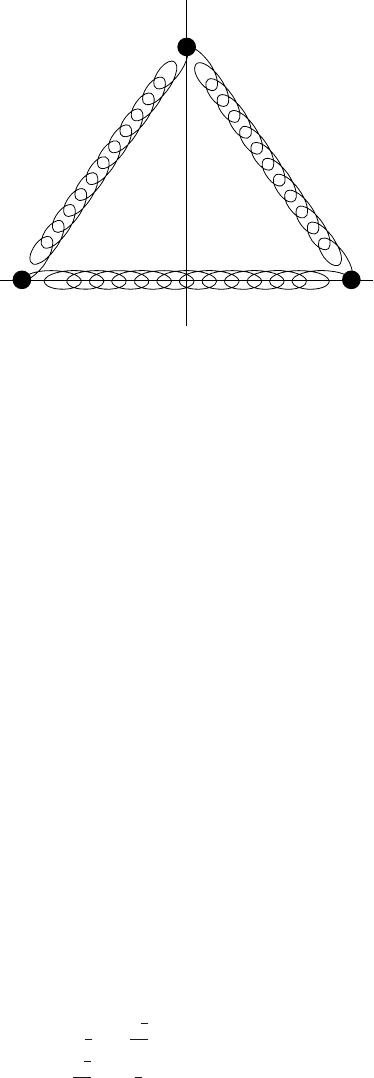
10.3 Representations 381
x
y
m
3
m
1
m
2
Figure 10.2. Vibrating equilateral triangle.
is the coupling matrix. We would like to prove that the Hamiltonian for this system is
invariant with respect to the symmetry group I,R,R
2
, P, PR, PR
2
, where R denotes rota-
tion by 120° and P is reflection across the y-axis, by constructing explicit matrix repre-
sentations for each of these symmetry operations and evaluating the similarity transforms
GΝG
1
where G is any of those matrices.
The basic symmetry operations combine a permutation of the mass indices with either
reflection or rotation of the coordinates at each vertex. Thus, reflection across the y-axis is
represented by
DP
3
4
4
4
4
4
4
4
5
0 p 0
p 00
00p
6
7
7
7
7
7
7
7
8
(10.45)
where
p
10
01
(10.46)
is a 2 2 matrix that performs the reflection x !x, y ! y at a single vertex. Similarly,
120° counterclockwise rotation is represented by
DR
3
4
4
4
4
4
4
4
5
00r
0 r 0
r 00
6
7
7
7
7
7
7
7
8
(10.47)
where
r
3
4
4
4
4
4
4
5
1
2
3
2
3
2
1
2
6
7
7
7
7
7
7
8
(10.48)

382 10 Group Theory
rotates the coordinates at a particular vertex. Thus, the reducible six-dimensional repre-
sentations of the primitive symmetry operators take the form
DP
3
4
4
4
4
4
4
4
4
4
4
4
4
4
4
4
4
4
4
4
4
4
5
001000
000100
100000
010000
000010
000001
6
7
7
7
7
7
7
7
7
7
7
7
7
7
7
7
7
7
7
7
7
7
8
(10.49)
DR
3
4
4
4
4
4
4
4
4
4
4
4
4
4
4
4
4
4
4
4
4
4
4
4
4
4
4
5
0000
1
2
3
2
0000
3
2
1
2
1
2
3
2
0000
3
2
1
2
0000
00
1
2
3
2
00
00
3
2
1
2
00
6
7
7
7
7
7
7
7
7
7
7
7
7
7
7
7
7
7
7
7
7
7
7
7
7
7
7
8
(10.50)
and the remaining group elements can be constructed from these using matrix multiplica-
tion.
At this point we would rather use to verify the symmetry relations than
perform tedious matrix multiplications by hand. Let
Ξ
x
1
,y
1
,x
2
,y
2
,x
3
,y
3
V
k
2
x
1
x
2
2
1
2
x
1
3
2
y
1
1
2
x
3
3
2
y
3
2
1
2
x
2
3
2
y
2
1
2
x
3
3
2
y
3
2
and verify that the matrix
Ν
1
4
5
3 401
3
33 0 0
3 3
40 5
3 1
3
00
33
3 3
1
3 1
32 0
3 3
3 30 6
reproduces the potential energy.
V
k
2
Ξ.Ν.Ξ / / Simpli fy
True

10.3 Representations 383
Next define the primitive symmetry operators
P
001000
000100
100000
010000
000010
000001
R
0000
1
2
3
2
0000
3
2
1
2
1
2
3
2
0000
3
2
1
2
0000
00
1
2
3
2
00
00
3
2
1
2
00
and construct the entire group as a list of matrices.
G IdentityMatrix6, R, R.R, P, P.R, P.R.R
Finally, we check that the potential energy is invariant with respect to a similarity transfor-
mation using any of the symmetry operations in the group.
TableΝ Gi.Ν.InverseGi, i, 1, LengthG
True, True, True, True, True, True
Therefore, we do indeed find that Ν is invariant with respect to G, as expected. Furthermore,
this G is isomorphic to a reducible representation of S
3
. Later we will learn how to use the
properties of S
3
to determine the eigenvalues of this physical system without solving a
sixth-order secular equation.
10.3.3 Orthogonality Theorem
In this section we prove an orthogonality theorem that is central to the theory of group
representations. Although we use different notation, the methods are based upon those
of Tinkham whose proofs, in turn, were based upon those of Wigner. It is necessary to
develop a few preliminary lemmas first before finally arriving at the grand result. Those
without the patience to wade through the linear algebra can skip to the finale.
Unitarity
First we demonstrate that any representation using matrices with nonvanishing determi-
nants is equivalent through a similarity transformation to a representation in terms of uni-
tary matrices. Consider the hermitian matrix
H
gG
DgDg
(10.51)
384 10 Group Theory
composed of manifestly hermitian terms summed over all group elements. A fundamental
theorem of linear algebra tells us that any hermitian matrix is diagonalized by the similarity
transformation
U
1
HU (10.52)
using a unitary matrix U whose columns are the orthonormal eigenvectors of H and that
the resulting diagonal matrix has positive eigenvalues on its diagonal. Thus,
gG
U
1
DgUU
1
Dg
U
gG
D
'
gD
'
g
(10.53)
where the matrices
D
'
gU
1
DgU (10.54)
represent G in the representation for which H is diagonal. Recognizing that is positive-
definite, we can construct a useful representation of the unit matrix for this representation
according to
I
1/ 2
1/ 2
1/ 2
3
4
4
4
4
4
5
gG
D
'
gD
'
g
6
7
7
7
7
7
8
1/ 2
gG
D
''
gD
''
g
(10.55)
where
Α
is the diagonal matrix containing the elements of raised to power Α and where
the doubly-primed representation
D
''
g
1/ 2
D
'
g
1/ 2
(10.56)
results from a similarity transformation based upon
1/ 2
. Finally, we demonstrate that the
D
''
g matrices are unitary by evaluating the products
D
''
gD
''
g
D
''
gID
''
g
1/ 2
D
'
g
1/ 2
1/ 2
hG
D
'
hD
'
h
1/ 2
1/ 2
D
'
g
1/ 2
(10.57)
with the aid of the aforementioned representation of the unit matrix. Note that we must
use a distinct summation index. Using the commutation properties of diagonal matrices,
the representation property DgDhDgh, and the hermitian conjugation property
DgDh
Dh
Dg
, we find that
D
''
gD
''
g
1
hG
D
'
gD
'
hD
'
h
D
'
g
1
hG
D
'
ghD
'
gh
1
I
(10.58)
is indeed unitary. Note that summation of gh over all h is equivalent to summation over
all g G in a different order. Therefore, one can always construct a unitary representation
using suitable similarity transformations and we henceforth assume, without loss of gen-
erality, that all representations employed are unitary.
10.3 Representations 385
Schur’s Lemma
Next we demonstrate that any matrix that commutes with all elements of an irreducible
representation must be a multiple of the unit matrix. Suppose that M is a matrix that com-
mutes with all elements of unitary representation D, such that
MDgDgM Dg
M
M
Dg
(10.59)
Multiplying by Dg on both left and right and using its unitarity,
M
DgDgM
(10.60)
we find that the hermitian conjugate M
also commutes with every Dg. Thus, there exist
hermitian matrices
H
M M
,H
M M
(10.61)
that also commute with all Dg. If we show that any commuting hermitian matrix is con-
stant, than any M H
H
/ 2 must also be constant. Of course, any hermitian matrix
can be reduced to the diagonal form U
1
HU by a similarity transformation, so we
use the corresponding representation
D
'
gU
1
DgU (10.62)
for group elements to write the commutation condition as
D
'
gD
'
g (10.63)
and must prove that the elements of are identical. Using the fact that
i, j
i
∆
i, j
, each
element of this matrix equation takes the form
i
j
D
'
i, j
g0 (10.64)
If
i
j
, then all D
'
i, j
g0 for any g such that the similarity transformation U reduces
representation D to block diagonal form, contradicting the stipulation that D is irreducible.
Therefore, if D is irreducible then
i
j
for any i, j is a constant diagonal matrix,
thereby proving Schur’s lemma.
Equivalence of Irreducible Representations of Common Dimension
The next intermediate result takes as much care to state as to prove. Suppose that D
1
is an
irreducible representation of dimension n
1
and D
2
is another irreducible representation of
dimension n
2
. Further, suppose that M is a rectangular matrix of dimensions n
1
n
2
such
that
D
1
gM MD
2
g (10.65)
for any g G. Then, n
1
n
2
requires M 0 while for n
1
n
2
either M 0orDetM0.
When DetM0, M is invertible and D
1
and D
2
are equivalent representations that are
related by the similarity transformation effected by M.