
Kelly J.J. Graduate Mathematical Physics, With MATHEMATICA Supplements
Подождите немного. Документ загружается.

406 10 Group Theory
unique output index c for each pair of input indices a, b. Functions of group elements can
be defined on n points by f a f R
a
. For example, the representation D
Μ
i, j
a is a group
function while the character Χ
Μ
a is a class function. The set of points is described as the
group manifold and is discrete for a finite group.
The elements of a continuous group are labeled by a finite number of continuous
parameters instead of a discrete index. We assume, for simplicity, that all parameters
are essential in the sense that there exists no smaller set of parameters, defined as func-
tions of the original parameters, capable of uniquely identifying every group element. If n
parameters are essential, the group is described as an n-parameter continuous group. Let
a a
i
,i 1,n represent the set of parameters and Ra represent elements of group R.
The continuous parameters a
i
may have either finite or infinite ranges depending upon the
nature of the group. If the parameters have finite ranges, the group manifold is described as
compact. We will assume that the group manifold is simply connected but generalizations
are possible. Group multiplication is represented by the law of composition
RaRbRcc
i
Φ
i
a, b (10.203)
where each c
i
falls within the allowed range for parameter i and where each Φ
i
a, b is a
continuous function of 2n variables. This requirement is analogous to the closure property
of finite groups. Similarly, there must exist an identity element a
0
such that
R
a
0
RbRbR
a
0
Rb (10.204)
and every element a must have an inverse ¯a such that
R
¯a
RaRaR
¯a
R
a
0
(10.205)
It is usually possible to define the group such that all parameters of the identity element
vanish; in other words a
0
i
0b i 1,n. Henceforth we will assume, unless stated other-
wise, that the identity element is at the origin of the parameter space. Finally, the associa-
tive property
RaRbRc RaRbRcΦ
a, Φb, c
Φ
Φa, b,c
(10.206)
is usually the most restrictive.
We will concentrate on Lie groups which perform transformations
x
'
i
Ξ
i
%
x
i
,i 1,n
&
b
%
a
k
,k 1,m
&
x
'
Ξxb a (10.207)
upon an n-dimensional vector space that are described by n functions of m essential para-
meters that are analytic in both x and a. For example, consider the two-parameter group of
nonsingular linear coordinate transformations on a line according to
x
'
Rax x
'
a
0
1 a
1
x (10.208)

10.4 Continuous Groups 407
where <a
i
< and a
1
1. The identity element is a
0
,a
1
0, 0 by construction.
Group multiplication is closed according to
RaRbx Ra
b
0
1 b
1
x
a
0
1 a
1
b
0
1 b
1
x
a
0
b
0
1 a
1
1 a
1
1 b
1
x
(10.209)
such that
Φ
0
a, ba
0
b
0
1 a
1
(10.210)
Φ
1
a, ba
1
b
1
1 a
1
(10.211)
are continuous functions within the specified (infinite) ranges. Each element a a
0
,a
1
has an inverse element ¯a ¯a
0
, ¯a
1
where
¯a
0
a
0
1 a
1
(10.212)
¯a
1
a
1
1 a
1
(10.213)
are analytic functions because a
1
1; furthermore, ¯a
1
1 is in the proper range. The
associative property requires
Φ
Φa, b,c
Φ
a, Φb, c
(10.214)
Although it might seem obvious that linear transformations are associative, perhaps it is
instructive to verify this property explicitly. Expansion of the left-hand side gives
Φ
0
%
a
0
b
0
1 a
1
,a
1
b
1
1 a
1
&
,
%
c
0
,c
1
&
a
0
b
0
1 a
1
c
0
1 a
1
b
1
1 a
1
a
0
b
0
c
0
a
1
b
0
a
1
c
0
b
1
c
0
a
1
b
1
c
0
(10.215)
Φ
1
%
a
0
b
0
1 a
1
,a
1
b
1
1 a
1
&
,
%
c
0
,c
1
&
a
1
b
1
1 a
1
c
1
1 a
1
b
1
1 a
1
a
1
b
1
c
1
a
1
b
1
a
1
c
1
b
1
c
1
a
1
b
1
c
1
(10.216)
while expansion of the right-hand side gives
Φ
0
%
a
0
,a
1
&
,
%
b
0
c
0
1 b
1
,b
1
c
1
1 b
1
&
a
0
b
0
c
0
1 b
1
1 a
1
a
0
b
0
c
0
a
1
b
0
a
1
c
0
b
1
c
0
a
1
b
1
c
0
(10.217)
Φ
1
%
a
0
,a
1
&
,
%
b
0
c
0
1 b
1
,b
1
c
1
1 b
1
&
a
1
b
1
c
1
1 b
1
1 a
1
a
1
b
1
c
1
a
1
b
1
a
1
c
1
b
1
c
1
a
1
b
1
c
1
(10.218)

408 10 Group Theory
Thus, these Φ
i
do satisfy the associative property and R satisfies all the requirements of a
continuous group. Notice that this group is nonabelian.
The requirement that every transformation be invertible means that one can always
solve for x
i
in terms of x
'
j
, which requires that the Jacobian
(Ξ
1
(x
1
(Ξ
1
(x
n
(Ξ
n
(x
1
(Ξ
n
(x
n
0 (10.219)
be nonsingular. The completeness condition requires successive transformations
x
'
Ξxb a (10.220)
x
''
Ξ
x
'
b b
(10.221)
to correspond to
x
''
Ξxb c (10.222)
where c is an allowed parameter set, calculable in terms of analytic functions
c
k
Η
k
ab b (10.223)
of the two constituent sets of transformation parameters.
10.4.2 Transformation of Functions
Suppose that new coordinates x
'
are obtained by applying group element R to the old
coordinates x. This transformation of variables is represented schematically by
x
'
Rx (10.224)
even if R is not simply a matrix. Thus, R is described as an operator that acts on the
coordinate variables. We wish to construct an operator that acts on a function f x to
produce a new function
˜
f x
'
that has the same values for the transformed coordinates,
such that
x
'
Rx
˜
f
x
'
f x f
R
1
x
(10.225)
It is important to understand that a forward transformation of a function is produced by an
inverse transformation of its arguments. Perhaps the simplest example is rotation within
a plane. Think of the function f x, where x x
1
,x
2
, as a surface. Positive rotation of
that surface relative to fixed coordinate axes is equivalent to negative rotation of those
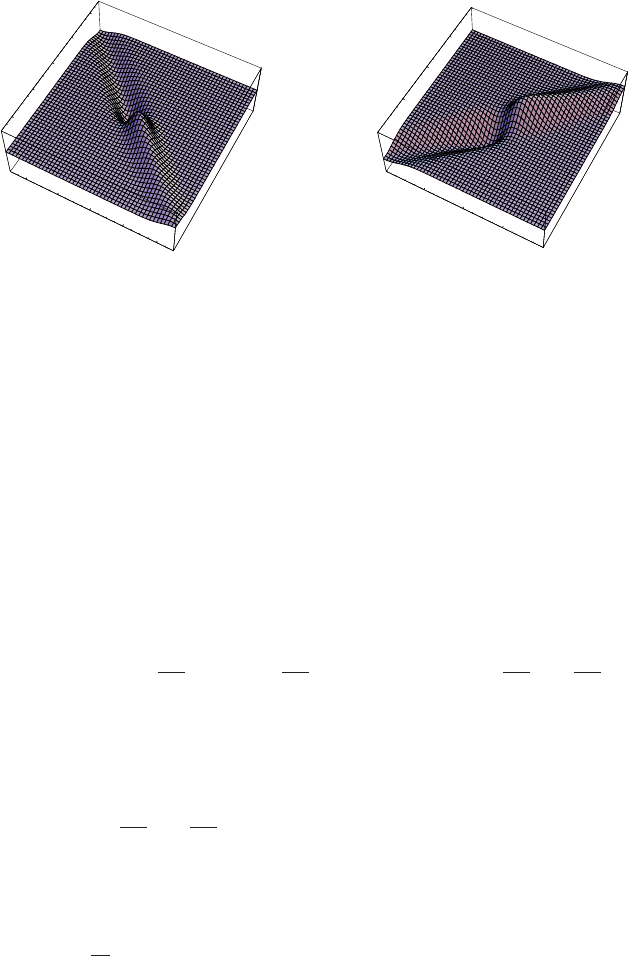
axes relative to a fixed surface. For example, the surface f x, y, shown on the left side of
Fig. 10.3, has a positive ridge in quadrant 4 with x>0, y<0. Positive rotation of the
surface by 90° relative to fixed coordinate axes yields the surface
˜
f x, y with its positive
lobe in quadrant 1. Alternatively, rotation of the coordinate axes relative to a fixed surface,
10.4 Continuous Groups 409
4
2
0
2
4
x
4
2
0
2
4
y
f #x,y'
4
2
0
2
x
4
2
0
2
4
y
4
2
0
2
4
x y
4
2
0
2
4
y x
f
q
#x,y'
4
2
0
2
x y
2
0
2
4
x
Figure 10.3. Positive rotation of a surface is equivalent to negative rotation of its coordinates.
such that x !y, y ! x, relabels the quadrant 4 as quadrant 1 and produces the same
transformation. We describe as an active transformation of the function and R
1
as a
passive transformation of the coordinate system.
In the next section we will develop a general technique for constructing given R,but
now we preview this method by analyzing infinitesimal rotations. Suppose that x x
1
,x
2
represents the original coordinates and x
'
Rx x
'
1
,x
'
2
represents coordinates after
an infinitesimal rotation
R
1
1
R
1
1
1
(10.226)
A first-order Taylor expansion
f
R
1
x
* f x
( f
(x
1
x
'
1
x
1
( f
(x
2
x
'
2
x
2
f x
x
2
( f
(x
1
x
1
( f
(x
2
(10.227)
relates functions at new and old coordinates where negative signs multiply the derivatives
because the argument R
1
x involves the inverse of R. Therefore, the operator that trans-
forms from f x to
˜
f x is
1
x
2
(
(x
1
x
1
(
(x
2
(10.228)
for infinitesimal . Notice that if we employ polar coordinates with x r CosΘ,rSinΘ,
infinitesimal rotation of a function is performed by the differential operator
1
(
(Θ
(10.229)
10.4.3 Generators
The continuity of Lie groups permits a finite transformation to be performed in a sequence
of smaller steps. Before confronting the general technique, consider the specific example
410 10 Group Theory
of coordinate translations. Let Ta be a translation whose effect upon coordinates is given
by
Tax x a (10.230)
Translations form an abelian group
TbT ax Tbx ax a b T bTaTaT bTa b (10.231)
with identity element T 0 and inverses T
1
aTa. The associative property is also
satisfied. We seek an operator a that performs a corresponding translation of an analytic
function
a f x f
T
1
ax
f x a (10.232)
Any finite translation can be performed in a sequence of infinitesimal steps
alim
n!
a
n
n
(10.233)
where an infinitesimal translation is evaluated using the definition of derivative as
f x f x f x
fx
x
1
x
f x (10.234)
Thus, a finite translation takes the form
alim
n!
1
a
n
x
n
Exp
a
x
(10.235)
where a function gA of an operator A is evaluated by substituting that operator into the
Maclaurin series for gx. Although this operator is really little more than a fancy repre-
sentation for the Taylor expansion
f x a
n0
1
n!
a
x
n
f xExp
a
x
f x (10.236)
it serves as a prototype for the definition and behavior of generators of Lie groups.
We identify p
x
(/ (x as the generator of infinitesimal translations along the x-axis,
such that arbitrary group elements can be expressed in the form
x
aExp
ap
x
(10.237)
Translations with respect to the x-axis are obviously a subgroup of translations within
three-dimensional space and we can generalize to three dimensions
a
Exp
a ,
+
a
f
r
f
r
a
(10.238)

10.4 Continuous Groups 411
and obtain an operator representation of the three-dimensional Taylor expansion. In gen-
eral, an n-parameter Lie group is described by n generators
G
i
(
(a
i
a0
(10.239)
of infinitesimal transformations. Notice that
G
1
aGa (10.240)
applies to any infinitesimal generator.
More generally, if x is an m-dimensional coordinate vector and a is an n-dimensional
group vector whose identity element is a 0, the Taylor expansion
Tax Ξxb aT ax
j
Ξ
j
xba*x
j
n
i1
a
i
(Ξ
j
(a
i
a0
(10.241)
can be used to write
f
Tax
* f x
m
j1
n
i1
a
i
( f
(x
j
(Ξ
j
(a
i
a0
(10.242)
or
a f x*
3
4
4
4
4
4
5
1
n
i1
a
i
G
i
6
7
7
7
7
7
8
f x (10.243)
where the infinitesimal generators
G
i
m
j1
(Ξ
j
(a
i
a0
(
(x
j
(10.244)
are linear differential operators. Therefore, the operator
aExpa , GExp
S
T
T
T
T
T
T
T
T
T
T
U
i
a
i
G
i
V
W
W
W
W
W
W
W
W
W
W
X
(10.245)
performs finite transformations from fx to f x f T
1
x. The inclusion of the factor
of in the definition of infinitesimal generators ensures that those operators are hermitian
when the transformation is unitary. Thus,
a
1
aaExp
a , G
Expa , GG
i
G
i
(10.246)
for arbitrary real a
i
. Although many mathematicians do not include this phase, applica-
tions of Lie groups to quantum mechanics benefit from this convention because physical
observables are represented by hermitian operators. We will adopt this convention here,

412 10 Group Theory
but the reader must be aware that it is not universal. Finally, notice that the generators
satisfy a product rule
G
i
f xgxgxG
i
f x f xG
i
f x (10.247)
where the differential operator G
i
acts on everything to its right within a term. Care must
be taken in evaluation of because the generators do not necessarily commute with each
other.
Next consider an arbitrary Lie group T with parameters a
i
and infinitesimal genera-
tors G
i
and assume that a general element can be expressed in a form
aExpa , GExp
S
T
T
T
T
T
T
T
T
T
T
U
i
a
i
G
i
V
W
W
W
W
W
W
W
W
W
W
X
(10.248)
that is sometimes called a Lie series in analogy with a Taylor series. Closure of the group
imposes important conditions upon the generators. Suppose that
i
Exp
i
G
i
* 1
i
G
i
1
2
2
i
G
2
i
(10.249)
j
Exp
j
G
j
* 1
j
G
j
1
2
2
j
G
2
j
(10.250)
represent two distinct infinitesimal transformations with inverses
1
i
Exp
i
G
i
* 1
i
G
i
1
2
2
i
G
2
i
(10.251)
1
j
Exp
j
G
j
* 1
j
G
j
1
2
2
j
G
2
j
(10.252)
such that
1
i
1
j
i
j
*
1
i
G
i
j
G
j
i
j
G
i
G
j
1
2
2
i
G
2
i
1
2
2
j
G
2
j
1
i
G
i
j
G
j
i
j
G
i
G
j
1
2
2
i
G
2
i
1
2
2
j
G
2
j
1
i
G
i
j
G
j
i
j
G
i
G
j
1
2
2
i
G
2
i
1
2
2
j
G
2
j
i
G
i
j
G
j
2
i
G
2
i
2
j
G
2
j
i
j
G
i
G
j
G
j
G
i
i
j
G
i
G
j
1
2
2
i
G
2
i
1
2
2
j
G
2
j
1
i
j
G
i
G
j
G
j
G
i
(10.253)
to second order in
i
and
j
. If this product is to represent an element of T,thecommutator
G
i
,G
j
[G
i
G
j
G
j
G
i
must be a linear combination of infinitesimal generators of the form
G
i
,G
j
k
c
k
i, j
G
k
(10.254)
where the structure constants c
k
i, j
are real numbers which are fundamental properties of
the generators that are independent of the choice of representation and are invariant with

10.4 Continuous Groups 413
respect to similarity transformations. The structure constants must be antisymmetric in
their lower indices, such that
c
k
j,i
c
k
i, j
(10.255)
because the commutator is antisymmetric. Although it should be obvious that the structure
constants are determined by the generators, Sophus Lie proved the more powerful con-
verse that groups of this kind are uniquely determined by specification of their structure
constants.
Another important relationship among the structure constants uses the double commu-
tator
G
i
,
G
j
,G
k
S
T
T
T
T
T
T
T
T
T
T
U
G
i
,
c
j,k
G
V
W
W
W
W
W
W
W
W
W
W
X
,m
c
j,k
c
m
,i
G
m
(10.256)
and the Jacobi identity
G
i
,
G
j
,G
k
G
j
,
G
k
,G
i
G
k
,
G
i
,G
j
0 (10.257)
to find
,m
c
j,k
c
m
,i
G
m
,m
c
k,i
c
m
,j
G
m
,m
c
i, j
c
m
,k
G
m
0 (10.258)
or
m
c
j,k
c
m
,i
c
k,i
c
m
,j
c
i, j
c
m
,k
G
m
0 (10.259)
Thus, assuming that the G
m
are linearly independent, the structure constants must satisfy
a Jacobi identity of the form
c
j,k
c
m
,i
c
k,i
c
m
,j
c
i, j
c
m
,k
0 (10.260)
Lie proved that antisymmetry of lower indices and compliance with the Jacobi identity
are necessary and sufficient conditions for generation of a continuous group from local
structure constants.
10.4.4 Example: Linear coordinate transformations in one dimension
To illustrate these relations, we return to the two-parameter group of linear coordinate
transformations
Txx a
0
1 a
1
x (10.261)
such that
a f x f
T
1
ax
f
¯a
0
1 ¯a
1
x
* f xa
0
( f
(x
a
1
x
( f
(x
(10.262)

414 10 Group Theory
where
¯a
0
a
0
1 a
1
*a
0
(10.263)
¯a
1
a
1
1 a
1
*a
1
(10.264)
for infinitesimal transformations. Thus, we identify the generators as linear differential
operators
G
0
(
(x
(10.265)
G
1
x
(
(x
(10.266)
The commutator is evaluated using
G
0
G
1
G
1
G
0
f x
(
(x
x
( f
(x
x
(
(x
( f
(x
x
(
2
f
(x
2
( f
(x
x
(
2
f
(x
2
( f
(x
(10.267)
to obtain
G
0
,G
1
G
0
c
0
0,1
1,c
1
0,1
0 (10.268)
The structure constants are indeed real numbers and are antisymmetric wrt lower indices.
The only set of indices for which the Jacobi identity does not vanish immediately is
c
0,1
c
0
,k
c
1,k
c
0
,0
c
k,0
c
0
,1
c
0
0,1
c
0
0,k
c
0
k,0
c
0
0,1
0 (10.269)
such that the identity is indeed satisfied. Therefore, the general transformation operator for
functions takes the form
aExp
a
0
a
1
x
(
(x
(10.270)
10.4.5 Example: SO(2)
A finite rotation within a plane is performed by the transformation matrix
RΘ
CosΘ SinΘ
SinΘ CosΘ
(10.271)
and one can (and should!) verify that RΘ satisfies all of the requirements of a group and
that the group multiplication law
R
Θ
2
R
Θ
1
R
Θ
1
Θ
2
(10.272)
is abelian. The inverse matrix
R
1
Θ RΘ R
T
Θ (10.273)
is the same as the transpose (indicated by superscript T ); hence, rotation matrices are
orthogonal. Also note that DetR1. Thus, rotations in the plane are isomorphic with

10.4 Continuous Groups 415
the group of all two-dimensional special orthogonal matrices, designated SO(2); the term
“special” refers to the requirement that the determinant be 1, which excludes reflections.
An infinitesimal rotation is described by
R*
1
1
Σ
2
(10.274)
where is the unit matrix, here two-dimensional, and where we identify the generator for
coordinate transformations as Σ
2
where
Σ
2
0
0
(10.275)
happens to be one of the Pauli matrices. A finite rotation is then given by
RΘ lim
n!
R
Θ
n
n
lim
n!
Θ
n
Σ
2
n
Exp
ΘΣ
2
(10.276)
Perhaps it is worthwhile to demonstrate that the original matrix is recovered from the
power series. Expanding
Exp
ΘΣ
2
n0
ΘΣ
2
n
n!
n0
n
ΘΣ
2
2n
2n!
n0
n
ΘΣ
2
2n1
2n 1!
(10.277)
and using
Σ
2
2
1 Σ
2n
2
, Σ
2n1
2
Σ
2
(10.278)
we obtain
Exp
ΘΣ
2
CosΘ SinΘΣ
2
RΘ (10.279)
as claimed. This result is a generalization of the Euler identity to two dimensions.
Next consider the transformation operator for functions of these coordinates. Let x
x
1
,x
2
represent the original coordinates, x
'
R
1
x x
'
1
,x
'
2
represent coordinates
after a passive infinitesimal rotation of the axes, and expand
f
x
'
* f x
( f
(x
1
x
'
1
x
1
( f
(x
2
x
'
2
x
2
f x
x
2
( f
(x
1
x
1
( f
(x
2
(10.280)
to first order. The final term in parentheses is the infinitesimal generator for transformations
of functions from the old coordinates to the new coordinates. Therefore, the operator that
transforms from f x to
˜
f x f R
1
x is
L
x
1
(
(x
2
x
2
(
(x
1
˜
f xExpΘL f x (10.281)
Notice that the operator L is antisymmetric, like the matrix R, and that when the derivatives
are interpreted as momentum operators, L is the operator for orbital angular momentum
perpendicular to this plane.