
Kelly J.J. Graduate Mathematical Physics, With MATHEMATICA Supplements
Подождите немного. Документ загружается.


416 10 Group Theory
10.4.6 Example: SU(2)
The states of a spin-
1
2
particle are described by two-component spinors of the form
Ψ
Ψ
1
Ψ
2
(10.282)
where the amplitudes Ψ
i
are expressed relative to a particular orientation of the coordinate
system. Rotations of the coordinate axes mix the components of the spinors, preserving its
norm, and are described by unitary 2 2 matrices, such that
Ψ
'
UΨ
Ψ
'
1
Ψ
'
2
U
1,1
U
1,2
U
2,1
U
2,2
Ψ
1
Ψ
2
(10.283)
where UU
. The set of all unitary 2 2 matrices with unit determinant forms a group
that is designated SU(2), which stands for special unitary group in two dimensions. Any
2 2 matrix contains four complex numbers or, equivalently, eight real parameters. The
requirement of unitarity imposes four constraints and the restriction upon the determinant
imposes another constraint, leaving three independent real parameters. Thus, an infinitesi-
mal transformation U can be parametrized in the form
U Exp
Θˆn ,
S
(10.284)
where ˆn is an arbitrary unit vector in three dimensions and
S is a set of three appropriately-
chosen 2 2 matrices that represent the infinitesimal generators of this group. Unitarity
requires
S to be hermitian and the condition DetU1 requires Tr
S0. Therefore, we
express the generators in the form
S
Σ/ 2 where the Pauli matrices
Σ
1
01
10
, Σ
2
0
0
, Σ
3
10
0 1
(10.285)
constitute a complete set of linearly independent, traceless, hermitian, 2 2 matrices and
where the factor of
1
2
ensures that the eigenfunctions
S
3
1
0
1
2
1
0
,S
3
0
1
1
2
0
1
(10.286)
have eigenvalues
1
2
for S
3
. Therefore, if we rotate the coordinate axis through angle
Θ about axis ˆn, the components of a spin-
1
2
wave function transform among themselves
according to the unitary matrix
U
Θ
Exp
Θ,
Σ
*
2
(10.287)
where
ΘΘˆn encodes the three parameters of SU(2).
Direct calculation will show that the Pauli matrices satisfy commutation relations of
the form
Σ
i
, Σ
j
2
ijk
Σ
k
S
i
,S
j
ijk
S
k
(10.288)
where, by convention, one sums over a repeated index; hence, the right-hand side is
summed over k. Also, recall that the Levi–Civita symbol
i, j,k
takes the values 1fora

10.4 Continuous Groups 417
symmetric permutation of the indices, 1 for an antisymmetric permutation, or 0 when-
ever two indices are repeated. Thus, the structure constants are antisymmetric and one can
show that they satisfy the Jacobi identity, as required for a Lie group. Finally, notice that
the commutation relations for SU(2) can be expressed in the form
S
S
S
Σ
Σ2
Σ (10.289)
where the cross-product does not vanish because the components of
Σ do not commute
with each other. One must be careful when generalizing results from vector algebra to
noncommuting operators or matrices.
The group SU(2) also admits matrix representations of higher dimension. Suppose
that we transform coordinates according to
x
'
R
x where the matrices R
i
Θ
i
describe
independent rotations about each of three axes. The corresponding infinitesimal generators
S
i
for transformations of a vector are then obtained by differentiating R
i
as follows.
R
1
Θ
1
3
4
4
4
4
4
4
4
5
10 0
0Cos
Θ
1
Sin
Θ
1
0 Sin
Θ
1
Cos
Θ
1
6
7
7
7
7
7
7
7
8
S
1
(R
1
(Θ
1
Θ
1
0
3
4
4
4
4
4
4
4
5
000
001
0 10
6
7
7
7
7
7
7
7
8
(10.290)
R
2
Θ
2
3
4
4
4
4
4
4
4
5
Cos
Θ
2
0 Sin
Θ
2
01 0
Sin
Θ
2
0Cos
Θ
2
6
7
7
7
7
7
7
7
8
S
2
(R
2
(Θ
2
Θ
2
0
3
4
4
4
4
4
4
4
5
001
00 0
10 0
6
7
7
7
7
7
7
7
8
(10.291)
R
3
Θ
3
3
4
4
4
4
4
4
4
5
Cos
Θ
3
Sin
Θ
3
0
Sin
Θ
3
Cos
Θ
3
0
001
6
7
7
7
7
7
7
7
8
S
3
(R
3
(Θ
3
Θ
3
0
3
4
4
4
4
4
4
4
5
010
100
000
6
7
7
7
7
7
7
7
8
(10.292)
These generators also satisfy the commutation relations of SU(2). More generally, the three
operators
S that describe the intrinsic spin are traceless hermitian matrices of dimension
2s 1 that satisfy the SU(2) commutation relations
S
i
,S
j
ijk
S
k
(10.293)
such that
U
Θ
Exp
Θ,
S
(10.294)
generates rotation of the state vectors for particles with spin s.
10.4.7 Example: SO(3)
Coordinate rotations that leave the Euclidean norm x
2
1
x
2
2
x
2
3
invariant are described
by orthogonal matrices R
Θ where
Θ stands for the three parameters needed to specify the
rotation. Proper rotations that exclude reflections also require DetR1. Thus, rotations
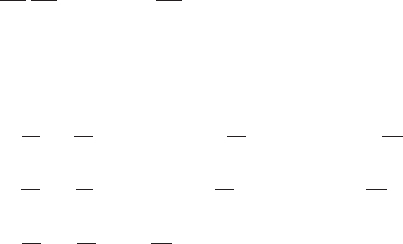
418 10 Group Theory
are isomorphic with the group of special orthogonal matrices in three dimensions, namely
SO(3). Let
x
'
i
Ξ
i
xbΘR
i, j
Θ
x
j
(10.295)
represent the coordinate transformation. Infinitesimal coordinate rotations are described
by
Ξ*
x
Θ
x Ξ
i
* x
i
i, j,k
Θ
j
x
k
(10.296)
where
ΘΘ
1
, Θ
2
, Θ
3
is an infinitesimal vector and where the summation convention is
employed. The infinitesimal generators are then
L
i
(Ξ
j
(Θ
i
(
(x
j
i, j,k
x
j
(
(x
k
x
p (10.297)
where
p
+ is the momentum operator. These generators can be expressed in either
cartesian or polar coordinates as
L
x
y
(
(z
z
(
(y
SinΦ
(
(Θ
CosΦ CotΘ
(
(Φ
(10.298)
L
y
z
(
(x
x
(
(z
CosΦ
(
(Θ
SinΦ CotΘ
(
(Φ
(10.299)
L
z
x
(
(y
y
(
(x
(
(Φ
(10.300)
and are easily seen to satisfy commutation relations
L
i
,L
j
i, j,k
L
k
(10.301)
that are the same as those of SU(2). Nevertheless, these groups are not identical and we will
later exploit the homomorphism between SU(2) and SO(3) to analyze their representations
in considerable detail. For now, suffice it to recognize that the operator that transforms
functions whose coordinates are rotated through a finite angle is given by
Θ
Exp
Θ,
L
(10.302)
where
ΘΘ
x
, Θ
y
, Θ
z
specifies the axis of rotation and the angle and where
L are the
differential operators defined above.
10.4.8 Total angular momentum
We can now combine spin and orbital angular momentum by considering the transforma-
tion properties of a wave function of the form
\
x
3
4
4
4
4
4
4
4
5
Ψ
1
x
Ψ
2
x
6
7
7
7
7
7
7
7
8
(10.303)

10.4 Continuous Groups 419
that consists of 2s 1 functions of the three-dimensional vector
x. Rotation of the coordi-
nate system will both change the coordinates in each function and mix the components of
the state vector. Thus, we write
\
'
x
Exp
Θˆn ,
S
\
R
Θˆn
x
(10.304)
where
S mixes the components and R acts upon the coordinates. Expanding the infinitesi-
mal transformations to first order
\
'
x
*
Θˆn ,
S
\
1 Θˆn
x
*
Θˆn ,
S
\
x
Θˆn ,
x
+\
x
(10.305)
and dropping higher-order terms, we can identify the infinitesimal generators as
J
L
S (10.306)
whereby
(\
'
x
(Θ
*ˆn ,
J\
x
\
'
x
Exp
Θ,
J
\
x
(10.307)
provides the wave function in the rotated coordinate system.
The spin of an elementary particle is an intrinsic property that should be independent
of its position or momentum. Therefore, the
S operators should be independent of
x or
p and, hence, commute with
L;
S acts upon a nonclassical internal space represented by
the 2s 1 components of the wave function while
L acts upon geometrical variables with
classical interpretations. Thus, the total angular momentum
J
L
S contains orbital and
spin contributions that satisfy the commutation relations
L
i
,L
j
i, j,k
L
k
(10.308)
S
i
,S
j
i, j,k
S
k
(10.309)
J
i
,J
j
i, j,k
J
k
(10.310)
L
i
,S
j
0 (10.311)
such that the transformation operators
Θ
Exp
Θ,
J
Exp
Θ,
L
Exp
Θ,
S
(10.312)
contain two factors that operate on different aspects of the wave function. If the hamilton-
ian is rotationally invariant, such that H,
J0, we can construct energy eigenfunctions
that are also eigenfunctions of J
2
and J
3
.OftenH,S
2
0 also indicates that S
2
is con-
served, but L
2
, L
3
, and S
3
usually are not when s>0.
10.4.9 Transformation of Operators
Suppose that U is a unitary operator that performs coordinate transformations upon func-
tions and that H is an arbitrary operator on the same Hilbert space. Operators in the new

420 10 Group Theory
and old coordinate systems are related by the familiar similarity transformation
Ψ
'
UΨH
'
UHU
1
(10.313)
If we now represent U ExpΑS in terms of a hermitian infinitesimal generator S and
a real parameter Α, this similarity transformation can be evaluated as a power series in Α
with the aid of the Baker–Haussdorff identity
ΑS
H
ΑS
H ΑS, H
Α
2
2!
S, S, H
Α
3
3!
S,
S, S, H
(10.314)
where the number of times S appears in the leading position of each multiple commutator
is given by the associated power of Α. Verification of this identity is left as an exercise
for the reader. For infinitesimal transformations, we find
(H
'
(Α
Α0
S, H (10.315)
An important consequence is that H is invariant with respect to transformations generated
by operators with which it commutes, such that
S, H0 H
'
H (10.316)
10.4.10 Invariant Functions
A function Ψ that is unchanged when its coordinates are transformed by any group element
is described as an invariant of the group and satisfies
Ψ
R
1
x
ΨxΨΨExpa , GΨ Ψ (10.317)
where a is the parameter vector and G is the corresponding vector of generators. For small
a
i
we can use the first-order expansion
1 a , GΨxΨxG
i
Ψ0 (10.318)
to conclude that invariants are annihilated by any of the group generators, labeled by
i 1,n. For example, consider a central function of the form Ψx, yΨr where
r
x
2
y
2
and the infinitesimal generator
L
z
x
(
(y
y
(
(x
(
(Φ
(10.319)
for rotations in the plane. Obviously, Ψ is invariant wrt L
z
because L
z
Ψr0 for any x, y.
If G
i
Ψ0 for some generators but not others, we can describe Ψ as invariant with
respect to the subgroups generated by each G
i
that annihilates Ψ. Suppose that Ψ is an
invariant wrt G
i
and Φ is an arbitrary function. Then
G
i
ΨΦ ΦG
i
ΨΨG
i
ΦΨG
i
Φ (10.320)
permits the invariant to be factored out as if it were a constant. Similarly, the transformation
i
ΨΦ Exp
a
i
G
i
ΨΦ Ψ Exp
a
i
G
i
Φ (10.321)
only affects Φ, the noninvariant (i.e., variable) factor.
10.4 Continuous Groups 421
A function Ψx that satisfies
GΨxΛxΨx (10.322)
where Λx is an invariant of the infinitesimal generator G is described as an eigenfunction
of G with eigenvalue Λx. Finite transformations based upon G then take the form
ExpaGΨx
aΛ
Ψx (10.323)
Suppose that Ψ
1
and Ψ
2
are two different eigenfunctions of G with eigenvalues Λ
1
and Λ
2
,
respectively. Then
GΨ
1
xΨ
2
xΨ
2
GΨ
1
Ψ
1
GΨ
2
Λ
1
xΛ
2
x
Ψ
1
xΨ
2
x (10.324)
shows that Ψ
1
Ψ
2
is also an eigenfunction of G whose eigenvalue is Λ
1
Λ
2
.
Let T a represent an element of a symmetry group with parameter a that acts on
coordinate x according to x
'
Tax and let a represent the corresponding operator
upon functions, such that
aΨxΨ
T
1
ax
(10.325)
Suppose that the Hamiltonian operator H commutes with , such that H,0 and that
Ψ
i
,i 1,n are a linearly independent set of eigenfunctions for H that share a common
eigenvalue E, such that
HΨ
i
EΨ
i
HΨ
i
EΨ
i
(10.326)
Thus, Ψ
i
is also an eigenfunction of H with the same eigenvalue and can be expanded as
the linear superposition
aΨ
i
xΨ
i
T
1
ax
n
j1
Ψ
j
xD
j,i
a (10.327)
with coefficients that depend upon the group parameter. The ordering of the indices may
appear unusual but is needed to ensure that the matrices Da constitute a representation
of the symmetry group . Suppose that we combine two symmetry operations
baΨ
i
n
j1
bΨ
j
D
j,i
a
n
j,k1
Ψ
k
D
k,j
bD
j,i
a (10.328)
such that
TbT aTcDbDaDc (10.329)
Therefore, Da is an n-dimensional matrix representation of group element Ta. Notice
that this ordering is consistent with the inverse relationship between and T, whereby
cΨxΨ
T
1
cx
Ψ
TbT a
1
x
Ψ
T
1
aT
1
bx
(10.330)

422 10 Group Theory
10.5 Lie Algebra
10.5.1 Definitions
A Lie algebra is a linear vector space with a law of composition (or multiplication) denoted
by A
i
,A
j
that satisfies the following properties:
• closure under multiplication: if A and B are members of the algebra, then the product
A, B is also a member
• antisymmetry under multiplication: B, AA, B
• distributive law: A B,CA,CB,C
• Jacobi identity:
A, B,C
B, C, A
C, A, B
0.
This abstract notion includes both Lie groups expressed in terms of differential operators
that generate infinitesimal coordinate transformations and their representations in terms of
matrices. The law of composition could be the commutator
A, BAB BA (10.331)
for quantum mechanics or it could be the Poisson bracket
A, B
i
(A
(q
i
(B
(p
i
(B
(q
i
(A
(p
i
(10.332)
for classical mechanics, where q
i
,p
i
are pairs of canonically conjugate generalized coordi-
nates and momenta. The fact that general theorems depend upon abstract postulates instead
of specific realizations gives this branch of mathematics considerable power and versatil-
ity.
The dimension of the algebra is the dimension of its underlying vector space or, equiv-
alently, the number of independent generators. An algebra is abelian if A
i
,A
j
0for
all A
i
,A
j
.Asubalgebra is a subset of the vector space that satisfies all conditions
for a Lie algebra. An algebra is described as simple if it does not contain an invariant
subalgebra or semisimple if it does not contain an abelian subalgebra. An algebra is semi-
simple if and only if it is a direct sum of simple algebras. A compact algebra is necessarily
semisimple. It is useful to define a metric tensor, also known as a Killing form,as
g
i, j
-
k,l
c
l
j,k
c
k
l,i
(10.333)
where the proportionality constant can be chosen for convenience. Cartan’s theorem states
that a Lie algebra is semisimple if and only if Detg0. Under those conditions we can
also define an inverse g
i, j
that satisfies
k
g
i,k
g
k,j
∆
i, j
(10.334)
The rank of an algebra is the maximum number of linearly independent mutually com-
muting operators that it supports. Let P
i
,i 1,r represent a set of mutually commuting
10.5 Lie Algebra 423
operators, such that P
i
,P
j
0 for all i, j r and let Q
j
,j r 1,d represent the
remaining generators. Racah proved that r independent Casimir operators C
i
,i 1,r
that commute with all A
i
, such that
C
i
,P
j
C
i
,Q
j
0 (10.335)
can be constructed for any semisimple Lie algebra of rank r from linear combinations of
products of the generators. For example,
C
1
-
i, j
g
i, j
A
i
A
j
(10.336)
commutes with all A
i
; the proportionality constant can be chosen for convenience.
This lowest-order Casimir operator is usually very useful but higher-order Casimir opera-
tors are often very complicated. Schur’s lemma tells us that any matrix which commutes
with all the matrices of an irreducible representation must be a multiple of the unit matrix.
Therefore, the irreducible representations of can be labeled with the eigenvalues c
i
for the Casimir operators while their members are distinguished by the eigenvalues p
i
for the selected P
i
. The basis states for such representations can then be expressed in the
form
C
i
c
1
c
r
b p
1
p
r
c
i
c
1
c
r
b p
1
p
r
(10.337)
P
i
c
1
c
r
b p
1
p
r
p
i
c
1
c
r
b p
1
p
r
(10.338)
Furthermore, raising and lowering operators (ladder operators)forthep
i
can then be
constructed from linear combinations of the Q
i
.
10.5.2 Example: SU(2)
For example, SU(2) is defined by the commutation relations
S
i
,S
j
i
i, j,k
S
k
(10.339)
and has dimension 3 and rank 1. Its metric tensor
k,l
j,k,l
,i,k
k,l
j,k,l
i,k,l
2∆
i, j
(10.340)
shows that it is semisimple. Because the normalization of g
i, j
is irrelevant, one normally
redefines the metric tensor for this group to be g
i, j
g
i, j
∆
i, j
. There is only one Casimir
operator
C S
2
1
S
2
2
S
2
3
(10.341)
and it is proportional to the operator for total spin, S
2
. Therefore, if H,
S0, one may
classify eigenstates s, mby their eigenvalues for S
2
and one of the S
i
, arbitrarily chosen

424 10 Group Theory
as S
3
, such that
S
3
s, m ms, m (10.342)
Furthermore,
s, m
S
2
s, m
2 m
2
(10.343)
demonstrates that there must be a maximum value of m for any finite s; equality applies
only when s 0.
To determine the eigenvalues of S
2
and the allowed values of m for each irrep s,itis
useful to define the ladder operators
S
S
1
S
2
(10.344)
whose commutation relations
S
3
,S
S
(10.345)
S
2
,S
0 (10.346)
S
,S
2S
3
(10.347)
can (and should!) be verified easily. Applying the first set of commutation relations
S
3
S
S
S
3
s, mS
3
mS
s, mS
s, m S
3
S
s, mm 1S
s, m
(10.348)
demonstrates that S
s, mis an eigenfunction of S
3
with eigenvalue m 1. Thus, the effect
of S
is to raise m by one unit while S
lowers m by one unit. We can express S
2
in two
alternative forms
S
2
S
S
S
3
S
3
1S
S
S
3
S
3
1 (10.349)
and choose to label irrep s using the maximum possible value of m, such that
S
s, s 0 S
2
s, s ss 1s, s (10.350)
Closure of irrep s with respect to the ladder operators, S
, requires the allowed values of
m to form a sequence s, s 1,...,s n where n is a finite nonnegative integer, such that
S
s, sn 0 S
2
s, snsnsn1s, snsnsn1ss1
(10.351)
requires n 2s. Therefore, s is either integral or half-integral such that the dimension of
irrep s is 2s 1 and its eigenvalues are given by
S
2
s, m
ss 1s, m
,s 0,
1
2
, 1,
3
2
, 2 ... (10.352)
S
3
s, m
ms, m
,m s, s 1,...,s (10.353)
It is important to recognize that this analysis was based entirely upon the commutation
relations of SU(2) and did not employ any specific representation of the associated Lie

10.6 Orthogonality Relations for Lie Groups 425
algebra. Therefore, it applies equally well to representations of any dimension, not just
the two-dimensional representation that originally motivated the correspondence between
the generators of SU(2) and the operators for spin. One might expect the same analysis
also to apply to the representations of SO(3) that describe orbital angular momentum if
one simply replaces S ! L and s ! everywhere. However, that correspondence does not
exclude half-integral orbital angular momentum, which is actually a tricky issue. For clas-
sical physics the requirement of single-valuedness excludes half-integral values because
mΦ
would change sign under Φ!Φ2Π if m were half-integral, but quantum mechan-
ics permits this sign change because observables depend upon the absolute magnitude of
the wave function. On the other hand, because orbital angular momentum is a classical
concept, we might appeal to the correspondence principle to require single-valuedness
anyway; no such appeal is possible for intrinsic spin because it is inherently nonclassical.
For a more rigorous argument that limits to integer values, we must return to the differ-
ential operators and their eigenfunctions; that argument is left to the exercises. Perhaps
we should have anticipated that the algebraic argument based upon commutation relations
alone would be inconclusive because the generators of SU(2) obey the same commutation
relations as those of SO(3), yet SU(2) was designed to describe spin-
1
2
. Therefore, such an
analysis does not distinguish between spin and orbital angular momentum. This is actually
a strength of the method! If we define angular momentum by the requirement that eigen-
states of a rotationally invariant Hamiltonian transform according to
Exp
Θ,
J
(10.354)
where the infinitesimal generators
J
L
S obey the commutation relations
J
i
,J
j
i, j,k
J
k
(10.355)
then both spin and orbital contributions are included.
10.6 Orthogonality Relations for Lie Groups
Orthogonality relations were crucial to the analysis of finite groups and we expect anal-
ogous relations to be central to applications using Lie groups, but we must generalize
from summation to integration using weight functions that preserve group properties. Let
a a
i
,i 1,m represent a point in the m-dimensional parameter space of a Lie group
and let a represent an infinitesimal volume surrounding that point. If b is another point in
the same parameter space, the group multiplication law c Φa, b assigns point c to the
composition of elements a and b.Ifa is a unique point and the number of elements in the
volume at b is Ρbb where Ρb is a density function, then the number of points
Ρcc Ρbb (10.356)
near c must be the same because group multiplication by a provides a one-to-one corre-
spondence between elements near c with those near b. Suppose that we choose a to be the