
Kelly J.J. Graduate Mathematical Physics, With MATHEMATICA Supplements
Подождите немного. Документ загружается.

446 10 Group Theory
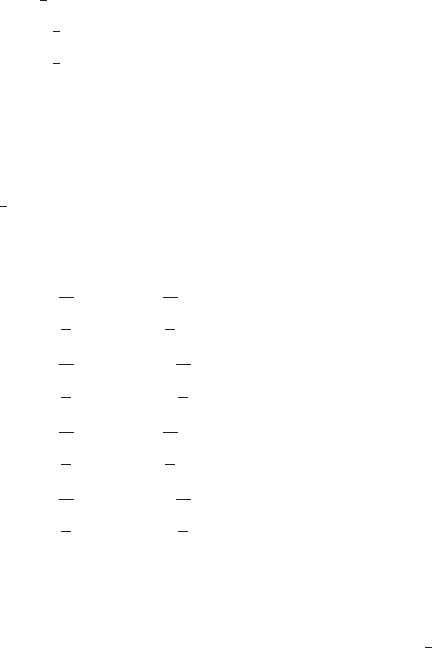
and that the proton and nucleon belong to a dimension-two representation with
T
2
N
3
4
N (10.511)
T
3
p
1
2
p (10.512)
T
3
n
1
2
n (10.513)
Similarly, the three charge states of the pion (Π
, Π
0
, Π
) are practically degenerate and
are assigned to a dimension three representation of SU(2) isospin. The most prominent
feature of low-energy interactions between pions and nucleons is a strong resonance in the
1 partial wave with four charge states labeled $
, $
, $
0
, and $
that are assigned
isospin
3
2
. Expressing the charge states
Π
p
3/ 2
3/ 2
!
(10.514)
Π
0
p
2
3
3/ 2
1/ 2
!
1
3
1/ 2
1/ 2
!
(10.515)
Π
p
1
3
3/ 2
1/ 2
!
2
3
1/ 2
1/ 2
!
(10.516)
Π
n
1
3
3/ 2
1/ 2
!
2
3
1/ 2
1/ 2
!
(10.517)
Π
0
n
2
3
3/ 2
1/ 2
!
1
3
1/ 2
1/ 2
!
(10.518)
Π
n
3/ 2
3/ 2
!
(10.519)
in terms of isospin eigenstates and assuming that the isospin
1
2
contributions to elastic ΠN
scattering are negligible at the resonance, isospin symmetry predicts that cross-sections
for the charge states will be found in the ratios
Σ
Π
p
Σ
Π
0
p
Σ
Π
p
Σ
Π
n
Σ
Π
0
n
Σ
Π
n
9 2 1 (10.520)
and data for the resonance region are indeed consistent with these ratios. Isospin symmetry
also plays a central role in the structure of atomic nuclei.
At a deeper level, isospin symmetry is understood to arise from the flavor symmetry of
the interaction between quarks and the near degeneracy between the masses of the lightest
quarks, called up and down (u or d) based upon the older isospin up or isospin down ter-
minology. It is natural to try to extend this symmetry to include also strange baryons con-
taining one or more strange quarks even though the s quark is significantly more massive
than the u or d quarks. The mass degeneracy within the resulting SU(3) multiplets is less
precise, but SU(3) flavor symmetry does help to explain many of the properties of baryons
with useful accuracy. We will not discuss the elegant methods that have been developed
for analyzing the structure of direct-product representations of SU(N), but merely quote a
Problems for Chapter 10 447
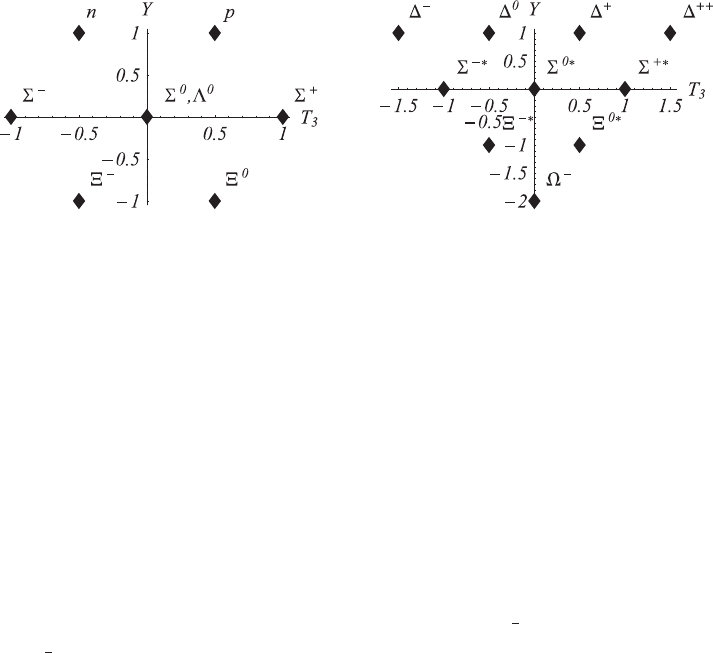
Figure 10.4. Weight diagrams for baryons assigned to symmetric octet (left) and decuplet (right)
representations of SU(3) flavor symmetry.
couple of results. The coupling of three quarks, each belonging to SU(3), can be decom-
posed into irreducible representations according to
3 P 3 P 3 1 d 8
M,S
d 8
M,A
d 10 (10.521)
where the singlet is fully antisymmetric, one octet is symmetric and the other antisymmet-
ric with respect to exchange of the first two quarks, and the decuplet is symmetric with
respect to the exchange of any pair of quarks. The mixed-symmetry representations (MS
and MA) can be constructed by coupling two quarks in either symmetric or antisymmet-
ric configurations and then coupling a third. The singlet is identified with the 01405
particle, while the other low-lying baryons are assigned to multiplets represented by the
accompanying weight diagrams. The hypercharge Y is defined so that the electric charge
is Q T
3
Y/2. Each member of 8
M,S
has spin and parity J
P
1
2
while the decuplet has
J
P
3
2
.
This model of the baryon spectrum was called the eightfold way by Gell-Mann, co-
inventor of the quark model with Zweig, because the SU(3) group has eight generators.
The prediction and subsequent discovery of the E
was a major success of the early quark
model. Even when symmetries apply only to one sector of a model and are broken by
another, group theoretical analyses often explain systematics well without detailed theories
or calculations of the underlying dynamics. Subsequent developments in particle theory
have relied heavily on such techniques, but are beyond the scope of this text.
Problems for Chapter 10
1. Which are groups?
Which of the following sets constitute groups under the stipulated law of combination?
Justify your answers:
a) real numbers under multiplication
b) real numbers under addition
448 10 Group Theory
c) all complex numbers except 0 under multiplication
d) rational numbers under multiplication
e) rational numbers under a b a/b.
2. Groups of order 4
Prove that groups of order 4 must be abelian and that there are only two distinct groups of
order 4.
3. Class period
Show that all elements of the same class have the same period.
4. Quaternions
Just as complex numbers are generalizations of real numbers to two dimensions, quater-
nions are generalizations of complex numbers to four dimensions. Suppose that q a
bcd where a, b, c, d are real numbers and the quaternion basis vectors 1, , , satisfy
the following multiplication rules
2
2
2
1 , (10.522)
a) Show that the set 1, , , constitute a group, , and that the set of all q is an
algebra.
b) Determine the classes and construct the character table for this group.
c) Construct a faithful four-dimensional representation and resolve it into irreducible rep-
resentations.
5. Commutator subgroups
Suppose that a and b are elements of group G. The commutator for abis defined as the
element c G for which cabba.LetH consist of all elements of G that can be
expressed as products of commutators, such that h c
1
c
2
c
n
. Prove that H is an invariant
subgroup of G.
6. Prove that factor groups are abelian
Suppose that H is an invariant subgroup of G. The factor group is defined by F G/H
H,g
1
H,g
2
H,... where the g
i
are all elements of G that are not contained in H. Prove
that F is abelian.
7. 3d representation of S
3
Construct and verify a faithful three-dimensional representation of S
3
.
8. Group of matrices with unit determinant
Show that the set of all n n complex matrices with unit determinant is an invariant
subgroup of the nonsingular complex n n matrices and that the corresponding factor
group is isomorphic to the set of complex numbers excluding 0.
9. Irreps of abelian groups
Show that every irreducible representation of an abelian group is one-dimensional.
Problems for Chapter 10 449
10. Symmetries of a square
Show that the symmetries of a square are a subgroup of S
4
. Display the group multiplica-
tion table and determine the classes and proper subgroups.
11. Rotational symmetries of a tetrahedron
A regular tetrahedron is a solid that contains four sides that are equilateral triangles.
a) Show that the rotational symmetries of a tetrahedron are a subgroup of S
4
. (We exclude
twists of a single face.)
b) Display the group multiplication table and determine its classes.
c) Construct the character table.
12. Character table for S
4
Construct the character table for S
4
. (Hint: if you encounter a situation in which there are
two solutions for one of the columns or rows, you should be able to choose the desired
solution by considering the two-dimensional representation for elements of order 2.)
13. Vibrating triangle
Three equal masses m are connected by three equal springs k forming an equilateral trian-
gle in its equilibrium configuration.
a) Construct the potential-energy matrix and demonstrate explicitly that it is invariant with
respect to S
3
.
b) Use group-theoretical arguments to deduce the eigenvalues for small-amplitude vibra-
tions of this system without solving a secular equation.
14. Vibrating square with central mass
Suppose that four masses m occupy the vertices of a square and that another is at the center.
The corner masses are connected by four springs k and the corners are connected to the
central mass by four springs Κk.
a) Construct the potential energy matrix for small-amplitude vibrations and verify that it
is symmetric wrt to the symmetry group of a square.
b) Use group theory to obtain the vibrational frequencies. (Hint: use TrV.V to distinguish
between multiple eigenvalues.)
15. Infinite groups are not necessarily reducible
We showed that representations of finite groups are equivalent to unitary representations.
As such, if a representation is partially reducible it is fully reducible to block diagonal
form. This is not necessarily true for infinite groups.
a) Show that
L
1
01
(10.523)
for real is a representation of a Lie group and identify the group.

450 10 Group Theory
b) Show that L cannot be reduced and is not unitary.
16. Monomial representations of translation group
Show that the set P
n1
1,x,,x
n
provides a representation basis of the translation
group Tax x a and determine its transformation matrices. Verify explicitly that these
transformation matrices satisfy the group multiplication law TaTbTa b.Isthis
representation reducible? Is it unitary; if not, why not?
17. Time evolution operator for two-state system
A two-state system has the Hamiltonian
H H
0
Μ
Σ,
B (10.524)
where H
0
is constant, Μ is the magnetic moment, and B is a constant magnetic field. The
easiest method to evaluate the eigenvalues and eigenvectors is to choose the quantization
axis parallel to
B, but the analysis in terms of an arbitrary direction provides valuable
practice with matrix exponentiation and the use of rotation matrices.
a) Use matrix exponentiation to evaluate the time evolution operator for arbitrary
B.
b) If the field were along the z-axis, we would write the eigenvectors as (1,0) and (0,1) with
respect to that axis. For an arbitrary direction, we should be able to obtain the eigenvec-
tors using the spin-
1
2
rotation matrix. Verify that states constructed in that manner are
indeed eigenstates of H.
18. SO(4)
The group SO(4) consists of all orthogonal matrices in four dimensions that have unit
determinant, thereby leaving the Euclidean metric x
2
1
x
2
2
x
2
3
x
2
4
invariant.
a) Show that any matrix belonging to SO(4) can be expanded in the form
M Exp
S
T
T
T
T
T
T
T
T
T
T
U
3
i1
a
i
A
i
b
i
B
i
V
W
W
W
W
W
W
W
W
W
W
X
(10.525)
where the nonvanishing elements of the basis matrices are
A
i
j,k
i, j,k
, 1 j, k 3 (10.526)
B
i
i,4
(10.527)
B
i
4,i
(10.528)
and where the coefficients a
i
,b
i
are real numbers. Evaluate the commutation relations
for this basis.
b) Show that the six generators for the associated Lie group of transformations acting upon
these coordinates take the form
%
A
1
,A
2
,A
3
,B
1
,B
2
,B
3
&
%
A
2,3
,A
3,1
,A
1,2
,A
1,4
,A
2,4
,A
3,4
&
(10.529)
A
i, j
x
i
(
(x
j
x
j
(
(x
i
(10.530)

Problems for Chapter 10 451
and satisfy the following commutation relations.
A
i
,A
j
i, j,k
A
k
(10.531)
A
i
,B
j
i, j,k
B
k
(10.532)
B
i
,B
j
i, j,k
A
k
(10.533)
c) Show that the linear transformation
J
i
1
2
A
i
B
i
(10.534)
K
i
1
2
A
i
B
i
(10.535)
allows one to decompose SO(4) SO(3) d SO(3) into two invariant subalgebras and
deduce the commutation relations for the new operators. What is the rank of SO(4)? Is
it simple? Is it semisimple?
d) Determine the Casimir operators for SO(4). Evaluate the corresponding matrices for
coordinate transformations.
19. Lorentz group in one spatial dimension
A Lorentz boost Bv performs the coordinate transformation
t
'
Γt vx (10.536)
x
'
Γx vt (10.537)
where Γ1 v
2
1/ 2
.
a) Show that Bv is a Lie group and deduce its law of composition. Interpret this result.
b) Deduce the infinitesimal generator K, evaluate the finite transformation ExpΑK in
closed form, and determine the relationship between Α and v.
c) Construct the operator for transformation of functions f t,x and discuss its superficial
resemblance to the generator for rotations. How is it related to the Galilean transforma-
tion?
20. Lorentz group
a) Construct matrices K
i
for infinitesimal boosts and L
i
for infinitesimal rotations of a
Lorentz four-vector. Then evaluate the structure constants for the Lorentz group and
verify compliance with the Jacobi identity. What is the rank of this group? It is important
to recognize that these matrices comprise a particular representation of the abstract
group that is defined in terms of their commutation relations, which are more general.
b) Evaluate the metric and show that the Lorentz group is semisimple. Express the Casimir
operator C
1
in terms of
L and
K and obtain the corresponding matrix for this particular
representation.
c) Show that there are linear combinations of
L and
K that allow the Lie algebra to be
separated into two disjoint subalgebras; in other words, show that commutation relations
for each subalgebra are closed and do not involve operators from the other subalgebra.
Then construct the Casimir operators for each subalgebra.

452 10 Group Theory
21. Alternative representation of
S for s 1
The infinitesimal generators derived in the text for the s 1 representation of SU(2)
do not diagonalize S
3
. Find a similarity transform that diagonalizes S
3
, with decreasing
eigenvalues on the diagonal, and makes S
1
real. Then verify that the proper commutation
relations are obtained in the new basis.
22. SU(3)
SU(3) matrices are conventionally parametrized in the form
U Exp
2
Θˆn ,
Λ
(10.538)
where Θ is a real number, ˆn is a real unit vector that represents an axis in the internal
coordinate space, and
Λ
1
3
4
4
4
4
4
4
4
5
010
100
000
6
7
7
7
7
7
7
7
8
, Λ
2
3
4
4
4
4
4
4
4
5
0 0
00
000
6
7
7
7
7
7
7
7
8
, Λ
3
3
4
4
4
4
4
4
4
5
100
0 10
000
6
7
7
7
7
7
7
7
8
, (10.539)
Λ
4
3
4
4
4
4
4
4
4
5
001
000
100
6
7
7
7
7
7
7
7
8
, Λ
5
3
4
4
4
4
4
4
4
5
00
00 0
00
6
7
7
7
7
7
7
7
8
, Λ
6
3
4
4
4
4
4
4
4
5
000
001
010
6
7
7
7
7
7
7
7
8
, (10.540)
Λ
7
3
4
4
4
4
4
4
4
5
00 0
00
0 0
6
7
7
7
7
7
7
7
8
, Λ
8
1
3
3
4
4
4
4
4
4
4
5
10 0
01 0
002
6
7
7
7
7
7
7
7
8
(10.541)
are traceless hermitian 3 3 matrices. The appearance of Pauli matrices in the upper-left
blocks of Λ
1
, Λ
2
, Λ
3
reveals an SU(2) subgroup.
a) Tabulate the structure constants for this group and verify that they meet the requirements
of a Lie algebra.
b) Show that anticommutators can be expressed in the form
%
Λ
i
, Λ
j
&
Λ
i
Λ
j
Λ
j
Λ
i
∆
i, j
d
k
i, j
Λ
k
(10.542)
and tabulate d
k
i, j
.
c) Evaluate Tr Λ
i
Λ
j
.
23. Baker–Haussdorff identity
Verify the Baker–Haussdorff identity.
24. Does orbital angular momentum 1/ 2 exist?
Show that the ladder operators for orbital angular momentum take the forms
L
ExpΦ
(
(Θ
CotΘ
(
(Φ
(10.543)

Problems for Chapter 10 453
in polar coordinates. Let the eigenfunctions for a hypothetical system with
1
2
be repre-
sented in the form
Ψ
1/ 2
uΘ
Φ/ 2
(10.544)
Ψ
1/ 2
vΘ
Φ/ 2
(10.545)
and use the requirements
L
Ψ
1/ 2
0,L
Ψ
1/ 2
0 (10.546)
to obtain first-order differential equations for uΘ and vΘ. Finally, show that
L
u av, L
v bu (10.547)
where a and b are constants. Therefore, a representation of SO(3) with
1
2
does not
exist. More generally, one can show that eigenfunctions of L
2
and L
3
must have integral .
25. Weights for one-dimensional Lorentz transformations
Recall that the law of composition for the group of one-dimensional Lorentz transforma-
tions is expressed either as
v
3
Φ
v
1
,v
2
v
1
v
2
1 v
1
v
2
(10.548)
for the velocity parametrization or as
Η
3
F
Η
1
, Η
2
Η
1
Η
2
(10.549)
in terms of rapidity v TanhΗ. Evaluate the density function for group integration using
both parametrizations and then re-express those results in terms of p/E.
26. Compare left and right densities
Suppose that matrices of the form
a
b
01
(10.550)
represent a Lie group. Determine the group multiplication laws for a, b and then evaluate
both left and right invariant densities for its parameter space.
27. Density for Euclidean transformations
a) The transformations of the Euclidean plane that preserve distances can be parametrized
by the three-parameter group
x
'
a x CosΘ y SinΘ (10.551)
y
'
b x SinΘ y CosΘ (10.552)
Evaluate the left and right invariant densities.
454 10 Group Theory
b) Alternatively, the Euclidean symmetries can be parametrized as
x
'
ΡCosΦ x CosΘ y SinΘ (10.553)
y
'
ΡSinΦ x SinΘ y CosΘ (10.554)
Determine the density function for this parametrization.
28. Density for SU(2)
a) Show that
p
0
p
3
p
2
p
1
p
2
p
1
p
0
p
3
(10.555)
with real p
i
constrained according to p
2
0
1 p
2
1
p
2
2
p
2
3
is a parametrization of SU(2)
with three parameters. Evaluate the left and right densities.
b) Show that the angular parametrization
Φ
CosΘ
Ψ
SinΘ
Ψ
SinΘ
Φ
CosΘ
(10.556)
is also a parametrization of SU(2) and use the preceding result to deduce the corre-
sponding density without working out the composition laws for these parameters.
29. Homomorphism between SU(2) and SO(3)
Here we ask you to use or other symbolic manipulation software to com-
plete some of the steps in the demonstration of the homomorphism between SU(2) and
SO(3). This can be done by hand, of course, but would be tedious. Let
U
p
0
p
3
p
2
p
1
p
2
p
1
p
0
p
3
(10.557)
where the parameters are real and where
p
2
0
1 p
2
1
p
2
2
p
2
3
(10.558)
ensures unitarity. Also let
Ρ
r ,
Σ
zxy
x y z
(10.559)
Evaluate Ρ
'
UΡU
1
and deduce the 3 3matrixA that performs the rotation
r
'
A
r.
Demonstrate that A is orthogonal and that DetA1.
30. Rotations using space-fixed or body-fixed axes
The text describes two methods for parametrizing rotations in terms of Euler angles. The
first,
RΑ, Β, Γ R
z
''
ΓR
y
'
ΒR
z
Α, (10.560)
employs a sequence of transformations based upon axes embedded in the physical system,
described as body-fixed axes. Each transformation produces a new set of coordinate axes.

Problems for Chapter 10 455
The second,
RΑ, Β, Γ R
z
ΑR
y
ΒR
z
Γ, (10.561)
describes a sequence of transformations using a common set of axes, described as space-
fixed axes. Prove that both methods produce the same rotation.
31. Commutation relations for orbital angular momentum
Verify that the differential operators for orbital angular momentum satisfy the commuta-
tion relations L
i
,L
j
i, j,k
L
k
.
32. Explicit formula for special CG coefficient
We derived the formula
j
1
j
2
j
1
j
2
j
j
1
j
2
!
2
2 j 1
j j
1
j
2
Ν
Ν
j j
1
j
2
j j
1
j
2
Ν
j j
1
j
2
Ν
A
2 j
1
Ν1
A
j j
1
j
2
Ν1
A
j j
1
j
2
2
(10.562)
in the text and would like to perform the summation. Use the identity
Ν
Ν
An Ν1
Am Ν1
k
Ν
Ak m nAn 1
Ak m 1Am n
(10.563)
to obtain
j
1
j
2
j
1
j
2
j
j
1
j
2
!
2
2 j 1
2 j
1
!
2 j
2
!
j
1
j
2
j
!
j
1
j
2
j 1
!
(10.564)
33. Integration of three spherical harmonics
Evaluation of matrix elements of spherical tensors often requires integration of a product
of three spherical harmonics. Evaluate
Y
1
,m
1
Θ, ΦY
2
,m
2
Θ, ΦY
3
,m
3
Θ, ΦE (10.565)
in terms of Clebsch–Gordan coefficients. Then deduce the reduced matrix element
3
)
Y
2
)
1
.
34. Commutation relations for products
Demonstrate the following commutation relations for products.
A, BCBA, CA, BC (10.566)
AB,CAB,CA,CB (10.567)