
Kelly W.K. The History of Russia: from the Earliest Period to the Present Time. Volume 2
Подождите немного. Документ загружается.

A.D.
1826]
CHABACTEEISTICS OF
NICHOLAS.
325
lamentably
inferior. On the
1st of
July,
1817,
Nicholas
married the
princess
Charlotte of
Prussia,
daughter
of Frede-
rick
William III. The new
grand-duchess,
on
being
received
into the
communion
of the Eussian
church,
took the name of
Alexandra
Feodorovna.
"
It is
said
on all
hands,
that
the
emperor
of Eussia
is one
of
the
handsomest
men in his
empire.
But
the czar
is
cold,
inanimate,
-without
grace,
and
without
brilliancy.
He is
taller
than was
his brother
Alexander,
but
he has
neither
his
smile
nor
that
engaging exterior,
nor those
amiable
manners
which
exercised
such
invincible attraction
for
all who
ap-
proached
him.
Nicholas
may
be one of the
tallest
men in
his
empire
;
we will
not
contest his
claim
to
that
privilege
;
but
Alexander was
the
most
amiable,
and the best
beloved.
Nicholas
is
stiff,
starched,
and
absolutely
freezing
in
his de-
portment.
His
features,
stern
and
severe,
show
no
impres-
sion.
He
has
no
freedom in his
manner,
but seems
to
imagine
that
his
constrained
demeanour
displays
dignity
—
you
would
say
that
he
was
inclosed from head
to foot
in
armour
of
whalebone.
His
countenance exhibits the
immovable
regu-
larity
of
a
lifeless statue
;
it
is
correctly
handsome,
but there
is
nothing
transparent
;
it
is like
marble,
and it
is
easy
to
see
that the
kindly
warmth
of
humanity
has
rarely
illumined
that
polished
brow
;
his
aspect
betrays
a constant
struggle
between a
desire
to
appear
benevolent and the
necessity
of
showing
himself
imperial;
he is
haughty,
and
yet
does not
inspire
awe.
AVhat is
peculiar
in the
expression
of
his coun-
tenance
is,
the want
of
agreement
between the
mouth,
which
sometimes will
smile,
and the
eye,
which
remains cold
and
unlighted.
It
is
more
difficult
for
Nicholas to
feign
to be a
man,
than
to
appear
as
the
emperor."*
The
present
autocrat of
Eussia
is
a
tyrant
at home and an
aggressor
abroad,
not
merely
by
instinct or from the force of
circumstances,
but what
is
a far
more fearful
thing,
from
principle
and
conviction.
He
by
no
means
regards
himself
as
"a
lucky
accident,"
like
his
brother
Alexander,
but has
an
unbounded
faith
in his
own
divine
right
and
infallibility.
His
negative,
no less than his
positive,
qualities,
are in com-
plete
harmony
with
this cardinal
principle.
He has few
human
sympathies,
and
knows
neither
pity
nor remorse.
He
has
*
Fournicr.
326
HISTOET
OF EUSSIA.
[CH.
LXV.
been called a
"civilised
Peter
the
Great,"
but
the
comparison
is
not a
very
apt
one,
for
the minds of the
two
men
show a
great disparity
in
scale.
The
heroic
lineaments of the one
are
wanting
in the
other.
In one
point
only
the
resem-
blance is
close.
Nicholas is
as void
of
humanity
as was
Peter,
but he
is
more
refined
in
his
cruelties,
and
also
far
more extensive.
The' direct
loss of
life caused
by
his ambi-
tion
is
stupendous.
Upon
a
moderate
computation,
more
than a million of
Eussians have
perished
in
the
wars
he
has
waged
in
Circassia, Persia, Poland,
Hungary,
and
Turkey.
If
to
these were
added the
numbers who
have
fallen on
the side
of
those who
fought
for their liberties
against
the
aggressions
of
Eussia,
it
would
probably
appear
that
neither
Julius
Caesar,
nor
Alexander,
nor even
Tamerlane,
has been a
greater
scourge
to
the human race
than
the
emperor
Nicholas.
On the 22nd of
September
(3rd
October),
1826,
the coro-
nation
of
the
emperor
took
place
at
Moscow,
in
the
midst of
such
pomp
and
ceremonies,
that a
handsome
woman
ex-
claimed,
"
How vexatious
it is
that such
fetes
are so
rare!"
On
the 16th
(28th)
of
September,
an
imperial
manifesto
declared war
against
Persia.
The
treaty
of
Gulistan
of the
26th of
October, 1813,
had
left
an
opening
for
inevitable
disputes
by stipulating
that
either
of
the two
contracting
parties
should have the
power
of
enlarging
its
territorial
possessions
according
to
circumstances,
on
condition
of in-
demnifying
the
party
injured. By
virtue of
this
stipulation,
Eussia
had
occupied
the coast
of*
lake
Goktcka,
offering
to
Persia,
by
way
of
indemnity,
the
territory
comprehended
between
the rivers
Capunaktchay
and
Tchudof;
but the
shah
declined
accepting
this
arrangement.
Prince
Mentchikof,
who was
despatched
by
the
emperor
to
settle the
difference,
was
refused
an audience.
The
khan
of
Talychyn
massacred
the Eussian
garrison
of
Erivan,
and
Abbas
Mirza,
heir
to the
Persian
throne,
invaded
the
pro-
vince
of
Elizabethpol,
at
the
head
of
50,000
regular
troops.
The
Mussulman tribes of the
Caucasus
rose
at
his
approach.
On
the
2nd
(14th)
of
September,
Madatof
defeated
the van-
guard
of
the Persian
army,
on
the
Shamkkor,
and
occupied
the
town
of
Elizabethpol.
On
the
21st,
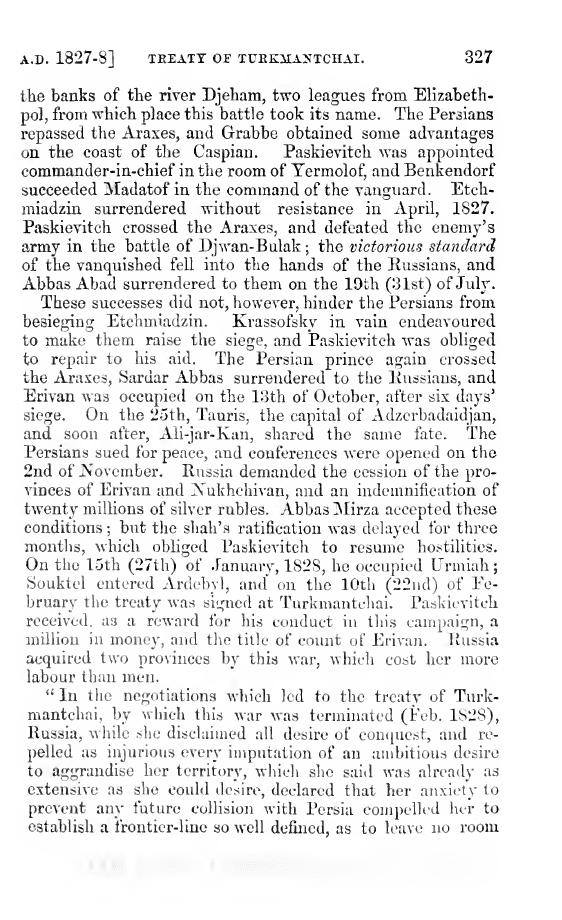
Paskievitch
joined
with his
division of 9000
men,
and
defeated
Abbas
Mirza on

A.D.
1827-8]
TEEATT OF
TUBKMANTCHAI.
327
the banks
of
the
river
Djeham,
two
leagues
from
Elizabeth-
pol,
from
which
place
this battle
took its name.
The
Persians
repassed
the
Araxes,
and
Grabbe obtained some
advantages
on
the
coast of the
Caspian.
Paskievitch
was
appointed
commander-in-chief
in the room of
Yermolof,
and
Benkendorf
succeeded
Madatof in the command
of the
vanguard.
Etch-
miadzin
surrendered without
resistance in
April,
1827.
Paskievitch crossed
the
Araxes,
and defeated
the
enemy's
army
in the battle
of
Djwan-Bulak
;
the
victorious
standard
of the
vanquished
fell into
the
hands
of
the
Russians,
and
Abbas Abad
surrendered to
them on the 19fch
(31st)
of
July.
These successes
did
not,
however,
hinder
the Persians
from
besieging
Etchmiadzin.
Krassofsky
in vain
endeavoured
to make
them
raise
the
siege,
and Paskievitch
was
obliged
to
repair
to
his
aid.
The
Persian
prince
again
crossed
the
Araxes,
Sardar
Abbas
surrendered to
the
Russians,
and
Erivan was
occupied
on
the 13th
of
October,
after
six
days'
siege.
On the
25th,
Tauris,
the
capital
of
Adzerbadaidjan,
and soon
after,
Ali-jar-Kan,
shared the same
fate.
The
Persians sued for
peace,
and conferences were
opened
on
the
2nd of
November. Russia
demanded the cession
of
the
pro-
vinces of Erivan and
jNTukhchivan,
and an indemnification
of
twenty
millions
of silver rubles.
Abbas
Mirza
accepted
these
conditions
;
but the
shah's
ratification was
delayed
for three
months,
which
obliged
Paskievitch to resume
hostilities.
On the 15th
(27th)
of
January,
1828,
he
occupied
Urmiah
;
Souktel entered
Ardebyl,
and
on the 10th
(22nd)
of
Fe-
bruary
the
treaty
was
signed
at
Turkmantchai.
Paskievitch
received,
a3
a reward
for
his
conduct
in
this
campaign,
a
million
in
money,
and the
title
of
count
of
Erivan.
Russia
acquired
two
provinces
by
this
war,
which
cost
her more
labour
than
men.
"
In
the
negotiations
which led to the
treaty
of
Turk-
mantchai,
by
which
this
war
was
terminated
(Feb.
1828),
Russia,
while .she
disclaimed
all
desire
of
conquest,
and
re-
pelled
as
injurious
every
imputation
of
an ambitious
desire
to
aggrandise
her
territory,
which
she
said was
already
as
extensive
as
she
could
desire,
declared that her
anxiety
to
prevent any
future
collision
with
Persia
compelled
her to
establish a frontier-line so
well
defined,
as
to leave
no
room
328
HISTORY OF RUSSIA.
[CH.
LXV.
for
doubt
or
discussion hereafter
;
and
as
this
could be
found
only
on the
Arras
(Araxes),
she had
no
alternative
but to
adopt
the
line of
that
river.
"
Persia,
besides
paying
the
whole
expenses
of
the
war,
was, therefore,
called
upon
to cede the
important
and
wealthy
provinces
of
Erivan
and
JNukhchivan,
including
the
fortresses
of
Erivan
and
Abbasabad
;
because it
was
necessary
to
the
future
tranquillity
of the two
empires,
that
their
common
frontier should
be
defined
by
the
Araxes.
The
sacrifice
to
Persia was
immense
;
but she
was
in
no
condition
to
renew
the
war
;
and she
consoled herself with
the
belief
that
this
arrangement,
while it
took
from
her
possessions
infinitely
more
valuable,
would at
least
give
her back
Talish
and
Moghan,
from
which
the
Russians had been
driven
by
the
revolt of the
inhabitants in
the
commencement of
the
war,
and
which
they
had
not been
able to
re-occupy.
But
this
was
not
consistent
with
the views of
Russia;
and
though
these
districts
were of
no real value
to
her,
and
even
caused
her
a
considerable
yearly
expenditure,
she
refused
to relin-
quish
her claim
to
them
;
treated
with
contempt every
allusion
to
the
promise
of
general
Ritescheff
;
and when
reminded
that
she
had
herself
required
the
cession
by
Persia
of
Erivan
and
Nukhchivan,
for the
sole
object
of
establishing
the
Arras
as
the
frontier-line,
and
was now
violating
the
principle
she had laid
down,
her
only
answer was a threat
to break
off
negotiations,
and
recommence
hostilities.
Persia
had no
alternative,
and
submitted.
"
The
object
of
Russia in
securing
this
position
is
suffi-
ciently
obvious. The
Arras
is
fordable,
at
short
intervals,
from the
vicinity
of
Julfa
(near
the
great
road
between
Erivan and
Tabreez)
to a ford
called
Yeddee Bolook
;
but
below
that
point
it
is never
fordable.
By retaining
Talish
and
Moghan,
she has secured to
herself
possessions beyond
the
Arras
extending
southward
to the
frontier of
Grhilan,
from the
point
where the
river ceases
to be fordable
to
its
mouth on the
Caspian
Sea
;
and
has thus laid
open
one
of
the
most
valuable
parts
of
Persia to
an attack
at
any
season
of
the
year,
and
placed
herself in a
position
from which
she
can
occupy
Grhilan with
most
facility.
That she
retains
her
views on
this rich
province,
is
sufficiently
proved by
the
fact
that
she
threatened
only
two
years
ago
(1834)
to
occupy
it
A.D.
1827-S]
TREATY OF TURKMANTCIf
AI.
329
as
a
security
for the
payment
of
500,000
tomans
(250,000?.)
of
indemnity
still
due to lier
by
Persia.
"
The
possession
of Talish and
Moghan
cannot
he
pre-
tended
to
he of
any
real value
to
Russia,
beyond
the
facility
it affords
for
future
aggressions
;
and
that in
this
point
of
view it
is of
the
greatest importance
is
demonstrated
by
the
fact,
that
from
the
natural
strength
of the
country,
and the
hostile
spirit
of the
inhabitants,
she was unable
to re-establish
her
authority
there,
after the conclusion of the
peace,
with-
out the aid
of the Persian
government.
"
In
the
province
of Nukhchivan ceded
to
Russia,
and on
the
left
bank
of the
Araxes,
is the fortress of
Abbasabad,
constructed
by
a French
engineer
in the service of
the late
Abbas Mirza.
Russia,
not content
with the
fortress,
de-
manded
possession
of an
unfinished
work
intended
for a
tete-
du-pont
on the
opposite
bank,
which
she
represented
as
a
part
of the
fortress,
though
no
bridge
had ever been
con-
structed
;
and
having
obtained this unfinised and
untenable
outwork,
founded on the concession another demand.
The
intended
tete-du-pont
to an
imaginary
bridge
required
an
esplanade
;
and
a
segment
of a
circle,
with a radius of two
miles,
was
assigned
to
her for this
purpose.
"
The
second
position
beyond
the Araxes
opens
to
her an
entrance into Persia on
the
other flank
of
the
frontier,
and
at
the nearest
point
of that frontier to
the fortress of
Khoe,
the
most
important
of all that now
remain to Persia.
It
commands
the
only
available line
of communication between
Persia
and
Turkey,
the
only
road
by
which their commerce
can
pass,
and
consequently
that
by
which the British
trade
with
Persia is carried
on. Its
importance
has not
escaped
the
observation of
Russia;
she
selected
it
as the
place
which
she was to
hold
in
pledge
for the
payment
of the last instal-
ment
of
the
indemnity
which
was
necessary
to
procure
the
final
evacuation
of
the
Persian
territories
by
the Russian
troops.
She,
therefore,
held
it
during
her war with
Turkey
in
1828,
and
frit its
value in
separating
from
one another
the Persian
and
Ottoman
dominions;
but on
the
payment
of
the
stipulated
sum
she
was
reluctantly
compelled
to
sur-^
render it.
"
By
the
treaty
of
Turkmantchai,
Persia
was
again
bound
to
maintain
no
navy
on
the
Caspian
: this
stipulation
was
330
HISTOEY OF
BUSSIA.
[CH.
LXT.
now made
to
rest on the
prescriptive right
of Russia
to
the
exclusive
privilege
of
having
a
navy
on
that
sea,
which
the
treaty
declares she
had
enjoyed
ab
antiquo.
This, however,
was an
antiquity
of
only
thirteen
years
;
for
she
acquired
the
exclusive
right
by
the
treaty
of
Gulistan,
which
was con-
cluded in
1814."*
"Whilst
the
war
with Persia was
pending,
measures
were
in
progress
with
respect
to
Greece,
which
resulted in
conse-
quences
most
advantageous
to Eussia
in her cherished
de-
signs against
the Ottoman
empire.
The duke
of
Wellington,
who had been sent as ambassador
extraordinary
to
congra-
tulate the
emperor
Nicholas
on his
accession,
expressed
to
count Nesselrode
the
indignation
of
his court at
the
atrocities
perpetrated
in
the Morea
after the
debarkation
of
the
troops
of Ibrahim
Pasha,
and
its desire to terminate the
contest
by
a
common
interference.
After this
preliminary
conversation
with
the
Russian
minister,
the duke had several
private
in-
terviews with the
emperor,
when the
great question
of
the
East
was
formally
discussed;
and then it was ascertained
that the
policy
of Nicholas
essentially
differed
from that of
Alexander.
The
emperor
drew at once a broad
line of
distinction be-
tween
the individual
interests of Eussia and
the
Turko-
Greek
differences which
the allied
powers
might
be called
upon
to
adjust.
He claimed
the
right
to
interfere,
in common with
the other
powers
of
Europe,
when
it suited
his
policy,
and
to
exclude them from
all
joint
mediation
whenever their co-
operation
militated
against
his own
views.
He did not
pre-
tend to
any
exclusive
intervention in the
affairs of
Greece,
although,
as he
adroitly
observed,
a
religious question
was
involved
;
but he
only
made this concession
on the distinct
understanding
that
the
powers
would
undertake
to
rescue
the
Greeks
from
the
ferocity
of their
enemies,
and
thenceforth
support
with
greater
energy
the
Christian
interests
in
the
East.
As to
what
might
concern Eussia
individually,
the
emperor
positively rejected
all
foreign
intervention.
He
justified
this
course
by
a
reference to
anterior
treaties
;
sub-
mitting
that he
only
claimed
rights
long
since
ignored
or
violated
by Turkey,
reserving
to himself
the
occasion
and
the
*
"
Progress
of
Eussia in the
East."
A.D.
1828]
CONVENTION
OF
AKERMAN.
331
means
of
recovering
them,
but
pledging
himself not
to
com-
promise
the
existence
of
the Ottoman
empire.
On the
4th of
April,
1826,
a
few
days
before his
departure
from St.
Petersburg,
the duke
of
"Wellington
signed,
with
count
Nesselrode,
the
first
protocol
relative to
the affairs of
Greece
;
and
ultimately
that
protocol
led to two
important
results,
though
different in their
nature. The
first was the
celebrated
treaty
of
London,
concluded on
the Gth
of
July,
1827,
between
England,
France,
and Russia
;
the second was
the convention
of
Akerman,
in
Bessarabia,
adjusted
between
Russia
and
Turkey. By
that
convention
Russia obtained
from
the
Ottoman
Porte
all
she deemed
it
prudent
to exact
at that
critical
juncture
:
but even
in
that
arrangement lay
the
germ
of
the
treaty
of
Adrianople.
The
ostensible
object
of
the
convention of Akerman was
to secure
the
exact
fulfilment
of
the
treaty
of
Bukharest
;
and
it
bound
the
sultan,
first,
to
grant
to
the
principalities
of Moldavia
and
Vallachia,
within
six months
at
the
latest,
all the
rights
and
privileges
specified
in
the hatti-sheriff of 1802
;
secondly,
to
guarantee
to Servia all its
former
privileges,
to
augment
them
by
new
advantages,
and,
by
a
particular
hatti-sheriff,
to define in
detail all the
rights
of
the
Servians,
according
to a mutual
agreement
with
the Russian court
;
thirdly,
to
satisfy
the
claims of
Russian
subjects
on the Turkish
government
;
fourthly,
to accord to Russian
commerce in
the
Black Sea
and in
the
Mediterranean the
most
perfect
liberty,
under no
pretence
whatever
impeding
the
navigation
of
merchantmen
sailing
under the Russian
flag
on the
waters of
the
Ottoman
empire,
or
hindering
the vessels
of the
powers
in alliance
with Russia from
entering
the
Black
Sea
;
fifthly,
it
was
sti-
pulated
that
the
Asiatic
boundary
between
the
two
empires
should
remain
exactly
in
the
same state
as
it was at
the
con-
clusion
of
the
convention,
and that
Turkey
should
give up
all
pretensions
to
the
different
forts
conquered
by
the
Rus-
sians
beyond
the
Caucasus in
the
former war.
The Turkish
government,
however,
has
publicly
asserted,
referring
to
the
protocols
in
verification of
the
assertion,
that it
signed
the
convention on the
express
understanding
that Russia
should
renounce all
bid
Hi
mice in
the
affairs of Greece
;
and
this
has
never
been
publicly
denied.*
* "
Progress
and
Present
Position
of
Russia in the
East,"
p.
79.
Third
edition.
332 HISTORY OF ETJSSIA.
[CH.
LST.
The
treaty
of
London
really
created
the
modern
kingdom
of Greece.
It
proposed
to the
Ottoman Porte
the
mediation
of
England,
France,
and
"Russia
;
and unless
accepted
within
a
month,
they
declared that
they
would not
tolerate the
con-
tinuance of
a
state of
things
which
had
disturbed the
East
for
six
years,
but accredit consular
agents
in
Greece,
and
receive
from
Greece
consular
agents
in their own countries.
They
also
proposed
an armistice
pending
negotiations. Einally,
if
the
Turkish
government
would
not listen to
any
terms
of
accom-
modation,
or if the Greeks refused
to
accept
the
conditions
proposed,
the
high contracting powers
would instruct
their
representatives
in
London
to determine
what ulterior
mea-
sures
might
be
necessary.
The
treaty
of
London,
however,
still
reserved to
the sultan
the suzerainte
of Greece and
a
yearly
tribute from that
country.
The ambassadors
of
the
three
powers,
in
communicating
to the
Porte the
stipiilations
of
the
treaty
of
London,
intimated
the
necessity
under
which
they
would
be
placed,
if
the Turkish
government
should
per-
sist
in
rejecting
their
mediation,
"
of
recurring
to such mea-
sures as
they
should
judge
most efficacious
for
putting
an
end
to a
state of
things
which
was
become
incompatible
even
with
the
true interests of
the Sublime
Porte,
with
the
secu-
rity
of
commerce
in
general,
and
with the
perfect
tranquillity
of
Europe."
Turkey
regarded
that note
as a declaration
of
war,
and
prepared
for the defence
of
Constantinople.
Ibra-
him,
son of Mehemet
Ali,
pacha
of
Egypt,
commander-in-
chief of the Ottoman forces
in
Egypt,
spared
neither
age
nor
sex,
burning
towns, devastating
the
fields,
and even
rooting
up
the
olive-trees.
Then
followed
the fatal
victory
of
Nava-
rino,
in which
England
and Prance
were the
dupes
of
Russia,
as
the destruction of the
Turkish
fleet rendered
the czar
master of the
Black
Sea.
The sultan
demanded satisfaction
for
the
loss he had
sustained,
and
reparation
for
his wounded
honour
;
declaring
that
until
he
received
satisfaction
he
could
hold no
intercourse with
the
ambassadors
of the three
powers,
who withdrew
from
Constantinople
in
December,
1827.
The
secret
policy
of Russia was
soon
made manifest.
She
proposed
"
to
occupy
Moldavia
and Vallachia
in
the name of
the
three
powers,"
and
even to march
an
army
into
Turkey,
"
dictating peace
under
the walls
of the
seraglio."
Prance
and
England
refused
their
assent
to these violent
measures,