
Kelly W.K. The History of Russia: from the Earliest Period to the Present Time. Volume 2
Подождите немного. Документ загружается.

y /
THE
HISTORY OF
RUSSIA,
FROM
THE
EARLIEST
PERIOD
TO THE
PRESENT
TIME.
©ompilrt
from
tf)c
most
authentic Sources,
INCLUDING THE WORKS OF
KAKAMSIN,
TOOKE,
AND
SEGUE.
WALTER K.
KELLY.
IN TWO VOLUMES.
VOL.
If.
LONDON:
HENRY Ox.
BONN,
FORK
STREET,
COVENT
GARDEN
M
DCCCf.V.

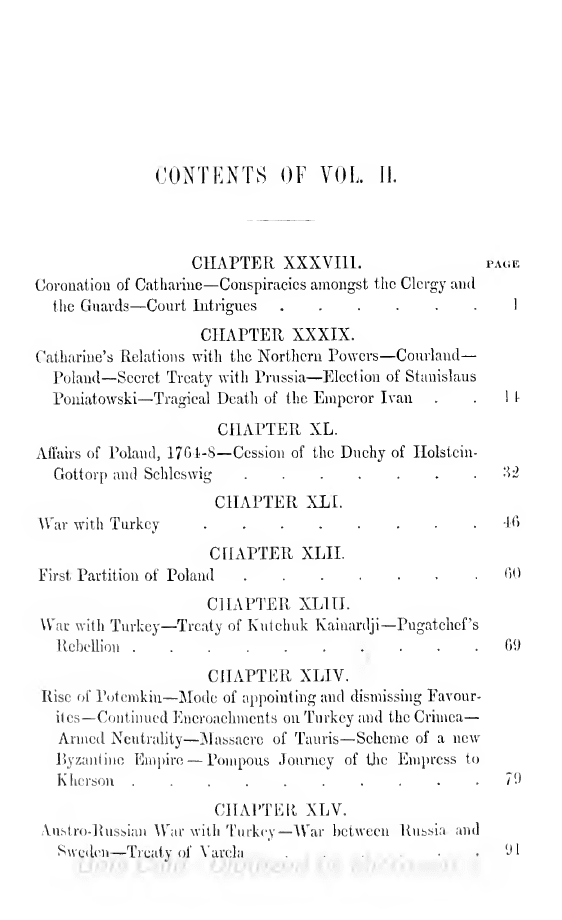
CONTENTS
OF VOL
II.
CHAPTER XXXVIII.
page
Coronation
of
Catharine
—
Conspiracies
amongst
the
Clergy
and
the Guards
—
Court
Intrigues
1
CHAPTER
XXXIX.
Catharine's
Relations with
the Northern
Powers
—
Courland
—
Poland
—
Secret
Treaty
with Prussia
—
Election
of Stanislaus
Poniatowski
—
Tragical
Death
of the
Emperor
Ivan
. .
14
CHAPTER
XL.
Affairs
of
Poland,
1764-8
—
Cession
of the
Duchy
of
Holstciu-
Gottorp
and
Schleswig
32
CHAPTER
XLI.
War with
Turkey
46
CHAPTER
XLII.
Pirst Partition of Poland
00
CHAPTER
XLIII.
War
with
Turkey
—
Treaty
of
Kutchuk
Kainardji—Pugatchcf's
Rebellion
69
#
CHAPTER
XLIV.
Rise
of
Poteinkin—
Mode
of
appointing
and
dismissing
Favour-
ites—Continued
Encroachments
on
Turkey
and the
Crimea
—
Armed
Neutrality
—
Massacre
of Tauris
—
Scheme
of a
new
Byzantine
Empire
—
Pompous
Journey
of
the
Empress
to
Kherson
79
CHAPTER
XLV.
Austro-Russian War with
Turkey—
War
between
Russia
and
Sweden
—
Treaty
of
Varolii
(
J1
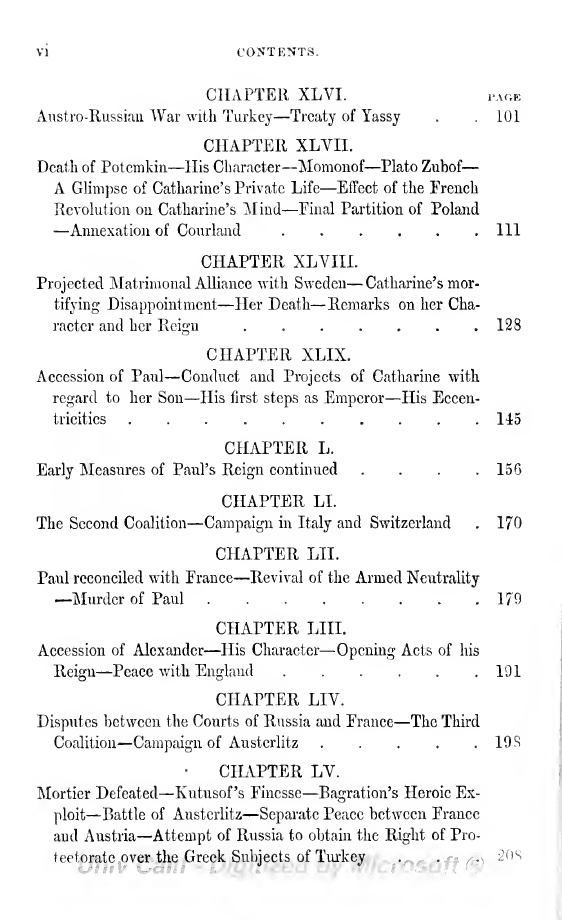
VI CONTENTS.
CHAPTER
XLVI.
page
Austro-Russian War with
Turkey
—
Treaty
of
Yassy
.
. 101
CHAPTER
XLVII.
Death of Potemkin
—
His Character
—
Momonof
—
Plato Zubof
—
A
Glimpse
of Catharine's Private
Life
—
Effect of the
French
Revolution
on
Catharine's
Mind
—
Final Partition of
Poland
—
Annexation
of
Courland ......
Ill
CHAPTER
XLVIII.
Projected
Matrimonal Alliance
with Sweden
—
Catharine's mor-
tifying Disappointment
—
Her Death
—
Remarks on her Cha-
racter and her
Reign
128
CHAPTER
XLIX.
Accession
of Paul
—
Conduct
and
Projects
of Catharine with
regard
to
her Son
—
His
first
steps
as
Emperor
—
His Eccen-
tricities 145
CHAPTER
L.
Early
Measures
of
Paul's
Reign
continued .... 156
CHAPTER LI.
The Second
Coalition
—
Campaign
in
Italy
and
Switzerland .
170
CHAPTER
LII.
Paul
reconciled
with France
—
Revival
of the
Armed
Neutrality
—Murder of Paul
179
CHAPTER LIII.
Accession
of Alexander
—
His Character
—
Opening
Acts of
his
Reign
—
Peace
with
England
191
CHAPTER LIV.
Disputes
between
the Courts
of
Russia and
France
—
The Third
Coalition
—
Campaign
of
Austerlitz 198
CHAPTER LV.
Mortier
Defeated
—
Kutusof
's
Finesse
—
Bagration's
Heroic Ex-
ploit
—
Battle
of
Austerlitz
—
Separate
Peace between
France
and Austria
—
Attempt
of Russia to obtain the
Right
of Pro-
tectorate
over
the
Greek
Subjects
of
Turkey
.
.
.
208
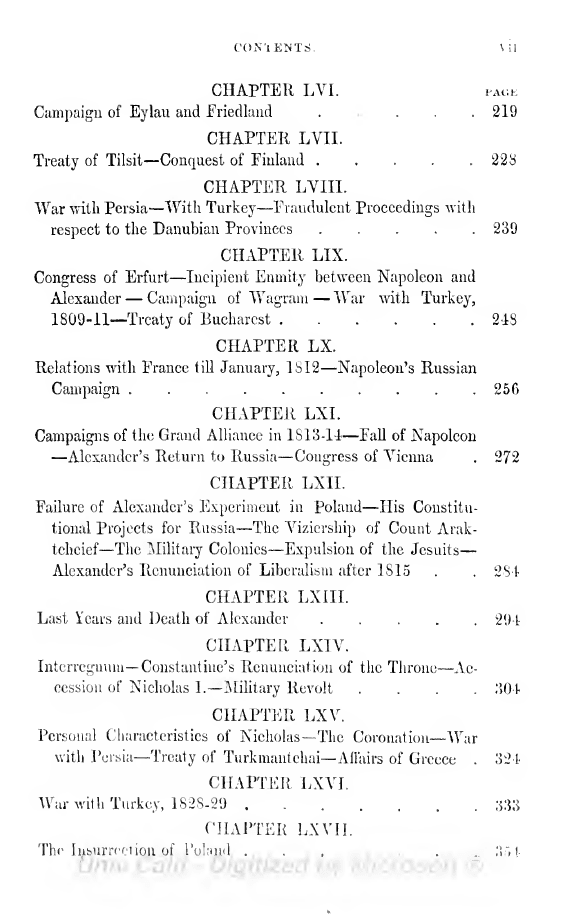
CON'lEHTS.
VII
CHAPTER
LVI.
page
Campaign
of
Eylau
and
Friedland
219
CHAPTER
LVII.
Treaty
of Tilsit—
Conquest
of Finland
228
CHAPTER LVIII.
War with Persia
—
With
Turkey
—
Fraudulent
Proceedings
with
respect
to the
Danubian Provinces
239
CHAPTER
LIX.
Congress
of
Erfurt
—
Incipient
Enmity
between
Napoleon
and
Alexander
—
Campaign
of
Wagram
—
War with
Turkey,
1809-11—
Treaty
of Bucharest
248
CHAPTER LX.
Relations
with
France
till
January,
IS 12
—
Napoleon's
Russian
Campaign
256
CHAPTER LXI.
Campaigns
of the
Grand
Alliance
in
1813-14
—
Fall of
Napoleon
—
Alexander's
Return
to Russia
—
Congress
of
Vienna
.
272
CHAPTER
LXII.
Failure
of Alexander's
Experiment
in
Poland
—
His
Constitu-
tional
Projects
for Russia
—
The
Yiziership
of
Count
Arak-
tcheief
—
The
Military
Colonies
—
Expulsion
of
the
Jesuits
—
Alexander's
Renunciation
of
Liberalism after
1815
.
.284
CHAPTER LXIII.
Last Years
and Death
of Alexander
294
CHAPTER
LXIV.
Interregnum—
Constantino's Renunciation
of the
Throne
—
Ac-
cession
of
Nicholas I.—
Military
Revolt
....
304
CHAPTER
LXV.
Personal Characteristics of
Nicholas—
The
Coronation
—
War
with
Persia
—
Treaty
of
Turkmantchai—
Allans of
Greece . 324
CHAPTER
LXVI.
War with
Turkey,
1828-29
333
CHAPTER LXV 1
1.
The
Insurrection
of
Poland
354
VIU CONTENTS.
CHAPTER
LXVIII.
page
Cruelties inflicted
on
the Poles
—
Persecution
of
the United
Greek Church
—
Martyrdom
of
the Nuns of
Minsk .
.
376
CHAPTER
LXIX.
The War
in the Caucasus
392
CHAPTER
LXX.
Treaty
of
Unkiar
Skelessi
—
Expedition
to
Khiva
—
Memorandum
of 1844 on the Eastern
Question
—
Extinction of
the
Re-
public
of Cracow
—
Secret Societies
—
Intervention in
the
Prin-
cipalities
and hi
Hungary
401
CHAPTER LXXI.
War with
Turkey,
France,
and
England
: its
Origin
. .414
CHAPTER LXXII.
War
with
Turkey
—
Operations
on
the Danube and in Asia
—
Destruction of the Turkish Eleet at
Sinope
.
.
.433
CHAPTER LXXIII.
War
with
Turkey
—
Operations
on
the
Danube
—
Battle of
Citate
—
England
and
France
put
their
Forces
in motion
.
.
448
CHAPTER
LXXIV.
Renewed Efforts
in the
Principalities
—
Final
Rejection
of
the
Terms
proposed by
England
and France
—
Rupture
between
Turkey
and
Greece
—
Russian Finance
—
Bombardment of
Odessa
—
Operations
in the Dobrudsha
.... 459
CHAPTER LXXV.
Historical
Enigma
—
Siege
of Sdistria
—
Discomfiture of
the
Russians
—
Evacuation
of
the
Principahties
. .
.472
CHAPTER
LXXVI.
The
Russians
evacuate,
and
the A.ustrians
cuter,
the
Principa-
lities
—
Operations
in the Baltic
—
Expedition
to the
Crimea
—
Battle
of the Alma
—
Siege
of
Sebastopol
—
Battles of Bala
klava
and
Inkermann
—
Attack
on
Pctropaulofski
. .
1 SI
CHAPTER
LXXVII.
The
Siege
of
Sebastopol
continued—
Accession of
Sardinia
to
the
Anglo-French
Alliance—
Death
of t
lie
Emperor
Nicholas
—
Conference
at Vienna
—
Conclusion
.
.
.
.502
Index
511
HISTORY OF
RUSSIA.
CHAPTER
XXXVIII.
CORONATION OF CATHARINE
—
CONSPIRACIES AMONGST THE
CLERGY
AND THE
GUARDS
—
COURT INTRIGUES.
The
second accounts
brought
from Moscow were of
a
more
favourable
complexion
than
the first.
Brandy
and
money,
distributed
judiciously by
the
governor,
had
worked a
great
change
in the
minds of the
garrison
; Catharine,
there-
fore,
hastened to celebrate
her
coronation
in
that
ancient
capital
of
the
empire.
Attended
by
a
numerous
cavalcade,
she made
her entrance
with
great pomp
;
but
notwithstanding
the
money
that had been
previously
distributed,
she too
easily
perceived
that
her
presence
was not welcome
to the
people.
She
nevertheless
repaired
to
the
chapel
of the
czars,
where
she
lavished her flatteries on
the
archbishop
and the
popes,
and
was
crowned
in the
presence
of
the
soldiery
and the
cour-
tiers.
The
crowd,
which looked
coldly
on the
empress,
ran
everywhere
to
welcome
the
grand-duke,
and
mingled
with
the
emotions of
tenderness
they
felt
for the child
a
visible concern
for
the
misfortunes of
his father.
Catharine,
dissatisfied with
Moscow,
industriously
concealed
her
chagrin
;
and
returned
with little
delay
to
Petersburg.
Careful to
flatter
the
military,
who
had been
neglected by
Peter,
she
published
a
manifesto,
on
the
day
of her corona-
tion,
in
praise
of
the
troops
that
had
fought
against
Prussia,
and
caused
a half
year's
pay
to
be
given
to
the
subalterns
and
common soldiers
who had
been
present
at
the
battles
of
Paltzig,
Kai, Zullichau,
Frankfort,
or
Kunersdorf.
Of each
of the
four
regiments
of
life-guards,
the
Prcobajenski,
Si-
meonofski,
Ismailofski,
and
the
horse-guards,
the
empress
VOL. II. B
2
HISTOEY
OF
BUSSIA.
[CH.
XXXVIII.
appointed
herself
colonel.
General-adjutant
Gregory
Orlof
was
made
lieutenant-colonel
of
the
last
regiment
;
his bro-
ther
Alexis of
the
first
;
Feodor
and Vladimir
Orlof
of
the
other
two.
Catharine
now
put
off
all
restraint.
The
monks,
who
had
long
favoured
her
projects,
and
to whom
she had often
pro-
mised
a restoration
of the
possessions
they
had been
despoiled
of
by
her
husband,
vainly
recalled
to her
mind their
services
and
her
promises.
She
perceived
that
it would not
be
prudent
to
let them
resume
an
ascendant
which
might
prove
as dan-
gerous
as
it
had been serviceable
to
her;
and
instead of
revoking
the
edict of
Peter
III.,
she referred
it
to the exami-
nation
of a
synod, composed
of
persons
implicitly
subservient
to
her will.
The
principal
members
of the
clergy
were
secretly
brought
over
;
the
rest were
sacrificed
; and,
animated with
sacred
fury,
vowed
revenge
against
their former
patron.
The
rage
of the
priests
could
not
fail of
having
some
effect.
They
fanned
the embers
of sedition
among
the
populace
and
the soldiers.
Calling
to
mind their
prince
Ivan,
they
ascertained
that
he was in
St.
Petersburg
on
the
very
day
of
the
revolution;
to which
city
Peter
III. had
mysteriously
caused
him to be
brought,
in
the
supposed
design
of
declaring
him
his
successor;
and
whence
Catharine had
since,
not
less
mysteriously,
had
him
conveyed away
;
and
they openly
said,
that
it was
to that
unhappy
prince
that
the
throne
belonged. They
moreover
published
an
alleged
imperial
manifesto,
all the
copies
of
which the
friends of
Catharine
had
not been
able to
suppress.
Their
story
was,
that
Peter
III.
had caused
this document
to be drawn
up
by
the
state-
councillor
Yolkof,
and had
signed
it
with
his own
hand. He
had therein
enumerated
all
the faults and
transgressions
of
Catharine
;
and
accusing
her of
adultery,
declared that he
would
not
acknowledge
the
young
grand-duke
for his
son,
since
he was
the
fruit
of
the scandalous
commerce
of
his
wife
with Soltikof.
This
manifesto,*
composed
with
great
fbrce
and
eloquence,
was
artfully
dispersed
among
the
people,
and
soon
found
its
way
among
the
soldiers, who,
for
the most
part
unable
to conceive
in
what
fit
of distraction
they
had
been
drawn
into
the
rebellion,
already,
as
we have
observed,
*
Perhaps
a
forgery
of the
exasperated
clergy.
A.D.
17G2]
DISMISSAL
OP
SIITTVALOF.
3
repented
their
wickedness,
and
deplored
the
sad lot of a
prince,
mistaken but
not
malevolent,
who had
been
barbarously
put
to
death.
Everything
seemed to
portend
a
new
revolution :
but
Glebof, Passek,
Teplof,
and
their
emissaries
were not
blind
to
all these
proceedings.
Suddenly
an
imperial procla-
mation came
forth,
forbiddiug
the
soldiers
of
the
guards
to
assemble without orders
received
from
their
officers. Some
of the most
violent were
imprisoned,
and
suffered the
punish-
ment of the
knout
;
others
were
banished
into
Siberia
:
terror for some time
kept
the
rest in
silence.
By
thus
chastising
the
regiments
of the
guards,
the em-
press
thought
she
should also shut
the
mouths
of the
priests.
She
refused even
to
temporise
with
the
courtiers who dis-
pleased
her,
and
who
thought
they
had
just
claims to her
gratitude.
Ivan
Shuvalof,
if
he had not
taken
part
in the
conspiracy,
had at least
promoted
it
beforehand
by
calumnia-
ting
Peter
III.,
and after
it
broke out he
became its
approver
and
supporter.
By
flattering
the
propensities
of
Catharine,
he
hoped
to
find that
easy
access with
her
which the
empress
Elizabeth had
granted
him.
Shuvalof
was
mistaken. He
awakened the
jealousy
of
Orlof
;
Catharine
sent
him
word
that
his
presence
was
not
necessary
at
court
;
then,
adding
derision to
harshness,
she made him
a
present,
as the
reward
of
his
services,
of an
old
negro,
who
played
the
part
of
a
buffoon
about
the
palace.
Yillebois,
the master
of the
ordnance,
whose
personal
affection for
her had
seduced
him
from the
path
of
duty,
now
paid
the forfeit of
his
mistake.
Orlof
was
afraid
of
his
talents,
and
Avanted
his
place.
Villebois was
dis-
missed,
and the
favourite
appointed
grand
master
of the
ordnance.
Even
the
princess
l)ashkof
found her
pretensions
slighted,
and
made no
secret of
her
resentment. This
was
reported
to
the
empress
: and the
princess
received
orders to
retire
to
Moscow.
At
the
same
time
Catharine
commissioned
the
Piedmontese
Odart to
engage
the
ambassador of
France
to write
to
Voltaire,
cautioning
him
to
be on his
guard
against
the
vanity
of
princess Dashkof,
and
to
tell
him,
that
if he
should transmit
to
posterity
the
event
that
had
just
happened
in
Russia,
he
need
only
make
mention
of this
young
woman
as
having
acted a
very
secondary
part
in
a
revolution,
the
b2
4
HISTOET OF
RUSSIA.
[CH.
XXXVIII.
success
whereof
was
owing
solely
to
the wisdom
and
courage
of
the
empress.*
The
same commission
was
given
to her
ambassadors
at London
and
at
Paris.
f
The
archbishop
of
Novgorod,
one
of the
principal
instru-
ments in
the
revolution,
and who
had
the
most assisted in
diminishing
the
privileges
of the
monks,
having
been
gained
over
by
money
and
promises,
found all at once that his
towering hopes
were frustrated.
When
Catharine had
no
longer
any
need of
his
services,
she
presently
dismissed him
;
and he
was
obliged
to take
back with
him
his
rage
and
disgrace
to
a
clergy
who hated
him,
and a
people
who
despised
his ambition.
In the
mean
time
Poniatowski had
learned,
with
inexpres-
sible
J03',
the
triumph
of Catharine.
Since
his
expulsion
from
St.
Petersburg,
in
consequence
of his detected
in-
trigue
with the
grand-duchess,
he had
kept up
a
regular
correspondence
with her
;
whilst
she,
though
in
secret
con-
soling
herself for
his
absence,
openly
affected a
romantic
constancy
in her attachment to him.
Perhaps
Poniatowski
flattered
himself that he should soon be honoured with
the hand
of her whose heart he
imagined
had
long
been
his.
He advanced
to the frontiers of
Poland,
and sent to
ask
permission
to
pay
a
visit
to her
majesty.
But she
re-
turned
him for
answer,
that his
presence
was not
neces-
sary
at
Petersburg
;
and
that
she had different views in
his
behalf.
Unwilling
that he should be further informed
of
her
new
connexions,
she continued
to write to
him
in
an
affectionate
style,
and sometimes shed tears before the confi-
dants of
the
Pole,
in
speaking
of her
passion
for him.
She
complained
that an inclination
for Orlof was
attributed to
her,
and affected to treat
the
imputation
with
ridicule.
But
the
period
of
fears was
past.
Orlof
had
done with
mystery.
Haughty
and coarse
in his
manners,
that
favourite
but
awkwardly
submitted
to dissimulation
;
and he now
made
it
appear
that
he had
no
longer
occasion for an irksome
pre-
*
M.
de
Breteuil
rather went
beyond
his
commission,
by
adding
in
his
letter
:
"
C'est
pousser
bien
loin la
jalousie
et la
hardiesse
de
l'ingratitude."
•f-
Upwards
of
five-and-twenty
years
after that
event,
Catharine
held
the
same
language
to the
English
minister at her court.
It
was
her
earnest
desire
that
the
history
of
her
life
and
reign
should
have
been
uudertaken
by
the
historian of
Charles
V. Various
suggestions