
Kojeve Alexandre. Introduction to the Reading of Hegel: Lectures on the Phenomenology of Spirit
Подождите немного. Документ загружается.

T,pDiatz8tbo|ilEnealatdttvP|lercmernlogicalMetlwilinHegel
he
"soes
beyond"
or
"trenscends"
the
given-being
which
n"
!il-
self
is,
this
"'going
beyond"
being pr-cisely
the
thought
which
,,reveals"
thisieirig
to'itself
and to
others,
by
illuminating
it as
it
were
from
outsidJ
and
from the
standpoint
of
a
nonexistent
be-
yond.
If Man
were
not
voluntarill
mgrtll!
(that is,
free,
individual,
lnd
historical;
that
is, total
or dialectical),
he
could
neither
think
nor
speak:
therefore
he would
be no
different
in any
respect
from
an animal.
To
say that
human
death,
in
contradistinction
to
an
animal's
"end,"
ii
a
"dialectical
overcoming"
(that ls'
free,
since
it can-be
biologically premature),
therefore,
is
first
of
all
to
say that
Man
knoats that
he must
die. An
animal,
a
plant,
and
a
thing
come
to
an
end
"in
themselves
or for
us"-that
is, only
for
an
external
observer. A
man's death.
on the
other
hand, also
exists "for
itself,"
for he himself
is conscious
of it. This
end
"in
and
for
itself"-
that is, a dialectical
or
"total"
end-is
Death
in the proper
sense
of
the word,
which takes place
only in Man;
and
it
is because
Man
ismortalinthis
sense thal
he is truly
human
and
esentially
different
from
an animal.so
It
is by actually
risking
his life
(unnecesarily)
that
Man
rises
to consciousness
of his death. And
once
in
posession
of this
con-
sciousness,
he, in contradistinction
to an
animal,
can
either
die
con-
sciously
(or
voluntarily)
or reject death
in and
by
hit thought
and
his will.
On
the
one hand, Man can
die
"without
losing
conscious-
ness"l thus he can voluntarily
face
death as
a
calculated
risk on
which he has reflected
or in full awareness
of
the
imminence
of a
fatal outcome;
he
can
even kill
himself, for any
motives
whatso-
ever
he may
iudge
valid. On the
other
hand,
he can
negate
his
death, as he can negete
(by
deluding
himself)
anything
that
is
se
Epicurus' well-known reasoning
is valid only for
an animal,
or for
non-
didectical
being
in
general,
which cen only
sufier its end
without
ever being
eble to
prepare
it. This
being ir
as
long as it lives,
and it is
annihilated after
its
deeth,
Therefore death does
not actually exist
far
il,
and one cannot
say of
it:
"it
is
dyingJ'But
man trrnscends
himseU
in
and by
his very existence:
in living,
he
is also
beyond
his real
existence; his future absence
is
present
in his life, and
the
Epicurean argument
cannot blot out this
presence
of
the
absence
in his
exi$ence. Thus,
man is mortal
fot
himself,
and
that is
why he alone can
die
in
the
proper
sense
of
the
word. For only he can live
while knowing
that he
is
going
to die. And that
is why,
in cenain cases,
he can live
in terms
of the idea
of death,
by subordinating to
it everything that is dictated
to him
only by his
life
(an
ascetic life).
255
INTRODUCTION
TO THE
READINC
OF HECEL
acmally
given ro him in
end by
his consciousnes:
he can declare
himself
immortal.
But
Man cannor
really
become
immortal.
It is
the being of
wh*
is
negated
that
passes into
the negation
rnd realizes its
result.
Thus,
by
(actively)
negating
the real
natural
Wortd,
Man can create
a
historical
or human
("rechnical")
World, which
is
iust
as
real,
although
real in
a different
way.
But death is
pure Nothingnes,
and
rt subsists
only
as
concept
of death
(-
presence
of the
absence
of life).
Now, by
negating
e
concepr, one
only
manages
to
creare
another
concept.
Hence
Man who
negates his death can only
"imagine"
himself
immortal:
he can
only belietse in his
"eternal"
life
or
his
"resurrection,"
but he
cannot
really
live his imaginary
"afterlife."
But
this faith,
whose counterpart and
origin are the
faculry
of freely
bringing
about
one's
death, also distinguishes
Man
from
animal.
Man
is not only
the sole living being
which knows
that
it
must die
and which
can freely bring about its death:
he
is
also the
only one
which can
aspire
to
immortality and
believe in it
more or
less firmlv.
Thus,
to say that
Man's death,
and
consequently
his
very
exist-
ence, are
dialecdcal
is to
say, among other things, that he
"mani-
fests"
himself as
a being
that
knows it is
mortal and
aspires
to
immortaliry-i.e.,
rhet
"goes beyond"
its
death
in
and
by irs
thought.
But
Man's
"transcendence"
with
respect to
his
death
"manifests"
itself
in
yet
another
wey then by the mistaken
"sub-
jective
certainty"
(Gewissheit)
of
en afterlife; this
ffenscendence
also
"appears" as
a uuth
(Wahrheit),
being the
revelation
of an
"obiective
reality"
(W
ir
klichkeit)
.
To
say
that
Man is dialectical
or
morral, in
the strict sense,
is
to say that he can
freely
prepere
his death,
or go
beyond his
given
existence,
whatever it is,
independently of
the character belonging
to that
existence.
This, then, is
to say
that
his
posibilities go
beyond
all
his
actual realizations
and
are not
determined bv
these
realiza-
tions in
an unequivocal
manner. But this
is
also to
say
thet
he can
actually
realize
only
a
limited
number of
his infinite
(or
better:
indefinite,
in
the sense that every
non-A is indefinite)
possibilities.
In
other
words,
Man always
dies
somehow
prematurely
(which
to
a certain
extent
"iusti6es"
his
desire for an afterlife)-that is,
before
exhausting
all the
possibilities
of his
being
(or
better: of
his
negating
256
Tfu
Dtalzctb
ol
tfu
Real ard'
ilw
Plvwmenologbal
Mertgd
ln Hegel
or creadve
ection).
An animal
can
be
annihilated
after
realizing
everything
of
which
it
was capable,
so
that
a
prolongationof
its
life
*ooid
no-long..
have any
meaning:
then
iis death
is
"natural'"
But Man
alwa--ys
dies
a
"violent"
death,
so to
speak,-for
his-death
prevents
him from
doing
something
other
than
what
he
has already
done.{o
Every
man
who
has died
could
have prolonge-d
his activity
or
neg"ted
it;
he did
not, therefore,
completely
exhaust.his.
human
exitential
posibilities.
And
that
is why
his
human possibilities
can
be
realized
humanly-i.e.,
in and
by another
man,
who will
take
up his work
and
prolong
his action
(which
was
his very
being).
Ii is tnus
that History
is
possible,
and
that
is why
it can
be
realized
in spite
of, or
rather
beCause
of,
death.
For
men
know
that
they
are mortal
when they
educate their
children,
in such
a way
that
the
children
can complete
their works,
by
acting
in terms
of the
memory
of ancestors
who
have
passed
away.
Now,
this proiection
into
the
future,
which will
never be a present
for the
one who
thinks
of it, and
also this
prolongation
in an existence
of a
Pest
that does not
belong to
thet existence,
are
precisely
what
charac-
terize
historical
existence and esentially
distinguish
it from
the
simple evolution
observed in Nature.
This uanscendence
of death in and
by History
is the
truth
(:
revealed
reality) of the subfective
certainty
of
an
"afterlife":
man
"goes
beyond"
his death to the extent
that
his very being
is
nothing other than
his action and that this
action
of his is
propa-
gated through
History
(which
is itself finite, by
the way). But
man atteins
this truth only very
late
and
always
reluctantly.
In the
beginning,
he believes
(or
better: would like
to believe)
in
his own
survival after his death, and
he
negates
his definitive
annihilation
in his imagination.
But
man is human
only when
he lives
in e
World. Accordingly
he
can think
of himself as
living
humanly
after
his
death
on earth only by imagining a transcendent
World
s
Evcn the socrlled
'liolent"
or
"accidentel"
cnd of an
animal appears
lut
"ntrturd,"
if
wc considcr
Nature in its entirety: this
end is dways determined,
or
"justifcd,"
by the enimd's
natural
place
in the Cosmos.
The
fact that the
animal's
offspring merely reproduces
its
own existencc
proves
that by
procreating
it has
exhauaed all
its essential existential
possibilities.
But the
"bright
son" always
goes
funhcr thrn his
"flther,"
even if he
goes
wrongi and thrt
is why
thc "frthcd'
somchow hrd thc
'tight"
(or
the
human
possibility)
to livc
longer
thrn
he did.
257
'IIE
READING
OF IIEGEL
or
a
"bcyond" said
to
be
"divine"
(the
divine
or the
,,sacred',
being
nothing
other
than
the
"natural
place" of
dead
men).
However,
we have
seen
that
where
there is etnnal
life
and hence
God,
there
is
no
place
for human
freedom,
individualiry,
or historicity.
Thus,
the man
who assefts
that
he is immonal-if
he
goes beyond
con-
tradiction-always
ends
up
conceiving
of himself
as
a
purely
natural
being,
determined
once and
for all in
its
purely puticota"
and utterly
uncreadve
existence.
And if
he
posesses the
idea
of
historical
free individualiry,
he assigns
it to
God
alone,
and
thus by
that very
fact assigns
to
God the death that he rejects
for
himself.
But man
can be
satisfied
only by realizing
his own
individualiry,
and by knowing
that
he is
realizing
it.
Consequently,
the
man
who
believes
himself
to be immortal,
or, what is
the same thing, the
man who believes
in God,
never
anains satisfaction
(Befriedigung),
and always
lives
in
contradiction
with himself: as
Hegel
says, he is
an
"unhappy
Consciousness"
(unglilckliches
Be,utsstseinl and
he
lives a
"divided
condition"
(Entzweiung).
Man's
definitive
satisfaction,
which completes
History,
neces-
sarily implies consciousness
of individuatity
that
has
beon realized
(by
universal recognition
of
particularity). And
this
conscious-
ness necessarily
implies
consciousnes
of
death. If,
then,
Man's
complete satisfacdon
is the
goal and the
natural end
of
history it
can be said
that history
completes itself
by
Man's
perfect
under-
standing of his death. Now,
it is in
and
by
Hegelian Science
that
Man
for the first
time
has
fully understood
the
phenomenological,
metaphysical,
and ontological
meaning of his esential finitenes.
Therefore, if this
Science, which is Wisdom,
could
appear only
at
the
end
of
History,
only
through it is History
perfected
and
definitively completed.
For it is only by understanding hirnself in
this Science as
mortal-that is,
as
a historical
free individual-
that Man etteins
fullnes
of
consciousness of a self that no longer
has any reason
to negete
itself and become
other.
Hegelian
Science
culminates
in
the
description
of
Man under-
stood as
a total
or
dialectical
being. Now,
to sey that
Man
is
dialec-
tical
is
to
sey that he
"eppears"
to himself
as mortel
(phenomeno-
logical level); or
what is
the
same thing, that
he necessarily
exists
in a natural
World that
has no beyond-i.e.,
where
there
is no
place
for
a God
(metaphysical
level);
or, what
is
again the same
258
Trro Didcatic
ol the
ReaI
and thc Phenomenologinal
Mahod
in
Hegel
thing,
that
he
is esentially
temporal
in his very being,
which
thus,
in truth,
is action
(ontological
level).rl
In summary:
Hegelian
Dialecdc
is not a
metbod of
research or
of
philosophical
exp-osition,
but the
adequate
description of
the
structure of
Being,
and of
the realizaaon
and
appearance
of
Being as well.
. I?
r1y
that
Being
is dialectical
is
first to
say-(on the ontological
level)
that it
is
a
Totility
that implies
ldentity
and, Negotiaity.
N.I!,
i is
to-say
(on
the
metaphyiical
level)
that
Being realizes
itself
not
only
as
naturd.
Wortd,
but
also
x z histoVical
(or
human)
World,
rhese
two
Worlds
exhausdng
the totality
of
the
objective-real (there
isno
divine
World).
Itis
finally to'say
(on
the
phenomenological
level)
that
the
objective-real
empirically-
exists-
and
eppears
not
only
as
inanimate
thing,
plant, and
animal,
but
also
as
essentially
temporal
or
mortal histiriiat
free
indiuidual
(who
figbts
and
who
yyr!s).
Or, to
put ir orherwise,
to say
thar
there_ is
Totality,
or Mediation,
or
dialectical
Ouercomingi
is
to
say that
in
addition
to
ghsen-Being,
there is
also
creati,ve-Acrton
which
ends
in
a
Product.
'God
and
the afterlife
have
always
been
denied by
certain
men.
But
Hegel
was
the fust
to
try
to
formulate
e
complete
philosophy
that
is
atheistic
and finilst
in relrtion
to
Man
(at
least in
the
great
Logik
rnd,
the
earlier writings),
Hc not
o{.1
gavg
e
correct
description
of
finite
humen
existence
on
the
"pheiomenologi-
cd" level, which
allowed
him
to
use
the
fundamental
""t
gorio
of
Judal
christian
thought
without
any
inconsistency.
He also tried
(without
"o-d"taysucceeding,
it is
true) to
complete
this
description
with
a metaphyri"A
*i
ontological
analysis,
also radicelly
atheisdc
and
finitisr.
But very
f"o
of
ir;s,".d"r,
have
understood
that
in
the finel
analysis
dialectic
meant
atireism,
sincc rregel,
atheisrn
has
never
egain
risen
to
the
metaphysicel
and
ontological
revers.
In iur
times Heidegger
is the
frst
to
undertake
a
complete
atheistic
lhilosophy,
But he
does,not
seem
to have
pushed-it
beyond
the
phenomenological
anthropology
developed
in
the
6rst
volume
of
sein
wtd zeit
(the
only
vJume
.r,r.
rir"
.-p-
peared).
This
anthropology
(which
is without
a doubt
remarkable
and
authenti-
cdly
philosophical)
adds,
fundamentally,
nothing
new
ro
the
anthropology
of
the
Phenornenology
(which,
by
the
way,
would
piobably
never
heve
been
under-
lood
if
Heidegger
had
not
published
his
book):
but atheism
or
ontological
fnitism
are implicidy
asserted
in his
book
in
a
perfecdy
corBequenr
fashion.
This
has
not
prevented
certain
readers,
who
arc
otf,erwise'competeng
from
sp""kin;
of
e
Heideggerien
theology
end
from
finding
e
notion
of
rn
efterffe
in
trii
antfuopology.
259

APPENDIX
The
Stnrcture
of tlrc
Phenomenology
of
Spirit
The Phenomenology
can
only be
understood
by the
reader who
is aware
of
its
dialectical
articulations.
These
articulations
are,
however,
only rarely explicated
by
Hegel
himself.
The purposc
of the following
analysis
will be to
indicate
them to
the
reader.
The
P
h enonteno
I
o
gy is
r
p
b en om
eno I o
gi
c
al description
of human
existence. That
is to
say, it describes
human
existence
as
it
"ap-
pears"
(erscheint'y
or
"manifests"
itself
to
the
very one
who ex-
periences
it. In other
words, Hegel describes
the
content
of the
self-consciousness of man,
whose existence
is dominated
eithcr
by
one of
the
typical existential attitudes
that are
found
everywhere
and at
all times
(First
Pan),
or by an attitude
characterizing
an
outstanding
historical epoch
(Second
Part). Since
"Consciousness"
(Bewu.sstsein)
is
the
general
term
for
man
in the
Pbenomenology,
Hegel
indicates that he is
giving
r
pbenontenological
description
when
he says he is
describing the attitude
in
question
as it exists
"for
Consciousness
itself"
(filr
das Beasusstsein selbst).
But
Hegel himself writes
the Pbenomenology
after
having
thoughc
it-that is,
after having integrated in
his mind all of. rhe
possible
existential attitudes. He
therefore
knows che
totality
of
human existence, and consequently
sees it as it is
in realiry
or in
truth
(iz
der
Tat).
Thus
posesing
"absolute
knowledge,"
he
sees a
given attitude, which is
panial
or historically
conditioned,
in a
different light than
the man who realizes ir.
The
latter
is
con-
cerned with
an attitude
which he
believes to be total
and
the
only
possible
one or, at
the very least,
the only admissible one. Hegel,
on
the contrary, knows
that
he
is dealing with a mere fragment
Editcd, trenslated,
and
correlated with
the Hoffmeistcr
(r95r)
and Baillic
(rgtr)
editions
of the Pbenutenology
by
Kenley and
Christa
Dovc.
26r
. T
ITION
TO TIIE
READTNC
OF ITEGEL
r 1\1
tl
\.,fl'-
'\,or
e stage
in
the
formation
of integral
existence.
He
is
the only
I
,
'1c("'
one
who
sees
the
links
which
unite
ihe fragments
with
each othei,
t
v\
''
.. well
as
the order
of
the
steges.
.
Bringing.
thesc
links
and
th[ order
to light
is
precisely what
gi*
1
*scientific"
or
philosophical
charactJr
to
thl
phenbmeno-
lgfl*]
description-
(which
otherwise
would
be
pureiy literary).
This is why-
Hegel
frames
the
descriptions
made
from
the
point
of
view
of
the
one who
is being
desciibed
(filr_es\
with
analyses
written
from
the
point
of
view
-of
,,absolut6in-owlldge,"
wnicn
is
the
viewpoint
of
Hegel
himself.
In
these remarks
ihat
sert'e
as
frameworks,
Hegel
therefore
describes
the
existential
attitudes
such as they."appear"-to.him,-or,
as he says:
,,to
tts',
(fljr
pn_s_)-r.
this
"we" being
Hegel
himself
and
the
reader
who
understandi'
4,"n,1
.
!
,
hh.
Now Hegel
sees the
things as
they are in truth
or in reality,
v'
)r1
^r..9r
as
he says:
-'in
themselves"-(an
sici). Therefore
he
says
ind#
'taj,V,a*lfer9ryly
"in
itself
or for
us"
(an
sich oiler
fiir
uns), or
sirirply
"in
itself"
or
else
"for
us,"
when he
wants
to
make clear that-ai
this
ii,. lr,,r*ipmicular
point he is not
giving L
pheno?flenotogical
description
/
'
;_'
',.r-
put
a
philosophical or scimtific
analysis
of the
situation.
,."'''ti-
'
'''"1
Unfortunately,
Hegel
often omits
the sacramental
formula,
and
i(li!'1i
l.
the
boundaries-berween
the descriptions
fi)r
es
and
the
analyses
gita.,'
"1.*'
!.Slir
uns
are
therefore not
always
easy
to
establish.
And it becomes
t
'.r
even more
complicated,
because
sometimes, without
telling
the
reader,
he inserts
into
the
descriptions
Notes
written from
the
point
of view of
Absolute
Knowledge
(filr
ans
:
an
sich).
But,
in
principle, these
Notes
should not
be there,
and each
description
filr
es
should be
preceded by an
introduction
where Hegel
indi-
cates
the
place
which the
constituenr-element
or the historical
stage in
question occupies
in the
simultaneous and consecutive
integrity
of human
existence;
and each description should be
fol-
lowed
by a sort
of conclusion
where
he
makes evident
the
"true"
why and
how of
the transformation
of the
element or
scage
under
consideration into
those
that result
from
it
(through
their
"dia-
lectical
overcoming").
The
"dialectical"
transformations
which
$e
erperienced
by
those
who undergo them
(or,
more exactly,
who
provoke them) are
described in the phenomenological
parts
(filr
es).
The
principal
aim of
the following Analysis
is
to indicate
the
boundaries
berween
the
phenomenological
parts
and
the
Introduc-
z6z
F
I
I
I
|
*"etdb,:
Tlp Stntcture
ol
rha
Phenomenology
of Spirit
T
I
tions
end Traniiozr
which
surround
them
and
which are
written
I
from
the
point of view
of
Absolute
Knowledge
(filr
uns).
The
I
Analysis also bringp
to light
the dialectical
(triadic)
artictlations
I
g{
the
phenomenological
parts themselves,
while
pointing
out the
I
Notes inserted
filr
uns.
I
In
Chapter VIII,
the distinction
berween
filr
es
end,
filr
ans
I
comes
to disappear,
because
this
chapter
describes
the self-con-
I
sciousness
of
the
Wise
Man
posesing Absolute
Knowledge-
I
tha.t i1
t9
sa5
H.g"l
himself-which
',ap-pears,,
ro rhat
lrclf
(filr
es)
|
".
it is in
reality
(an
sicb)
and also
as
it
appean
to
those who
|
,.*ty.onderstand
ft
(filr
uns).
At
this stage
the
phenomenological
I
d3lcliption
therefore
coincides
with
the-philosophical
or
.,sJien-
I
tific"
analysis.
However,
this
coinciding'of
thi
yhr
er and
the
I
t!t,
ans
only-
comes
about
ar
the
end of
the
chapter.
Therefore
I
the chapter
has
a
general lntroduction,
end its
first
section
has
an
I
Intoduction
arnd
a,
Transition.
| .Of
course,
the Preface
(Vorrede)
and the Introduction (Ein-
I
le!ftt?g)
of the
Phenomenology
are
written
entirely
from
the
point
of
view
of
Absolute
Knowledge
(fiir
uns).
PREFACE
HOFFMEISTER
A.
The
goal
which
Hegel proposes
to
reach:
the scientifc
Systern
r.
Impossibiliry
of
a
partial
truth
r.
Trurh
is
total and
well-ordered
knowl-
edge
B.
Point of
deparnrre:
critique
of
the
philoso-
phy
of
the
epoch
and
especially
of that
of
Schelling
r.
General
characterization
of
the
epoch
r.
Evidence
for
the
coming
of
a new
era
C. The
road
which
leads
to the
goal:
the
phG
r.
Subsance
as Subject
r. The
system
of
Science
9t2
67:z
rt:r4
7o:5
r2.27
r5:26
t9:t6
r9:24
2!:2r
7r.9
7t,
t
79230
8o: t
8t,l
[The
fint
two
numbers
indiiate
the
page
and
line
of
the Hofi-
meister
edition (Hamburg:
Meiner,
,srri;
the last
rwo
numbers
indicate
t:
p"s" and
line
of
the
nnglistr
translation
of
Baillie
(second
edition,
London:
Allen
&
Unwin,
r93r).
.,phc"
is
used
as
an
abbreviation
for
the
Phenonenology.l
eog
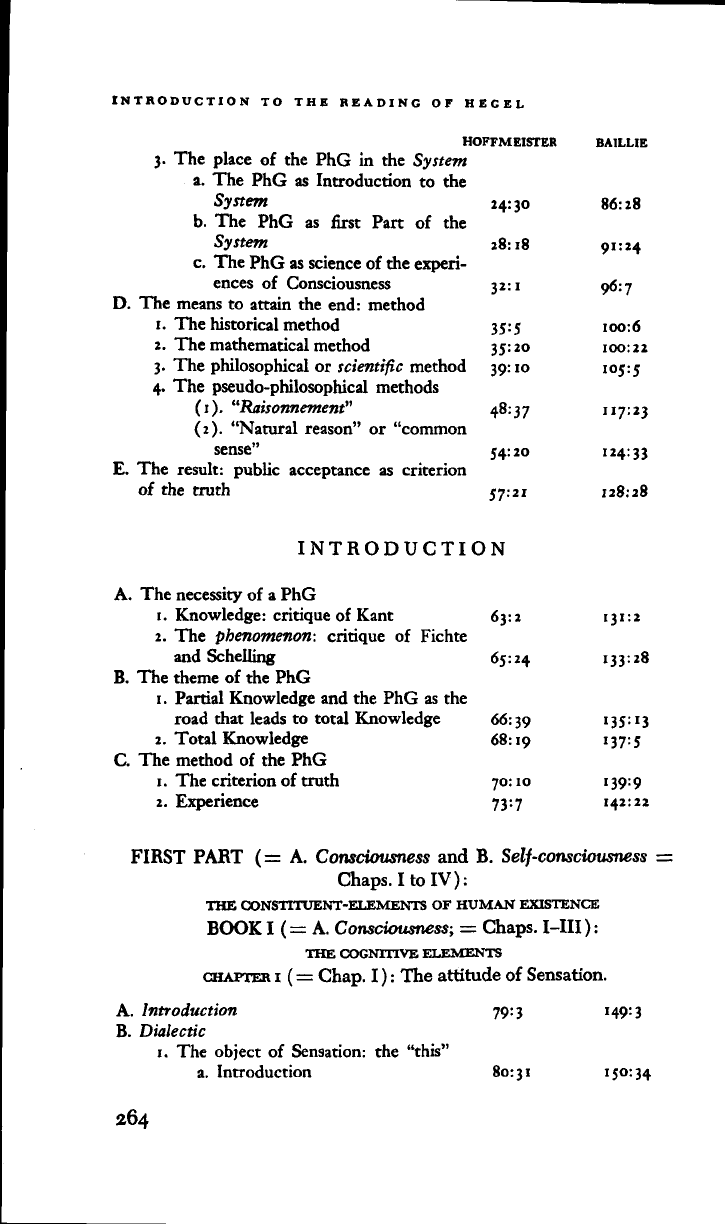
INTNODUCIION
TO THE
NEADING
OT HgGEL
HOFFMEISTEN
3.
The
place
of the PhG
in the
Systert
a. The
PhG as
Introduction
to the
Synen
b.
The
PhG
as first Part
of
the
System
c. The
PhG as science
of dre
experi-
ences
of
Consciousness
D.
The
means
to
attain the
end: method
r.
The historical
method
z.
The mathematical
method
3.
The
philosophical
or
scientific merhod
4.
The
pseudo-philosophical
methods
(r),
"Rdsonnement"
(z).
"Narural
reason"
or
"common
sense"
E.
The
result:
public
ecceptance as crirerion
of
the
truth
I NTR
ODU CTI ON
24:3()
r8:
r8
322
|
35t 5
,5120
39:
lo
4*17
54tzo
57:2t
EAILLIE
86:
r8
9r':21
fi:7
roo:6
roo:22
r
()5:5
I 17i2t
r24ttl
rz8::8
r3r:2
r33:
r8
r35:r3
rt7':5
ttgt9
r42i22
A.
The
necessity
of
a PhG
r.
Knowledge: critique
of
Kant
z.
The
phmomenoni
critique
of
Fichte
and
Schelling
B.
The
theme of the PhG
r.
Panial
Knowledge and
the
PhG
as the
road that leads
to total
Knowledge
z. Total Knowledge
C.
The method of
the
PhG
r. The criterion of truth
z.
Exlrrience
63tz
65tzq
66l19
68:
t9
70:
rO
7317
FIRST PART
(-
A.
Cotwcirl.tsnes$ and
B.
Self-cotxcbtatr€s,$
-
Chaps.I
to
IV):
TIIE
@NSTITI,'ENT.ELEMENTS
OF
HUMAN
E:XISTENCS
BOOK I
(
-
A. Consciotlsness;
-
Chaps.
I-III) :
TIIE
@GNITIVE
EI.EMENTS
cf,raprER
r
(
-
Chap. I) : The
attitude of
SensaUon.
A.
Inttoduction
79t!
r49tt
B.
Dialectic
r. The obiect of Sensation: the
'this"
a,
Introduction
8o:3r
264
r
5o:34