
Korn G.A. Advanced Dynamic-system Simulation: Model-replication Techniques and Monte Carlo Simulation
Подождите немного. Документ загружается.


2 Introduction to Dynamic-system Simulation
Computer simulations can be speeded up or slowed down at the experi-
menter’s convenience. You can simulate a flight to Mars or to Alpha Centauri
in one second. Periodic clock interrupts synchronizing suitably scaled simu-
lations with real time permit “hardware in the loop”: you can “fly” a real
autopilot—or a real human pilot—on a tilting platform controlled by a com-
puter flight simulation. In this book, we are interested in very fast simulation,
for we want to study the effects of many different model changes.
Specifically, we want to
1. Enter and edit programs in convenient editor windows.
2. Use typed or graphical-interface commands to start, stop, and pause
simulations, to select displays, and to make parameter changes. Results
ought to appear immediately to provide an intuitive “feel” for the
effects of model changes (interactive modeling).
3. Program systematic parameter-influence studies and produce cross-
plots or tables.
4. Program model changes to optimize effectiveness measures, and study
effects of random parameter changes or random model inputs by taking
statistics on repeated simulations (Monte Carlo simulation).
1-2. Differential-equation Models
Continuous-system simulation models delayed interactions of physical state
variables
x1, x2, … with first-order ordinary differential equations (state
equations)
(d/dt) xi = fi(t; x1, x2, …; y1, y2, …; a1, a2, …) (i = 1, 2, …) (1-1a)
Here
t represents the time, and the quantities
yj = gj(t; x1, x2, ...; y1, y2, …; b1, b2, …) (j = 1, 2, …) (1-1b)
are defined variables.
a1, a2, …, and b1, b2, … are constant model
parameters.
Simulation programs exercise such models by solving the state-equation
system (1-1) to produce time histories of the system variables
xi = xi(t) and
yj = yj(t) for t = t0 to t = t0 + TMAX, starting with given initial values t0 and
xi(t0). In Section 1-6 and Chapter 2, we shall add sampled-data operations
representing periodic inputs and outputs, sample-holds, and digital
controllers.
The state variables xi are system outputs. They start at t = t0 with given
initial values; subsequent values are produced by an integration routine
(Section 1-7) from the
fi-values generated by the preceding execution
(derivative call) of the operations (1).
There are three kinds of defined variables
yj:
1. system inputs (specified functions of the time
t)
2. system outputs
3. intermediate results needed to compute the derivatives
fi
It must be possible to sort the defined-variable assignments (1-1b) into a pro-
cedure that successively derives all the
yj from state variables xi and/or the
time
t without recurrence relations or “algebraic loops” (Section 1-9).
Some dynamic systems (e.g., systems involving interconnected mechani-
cal devices in automotive engineering and robotics) are modeled with differ-
ential-equation systems that cannot be explicitly solved for state-variable
derivatives as in Eq. (1-1). Simulation then requires solution of algebraic
equations at each integration step. Such differential-algebraic-equation
(DAE) systems are not treated in this book. References [1–4] describe suit-
able mathematical methods and special software.
1-3. Interactive Modeling—Experiment Protocol and
Simulation Studies
Practical computer simulation is not simply a matter of programming and
solving model equations. We must also make it convenient to modify our
models and try many different experiments (see also Section 1-5). In addition
to DYNAMIC program segments listing the model equations (1-1), each sim-
ulation study requires an experiment protocol program that sets and changes
initial conditions and model parameters, calls computer runs, and displays or
tabulates solutions for different model configurations.
The simplest experiment protocols are just sequences of successive
commands, say
a = 20.0 | b = – 3.35 (set parameter values)
x = 12.0 (set the initial value of x)
drun (make a differential-equation
-solving simulation run)
reset (reset initial values)
a = 20.1 (change model parameters)
b = b – 2.2
drun (try another run)
Dynamic-system Models and Computer Programs 3

Each drun command calls a differential-equation-solving simulation run, and
reset resets initial conditions. Typed commands ought to execute immediately
to permit interactive modeling. The operator inspects the solution output after
each simulation run and then types new commands for the next run. Command-
mode operation also permits interactive program debugging [5].
A simulation study combines such commands into a storable program seg-
ment (experiment-protocol script) that can branch and loop to call repeated
simulation runs for different parameter combinations. Simulation studies
may involve thousands of model and parameter changes, so programming
must be easy and computations must be as fast as possible. This is why we
like to interpret experiment-protocol scripts and compile the program seg-
ments executing the actual simulation runs.
1-4. Simulation Software
Commercially available equation-oriented simulation programs such as
ACSL
TM
accept system equations in a more or less human-readable form,
sort defined variable assignments as needed, and feed the sorted equations to
an optimizing Fortran or c compiler [5]. Berkeley Madonna and DESIRE
(see below) have built-in equation-language compilers and execute immedi-
ately. Block-diagram interpreters (e.g., Simulink
TM
, Vissim
TM
, and the open-
source program Scicos) permit graphical block-diagram composition and
immediately execute interpreted simulation runs. Such programs usually pro-
vide equation-language blocks for complicated expressions. Interpreted code
is slow; production runs are sometimes translated into c for faster execution.
Alternatively, ACSL
TM
, Easy5
TM
, and Berkeley Madonna have block-diagram
preprocessors for compiled simulation programs. More advanced modeling
is possible with the Modelica language [6–8].
1-5. OPEN DESIRE and DESIRE
The simulation programs described in this book, and, in particular, our new
techniques for model replication (vectorization), Monte Carlo simulation,
and submodels (Chapters 3–7), use the open-software simulation package
OPEN DESIRE for Linux, Unix including Cygwin (Unix under Windows),
and Microsoft Windows
TM
, or the commercially available DESIRE/2000
program for Windows.
1
DESIRE simulation systems allow inexpensive per-
sonal computers and workstations solve thousands of differential equations
in seconds.
4 Introduction to Dynamic-system Simulation
1
The earlier (1995) Windows version of DESIRE discussed in References [1,2] lacks the
vector-compilation features used in this book.

How a Simulation Run Works 5
DESIRE uses double-precision (64-bit) floating-point arithmetic and
accepts command scripts and model descriptions in a readable mathematical
notation such as
y = a
*
cos(x) + b d/dt x = – x + 4
*
y
Command scripts can include operating-system calls, shell scripts, and calls to
other computer programs. DESIRE’s command-script language is itself a
general-purpose mathematical language and handles vectors, matrices, and
even complex numbers (e.g., for frequency-response and root-locus plots) [9].
Programs are entered and edited in editor windows (Fig. 1-1). Each program
begins with an experiment-protocol script that is interpreted much like an
advanced Basic dialect. When the experiment-protocol script encounters a
drun statement, a built-in runtime compiler automatically compiles a
DYNAMIC program segment listing model equations. The state-equation-
solving simulation run then executes at once and produces solution displays
in bright color.
Very fast compilation (typically under 50 ms) simplifies interactive mod-
eling. Experimenters can immediately observe results of programmed or
screen-edited models and experiment-protocol changes. One can enter and
edit different models in multiple editor windows and run these models in turn
to compare results (Fig. 1-1). Runtime displays show solution time histories
and error messages during rather than after each simulation run, so that you
can save time by aborting undesirable runs before they complete.
The experiment-protocol script starting each DESIRE program defines an
experiment. Subsequent DYNAMIC program segments define models used
in the experiment and specify runtime input/output requests. An experiment
protocol can call multiple DYNAMIC segments with different models, dif-
ferent versions of the same model, and/or different input/output operations.
HOW A SIMULATION RUN WORKS
1-6. Sampling the DYNAMIC Segment Variables
When
drun calls a simulation run, the program initializes input/output opera-
tions requested by the DYNAMIC program segment. The independent variable
t (simulation time) and the differential-equation state variables start with initial
values assigned by the experiment protocol.
2
A first pass through the
DYNAMIC-segment code [Eq. (1-1)] produces initial values of the defined
2
Unspecified initial values of unsubscripted differential-equation state variables conveniently
default to 0.
6 Introduction to Dynamic-system Simulation
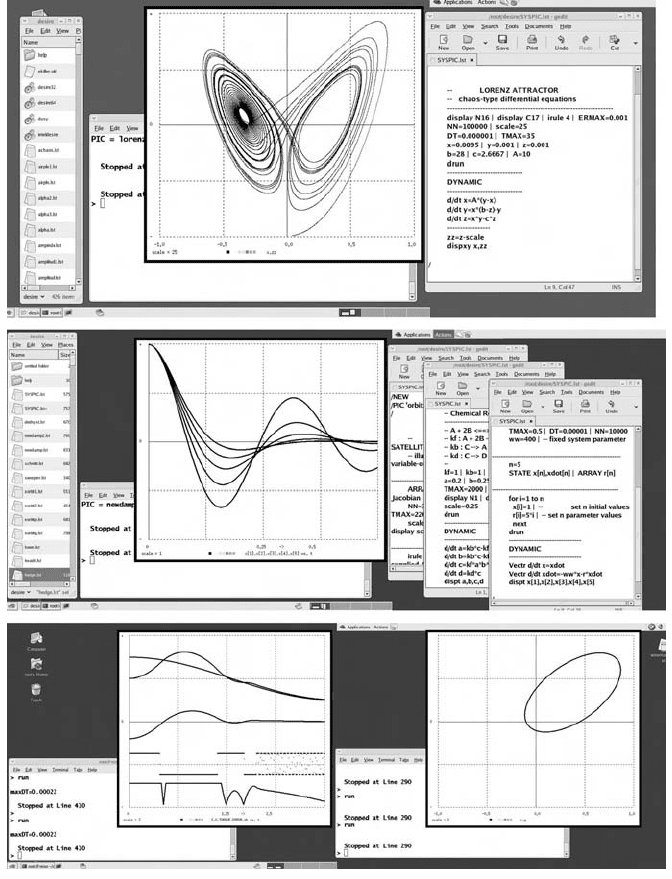
FIGURE 1-1
a
. OPEN DESIRE running under Linux. The first dual-monitor screen shows a
file-manager window for calling user programs, the DESIRE command window, a graph win-
dow, and an editor window. The second screen has a file manager and three editor windows;
one can click on any file-manager or editor window to run and compare different programs.
On the third screen, two independent simulations run in separate command windows. Solution
graphs were set to black-on-white for publication, but normally each displayed curve has a dif-
ferent color.
How a Simulation Run Works 7
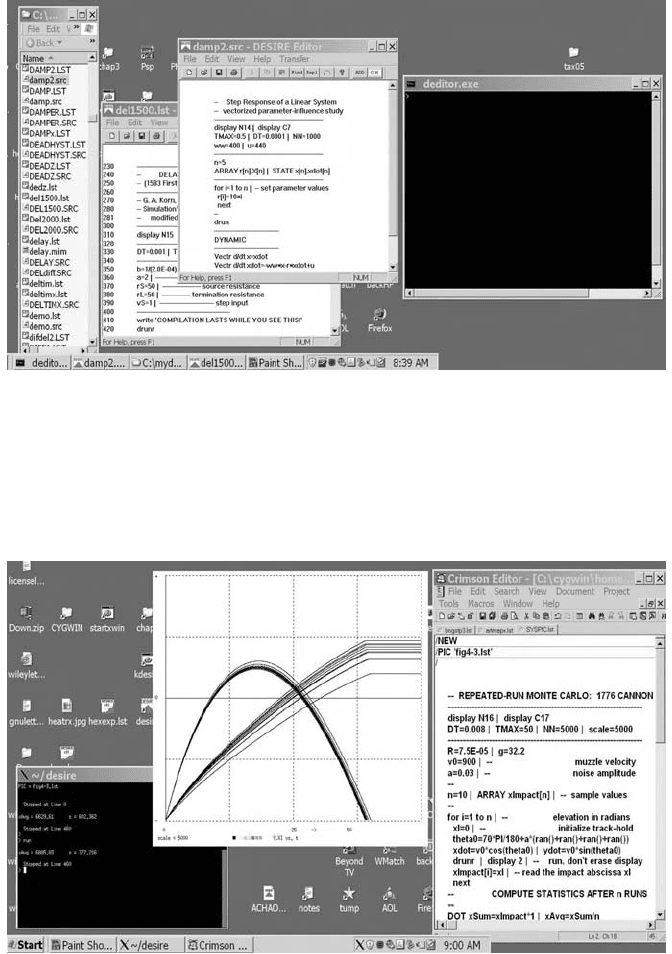
FIGURE 1-1
b
. DESIRE on a dual Windows
TM
screen showing a file manager window, two
editor windows, and a command Window. The red OK button on each DESIRE editor window
transfers the selected edited program to DESIRE. This makes it convenient to compare two or
more programs.
FIGURE 1-1
c
. Cygwin (Unix under Windows
TM
) display with a Unix console window, the
DESIRE graphics window, and an editor window using the open-source Crimson Editor. The
original display was in color.
variables [Eq. (1-1b)]. Unless stopped, simulations run from the initial time t =
t0 to t = t0 + TMAX. You can stop a simulation run by typing ctrl c and space
(zz under Windows), and restart or extend a run with drun.
DESIRE normally samples DYNAMIC-segment variables for output (usu-
ally to displays) or sampled-data operations at
NN uniformly spaced sam-
pling times (communication times):
t = t0, t0 + COMINT, t0 + 2 COMINT, … ,
t0 + (NN – 1)COMINT = t0 + TMAX (1-2a)
with
COMINT = TMAX/(NN – 1) (1-2b)
The experiment-protocol script sets appropriate values of
t0, TMAX, and
NN or uses default values listed in the DESIRE manual.
If the DYNAMIC program segment contains differential equations
(d/dt
or Vectr d/dt statements), then t0 defaults to t0 = 0 unless another value is
specified. Starting at
t = t0, the integration routine increments t by successive
constant or variable
DT steps until t reaches the next data-sampling commu-
nication point (Fig. 1-2a). Within each integration step, numerical integration
8 Introduction to Dynamic-system Simulation
x
x (t)
DT
COMINT
t0 t0+COMINT t0+2 COMINT t0+TMAX
t
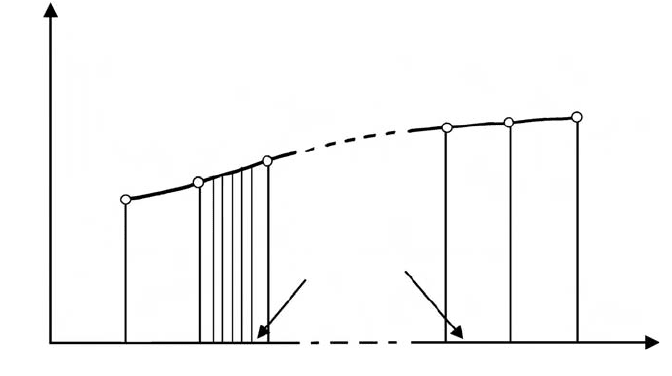
FIGURE 1-2
a
. Time history of a simulation variable, showing sampling times t = t0, t0 +
COMINT, t0 + 2 COMINT, …, t0 + TMAX and some integration steps. In the figure, all integration
steps end on a sampling point. This is always true for variable-step integration rules, but fixed
integration steps
DT may overshoot the sampling points by a small fraction of DT, as shown in
Figure 1-2b.
approximates continuous updating of the “continuous” model variables t, xi,
and
yj. Each integration step usually requires more than one derivative call
executing the model equations (1-1) (Section 1-7; [10–18]).
In DYNAMIC program segments without differential equations,
t0
defaults to t0 = 1 unless the experiment-protocol script specifies a different
value. All operations in such a DYNAMIC segment are sampled-data assign-
ments and execute at successive communication times [Eq. (1-2)], except for
assignments preceded by a
SAMPLE m statement, where m is an integer >1.
Such assignments execute only at
t = t0 and then at every m
th
communication
point. This permits multirate sampling. DESIRE admits only one
SAMPLE
m statement per DYNAMIC program segment.
Differential-equation-solving DYNAMIC segments can also include sam-
pled-data assignments that execute only at the periodic sampling points (1-2).
Such assignments model sampled-data controllers and noise generators and
must be collected in sections following an
OUT and/or SAMPLE m statement
at the end of the DYNAMIC program segment (Section 2-3).
DYNAMIC-segment input/output (e.g., to displays and listings) occurs at
the
NN communication points (1-2), unless the system variable MM, which
defaults to 1, is set to an integer >1. In this case, input/output occurs at
t = t0,
then at every
MM
th
sampling point, and finally at t = t0 + TMAX. NN can thus
be set to a larger value than the desired number of input/output points. This
How a Simulation Run Works 9
FIGURE 1-2
b
. DESIRE output listings for variable-step integration and for fixed-step
integration. Parameters were deliberately chosen to exaggerate the fixed-
DT effect.
Variable-step integration
NN = 6 | TMAX = 10 | initial DT = 0.01
t, x,X,y
0.00000e+00 0.00000e+00 0.00000e+00 0.00000e+00
2.00000e+00 3.89418e-01 3.89418e-01 0.00000e+00
4.00000e+00 7.17356e-01 3.89418e-01 3.89418e-01
6.00000e+00 9.32039e-01 9.32039e-01 3.89418e-01
8.00000e+00 9.99574e-01 9.32039e-01 9.32039e-01
1.00000e+01 9.09298e-01 9.09298e-01 9.32039e-01
Fixed-step integration
NN = 6 | TMAX = 11 | initial DT = 0.01
t, x,X,y
0.00000e+00 0.00000e+00 0.00000e+00 0.00000e+00
2.00000e+00 3.89419e-01 3.89419e-01 0.00000e+00
4.01000e+00 7.18748e-01 3.89419e-01 3.89419e-01
6.01000e+00 9.32762e-01 9.32762e-01 3.89419e-01
8.01000e+00 9.99513e-01 9.32762e-01 9.32762e-01
1.00100e+01 9.08463e-01 9.08463e-01 9.32762e-01
can provide fast sampling for pseudorandom noise (Section 5-4) and/or for
sampling switch and limiter functions (Sections 2-10 and 2-11).
Some defined-variable assignments (1-1b) do not affect state variables but
only scale or modify model output. Such operations are not needed at every
derivative call but only at sampling points. The simulation will run faster if
such assignments are programmed as sampled-data operations following an
OUT statement.
1-7. Numerical Integration
(a) Euler Integration
The simplest procedure that approximates continuous updating of a state
variable x in successive integration steps is the explicit Euler integration rule
(see also Appendix)
xi(t + DT) = xi(t) + fi[t; x1(t), x2(t), ...; y1(t), y2(t),... ]DT
(i = 1, 2, …, n) (1-3)
where
fi is the value of dx/dt calculated by the derivative call executing Eq.
(1-1) at the time
t.
The integration routine loops until
t reaches the next communication point
(1-2), where the solution is sampled for input/output and sampled-data oper-
ations. The simulation run terminates after accessing the last sample at
t = t0 +
TMAX unless the run is stopped either by the user or by a programmed
termination (
term) statement.
(b) Improved Integration Rules
The Euler integration rule [Eq. (1-3)] simply increments each state variable
by an amount proportional to its last computed derivative. This does not
approximate true integration well except for very small integration steps
DT.
Improved updating requires multiple derivative calls per integration step
DT
[10–18]. This can actually reduce the total number of derivative calls (the
main computing load of a simulation) required for a specified accuracy. In
particular:
• Multistep rules extrapolate updated values of the
xi as polynomials based
on values of the
xi and fi at several past times t – DT, t – 2DT, … .
• Runge–Kutta rules precompute two or more approximate derivative values
in the interval
(t, t + DT) by Euler-type steps and use their weighted aver-
age for updating.
10 Introduction to Dynamic-system Simulation
Coefficients in such integration formulas are chosen so that polynomials
of degree
N integrate exactly (N
th
-order integration formula).
Explicit integration rules such as Eq. (1-3) express future values
xi(t + DT)
in terms of already computed past state-variable values. Implicit rules, such
as the implicit Euler rule,
xi(t + DT) = xi(t) + fi[t + DT; x1(t + DT), x2(t + DT), ...;
y1(t + DT), y2(t + DT), ...] DT (i = 1, 2, ..., n) (1-4)
require a program that solves the predictor equation (1-4) for
xi(t + DT) at
each step. Implicit rules clearly involve more computation, but they may
admit larger
DT values without numerical instability.
Variable-step integration adjusts integration step sizes to maintain accu-
racy estimates obtained by comparing various tentative updated solution val-
ues. This can save many steps. Figures 1-5, 7-7, and 7-8 show examples.
Numerical integration normally assumes integrands
fi that are continuous and
differentiable within each integration step. Step-function inputs are accept-
able only at
t = t0 and thereafter at the end of integration steps. Sections 2-10
to 2-12 discuss this problem in connection with models involving sampled-
data operations and switching functions.
1-8. Sampling Times and Integration Steps
The experiment protocol script selects the simulation runtime
TMAX and the
number of samples
NN needed for display, listings, and/or sampled-data
models. DESIRE returns an error message if an integration-step value
DT
larger than COMINT = TMAX/(NN – 1) is selected, for the program must never
sample data within integration steps. Sampled-data output to displays or sam-
pled-data assignments is not well-defined at such times. Sampled-data input
within integration steps might make the numerical-integration routine invalid
(see also Sections 2-9 to 2-11).
DESIRE’s variable-step integration routines automatically force the last
integration step in each communication interval to end precisely on one of the
user-selected communication points (1-2). An error message warns if the initial
DT value exceeds COMINT. Fixed-step integration routines, however, may
have to add a fraction of
DT to each sampling time (1-2) to make sure that sam-
pling always occurs at the end of an integration step, as shown in Eq. (1-2b).
This does not cause errors in displays or listings, for each
x(t) value is still asso-
ciated with its correct
t value. But if output listings at specified periodic sam-
pling times (1-2) are needed, one must either use variable-step integration or set
DT to a very small integral fraction of COMINT.
How a Simulation Run Works 11