
Kosevich A.M. The crystal lattice
Подождите немного. Документ загружается.

0
Geometry of Crystal Lattice
0.1
Translational Symmetry
The crystalline state of su bstances is different from other states (gaseous, liquid, amo r-
phous) in that the atoms are in an ordered and symmetrical arrangement called the
crystal lattice. The lattice is characterized by space p e riodicity or translational sym-
metry. In an unbounded crystal we can define three noncoplanar vectors a
1
, a
2
, a
3
,
such that displacement of the crystal by the length of any of these vectors brings it
back on itself. The unit vectors a
α
, α = 1, 2, 3 are the shortest vectors by which a
crystal can be displaced and be brought back into itself.
The crystal lattice is thus a simple three-dimensional network of straight lines
whose points of intersection are called the crystal lattice
1
. If the origin of the co-
ordinate system coincides with a site th e position vector of any other site is written
as
R = R
n
= R(n)=
3
∑
α=1
n
α
a
α
, n =(n
1
, n
2
, n
3
), (0.1.1)
where n
α
are integers. The vector R is said to be a translational vector or a transla-
tional period of the lattice. According to the definition of translational symmetry, the
lattice is brought back onto itself when it is translated along the vector R.
We can assign a translation o perator to the translation vector R(n).Asetofall
possible translations with the given vectors a
α
forms a discrete group of translations.
Since sequential translations can be carried out arbitrarily, a group of transformations
is commutative (Abelian). A group of symmetry transformations can be used to ex-
plain a number of qualitative physical properties of crystals independently of their
specific structure.
Now consider the g eometry of the crystal lattice. The parallelepiped constructed
from the vectors corresponding to the translational periods is called a unit cell.Itis
1) The lattice sites are not necessarily associated with the positions of the
atoms.
The Crystal Lattice: Phonons, Solitons, Dislocations, Superlattices, Second Edition. Arnold M. Kosevich
Copyright
c
2005 WILEY-VCH Verlag GmbH & Co. KGaA, Weinheim
ISBN: 3-527-40508-9
4
0 Geometry of Crystal Lattice
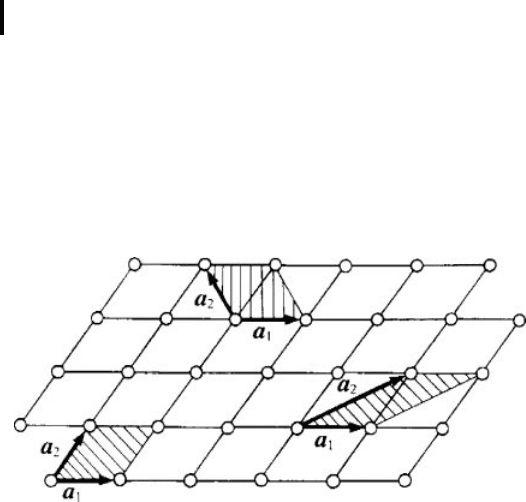
clear that the unit vectors, and thus the unit cell, may be chosen in different ways. A
possible choice of unit cell in a planar lattice is shown in Fig. 0 .1. As a rule, the unit
cell is chosen so that its vertex coincides with one the atoms of the crystal. The lattice
sites are then occupied by atoms, and vectors a
α
connect the nearest equivalent atoms.
By arranging the vectors a
1
, a
2
, a
3
in the correct sequence, it is easy to see that the
unit cell volume V
0
= a
1
[a
2
, a
3
]. Although the main translation periods are chosen
arbitrarily, th e unit cell volume still remains the same for any choice of the un it vectors.
Fig. 0.1 Choice of unit cells (dashed) in a two-dimensional lattice.
The unit cell contains at least one atom of each of the types that compose the crys-
tal
2
. Since the atoms of different type are distinguished not only by their chemical
properties but also by their arrangement in the cell, even in a crystal of a pure element
there can be more than one type of atom. If the unit cell consists of only one type of
atom it is called monatomic, otherwise it is polyatomic. A monatomic lattice is also
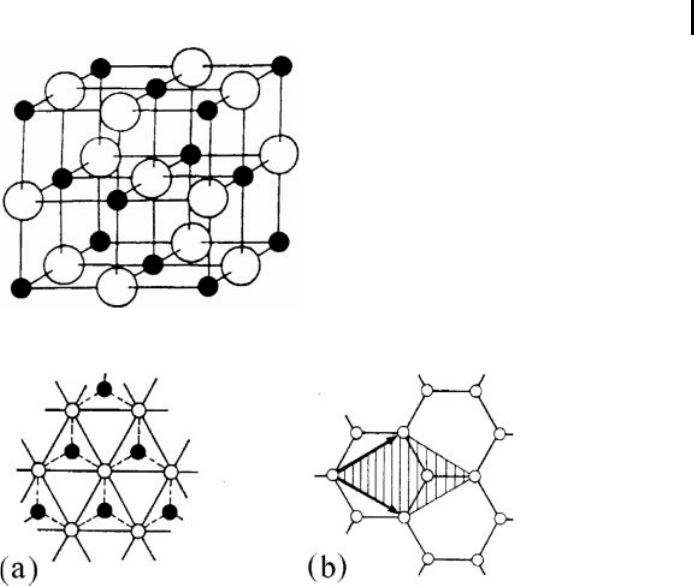
often called simple and a polyato mic lattice composite. Table salt (NaCl) containing
atoms of two typ es is an example of a polyatomic crystal lattice (Fig. 0.2), and 2D
lattice composed of atoms of two types is presented also in Fig. 0.3a. A polyatomic
crystal lattice may also consist of atoms of the same chemical type. Figure 0.3b shows
a highly symmetrical diatomic plan ar lattice whose atoms are located at the vertices
of a hexagon.
The differences between simple and composite lattices lead to different physical
properties. For example, the v ibrations of a diatomic lattice have some features that
distinguish them from the vibrations of a monatomic lattice.
We would like to emphasize that the unit cell o f a crystal involves, by definition,
all the elements of the translation symmetry of the crystal. By drawing the unit cell
one can construct the whole crystal. However, the unit cell may not necessarily be
symmetrical with respect to rotations an d reflections as the crystal can be. This is
clearly seen in Fig. 0.3 where the lattices have a six-fold symmetry axis, while the
unit cells do not.
2) We note that the contribution to a cell of an atom positioned in a cell vertex
equals 1/8, on an edge 1/4 and on a face 1/2.
0.2 Bravais Lattice
5
Fig. 0.2 NaCI crystal structure ( -Na,● -Cl).
Fig. 0.3 Hexagonal 2D diatomic lattice composed of atoms (
a
)ofdiffer-
ent types and (
b
) of the same type. The unit cell is hatched.
0.2
Bravais Lattice
The Bravais lattice is the set of all equivalent atoms in a crystal that are brought back
onto themselves when they are displaced by the length of a unit vector in a d irec-
tion p arallel to a unit vector. Bravais and monatomic lattices are usually coincident.
A polyato mic lattice, however, consists of several geometrically identical interpo sed
Bravais lattices.
The Bravais lattice of a polyatomic crystal is often more symmetrical than the crys-
tal lattice itself. It contains all the elements of the crystal symmetry and may also
have additional symmetry elements. For example, a planar crystal may have three-
fold symmetry (Fig. 0.3a) whereas its Bravais lattice may have six-f old symmetry.
The Bravais lattice has inversion centers at all of the sites, whereas the crystal lattices
(necessarily polyatomic) do not necessarily have such a symmetry element.
The Bravais lattices are classified according to the symmetry of rotations and re-
flections. Seven symmetry groups or space groups are defined. Each of the lattices of
a given group has an inversion center, a unique set of axes and symmetry planes. Each
space group is associated with a polyhedron whose vertices correspond to the nearest
6
0 Geometry of Crystal Lattice
sites of the corresponding Bravais lattice and that has all the symmetry elements of
the space group. The polyhedron is either a parallelepiped or a prism.
In the most symmetrical Bravais lattice, the cube is used as the symmetry “carrier”,
and the lattice is called cubic.Ahexagonal lattice is characterized completely by
a regular hexahedral prism, the Bravais rhombohedron lattice by a rhombohedron,
(i. e., the figure resulting when a cube is stretched along one of its diagonals), etc.
A rectangular prism with at least one square face has tetragonal symmetry.
Within a given space group an additional subdivision into several types of Bravais
lattices can be made. Th e type of Bravais lattice depends on where th e lattice sites are
located: either only at the vertices of the polyhedrons or also on the faces or at the
center. We distinguish between the following types of Bravais lattice: primitive (P),
base-centered (BC), face-centered (FC) and body-centered (BC) lattices.
The lattice of NaCl in Fig. 0.2 gives an example of a cubic lattice. A plane diatomic
lattice with the 3-fold symmetry axes is shown in Fig. 0.3a, however, its Bravais lat-
tice has 6-fold symmetry axes; a hexagonal lattice with the 6-fold symmetry axes is
presented in Fig. 0.3b.
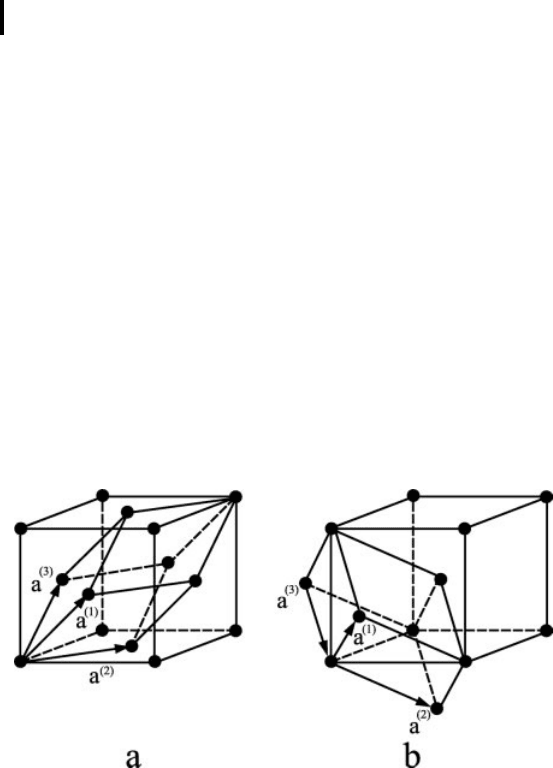
Fig. 0.4 Unit cells with translation vectors inside the cubic unit cells
(a) of the FCC lattice and (b) of the BCC lattice.
It should be noted that the unit cell is not a principal geometrical figure being the
“carrier” of all rotation elements of symmetry in the case of centered lattices. In order
to demonstrate this fact a situation of the atoms in the single cube of BC-cubic and
FC-cubic lattices is shown in Fig. 0.4a and 0.4b where the unit cells of these lattices
are presented as well.
Naming the cubic, hexagonal and tetragonal lattices we have thereby counted the
lattices possessing axes of 2-, 3-, 4- and 6-fold symmetry. Naturally, the question
arises what types of the symmetry axes are compatible with the translational symmetry
of a spatial lattice. It appears that the symmetry axes of the 2-, 3-, 4- and 6-fold only
can exist in the unbounded spatial lattice (see Problems at the and of the chapter).
0.3 The Reciprocal Lattice
7
0.3
The Reciprocal Lattice
In order to describe physical processes in crystals more easy, in particular wave phe-
nomena, the crystal lattice co nstructed with unit vectors a
α
in real space is associated
with some periodic structure called the reciprocal lattice. The reciprocal lattice is
constructed from the vectors b
β
, β = 1, 2, 3, related to a
α
through
a
α
b
β
= 2πδ
αβ
, α, β = 1, 2, 3,
where δ
αβ
is the Kronecker delta. The vectors b
β
can be simply expressed through the
initial translational vectors a
α
:
b
1
=
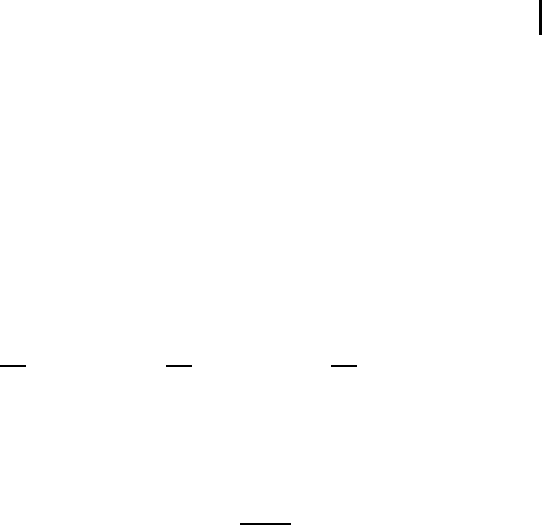
2π
V
0
[a
2
, a
3
], b
2
=
2π
V
0
[a
3
, a
1
], b
3
=
2π
V
0
[a
1
, a
2
].
The parallelepiped constructed from b
β
is called the unit cell of a reciprocal lattice.
It is easy to verify th at the unit cell volume in the reciprocal lattice is equal to the
inverse value of the unit cell volume of the regular lattice:
Ω
0
= b
1
[b
2
, b
3
]=
(2π)
3
V
0
.
Note that the reciprocal lattice vectors have dimensio ns of inverse length. The space
where the reciprocal lattice exists is called reciprocal space. The question arises: what
are the points that make a reciprocal space? Or in other words: what vector connects
two arbitrary points of reciprocal space?
Consider a wave process associated with the propagation of some field (e. g., elec-
tromagnetic) to be observed in the crystal. Any spatial distribution of the field is,
generally, represented by the superposition of plane waves such as
ψ
q
= e
iqr
,
where q is the wave vector whose values are determined by the boundary conditions.
However, in principle the vector q takes arbitrary values. The dimension of the
wave vector coincides with the dimension of inverse length, and the continuum of all
possible wave vectors forms the reciprocal space. Thus, the reciprocal space is the
three-dimensional space of wave vectors.
By analogy to th e tran slatio n vectors of the regular lattice (0.1.1), we can also d e fine
translation vectors in reciprocal space:
G ≡ G(m) =
3
∑
α=1
m
α
b
α
, m =(m
1
, m
2
, m
3
), (0.3.1)
where m
α
are integers. The vector G is called a reciprocal lattice vector .
It can be seen that simple lattices in reciprocal space correspond to simple lattices
in real space for a given Bravais space group. The reciprocal lattice of FC Bravais
8
0 Geometry of Crystal Lattice
lattices (rhombic, tetragonal and cubic) is a body-centered lattice and vice versa. A
lattice with a point at the center of the base has a corresponding reciprocal lattice also
with a point at the center of the base.
In addition to the unit cell of a reciprocal lattice, one frequently constructs a “sym-
metry” cell. This cell is called the Brillouin zone. We choose a reciprocal lattice site
as origin and d raw from it all the vectors G that connect it to all recipro cal lattice sites.
We then draw planes that are perpendicular to these vectors and that bisect them. If q
is a vector in a reciprocal space, these planes are given by
qG =
1
2
G
2
. (0.3.2)
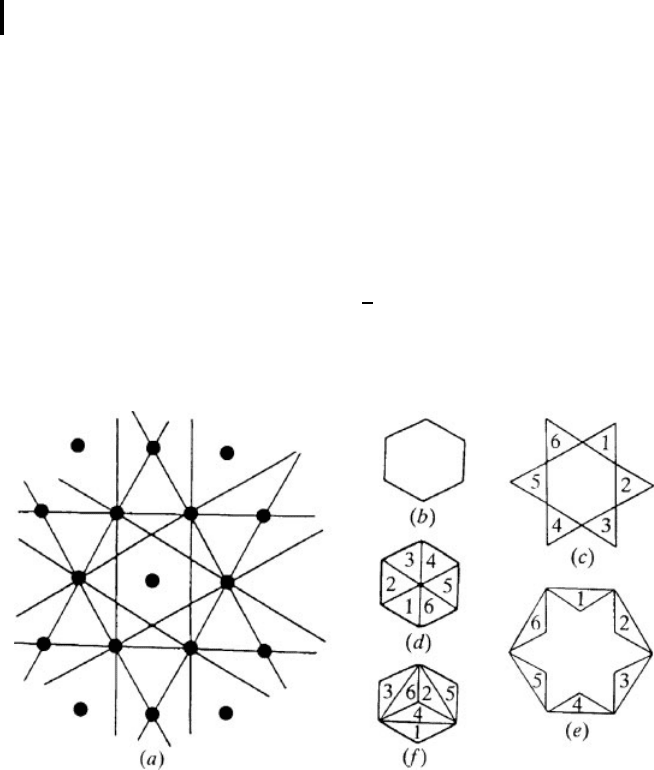
The planes (0.3.2) divide all of reciprocal space into a set of regions of different
shapes (Fig. 0.5a).
Fig. 0.5 Brillouin zones of hexagonal crystal: (
a
) construction of zones;
the point in the middle is the origin, the lines drawn are the planes per-
pendicular to and bisecting the vectors connecting the origin with all
other lattice sites (not shown); (
b
) the first zone; (
c
) the six parts of the
second zone; (
d
) reduction of the second zone to the first; (
e
)thesix
parts of the third zone; (
f
) reduction of the third zone to the first.
The region containing the origin is called the first Brillouin zone. The regions of
the reciprocal space that directly adjoin it make up the second zone and the regions
bordering that are the third Brillouin zone, etc. The planes given by (0.3.2) are the
boundaries of the Brillouin zones.
The regions of higher Brillouin zones can be combined into a single figure, identical
to the first zone (Fig. 0.5d, f). Thus, any zone can be reduced to the first one. The
concept of a reduced zone is convenient because it requires knowledge of the geometry
of the first Brillouin zone only.

0.3 The Reciprocal Lattice
9
Mathematical relations between quantities in real and reciprocal space are en tirely
symmetrical with respect to these spaces and , formally, the lattices constructed with
two sets of three vectors a
α
and b
β
are reciprocal to one another. That is, if one
is defined as the lattice in real space, the oth er is its reciprocal. It should be noted,
however, that the physical meaning of these spaces is different. For a crystal, one
initially defines the crystal lattice as the lattice in real space.
The concept of a reciprocal lattice is used because all physical properties of an
ideal crystal are described by functions whose periodicity is the same as that of this
lattice. If φ(r) is such a func tion (the charge density, the electric potential, etc.), then
obviously,
φ (r + R)=φ(r), (0.3.3)
where R is a lattice translation vector (0.1.1). We expand the function φ(r) as a three-
dimensional Fourier series
φ (r)=
∑
q
φ
q
e
iqr
, (0.3.4)
where it is summed over all possible values of the vector q determined by the period-
icity requirement (0.3.3)
∑
q
φ
q
e
iqr
e
iqR
=
∑
q
φ
q
e
iqr
. (0.3.5)
Equation (0.3.5) can be satisfied if
e
iqR
= 1, qR = 2πp, (0.3.6)
where p is an integer. To satisfy (0.3.6) it is necessary that
qa
α
= 2πp
α
, α = 1, 2, 3, (0.3.7)
where p
α
are the integers.
The solution to (0.3.7) for the vector q has the form
q = m
1
b
1
+ m
2
b
2
+ m
3
b
3
. (0.3.8)
It follows from (0.3.8) that the vector q is the same as that of the reciprocal lattice:
q = G where G is determined by (0.3.1).
Thus, any function describing a physical property of an ideal crystal can be ex-
panded as a Fourier series (0.3.4) where the vector q runs over all points of the recip-
rocal lattice
φ (r)=
∑
G
φ
G
e
iGr
. (0.3.9)
Since there is a simple correspondence between the real and reciprocal lattices there
should also be a simple correspondence between geometrical transformations in real

10
0 Geometry of Crystal Lattice
and reciprocal space. We illustrate this correspondence with an example widely used
in structural analysis. Consider the vector r such that
Gr = 2πp, (0.3.10)
where p is the integer and G is a reciprocal lattice vector. Equa tion (0.3.10) describes
a certain plane in the crystal. It is readily seen that this is a crystal plan e, i. e., the
plane running through an infinite set of Bravais lattice sites. Since the constant p
may take any value, (0.3.10) describes a family of parallel planes. Thus, each vector
of a recip rocal lattice G = G(m) corresponds to a family of parallel crystal planes
(0.3.10) rather than to a single plane. The distance between adjacent planes of the
family is d
B
= 2π/G,whereG is the length of a corresponding vector of a reciprocal
lattice. Three qu antities m
1
, m
2
, m
3
in these relations can always be represented as
a triplet of prime numbers p
1
, p
2
, p
3
(i. e., assume that p
1
, p
2
, p
3
have no common
divisor except unity). These three numbers (p
1
, p
2
, p
3
) are called the Miller indices.
0.4
Use of Penetrating Radiation to Determine Crystal Structure
We consider the transmission of a field (X-rays, beams of fast electrons or slow neu-
trons) through a crystal. We assume the distribution of the field in space to be de-
scribed by a scalar function ψ that in vacuo obeys the equation
ψ + c
2
∆ψ = 0,
where for electromagnetic waves is the frequency squared ( = ω
2
) and c the
light velocity, or in the case of electrons and neutrons they are the energy and the
inverse mass (c = ¯h
2
/2m). The crystal atoms interact with the wave, generating
a perturbation. This perturbation is taken into account in the above equation by an
additional potential
ψ + c
2
∆ψ + U(r)ψ = 0. (0.4.1)
The potential U(r) has the same periodicity as the crystal (for example, it may be
proportional to the electric charge density in a crystal).
We now consider how the periodic potential can affect the free wave
ψ
k
= e
ikr
, c
2
k
2
= . (0.4.2)
We assume that U is weak, i. e., we can use perturbatio n theory (this is a reasonab le
assumption in many real systems). Let the wave (0.4.2) be incident on a crystal and
scattered under the effect of the potential U. In the Born approximation, the amplitude
of the elastically scattered wave with wave vector k
is proportional to the integral
U(k
, k)=
U(r)e
−i(k
−k)r
dV , (0.4.3)

0.4 Use of Penetrating Radiation to Determine Crystal Structure
11
which is the matrix element of the potential U. The scattering proba bility, i. e., the
probability for the wave (0 .4 .2 ) to be transformed to a wave
ψ
k
= Ae
ik
r
, A = constant, c
2
k
2
= , (0.4.4)
is proportional to the squared matrix element (0.4.3).
To calculate the integral (0.4.3) we use an expansion such as (0.3.9) for the periodic
function U(r):
U(k
, k)=
∑
G
U
G
e
i(G−k
+k)r
dV . (0.4.5)
In an unbounded crystal (0.4.5) is reduced to
U(k
, k)=(2π)
3
∑
G
U
G
δ(k
− k − G). (0.4.6)
It is clear that the incident wave (0.4.2) with the wave vector k can be transformed
only into the waves whose wave vector is
k
= k + G, (0.4.7)
where G is any reciprocal lattice vector.
In elastic scattering the wave frequency (or the scattered particle energy) does not
change, so that
k
2
= k
2
. (0.4.8)
The relations (0.4.7), (0.4.8) are called the Laue equations and are used in the anal-
ysis of X-ray diffraction and the electron and neutron elastic scattering spectra in crys-
tallography. By fixing the direction of the incident beam and measuring the directions
of the scattered waves, one can determine the vectors G, i. e., the reciprocal lattice.
From these it may be possible to reproduce the crystal structure.
To simplify (0.4.7), (0.4.8) further, we first establish their relation to the reciprocal
lattice. We take the scalar product of (0.4.7) and take into account (0.4.8):
k
G = −kG =
1
2
G
2
. (0.4.9)
Comparing (0.4.9) and (0.3.2), it can be seen that only those beams whose wave-
vector ends lie on the Brillouin zone boundaries (the origin of the waves vectors is at
the center of the Brillouin zones) are reflected from the crystal.
We denote the angle between the vectors k and k
by 2θ. Then from (0.4.8) we
obtain the relation
G = 2k sin θ. (0.4.10)
As was shown above, the length of the vector G is inversely proportional to the
distance d between the nearest planes of atoms to which this vector is perpendicular
G =
2πn
d
, (0.4.11)

12
0 Geometry of Crystal Lattice
where n is the integer. Substituting (0.4.11) into (0.4.10) and introducing the wave-
length of the incident radiation λ = 2π/k we obtain
nλ = 2d sin θ. (0.4.12)
This relation is kn own as the Bragg reflection law. The diffraction described by
(0.4.12) is sometimes referred to as “reflection” from crista1 planes.
It should be noted that this simplest geometrical (or kinematic) theory of diffraction
in crystals is applicable only to scattering in thin crystal samples. It does not include
the interaction of the incident and diffracted beams with deeper atomic layers in thick
samples.
0.4.1
Problems
1. Prove that if r is the rad ius-vector of an arbitrary site in the crystal the following
equation is valid
∑
G
e
iGr
= V
0
∑
R
δ(r − R), (0.4.13)
where the summation on the r.h.s. is carried out over all lattice sites and on the l.h.s.
over all reciprocal lattice sites.
2. Derive from (0.4.13) the equation
∑
R
e
−ikR
= Ω
0
∑
G
δ(k − G ), (0.4.14)
where k is the position vector of an arbitrary point in the reciprocal space.
3. Elucidate which symmetry axes can be inherent elements of the symmetry of a
lattice.
Hint. Consider two neighboring sites A and B in the plane perpendicular to the sym-
metry axis (see Fig. 0.6). Perform a rotation by the angle φ=2π/n about the axis C
n
through the point A; after that B occupies position B
. Analogous rotation about B
transfers A to A
. Since the sites B
and A
belong to the same lattice the length B
A
should be divisible by the length AB.