
Kosevich A.M. The crystal lattice
Подождите немного. Документ загружается.

1.11 Heavy Defects and 1D Superlattice
55
such conditions allow us to use a long-wave approximation. The continuous analog of
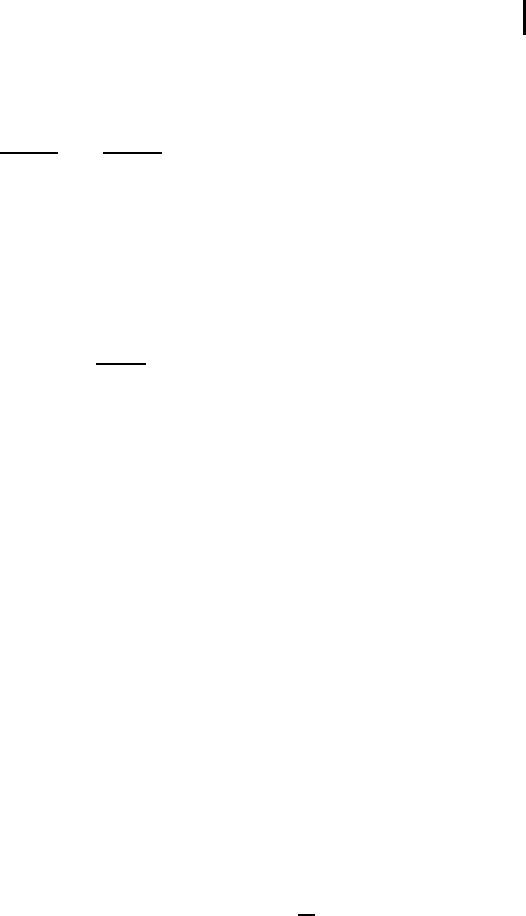
(1.10.4) for one isolated isotope defect at the frequencies ω ω
m
is the following
∂
2
u(x)
∂t
2
− s
2
∂
2
u(x)
∂x
2
= aU
0
u(0)δ(x − x
0
), (1.11.1)
where x
0
is the defect coordinate. See (1.1.4) and compare (1.11.1) with (1.10.15) for
ω −ω
m
ω
m
.
The presence of the delta-function in the r.h.p. of (1.11.1) determines a jump of
the first spatial derivative of the continuous function u(x) at the point x = x
0
and is
equivalent to the following boundary condition for (1.1.16)
−s
2
∂u(x)
∂x
x
0
+0
x
0
−0
= aU
0
u(0). (1.11.2)
From the macroscopic point of view the model proposed for consideration is a 1D
acoustic superlattice consisting of elastic elements of the length d separated by set
of joints. Ex citations inside the elastic elements are described by the wave equation
(1.1.4) with the boundary conditions (1.11.2) on the all joints. From the microscopic
point of view such a system is a polyatomic 1D crystal with the unit cell including a
very large number N
0
of atoms. Taking into account this fact, let the large unit cells
(elements of the superlattice) be numbered by n.
Then the eigenvibration in the n-th element can be written in the form of th e Bloch
wave
u
n
(x)=v
k
(x)e
ikx
, v
k
(x + d)=v
k
(x), (1.11.3)
where the Bloch amplitude v(x) is a solution to the wave equation (1.1.4) and the
function u(x) obeys the boundary conditions (1.11.2).
Let the origin of coordinates coincide with one of the joints (it will have the number
n = 0). Then (1.11.3) can be written in the form
u
n
(x)=v(x − nd)e
ikx
.
Take the function v(x) as a general solution to (1.1.4)
v(x)=Ae
iqx
+ Be
−iq x
, q =
ω
s
, (1.11.4)
and consider the solution inside the interval 0 < x < d.
Writing the boundary conditions such that at the left joint
u
−1
(−0)=u
0
(d −0)e
−ikd
= v(d)e
−ikd
,
and at the right joint
u
+1
(d + 0)=u
0
(+0)e
ikd
= v(0)e
ikd
.
56
1 Mechanics of a One-Dimensional Crystal
The boundary conditions (1.11.2) and continuity of the function u(x) at the point
x = 0 or x = d turn into the following set of linear algebraic eq uations for the
coefficients A and B
A − B − i
aMω
ms
(A + B)=(Ae
iqd
− Be
−iqd
)e
−ikd
,
A + B =(Ae
iqd
− Be
−iqd
)e
−1kd
.
(1.11.5)
The determinant of (1.11.5) can be easy calculated and equ ality of the determinant to
zero leads to the following expression (the calculation can be considered as a p roblem
for readers)
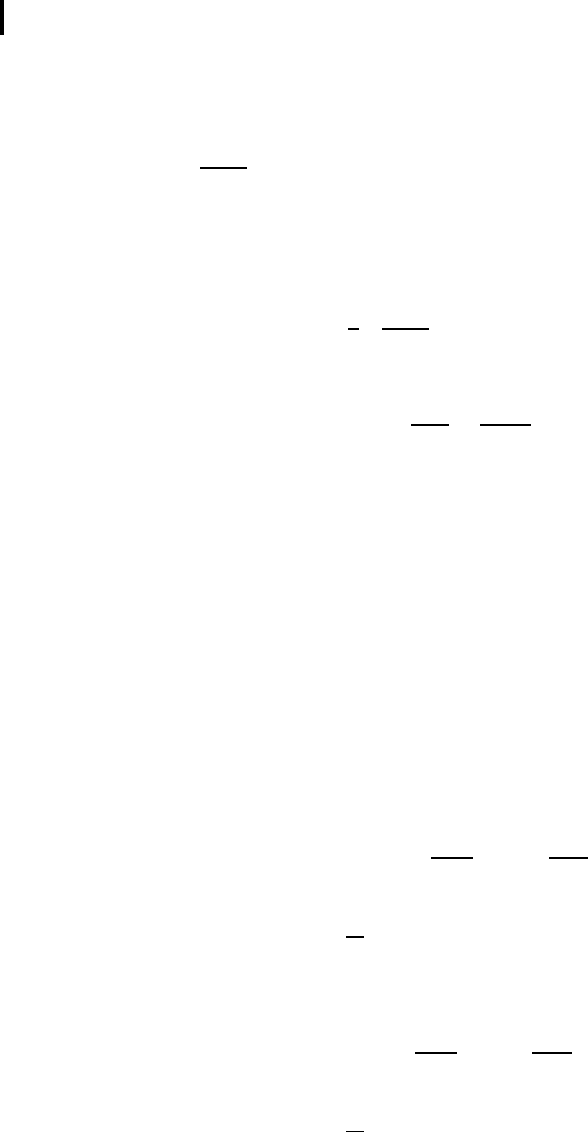
cos kd = cos qd −
1
2
aMω
ms
q sin qd. (1.11.6)
Introduce a new variable z = qd and rewrite (1.11.6)
cos kd = cos z − Qz sin z, Q =
aM
2md
=
M
2N
0
m
. (1.11.7)
It is assumed that M m and N
0
1. Since the long-wave approximation was used
the variable z can not be very large (z N
0
).
Equation (1.11.7) gives the dispersion law for the superlattice and corresponds to a
band structure of the spectrum. The allowed vibrational frequencies of a continuous
spectrum of the system under study can be qualitatively found by analyzing graph-
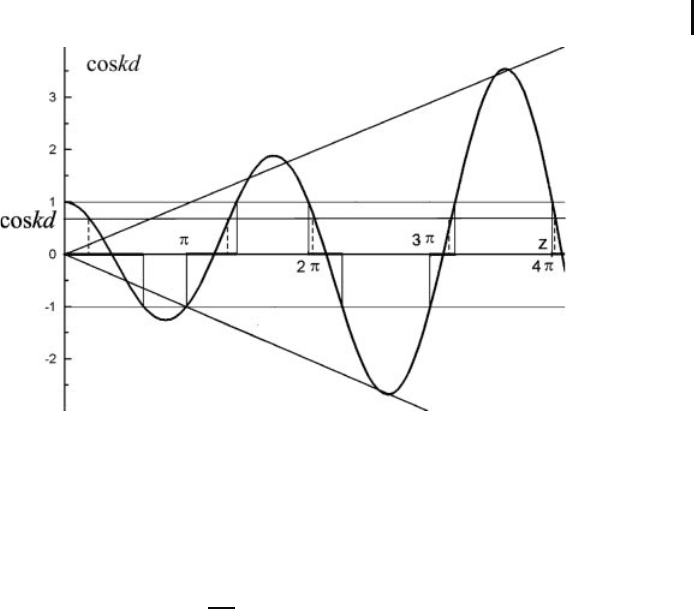
ically (1.11.7) as shown in Fig. 1.15: if the expression cos z − Qz sin z has values
between ± 1, the roots of the equation have values in the intervals shown on the ab-
scissa. As a result the vibration spectrum consists of bands of two types: allowed
frequency bands and forbidden bands (gaps).
Note that, as z increases, th e allowed frequencies are localized within the narrowing
intervals near the values k
1
d = ±mπ where m is a large integer. For the condition
m
2
Q 1 the dispersion law for the m-th band can be found. Indeed, near odd
m = 2p + 1 (see the vicinity of z = 3π in Fig. 1.15) we can write with sufficient
accuracy
cos kd = −1 + Qmπ(z − mπ)=−1 +
mπd
s
Q
ω −
mπs
d
,
which yields
ω = mΩ
0
+
Q
m
(1 + cos kd), (1.11.8)
where ω
0
= πs/d and Ω = s /(πQd). Similarly, near even m = 2p (see the vicinity
of z = 4π in Fig. 1.15) we can write
cos kd = 1 − Qmπ(z − mπ)=1 +
mπd
s
Q
ω −
mπs
d
,
which gives
ω = mΩ
0
+
Q
m
(1 − cos kd). (1.11.9)
1.11 Heavy Defects and 1D Superlattice
57
Fig. 1.15 Graphical solution of (1.11.7).Ifcos z − Qz sin z has values
between ±1, the roots of the equation have values in the intervals indi-
cated on the abscissa.
By combining (1.11.8) and (1.11.9), we obtain the dispersion relations for the m-th
band:
ω = mω
0
+
2Q
m
sin
2
(kd/2 ), m = 2p ,
cos
2
(kd/2 ), m = 2p + 1.
(1.11.10)
One can easily see that expressions (1.11.10) represent the size-quantization spectrum
of vibrations in a 1D elastic element of length d with levels (frequencies) split up
into minibands due to a low “transparency” of the joints dividing the 1D crystal into
elements.
Thus studying a biatomic 1D crystal in Section 1.5 and a simple continuous model
of the sup erlattice in this Section we consider two limiting cases of p olyatomic lattices:
a lattice with 2 atoms in the unit cell and a lattice with N
0
1 atoms in the unit cell.
And the number of gaps in the continuous vibrational spectrum is determined by the
number of atoms in the unit cell.
2
General Analysis of Vibrations of Monatomic Lattices
2.1
Equation of Small Vibrations of 3D Lattice
According to the definition of a crystal structure all spatial lattice points can be repro-
duced by the integral vector n =(n
1
, n
2
, n
3
) where n
α
(α = 1, 2, 3) are integers. If
we choose the coordinate origin at one of the sites, the position vector of an arbitrary
lattice site with “number” n will have the form
1
r
n
≡ r(n) =
3
∑
α=1
n
α
a
α
. (2.1.1)
In a monatomic lattice the sites are numbered in the same way as the atoms, so that
the integral vector n is at the same time “the number” or “the number vector” of a
corresponding atom. However, a lattice site coordinate (2.1.1) differs from the coordi-
nate of the corresponding atom when atoms are displaced relative to their equilibrium
positions. If the atom equilibrium p ositions coincide with the lattice sites (2.1.1), to
define the coordinates of an atom, it is necessary, apart from its “number”, to indicate
its displacement with respect to its own site.
We denote the displacement of an atom with “number” n from its equilibrium po-
sition by u(n).
The existence of the crystal state means that over a wide temperature range the
relative atomic displacemen ts are small compared with the lattice constant a (by the
lattice constant we mean the value whose o rder coincides with the values of funda-
mental translation vectors a
α
, in a cubic lattice. Therefore, we shall begin studying
crystal lattice vibratio ns with the case of small harmonic oscillations.
It is easy to derive and to write the equa tions for small lattice vibrations. We con-
sider the potential energy of a crystal whose atoms are displaced from their equilib-
rium positions and express it through the displacement u(n). The crystal energy is
1) In the following, for the coordinates of the crystal lattice sites, we shall use
the notation r(n) instead of R(n) used in the Introduction.
The Crystal Lattice: Phonons, Solitons, Dislocations, Superlattices, Second Edition. Arnold M. Kosevich
Copyright
c
2005 WILEY-VCH Verlag GmbH & Co. KGaA, Weinheim
ISBN: 3-527-40508-9

60
2 General Analysis of Vibrations of Monatomic Lattices
dependent on the coordinates of all particles making up the crystal, that is, the atomic
nuclei and electrons. The latter, however, are so mobile that they manage to adapt
to nuclear motion. Thus, at every given moment the electronic state is described by a
function dependent on the positions of the nuclei. Excluding the electronic coordinates
from the crystal energy is the essence of the so-called adiabatic approximation that is
justified both in studying harmonic vibrations and in the case of small anharmonicity.
Regarding the potential energy of a crystal U as a function only o f the coordinates of
atomic nuclei that coincide with the coordinates of atomic centers of mass we expand
it in powers of u(n) and consider the first nonvanishing expansion terms. Assuming
the crystal to be in equilibrium at u(n) = 0 we write the potential energy in the for m
U = U
0
+
1
2
∑
n, n
β
ik
(n, n
)u
i
(n)u
k
(n
), (2.1.2)
where U
0
= constant and the summation is over all crystal sites. The Latin letters
i, k (also j, l, m,...) are the coordinate indices. The summation over doubly repeated
coordinate indices from 1 to 3 is assumed. To simplify the notation of the sums over
the numbers n, n
, etc., we do not indicate the summation indices under the summation
sign if the summation is over all indices involved under the summation sign.
Since we consider that the crystal at u(n) = 0 is in mechan ical equilibrium , the
matrix β
ik
(n, n
) should be defined positively; in particular, the following inequalities
must be satisfied
β
11
(n, n) > 0, β
22
(n, n) > 0, β
33
(n, n) > 0.
Other important properties of the matrix will be discussed below.
The positively d e fined matrix with elements β
ik
(n, n
) is generally called the matrix
of atomic force constants or dynamical matrix of a crystal.
With a general expression for the potential energy (2.1.2) we can easily write down
the equa tion of motion of every atom in a crystal:
m
d
2
u
i
dt
2
= −
∂U
∂u
i
(n)
= −
∑
n
β
ik
(n, n
)u
k
(n
), (2.1.3)
where m is the atomic mass.
To simplify formulae and equations such as (2.1.2), (2.1.3) containing the u
i
(n)
displacement vectors and the β
ik
(n, n
) dynamical force matrix or similar matrices,
we omit the coordinate indices i, k, l,... for the matrix and vector values, and the
square (3 × 3) matrices are denoted by the corresponding capital letters, e. g., the
matrix of force constants is denoted by the letter B:
B = β
ik
, i, k = 1, 2, 3.
By u(n ) we mean the displacement vector that is in the form of a column consisting
of three elements: u = co l (u
1
, u
2
, u
3
). Such a notation is only “decoded” when
possible misunderstanding may appear.
2.1 Equation of Small Vibrations of 3D Lattice
61
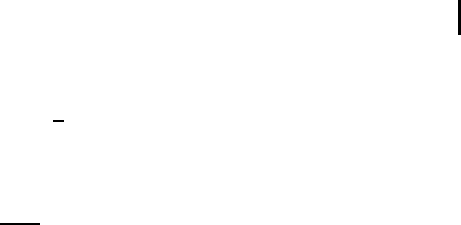
Thus, the quadratic expression for the potential energy (2.1.2) is
U = U
0
+
1
2
∑
B(n, n
)u(n)u(n
). (2.1.4)
In the new notation we write the equations of motion in the form
m
d
2
u
k
dt
2
= −
∑
n
B(n, n
)u(n
). (2.1.5)
Here we easily see one important property of the coefficients B(n, n
). Assume the
crystal to be displaced as a whole: u(n)=u
0
= constant. Then the internal crystal
state cannot change (absence of external forces). Thus, the atoms are not affected by
additional forces. Consequently,
∑
n
B(n, n
) ≡
∑
n
β
ik
(n, n
)=
∑
n
β
ik
(n
, n)=0. (2.1.6)
The requirement (2.1.6) follows from the conservation of total momentum in the
crystal. Another obvious requirement is that the total angular momentum conserva-
tion law be automatically obeyed in the absence of external forces. We assume rigid
rotation of the crystal effected and described by the axial vector Ω:
u
i
(n)=
ikl
Ω
k
x
l
(n) , (2.1.7)
where
ikl
is a rank three unit antisymmetric tensor and x
l
(n) is determined by (2.1.1).
The above rotation causes no change in the internal lattice state if external forces are
absent. Hence, with (2.1.7 ) substituted into (2 .1.3), (2.1.5 ) we have
kl m
Ω
l
∑
n
β
ik
(n, n
)x
m
(n
)=0. (2.1.8)
Since the vector Ω is arbitrary
∑
n
β
ik
(n, n
)x
l
(n
)=
∑
n
β
il
(n, n
)x
k
(n
). (2.1.9)
The conditions (2.1.6), (2.1.9) should be satisfied for any atom in the lattice (for
any vector n). The last point is especially important when not all crystal sites are
equivalent. For example, in describing the vibrations of a finite crystal specimen (the
atoms near the surface are under conditions differing from those in the crystal interior)
or a real crystal with broken translational symmetry (a crystal with defects).
A detailed discussion of constraints imposed on the elements of the matrix B is
due to a usual simplification of crystal models when the minimum possible number of
elements of this matrix is nonzero, thus describing the interaction of only the nearest-
neighbor atoms in the lattice. But it is questionable whether such a choice of model
agrees with general physical properties of a crystal, i. e., with mechanical conservation
laws.

62
2 General Analysis of Vibrations of Monatomic Lattices
We now turn to (2.1.4) and discuss firstly the bulk properties of a crystal assuming
the crystal lattice to be unbounded. For an unbounded homogeneous lattice, due to its
homogeneity the matrix B has the form
B(n, n
) = A(n − n
),
where we introduced A = α
ik
, i, k = 1, 2, 3 whose elements are satisfied by the
conditions
∑
n
A(n − n
) ≡
∑
n
α
ik
(n − n
)=
∑
n
α
ik
(n)=0. (2.1.10)
Then (2.1.4) is written as
U = U
0
+
1
2
∑
A(n − n
)u(n)u(n
), (2.1.11)
and the equations of motion (2.1.3) take the form
m
d
2
u(n)
dt
2
= −
∑
n
A(n − n
)u(n
). (2.1.12)
We substitute the condition (1.1.10) into the equation of motion (1.1.12) to obtain
m
d
2
u(n)
dt
2
=
∑
n
A(n − n
)
u(n) −u(n
)
. (2.1.13)
The equa tion of motion (2.1.13) illustrates th e invariance of a crystal state with
respect to its displacement as a whole.
Because (2.1.4) and (2.1.11)–(2.1.13) are equations for three-dimensional displace-
ment vectors we shall use the simplest model to describe the vibration o f a crystal
lattice where all atoms are displaced in one direction. Then the atom displacement
from its equilibrium position is determined by a scalar rather than a vector one. This
model allows us to describe the main properties of a vibrating crystal using simple
formulae and to obtain the correct quantitative estimates. This model, here called
conventionally scalar, is used to illustrate the calculation scheme or the ideology of
mathematical methods that produce, in a real th ree-dimensional crystal, the same re-
sults as those obtained by employing sophisticated and cumbersome calculations.
In the scalar model the quadratic expressions for the potential energy (1.1.2),
(1.1.11) preserve their form; however, we see here no coordinate indices, and the
dynamical matrix of an unbounded crystal is reduced to a scalar function of the vector
argument α(n):
U = U
0
+
1
2
∑
α(n − n
)u(n)u(n
). (2.1.14)
We include in the properties of a scalar model the energy invariance (1.1.14) with
respect to the displacement of a crystal as a whole assuming the function α(n ) to be
satisfied by the condition (1.1.10), i. e.,
∑
α(n)=0. (2.1.15)

2.2 The Dispersion Law of Stationary Vibrations
63
Replacing (2.1.11) by (2.1.14) in the analysis of crystal lattice vibrations will in
some cases allow us to avoid cumbersome calculations.
2.2
The Dispersion Law of Stationary Vibrations
The stationary crystal vibrations for which the displacement of all atoms are time
dependent only by the factor e
−iωt
are of special interest. For such vibrations we
obtain instead of (2.1.12)
mω
2
u(n)=
∑
n
A(n − n
)u(n
). (2.2.1)
If we introduce the notation = ω
2
we can rewrite (1.2.1) in a canonical form:
1
m
∑
n
A(n − n
)u(n
) − u(n)=0. (2.2.2)
Equation (2.2.2) together with certain boundary conditions for the function u is the
eigenvalue problem for the linear Hermitian operator (1/m)A.
Let the solution to (2.2.1), (2.2.2) has the form
u(n)=ue
ikr (n)
. (2.2.3)
The vector k is analogous to a wave vector of crystal vibrations and is regarded as
a quasi-wave vector. It is now a free parameter that determines the solution. Substi-
tuting (2.2.3) into (2.2.1), we obtain for the displacement a system of linear equations
mω
2
u =
∑
n
A(n − n
)ue
ik[r(n
)−r(n)]
.
From the definition (1.1.1) it follows that
r(n
) − r(n)=
3
∑
α=1
(n
α
− n
α
)a
α
= r(n − n
),
hence
mω
2
u − A(k)u = 0, (2.2.4)
where the matrix A( k) is given by
A(k)=
∑
n
A(n)e
−ikr (n)
. (2.2.5)
Here, and in what follows, we denote with the same capital letter the matrix in
various “representations” and distinguish the form of representation by the argument
only. Since throughout the book the vectors n or r refer to the real space of sites
64
2 General Analysis of Vibrations of Monatomic Lattices
or the coordinates in a crystal and the vectors k to reciprocal space, this generally
accepted system of notations will be quite clear. Thus, in the given case, A(n) is
the force dynamical matrix in the site representation, A(k) is the same matrix in k-
representation.
The condition for the system (2.2.4) to be compatible has the form
Det mωI − A(k) = 0, (2.2.6)
where I is the unit matrix; I ≡ δ
ik
, i, j = 1, 2, 3.
Express now (2.2.6) as
D(ω
2
)=0, (2.2.7)
introducing the new notation
D()=Det
I −
1
m
A(k)
. (2.2.8)
In mechanics, the relation (2.2.6) or (2.2.8) is called the characteristic equation for
eigenfrequencies and its solution relates the frequency of possible crystal vibrations
to a quasi-wave vector k. The wave-vector dependence of frequency is called the
dispersion law or dispersion relation and the equation is referred to as a dispersion
equation. Thus, solving the dispersion equation we obtain the dispersion law
= ω
2
(k)
for crystal lattice vibr ations.
In a monatomic lattice each atom is an inversion center, therefore,
A(n)=A(−n),
and (2.2.5) is reduced to the following expression, where it is obvious that the matrix
A(k) is real:
A(k)=
∑
A(n) cos kr(n)=
∑
A(n)[cos kr (n) −1] . (2.2.9)
The last part of (2.2.9) follows from the force matrix property (2.1.10).
Thus, the plane-wave vibration (2.2.3) can be traveling in a crystal if its frequency
ω is connected with the quasi-wave vector k by the dispersion law (2.2.6) or (2.2.7).
In a scalar model instead of the system of (2.2.4) there is only one equation of
vibrations, and the dispersion law can be written explicitly
ω
2
(k)=
1
m
∑
α(n)e
−ikr (n)
=
1
m
∑
α(n)[cos kr (n) −1] . (2.2.10)
From (2.2.6) or (2.2.10) we note that the dispersion law determines the frequency
as a periodic fun ction of the quasi-wave vector with a period of a reciprocal lattice
ω(k)=ω(k + G ).

2.2 The Dispersion Law of Stationary Vibrations
65
This proves to be the basic distinction between the dispersion law of crystal vi-
brations and that of continuous medium vibrations, since the monotonic wave-vector
dependence of the frequency is typical for the latter. The difference between the quasi-
wave vector k and the ordinary wave vector is also observed here. Only vector k values
lying inside one unit cell of a reciprocal lattice correspond to physically nonequivalent
states of a crystal.
Recall that free space is homogeneous, i. e., invariant with respect to a translation
along an arbitrary vector including an infinitely small one. A set of all similar dis-
placements forms a continuous group of translations. The operator of a translation
onto an infinitely small vector is the momentum operator ( the momentum operator is
said to be the generator of a continuous group of translations).
The invariance of mechanical equations with respect to a continuous group of trans-
lations generates the momentum vector p as the main ch aracteristic of a free particle
state or the wave vector k as the main characteristic of the wave process in a vacuum.
The vectors p and k in free space are not restricted in value by any conditions and are
related by
p = ¯hk.
(2.2.11)
A crystal lattice, unlike a vacuum, has no homogeneity, but is spatially periodic. We
see that the quasi-wave vector is the result of translational symmetry of the periodic
structure to the same extent as the wave vector is the result of free-space homogeneity.
Thus, in an unbounded crystal the wave processes can be described using the concept
of a quasi-wave vector k, and the motion of particles using the concept of quasi-
momentum related to the vector k via (2.2.11). The wave function corresponding to
a quasi-momentum (or quasi-wave vector) represents a plane wave modulated with a
lattice period.
When the minimum space dimension (lattice period) tends to zero, the Brillouin
zone dimensions become unbounded and we go over to a homogeneous space and
return to the concept of momentum and its eigenfunctions in the form of plane waves.
Returning to the dispersion law as a solution of the dispersion equation (2.2.6), we
take into account that it is a cubic algebraic equation with respect to ω
2
:
Det
mω
2
δ
ij
− A
ij
(k)
= 0, i, j = 1, 2, 3. (2.2.12)
The roots of this equation determine the three branches for monato mic crystal lattice
vibrations specified by the dispersion law: = ω
2
α
(k) , α = 1, 2, 3, where α is the
number of a branch of vibrations.
But the characteristic equation (2.2.12) only determines the squared frequency ω
2
.
Thus, the α-branch dispersion law actualizes each value of the vector k with two
frequencies: ω = ±ω
α
(k) . Hence the spectrum of squared frequencies of a vibrating
crystal seems to be doubly degenerate. However, as follows from (1.2.9), (1.2.12)
the dispersion law is invariant relative to the change in sign of the quasi-wave vector:
ω
2
(k)=ω
2
(−k). Therefore, the wave with a quasi-wave vector k and frequency