
Kosevich A.M. The crystal lattice
Подождите немного. Документ загружается.

1.7 Soliton as a Particle in 1D Crystals
45
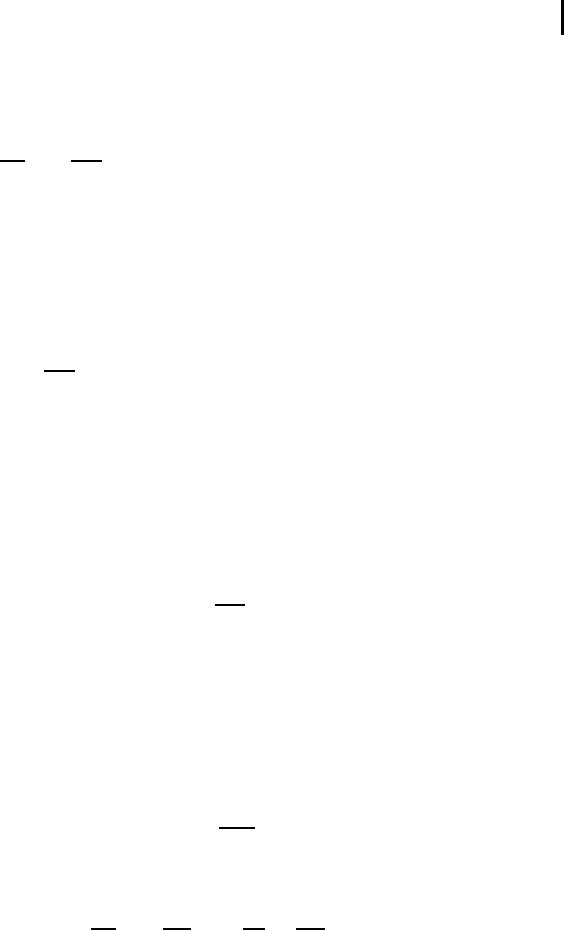
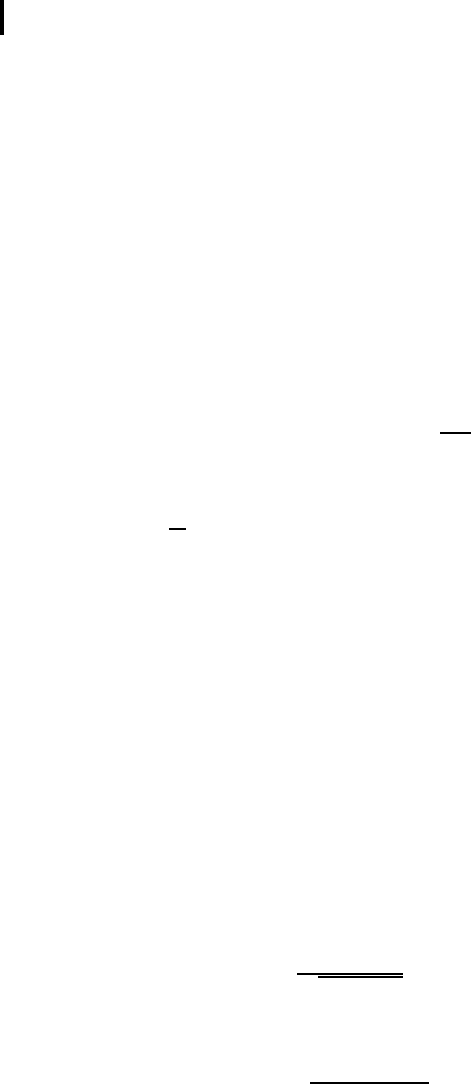
Within the main approximation for small perturbations, we can substitute
u = u
s
(x − ζ) on the r.h.s. of (1.7.10). ∂u/ ∂x = −∂u/∂ζ, and we obtain
dP
dt
= −
∂W
∂ζ
, W(ζ)=−
∞
−∞
f (x)u
s
(x − ζ) dx. (1.7.11)
Equation (1.7.11 ) has the form o f one of the Hamilton equations and W(ζ) plays
the role of the soliton potential energy in an external field. If the force density f (x) is
of purely elastic origin, it can be written as f (x)=∂σ
e
/∂x,whereσ
e
are the elastic
stresses created in a 1D crystal by external loads. In this case
W(ζ)=−
∞
−∞
∂σ
e
∂x
u
s
dx = aσ
e
(−∞)+
∞
−∞
σ
e
(x)u
s
x
(x − ζ) dx. (1.7.12)
The first term on the r.h.s. of (1.7.12) is a constant that may not be taken into account
in writing the potential energy of a soliton W(ζ).
We assume further that the field of stresses σ
e
(x) varies smoothly in space and the
characteristic distance of its variation is much larger than l (soliton width). Then we
may replace (1.7.12) by
W(ζ)=σ
e
(ζ)
∞
−∞
∂u
s
∂x
dx = aσ
e
(ζ). (1.7.13)
Comparing (1.7.11), (1.7.13) we conclude that the force acting on a soliton is deter-
mined by the gradient (space derivative) of elastic stresses created by external loads at
the point where the soliton center of mass is located.
On the other hand, the relation (1.7.13) makes it possible to generalize the expres-
sion for the Hamilton fun c tion that, for small soliton momenta, takes the form
H(ζ, P)=E
0
+
P
2
2m
∗
+ aσ
e
(ζ). (1.7.14)
Using (1.7.14), a standard pair of Hamilton equations is constructed
dP
dt
= −
∂H
∂ζ
,
dζ
dt
=
∂H
∂P
. (1.7.15)
The equations for soliton motion thus take the form of equations of the motion of
a particle with mass m
∗
and effective “charge” a, reflecting its interaction with the
elastic potential field, where σ
e
(x) is the field p otential.
The soliton, a collective excitation of a 1D crystal, has very different properties
from the collective small harmonic vibrations of a crystal lattice. The primary differ-
ence is that the soliton is generated by the nonlinear dynamics of a 1D crystal. Thus,
the usual superposition principle is inapplicable to solitons. One may expect that this

46
1 Mechanics of a One-Dimensional Crystal
restricts the possibility of using solitons to describe the excited states of a crystal.
Problems may arise when we try to consider many solitons in the crystal or the inter-
action between soliton perturbation and small harmon ic vibrations of the crystal.
The remarkable properties of (1.6.9) eliminate these problems. First, the asymp-
totic superposition principle is applicable to solitons. If at time t = 0 two solitons
with velocities V
1
and V
2
(assume them moving in the opposite directions) exist in a
1D crystal, then at t → ∞ the same two solitons with velocities V
1
and V
2
will remain
in the crystal. In other words, the asymptotic behavior of soliton solutions to the non-
linear equation (1.6.9) is analogous to the independent behavior of the eigensolutions
to a linear equation.
Then, the asymp totic superposition principle is valid also for the interaction of col-
lective excitations of different types: solitons and small harmonic vibrations. Without
going into details of the nonlinear mechanics to justify the first remark, we illustrate
the validity of the second one by studying the properties of small harmonic v ibrations
in a 1D crystal containing one crowdion ( soliton).
1.8
Harmonic Vibrations in a 1D Crystal Containing a Crowdion (Kink)
We use the simplest (linear) perturbation theory to describe how a harmonic vibration
moves through a soliton (1.6.12). We assume a soliton to be at rest (results for a
moving soliton can be obtained by means of th e Lorentz transformation) and represent
the soliton to (1.6.9) in the form
u = u
s
+ u
1
, u
s
= 4arctan
exp
−
x
l
0
. (1.8.1)
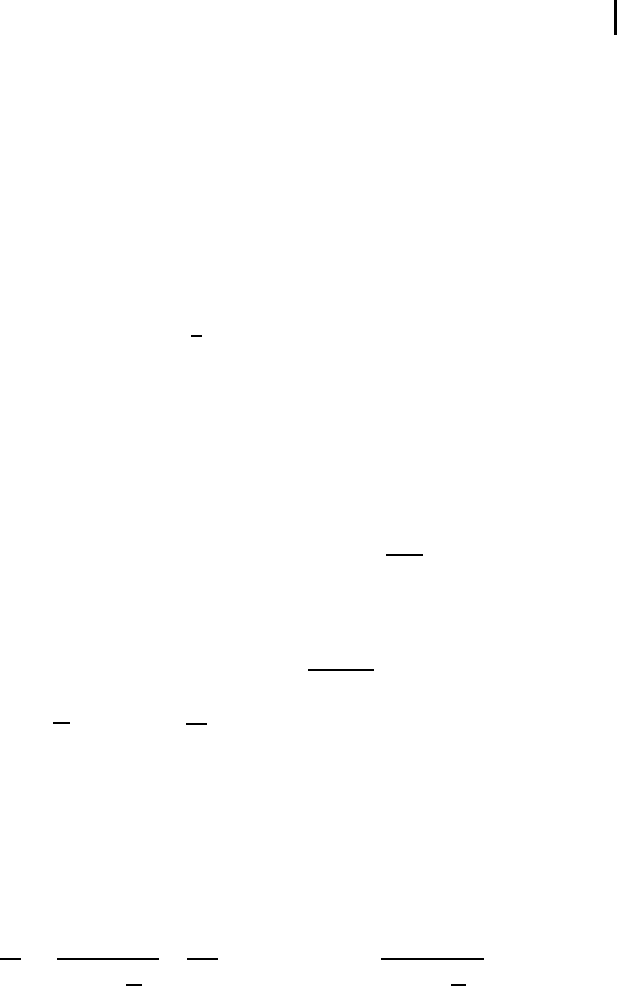
We substitute (1.8.1) into (1.6.9) and linearize the equation obtained in u
1
.Then
u
1
tt
−s
2
0
u
1
xx
+ ω
2
0
1 − sech
2
x
l
0
u
1
= 0.
We seek for the solution to this linear equation in a standard form u
1
= ψ(x)e
−iωt
.
For the function ψ(x) we have
ω
2
ψ = −s
2
0
d
2
ψ
dx
2
+ ω
2
0
1 −sech
2
x
l
0
ψ. (1.8.2)
Equation (1.8.2) is a Schrödinger stationary equation with a reflectionless potential.
One localized eigenstate is among its solutions
ψ
loc
(x)=
2
l
0
sech
x
l
0
, (1.8.3)

1.8 Harmonic Vibrations in a 1D Crystal Containing a Crowdion (Kink)
47
corresponding to a zero frequency (ω = 0), and a set of harmonic vibrations of the
continuum spectrum
ψ
k
(x)=
1
√
2π
ω
0
ω(k)
kl
0
+ i tanh
x
l
0
e
ikx
, (1.8.4)
with the dispersion law (1.6.8).
Formula (1.8.3) gives a translational mode in the linear approximation
ψ
loc
(x)=
du
s
(x)
dx
.
It reflects the homogeneity of a 1D crystal and the possibility to choose arbitrarily the
position of the cen ter of gravity of a soliton. Indeed, the linear approximation gives
u
s
(x)+δxψ
loc
(x)=u
s
(x)+δx
du
s
(x)
dx
∼
=
u
s
(x + δx) .
The solutions (1.8.4) describe the harmonic vibrations with the background of a
crowdion at rest. Their form confirms the asymptotic superposition principle accord-
ing to which the independent eigenvibrations are only slightly modulated near the
soliton center and change insignificantly. Each eigenvibration is still characterized by
the wave number k and the dispersion law (the vibration frequency dependence on k)
does not change.
A set of functions (1.8.3), (1.8.4), as a set of eigenfunctions of the self-adjoint
operator (1.8.2), forms a total basis in the space of functions of the variable x.This
is the most natural basis for the representation of p erturbations of a soliton solution,
as it allows one to give a clear physical interpretation. A translational mode describes
the motion of a soliton mass center, and the continuum spectrum modes refer to the
change in its form and the resulting “radiation” of small vibrations.
It follows from (1.8.4) that on passing through a soliton, the eigenvibration repro-
duces its standard coordinate dependence ∼ e
ikx
, but the vibration phase η(x, k) is
shifted by
η
k
= η(+∞, k) −η(−∞, k)=π −2arctan(kl
0
). (1.8.5)
The phase shift (1.8.5) affects the vibration density in a 1D crystal. In the absence
of a soliton, the expression for the density of states in the specimen of the finite dimen-
sion L follows from the requirement kL = 2πn, n = 1, 2, 3 . . ., that is a consequence
of cyclicity conditions (1.1.8) for the eigenvibrations. In the presence of a soliton an
additional phase shift (1.8.5) results in a change in the allowed wave-vector values:
kL + η(k)=2πn, n = 0, 1, 2, . . . . In the limit L → ∞, the spectrum of the values of
k becomes continuous. The vibration density (the distribution function for the wave
vector k) then equals
ν(k)=
dn
dk
=
L
2π
+
1
2π
dη(k)
dk
=
L
2π
−
1
π
l
0
1 +(l
0
k )
2
, (1.8.6)

48
1 Mechanics of a One-Dimensional Crystal
where L/2 π is the vibratio n density in the absence of a soliton. It is easily seen that
∞
−∞
ν(k) −
L
2π
dk = −1.
The number of plane-wave vibrations (with a continuous frequency spectrum) scat-
tered by the soliton is reduced by un ity because of the presence of one local state with
a discrete frequency ω = 0 (translational mode).
Analyzing the changes in the vibration distribution, it is of interest to find the fre-
quency spectrum function ν(ω) in a crystal with a soliton. Since the dispersion law
(1.6.8) does not change in the presence of a soliton, the function ν(ω) is found by
multiplying (1.8.6) by dk/dω:
ν(ω)=ν
0
(ω) −
1
π
ω
0
ω
1
ω
2
− ω
2
0
= ν
0
(ω)
1 −
2l
0
L
ω
0
ω
2
, (1.8.7)
where ν
0
(ω) is the frequency spectrum in the absence of a soliton
nu
0
(ω)=
L
2πs
0
ω
ω
2
−ω
2
0
, ω > ω
0
.
If a soliton moves with velocity V, the formula for the phase shift is obtained from
(1.8.5) by replacing l
0
→ l(V)=l
0
1 − (V/s
0
)
2
:
η
k
= π − 2arctan
l
0
k
1 −
V
s
0
2
. (1.8.8)
Finally, if there are several solitons (crowdions with different velocities) in the sys-
tem, the total phase shift of an eigenvibration is equal to the sum of the phase shifts
for each soliton
η
k
= Nπ −2
N
∑
α=1
arctan
l
0
k
1 −
V
α
s
0
2
, (1.8.9)
where V
α
is the soliton velocity with number α, N is the number of solitons. It be-
comes clear that a set of kinks and small harmonic vibrations can be considered as
“nonlinear normal modes”. It follows from the “asymptotic independence” of these
modes that the energy is the sum of soliton energies (1.7.1) and the energy of small
vibrations with the den sity of states determin ed by (1.8.6), (1.8.9).
1.9 Motion of the Crowdion in a Discrete Chain
49
1.9
Motion of the Crowdion in a Discrete Chain
According to the classical equations of crowdion motion, the crowdion Hamiltonian
function (1.7.6) is independent of the position of its center and this is a result of the
continuum approximation in which this function is d erived.
The simplest way to take into account the discreteness of the system concerned is
the following. We use the solution (1.6.12) to the continuous differential equation
(1.6.9) a nd calculate the static energy of a d iscrete atomic chain with a crowdion at
rest by using the formula
E =
∞
∑
n=−∞
1
2
α
0
u
n+1
− u
n
)
2
+ f (u
n
, (1.9.1)
where u
n
= u(x
n
) ≡ u(an).
It is easily seen that the static crowdion energy in the continuum approximation is
equally divided between the interatomic interaction energy and the atomic energy in
an external field. It can be assumed that the same equal energy distribution remains in
a discrete chain, and instead of (1.9.1) we then write
E = 2
∞
∑
n=−∞
F(u
n
)=τ
2
∞
∑
n=−∞
sin
2
πu
n
a
.
We substitute here (1.6.12), assuming the point x = x
0
to be a crowdion center:
E = τ
2
∞
∑
n=−∞
sech
2
an − x
0
l
0
, (1.9.2)
where l
0
= as
√
m/(πτ )=a
2
√
α
0
/(πτ).
Using the Poisson summation formula,
∞
∑
n=−∞
f (n)=
∞
∑
m=−∞
+∞
−∞
f (k)e
2πimk
dk , (1.9.3)
we find
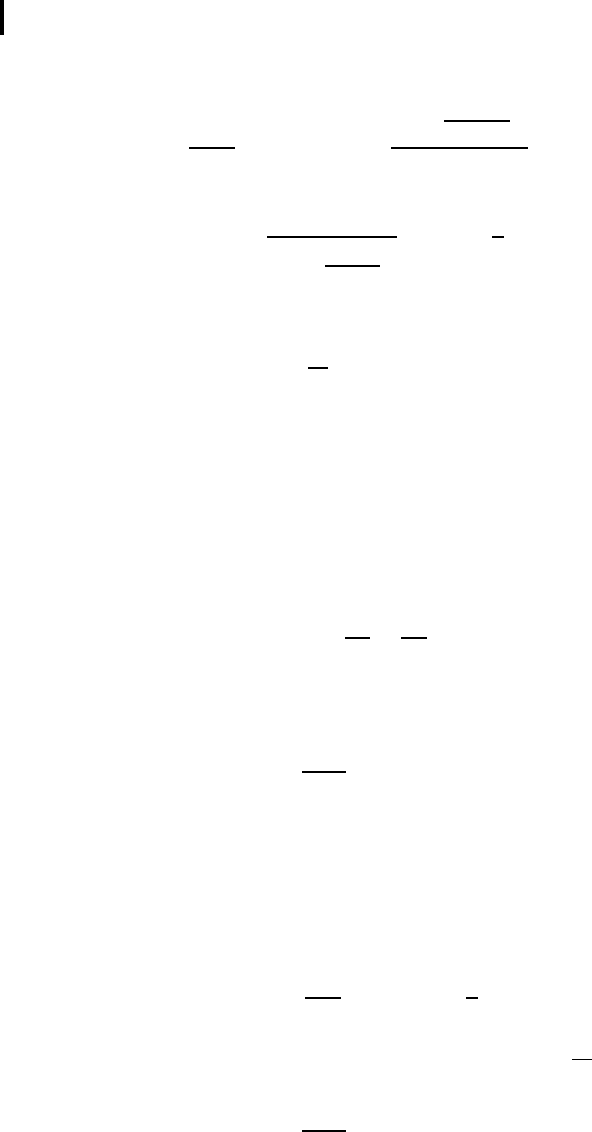
E =
τ
2
a
+∞
−∞
dx
cosh
2
x
l
0
+
2τ
2
a
∞
∑
m=1
e
2πim(x
0
/a)
+∞
−∞
e
2πim(x/a)
cosh
2
x
l
0
dx. (1.9.4)
The first term in (1.9.4) coincides with the energy E
0
of a crowdion at rest found
in the continuum approximation (1.7.1), and the second term is a periodic function of
50
1 Mechanics of a One-Dimensional Crystal
the coordinate x
0
with period a: E = E
0
+ U(x
0
),where
U(x)=
2l
0
τ
2
a
∞
∑
m=1
e
2πim(x/a)
+∞
−∞
cos
2πml
0
ξ
a
cosh
2
ξ
dξ
= 4α
0
a
∞
∑
m=1
m
sinh
π
2
ml
0
a
cos
2πm
x
a
.
(1.9.5)
Sincewehaveassumedthatl
0
a, it then suffices to keep one term with m = 1
U(x
0
)=U
1
cos
2π
x
0
a
, U
1
= 8α
0
a
2
e
−π
2
(l
0
/a)
. (1.9.6)
It is clear that the crowdion energy is periodically dependent on the coordinate of
its center x
0
that may be regarded as a quasi-particle coordinate. We set x
0
= Vt
in (1.6.15) using the ordinary relation between the coordinate and the velocity at
V = const = 0. The part of the energy (1.9.6) that is dependent on the coordi-
nate plays the role of the crowdion potential energy. Minima of the potential en-
ergy determine possible equilibrium states of the crowdion (x
0
= a/2 ± na,where
n = 0, ±1, ±2,...), an d the crowdion can oscillate relative to these equilibrium posi-
tions with the frequency
Ω
2
0
=
2π
a
2
U
0
m
∗
.
Vibration motion with such a freq uency can really be a free harmonic oscillation if
the quantum energy of the ground (zero) state of the oscillator ¯hΩ
0
is much smaller
than U
0
:
¯h
2
m
∗
a
2
U
1
. (1.9.7)
Under such a condition the crowdion in a discrete structu re possesses an internal vi-
bration degree of freedom with the frequency Ω
0
.
However, in the case l
0
a, the potential energy curve (1.9.6) creates very weak
potential barriers between the neighboring energy minima, and the crowdion may
overcome them through quantum tunneling. Thus, the crowdion migrates really in
a discrete atomic chain overcoming the potential relief (1.9.6).
The Hamiltonian
H = E
0
+
P
2
2m
∗
+ U
1
cos
2π
x
a
(1.9.8)
is used for the quantum description of crowdion motion.
As both m
∗
and U
1
decrease with incr easing parameter l
0
/a ∼ a
√
α
0
/τ the phys-
ical situations, where
¯h
2
m
∗
a
2
U
1
, (1.9.9)
1.10 Point Defect in the 1D Crystal
51
are quite reasonable. The inequality (1.9.9) means that the potential energy contribu-
tion that is dependent on the coordinate is a weak perturbation o f the kinetic energy
of free crowdion motion. In other words, the amplitude of zero crowdion vibrations in
one of the potential minima (1.9.9) greatly exceeds much the one-dimensional crystal
period and the crowdion transforms into a crowdion wave.
The energy spectrum of a crowdion wave with the Hamiltonian (1.9.7) is rather
complicated and consists of many bands in each of which the energy is a periodic
function of the quasi-wave number k with period 2π/a. However, small crowdion
wave energies for k 2π/a are not practically distinguished from the free particle
energy with the Hamiltonian (1.9.8) under the condition (1.9.9). I ndeed, if we calcu-
late quantum-mechanical corrections to the free particle energy in the second order of
perturbation theory in the potential (1.9.6), then
ε(k)= E
0
−U
1
m
∗
a
2
U
1
(2π¯h)
2
+
¯h
2
k
2
2M
,
M = m
∗
1 +
1
2
m
∗
a
2
U
1
(π¯h )
2
2
.
Thus, in spite of the presence of a potential energy curve (1.9.6), the crowdion wave
moves through a crystal as a free particle with a mass close to the crowdion effective
mass.
1.10
Point Defect in the 1D Crystal
Any distortion of regularity in the crystal atom arrangement is regarded as a crystal
lattice defect. A point (from the macroscopic point of view) defect is a lattice dis-
tortion concentrated in the volume of the order of magnitude of the atomic volume.
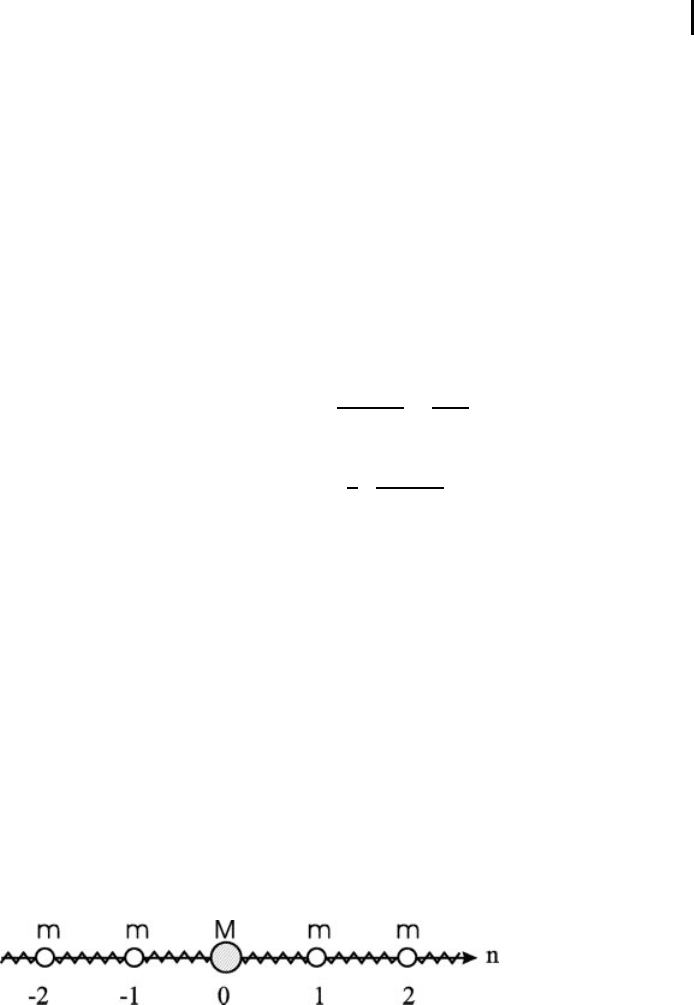
The typical point defects in a 1D crystal are as follows: an interstitial atom is an atom
occupying position between the equilibrium po sitio ns of ideal lattice atoms ( a crow-
dion can be considered as the extende d interstitial atom); a substitutional impurity is
a “strange” atom tha t replaces the host atom in a lattice site (Fig. 1.14).
Fig. 1.14 Substitutional impurity in 1D crystal.
The simplest point defect arises in a monatomic species when one of the lattice
sites is o ccupied by an isotope of the atom making up the crystal. Since the isotope
atom differs from the host atom in mass only, it is natural to assume that the crystal
52
1 Mechanics of a One-Dimensional Crystal
perturbation does not change the elastic bond parameters. Let the isotope be situated
at the origin (n = 0) and have a mass M different from the mass of the host atom m.
With such a defect we get in the case of stationary vibrations the following set o f
equations
ω
2
Mu(0) −α [u(+1) −2u(0)+u(−1)] = 0, n = 0;
ω
2
mu(n) −α [u (n + 1) −2u(n)+u(n −1)] = 0, n = 0.
(1.10.1)
Equations (1.10.1) can be written more compactly as
mω
2
u(n) − α[u(n + 1) − 2u( n)+u (n − 1)] = (m − M)ω
2
δ
n0
, (1.10.2)
by introducing the Kronecker delta δ
nn
.
We denote
∆m = M −m, U
0
= −
∆m
m
ω
2
, (1.10.3)
and rewrite (1.10.2) in a form typical for such problems
ω
2
u(n) −
α
m
[u(n + 1) − 2u(n)+u(n − 1)] = U
0
u(0)δ
n0
. (1.10.4)
We write a formal solution to (1.10.4) as
u(n)=U
0
G
0
ε
(n)u(0), (1.10.5)
where G
0
ε
is the Green functio n for ideal lattice vibr ations, ε = ω
2
; u(0) is a constant
multiplier still to be defined.
Setting n = 0 in (1.10.5), we find that (1.10.5) is consistent only when
1 −U
0
G
0
ε
(0)=0. (1.10.6)
Equation (1.10.6) is an equation to determine the squares of frequencies ε at which
the atomic displacements around an isotope have the form of (1.10.5). In the theory of
crystal vibrations with a point defect, an equation such as (1.10.6) was first obtained
by Lifshits, 1947.
The expression (1.1.22) for the Green function for ε > ω
2
m
at n = 0 is substituted
into (1.10.6):
1 −
U
0
ε(ε − ω
2
m
)
= 0. (1.10.7)
Since ε > 0, a solution to (1.10.7) exists only at U
0
> 0. It is not difficult to find this
solution:
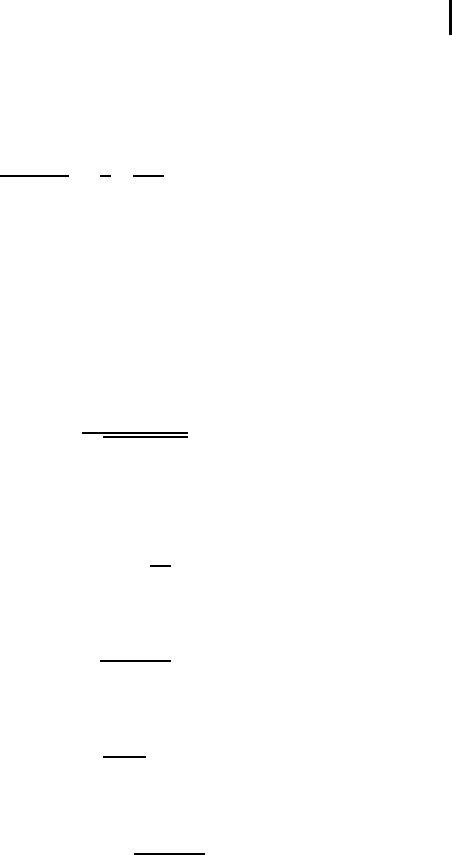
ε =
ω
2
m
1 − (∆m/m)
2
. (1.10.8)
1.10 Point Defect in the 1D Crystal
53
Thus we obtain a discrete frequency corresponding to vibrations of the crystal with
the single point defect. For |∆m|m this frequency is slightly shifted relative to the
upper edge of the frequency spectrum:
ω −ω
m
ω
m
=
1
2
∆m
m
2
. (1.10.9)
Crystal vibrations with the frequencies d escribed are called local vibrations,and
the discrete freq uencies are called local frequencies ω
d
. These names are attributed
to the fact that the amplitude of the corresponding vibration is only nonzero in a small
vicinity near the point defect. The local vibration amplitude is given b y (1.10.6),
implying its coordinate dependence is completely d etermined by the behavior of the
ideal crystal Green function. In order to obtain the Green function using (1.1.22) for
ε > ω
2
m
it is convenient to take the quasi-wave number in the complex form (1.1.24):
G
0
ε
(n)=
(−1)
n
e
−κna
ε(ε − ω
2
m
)
, (1.10.10)
and take into account the connection of the frequency with the parameter κ (1.1.25)
for the discrete local frequency (ε
d
= ω
2
d
):
ε
d
= ω
2
m
cosh
2
aκ
2
. (1.10.11)
Combining Eqs (1.10.8) and (1.10.11) one can get
κa = log
2m − M
M
. (1.10.12)
At m − M m (1.10.12) can be simplified:
κa = 2
|∆m|
m
. (1.10.13)
We substitute the result (1 .10.12) in (1.10.10) and rewrite (1.10.5)
u(n)=u(0)(−1)
n
M
2m − M
n
. (1.10.14)
Thus, the local vibration amplitud e decreases if the distance na increases and this
decay of the amplitude confirms the fact of the vibration localization.
Let us introduce a length of the localization region of vibrations l = 1/κ.Asitre-
sults from (1.10.12), under the condition |∆ m|m the length of localization is very
large (l = am/∆m a). In this connection it is interesting to consider a long-wave
description of p roblems concerning with the localization of crystal vibrations near a
point defect. Returning to (1.10.4) and using (1.1.15) in the long-wave approxima-
tion the Kronecker delta δ
n0
in the r.h .p. of (1.10.4) can be substituted by the Dirac
delta-function
δ
n0
= aδ(na)=aδ(x), x = na,
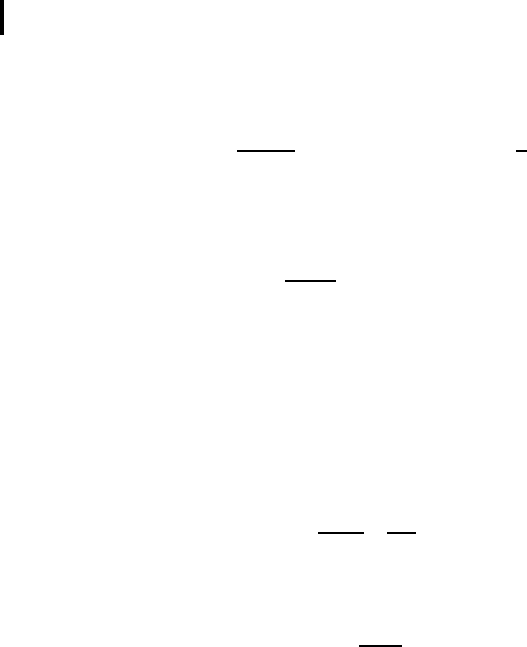
54
1 Mechanics of a One-Dimensional Crystal
and the finite differences in the l.h.p. can be substituted with the partial derivatives of
the function v(x) (see (1.1.16) written in the same approximation):
(ω
2
− ω
2
m
)v(x) −s
2
∂
2
v(x)
∂x
2
= aU
0
v(0) δ(x), s =
1
2
a ω
m
. (1.10.15)
The presence of the delta-function in the r.h.p. of (1.10.15) is equivalent to the
following boundary condition for (1.1.16)
−s
2
∂u(x)
∂x
+0
−0
= aU
0
u(0), (1.10.16)
which determines a jump of the first spatial derivative of the continuous function v(x)
at the point x = 0 (on the isotopic defect).
Take a solution to (1.10.15) in the form
u(x)=u(0) exp(−κ |x|), s
2
κ
2
= ω
2
− ω
2
m
,
and find the parameter κ from (1.10.16):
κa = 2
|∆m|
m
ω
ω
m
2
. (1.10.17)
In the long-wave approximation aκ 1 and ω − ω
m
ω
m
, and then the simplifi-
cation o f (1.10.17) is possible:
κa = 2
|∆m|
m
.
The result obtained coincides with (1.10.13).
Therefore, the long-wave approximation allows us to solve problems associated
with local vibrations in the frequency interval ω − ω
m
ω
m
.
1.11
Heavy Defects and 1D Superlattice
In the previous section we analyzed the local vibrations and found that only a light iso-
tope defect could produce such a vibration with a frequency higher than all frequencies
of a defectless chain. Under the conditions m − M m and ω − ω
m
ω
m
de-
scription of the problems under consideration could be performed in the long-wave
approximation. It was explained why a heavy isotope defect could not produce a local
vibration. Nevertheless, the h eavy defect influences the continuous vibration spec-
trum. Obviously a heavy defect can influence low vibrational frequencies, because
heavier masses are associated with lower frequencies. One can expect to find essential
effects at very low frequencies ω ω
m
at M −m m.
Consider a periodical array of isotope defects with M > m separated by the dis-
tance d = N
0
a in the linear chain. Suppose d a (N
0
1)andM − m m;