
Krantz W.B. Scaling Analysis in Modeling Transport and Reaction Processes: A Systematic Approach to Model Building and the Art of Approximation
Подождите немного. Документ загружается.

EXAMPLE PROBLEMS 203
x
y
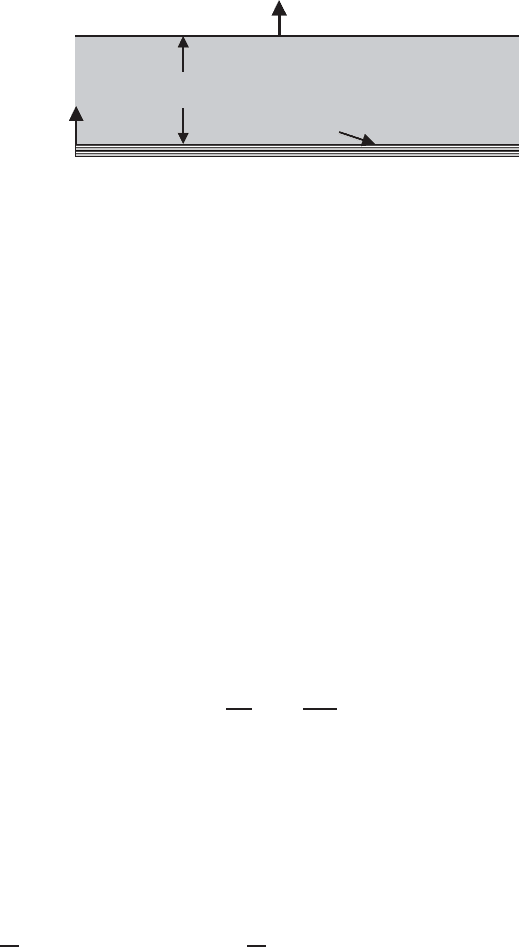
Injection of fluid at a constant velocity V
Withdrawal of fluid at a constant velocity V
T = T
1
at x = 0
T (x
1
, y)
T
1
T
0
H
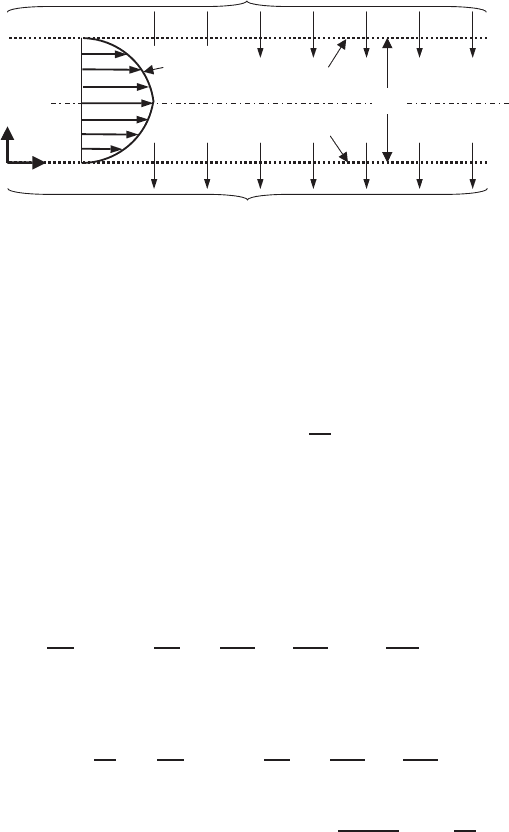
Figure 4.E.3-1 Steady-state fully developed laminar flow of a viscous Newtonian fluid
with constant physical properties between two infinitely wide permeable parallel plates
separated by a distance H ; the same fluid is injected and withdrawn at a constant velocity
V at the upper and lower plates, respectively; the fluid enters at T
1
; the upper and lower
plates are maintained at temperatures T
1
and T
0
, respectively, where T
1
>T
0
.
laminar and fully developed, the velocity profile is given by
u
x
= U
m
!
1 −
1 −
2y
H
2
"
(4.E.3-1)
where U
m
is the maximum velocity. We use scaling to explore simplifying approx-
imations that might be invoked for this heat-transfer problem.
We begin by appropriately simplifying the energy equation given by
equation (F.1-2) in the Appendices (step 1). Note that we must include axial con-
vection, transverse convection, axial conduction, transverse conduction, and viscous
dissipation.
ρC
p
u
x
∂T
∂x
− ρC
p
V
∂T
∂y
= k
∂
2
T
∂x
2
+ k
∂
2
T
∂y
2
+ μ
du
x
dy
2
(4.E.3-2)
When equation (4.E.3-1) is substituted into the above, we obtain the following set
of describing equations:
ρC
p
U
m
!
1 −
1 −
2y
H
2
"
∂T
∂x
− ρC
p
V
∂T
∂y
= k
∂
2
T
∂x
2
+ k
∂
2
T
∂y
2
+
16μU
2
m
H
2
1 −
2y
H
2
(4.E.3-3)
T = T
1
at x = 0 (4.E.3-4)
T = f(y) at x = L (4.E.3-5)
T = T
1
at y = H (4.E.3-6)
T = T
0
at y = 0 (4.E.3-7)
Equation (4.E.3-5) prescribes the downstream boundary condition in terms of the
function f(y), which might be unknown. We use
◦
(1) scaling to explore when

204 APPLICATIONS IN HEAT TRANSFER
the axial conduction, viscous heat generation, and axial convection terms can be
neglected. Introduce the following dimensionless variables involving unspecified
scale and reference factors (2, 3, and 4):
T
∗
≡
T − T
r
T
s
; x
∗
≡
x
x
s
; y
∗
≡
y
y
s
(4.E.3-8)
Substitute these dimensionless variables into the describing equations and divide
through by the coefficient of one term in each equation (steps 5 and 6):
ρC
p
U
m
y
2
s
kx
s
1 −
1 − 2
y
s
H
y
∗
2
∂T
∗
∂x
∗
−
ρC
p
Vy
s
k
∂T
∗
∂y
∗
=
y
2
s
x
2
s
∂
2
T
∗
∂x
∗2
+
∂
2
T
∗
∂y
∗2
+
16μU
2
m
y
2
s
kT
s
H
2
1 − 2
y
s
H
y
∗
2
(4.E.3-9)
T
∗
=
T
1
− T
r
T
s
at x
∗
= 0 (4.E.3-10)
T
∗
= f(y
∗
) at x
∗
=
L
x
s
(4.E.3-11)
T
∗
=
T
1
− T
r
T
s
at y
∗
=
H
y
s
(4.E.3-12)
T
∗
=
T
0
− T
r
T
s
at y
∗
= 0 (4.E.3-13)
We have divided by the coefficient of the conduction term in the y-direction since
this term must be retained to satisfy the boundary conditions at the upper and lower
plates.
We can bound the dimensionless temperature to be
◦
(1) by setting the dimen-
sionless group in equation (4.E.3-13) equal to zero, thereby determining the ref-
erence temperature, and by setting the dimensionless group in equation (4.E.3-10)
equal to 1 to determine the temperature scale (step 7). We can bound the dimen-
sionless axial and transverse coordinates to be
◦
(1) by setting the dimensionless
groups in equations (4.E.3-11) and (4.E.3-12) equal to 1. Hence, we obtain the
following scale and reference factors:
T
r
= T
0
; T
s
= T
1
− T
0
; x
s
= L; y
s
= H (4.E.3-14)
Substitution of these scale and reference factors into equations (4.E.3-9) through
(4.E.3-13) yields
Pe
t
H
L
&
1 − (1 − 2y
∗
)
2
'
∂T
∗
∂x
∗
−
ρC
p
VH
k
∂T
∗
∂y
∗
(4.E.3-15)
=
H
2
L
2
∂
2
T
∗
∂x
∗2
+
∂
2
T
∗
∂y
∗2
+
16μU
2
m
k(T
1
− T
0
)
(1 − 2y
∗
)
2

EXAMPLE PROBLEMS 205
T
∗
= 1atx
∗
= 0 (4.E.3-16)
T
∗
= f(y
∗
) at x
∗
= 1 (4.E.3-17)
T
∗
= 1aty
∗
= 1 (4.E.3-18)
T
∗
= 0aty
∗
= 0 (4.E.3-19)
where Pe
t
≡ HU
m
/α is the Peclet number for heat transfer.
The dimensionless describing equations given by equations (4.E.3-15) through
(4.E.3-19) can be simplified if any of the following conditions are satisfied
(step 8):
Pe
t
H
L
1 ⇒ axial heat convection can be ignored (4.E.3-20)
H
2
L
2
1 ⇒ axial heat conduction can be ignored (4.E.3-21)
16μU
2
m
k(T
1
− T
0
)
1 ⇒ viscous heat generation can be ignored (4.E.3-22)
Note in particular that if the condition defined by equation (4.E.3-21) is satisfied,
the elliptic thermal energy equation is reduced to a parabolic differential equation,
thereby obviating the need to satisfy any downstream boundary condition on the
temperature.
Let us now assume that the conditions defined by equations (4.E.3-20) through
(4.E.3-22) are satisfied; that is, axial heat conduction and convection as well as
viscous dissipation can be ignored. Hence, only the effects of transverse heat
conduction and convection remain in our describing equations. If the transverse
injection and withdrawal of fluid is sufficiently large, one might anticipate that
there will be a region of influence near the lower plate where essentially all the
heat transfer is occurring. We use scaling analysis to determine the thickness of this
region. In this case the transverse length scale will not be H since the dimension-
less temperature will experience a change of
◦
(1) over a much shorter distance.
Hence, we must rescale the describing equations to determine the thickness δ
t
of the
region of influence or thermal boundary layer near the lower plate. Our simplified
dimensional describing equations now are given by
−ρC
p
V
∂T
∂y
= k
∂
2
T
∂y
2
(4.E.3-23)
T = T
1
at y = H (4.E.3-24)
T = T
0
at y = 0 (4.E.3-25)
206 APPLICATIONS IN HEAT TRANSFER
If we again introduce the dimensionless variables defined by equations (4.E.3-8),
we obtain the following set of dimensionless describing equations:
−
ρC
p
Vy
s
k
∂T
∗
∂y
∗
=
∂
2
T
∗
∂y
∗2
(4.E.3-26)
T
∗
=
T
1
− T
r
T
s
at y
∗
=
H
y
s
(4.E.3-27)
T
∗
=
T
0
− T
r
T
s
at y
∗
= 0 (4.E.3-28)
Our reference and scale factors for the temperature will be the same as before.
Since the two terms in equation (4.E.3-26) must be
◦
(1) to balance each other,
the dimensionless group multiplying the first term must be equal to 1; this then
determines the transverse length scale as follows:
ρC
p
Vy
s
k
= 1 ⇒ y
s
≡ δ
t
=
k
ρC
p
V
=
α
V
(4.E.3-29)
where we have identified the transverse length scale with the thickness of the
region of influence δ
t
. We see that δ
t
decreases with increasing injection velocity
and decreasing thermal diffusivity α.
If the injection velocity is sufficiently large, δ
t
will be very small so that
H/δ
t
→∞. Hence, our scaled dimensionless describing equations reduce to
−
∂T
∗
∂y
∗
=
∂
2
T
∗
∂y
∗2
(4.E.3-30)
T
∗
= 1aty
∗
→∞ (4.E.3-31)
T
∗
= 0aty
∗
= 0 (4.E.3-32)
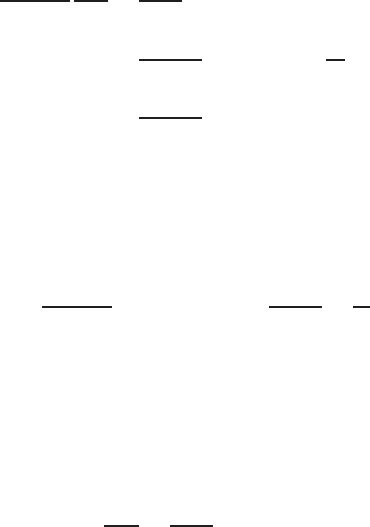
These equations admit an analytical solution given by
T
∗
= 1 − e
−y
∗
(4.E.3-33)
Note that this solution indicates that T
∗
is bounded of
◦
(1), as it should be if our
scaling analysis was carried out properly.
4.E.4 Steady-State Heat Transfer to Falling Film Flow
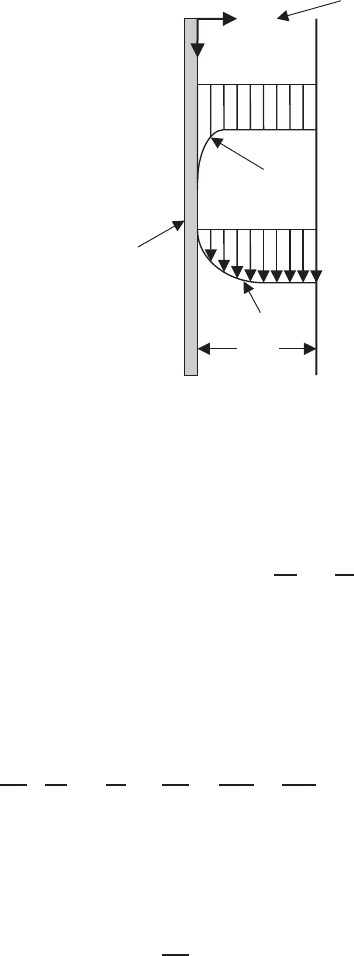
Consider the fully developed laminar flow of a Newtonian liquid film of thickness
H and constant physical properties down a solid vertical wall maintained at a
temperature T
1
, as shown in Figure 4.E.4-1. The temperature of the liquid at x = 0
is T
0
. Assume that negligible heat is transferred to the adjacent gas phase along the
length of the liquid film and that viscous heat generation can be ignored. We seek
EXAMPLE PROBLEMS 207
x
y
Liquid film
H
Inviscid gas phase
T (x, y)
T
1
u
x
(y)
T = T
0
at x = 0
Figure 4.E.4-1 Steady-state heat transfer from a vertical plate at temperature T
1
to a liquid
film in fully developed laminar flow of initial temperature T
0
, thickness H , and constant
physical properties.
to determine how the describing equations can be simplified. The velocity profile
for fully developed laminar film flow is given by
u
x
= U
m
2y
H
−
y
H
2
(4.E.4-1)
where U
m
is the maximum fluid velocity, that is, the velocity at the liquid–gas
interface.
The thermal energy equation given by the appropriately simplified form of
equation (F.1-2) in the Appendices, along with the required boundary conditions,
are given by (step 1)
U
m
α
2y
H
−
y
H
2
∂T
∂x
=
∂
2
T
∂x
2
+
∂
2
T
∂y
2
(4.E.4-2)
T = T
0
at x = 0, 0 ≤ y ≤ H (4.E.4-3)
T = f(y) at x = L, 0 ≤ y ≤ H (4.E.4-4)
T = T
1
at y = 0, 0 ≤ x ≤ L (4.E.4-5)
∂T
∂y
= 0aty = H, 0 ≤ x ≤ L (4.E.4-6)
where α = k/ρC
p
is the thermal diffusivity. Equation (4.E.4-2) is an elliptic dif-
ferential equation that requires a downstream boundary condition, which we have
indicated formally by equation (4.E.4-4); in practice, the inability to specify this

208 APPLICATIONS IN HEAT TRANSFER
downstream boundary condition precludes solving problems of this type even
numerically. Introduce the following scale and reference factors (steps 2, 3, and 4):
T
∗
≡
T − T
r
T
s
; x
∗
≡
x
x
s
; y
∗
≡
y
y
s
(4.E.4-7)
The resulting dimensionless describing equations are given by (steps 5 and 6)
ρC
p
U
m
y
3
s
kHx
s
2y
∗
−
y
s
H
y
∗2
∂T
∗
∂x
∗
=
y
2
s
x
2
s
∂
2
T
∗
∂x
∗2
+
∂
2
T
∗
∂y
∗2
(4.E.4-8)
T
∗
=
T
0
− T
r
T
s
at x
∗
= 0, 0 ≤ y
∗
≤
H
y
s
(4.E.4-9)
T
∗
=
f(y
∗
) − T
r
T
s
at x
∗
=
L
x
s
, 0 ≤ y
∗
≤
H
y
s
(4.E.4-10)
T
∗
=
T
1
− T
r
T
s
at y
∗
= 0, 0 ≤ x
∗
≤
L
x
s
(4.E.4-11)
∂T
∗
∂y
∗
= 0aty
∗
=
H
y
s
, 0 ≤ x
∗
≤
L
x
s
(4.E.4-12)
The dimensionless temperature can be bounded to be
◦
(1) by setting the
dimensionless groups in equations (4.E.4-9) and (4.E.4-11) equal to zero and 1,
respectively, to obtain T = T
0
and T
s
= T
1
− T
0
(step 7). The streamwise spatial
coordinate can be bounded to be
◦
(1) by setting the appropriate group appear-
ing in equations (4.E.4-10) through (4.E.4-12) to obtain x
s
= L.Therearetwo
choices for bounding the cross-stream spatial coordinate to be
◦
(1): by setting
the appropriate group in any one of equations (4.E.4-9), (4.E.4-10), and (4.E.4-12)
equal to 1, or by setting the dimensionless group multiplying the convection term
in equation (4.E.4-8) equal to 1. However, the convection term has to balance the
principal conduction term in equation (4.E.4-8); this yields the following equation
for y
s
:
ρC
p
U
m
y
3
s
kHx
s
=
ρC
p
U
m
y
3
s
kHL
⇒
y
s
H
≡
δ
t
H
=
kL
ρC
p
U
m
H
2
1/3
=
1
Pe
t
L
H
1/3
(4.E.4-13)
We see that y
s
= δ
t
is a region of influence near the hot wall whose thickness
increases slowly with axial length and is inversely proportional to the thermal
Peclet number, Pe
t
≡ U
m
H/α. Sufficiently far downstream, δ
t
will become equal
to the film thickness H .
For large Peclet numbers the ratio δ
t
/H will be quite small. This permits signifi-
cant simplification of the describing equations (step 8). In particular, the aspect ratio
δ
2
t
/L
2
will be quite small, which permits ignoring the axial conduction term, thereby
avoiding the complication of having to specify a downstream boundary condition.
In addition, for sufficiently large Peclet numbers, the quadratic term in the equation
EXAMPLE PROBLEMS 209
for the velocity profile can be ignored since it is only the velocity in the vicinity
of the solid wall that is important for a thin region of influence. Finally, since
H/δ
t
1 for large Peclet numbers, the boundary condition by equation (4.E.4-
12) can be applied at y
∗
→∞. The resulting simplified dimensionless describing
equations are given by
2y
∗
∂T
∗
∂x
∗
=
∂
2
T
∗
∂y
∗2
(4.E.4-14)
T
∗
= 0atx
∗
= 0, 0 ≤ y
∗
≤∞ (4.E.4-15)
T
∗
= 1aty
∗
= 0, 0 ≤ x
∗
≤ 1 (4.E.4-16)
∂T
∗
∂y
∗
= 0 ⇒ T
∗
= 0asy
∗
→∞, 0 ≤ x
∗
≤ 1 (4.E.4-17)
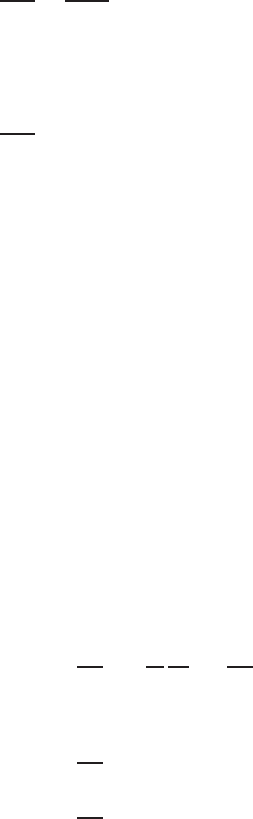
This system of equations admits a solution via a similarity solution or combination
of variables, as is shown in standard references.
15
4.E.5 Unsteady-State Heat Transfer from a Sphere at Large Biot Numbers
In Section 4.4 we considered heat transfer from a solid sphere initially at temper-
ature T
0
of radius R falling at its terminal velocity through a liquid at temperature
T
∞
for which the convective heat transfer was characterized via a heat-transfer
coefficient, as shown in Figure 4.4-1. We considered a scaling appropriate to a
small Biot number for which all the resistance to heat transfer was in the exter-
nal liquid. This implied that the temperature gradient in the sphere was negligible
and the temperature was spatially uniform. Here we apply scaling analysis to the
complementary case of a large Biot number corresponding to rapid heat transfer in
the external liquid. To have continuity of heat flux at the surface of the sphere, the
temperature gradient in the sphere will occur over a region of influence or thermal
boundary layer whose thickness δ
t
is the appropriate radial length scale.
The dimensional describing equations will be the same as those in Section 4.4
(step 1):
∂T
∂t
= α
1
r
2
∂
∂r
r
2
∂T
∂r
(4.E.5-1)
T = T
0
at t ≤ 0, 0 ≤ r ≤ R (4.E.5-2)
∂T
∂r
= 0atr = 0,t>0 (4.E.5-3)
k
∂T
∂r
= h(T
∞
− T) at r = R, t > 0 (4.E.5-4)
15
R. B. Bird, W. E. Stewart, and E. L. Lightfoot, Transport Phenomena, Wiley, New York, 1960,
pp. 349–350.

210 APPLICATIONS IN HEAT TRANSFER
It is convenient to reference the coordinate system to the surface of the sphere
where the thermal boundary layer is located. Hence, we define the following dimen-
sionless variables (steps 2, 3, and 4):
T
∗
≡
T − T
r
T
s
; r
∗
≡
R − r
δ
t
; t
∗
≡
t
t
s
(4.E.5-5)
Introduce these dimensionless variables into the describing equations and divide
through by the coefficient of one term in each equation that should be retained
(steps 5 and 6):
δ
2
t
αt
s
∂T
∗
∂t
∗
=
1
&
R/δ
t
− r
∗
'
2
∂
∂r
∗
!
R
δ
t
− r
∗
2
∂T
∗
∂r
∗
"
(4.E.5-6)
T
∗
=
T
0
− T
r
T
s
at t
∗
≤ 0, 0 ≤ r
∗
≤
R
δ
t
(4.E.5-7)
∂T
∗
∂r
∗
= 0atr
∗
=
R
δ
t
,t
∗
> 0 (4.E.5-8)
∂T
∗
∂r
∗
=−
hδ
t
k
T
∞
− T
r
T
s
− T
∗
at r
∗
= 0,t
∗
> 0 (4.E.5-9)
When set equal to zero and 1, respectively, the dimensionless groups in equa-
tions (4.E.5-7) and (4.E.5-9), indicate that T
r
= T
0
and T
s
= T
∞
− T
0
(step 7).
Since this is inherently unsteady state, the appropriate time scale is the observation
time t
o
. The fact that the unsteady-state and radial heat conduction terms in equa-
tion (4.E.5-6) must be of the same order provides an estimate for δ
t
:
δ
2
t
αt
s
= 1 ⇒ δ
t
=
√
αt
o
= R
Fo
t
(4.E.5-10)
where Fo
t
≡ αt
o
/R
2
is the thermal Fourier number. Note that the thermal boundary
layer penetrates progressively farther into the sphere in time. Eventually, it will
penetrate to the center of the sphere when Fo
t
∼
=
1, corresponding to an observation
time t
o
∼
=
R
2
/α.
When these scale and reference factors are substituted into equations (4.E.5-6)
through (4.E.5-9), we obtain the following dimensionless describing equations:
∂T
∗
∂t
∗
=
1
1
√
Fo
t
− r
∗
2
∂
∂r
∗
!
1
√
Fo
t
− r
∗
2
∂T
∗
∂r
∗
"
(4.E.5-11)
T
∗
= 0att
∗
≤ 0, 0 ≤ r
∗
≤
1
√
Fo
t
(4.E.5-12)

EXAMPLE PROBLEMS 211
∂T
∗
∂r
∗
= 0atr
∗
=
1
√
Fo
t
,t
∗
> 0 (4.E.5-13)
∂T
∗
∂r
∗
=−Bi
t
Fo
t
(1 − T
∗
) at r
∗
= 0,t
∗
> 0 (4.E.5-14)
where Bi
t
≡ hR/k is the thermal Biot number.
Now let us consider how this system of describing equations can be simplified
(step 8). We note that the curvature effects can be ignored when
√
Fo
t
1, cor-
responding to short contact times for which the thermal boundary layer will be
thin in comparison to the radius of the sphere. If
√
Fo
t
1, the boundary con-
dition given by equation (4.E.5-13) can be applied at infinity. A zero conductive
heat flux far from the surface of the sphere implies no change in the temperature
outside the thermal boundary layer. Hence, equation (4.E.5-13) can be replaced
by the condition that T
∗
= 0asr
∗
→∞. Equation (4.E.5-14) indicates that as
Bi
t
→∞,T
∗
→ 1 to ensure that ∂T
∗
/∂r
∗
remains bounded of
◦
(1). This implies
that the surface temperature of the sphere is at T
∞
and that there is essentially no
temperature gradient in the liquid. Hence, for
√
Fo
t
1 and large Biot numbers,
the describing equations simplify to
∂T
∗
∂t
∗
=
∂
2
T
∗
∂r
∗2
(4.E.5-15)
T
∗
= 0att
∗
≤ 0, 0 ≤ r
∗
< ∞ (4.E.5-16)
T
∗
= 0atr
∗
→∞,t
∗
> 0 (4.E.5-17)
T
∗
= 1atr
∗
= 0,t
∗
> 0 (4.E.5-18)
This simplified set of describing equations can be solved via standard methods such
as combination of variables.
4.E.6 Evaporative Cooling of a Liquid Film
An infinitely wide film of an incompressible volatile pure (i.e., single compo-
nent) liquid has an initial thickness of L
0
and is resting on a solid boundary that
is maintained at a constant temperature T
0
. Initially, the entire liquid film is at
this temperature. At time t = 0, evaporation from the film begins that causes the
film thickness to decrease, thus implying that this is a moving boundary prob-
lem. The surrounding gas phase is assumed to transfer negligible heat to the
liquid film. Hence, the latent heat of vaporization (evaporation) must be supplied
entirely by heat conduction from the liquid film. This, of course, causes heat trans-
fer within the liquid film. The evaporative mass flux at the free surface n
G
is
given by
n
G
= k
•
G
p
◦
L
(units of mass/area · time) (4.E.6-1)
212 APPLICATIONS IN HEAT TRANSFER
x
Volatile liquid
Gas
n
G
= k
G
•
p°
L
L(t)
T = T
0
Figure 4.E.6-1 Evaporative cooling of an infinitely wide planar film of an incompressible
volatile liquid of vapor pressure p
◦
L
and initial temperature T
0
, into an adjacent insoluble gas
phase whose mass-transfer coefficient is k
•
G
; the gas phase is assumed to transfer negligible
heat to the liquid.
in which k
•
G
is the constant mass-transfer coefficient in the ambient gas phase and
p
◦
L
is the temperature-dependent vapor pressure of the liquid at the instantaneous
temperature of the liquid–gas interface. Note that equation (4.E.6-1) assumes that
the bulk of the ambient gas phase does not contain any of the evaporating com-
ponent. For moderate departures of the temperature from T
0
, the temperature
dependence of the vapor pressure can be approximated by
p
◦
L
= p
◦
L0
+ β(T − T
0
) (4.E.6-2)
where p
◦
L0
is the vapor pressure at T
0
and β is a constant. We seek to develop a
model for this evaporative cooling, film-thinning process, whose essential features
are shown in Figure 4.E.6-1. In particular, we explore conditions for which the
describing equations can be simplified.
The appropriately simplified form of equation (F.1-2) in the Appendices along
with the initial condition and boundary condition at x = 0 are given by (step 1)
ρ
L
C
pL
∂T
∂t
= k
L
∂
2
T
∂x
2
(4.E.6-3)
T = T
0
at t = 0 (4.E.6-4)
T = T
0
at x = 0 (4.E.6-5)
where k
L
,ρ
L
,andC
pL
are the thermal conductivity, density, and heat capacity of
the liquid, respectively. The boundary condition at the moving upper interface is
obtained from an integral energy balance as follows:
d
dt
L
0
ρ
L
C
pL
(T − T
◦
)dx +
d
dt
∞
L
ρ
G
C
pG
(T − T
◦
)dx = q
0
(4.E.6-6)
where T
◦
is an arbitrary reference temperature for the enthalpy or heat content
and q
0
is the heat transferred into the liquid film at x = 0. Applying Leibnitz’s