
Krantz W.B. Scaling Analysis in Modeling Transport and Reaction Processes: A Systematic Approach to Model Building and the Art of Approximation
Подождите немного. Документ загружается.


THERMALLY DRIVEN FREE CONVECTION: BOUSSINESQ APPROXIMATION 183
When the reference and scale factors defined by equations (4.8-14), (4.8-15),
and (4.8-16) are substituted into our dimensionless describing equations, we
obtain
0 = 1 +
d
dy
∗
!
1 −
B
T
2
0
H
4
kμ
0
P
L
2
T
∗
"
du
∗
x
dy
∗
#
(4.8-17)
0 =
d
2
T
∗
dy
∗2
+
!
1 −
B
T
2
0
H
4
kμ
0
P
L
2
T
∗
"
du
∗
x
dy
∗
2
(4.8-18)
du
∗
x
dy
∗
= 0,
dT
∗
dy
∗
= 0aty
∗
= 0 (4.8-19)
u
∗
x
= 0,T
∗
= 0aty
∗
=±1 (4.8-20)
We see that the criterion for ignoring the temperature dependence of the viscosity
is given by (step 8)
B
T
2
0
H
4
kμ
0
P
L
2
1 (4.8-21)
If the criterion given by equation (4.8-21) is satisfied, equations (4.8-17) through
(4.8-20) reduce to exactly the same equations that were considered in Section 4.5;
that is, equations (4.5-22) through (4.5-24) for which the solution for the velocity
profile is given by equation (4.5-1) and for which the temperature profile is given
by equation (4.5-25).
4.9 THERMALLY DRIVEN FREE CONVECTION: BOUSSINESQ
APPROXIMATION
Thus far we have considered problems that have involved either pure conduc-
tion or heat transfer with forced convection, that is, flow that is caused by some
external driving force, such as a pump, fan, moving boundary, gravitational field,
or other body force. Here we consider an example of thermal free convection,
convection caused internal to the system, owing to a temperature gradient that cre-
ates unstable density variations. Note that unstable density variations can also be
caused by concentration gradients, in which case it is referred to as solutal free
convection. Free convection can also arise due to surface-tension gradients at an
interface.
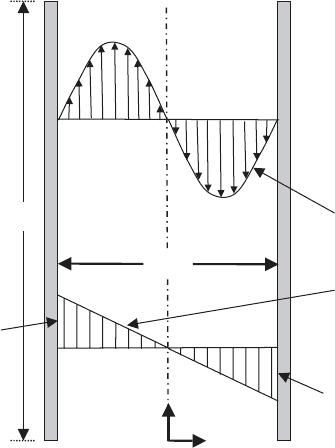
Consider a fluid with density ρ and viscosity μ that is confined between two
vertical parallel plates of vertical height L separated by a distance 2H , as shown
in Figure 4.9-1. We assume that the space between the plates is capped at the
top and the bottom but that L H . The vertical plate at y =−H is main-
tained at a constant temperature T
1
, whereas the vertical plate at y =+H is
maintained at a constant temperature T
2
,whereT
1
>T
2
. Because the density of
184 APPLICATIONS IN HEAT TRANSFER
x
y
T
1
T
2
Temperatur
e
profile
Velocity
profile
2H
L
Figure 4.9-1 Steady-state fully developed buoyancy-induced free convection of a fluid
confined between two vertical plates maintained at temperatures T
1
and T
2
,whereT
1
>T
2
,
showing representative temperature and velocity profiles.
a fluid decreases with increasing temperature, there will be a tendency for the
fluid near the hot wall to flow upward and for the fluid near the cold wall to
flow downward. As long as the plates are not too close together or the fluid is
not too viscous, a steady-state free-convection flow can be generated for which
the mass flow upward is equal to the mass flow downward.
14
We use scaling
analysis to determine the conditions that permit the equations describing free-
convection heat transfer to be simplified. We ignore end effects at the top and
bottom of the vertical parallel plates as well as heat generation due to viscous
dissipation.
Appropriate simplification of the equations of motion given by equations (D.1-
10) and (D.1-11) and the thermal energy equation given by equation (F.1-2) in
14
To determine if free-convection flow will be generated, it is necessary to carry out a stability analysis;
the latter leads to the conditions required for free convection to be initiated expressed in terms of
a critical value of the thermal Grashof number, Gr
t
≡ H
3
gβ
t
ρ /ν
2
, or thermal Rayleigh number,
Ra
t
≡ Gr
t
· Pr, where ρ in the present case is the difference in density between the fluid at the cold
and hot plates; note that if the plates are too closely spaced or if the viscosity is sufficiently high, the
Grashof number can be below the critical value for the inception of free convection; the reader interested
in more information on stability theory applied to free convection is referred to standard references such
as P. G. Drazin and W. H. Reid, Hydrodynamic Stability, Cambridge University Press, Cambridge,
England, 1981, or J. S. Turner, Buoyancy Effects in Fluids, Cambridge University Press, Cambridge,
England, 1973.

THERMALLY DRIVEN FREE CONVECTION: BOUSSINESQ APPROXIMATION 185
the Appendices and specification of the required boundary conditions yield the
following set of describing equations (step 1):
0 =−
∂P
∂x
+ μ
d
2
u
x
dy
2
− ρg (4.9-1)
0 =−
∂P
∂y
(4.9-2)
0 =
d
2
T
dy
2
(4.9-3)
u
x
= 0,T= T
1
at y =−H (4.9-4)
u
x
= 0,T= T
2
at y = H (4.9-5)
Note that axial derivatives of both velocity and temperature are assumed to be zero
under the assumptions of fully developed flow and no end effects. Since the density
is temperature dependent, we need an appropriate equation of state. Here we con-
sider small density variations and hence represent the density via a Taylor series
expansion about the density
ρ at the average temperature between the two plates,
T ≡ (T
1
+ T
2
)/2, given by
ρ = ρ|
T
+
∂ρ
∂T
T
(T − T)+
1
2
∂
2
ρ
∂T
2
T
(T − T)
2
+··· (4.9-6)
ρ =
ρ −ρβ
t
(T − T)+ ργ
t
(T − T)
2
+··· (4.9-7)
where β
t
is the coefficient of volume expansion and γ
t
is a positive constant. When
equation (4.9-7) is substituted into equation (4.9-1) and truncated at the third term
in the expansion, we obtain
0 =−
∂P
∂x
+ μ
d
2
u
x
dy
2
− ρg + ρgβ
t
(T − T)− ρgγ
t
(T − T)
2
(4.9-8)
Equation (4.9-3) can be integrated directly subject to the boundary conditions given
by equations (4.9-4) and (4.9-5) to obtain the following temperature profile:
T =
T
1
+ T
2
2
−
T
1
− T
2
2
y
H
=
T −
T
2
y
H
(4.9-9)
Moreover, equation (4.9-2) in combination with equation (4.9-1) implies that
∂P/∂x = dP/dx = a constant. Hence, we can evaluate dP/dx at any lateral
position between the two vertical plates. It is convenient to evaluate the pres-
sure gradient at the centerline between the two plates where T =
T ; therefore,
dP/dx =−
ρg. With this simplification, equation (4.9-8) takes the form
0 = μ
d
2
u
x
dy
2
+ ρgβ
t
(T − T)− ρgγ
t
(T − T)
2
(4.9-10)

186 APPLICATIONS IN HEAT TRANSFER
Introduce the following scale and reference factors (steps 2, 3, and 4):
u
∗
x
≡
u
x
u
s
; T
∗
≡
T − T
r
T
s
; y
∗
≡
y
y
s
(4.9-11)
Substitute these dimensionless variables into the describing equations and divide
each equation through by the dimensional coefficient of one term that should be
retained to maintain physical significance (steps 5 and 6):
0=
d
2
u
∗
x
dy
∗2
+
ρgβ
t
y
2
s
T
s
μu
s
$
T
∗
+
T
r
− T
T
s
%
−
ρgγ
t
y
2
s
T
2
s
μu
s
$
T
∗
+
T
r
− T
T
s
%
2
(4.9-12)
0 =
d
2
T
∗
dy
∗2
(4.9-13)
u
∗
x
= 0,T
∗
=
T
1
− T
r
T
s
at y
∗
=−
H
y
s
(4.9-14)
u
∗
x
= 0,T
∗
=
T
2
− T
r
T
s
at y
∗
=
H
y
s
(4.9-15)
The dimensionless groups in equations (4.9-14) and (4.9-15) when set equal to
1 and zero, respectively, provide the following reference and scale factors (step 7):
T
2
− T
r
T
s
= 0 ⇒ T
r
= T
2
,
T
1
− T
r
T
s
=
T
1
− T
2
T
s
= 1 ⇒ T
s
= T
1
− T
2
(4.9-16)
In addition, the dimensionless groups in these equations provide the characteristic
length scale
H
y
s
= 1 ⇒ y
s
= H (4.9-17)
Since what causes this flow (i.e., the leading-order gravitational body force term)
must balance the viscous resisting force, the corresponding dimensionless group
that provides a measure of this ratio in equation (4.9-12) must be equal to 1, which
provides the characteristic scale for the velocity:
ρgβ
t
y
2
s
T
s
μu
s
= 1 ⇒ u
s
=
ρgβ
t
y
2
s
T
s
μ
=
ρgβ
t
H
2
(T
1
− T
2
)
μ
(4.9-18)
If the reference and scale factors defined by equations (4.9-16) through (4.9-18)
are substituted into our dimensionless describing equations, we obtain
0 =
d
2
u
∗
x
dy
∗2
+
T
∗
−
1
2
−
γ
t
(T
1
− T
2
)
β
t
T
∗
−
1
2
2
(4.9-19)
0 =
d
2
T
∗
dy
∗2
(4.9-20)

DIMENSIONAL ANALYSIS CORRELATION FOR COOKING A TURKEY 187
u
∗
x
= 0,T
∗
= 1aty
∗
=−1 (4.9-21)
u
∗
x
= 0,T
∗
= 0aty
∗
= 1 (4.9-22)
We see that the criterion for ignoring the higher-order temperature dependence of
the density is given by (step 8)
γ
t
(T
1
− T
2
)
β
t
1 (4.9-23)
This simplification, which considers only the leading-order effects of the tempera-
ture on the density, is referred to as the Boussinesq approximation.
4.10 DIMENSIONAL ANALYSIS CORRELATION FOR COOKING
A TURKEY
In dimensional analysis we seek to determine the dimensionless groups required
to correlate data or to scale a process up or down. These dimensionless groups
can always be determined using
◦
(1) scaling analysis since this procedure leads
to the minimum parametric representation for a set of describing equations. How-
ever, the preceding sections indicated that carrying out an
◦
(1) scaling analysis
can be somewhat complicated and time consuming. In contrast, the scaling analy-
sis approach to dimensional analysis illustrated in this section is much easier and
quicker to implement. Note, however, that it does not provide as much information
as does
◦
(1) scaling analysis for achieving the minimum parametric representation.
In particular, it does not lead to groups whose magnitude can be used to assess the
relative importance of particular terms in the describing equations. It also does not
identify regions of influence or boundary layers whose identification can in some
cases reduce the number of dimensionless groups. This first example of the use
of scaling for dimensional analysis in heat-transfer applications will provide more
details on the steps involved. We will also compare the results of scaling analysis
to the results obtained from using the Pi theorem, to underscore the advantages
of using the former to achieve the minimum parametric representation. The steps
referred to here are those outlined in Section 2.4 for the scaling approach to dimen-
sional analysis; these differ from those used in Sections 4.2 through 4.9, since no
attempt is made to achieve
◦
(1) scaling.
This first example of the use of scaling analysis for dimensional analysis in heat
transfer will consider developing a correlation for determining the cooking time
of a turkey. In particular, we seek to determine how long it will take to cook the
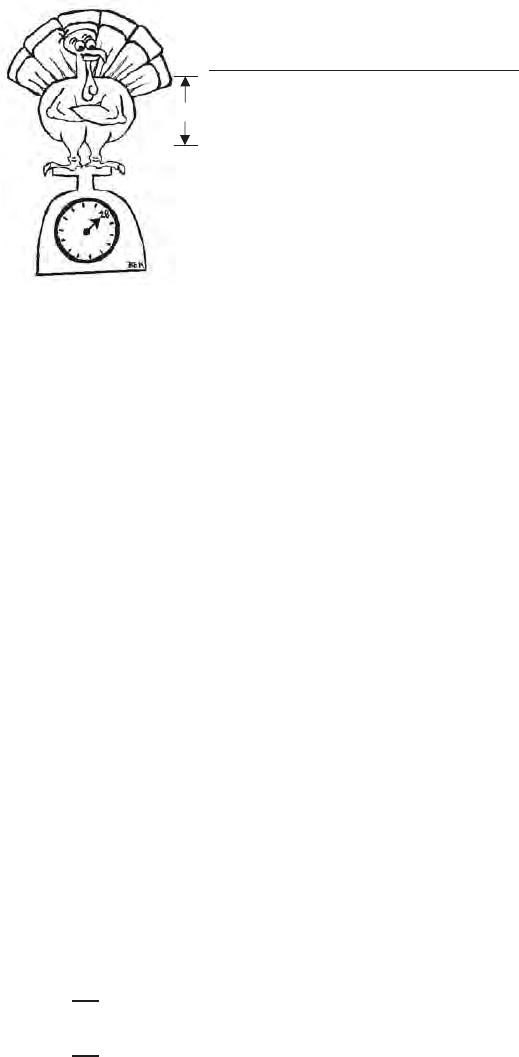
28-lb (12.7-kg) turkey shown in Figure 4.10-1. Cookbooks do not provide equations
to determine the cooking time. Rather, they usually provide discrete data for the
required cooking time t
c
as a function of the mass of the turkey M, such as shown
in the table that accompanies Figure 4.10-1. A problem arises in that this table does
not indicate in any precise way how much time is required to cook a 28-lb turkey.
A crude way to estimate this time might be to do some type of extrapolation from
188 APPLICATIONS IN HEAT TRANSFER
Ready to cook weight
M (lb)
5 to 8
8 to 12
12 to 16
16 to 20
20 to 24
Total cooking tim
e
t
c
(hr)
3 to 3½
3½ to 4½
4½ to 5½
5½ to 6½
6½ to 7
L
Figure 4.10-1 Schematic of a very large turkey of a characteristic length L along with
cookbook data for the cooking time t
c
as a function of the mass of the turkey M.(Data
from General Mills, Betty Crocker’s Cookbook, Golden Press, New York, 1972.)
the data given in this table. However, a better way is to use these data and scaling
analysis to determine the underlying correlation between the weight of the turkey
and the cooking time.
The time it takes to fully cook the turkey is that required to bring the center of the
bird from its initial temperature T
0
up to the temperature T
1
specified by the cook-
book (typically, 165
◦
For73.9
◦
C) by placing it in a preheated oven maintained at a
temperature T
2
(typically 325
◦
F or 163
◦
C). It is reasonable to assume that the heat
transfer is controlled by conduction in the turkey. To determine the time required
to reach this temperature, in principle we would have to solve the unsteady-state
heat-conduction equation. This is complicated by the fact that the center of the
turkey is usually filled with dressing that has physical properties that differ from
those of the turkey itself. A further complication is that appropriate boundary con-
ditions need to be specified on the surface of the turkey and at the interface between
the turkey and the dressing along with appropriate conditions at the center of the
stuffed turkey. Indeed, this would be a complicated problem to solve numerically!
However, we will see that with the aid of the data given in the cookbook, we can
determine the cooking time without having to solve the describing equations.
We begin by writing the equations we would solve for the cooking time, if indeed
we could solve these equations (step 1 in the scaling procedure for dimensional
analysis); namely, the unsteady-state heat-conduction equations in both the turkey
proper and in the dressing in its interior, which are given in generalized vector
notation by equation (B.4-2) in the Appendices:
∂T
∂t
= α
T
∇
2
T (applicable in the turkey) (4.10-1)
∂T
∂t
= α
D
∇
2
T (applicable in the dressing) (4.10-2)

DIMENSIONAL ANALYSIS CORRELATION FOR COOKING A TURKEY 189
where ∇
2
denotes the Laplacian operator and α
T
≡ k
T
/ρ
T
C
PT
and α
D
≡ k
D
/
ρ
D
C
PD
are the thermal diffusivities of the turkey and dressing, respectively, in
which k
i
,ρ
i
,andC
Pi
are the thermal conductivity, density, and heat capacity of
medium i, respectively. Note that we have chosen to write the thermal energy
equation in generalized notation that is not specific to any particular coordinate
system; this is convenient to do in dimensional analysis since there is no need to
scale specific spatial derivatives to be
◦
(1). The initial and boundary conditions
are given by
T = T
0
at t = 0 (4.10-3)
T = T
2
at the surface of the turkey (4.10-4)
T |
+
= T |
−
at the interface between the turkey and dressing (4.10-5)
k
T
∇T |
+
= k
D
∇T |
−
at the interface between the turkey and dressing
(4.10-6)
n ·∇T = 0 along the plane of symmetry in the turkey (4.10-7)
where + and − denote the turkey and dressing side of the interface, respectively,
and n is a unit vector normal to the plane of symmetry in the turkey.
To solve equations (4.10-1) through (4.10-7), we would need to describe math-
ematically the surface of the turkey and its interface with the dressing; this would
be prohibitively difficult to do in practice. However, in dimensional analysis this
challenging task can be avoided by recognizing that it is reasonable to assume
that all turkeys are geometrically similar. By this we mean that although their
mass might differ, their geometry is more or less the same. Assume that it takes
p geometric parameters to characterize the shape of a turkey. Recall that one can
form p − 1 dimensionless ratios from p quantities having one dimension (length in
this case). For geometrically similar turkeys, these p − 1 dimensionless geometric
ratios will be the same. Hence, one needs to include in the dimensional analysis
only one geometric quantity such as some characteristic body dimension along with
the quantities that characterize the heat transfer. This arbitrary characteristic length
is chosen to be the maximum body width L as shown in Figure 4.10-1.
Steps 2 and 3 in the scaling procedure for dimensional analysis involve defining
arbitrary scale factors for all the dependent and independent variables and reference
factors for those not naturally referenced to zero. Hence, we introduce the following
dimensionless variables:
T
∗
≡
T − T
r
T
s
;∇
∗
≡ L∇; ∇
2∗
≡ L
2
∇
2
; t
∗
≡
t
t
s
(4.10-8)
Note that we have chosen L for our length scale since we arbitrarily chose it to form
the p − 1 geometric ratios that define the surface of the turkey and its interface
with the dressing.
Steps 4 and 5 involve introducing these dimensionless variables into the describ-
ing equations and dividing through by the dimensional coefficient of one term in

190 APPLICATIONS IN HEAT TRANSFER
each equation. In dimensional analysis it makes no difference which term you
choose. These steps yield the following dimensionless describing equations:
∂T
∗
∂t
∗
=
α
T
t
s
L
2
∇
∗2
T
∗
(applicable in the turkey) (4.10-9)
∂T
∗
∂t
∗
=
α
D
t
s
L
2
∇
∗2
T
∗
(applicable in the dressing) (4.10-10)
T
∗
=
T
0
− T
r
T
s
at t
∗
= 0 (4.10-11)
T
∗
=
T
2
− T
r
T
s
at the surface of the turkey (4.10-12)
T
∗
|
+
= T
∗
|
−
at the interface between the turkey and dressing (4.10-13)
∇
∗
T
∗
|
+
=
k
D
k
T
∇
∗
T
∗
|
−
at the interface between the turkey and dressing
(4.10-14)
n ·∇
∗
T
∗
= 0 along the plane of symmetry in the turkey (4.10-15)
Step 6 involves setting the various groups equal to 1 or zero to determine the
scale and reference factors, respectively. It makes no difference in dimensional anal-
ysis which groups we set equal to 1 since there is no attempt to achieve
◦
(1) scaling.
We need to do the latter only if we are seeking to simplify the equations by dropping
one or more of the terms. In dimensional analysis we are seeking to determine the
minimum parametric representation. Let us set equation (4.10-11) equal to zero
to determine the reference temperature and set equation (4.10-12) equal to 1 to
determine the temperature scale. Finally, let us set the dimensionless group in
equation (4.10-9) equal to 1 to obtain the time scale; we could equally well have
set the dimensionless group in equation (4.10-10) equal to 1 to determine this time
scale. These choices then yield the following minimum parametric representation of
the describing equations; that is, in terms of the minimum number of dimensionless
groups:
∂T
∗
∂t
∗
=∇
∗2
T
∗
(applicable in the turkey) (4.10-16)
∂T
∗
∂t
∗
=
α
D
α
T
∇
∗2
T
∗
(applicable in the dressing) (4.10-17)
T
∗
= 0att
∗
= 0 (4.10-18)
T
∗
= 1 at the surface of the turkey (4.10-19)
T
∗
|
+
= T
∗
|
−
at the interface between the turkey and dressing (4.10-20)
∇
∗
T
∗
|
+
=
k
D
k
T
∇
∗
T
∗
|
−
at the interface between the turkey and dressing
(4.10-21)

DIMENSIONAL ANALYSIS CORRELATION FOR COOKING A TURKEY 191
n ·∇
∗
T
∗
= 0 along the plane of symmetry in the turkey (4.10-22)
The solution to equations (4.10-16) through (4.10-22) for the dimensionless tem-
perature as a function of the dimensionless time then will be of the form
T
∗
= f
1
x
∗
,y
∗
,z
∗
,t
∗
,
α
D
α
T
,
k
D
k
T
(4.10-23)
However, we seek the particular value of the dimensionless time t
∗
c
at which the
center of the turkey reaches the temperature T
1
. The center of the turkey is located
at some specific values of the dimensionless coordinates x
∗
, y
∗
,andz
∗
. Hence, our
correlation for the dimensionless cooking time is given by
T
∗
1
=
T
1
− T
0
T
2
− T
0
= f
2
t
∗
c
,
α
D
α
T
,
k
D
k
T
(4.10-24)
An equivalent statement is
t
∗
c
=
α
T
t
c
L
2
= f
3
T
1
− T
0
T
2
− T
0
,
α
D
α
T
,
k
D
k
T
(4.10-25)
Hence, for specified cooking conditions and geometrically similar turkeys and
dressing with specified physical and transport properties, we conclude that t
c
∝ L
2
.
It is reasonable to assume for geometrically similar turkeys that the characteristic
length L will be proportional to the mass of the turkey; that is,
L = AM
B
(4.10-26)
When equation (4.10-26) is substituted into equation (4.10-25), we obtain the fol-
lowing equation that can be used to correlate the data given in Table 4.10-1 for the
cooking time as a function of turkey weight:
t
c
=
L
2
α
T
f
T
1
− T
0
T
2
− T
0
,
α
D
α
T
,
k
D
k
T
= A
M
2B
α
T
f
T
1
− T
0
T
2
− T
0
,
α
D
α
T
,
k
D
k
T
= A
M
B
(4.10-27)
where A
and B
are empirical constants that will be determined by fitting the
cooking-time data given in the cookbook as a function of the mass of the turkey.
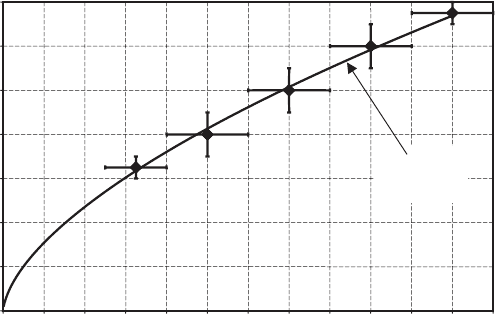
Figure 4.10-2 shows a plot of the cooking time t
c
as a function of the mass M
of the turkey. The data points represent average values of the cooking time and
turkey mass for each table entry in Figure 4.10-1; the corresponding error bars
then represent the maximum deviation of the values in Figure 4.10-1 about these
average values for each of the five data points. The trend line in Figure 4.10-2 fits
the data with a regression coefficient R
2
= 0.994 and is given by the equation
t
c
= M
0.61
(4.10-28)
192 APPLICATIONS IN HEAT TRANSFER
0
1
2
3
4
5
6
7
0 2 4 6 8 1012141618202224
Turkey mass, M (lb)
Cooking time, t
c
(hrs)
t
c
= M
0.61
R
2
= 0.994
Figure 4.10-2 Cooking time in hours as a function of turkey mass in pounds. The solid
line shows the correlation suggested by using the scaling approach to dimensional analysis.
(Data from General Mills, Betty Crocker’s Cookbook, Golden Press, New York, 1972.)
Note that if the turkey body were perfectly spherical with a diameter L, the exponent
in equation (4.10-28) would be 0.67. Equation (4.10-28) now permits determining
the time required to cook a 28-lb turkey, which is found to be 7.6 hours.
Equation (4.10-25) indicates that the cooking time can be correlated in terms
of four dimensionless groups and p − 1 geometric ratios required to specify the
shape of a turkey. It is of interest to explore the possible consequences of using
the Pi theorem to develop a correlation for the cooking time. The Pi theorem
approach would require first somehow identifying the quantities that enter into the
correlation; these would include t
c
,α
T
,α
D
,k
T
,k
D
,L,T
0
,T
2
,andT
1
. Note that the
quantity L can be expressed in terms of the mass M of the turkey via a relation of
the form of equation (4.10-26). These nine quantities are expressed in terms of four
units: length, time, energy, and temperature (note that energy is a fundamental unit
in the system of thermodynamics when no exchange is involved between internal
and mechanical energy). Hence, we might conclude that five dimensionless groups
are required to correlate the cooking time (i.e., n − m = 9 −4 = 5) in addition
to p − 1 geometric aspect ratios when, in fact, our scaling analysis indicated that
only four dimensional groups are needed in addition to the p − 1 aspect ratios. A
more enlightened use of the Pi theorem cleverly might recognize that the quantities
T
0
,T
2
,andT
1
can be combined into the single variable (T
1
− T
0
)/(T
2
− T
0
),which
then leads to the conclusion that only three dimensionless groups (n − m = 7 −4 =
3) plus the p − 1 geometric aspect ratios are required. However, this conclusion
drawn from the Pi theorem is error since our scaling analysis indicates that the
minimum parametric representation involves four dimensionless groups. This error
arises owing to a breakdown of the Pi theorem associated with the quantities