
Krantz W.B. Scaling Analysis in Modeling Transport and Reaction Processes: A Systematic Approach to Model Building and the Art of Approximation
Подождите немного. Документ загружается.

SUMMARY 193
α
T
,α
D
,k
T
,andk
D
; the Pi theorem would indicate zero groups for these four
quantities (i.e., n − m = 4 −4 = 0) when in fact they lead to two dimensionless
groups. This example clearly indicates the pitfalls of using the Pi theorem for
dimensional analysis. Scaling analysis provides a systematic method for avoiding
these problems associated with the Pi theorem.
4.11 SUMMARY
The example in Section 4.2 provided an introduction to the step-by-step procedure
for scaling analysis in heat transfer. Scaling was used in this problem to assess the
criterion for ignoring edge effects so that the heat transfer could be considered to
be one-dimensional when predicting the temperature sufficiently far removed from
the sidewalls or integral quantities such as the total heat-transfer rate. This problem
involved the introduction of both reference and scale factors since the temperature
was not naturally referenced to zero. It also introduced region-of-influence scaling
to determine the thickness of the zone near the sidewalls, wherein the effects of
lateral heat transfer could never be ignored when predicting quantities such as
the temperature or heat flux at or near the sidewalls. This example provided a
means for estimating the error incurred when the assumptions suggested by scaling
analysis are invoked since an analytical solution was available for this heat-transfer
problem. Demanding that a quantity be
◦
(0.1) in order to ignore some term in
the describing equations typically results in an error of 40 to 50%; demanding
that it be
◦
(0.01) reduces the error to less than 10%. However, the error that
is encountered also depends on the quantity being considered; for example, point
quantities within a region of influence might incur very large errors even when the
relevant dimensionless group is very small.
In Section 4.3 we applied scaling analysis to unsteady-state one-dimensional
heat conduction in a flat solid slab. This example led to two time scales, the
observation time and the characteristic conduction time, whose ratio is the Fourier
number for heat transfer. If the Fourier number is very large, the process can be
assumed to be steady-state, whereas if it is very small, the unsteady-state heat
transfer is confined to a region of influence or thermal boundary layer. We referred
to these as the film theory and penetration theory approximations, respectively,
although this terminology is generally used only for the analogous approximations
in mass-transfer modeling.
Unsteady-state convective heat transfer from a solid sphere was considered in
Section 4.4. A lumped-parameter boundary condition involving an appropriate heat-
transfer coefficient was used to describe the heat transfer in the fluid phase. It
was necessary to introduce a separate scale for the temperature gradient in this
problem since the temperature did not go through a characteristic change over the
characteristic length. Scaling this problem introduced the Biot number, which is
the dimensionless ratio of the heat-conduction resistance in the solid sphere to
the convective heat-transfer resistance in the surrounding fluid. The criterion for
assuming steady-state in this problem involved an interrelationship between the
194 APPLICATIONS IN HEAT TRANSFER
Fourier and Biot numbers; the observation time required to achieve steady-state
was found to decrease with increasing Biot number. Scaling analysis provided a
systematic method for arriving at the simplified equations appropriate to the small
Biot number approximation whereby the temperature can be assumed to be uniform
within the conducting object. Most heat-transfer textbooks do not provide any
rigorous justification for the low Biot number approximation.
In Section 4.5 we considered fully developed laminar flow between two flat
plates with heat generation due to viscous dissipation. The presence of both the
transverse and axial conduction terms made the describing equations elliptic. This
complicated the solution since the required downstream boundary condition often
is unknown. The concept of local scaling in heat transfer was introduced in this
problem, whereby one considers the describing equations within a domain defined
by some arbitrary distance in the principal direction of flow that is assumed to be
constant during the scaling analysis. In contrast to the preceding three examples,
there was no explicit temperature scale in this problem; rather, the temperature scale
was determined by balancing the viscous dissipation and transverse heat-conduction
terms. Scaling analysis led to two important dimensionless groups in heat transfer:
the Peclet and Prandtl numbers. The former is a measure of the ratio of the convec-
tion to conduction of heat, whereas the latter is a measure of the viscous transport
of momentum to the conductive transfer of heat. The Peclet number has a role in
heat transfer that is analogous to that of the Reynolds number in fluid dynamics. For
example, we found that the convective heat transfer could be ignored if the Peclet
number was very small; this is analogous to the low Reynolds number or creeping-
flow approximation in fluid dynamics. We also found that the complicating effects
of axial heat conduction could be ignored if the width-to-length aspect ratio was
very small. The combination of small Peclet number and small aspect ratio in heat
transfer is analogous to the lubrication-flow approximation in fluid dynamics.
Scaling analysis was applied to the complementary problem of high Peclet num-
ber, coupled heat and momentum transfer in Section 4.6. The problem considered
here was heat transfer from a hot flat plate to the developing flow over this surface.
In this problem the transverse derivative of the temperature and axial velocity were
scaled with different characteristic lengths: the thermal and momentum boundary-
layer thicknesses, respectively. The relative thickness of the two boundary layers
depended on the Prandtl number. For liquids whose Prandtl number is much greater
than 1, the thermal was thinner than the momentum boundary layer. For liq-
uid metals whose Prandtl number is less than 1, the thermal is thicker than the
momentum boundary layer. For gases whose Prandtl number is nearly 1, the two
boundary layers have essentially the same thickness. We found that the boundary-
layer approximation is reasonable when the Peclet and Reynolds numbers based
on the local axial length scale become large (i.e., Pe
t
≡ U
∞
L/α = Re ·Pr 1
and Re ≡ U
∞
ρL/μ 1). Note that for ordinary liquids, thermal boundary-layer
analysis might apply, whereas the momentum boundary-layer analysis might not.
Note also that the boundary-layer approximation must break down in the vicinity
of the leading edge, where L becomes small. Hence, this problem involved both
a transverse and an axial region of influence; boundary-layer theory is applicable
SUMMARY 195
within the former and beyond the latter. This upstream limitation of boundary-layer
theory, which emerges from scaling analysis, is not mentioned in some transport
and fluid mechanics textbooks. This problem also illustrated how scaling analysis
can suggest a strategy for solving the describing equations by using the solution
to the parabolic boundary-layer equations to specify the downstream boundary
conditions on the elliptic equations that must be solved near the leading edge.
Scaling analysis was applied to heat transfer associated with phase change in
Section 4.7. Conductive heat transfer causes a melting front to penetrate progres-
sively into frozen porous media. This provided an introduction to moving boundary
problems, those for which boundary conditions must be applied at surfaces whose
location in turn had to be determined by solving the describing equations. Since
the location of the moving boundary constituted an additional unknown, an auxil-
iary condition was needed. This was obtained by an integral energy balance over
the domain of interest. An analogy was drawn between this auxiliary condition in
heat transfer and the kinematic condition in fluid dynamics in that both are based on
integral balances done to derive an additional equation to determine the location of
an unspecified boundary. The forgiving nature of scaling analysis was illustrated by
intentionally scaling one of the dependent variables incorrectly and thereby arriving
at a contradiction: that the unsteady-state term was not multiplied by the reciprocal of
the Fourier number. A proper analysis required that the time derivative of the moving
boundary location be scaled with a velocity scale rather than with the ratio of the char-
acteristic length divided by the time scale. We then found that for sufficiently large
Fourier numbers, quasi-steady-state thermal penetration of the melting front could be
assumed. This problem also introduced the pseudo-convection term that arises when
the scaling introduces either a scale or a reference factor that is time-dependent.
In Section 4.8 we illustrated how scaling analysis could be used to determine
when it is reasonable to ignore the temperature dependence of the viscosity for a
problem involving laminar flow between two flat plates with transverse heat con-
duction and viscous dissipation. Since we sought to determine only if any significant
variation in the viscosity occurred, it was sufficient to expand the equation describ-
ing the temperature dependence of the viscosity in a Taylor series and retain only
the first-order correction. Scaling then identified the condition required to ignore
this first-order correction. The scaling procedure used here for assessing when the
temperature dependence of the viscosity can be ignored can be applied to assess
the dependence of any physical or transport property on state variables such as
temperature, pressure, or concentration.
In Section 4.9 we applied scaling to a free-convection heat-transfer problem;
that is, to a problem wherein the driving force for flow was internal to the system,
in this case due to density variations created by temperature gradients. Scaling was
employed to determine when the temperature dependence of the density could be
represented by the first two terms in a Taylor series expansion about the density at
the average temperature. This is the basis of the classical Boussinesq approximation
in the analysis of free convection.
Scaling was applied to dimensional analysis in Section 4.10. In contrast to
◦
(1) scaling analysis, the scaling approach to dimensional analysis merely seeks to
196 APPLICATIONS IN HEAT TRANSFER
arrive at the minimum parametric representation of the problem; that is, to obtain
a set of dimensionless describing equations in terms of the minimum number of
dimensionless parameters. The goal of this problem was to determine the relation-
ship between the required cooking time and turkey mass based on discrete data
taken from a cookbook. This example illustrated the advantages of the scaling
analysis methodology for dimensional analysis relative to using the conventional
Pi theorem approach in that the latter did not lead to the minimum parametric
representation. Scaling analysis led to a single dimensionless group that involved
the two quantities that we sought to interrelate. By using this dimensionless group
in conjunction with the discrete cookbook data it was possible to develop a fully
predictive equation that related the required cooking time to the mass of the turkey.
4.E EXAMPLE PROBLEMS
4.E.1 Steady-State Heat Conduction in a Rectangular Fin
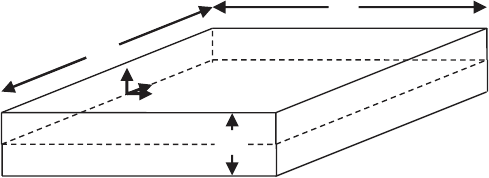
A solid metallic flat fin with a constant thermal conductivity k, length L, width
W , and height H such that H L<W is attached at one end to a surface that is
maintained at a constant temperature T
0
. The convective heat-transfer flux q
0
from
the surfaces of the fin to the ambient air is describing via the lumped-parameter
approach and given by
q
0
= h(T − T
∞
) (4.E.1-1)
where h is the heat-transfer coefficient and T
∞
is the temperature of the ambient
air far removed from the fin. A schematic of the fin is shown in Figure 4.E.1-1.
We use scaling analysis to explore what simplifications are possible in describing
heat transfer in this fin.
The describing equations obtained by considering only the conduction terms
in equation (F.1-2) in the Appendices and the necessary boundary conditions are
given by (step 1)
T
0
Solid metallic fin
y
z
x
L
W
Ambient gas phase at T
∞
H
Figure 4.E.1-1 Flat solid metallic fin that has a constant thermal conductivity and length
L, width W , and height H such that H L<W; the convective heat-transfer flux q
0
from
the surfaces of the fin to the ambient air is described by h(T − T
∞
).

EXAMPLE PROBLEMS 197
0 =
∂
2
T
∂x
2
+
∂
2
T
∂y
2
+
∂
2
T
∂z
2
(4.E.1-2)
T = T
0
at x = 0, 0 ≤ y ≤ H, 0 ≤ z ≤ W (4.E.1-3)
−k
∂T
∂x
= h(T −T
∞
) at x = L, 0 ≤ y ≤
H
2
, 0 ≤ z ≤
W
2
(4.E.1-4)
∂T
∂y
= 0aty = 0, 0 ≤ x ≤ L, 0 ≤ z ≤
W
2
(4.E.1-5)
−k
∂T
∂y
= h(T −T
∞
) at y =
H
2
, 0 ≤ x ≤ L, 0 ≤ z ≤
W
2
(4.E.1-6)
∂T
∂z
= 0atz = 0, 0 ≤ x ≤ L, 0 ≤ y ≤
H
2
(4.E.1-7)
−k
∂T
∂z
= h(T −T
∞
) at z =
W
2
, 0 ≤ x ≤ L, 0 ≤ y ≤
H
2
(4.E.1-8)
Because of the planar symmetry, we have considered the heat transfer in only the
upper half-width of the fin.
Introduce the following scale and reference factors (steps 2, 3, and 4):
T
∗
≡
T − T
r
T
s
; x
∗
≡
x
x
s
; y
∗
≡
y
y
s
; z
∗
≡
z
z
s
;
∂T
∂x
∗
≡
1
T
xs
∂T
∂x
;
∂T
∂y
∗
≡
1
T
ys
∂T
∂y
;
∂T
∂z
∗
≡
1
T
zs
∂T
∂z
(4.E.1-9)
Note that we have allowed for separate scales for the temperature gradients in the
x-, y-, and z-directions since there is no reason to assume that the temperature
will change from its maximum to its minimum value over the length, thickness,
or width of the fin, respectively. Substitute these dimensionless variables into the
describing equations to obtain (steps 5 and 6)
0 =
∂
∂x
∗
∂T
∂x
∗
+
x
s
T
ys
y
s
T
xs
∂
∂y
∗
∂T
∂y
∗
+
x
s
T
zs
z
s
T
xs
∂
∂z
∗
∂T
∂z
∗
(4.E.1-10)
T
∗
=
T
0
− T
r
T
s
at x
∗
= 0, 0 ≤ y
∗
≤
H
y
s
, 0 ≤ z
∗
≤
W
z
s
(4.E.1-11)
∂T
∂x
∗
=−
hT
s
kT
xs
T
∗
+
T
r
− T
∞
T
s
at x
∗
=
L
x
s
, 0 ≤ y
∗
≤
H
y
s
,
0 ≤ z
∗
≤
W
z
s
(4.E.1-12)
∂T
∂y
∗
= 0aty
∗
= 0, 0 ≤ x
∗
≤
L
x
s
, 0 ≤ z
∗
≤
W
z
s
(4.E.1-13)

198 APPLICATIONS IN HEAT TRANSFER
∂T
∂y
∗
=−
hT
s
kT
ys
T
∗
+
T
r
− T
∞
T
s
at y
∗
=
H
y
s
, 0 ≤ x
∗
≤
L
x
s
,
0 ≤ z
∗
≤
W
z
s
(4.E.1-14)
∂T
∂z
∗
= 0atz
∗
= 0, 0 ≤ x
∗
≤
L
x
s
, 0 ≤ y
∗
≤
H
y
s
(4.E.1-15)
∂T
∂z
∗
=−
hT
s
kT
zs
T
∗
+
T
r
− T
∞
T
s
at z
∗
=
W
z
s
, 0 ≤ x
∗
≤
L
x
s
,
0 ≤ y
∗
≤
H
y
s
(4.E.1-16)
Inspection of the dimensionless describing equations indicates that the tempera-
ture can be bounded to be
◦
(1) if we set T
r
= T
∞
and T
s
= T
0
− T
∞
. The dimen-
sionless spatial coordinates can be bounded to be
◦
(1) if we set x
s
= L, y
s
= H ,
and z
s
= W. The dimensionless groups in equations (4.E.1-14) and (4.E.1-16) pro-
vide the following scales for the temperature gradients in the y-andz-directions,
respectively (step 7):
T
ys
= T
zs
=
h(T
0
− T
∞
)
k
=
hH
k
(T
0
− T
∞
)
H
= Bi
t
T
0
− T
∞
H
(4.E.1-17)
where Bi
t
≡ hH/k is the Biot number for heat transfer based on the smallest
length dimension H . However, it would not be appropriate to determine T
xs
from
the dimensionless group in equation (4.E.1-12) since the small amount of heat
leaving the tip of the fin does not cause the axial temperature gradient; rather, we
expect that the axial temperature gradient is caused by the heat being transferred
from the side of the fin.
When the scale and reference factors are substituted into equations (4.E.1-10)
through (4.E.1-16), we obtain the following dimensionless describing equations:
0 =
∂
∂x
∗
∂T
∂x
∗
+ Bi
t
L(T
0
− T
∞
)
H
2
T
xs
∂
∂y
∗
∂T
∂y
∗
+ Bi
t
L(T
0
− T
∞
)
WHT
xs
∂
∂z
∗
∂T
∂z
∗
(4.E.1-18)
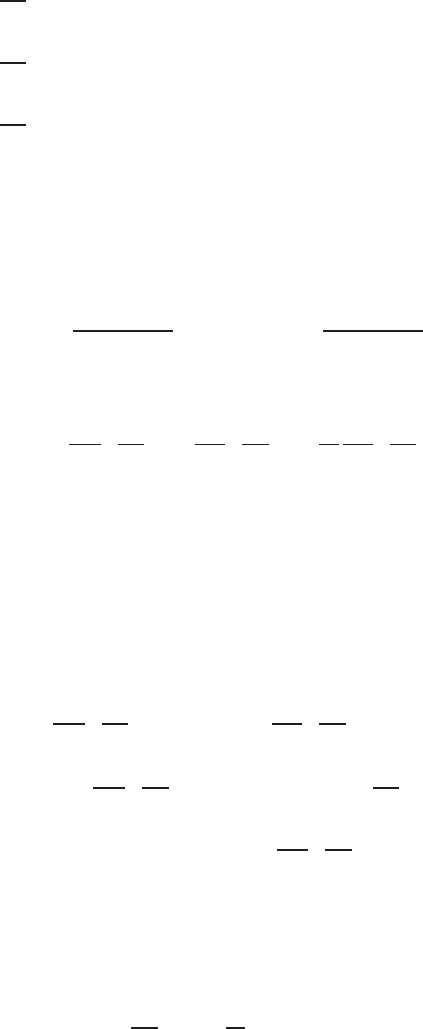
T
∗
= 1atx
∗
= 0, 0 ≤ y
∗
≤ 1, 0 ≤ z
∗
≤ 1 (4.E.1-19)
∂T
∂x
∗
=−
h(T
0
− T
∞
)
kT
xs
T
∗
at x
∗
= 1, 0 ≤ y
∗
≤ 1, 0 ≤ z
∗
≤ 1
(4.E.1-20)
∂T
∂y
∗
= 0aty
∗
= 0, 0 ≤ x
∗
≤ 1, 0 ≤ z
∗
≤ 1 (4.E.1-21)
EXAMPLE PROBLEMS 199
∂T
∂y
∗
=−T
∗
at y
∗
= 1, 0 ≤ x
∗
≤ 1, 0 ≤ z
∗
≤ 1 (4.E.1-22)
∂T
∂z
∗
= 0atz
∗
= 0, 0 ≤ x
∗
≤ 1, 0 ≤ y
∗
≤ 1 (4.E.1-23)
∂T
∂z
∗
=−T
∗
at z
∗
= 1, 0 ≤ x
∗
≤ 1, 0 ≤ y
∗
≤ 1 (4.E.1-24)
The axial conduction must be balanced by at least one of the other two terms
in equation (4.E.1-18). However, since H W , it is clear that conduction in the
y-direction is far more important than that in the z-direction. Hence, we set the
dimensionless group multiplying the conduction term in the y-direction equal to 1
to obtain T
xs
as
Bi
t
L(T
0
− T
∞
)
H
2
T
xs
= 1 ⇒ T
xs
= Bi
t
L(T
0
− T
∞
)
H
2
(4.E.1-25)
Substituting this value for T
xs
into equation (4.E.1-18) then yields
0 =
∂
∂x
∗
∂T
∂x
∗
+
∂
∂y
∗
∂T
∂y
∗
+
H
W
∂
∂z
∗
∂T
∂z
∗
(4.E.1-26)
Inspection of equation (4.E.1-26) indicates that conduction in the z-direction can
be ignored if H/W 1, which is the case for a thin wide fin such as that being
considered here (step 8). Furthermore, if we invoke the low Biot number approxi-
mation developed in Section 4.4 (i.e., Bi
t
1), equation (4.E.1-17) indicates that
the temperature gradient in the y-direction will be essentially zero, which implies
that the temperature will be constant across the thickness of the fin. Analogously
to the procedure used in Section 4.4, let us integrate equation (4.E.1-26) across the
cross-sectional area of the fin:
1
−1
∂
∂x
∗
∂T
∂x
∗
Wdy
∗
+
1
−1
∂
∂y
∗
∂T
∂y
∗
Wdy
∗
= 0 (4.E.1-27)
∂
∂x
∗
∂T
∂x
∗
1
−1
dy
∗
+
−T
∗
T
∗
∂
∂T
∂y
∗
= 0 (4.E.1-28)
∂
∂x
∗
∂T
∂x
∗
− T
∗
= 0 (4.E.1-29)
Equation (4.E.1-29) is subject to the boundary conditions given by equations
(4.E.1-19) and (4.E.1-20), given by
T
∗
= 1atx
∗
= 0 (4.E.1-30)
∂T
∂x
∗
=−
H
L
T
∗
∼
=
0atx
∗
= 1 (4.E.1-31)
200 APPLICATIONS IN HEAT TRANSFER
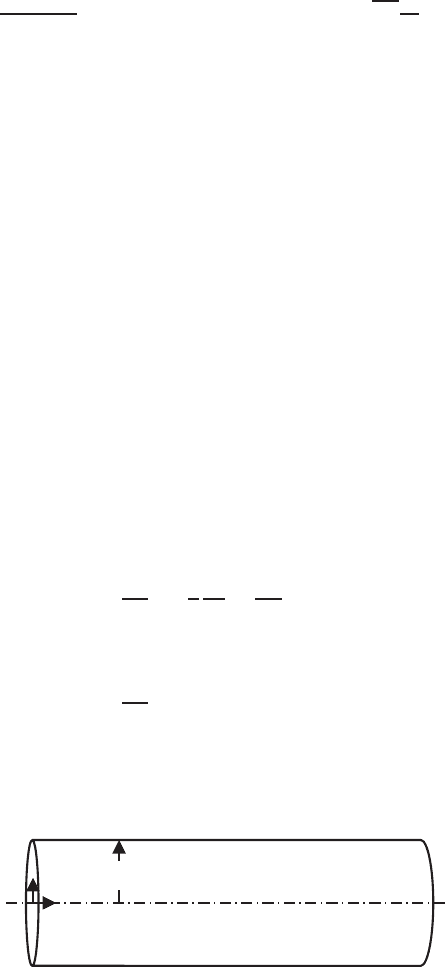
The solution to this simplified system of equations is straightforward and given by
T
∗
=
e
x
∗
1 + e
−2
e
−2x
∗
+ e
−2
, where ≡
Bi
t
L
H
(4.E.1-32)
The solution given by equation (4.E.1-32) is applicable for small Biot numbers
for which the temperature across the thickness of the fin can be assumed to be
constant and for which heat transfer along the sides and tip of the fin can be
neglected. These are reasonable assumptions for thin fins made from a highly
conducting metal.
4.E.2 Unsteady-State Resistance Heating in a Wire
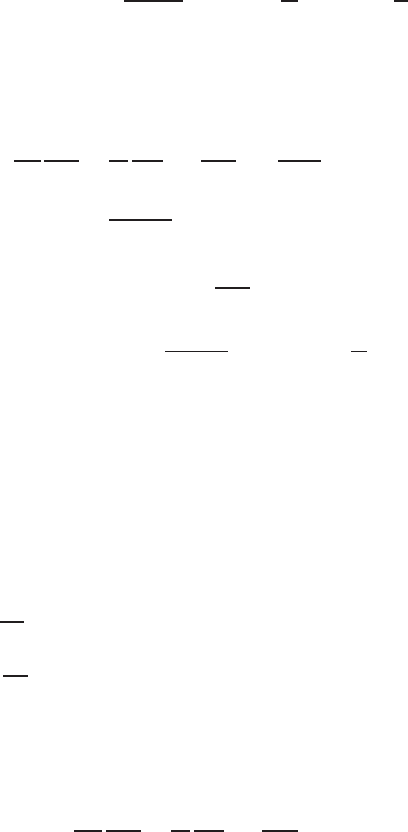
Consider a long solid wire having radius R as shown in Figure 4.E.2-1, whose ini-
tial temperature is T
0
. At time t = 0 an alternating current begins to flow through the
wire that causes electrical resistance heating whose volumetric energy generation
rate G
e
is given by
G
e
= G
0
cos ωt (energy generation rate per unit volume) (4.E.2-1)
where ω is the angular frequency in radians per second. The temperature at the
surface of the wire is held constant at the initial temperature T
0
. We use scaling to
explore how the describing equations might be simplified.
The appropriately simplified form of the thermal energy equation given by
equation (F.2-2) in the Appendices and the required initial and boundary conditions
are given by (step 1)
ρC
p
∂T
∂t
= k
1
r
d
dr
r
dT
dr
+ G
0
cos ωt (4.E.2-2)
T = T
0
at t = 0 (4.E.2-3)
T is bounded or
∂T
∂r
= 0atr = 0 (4.E.2-4)
T = T
0
at r = R (4.E.2-5)
T = T
0
G = G
0
cos wt
z
r
R
Figure 4.E.2-1 Unsteady-state heat conduction in a solid cylinder of radius R due to
electrical heat generation at a volumetric rate given by G
e
= G
0
cos ωt.
EXAMPLE PROBLEMS 201
The boundary condition given by equation (4.E.2-4) merely states that the temper-
ature cannot be infinite or is an extremum (a maximum in this case) at r = 0; this
type of boundary condition is often invoked in problems involving cylindrical or
spherical coordinates. Introduce the following scale and reference factors (steps 2,
3, and 4):
T
∗
≡
T − T
r
T
s
; r
∗
≡
r
r
s
; t
∗
≡
t
t
s
(4.E.2-6)
Substitute these dimensionless variables into the describing equations and divide
through by the dimensional coefficient of one term in each of the equations to
obtain (steps 5 and 6)
r
2
s
αt
s
∂T
∗
∂t
∗
=
1
r
∗
d
dr
∗
r
∗
dT
∗
dr
∗
+
G
0
r
2
s
kT
s
cos ωt
s
t
∗
(4.E.2-7)
T
∗
=
T
0
− T
r
T
s
at t
∗
= 0 (4.E.2-8)
T
∗
is bounded or
∂T
∗
∂r
∗
= 0atr
∗
= 0 (4.E.2-9)
T
∗
=
T
0
− T
r
T
s
at r
∗
=
R
r
s
(4.E.2-10)
Setting the appropriate dimensionless groups in equation (4.E.2-8) and (4.E.2-
10) equal to zero and 1, respectively, gives T
r
= T
0
and r
s
= R (step 7). Since
the heat generation must be balanced by the radial heat conduction, we set the
dimensionless group in equation (4.E.2-7) equal to 1 to obtain T
s
= G
0
R
2
/k.There
are three relevant time scales whose relative values determine the simplifications
that are possible for this problem (step 8):
t
s
= t
o
time scale corresponding to the observation time
t
s
= t
c
=
R
2
α
time scale characterizing the heat conduction (4.E.2-11)
t
s
= t
p
=
2π
ω
time scale characterizing the periodic rate of heat generation
Note that we use the reciprocal of the cyclic rather than the angular frequency to
properly characterize the time scale for the periodic rate of heat generation.
Consider first the case where t
s
= t
o
, for which equation (4.E.2-7) simplifies to
1
Fo
t
∂T
∗
∂t
∗
=
1
r
∗
d
dr
∗
r
∗
dT
∗
dr
∗
+ cos ωt
o
t
∗
(4.E.2-12)
where Fo
t
≡ R
2
/αt
o
is the Fourier number for heat transfer. It is not possible for the
Fourier number to be much less than 1 since the conduction term has to be retained
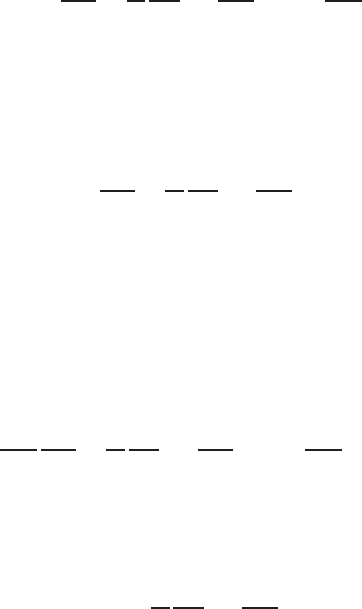
202 APPLICATIONS IN HEAT TRANSFER
at all times. If Fo
t
∼
=
1,t
o
= R
2
/α and equation (4.E.2-12) can be written as
∂T
∗
∂t
∗
=
1
r
∗
d
dr
∗
r
∗
dT
∗
dr
∗
+ cos
ωR
2
α
t
∗
(4.E.2-13)
Equation (4.E.2-13) can be simplified further if ωR
2
/α 1. This implies that
the heat conduction occurs much faster than the periodic heat generation; that is,
the heat conduction smoothes out the variations in temperature due to the time-
dependence of the heat generation, and equation (4.E.2-13) simplifies to
∂T
∗
∂t
∗
=
1
r
∗
d
dr
∗
r
∗
dT
∗
dr
∗
+ 1 (4.E.2-14)
This equation describes the transient heat conduction period for the special case of
the conduction time scale being much smaller than the characteristic time scale for
the periodic heat generation.
If Fo
t
1, the transient heat conduction effects have died out; however, the
problem is still possibly unsteady state, due to the time-dependent heat-generation
term. For this case the characteristic time scale is t
s
= t
p
= 2π/ω and equa-
tion (4.E.2-7) assumes the form
ωR
2
2πα
∂T
∗
∂t
∗
=
1
r
∗
d
dr
∗
r
∗
dT
∗
dr
∗
+ cos
ωR
2
2πα
t
∗
(4.E.2-15)
Equation (4.E.2-15), which describes unsteady-state heat conduction due to time-
dependent heat generation, can be simplified further if ωR
2
/2πα 1, whereby it
reduces to
0 =
1
r
∗
d
dr
∗
r
∗
dT
∗
dr
∗
+ 1 (4.E.2-16)
which describes steady-state heat conduction due to constant heat generation.
4.E.3 Convective Heat Transfer with Injection Through Permeable Walls
Consider the steady-state fully developed laminar flow of a viscous Newtonian fluid
with constant physical properties between two infinitely wide permeable parallel
plates separated by a distance H as shown in Figure 4.E.3-1. There is constant
injection of the same fluid at velocity V through the permeable plate at y = H
and constant withdrawal of the same incompressible fluid through the permeable
plate at y = 0. The continuity equation can be used to prove that the injection and
withdrawal velocities at the upper and lower plates must be equal for the flow to
be fully developed. The upstream (entering) temperature of the fluid is T
1
.The
temperature of the upper plate at y = H is also T
1
, whereas the temperature of
the lower plate at y = 0isT
0
, such that T
1
>T
0
. Since the flow is assumed to be