
Krantz W.B. Scaling Analysis in Modeling Transport and Reaction Processes: A Systematic Approach to Model Building and the Art of Approximation
Подождите немного. Документ загружается.

HEAT TRANSFER WITH PHASE CHANGE 173
Since L is merely some fixed value of the axial coordinate x, the criteria above always
break down in the vicinity of the leading edge of the flat plate. Hence, if one is seek-
ing to determine an integral quantity such as the total drag or heat flux along the flat
plate, the error will not be significant if equations (4.6-36) and (4.6-37) are satisfied
over most of the plate. However, the error incurred by invoking the boundary-layer
approximation can be quite large in the vicinity of the leading edge of the plate for
point quantities such as the local velocity components, shear stress, temperature, or
heat flux. Note for 90% of the flat plate to satisfy the condition that Re ≥
◦
(100),
the Reynolds number at the end of the plate must be 1000. Since the Peclet number
is the product of the Reynolds number and the Prandtl number, equation (4.6-36) is
more limiting than equation (4.6-37) for fluids other than liquid metals.
Note that scaling analysis suggests how a solution to the coupled heat- and
momentum-transfer problem can be developed that applies from the leading edge
of the plate to any arbitrary downstream distance. Recall that the coupled describing
equations are difficult to solve, owing to the presence of the axial diffusion terms
in both the thermal energy equation and the equations of motion. These terms
require specifying downstream boundary conditions that in practice are usually not
known. However, the parabolic boundary-layer equations suggested by scaling can
be solved either numerically or via approximate analytical methods downstream
from the leading edge of the plate. The resulting solutions for the temperature and
velocity profiles then can be used as downstream boundary conditions on the full
elliptic describing equations that must be solved in the vicinity of the leading edge
of the flat plate. Hence, we see that scaling not only provides a systematic method
for simplifying the describing equations, but also suggests a strategy for solving
them.
4.7 HEAT TRANSFER WITH PHASE CHANGE
Heat transfer is very often involved in problems wherein phase change occurs,
owing to the need to supply or remove the latent heat associated with the transition
from one phase to another. Figure 4.7-1 shows a schematic of melting ice within
porous soil that was initially at its freezing temperature T
f
and then was subjected
to a higher constant temperature T
0
at the ground surface. We will assume that
the heat transfer is one-dimensional and purely conductive and that the physical
properties are constant.
11
This example will illustrate scaling of a moving boundary
problem; that is, the melting front is a boundary that moves progressively downward
into the frozen soil as heat is conducted upward to the warm ground surface. We
will again explore how this problem can be simplified. We use this problem to
illustrate the forgiving nature of scaling by making a na
¨
ıve mistake in the way we
11
Note that the melting of ice can induce free convection heat transfer arising from the density gradients
that can be generated, due to the fact that water has a density maximum at 4
◦
C; that is, unfrozen water
adjacent to melting ice is less dense than the water immediately above it, which can give rise to
free convection; however, this is not likely to occur in most soils, due to their low permeability to
flow.
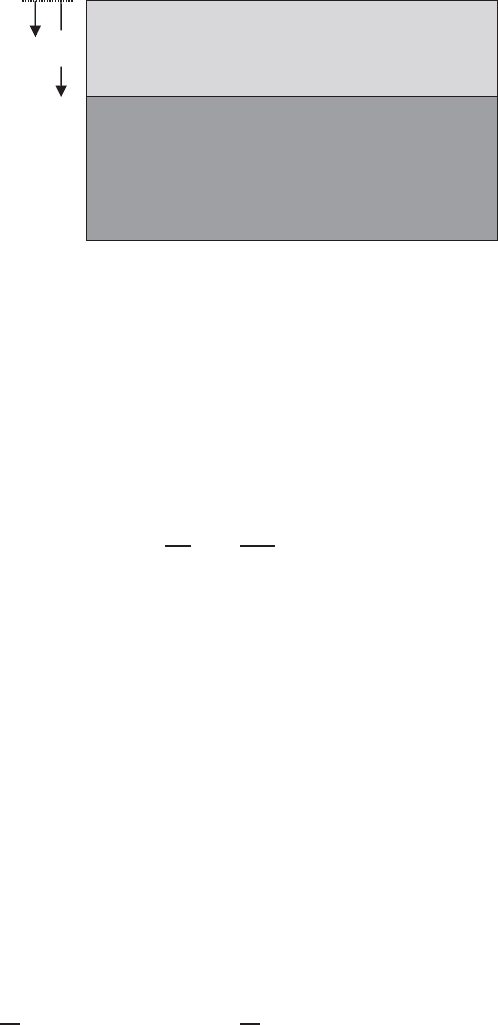
174 APPLICATIONS IN HEAT TRANSFER
L(t)
Frozen soil
x
Thawed soil
T = T
f
, t ≤ 0; T = T
0
, t > 0
T = T
f
Figure 4.7-1 Unsteady-state one-dimensional heat transfer due to the imposition of a tem-
perature T
0
at the surface of frozen water-saturated porous soil whose initial temperature was
T
f
where T
0
>T
f
; the position of the thaw front denoted by L(t) progressively penetrates
farther into the frozen soil due to conductive heat transfer from the ground surface.
scale one of the derivatives. This will then lead to a contradiction that suggests
that we rescale the equations to achieve
◦
(1) scaling.
The describing equations are obtained by appropriately simplifying equation
(F.1-2) in the Appendices and prescribing the requisite initial and boundary condi-
tions (step 1):
ρ
u
C
pu
∂T
∂t
= k
u
∂
2
T
∂x
2
(4.7-1)
T = T
f
at t = 0 (4.7-2)
T = T
0
at x = 0fort>0 (4.7-3)
T = T
f
at x = L(t) (4.7-4)
where k
u
,ρ
u
,andC
pu
are the effective thermal conductivity, mass density, and
heat capacity, respectively, of the unfrozen soil; note that by effective we mean
that these properties account for the presence of the solid soil and the unfrozen
water that is contained in its pores. Equations (4.7-2) and (4.7-3) are the prescribed
initial temperature and imposed temperature at the ground surface, respectively.
Equation (4.7-4) states that ice and unfrozen water that meet at the freezing front are
in thermodynamic equilibrium at the freezing temperature of water. Note that this
boundary condition is applied at the moving interface between the ice and unfrozen
water L(t); hence, problems of this type are referred to as moving boundary prob-
lems.SinceL(t ) is an additional unknown, it is necessary to prescribe an auxiliary
condition to determine it. This is obtained via an integral energy balance as follows:
d
dt
L
0
ρ
u
C
pu
(T − T
◦
)dx +
d
dt
∞
L
ρ
f
C
pf
(T − T
◦
)dx = q
0
(4.7-5)
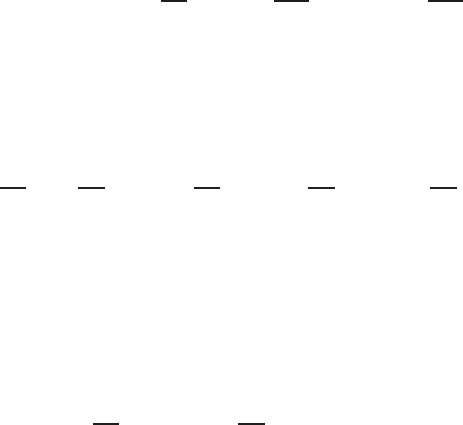
HEAT TRANSFER WITH PHASE CHANGE 175
where T
◦
is an arbitrary reference temperature for the enthalpy or heat content,
ρ
f
and C
pf
are the effective mass density and heat capacity, respectively, of the
frozen soil, and q
0
is the heat transferred into the unfrozen soil at the ground surface.
Applying Leibnitz’s rule for differentiating an integral given by equation (H.1-2)
in the Appendices and substituting equation (4.7-1) while recalling that the frozen
ice remains at the constant temperature T
f
yields
(ρ
u
C
pu
− ρ
f
C
pf
)(T
f
− T
◦
)
dL
dt
+
L
0
k
u
∂
2
T
∂x
2
dx +
∞
L
k
f
∂
2
T
∂x
2
dx = q
0
(4.7-6)
The first term in the above is the difference in heat content between the unfrozen
and frozen soil; this can be related to H
f
, the latent heat of fusion of water.
Hence, integrating equation (4.7-6) yields
H
f
ερ
w
dL
dt
+ k
u
∂T
∂x
x=L
− k
u
∂T
∂x
x=0
+ k
f
∂T
∂x
x=∞
− k
f
∂T
∂x
x=L
= q
0
(4.7-7)
where ρ
w
is the mass density of water, ε the porosity of the soil, and k
f
the thermal
conductivity of the frozen soil. The fourth and fifth terms in equation (4.7-7) are
identically zero if there is no heat transfer in the frozen soil and the third term
is equal to the last term. Hence, the auxiliary condition needed to determine the
instantaneous location of the freezing front is given by
k
u
∂T
∂x
=−H
f
ερ
w
dL
dt
at x = L (4.7-8)
This condition merely states that the heat conducted to the freezing front supplies
the instantaneous latent heat required for melting the ice. To integrate equation
(4.7-8), it is necessary to specify an initial condition on L; this is given by
L = 0att = 0 (4.7-9)
Note that whenever boundary conditions must be applied at a location whose
position is unknown and dependent on the solution to the particular describing
equations, it is necessary to use some type of integral balance to obtain an addi-
tional condition to determine the location of this boundary. In fluid dynamics this
occurs for flows involving free surfaces such as were considered in Section 3.7
and Example Problem 3.E-8 and requires using an integral mass balance, which
is called the kinematic surface condition. In heat transfer this occurs in problems
such as the one considered here involving phase change and requires an integral
energy balance. In some heat-transfer problems involving phase change such as
evaporation, mass loss is also involved. In the latter moving boundary problems
it is necessary to include both an integral energy and an integral mass balance.
One of these is used as a boundary condition on the energy equation, and the
176 APPLICATIONS IN HEAT TRANSFER
other constitutes the auxiliary equation used to locate the position of the moving
boundary.
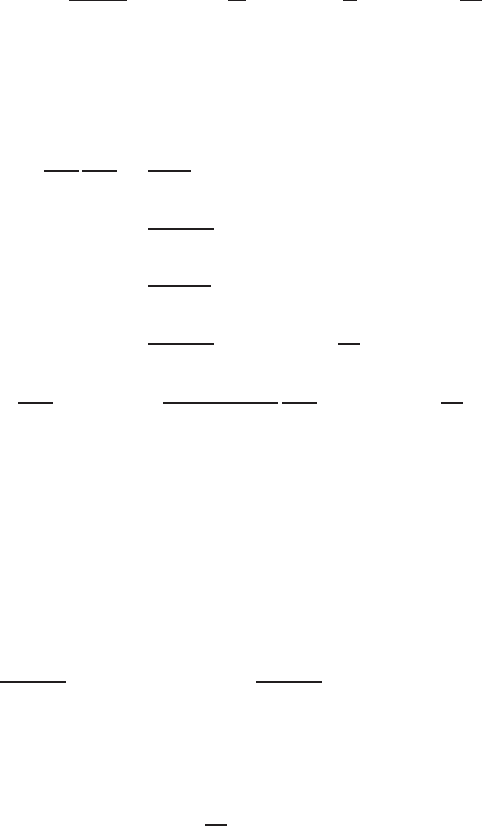
Define the following dimensionless dependent and independent variables (steps
2, 3, and 4):
T
∗
≡
T − T
r
T
s
; x
∗
≡
x
x
s
; t
∗
≡
t
t
s
; L
∗
≡
L
L
s
(4.7-10)
Introduce these dimensionless variables into the describing equations and divide
each equation through by the dimensional coefficient of one term that should be
retained to maintain physical significance (steps 5 and 6):
x
2
s
α
u
t
s
∂T
∗
∂t
∗
=
∂
2
T
∗
∂x
∗2
(4.7-11)
T
∗
=
T
f
− T
r
T
s
,L
∗
= 0att
∗
= 0 (4.7-12)
T
∗
=
T
0
− T
r
T
s
at x
∗
= 0for t
∗
> 0 (4.7-13)
T
∗
=
T
f
− T
r
T
s
at x
∗
=
L
s
x
s
L
∗
(4.7-14)
∂T
∗
∂x
∗
x
∗
=L/x
s
=−
H
f
ρ
w
εx
s
L
s
k
u
T
s
t
s
dL
∗
dt
∗
at x
∗
=
L
s
x
s
L
∗
(4.7-15)
L
∗
= 0att
∗
= 0 (4.7-16)
where α
u
= k
u
/ρ
u
C
pu
is the thermal diffusivity of the unfrozen soil.
We can bound the dimensionless temperature to be
◦
(1) by setting the dimen-
sionless group in equation (4.7-12) or (4.7-14) equal to zero to determine the
reference temperature and by setting the dimensionless group in equation (4.7-13)
equal to 1 to determine the temperature scale (step 7); that is,
T
f
− T
r
T
s
= 0 ⇒ T
r
= T
f
;
T
0
− T
f
T
s
= 1 ⇒ T
s
= T
0
− T
f
(4.7-17)
We can bound the dimensionless spatial coordinate to be
◦
(1) by setting the dimen-
sionless group in equation (4.7-14) or (4.7-15) equal to 1; that is,
L
s
x
s
= 1 ⇒ x
s
= L
s
(4.7-18)
The time scale will again be the observation time t
o
since this is inherently an
unsteady-state problem. Since the two remaining terms in equation (4.7-15) must
balance each other, to ensure that each term is
◦
(1), we must set the dimensionless

HEAT TRANSFER WITH PHASE CHANGE 177
group in this equation equal to 1; this then provides the scale factor for the freezing
penetration front; that is,
H
f
ρ
w
εx
s
L
s
k
u
T
s
t
s
=
H
f
ρ
w
εL
2
s
k
u
(T
0
− T
f
)t
o
= 1 ⇒ L
s
=
k
u
(T
0
− T
f
)t
o
H
f
ρ
w
ε
1/2
(4.7-19)
If we now rewrite our dimensionless describing equations in terms of the scales
defined by equations (4.7-16) through (4.7-19), we obtain
k
u
(T
0
− T
f
)
H
f
ρ
w
εα
u
∂T
∗
∂t
∗
−
x
∗
L
∗
dL
∗
dt
∗
∂T
∗
∂x
∗
=
∂
2
T
∗
∂x
∗2
(4.7-20)
T
∗
= 0att
∗
= 0 (4.7-21)
T
∗
= 1atx
∗
= 0fort
∗
> 0 (4.7-22)
T
∗
= 0atx
∗
= 1 (4.7-23)
dT
∗
dx
∗
=−
dL
∗
dt
∗
at x
∗
= 1 (4.7-24)
Note that an additional term now appears in equation (4.7-20) because of the trans-
formation to a dimensionless spatial coordinate that is scaled with the instantaneous
depth of the thawed layer. This is referred to as a pseudo-convection term since it
involves a velocity multiplied by a spatial derivative in the same direction as that
of the velocity. Pseudo-convection terms will always arise when one transforms
from a stationary coordinate system to one for which either the reference or scale
factor is a function of time.
Now let us assess the conditions under which the dimensionless describing
equations can be simplified (step 8). We detect an immediate problem in
equation (4.7-20) in that the relative importance of the transformed unsteady-state
term is independent of the observation time t
o
. Recall from the problem consid-
ered in Section 4.3 that the unsteady-state term should be multiplied by the inverse
Fourier number, which is equal to the ratio of the observation time to the character-
istic heat conduction time. For very large Fourier numbers we would anticipate that
quasi-steady-state heat transfer should apply. Hence, we have obtained an unrea-
sonable result and the forgiving nature of scaling has indicated a contradiction:
namely, that quasi-steady-state conditions can never be achieved. Another contra-
diction inherent in this scaling is that the dimensionless thaw penetration depth is
always equal to 1 since L
∗
= L/L
s
= L/x
s
= 1. Therefore, we need to rescale the
problem; we will know that we have scaled correctly when the relevant terms are
bounded of
◦
(1) and no contradictions occur.
We suspect that our error was introduced by scaling dL/dt with L
s
/t
s
.Let
us rescale the describing equations by introducing a scale factor
˙
L
s
for dL/dt to
ensure that we bound this derivative to be
◦
(1):
dL
dt
∗
≡
1
˙
L
s
dL
dt
(4.7-25)
178 APPLICATIONS IN HEAT TRANSFER
The other dimensionless variables are the same as defined by equation (4.7-10).
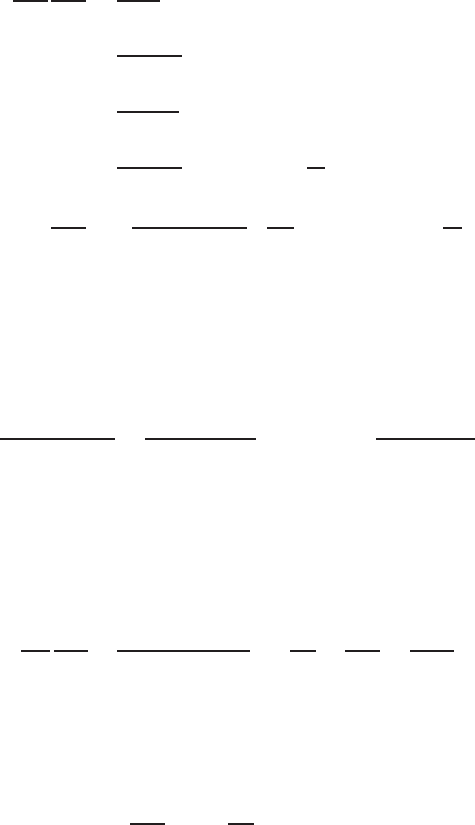
Introduce these dimensionless variables into the describing equations and divide
each equation through by the dimensional coefficient of one term that should be
retained to maintain physical significance:
x
2
s
α
u
t
s
∂T
∗
∂t
∗
=
∂
2
T
∗
∂x
∗2
(4.7-26)
T
∗
=
T
f
− T
r
T
s
,L
∗
= 0att
∗
= 0 (4.7-27)
T
∗
=
T
0
− T
r
T
s
at x
∗
= 0fort
∗
> 0 (4.7-28)
T
∗
=
T
f
− T
r
T
s
at x
∗
=
L
x
s
(4.7-29)
∂T
∗
∂x
∗
=−
H
f
ρ
w
εx
s
˙
L
s
k
u
T
s
dL
dt
∗
at x
∗
=
L
x
s
(4.7-30)
Our reference and scale factors for the temperature, the time, and the spatial coor-
dinate remain the same as before. Since the two terms in equation (4.7-30) must
balance each other, to ensure that each term is
◦
(1), we must set the dimensionless
group in this equation equal to 1; this then provides the scale factor for the melting
front velocity; that is,
H
f
ρ
w
εx
s
˙
L
s
k
u
T
s
=
H
f
ρ
w
εL
˙
L
s
k
u
(T
0
− T
f
)
= 1 ⇒
˙
L
s
=
k
u
(T
0
− T
f
)
H
f
ρ
w
εL
(4.7-31)
We see that L
s
never appears explicitly in our dimensionless describing equa-
tions. Hence, L can be nondimensionalized with any relevant length scale such
as the maximum thaw depth L
m
. If we now rewrite our dimensionless describing
equations in terms of the scales defined by equations (4.7-17), (4.7-18), and (4.7-
31), we obtain
1
Fo
t
∂T
∗
∂t
∗
−
ρ
u
C
pu
(T
0
− T
f
)
H
f
ρ
w
ε
x
∗
dL
dt
∗
∂T
∗
∂x
∗
=
∂
2
T
∗
∂x
∗2
(4.7-32)
T
∗
= 0att
∗
= 0 (4.7-33)
T
∗
= 1atx
∗
= 0fort
∗
> 0 (4.7-34)
T
∗
= 0atx
∗
= 1 (4.7-35)
dT
∗
dx
∗
=−
dL
dt
∗
at x
∗
= 1 (4.7-36)
where Fo
t
≡ α
u
t
o
/L
2
is the Fourier number for heat transfer. Note again that an
additional pseudo-convection term appears in equation (4.7-32), due to the trans-
formation from T(x,t) to T
∗
(x
∗
,t
∗
),inwhichx
∗
= x/L(t). The dimensionless

HEAT TRANSFER WITH PHASE CHANGE 179
group ρ
u
C
pu
(T
0
− T
f
)/H
f
ρ
w
ε multiplying the pseudo-convection term is a ratio
of the sensible heat to latent heat effects.
Now let us assess the conditions under which these dimensionless describing
equations can be simplified (step 8). We see that the relative importance of the
unsteady-state term in equation (4.7-32) is determined by the magnitude of the
Fourier number. The two terms in this equation must balance each other. We have
scaled ∂T
∗
/∂t
∗
to be
◦
(1). However, we are not certain that ∂
2
T
∗
/∂x
∗2
is
◦
(1).
The fact that we have scaled ∂T
∗
/∂x
∗
to be
◦
(1) does not necessarily ensure that
∂
2
T
∗
/∂x
∗2
is
◦
(1). If Fo
t
=
◦
(1), both the unsteady-state term and the conduction
term will be
◦
(1). This condition implies that
1
Fo
t
=
L
2
α
u
t
o
= 1 ⇒ L =
√
α
u
t
o
for short contact times (4.7-37)
The question might arise as to whether L
2
/α
u
t
o
can ever be much greater than 1,
corresponding to very short contact times. However, this would lead to a contra-
diction since the dimensionless unsteady-state term should be of the same order
as the dimensionless heat-conduction term. Hence, we conclude that for very short
contact times, L
2
∝ t
o
, to ensure that L
2
/α
u
t
o
remains bounded as t
o
→ 0; that is,
scaling analysis permits us to infer the time dependence of the thaw penetration
for short contact times.
Now let us consider the case when Fo
t
= α
u
t
o
/L
2
1, corresponding to very
long contact times. When this condition prevails, the unsteady-state term in equation
(4.7-32) can be ignored and quasi-steady-state prevails. The time dependence now
enters implicitly through both the pseudoconvection term and the condition applied
at the moving boundary given by equation (4.7-36). The resulting quasi-steady-
state describing equations can be solved analytically. However, if in addition
the dimensionless group multiplying the pseudo-convection term is small, that is,
ρ
u
C
pu
(T
0
− T
f
)/H
f
ρ
w
ε 1, further simplification is possible. In the latter case,
equation (4.7-32) predicts a linear temperature profile given by
T
∗
= 1 − x
∗
(4.7-38)
When equation (4.7-38) is substituted into equation (4.7-36) and the result is cast
into dimensional form and integrated, one obtains
dL
dt
=
k
u
(T
0
− T
f
)
H
f
ρ
w
εL
= L
ts
(4.7-39)
That is, for long contact times we find that the solution to the describing equations
agrees identically with the scale factor for the thawing front velocity given by
equation (4.7-31). This should not be surprising since if scaling is done properly,
it should give estimates that are within an
◦
(1) factor of those obtained by solving
the describing equations. One can integrate equation (4.7-39) to obtain an equation
for L as a function of t;thatis,
L
2
=
2k
u
(T
0
− T
f
)
H
f
ρ
w
ε
(t
o
− t
i
) + L
2
i
for long contact times (4.7-40)
180 APPLICATIONS IN HEAT TRANSFER
where L
i
is an integration constant; note that one cannot apply the initial condition
that L = 0 since equation (4.7-40) does not apply at short times. However, this
initial condition can be estimated from the short-time solution given by equation
(4.7-37). Note also that although both equations (4.7-37) and (4.7-40) predict that
L
2
will increase linearly with t
o
, the short-contact time thaw-penetration rate is
faster than that for the long-contact time.
In summary, if Fo
t
1, this unsteady-state moving boundary heat-transfer
problem can be considered to be quasi-steady-state; that is, the describing
equations can be simplified by ignoring the unsteady-state term in the thermal
energy equation. For quasi-steady-state conditions the time dependence enters
through the boundary condition at the moving boundary whose location is time-
dependent.
4.8 TEMPERATURE-DEPENDENT PHYSICAL PROPERTIES
In Section 3.9 we used scaling analysis to determine when the incompressible flow
assumption could be made for a fluid whose density was pressure-dependent. Here
we consider a related coupled fluid-dynamics and heat-transfer problem in which
we will use scaling to determine when the temperature-dependent shear viscosity
can be assumed to be constant. Note that the manner in which scaling analysis is
used to assess when the temperature-dependence of the viscosity can be ignored
in this problem can be applied to assessing when the dependence of any other
physical or transport property on some state variable such as temperature, pressure,
or concentration can be ignored.
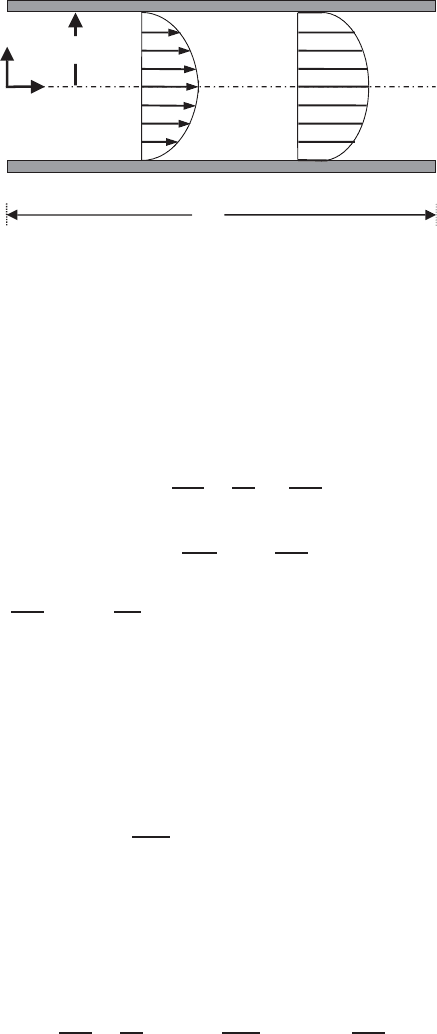
Figure 4.8-1 shows a schematic of the steady-state pressure-driven flow of an
incompressible Newtonian liquid between two infinitely wide parallel flat plates,
each of which is maintained at T
0
, which is also the initial temperature of the
liquid. The shear flow causes significant viscous heating that can possibly cause
a progressive decrease in the liquid viscosity whose temperature dependence is
given by
μ = Ae
B/T
(4.8-1)
where A and B are positive constants. This in turn implies a possible developing
flow due to the influence of the decrease in viscosity on the velocity profile. How-
ever, we will invoke the lubrication-flow
12
and low Peclet number approximations
and in addition ignore axial conduction.
13
We use scaling analysis to assess when
the temperature dependence of the viscosity can be ignored.
Appropriate simplification of the equations of motion given by equations (D.1-
10) and (D.1-11) in the Appendices and the thermal energy equation given by
12
Scaling analysis was applied to justify the lubrication-flow approximation in Section 3.3.
13
Scaling analysis was applied to justify the low Peclet number approximation, ignoring the axial
conduction in Section 4.5.
TEMPERATURE-DEPENDENT PHYSICAL PROPERTIES 181
x
y
L
T
0
T
0
T
0
H
Figure 4.8-1 Steady-state pressure-driven lubrication flow of an incompressible Newtonian
liquid between two infinitely wide parallel flat plates, each of which is maintained at T
0
,
which is also the initial temperature of the liquid; this shear flow causes viscous heating
that can result in a progressive decrease in the liquid viscosity; representative velocity and
temperature profiles are shown in this figure.
equation (F.1-2), and specification of the required boundary conditions yields the
following set of describing equations (step 1):
0 =
P
L
+
d
dy
μ
du
x
dy
(4.8-2)
0 = k
d
2
T
dy
2
+ μ
du
x
dy
2
(4.8-3)
du
x
dy
= 0,
dT
dy
= 0aty = 0 (4.8-4)
u
x
= 0,T= T
0
at y =±H (4.8-5)
Since we seek to assess when the temperature dependence of the viscosity can be
ignored, we need consider only small departures of the temperature from the initial
temperature T
0
. Hence, it is convenient to expand equation (4.8-1) in a Taylor series
about T
0
at which the viscosity is μ
0
:
μ = μ
0
−
Bμ
0
T
2
0
(T − T
0
) +
◦
(T − T
0
)
2
(4.8-6)
Since we need consider only the first-order effects of temperature to assess whether
there is any significant change in the viscosity, truncate equation (4.8-6) after the
second term on the right-hand side and substitute it into equations (4.8-2) and
(4.8-3):
0 =
P
L
+
d
dy
!
μ
0
−
Bμ
0
T
2
0
(T − T
0
)
"
du
x
dy
#
(4.8-7)
182 APPLICATIONS IN HEAT TRANSFER
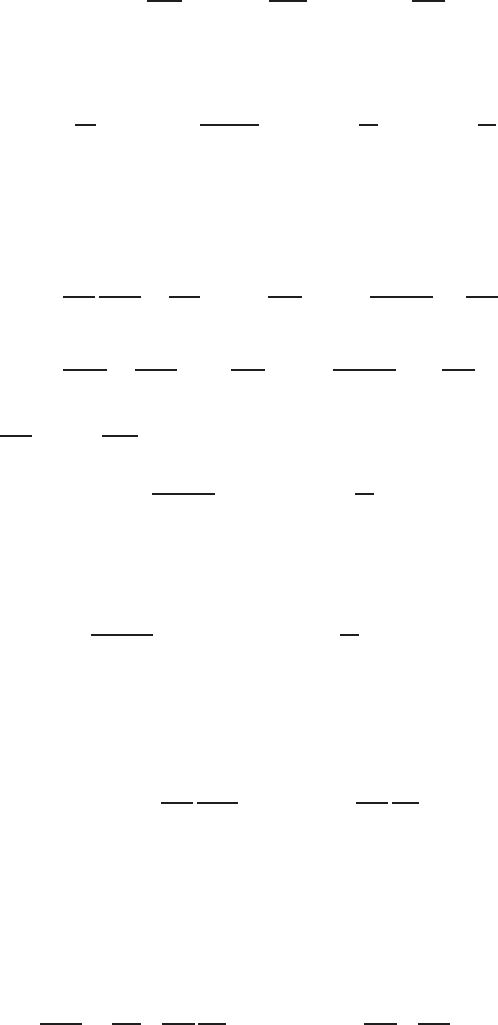
0 = k
d
2
T
dy
2
+
!
μ
0
−
Bμ
0
T
2
0
(T − T
0
)
"
du
x
dy
2
(4.8-8)
Introduce the following scale and reference factors (steps 2, 3, and 4):
u
∗
x
≡
u
x
u
s
; T
∗
≡
T − T
r
T
s
; x
∗
≡
x
x
s
; y
∗
≡
y
y
s
(4.8-9)
Substitute these dimensionless variables into the describing equations and divide
each equation through by the dimensional coefficient of one term that should be
retained in order to maintain physical significance (steps 5 and 6):
0 =
P
L
y
2
s
μ
0
u
s
+
d
dy
∗
!
1 −
BT
s
T
2
0
T
∗
+
T
r
− T
0
T
s
"
du
∗
x
dy
∗
#
(4.8-10)
0 =
d
2
T
∗
dy
∗2
+
μ
0
u
2
s
kT
s
!
1 −
BT
s
T
2
0
T
∗
+
T
r
− T
0
T
s
"
du
∗
x
dy
∗
2
(4.8-11)
du
∗
x
dy
∗
= 0,
dT
∗
dy
∗
= 0aty
∗
= 0 (4.8-12)
u
∗
x
= 0,T
∗
=
T
0
− T
r
T
s
at y
∗
=±
H
y
s
(4.8-13)
When set equal to zero and 1, respectively, the dimensionless groups in equations
(4.8-13) provide the following reference and scale factors (step 7):
T
0
− T
r
T
s
= 0 ⇒ T
r
= T
0
,
H
y
s
= 1 ⇒ y
s
= H (4.8-14)
Since the pressure term must balance the principal viscous term for this lubrication
flow, the dimensionless pressure term in equation (4.8-10) must be set equal to 1
to obtain the velocity scale:
P
L
y
2
s
μ
0
u
s
= 1 ⇒ u
s
=
P
L
H
2
μ
0
(4.8-15)
This is a reasonable velocity scale since it is equal to the average velocity for
fully developed laminar flow between two parallel flat plates. Since the viscous
dissipation must be balanced by the heat conduction to the parallel flat plates, the
dimensionless dissipation term in equation (4.8-11) must be set equal to 1 to obtain
the temperature scale:
μ
0
u
2
s
kT
s
=
μ
0
kT
s
P
L
H
2
μ
0
2
= 1 ⇒ T
s
=
H
4
kμ
0
P
L
2
(4.8-16)