
Krantz W.B. Scaling Analysis in Modeling Transport and Reaction Processes: A Systematic Approach to Model Building and the Art of Approximation
Подождите немного. Документ загружается.

EXAMPLE PROBLEMS 323
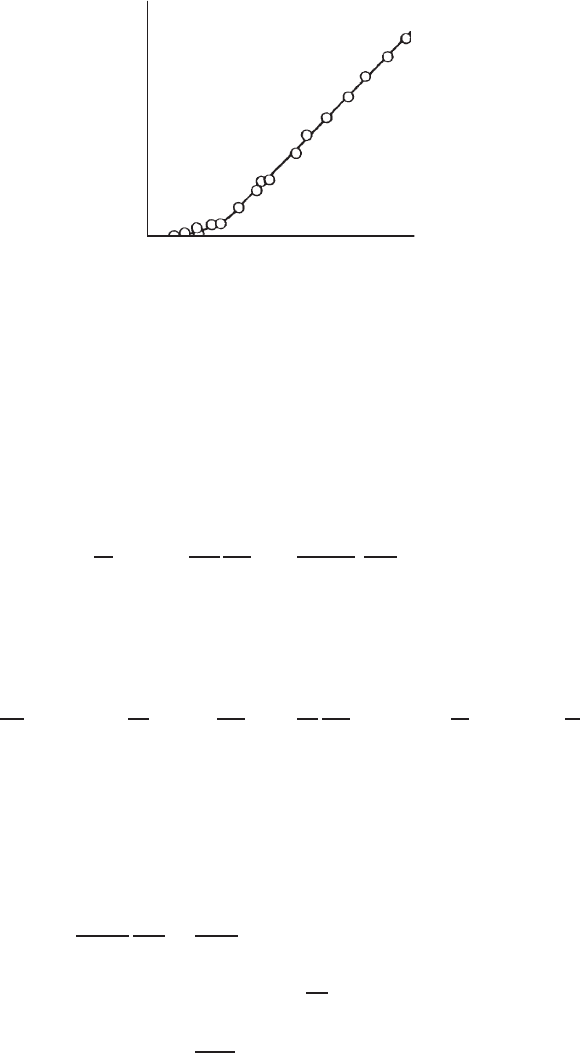
t (min)
0
P (mm Hg)
Figure 5.E.7-2 Pressure in the upper chamber versus time from the inception of the per-
meation process through the membrane separating the upper and lower chambers.
ρ
A
= HP at x = L (5.E.7-4)
The boundary condition given by equation (5.E.7-4) is in terms of the unknown
instantaneous pressure in the upper chamber. The auxiliary equation needed to
determine this pressure can be obtained from an integral mass balance on the
upper chamber as follows:
d
dt
(cV
u
) =
V
u
RT
dP
dt
=−
D
AB
S
c
M
A
∂ρ
A
∂x
x=L
(5.E.7-5)
where c is the molar density of the gas in the upper chamber, R the gas constant,
and T the absolute temperature.
Define the following dimensionless variables (steps 2, 3, and 4):
ρ
∗
A
≡
ρ
A
ρ
s
; P
∗
≡
P
P
s
;
dP
dt
∗
≡
1
˙
P
s
dP
dt
; x
∗
≡
x
x
s
; t
∗
≡
t
t
s
(5.E.7-6)
Note that we have introduced a separate scale,
˙
P
s
, for the time derivative of the
pressure since there is no reason why this should scale with P
s
and t
s
.
Introduce these dimensionless variables into the describing equations and divide
through by the coefficient of one term in each equation (steps 5 and 6):
x
2
s
D
AB
t
s
∂ρ
∗
A
∂t
∗
=
∂
2
ρ
∗
A
∂x
∗2
(5.E.7-7)
ρ
∗
A
= 0,P
∗
=
P
0
ρ
s
at t
∗
= 0 (5.E.7-8)
ρ
∗
A
=
HP
0
ρ
s
at x
∗
= 0 (5.E.7-9)
324 APPLICATIONS IN MASS TRANSFER
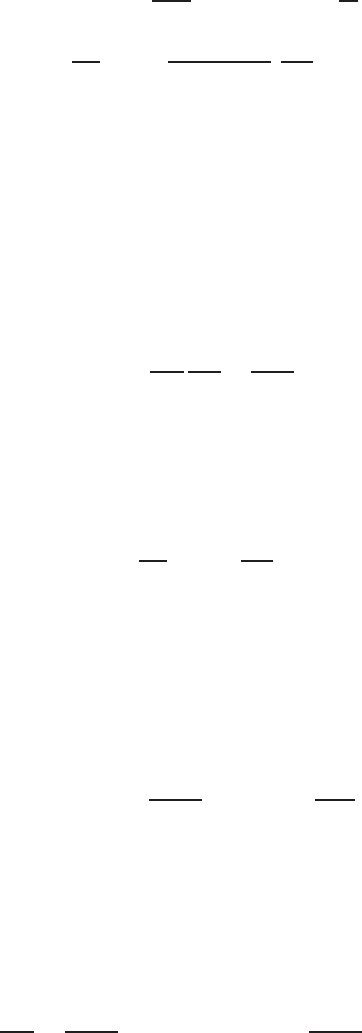
ρ
∗
A
=
HP
s
ρ
s
P
∗
at x
∗
=
L
x
s
(5.E.7-10)
dP
dt
∗
=−
D
AB
S
c
RTρ
s
M
A
V
u
x
s
˙
P
s
∂ρ
∗
A
∂x
∗
x
∗
=L/x
s
(5.E.7-11)
The scale factors are determined by means of the following considerations
(step 7). The dimensionless concentration and pressure can be bounded to be
◦
(1) by setting the dimensionless groups in equations (5.E.7-8), (5.E.7-9), and
(5.E.7-10) equal to 1 to obtain ρ
s
= HP
0
and P
s
= P
0
. Since this is unsteady-state
mass transfer, the time scale is the observation time t
o
. The length scale is obtained
from the appropriate dimensionless group in equation (5.E.7-10) equal to 1 to obtain
x
s
= L. Since the two terms in equation (5.E.7-11) must balance, the dimensionless
group in this equation is set equal to 1 to obtain
˙
P
s
= D
AB
S
c
RT HP
0
/M
A
V
u
L.
These choices for the scale factors then result in the following describing equations:
1
Fo
m
∂ρ
∗
A
∂t
∗
=
∂
2
ρ
∗
A
∂x
∗2
(5.E.7-12)
ρ
∗
A
= 0att
∗
= 0 (5.E.7-13)
ρ
∗
A
= 1atx
∗
= 0 (5.E.7-14)
ρ
∗
A
= P
∗
at x
∗
= 1 (5.E.7-15)
dP
dt
∗
=−
∂ρ
∗
A
∂x
∗
x
∗
=1
(5.E.7-16)
where Fo
m
≡ D
AB
t
o
/L
2
is the solutal Fourier number.
Now let us consider how our scaled describing equations can be used to interpret
the data shown in Figure 5.E.7-2 (step 8). The time required for any pressure
increase to occur in the upper chamber can be estimated from the time required for
the permeating component to penetrate the membrane. This corresponds to setting
the solutal Fourier number equal to 1; that is,
Fo
m
=
D
AB
t
o
L
2
= 1 ⇒ t
o
=
L
2
D
AB
(5.E.7-17)
Equation (5.E.7-17) then provides an estimate of the dead time for any pressure
response to occur in the upper chamber for the data shown in Figure 5.E.7-2. Once
the permeating component penetrates through the membrane, a period of unsteady-
state mass transfer will occur during which the pressure will increase nonlinearly
in time. The duration of the latter period can be estimated from the time required
to achieve quasi-steady-state mass-transfer conditions; that is, when
1
Fo
m
=
L
2
D
AB
t
o
1orwhent
o
∼
=
100L
2
D
AB
(5.E.7-18)

EXAMPLE PROBLEMS 325
This then provides an estimate of the time required from the introduction of
the permeating gas to achieve quasi-state mass transfer through the membrane.
We will show that the latter condition corresponds to a linear pressure increase
in time. For observation times greater than that defined by equation (5.E.7-18),
the unsteady-state term in equation (5.E.7-12) can be ignored. If, in addition,
P
∗
1, the concentration driving force across the membrane will be constant,
and equation (5.E.7-16) implies that
dP
dt
∗
= 1 ⇒
dP
dt
=
˙
P
s
=
D
AB
S
c
RT HP
0
M
A
V
u
L
⇒ P =
D
AB
S
c
RT HP
0
M
A
V
u
L
t
(5.E.7-19)
That is, the pressure will increase linearly in time, as seen in Figure 5.E.7-2 at
longer times. Note that the diffusion coefficient for permeation through the mem-
brane can be obtained from the slope in linear region of the pressure response
curve. However, when P
∗
≥ 0.1 the permeation driving force across the mem-
brane will decrease progressively, causing a less than linear increase in the pres-
sure in the upper chamber. Figure 5.E.7-2 does not show this long-time behavior
since it obviously does not include data taken for sufficiently long observation
times.
For quasi-steady-state conditions, equations (5.E.7-12) and (5.E.7-16) can be
solved analytically to obtain the following solution for the pressure in the upper
chamber:
P = P
0
&
1 − e
−
(
D
AB
S
c
RT H /M
A
V
u
L
)
t
'
(5.E.7-20)
Note that for small values of the exponent, equation (5.E.7-20) reduces to the
linear response given by equation (5.E.7-19). Hence, in summary, scaling anal-
ysis of the describing equations is able to describe all the principal features of
the pressure-response curve for this standard membrane characterization test proc-
edure.
5.E.8 Large Damk
¨
ohler Number Approximation for Laminar Flow with a
Heterogeneous Reaction
In Section 5.5 we considered steady-state laminar tube flow containing a solute A
that underwent a first-order irreversible reaction at the wall as shown in Figure 5.5-
1. We considered a scaling appropriate to a small Damk
¨
ohler number for which
the mass transfer was controlled by the slow rate of heterogeneous reaction. This
implied that the concentration gradient across the tube was negligible and the
concentration was spatially uniform. Here we apply scaling analysis to the comple-
mentary case of a large Damk
¨
ohler number corresponding to a fast heterogeneous
reaction. To supply mass to the tube wall at the same rate that it is consumed
by the heterogeneous reaction, the concentration gradient will be very steep and
occur over a region of influence or solutal boundary layer whose thickness δ
s
is
the appropriate radial length scale.

326 APPLICATIONS IN MASS TRANSFER
The appropriately simplified species-balance equation and associated boundary
conditions are the same as those in Section 5.5 (step 1):
2
U
1 −
r
2
R
2
∂c
A
∂z
= D
AB
∂
2
c
A
∂z
2
+ D
AB
1
r
∂
∂r
r
∂c
A
∂r
(5.E.8-1)
c
A
= c
A0
at z = 0 (5.E.8-2)
c
A
= f(r) at z = L (5.E.8-3)
∂c
A
∂r
= 0atr = 0 (5.E.8-4)
−D
AB
∂c
A
∂r
= k
•
1
c
A
at r = R (5.E.8-5)
It is convenient to reference the coordinate system to the surface of the tube
where the solutal boundary layer is located. Hence, we define the following dimen-
sionless variables (steps 2, 3, and 4):
c
∗
A
≡
c
A
c
s
; r
∗
≡
R − r
δ
s
; z
∗
≡
z
z
s
(5.E.8-6)
Substitute these dimensionless variables into the describing equations and divide
through by the coefficient of one term in each equation (steps 4 and 5):
4
Uδ
3
s
D
AB
Rz
s
r
∗
−
δ
s
2R
r
∗2
∂c
∗
A
∂z
∗
=
r
2
s
z
2
s
∂
2
c
∗
A
∂z
∗2
+
1
R
δ
s
− r
∗
∂
∂r
∗
R
δ
s
− r
∗
∂c
∗
A
∂r
∗
(5.E.8-7)
c
∗
A
=
c
A0
c
s
at z
∗
= 0 (5.E.8-8)
c
∗
A
= f(r
∗
) at z
∗
=
L
z
s
(5.E.8-9)
∂c
∗
A
∂r
∗
= 0atr
∗
=
R
δ
s
(5.E.8-10)
∂c
∗
A
∂r
∗
=
k
•
1
δ
s
D
AB
c
∗
A
at r
∗
= 0 (5.E.8-11)
The dimensionless groups in equations (5.E.8-8) and (5.E.8-9), when set equal
to 1 indicate that c
s
= c
A0
and z
s
= L (step 7). Since the convection and radial
heat conduction terms must be of the same order, equation (5.E.8-7) provides the
following estimate for δ
s
:
4
Uδ
3
s
D
AB
RL
= 1 ⇒ δ
s
=
D
AB
RL
4U
1/3
=
R
2
L
4Pe
m
1/3
(5.E.8-12)
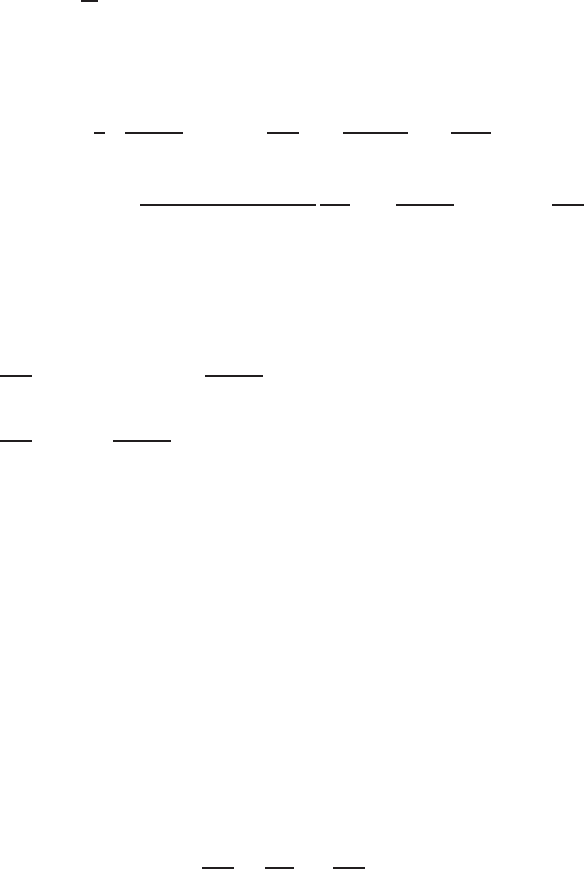
EXAMPLE PROBLEMS 327
where Pe
m
≡ UR/D
AB
is the solutal Peclet number. Substitution of these scale
factors into equations (5.E.8-7) through (5.E.8-11) then yields the following set of
dimensionless describing equations:
!
r
∗
−
1
2
L
4Pe
m
R
1/3
r
∗2
"
∂c
∗
A
∂z
∗
=
R
2
4Pe
m
L
2
2/3
∂
2
c
∗
A
∂z
∗2
+
1
&
(
4Pe
m
R/L
)
1/3
− r
∗
'
∂
∂r
∗
!
4Pe
m
R
L
1/3
− r
∗
"
∂c
∗
A
∂r
∗
#
(5.E.8-13)
c
∗
A
= 1atz
∗
= 0 (5.E.8-14)
c
∗
A
= f(r
∗
) at z
∗
= 1 (5.E.8-15)
∂c
∗
A
∂r
∗
= 0atr
∗
=
4Pe
m
R
L
1/3
(5.E.8-16)
∂c
∗
A
∂r
∗
= Da
II
L
4Pe
m
R
1/3
c
∗
A
at r
∗
= 0 (5.E.8-17)
where Da
II
≡ k
•
1
R/D
AB
is the second Damk
¨
ohler number.
Now let us consider how this set of dimensionless describing equations can
be simplified (step 8). If
R
2
/4Pe
m
L
2
2/3
1, the axial diffusion term can be
ignored in equation (5.E.8-13). If
(
L/4Pe
m
R
)
1/3
1, the curvature effects and
higher-order term in the velocity profile can be ignored in equation (5.E.8-13).
Moreover, the boundary condition given by equation (5.E.8-16) can be applied
at infinity. A zero mass flux far from the tube wall implies no change in the
concentration in the core of the flowing fluid. Hence, equation (5.E.8-16) can be
replaced by the condition that c
∗
A
= 1asr
∗
→∞. Equation (5.E.8-17) indicates
that as Da
II
→∞, c
∗
A
→ 0, to ensure that ∂c
∗
A
/∂r
∗
remains bounded of
◦
(1).
This implies that the concentration at the tube wall is zero. Hence, for large solu-
tal Peclet numbers and large Damk
¨
ohler numbers, the describing equations sim-
plify to
r
∗
∂c
∗
A
∂z
∗
=
∂
∂r
∗
r
∗
∂c
∗
A
∂r
∗
(5.E.8-18)
c
∗
A
= 1atz
∗
= 0 (5.E.8-19)
c
∗
A
= 1atr
∗
→∞ (5.E.8-20)
c
∗
A
= 0atr
∗
= 0 (5.E.8-21)
This simplified system of describing equations can be solved by standard methods,
such as combination of variables.
328 APPLICATIONS IN MASS TRANSFER
R
1
R
2
Laminar flow of feed
solution through lumen
z
r
L
lumen
Annular membrane wall
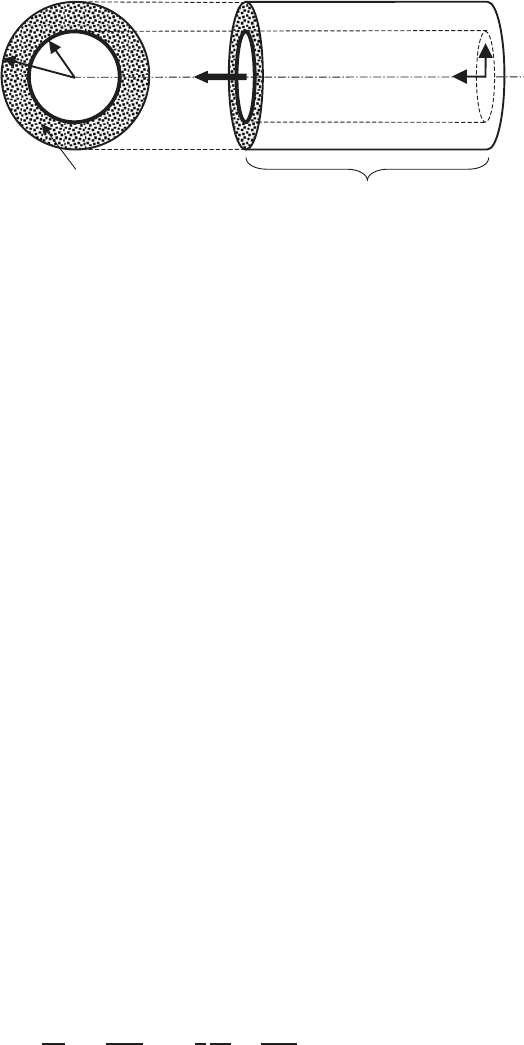
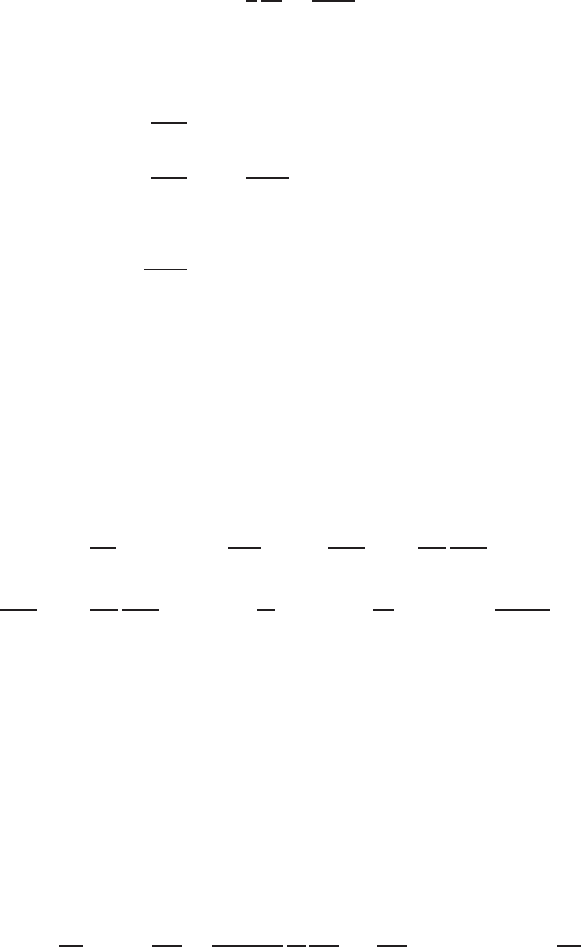
Figure 5.E.9-1 Hollow-fiber membrane of length L, lumen radius R
1
, and outer annular
membrane wall radius R
2
. A feed solution flows axially in fully developed laminar flow.
A reacting component in the feed permeates through the inner wall of the hollow fiber and
undergoes a first-order homogeneous reaction with an enzyme that is immobilized within
the pores of the annular region.
5.E.9 Small Thiele Modulus Approximation for Mass Transfer in a
Hollow-Fiber Membrane
The development of hollow-fiber membranes with diameters of at most a few
hundred micrometers has made it possible to design membrane separation systems
having a very high area-to-volume ratio. This same feature has also permitted
designing efficient catalytic membrane bioreactors by immobilizing an enzyme
within the porous matrix of the tubular membrane. Figure 5.E.9-1 shows both cross-
sectional and profile views of a single hollow-fiber membrane of length L and inner
and outer radii R
1
and R
2
, respectively. The annular membrane wall is made from
a synthetic polymer that is microporous and serves as host to the immobilized
enzyme. An ultrathin layer at the inner surface of the microporous annular region
is impermeable to the enzyme and thereby confines it, but is highly permeable
to low-molecular-weight solute(s). A solution of a low-molecular-weight solute is
then pumped through the lumen or hollow core of the hollow fiber in steady-state
laminar flow. This solute diffuses through the solution into the annular wall of the
hollow fiber, where it reacts with the enzyme via a first-order reaction in the solute
concentration. The aspect ratio of hollow fibers is such that axial diffusion can
be ignored in most applications. Moreover, the concentration of the solute in both
the solution and membrane is sufficiently dilute so that binary diffusion can be
assumed; that is, the reaction product(s) does(do) not influence the diffusion of the
solute through either the solution or the membrane. We use scaling to determine
how the describing equations for the membrane enzyme reactor can be simplified.
The species-balance equation in cylindrical coordinates given by equation (G.2-
10) in the Appendices and the corresponding boundary conditions for both the
lumen and annular wall regions of the membrane, after appropriate simplification,
are given by (step 1)
U
0
!
1 −
r
R
1
2
"
∂c
Al
∂z
= D
l
1
r
∂
∂r
r
∂c
Al
∂r
, 0 ≤ r ≤ R
1
(5.E.9-1)
EXAMPLE PROBLEMS 329
0 = D
m
1
r
∂
∂r
r
∂c
Am
∂r
− k
1
c
Am
,R
1
≤ r ≤ R
2
(5.E.9-2)
c
Al
= c
A0
at z = 0 (5.E.9-3)
∂c
Al
∂r
= 0atr = 0, 0 ≤ z ≤ L (5.E.9-4)
D
l
∂c
Al
∂r
= D
m
∂c
Am
∂r
at r = R
1
, 0 ≤ z ≤ L (5.E.9-5)
c
Am
= K
A
c
Al
at r = R
1
, 0 ≤ z ≤ L (5.E.9-6)
∂c
Am
∂r
= 0atr = R
2
, 0 ≤ z ≤ L (5.E.9-7)
where c
Al
and c
Am
are the molar concentrations of the solute in the lumen solu-
tion and annular membrane wall, respectively, U
0
the maximum fluid velocity at
the centerline of the lumen, D
l
and D
m
the effective binary diffusion coefficients
of the solute in the lumen solution and annular wall, respectively, c
A0
the initial
concentration in the feed solution to the lumen, and K
A
the distribution coefficient
for the thermodynamic equilibrium of component A between the lumen solution
and the annular membrane wall, respectively.
Define the following dimensionless variables (steps 2, 3, and 4):
c
∗
Al
≡
c
Al
c
ls
; c
∗
Am
≡
c
Am
c
ms
;
∂c
Al
∂r
∗
≡
1
c
rls
∂c
Al
∂r
;
∂c
Al
∂z
∗
≡
1
c
zls
∂c
Al
∂z
; z
∗
≡
z
z
s
; r
∗
l
≡
r
r
ls
; r
∗
m
≡
r − r
lr
r
ms
(5.E.9-8)
Note that we have introduced separate scales for the concentration and radial coor-
dinate within the lumen and the annular wall. We also have allowed separate scales
for both the axial and radial concentration gradients within the lumen since these
do not necessarily scale with the concentration scale divided by the length scale. If
we had naively scaled these derivatives with the concentration scale divided by a
length scale, the forgiving nature of scaling would have indicated a contradiction.
33
We have also allowed for a reference length factor for the radial coordinate in order
to reference it to zero within the annular membrane wall.
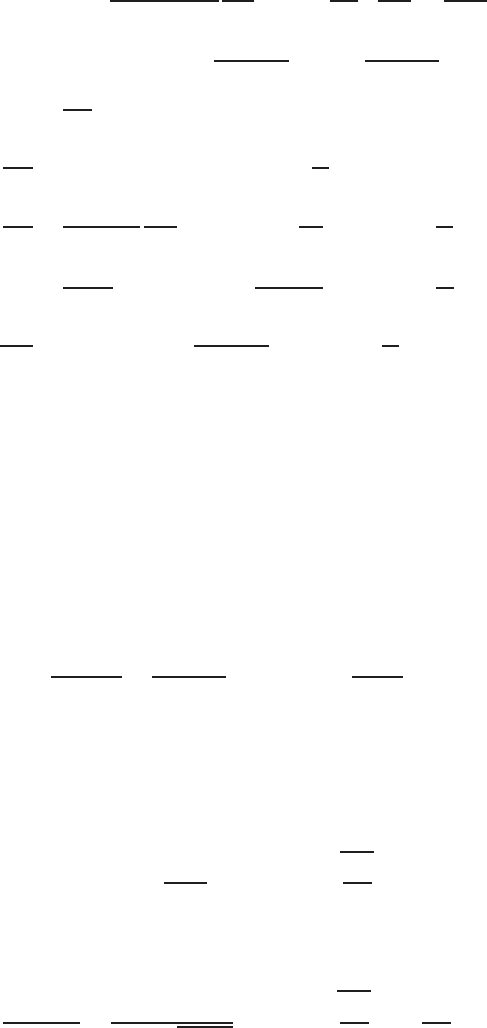
Introduce these dimensionless variables into the describing equations and divide
through by the coefficient of one term in each equation (steps 5 and 6):
!
1 −
r
ls
R
1
2
r
∗2
l
"
∂c
∗
l
∂z
∗
=
D
l
c
rls
U
0
c
zls
r
ls
1
r
∗
l
∂
∂r
∗
l
r
∗
l
∂c
∗
l
∂r
∗
l
, 0 ≤ r
∗
l
≤
R
1
r
ls
(5.E.9-9)
33
This is explored further in Practice Problem 5.P.18.
330 APPLICATIONS IN MASS TRANSFER
0 =
1
r
∗
m
+ r
mr
/r
ms
∂
∂r
∗
m
r
∗
m
+
r
mr
r
ms
∂c
∗
m
∂r
∗
m
−
k
1
r
∗2
m
D
m
c
∗
Am
R
1
− r
mr
r
ms
≤ r
∗
m
≤
R
2
− r
mr
r
ms
(5.E.9-10)
c
∗
l
=
c
A0
c
ls
at z
∗
= 0 (5.E.9-11)
∂c
∗
l
∂r
∗
= 0atr
∗
l
= 0, 0 ≤ z
∗
≤
L
z
s
(5.E.9-12)
∂c
∗
l
∂r
∗
l
=
D
m
c
ms
D
l
c
rls
r
ms
∂c
∗
m
∂r
∗
m
at r
∗
l
=
R
1
r
ls
, 0 ≤ z
∗
≤
L
z
s
(5.E.9-13)
c
∗
m
=
K
A
c
ls
c
ms
c
∗
l
at r
∗
m
=
R
1
− r
lr
r
ls
, 0 ≤ z
∗
≤
L
z
s
(5.E.9-14)
∂c
∗
m
∂r
∗
m
= 0atr
∗
m
=
R
2
− r
mr
r
ms
, 0 ≤ z
∗
≤
L
z
s
(5.E.9-15)
The following considerations dictate determining our scale factors (step 7). The
concentration in the lumen and annular membrane wall can be bounded to be
◦
(1) by setting the appropriate dimensionless groups in equations (5.E.9-11) and
(5.E.9-14) equal to 1 to obtain c
ls
= c
A0
and c
ms
= K
A
c
A0
. The axial length scale is
obtained from the dimensionless group L/z
s
. The radial length scale in the annular
membrane wall can be referenced to zero by setting the appropriate dimensionless
group equal to zero in equation (5.E.9-14) to obtain r
ls
= R
1
. Since the radial
diffusion must balance the axial convection in equation (5.E.9-9), the dimensionless
group, which is a measure of this ratio, must be set equal to 1; this establishes a
relationship between the axial and radial concentration gradient scales:
D
l
c
rls
U
0
c
zls
r
ls
=
D
l
c
rls
U
0
c
zls
R
1
= 1 ⇒ c
zls
=
D
l
c
rls
U
0
R
1
(5.E.9-16)
For steady-state to exist, all the diffusing solute must react within the annular
membrane wall. This implies that radial diffusion must balance the homogeneous
reaction within the annular membrane wall. Hence, by setting the dimensionless
group in equation (5.E.9-10) that is a measure of this ratio equal to 1, we obtain
the radial length scale factor:
k
1
r
∗2
m
D
m
= 1 ⇒ r
m
=
D
m
k
1
(5.E.9-17)
Setting the dimensionless group in equation (5.E.9-13) equal to 1 provides the scale
for the radial concentration gradient in the lumen:
D
m
c
ms
D
l
c
rls
r
ms
=
D
m
K
A
c
A0
D
l
c
rls
√
D
m
/k
1
⇒ c
rls
=
D
m
D
l
K
A
Th
c
A0
R
1
(5.E.9-18)

EXAMPLE PROBLEMS 331
where Th ≡
k
1
R
2
1
/D
l
is the Thiele modulus, a dimensionless group that is a mea-
sure of the characteristic time for diffusion in the lumen to homogeneous reaction
in the annular membrane wall. It is convenient to express the scale for the radial
concentration gradient within the lumen in terms of the Thiele modulus, since this
provides a means for assessing its magnitude relative to the maximum possible
concentration gradient.
34
These scale factors then result in the following set of dimensionless describing
equations:
1 − r
∗2
l
∂c
∗
l
∂z
∗
=
1
r
∗
l
∂
∂r
∗
l
r
∗
l
∂c
∗
l
∂r
∗
l
, 0 ≤ r
∗
l
≤ 1 (5.E.9-19)
0 =
1
r
∗
m
+ R
1
/
√
D
m
/k
1
∂
∂r
∗
m
r
∗
m
+
R
1
√
D
m
/k
1
∂c
∗
m
∂r
∗
m
− c
∗
Am
0 ≤ r
∗
m
≤
R
2
− R
1
√
D
m
/k
1
(5.E.9-20)
c
∗
l
= 1atz
∗
= 0 (5.E.9-21)
∂c
∗
l
∂r
∗
= 0atr
∗
l
= 0, 0 ≤ z
∗
≤ 1 (5.E.9-22)
∂c
∗
l
∂r
∗
l
=
∂c
∗
m
∂r
∗
m
(5.E.9-23)
c
∗
m
= c
∗
l
at r
∗
m
= 0, 0 ≤ z
∗
≤ 1 (5.E.9-24)
∂c
∗
m
∂r
∗
m
= 0atr
∗
m
=
R
2
− R
1
√
D
m
/k
1
, 0 ≤ z
∗
≤ 1 (5.E.9-25)
Now let us consider how these dimensionless describing equations can be sim-
plified (step 8). If the dimensionless group R
1
/
√
D
m
/k
1
1, implying that the
region of influence wherein the homogeneous reaction converts all of the reacting
solute to product is much thinner than the radius of the lumen, curvature effects on
the mass-transfer process can be ignored. Moreover, if (R
2
− R
1
)/
√
D
m
/k
1
1,
the aforementioned region of influence is much thinner than the thickness of the
annular membrane wall, the boundary condition given by equation (5.E.9-25) can
be applied at infinity.
The solution to equations (5.E.9-19) and (5.E.9-20) can be simplified for the
special case of very small Thiele moduli, that is, for Th 1. For this case,
equation (5.E.9-18) indicates that the concentration gradient within the lumen of
the hollow fiber is negligibly small, thereby implying that the concentration within
34
This problem is a mass-transfer analog to the heat-transfer problem considered in Section 4.4; that
is, the low Biot number approximation made in the latter is analogous to the small Thiele modulus
approximation made here.

332 APPLICATIONS IN MASS TRANSFER
the lumen is uniform. Hence, equation (5.E.9-19) can be integrated as follows:
1
0
1 − r
∗2
l
∂c
∗
l
∂z
∗
2πr
∗
l
dr
∗
l
=
1
0
1
r
∗
l
∂
∂r
∗
l
r
∗
l
∂c
∗
l
∂r
∗
l
2πr
∗
l
dr
∗
l
(5.E.9-26)
1
0
1 − r
∗2
l
∂c
∗
l
∂z
∗
r
∗
l
dr
∗
l
=
∂c
∗
m
/∂r
∗
m
0
∂
r
∗
l
∂c
∗
l
∂r
∗
l
(5.E.9-27)
Use of Leibnitz’s rule given by equation (H.1-2) in the Appendices to integrate
the first term and the fact that the concentration is essentially uniform within the
lumen for very small Thiele moduli then yields
d
dz
∗
1
0
c
∗
l
1 − r
∗2
l
r
∗
l
dr
∗
l
=
dc
∗
l
dz
∗
1
0
1 − r
∗2
l
r
∗
l
dr
∗
l
=
1
4
dc
∗
l
dz
∗
=
∂c
∗
m
∂r
∗
m
(5.E.9-28)
Equation (5.E.9-28) now replaces equation (5.E.9-23) as one of the boundary con-
ditions on the differential equation for the mass transfer with the annular membrane
wall. If the conditionsR
1
/
√
D
m
/k
1
1and(R
2
− R
1
)/
√
D
m
/k
1
1 apply, the
solution of the resulting simplified system of describing equations is straightforward
and given by
35
c
∗
l
= e
−4z
∗
; c
∗
m
= e
−(4z
∗
+r
∗
m
)
(5.E.9-29)
5.E.10 Dimensional Analysis for Oxygen Diffusion into a Spherical Red
Blood Cell
Consider a spherical red blood cell of radius R in the blood stream, as shown in
Figure 5.E.10-1. The cell is sufficiently large that it moves more slowly than the
blood flow far removed from its surface (where the no-slip condition has to be
satisfied). Hence, there is a velocity of the bloodstream U
∞
relative to that of the
red blood cell. Oxygen diffuses through the bloodstream to this red blood cell,
after which it diffuses into the cell and reacts with the hemoglobin. The oxygen
and blood are referred to as components A and B, respectively. We wish to model
the convective oxygen mass transfer through the bloodstream to the cell. However,
since this is a rather complicated problem to solve, we employ the scaling method
for dimensional analysis to obtain a correlation for the dimensionless mass-transfer
coefficient, defined by
k
L
≡
N
Aw
c
Aw
− c
A∞
(5.E.10-1)
where N
Aw
is the molar flux (moles/area·time) at the outer cell wall, c
Aw
the
oxygen concentration (moles/volume) at the outer cell wall, and c
A∞
the oxygen
35
An analytical solution to this problem accounting for curvature effects is given by W. Lewis and S.
Middleman, A.I.Ch.E.J., 20(5), 1012–1014 (1974).