
Krantz W.B. Scaling Analysis in Modeling Transport and Reaction Processes: A Systematic Approach to Model Building and the Art of Approximation
Подождите немного. Документ загружается.

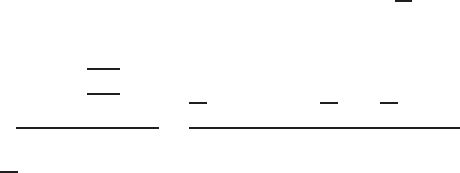
PRACTICE PROBLEMS 353
Permeable boundarie
s
Distorted velocity profile
due to mass transfer
R
1
R
2
r
2
r
1
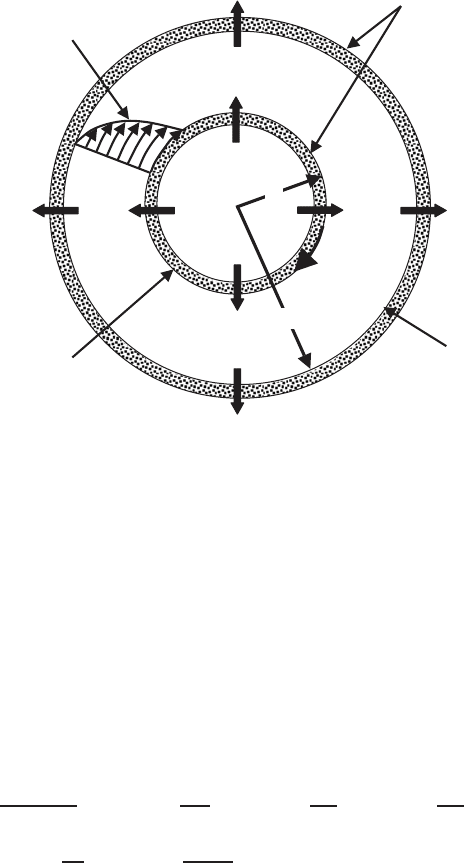
Figure 5.P.22-1 Circumferential flow between an inner permeable boundary at R
1
that is
rotating at a constant angular velocity ω (radians/time) and a stationary outer permeable
boundary at R
2
. Steady-state mass transfer occurs in the radial direction to maintain the
mass concentration at the inner and outer boundaries at ρ
1
and ρ
1
, respectively. Whereas
the circumferential fluid flow does not affect the mass transfer, the radial mass transfer can
distort the velocity profile.
(c) Write the appropriately simplified steady-state species-balance equation in
cylindrical coordinates in terms of the mass concentration ρ
A
and mass
flux n
A
along with Fick’s law of diffusion expressed in terms of the mass
flux.
(d) Write the requisite boundary conditions on the equations in part (c).
(e) Introduce the following dimensionless variables and determine the unspeci-
fied scale and reference factors:
ρ
∗
A
≡
ρ
A
− ρ
Ar
ρ
As
; n
∗
A
≡
n
A
n
As
; u
∗
r
≡
u
r
u
rs
; u
∗
θ
≡
u
θ
u
θs
;
μ
∗
≡
μ
μ
s
; r
∗
≡
r − r
r
r
s
(5.P.22-2)
(f) Determine the criterion for ignoring the curvature effects.
(g) Determine the criterion for ignoring the bulk-flow contribution to Fick’s law.
(h) Determine the criterion for ignoring the concentration-dependence of the
viscosity.
(i) Determine the criterion for ignoring the effect of the radial velocity on
distorting the circumferential velocity profile.
354 APPLICATIONS IN MASS TRANSFER
5.P.23 Bulk-Flow Effects for Free-Convection Mass Transfer from a
Vertical Cylinder
In Section 5.9 we considered solutally driven free convection caused by the tran-
spiration of water vapor through the inner wall of a vertical annular region. We
employed scaling to determine how the describing equations could be simplified
for large solutal Grashof numbers. Although we allowed for a radial component of
velocity appropriate to a developing free-convection flow, we did not allow for any
effect of the water vapor transpiration on the radial velocity. That is, the transpi-
ration of water vapor will cause a nonzero radial velocity component at the inner
wall. In this problem we use scaling analysis to determine the criterion for ignor-
ing this blowing or transpiration velocity effect. Assume that the water vapor is
transpired into the annular region at a constant radial velocity V
0
so as to maintain
a constant concentration c
A0
at the wall.
(a) Write the appropriately simplified form of the continuity equation, equations
of motion, and species-balance equation for this free-convection problem for
which the effects of the transpiration velocity must be considered.
(b) Write the requisite boundary conditions for the equations you derived in
part (a).
(c) Determine the criterion for ignoring the effect of the transpiration or blowing
velocity at the porous inner wall.
5.P.24 Free-Convection Mass Transfer Adjacent to a Transpiring Vertical
Flat Wall
Consider an infinitely wide vertical flat porous wall of length L that transpires
water vapor into initially quiescent air, as shown in Figure 5.P.24-1. The water
u
x
c
A
(x
1
, y)
c
A
(x
2
, y)
x
y
c
A
= 0
c
A0
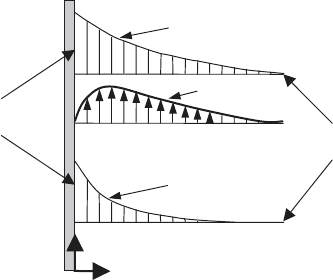
Figure 5.P.24-1 Buoyancy-induced free convection next to a vertical porous wall that
transpires water vapor into initially dry air to maintain a concentration c
A0
at its surface;
concentration profiles at positions x
1
and x
2
along the plate, where x
2
>x
1
, and the velocity
profile of the component parallel to the plate are shown.
PRACTICE PROBLEMS 355
concentration at the wall is c
A0
, whereas the quiescent air is assumed to be initially
dry. The air next to the porous wall will become less dense than the air farther
removed from it. Hence, a hydrostatic pressure imbalance will occur that causes
fluid near the wall to rise. We consider this convective flow after the transients
have died out when steady-state free convection prevails. We ignore end effects
at the top and bottom of the plate and viscous dissipation and assume constant
physical properties other than the density in the gravitational body force term in
the equations of motion. Note that this is inherently a developing flow due to
the progressive water transpiration that occurs as the fluid moves up the wall;
therefore, velocity components in both the x-andy-directions must be considered.
Since the density is temperature-dependent, we need an appropriate equation of
state. We consider small density variations and hence represent the density via a
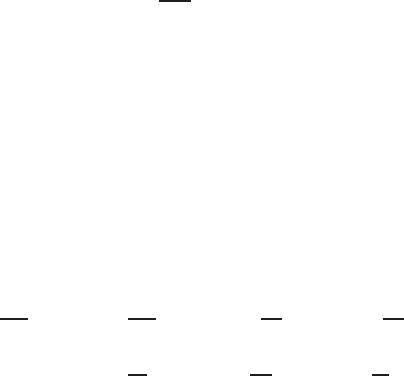
Taylor series expansion about the density ρ
0
of the dry air given by
ρ = ρ
0
+
∂ρ
∂c
A
0
c
A
= ρ
0
− ρ
0
β
s
c
A
(5.P.24-1)
where β
s
is the coefficient of solutal volume expansion. It will be convenient in
this problem to split the pressure into dynamic, P , and hydrostatic, P
h
, contribu-
tions:
P = P(x,y)+P
h
(x) (5.P.24-2)
(a) Write the appropriately simplified steady-state continuity equation, equations
of motion, and species-balance equation.
(b) Write the requisite boundary conditions on the equations in part (a).
(c) Introduce the following dimensionless variables and determine the unspeci-
fied scale and reference factors:
u
∗
x
≡
u
x
u
xs
; u
∗
y
≡
u
y
u
ys
; P
∗
≡
P
P
s
; c
∗
A
≡
c
A
c
s
;
x
∗
≡
x
x
s
; y
∗
m
≡
y
δ
m
; y
∗
c
≡
y
δ
s
(5.P.24-3)
where δ
m
and δ
s
are the momentum and solutal boundary-layer thicknesses,
respectively. Indicate why different y-length scales are used for the equations
of motion and species-balance equation.
(d) Determine the scale factors and estimate the thicknesses of both the momen-
tum and solutal boundary layers.
(e) Consider the limit of very large solutal Grashof numbers, where Gr
m
≡
L
3
gβ
s
ρ
2
0
c
A
/μ
2
,inwhichμ is the shear viscosity, to derive the boundary-
layer equations for solutal free convection.
5.P.25 Correlation for Steady-State Mass Transfer from a Sphere
Correlations for mass transfer to standard geometries are usually characterized in
terms of a dimensionless mass-transfer coefficient known as the Sherwood num-
ber or Nusselt number for mass transfer. The latter is a function of the other

356 APPLICATIONS IN MASS TRANSFER
dimensionless groups characterizing the mass-transfer process, such as the Reynolds
or Peclet number, Schmidt number, and ratios of characteristic lengths that define
the geometry. Consider steady-state flow over a sphere having radius R that is
transferring a solute A to the surrounding fluid, consisting primarily of a binary
solution of components A and B. Assume that the concentrations of solute A in
the flowing fluid adjacent to and far from the sphere are c
A0
and c
A∞
, respec-
tively. Component B is assumed to be insoluble in the sphere, and the solution is
assumed to be dilute. The physical and transport properties of the surrounding fluid
stream can be assumed to be constant and constitute the density ρ, viscosity μ,
and binary diffusion coefficient D
AB
. The fluid velocity far from the sphere is U
∞
.
We seek to develop a correlation for the steady-state mass-transfer coefficient de-
fined by
k
•
x
≡
−cD
AB
∂x
A
∂r
x
A0
− x
A∞
=
N
Ar
− x
A0
(N
Ar
+ N
Br
)
x
A0
− x
A∞
∼
=
N
Ar
x
A0
− x
A∞
(5.P.25-1)
where
N
ir
is the molar flux of component i in the r-direction averaged over
the surface of the sphere and x
A
denotes a mole fraction; the simplification in
equation (5.P.25-1) follows from applying Fick’s law of diffusion given by equ-
ation (G.3-7) in the Appendices and the assumption of dilute solutions.
(a) Write the equation that relates the average molar flux at the surface of the
sphere to the concentration.
(b) Write the appropriate forms of the continuity equation, equations of motion
and species-balance equation and their boundary conditions for this mass-
transfer problem.
(c) Use the scaling method for dimensional analysis to obtain the dimension-
less groups needed to correlate the mass-transfer coefficient defined by
equation (5.P.25-1).
(d) Consider how the correlation that you obtained in part (c) simplifies in the
limit of zero flow, that is, U
∞
= 0.
(e) Compare the result that you obtained in part (c) to the standard correlation
for the Sherwood number given by
37
Sh = 2 +0.60Re
1/2
Sc
1/3
(5.P.25-2)
where the Sherwood and Reynolds numbers are based on the sphere diam-
eter.
(f) In Practice Problem 5.P.9, scaling was applied to the aeration of water by the
sparging of spherical bubbles; each bubble was assumed to be surrounded
by a stagnant film having thickness δ
m
; use the correlation you obtained for
the mass-transfer coefficient to develop a correlation for the thickness of the
region of influence or solutal boundary layer.
37
Bird et al., Transport Phenomena, 2nd ed., p. 681.

PRACTICE PROBLEMS 357
5.P.26 Mass-Transfer-Coefficient Correlation for Film Theory
In Section 5.2 we used scaling analysis to develop the classical film theory approx-
imation. Consider the following definition of the mass-transfer coefficient:
k
•
L
≡
−ρD
AB
(∂ω
A
/∂z)
ω
A1
− ω
A0
=
n
Az
− ω
A
(n
Az
+ n
Bz
)
ω
A1
− ω
A0
(5.P.26-1)
where n
Az
is the mass-transfer flux (mass/area·time) in the z-direction and ω
A0
and
ω
A1
are the mass fractions on each side of the film.
(a) Use the scaling approach to dimensional analysis to determine the dimen-
sionless groups required to correlate the dimensionless mass-transfer coeffi-
cient (Sherwood number) for film theory. Do not assume that the convective
transport is negligible.
(b) Evaluate the Sherwood number using the general solution for the film theory
model given by equation (5.2-29), and discuss the physical significance of
the result that you obtain; that is, relate the value of the Sherwood number
to the nature of the mass transfer through a stationary film.
(c) Determine the ratio of the Sherwood number for the general case of film
theory (i.e., when convective transport is included) to the Sherwood number
for the special case of negligible convection.
(d) Discuss how the result that you obtained in part (c) could be used to cor-
rect a mass-transfer coefficient obtained from some literature correlation for
very dilute solutions (low mass transfer rates) to account for the effect of
convective transport.
(e) Discuss when using film theory might provide a reliable correction for
the effects of convective transport on a mass-transfer coefficient obtained
from a correlation applicable only to dilute solutions and low mass-transfer
fluxes.
5.P.27 Correlation for Free-Convection Mass Transfer from an Evaporating
Liquid
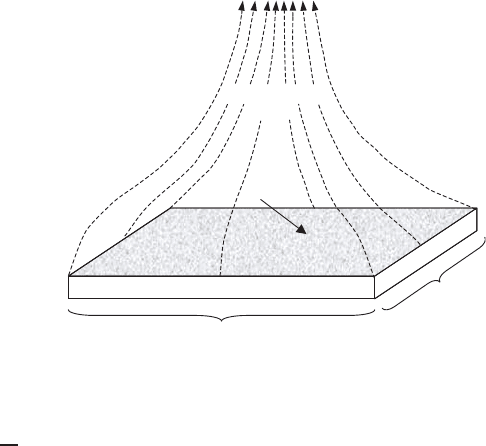
Consider a horizontal film of width W on each side that consists of a pure volatile
liquid A exposed on its upper surface to dry air, referred to a component B,as
shown in Figure 5.P.27-1. The volatile component is less dense than the surround-
ing air, so that steady-state free convection develops. The equilibrium concentration
of the volatile component in the air adjacent to the liquid–gas interface is c
A0
,
which can be assumed to be dilute. The air is assumed to be insoluble in the liquid
film. We seek to develop a correlation for the steady-state mass-transfer coefficient
defined by
k
•
x
≡
−cD
AB
∂x
A
∂y
x
A0
− x
A∞
=
N
Ay
− x
A0
(N
Ay
+ N
By
)
x
A0
− x
A∞
∼
=
N
Ay
x
A0
− x
A∞
(5.P.27-1)
358 APPLICATIONS IN MASS TRANSFER
W
W
Volatile liquid film
Free-convection
plume
c
A0
Ambient air Ambient air
Figure 5.P.27-1 Solutally driven buoyancy-induced free convection due to the evaporation
of a pure volatile liquid contained in a trough with sides of width W ; the vapor of the
evaporating liquid is less dense than that of the ambient air.
where N
iy
is the molar flux of component i in the y-direction (perpendicular
to the horizontal plate) averaged over the surface of the film and x
A
denotes a
mole fraction; the simplification in equation (5.P.27-1) follows from Fick’s law of
diffusion given by equation (G.1-7) in the Appendices and the assumption of dilute
solutions.
(a) Write the equation that relates the average molar flux at the surface of the
liquid film to the concentration.
(b) Write the appropriate forms of the continuity equation, equations of motion,
and species-balance equation and their boundary conditions for this mass-
transfer problem.
(c) Use the scaling method for dimensional analysis to obtain the dimensionless
groups needed to correlate the mass-transfer coefficient defined by equ-
ation (5.P.27-1).
(d) Compare the result that you obtained in part (c) to the standard correlation
for the Sherwood number given by
38
Sh = 0.816(Gr
m
Sc)
0.2
(5.P.27-2)
where the Sherwood and solutal Grashof numbers are based on the half-
width of the film.
5.P.28 Correlation for a Tubular Photocatalytic Reactor
Photocatalytic reactors can be used to employ solar energy for promoting hetero-
geneous natural reactions. A typical geometry involves a feed stream containing a
38
S. N. Singh, R. C. Birkebak, and R. M. Drake, Prog. Heat Mass Transfer, 2:87 (1969).
PRACTICE PROBLEMS 359
solute that diffuses to the transparent walls of the flow channel that are exposed
to sunlight. The solute decomposes due to a photocatalytic reaction at the tube
wall.
39
Consider steady-state fully developed laminar flow of a Newtonian fluid
having constant physical properties in a cylindrical tube of radius R containing
a solute A having an initial concentration c
A0
that undergoes a photocatalytic
reaction along length L, such as that shown in Figure 5.5-1. The heterogeneous
reaction is assumed to be irreversible and first-order with a reaction-rate constant
ˆ
k
1
(length/time).
(a) Develop a correlation for the Sherwood number or Nusselt number for mass
transfer as a function of the Reynolds number, Re ≡ Rρ
U/μ, and other rele-
vant dimensionless groups, where the mass-transfer coefficient is defined as
k
•
x
≡
−cD
AB
∂x
A
∂r
r=R
x
A0
− x
A∞
=
N
Ar
|
r=R
− x
A0
(N
Ar
+ N
Br
)|
r=R
x
A0
− x
A∞
(5.P.28-1)
where
N
Ar
denotes the molar flux in the r-direction averaged over the inner
wall of the photocatalytic reactor.
(b) Sketch a plot of n
∗
A
versus Re based on your dimensional analysis correlation
and the results of Section 5.5 and Example Problem 5.E.8.
(c) Based on the results of Example Problem 5.E.8, derive an equation for the
Reynolds number beyond which no further increase in the dimensionless
mass-transfer flux to the tube wall is possible for a photocatalytic reactor
system with fixed physical and chemical properties.
(d) Develop an equation for the maximum possible mass-transfer flux to the tube
wall for a photocatalytic reactor system with fixed physical and chemical
properties.
39
An annular photocatalytic reactor has been considered for removing trace amounts of trichloroethane
(TCE) from air; TCE is a common solvent and chemical intermediate used in industry; owing to its
volatility, it evaporates readily and poses a health hazard if present in air.

6 Applications in Mass Transfer
with Chemical Reaction
Taking all the mutually interfering phenomena which constitute a process of mass
transfer with chemical reaction into account simultaneously is so difficult a task that,
in practice, simplifying hypotheses are always needed. It is more useful in my opinion
to recognize these simplifying hypotheses as justified on the grounds of physical
intuition, than to perceive a strictly mathematical justification.
1
6.1 INTRODUCTION
Mass transfer with chemical reaction can be very challenging to model since it not
only can be affected by the complex hydrodynamics discussed in Chapter 3 and
heat-transfer effects considered in Chapter 4, but necessarily includes mass transfer,
discussed in Chapter 5. Indeed, reacting systems involve at least one or more fluid
phases and can involve the release or absorption of energy arising from heat-of-
reaction effects. Chemical species are no longer conserved in reacting systems but
can be depleted or generated. Hence, we would certainly agree with the first part
of the quotation at the top of the page; that is, simplifications need to be made to
model mass transfer with chemical reaction. In this chapter we address the second
part of this quotation; that is, scaling analysis provides a mathematical formalism
for justifying these approximations that obviates the need to be gifted with physical
intuition.
In Chapter 5 scaling analysis was applied to several examples that involved
either homogeneous or heterogeneous chemical reactions. However, these examples
involved mass transfer, with chemical reaction occurring on only one length scale.
We considered problems for which mass transfer with chemical reaction occurred
over the length of the reactor, such as in Section 5.4, or over a small element such
as a rising bubble in Practice Problem 5.P.9. It is easy to see how problems can
1
G. Astarita, Mass Transfer with Chemical Reaction, Elsevier, New York, 1967, pp. v–vi.
Scaling Analysis in Modeling Transport and Reaction Processes: A Systematic Approach
to Model Building and the Art of Approximation, By William B. Krantz
Copyright © 2007 John Wiley & Sons, Inc.
360
INTRODUCTION 361
arise involving transport phenomena on multiple scales. Consider, for example, the
bubbling of a gas into a countercurrently flowing liquid in which it is chemisorbed;
that is, the gaseous component dissolves in the liquid while reacting with it. The
solute from the gas phase can enter the liquid only during the short time that it
passes over a gas bubble. If the reaction is relatively slow, none of the transferring
solute will react during the short contact time for passage of the liquid over a gas
bubble. However, once the solute is in the bulk of the liquid, it can both diffuse and
react. Hence, this example involves mass transfer, with chemical reaction occurring
on two scales. There is the microscale, characterizing the flow of the liquid over
a bubble, and the macroscale, characterizing the flow through the chemisorption
device. In this chapter we employ scaling analysis to assess appropriate simplifica-
tions that can be made in both the microscale and macroscale describing equations
for mass transfer with chemical reaction.
To provide a coherent focus in this chapter, we restrict our attention to a partic-
ular form of mass transfer with a chemical reaction: namely, chemisorption. The
latter refers to the use of chemical reaction to enhance the solubility of a solute in
a fluid into which it is being transferred. However, the scaling protocols illustrated
in the chapter can be applied more generally to any type of process involving mass
transfer with chemical reaction.
This chapter has a dual focus in that it applies scaling analysis to mass trans-
fer with chemical reaction, but uses the latter as an example of scaling analysis
in microscale–macroscale modeling. In general, any system involving dispersed
phases will involve phenomena occurring on multiple scales. For example, phase-
transition phenomena such as crystallization, boiling, and condensation will involve
transport occurring on the microscale of a dispersed phase particle and on the
macroscale of the bulk liquid. A fluidized bed reactor will involve heat and or
mass transfer on the microscale of the particles as well as on the macroscale of
the reactor. The scaling protocols illustrated in this chapter can be applied to any
modeling problem involving transport phenomena and chemical reaction occurring
on multiple scales.
The organization of this chapter is somewhat different from that of the preceding
chapters. Rather than considering several different examples to illustrate how scal-
ing is used to arrive at the various approximations made in transport processes, we
focus here on illustrating how scaling is applied to microscale–macroscale modeling
using chemisorption as the example.
2
We begin with a discussion of the microscale
element in Section 6.2, since it is critical to understand precisely what is meant by
this concept. Since scaling on the microscale involves some concepts that are differ-
ent from those for the macroscale, we treat these two topics in separate sections.
In Section 6.3 we focus on applying systematic scaling analysis to the describ-
ing equations for the microscale element. Scaling of the complementary describing
equations for the macroscale element is considered in Section 6.8. Scaling analysis
2
Microscale–macroscale modeling of mass transfer with chemical reaction has been treated by other
authors, although there is no general agreement on the terminology used to describe this. Prior treatments
rely on intuition rather than systematic scaling analysis in order to simplify the describing equations at
the two scales. See, for example, Astarita, Mass Transfer with Chemical Reaction.
362 APPLICATIONS IN MASS TRANSFER WITH CHEMICAL REACTION
of the microscale element leads to the identification of various reaction regimes dis-
cussed in Sections 6.4 through 6.7. Scaling analysis of the macroscale element leads
to the identification of various reaction domains in the slow reaction regime that
are discussed in Sections 6.9 and 6.10. Scaling analysis will not only develop cri-
teria for determining the relative importance of diffusion and reaction on both the
micro- and macroscale but will also lead to a set of precepts for selecting the type
of reactor that will be most effective for a particular reaction regime or domain,
as shown in Section 6.11. Scaling analysis will be used to explain why the perfor-
mance of a contacting device for mass transfer with chemical reaction depends on the
hydrodynamics for the slow and instantaneous reaction regimes but not for the fast
reaction regime. In Section 6.12, simple models suggested by scaling analysis will
be developed to interrelate the mass-transfer coefficients in the presence and absence
of chemical reaction. The power of scaling analysis to provide considerable insight
into the design of devices involving mass transfer with chemical reaction without
the need to actually solve any model equations analytically or numerically is shown
in Section 6.11 and again in Sections 6.13 and 6.14. In Section 6.13 we illustrate
how microscale–macroscale scaling can be used to design and interpret performance
data for a continuous-stirred tank reactor. Section 6.14 does the same for a packed
gas-absorption column. In Section 6.15 we summarize the implications of scaling
analysis for microscale–macroscale modeling and, in particular, its application to
chemisorption. Unworked practice problems are included at the end of the chapter.
6.2 CONCEPT OF THE MICROSCALE ELEMENT
In developing models for complex mass-transfer processes, in particular those in-
volving dispersed phases, it is convenient to consider the concept of the microscale
element. The latter is associated with mass transfer at the smallest continuum scale.
For example, in a gas-absorption process in which a gas containing a soluble com-
ponent is bubbled through a countercurrently flowing liquid phase, the microscale
element is a gas bubble. In a fluidized bed reactor involving the flow of a gas rel-
ative to suspended recirculating solid particles, the microscale element is a solid
particle. In phase-transition processes involving growth kinetics, the microscale ele-
ment is a dispersed phase particle. In turbulent flows the microscale element can
be an eddy that transports species to and from an interface. The mass-transfer rate
on the microscale is controlled by a region of influence within the fluid adjacent to
the microscale element. A pivotal consideration in microscale–macroscale model-
ing is that the microscale element is a mathematical point on the macroscale; that is,
the mass-transfer flux from or to a microscale element becomes in the macroscale
balance a homogeneous source or sink term, respectively
3
.
3
Some authors consider the microscale element to be the thin region of fluid adjacent to what we call
the microscale element here. For example, these authors would consider the microscale element to be
a thin element of liquid flowing adjacent to and around a gas bubble rather than the bubble itself.
The definition of the microscale element used in this chapter is preferred since this is what is reduced
to a mathematical point when one considers the implications of the microscale mass transfer on the