
Krantz W.B. Scaling Analysis in Modeling Transport and Reaction Processes: A Systematic Approach to Model Building and the Art of Approximation
Подождите немного. Документ загружается.

EXAMPLE PROBLEMS 333
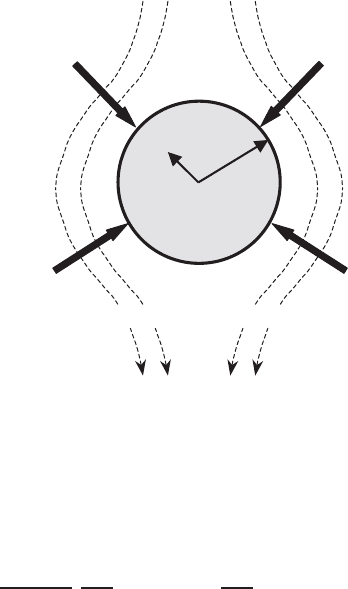
Red blood cell
r
R
Blood flow relative to blood cell
Oxygen mass
transfer from
bloodstream to
red blood cell
Figure 5.E.10-1 Steady-state oxygen mass transfer from a flowing bloodstream to a spher-
ical red blood cell.
concentration in the bulk of the bloodstream far from the red blood cell. We assume
that c
Aw
,c
A∞
,U
∞
, and the physical properties of the blood are known. Moreover,
we assume that the oxygen concentration in the blood is dilute.
Equation (5.E.10-1) requires determination of N
Aw
, which is given by
N
Aw
=−
D
AB
1 − x
A∞
∂c
A
∂r
R
∼
=
−D
AB
∂c
A
∂r
R
(5.E.10-2)
where D
AB
is the effective binary diffusion coefficient of oxygen in blood and
x
Aw
is the oxygen mole fraction at the outer wall of the red blood cell. The
molar concentration in equation (5.E.10-2) would have to be determined from a
solution to the coupled species-balance equation and equations of motion given
by equations (B.5-3) and (B.2-3) in the Appendices, respectively, which when
appropriately simplified in a spherical coordinate system referenced to the center
of the spherical red blood cell are given by
u ·∇c
A
= D
AB
∇
2
c
A
(5.E.10-3)
ρ u ·∇u = μ∇
2
u −∇P (5.E.10-4)
where u is the vector velocity in the bloodstream, ρ and μ are the mass density
and shear viscosity of the blood, respectively, and P is the pressure. Note that each
term in equation (B.5-3) has been divided by the molecular weight of component
A in arriving at equation (5.E.10-3). The boundary conditions required to solve
equations (5.E.10-3) and (5.E.10-4) are given formally as follows:
c
A
= c
Aw
at r = R (5.E.10-5)
n ·u = 0atr = R (5.E.10-6)
334 APPLICATIONS IN MASS TRANSFER
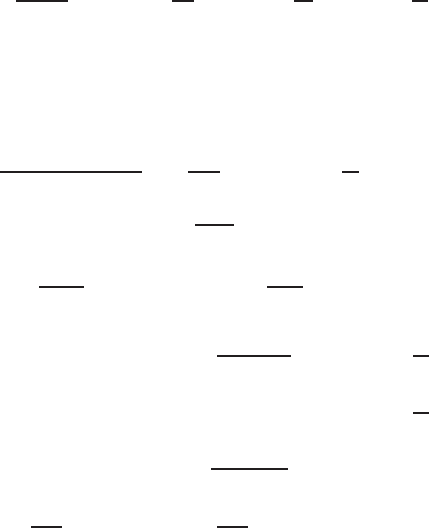
c
A
= c
A∞
as r →∞ (5.E.10-7)
u ·
δ
r
= U
∞
cos θ, u ·
δ
θ
= U
∞
sin θ as r →∞ (5.E.10-8)
where
δ
r
and
δ
θ
are unit vectors in the radial and circumferential directions,
respectively. It is not necessary to specify any boundary conditions on the pres-
sure if the velocity of the bloodstream far from the red blood cell is specified.
Equations (5.E.10-1) through (5.E.10-8) constitute step 1 in the scaling analysis
procedure for dimensional analysis.
Define arbitrary scale factors for all the dependent and independent variables and
reference factors for those variables not naturally referenced to zero (steps 2 and 3):
c
∗
≡
c − c
r
c
s
; P
∗
≡
P
P
s
;u
∗
≡
u
u
s
; r
∗
≡
r
r
s
(5.E.10-9)
Note that we do not need to scale the angular coordinates θ and φ, since they are
dimensionless and bounded of
◦
(1).
Introduce these dimensionless variables into the describing equations and divide
through by the dimensional coefficient of one term in each equation (steps 4 and 5):
k
L
(c
Aw
− c
A∞
)r
s
D
AB
c
s
=−
∂c
∗
A
∂r
∗
at r
∗
=
R
r
s
(5.E.10-10)
u
s
r
s
D
AB
u
∗
·∇
∗
c
∗
A
=∇
∗2
c
∗
A
(5.E.10-11)
ρv
s
r
s
μ
u
∗
·∇
∗
u
∗
=∇
∗2
u
∗
−
P
s
r
s
μu
s
∇
∗
P
∗
(5.E.10-12)
c
∗
A
=
c
Aw
− c
r
c
s
at r
∗
=
R
r
s
(5.E.10-13)
n ·u
∗
= 0atr
∗
=
R
r
s
(5.E.10-14)
c
∗
A
=
c
A∞
− c
r
c
s
as r
∗
→∞ (5.E.10-15)
u
∗
·
δ
r
=
U
∞
u
s
cos θ, u
∗
·
δ
θ
=
U
∞
u
s
sin θ as r
∗
→∞ (5.E.10-16)
Step 6 involves setting the various groups equal to 1 or zero to determine
the scale and reference factors, respectively. Since there is no attempt to achieve
◦
(1) in dimensional analysis scaling, it makes no difference which groups we
choose. Hence, the two dimensionless groups in equation (5.E.10-13), when set
equal to zero and 1, respectively, indicate that c
r
= c
Aw
and r
s
= R.The
dimensionless group in equation (5.E.10-15), when set equal to 1, indicates that
c
s
= c
A0
− c
Aw
. Setting the dimensionless group in equation (5.E.10-16) equal
to 1 indicates that u
s
= U
∞
. The dimensionless group in equation (5.E.10-12)
multiplying the dimensionless pressure gradient, when set equal to 1, indicates

EXAMPLE PROBLEMS 335
that P
s
= μU
∞
/R. These choices then yield the following minimum parametric
representation of the describing equations:
Sh =
∂c
∗
A
∂r
∗
at r
∗
= 1 (5.E.10-17)
Pe
m
·u
∗
·∇
∗
c
∗
A
=∇
∗2
c
∗
A
(5.E.10-18)
Re ·u
∗
·∇
∗
u
∗
=∇
∗2
u
∗
−∇
∗
P
∗
(5.E.10-19)
c
∗
A
= 0atr
∗
= 1 (5.E.10-20)
n ·u
∗
= 0atr
∗
= 1 (5.E.10-21)
c
∗
A
= 1asr
∗
→∞ (5.E.10-22)
u
∗
·
δ
r
= cos θ, u
∗
·
δ
θ
= sin θ as r
∗
→∞ (5.E.10-23)
where
Sh ≡
k
L
R
D
AB
is the Sherwood number (5.E.10-24)
Pe
m
≡
U
∞
R
D
AB
is the solutal Peclet number (5.E.10-25)
Re ≡
ρU
∞
R
μ
is the Reynolds number (5.E.10-26)
Note that Sherwood number provides a measure of the overall mass transfer to that
by diffusion alone; as such, it is analogous to the Nusselt number in heat transfer.
The solutal Peclet number is a measure of the convective to diffusional transport
of species. Equation (5.E.10-17) implies that the Sherwood number is a function of
the dimensionless groups involved in determining ∂c
∗
/∂r
∗
|
r
∗
=1
and hence will be
a function of only the dimensionless groups involved in solving equations (5.E.10-
18) and (5.E.10-19), which introduce the Peclet and Reynolds numbers. Hence, we
conclude that oxygen transfer to a red blood cell can be correlated in terms of three
dimensionless groups, that is,
Sh = f(Re, Pe
m
) (5.E.10-27)
Note that a naive application of the Pi theorem would imply that five dimensionless
groups would be required (i.e., n = 8andn = 3).
The three dimensionless groups in the correlation given by equation (5.E.10-
27) are not unique. It is convenient to isolate the velocity into just one group by
applying the formalism indicated in equation (2.4-2); that is,
Sc = Pe
m
Re
−1
=
μ
ρD
AB
≡ the Schmidt number (5.E.10-28)
Hence, our modified correlation for the Sherwood number is given by
Sh = f(Re, Sc) (5.E.10-29)

336 APPLICATIONS IN MASS TRANSFER
A frequently used equation for the Sherwood number for mass transfer to a
single sphere that has a constant velocity relative to a fluid far removed from
it is
36
Sh = 1 +0.4536
√
Re · Sc = 1 + 0.4536
Pe
m
(5.E.10-30)
Equation (5.E.10-30) indicates that the Sherwood number can be correlated in terms
of just one dimensionless group, the solutal Peclet number. Note that this correlation
is applicable only in the limit of very small Reynolds numbers. This more restrictive
correlation can be obtained from the general correlation given by equation (5.E.10-
29) by invoking the formalism suggested by equation (2.4-3); that is, by expanding
equation (5.E.10-29) in a Taylor series for small Reynolds number (step 9):
Sh = f(Re, Pe
m
) = f |
Re
=0
+
∂f
∂Re
Re
=0
Re + O(Re
2
) (5.E.10-31)
Hence, in the limit of very small Reynolds number, we conclude that
Sh = f(Pe
m
) = f(Re · Sc) (5.E.10-32)
which is consistent with the form of equation (5.E.10-30).
5.P PRACTICE PROBLEMS
5.P.1 Penetration Theory Approximation for a Specified Equation of State
Consider unsteady-state mass transfer in the liquid film considered in Section 5.3
and shown in Figure 5.2.1. The boundary conditions at z = 0andz = H remain
the same. However, rather than specifying the ratio of the mass fluxes, an equation
of state is given for the mass density of the form
ρ = ω
A
ρ
0
A
+ ω
B
ρ
0
B
(5.P.1-1)
where ω
i
and ρ
0
i
are the mass fraction and pure component mass density of com-
ponent i. Use scaling analysis to determine when the convective transport arising
from the diffusive mass transfer can be neglected.
5.P.2 Error Estimate for Penetration Theory Approximation
Consider unsteady-state mass transfer through the liquid film considered in Sec-
tion5.3andshowninFigure5.2-1.
36
Bird et al., Transport Phenomena, 2nd ed., p. 678. Note that this reference defines the Sherwood and
Reynolds numbers in terms of the sphere diameter rather than the radius.

PRACTICE PROBLEMS 337
(a) Estimate the time required for the mass transfer to penetrate the entire thick-
ness of the film.
(b) Consider the special case of unimolecular diffusion of component A in
stationary component B for which equation (5.2-6) implies that κ = 0. Solve
equations (5.3-2) through (5.3-6) for the concentration profile ρ
∗
A
(z
∗
,t
∗
),in-
voking the penetration theory approximation given by equation (5.3-7) while
retaining the convective mass-transfer contribution to the mass flux in equ-
ation (5.3-3).
(c) Plot ρ
∗
A
(z
∗
,t
∗
) as a function of the dimensionless group
1
defined by
equation (5.2-26) to show the error encountered when the convective contri-
bution to the total mass-transfer flux defined by equation (5.3-3) is ignored.
5.P.3 Diffusion in a Tapered Pore
In Section 5.E.3 we considered steady-state binary gas-phase diffusion at constant
pressure and temperature through the pore shown in Figure 5.E.3-1, which has a
nonconstant circular cross-sectional area with a radius R = R
0
− β
√
z,whereβ
is a constant. The concentration at the mouth of the pore was held constant at
c
A0
(moles/volume), whereas it was maintained at zero at z = L. We scaled this
problem to determine a criterion to assess when radial diffusion could be neglected.
Determine when this assumption is no longer valid.
5.P.4 Liquid Evaporation for Short Contact Times
In Section 5.7 we considered the unsteady-state evaporation of a pure liquid con-
tained in a cylindrical tube that initially contained none of the evaporating compo-
nent in the gas phase and for which the evaporating component concentration was
maintained at zero, as shown in Figure 5.7-1. We considered a long-time scaling
to assess when quasi-steady-state could be assumed. Here we consider this same
problem for very short contact times.
(a) Write the appropriately simplified species-balance equation and its initial
and boundary conditions.
(b) Consider an integral mass balance in order to derive an auxiliary condition
needed to determine the location of the moving liquid–gas interface.
(c) Scale the describing equations appropriate to very short contact times to
determine the thickness of the region of influence wherein all the mass
transfer is effectively concentrated.
(d) Develop a criterion for assuming that the boundary condition at the entrance
of the tube can be applied at infinity; note that if this criterion is satisfied,
a pseudo-convection term is not generated when converting the describing
equations to a translated coordinate system.
(e) Use your scaling analysis result in part (c) to determine when the region of
influence penetrates the entrance of the tube.

338 APPLICATIONS IN MASS TRANSFER
(f) Determine the criterion for ignoring the convective contribution to the mass-
transfer flux.
5.P.5 Mass Transfer to Film Flow Down a Vertical Plane
In Section 5.6 we applied scaling analysis to the absorption of a soluble gas into
falling film flow. We found that if the solutal Peclet number were sufficiently
large, the mass transfer was confined to a region of influence in the vicinity of the
liquid–gas interface. Moreover, if the solutal Peclet number were sufficiently large,
we found that the convective mass transfer was influenced only by the velocity at
the liquid–gas interface. However, both of these approximations have limitations
that we explore in this problem.
(a) Based on the scaling analysis in Section 5.6, determine when the region of
influence or mass-transfer boundary layer penetrates the full distance from
the liquid–gas interface to the solid boundary.
(b) Determine when the assumption that the convective mass transfer is influ-
enced only by the surface velocity breaks down.
(c) Determine the thickness of the region of influence near the top of the liquid
film wherein axial diffusion cannot be neglected.
(d) Discuss how the scaling analysis done in Section 5.6 can be used to solve
the full set of elliptic differential equations that are required to describe
mass transfer at the top of the liquid film.
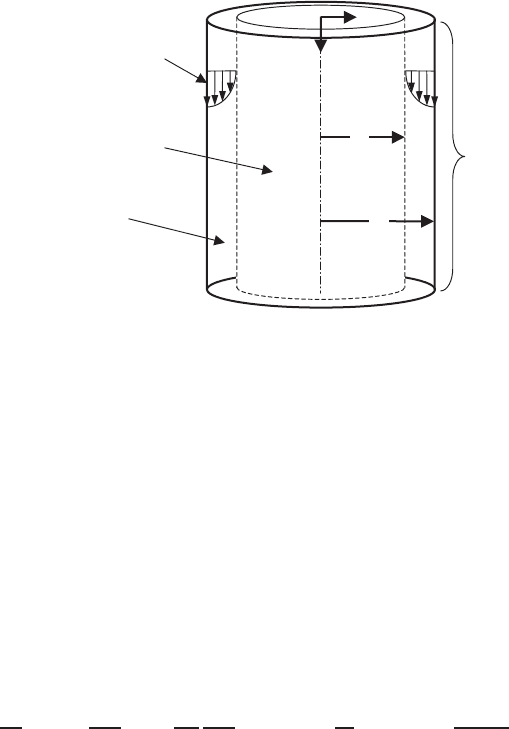
5.P.6 Mass Transfer to Film Flow Down a Vertical Cylinder
Consider the absorption of a sparingly soluble component from an inviscid gas into
a liquid film in fully developed laminar flow down a cylindrical wire of radius R
1
.
The liquid–gas interface is located at R
2
, as shown in Figure 5.P.6-1. The liquid
film has an initial concentration c
A0
at z = 0 and an interfacial concentration c
AI
established through equilibrium with the adjacent gas phase. The velocity profile
in the liquid film is given by
u
z
= U
m
(r
2
− R
2
1
) − 2R
2
2
ln(r/R
1
)
(R
2
2
− R
2
1
) − 2R
2
2
ln(R
2
/R
1
)
(5.P.6-1)
where U
m
is the maximum liquid velocity: namely, at the liquid–gas interface.
(a) Use scaling analysis to develop a criterion for assuming that the mass transfer
is confined to a region of influence or boundary layer near the liquid–gas
interface.
(b) Develop a criterion for assuming that the convective mass transfer is influ-
enced only by the surface velocity of the liquid film.
(c) Develop a criterion for ignoring the axial diffusion of species.
(d) Develop a criterion for assuming that the curvature effects can be ignored.
PRACTICE PROBLEMS 339
r
z
R
1
R
2
L
Cylindrical rod
Liquid film
Velocity profile
Figure 5.P.6-1 Mass transfer of a sparingly soluble solute from an inviscid gas to a liquid
film flowing down a vertical cylindrical rod.
5.P.7 Mass Transfer with Chemical Reaction for Flow Between
Semipermeable Membranes
In Section 5.4 we considered fully developed laminar flow between two parallel
semipermeable membrane boundaries through which a component was injected that
reacted with the liquid feed stream. We considered a low solutal Peclet number
scaling for which the convective transport of species could be neglected. However,
we considered the implications of both a low and a high Thiele modulus, corre-
sponding to very slow and very fast homogeneous reaction conditions. Consider
this same flow geometry, as shown in Figure 5.4-1 for the special case of a high
Thiele modulus when convective mass transfer is important. For this scaling use
the following dimensionless variables:
c
∗
A
≡
c
A
c
s
;
∂c
A
∂x
∗
≡
1
c
xs
∂c
A
∂x
; x
∗
≡
x
x
s
; y
∗
≡
y
r
− y
y
s
(5.P.7-1)
(a) Indicate why a separate scale is needed for the axial derivative of the con-
centration and why a reference factor is needed for the transverse coordinate.
(b) Determine the scale and reference factors for this convective mass-transfer
problem.
(c) Determine the thickness of the region of influence near the membrane bound-
aries within which all the permeating reactant is consumed.
(d) Determine the criterion for assuming that the velocity profile can be lin-
earized.
(e) Determine the criterion for ignoring the axial diffusion of species.
(f) Indicate when the criterion in part (e) breaks down.
(g) When the criterion in part (e) is not satisfied, the full elliptic problem must
be considered. Often an appropriate downstream boundary condition to solve
340 APPLICATIONS IN MASS TRANSFER
this elliptic problem is not known. Indicate how the results of the scaling
analysis in parts (a) through (e) can be used to solve the full elliptic problem
in the entry region.
5.P.8 Entrance Effect Limitations for Laminar Tube Flow with a Fast
Heterogeneous Reaction
In Example Problem 5.E.8 we considered fully developed laminar flow in a cylin-
drical tube for which a solute underwent an irreversible heterogeneous reaction at
the wall. We considered the special case of a very large Damk
¨
ohler number for
which our scaling analysis indicated that there was a region of influence or solutal
boundary layer near the tube wall across which the concentration dropped from its
initial value to essentially zero.
(a) Scaling analysis for large Damk
¨
ohler numbers led to a simplified set of
describing equations given by (5.E.8-18) through (5.E.8-21). Indicate when
the criteria leading to these simplified equations break down.
(b) Determine the thickness of the region of influence near the entrance of the
tube wherein the axial diffusion term cannot be neglected.
(c) When the axial diffusion term cannot be neglected, one is faced with solving
an elliptic system of equations for which a downstream boundary condition
is required. Indicate how the results of the scaling analysis in Example Prob-
lem 5.E.8 can be used to solve the full elliptic problem in the entry region.
(d) In Section 5.4 we considered steady-state convective mass transfer for the
case of a homogeneous chemical reaction and found that for sufficiently small
Peclet numbers, the convective transport of species could be neglected. Is a
small Peclet number approximation ever justified for steady-state mass trans-
fer in the convective mass-transfer problem being considered in Example
Problem 5.E.8?
5.P.9 Aeration of Water Containing Aerobic Bacteria
Consider a spherical bubble consisting of pure oxygen with a radius R rising at
its terminal velocity U
t
through at stationary tank of water of depth L.Thewater
contains aerobic bacteria that consume dissolved oxygen via a zeroth-order reaction
whose rate constant is k
0
(moles/volume·time). The water is assumed to have no
oxygen at the bottom of the tank where the bubbles enter. The bubbles can be
assumed to become saturated with water vapor very quickly relative to the oxygen
transfer to the liquid. The corresponding equilibrium concentration of oxygen in
water, denoted by c
A0
(moles/volume), will be assumed to be unaffected by the
small increase in the bubble pressure associated with the decrease in bubble size due
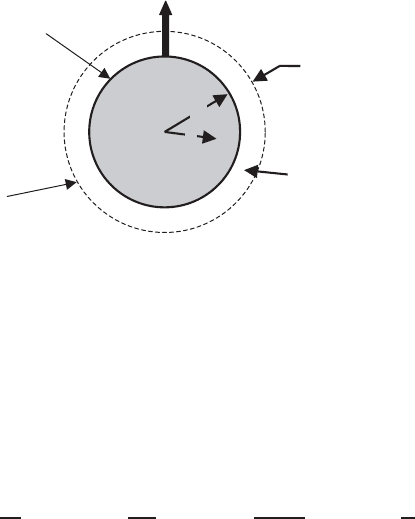
to oxygen absorption. We assume that the bubbles rise such that the hydrodynamics
cause the mass transfer to be confined to a film of liquid having a constant thickness
δ
m
that surrounds each bubble as shown in Figure 5.P.9-1. However, δ
m
is not
necessarily thin in comparison to the radius of the bubble. We ignore any effects
PRACTICE PROBLEMS 341
U
t
d
m
r
Oxygen
bubble
Stagnant film determined
by hydrodynamics
c
A0
c
A0
= 0
Liquid water containing
aerobic bacteria
R
Figure 5.P.9-1 Water-saturated oxygen bubble of radius R rising at its terminal velocity
U
t
in liquid water containing aerobic bacteria that consume the oxygen via a zeroth-order
reaction.
of the change in bubble size and also assume that the molar density of the liquid,
c, remains constant. Use the following dimensionless variables containing arbitrary
scale and reference factors for scaling this problem:
c
∗
A
≡
c
A
c
s
; N
∗
A
≡
N
A
N
s
; r
∗
≡
r − r
r
r
s
; t
∗
≡
t
t
s
(5.P.9-1)
(a) Consider a spherical coordinate system located at the center of a single
rising bubble as shown in Figure 5.P.9-1; write the appropriate form of the
species-balance equation in spherical coordinates along with the requisite
initial and boundary conditions; do not ignore the bulk-flow contribution
to the molar flux; note that if the oxygen bubbles are saturated with water
vapor, this is unimolecular diffusion.
(b) Introduce the dimensionless variables defined above into your describing
equations and determine the relevant scale and reference factors; note that
the observation time for this problem is well-defined since it will be the
time required for a bubble to rise at its terminal velocity through the entire
depth of liquid.
(c) Determine the criterion for ignoring curvature effects.
(d) Determine the criterion for assuming quasi-steady-state.
(e) Determine the criterion for ignoring the effect of the bacterial consumption
of oxygen.
(f) Consider the case of a very fast bacterial consumption of oxygen such that
the oxygen concentration is essentially reduced to zero within a distance
much smaller than the film thickness δ
m
; determine the region of influ-
ence or boundary-layer thickness wherein all the diffusive mass transfer
occurs.
342 APPLICATIONS IN MASS TRANSFER
(g) Discuss how the scaling of this problem would change if we allowed
for the effects of the decrease in bubble size due to the oxygen absorp-
tion.
5.P.10 Dissolution of a Spherical Capsule for a Concentrated Solution
In Section 5.E.4 we considered the dissolution of a spherical capsule of pure solid
component A as shown in Figure 5.E.4-1 and used scaling analysis to assess how
the describing equations could be simplified. One assumption that we made was
that the solution was dilute, which permitted us to ignore the bulk-flow contribution
to Fick’s law of diffusion. In this problem we no longer assume dilute solutions
but assume constant physical properties and that the effect of any reaction products
resulting from the dissolution can be ignored.
(a) Rescale this problem appropriate to a slow chemical reaction to assess when
the reaction and the bulk-flow contributions can be ignored.
(b) Rescale this problem appropriate to a fast chemical reaction to assess when
quasi-steady-state can be assumed and when the bulk-flow contribution can
be ignored.
5.P.11 Dissolution of a Spherical Capsule for a Bimolecular Reaction
In Section 5.E.4 we considered the mass transfer from a spherical capsule of pure
solid component A as shown in Figure 5.E.4-1 for the case of a first-order dissolu-
tion chemical reaction. Assume now that the dissolution kinetics are governed by
a bimolecular reaction of component A with the stomach liquid B, for which the
reaction rate (moles/volume·time) is given by R
A
= k
2
c
A
c
B
,wherek
2
is the second-
order reaction-rate constant. We do not assume dilute solutions in this problem but
assume constant physical properties and that the effect of any reaction products
resulting from the dissolution can be ignored.
(a) Write the appropriately simplified species-balance equations and their initial
and boundary conditions in spherical coordinates; express the concentrations
in terms of mole fractions.
(b) Carry out an integral mass balance to obtain the auxiliary equation required
to determine the location of boundary that defines the interface between the
spherical capsule and the stomach liquid.
(c) Scale the describing equations for conditions appropriate to a fast homoge-
neous chemical reaction.
(d) Determine the criterion for quasi-steady-state mass transfer.
(e) Determine the criterion for ignoring the bulk-flow contribution to the mass-
transfer flux.
(f) Determine the criterion for ignoring the curvature effects on the mass
transfer.