
Krantz W.B. Scaling Analysis in Modeling Transport and Reaction Processes: A Systematic Approach to Model Building and the Art of Approximation
Подождите немного. Документ загружается.

PRACTICE PROBLEMS 343
(g) Use your scaling analysis with the simplification considered in part (e) to
estimate the time required for the capsule to dissolve.
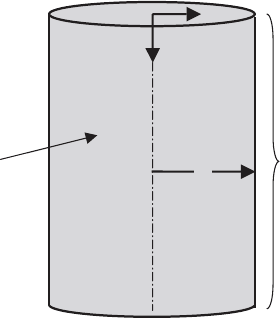
5.P.12 Slow Dissolution of a Cylindrical Capsule
Consider the dissolution of a medication in the form of a cylindrical capsule of pure
solid component A with initial radius and length, R
0
and L
0
, respectively, as shown
in Figure 5.P.12-1. We assume that this cylindrical solid capsule is swallowed and
dissolves in the acidic aqueous liquid environment of the stomach via binary diffu-
sion accompanied by a relatively slow zeroth-order homogeneous chemical reaction
for which the rate constant is k
0
(moles/volume·time). The equilibrium solubility
mole fraction of component A in the stomach liquid is x
A0
. The binary solution can
be assumed to be dilute and to have constant physical and transport properties. How-
ever, mass transfer must be considered from both the circumferential area and the
end of the cylindrical capsule. We scale this problem to assess when the mass trans-
fer from the circular ends of the cylindrical capsule can be neglected; this has sig-
nificant consequences for how you determine your length scales. We also make the
assumption that the capsule remains a cylinder throughout the dissolution process.
In fact, variations in the mass-transfer fluxes along the length and ends of the cylin-
der will gradually cause it to become ellipsoidal and eventually spherical. However,
during the early stage of the dissolution process, the cylindrical shape will be main-
tained at least approximately. Note that because of the plane of symmetry in the cap-
sule, one can consider the mass-transfer problem only for one-half of the capsule.
(a) Write the appropriately simplified species-balance equation and its initial and
boundary conditions in cylindrical coordinates; express the concentration in
terms of mole fraction.
R
L
z
Cylindrical capsule of
pure component A
r
Stomach liquid
Figure 5.P.12-1 Unsteady-state dissolution of a medication in the form of a cylindrical
capsule of pure component A into the stomach liquid, where it is consumed via a zeroth-order
homogeneous chemical reaction.
344 APPLICATIONS IN MASS TRANSFER
(b) Carry out an integral mass balance to obtain the auxiliary equation required
to determine the location of boundary that defines the interface between
the cylindrical capsule and the stomach liquid; account for both a changing
cylindrical radius and length.
(c) Scale the describing equations for conditions appropriate to a relatively slow
homogeneous chemical reaction.
(d) Based on your scaling analysis, discuss whether quasi-steady-state mass
transfer is ever possible.
(e) Determine the criterion for ignoring mass transfer from the ends of the
cylindrical capsule.
(f) Determine the criterion for ignoring the curvature effects on the mass
transfer.
(g) Use your scaling analysis with the simplification considered in part (e) to
estimate the time required for the cylindrical capsule to dissolve.
5.P.13 Dissolution of a Cylindrical Capsule in the Fast Reaction Limit
Let us consider the mass-transfer problem defined in Practice Problem 5.P.12 for
the special case of a fast reaction.
(a) Write the appropriately simplified species-balance equation and its initial and
boundary conditions in cylindrical coordinates; express the concentration in
terms of mole fraction.
(b) Carry out an integral mass balance to obtain the auxiliary equation required
to determine the location of boundary that defines the interface between
the cylindrical capsule and the stomach liquid; account for both a changing
cylindrical radius and length.
(c) Scale the describing equations for conditions appropriate to a fast homoge-
neous chemical reaction.
(d) Determine the criterion for assuming quasi-steady-state mass transfer.
(e) Determine the criterion for ignoring the curvature effects on the mass
transfer.
(f) Use your scaling analysis with the simplification considered in part (e) to
estimate the time required for the cylindrical capsule to dissolve completely;
do not ignore the dissolution from the ends of the capsule in determining
your estimate.
5.P.14 Diffusional Growth of a Nucleated Water Droplet
Nucleation of a liquid droplet from a gas phase requires that the latter be suf-
ficiently supersaturated with the nucleating component. This is required because
a submicroscopic nucleus has a large surface area relative to its volume, which
increases its Gibbs free energy. Supersaturation in turn increases the Gibbs free
energy of this component in the gas phase, thereby permitting a decrease in the
PRACTICE PROBLEMS 345
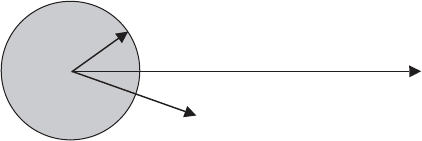
R(t)
r
c
A∞
r → ∞
c
A0
Growing
water droplet
Air supersaturated
with water vapor
Figure 5.P.14-1 Water droplet of instantaneous radius R(t) growing in supersaturated air
at concentration c
A∞
due to diffusion and instantaneous heterogeneous nucleation on its
surface, at which the saturated gas-phase concentration is c
A0
.
system Gibbs free energy via nucleation. Once nucleation occurs, the dispersed
phase droplets grow via coalescence with neighboring droplets and diffusion of the
nucleating component from the supersaturated gas accompanied by heterogeneous
nucleation on their surface. Here we explore the diffusive growth of a water droplet
in supersaturated air as shown schematically in Figure 5.P.14-1. We assume that
the heterogeneous nucleation occurs instantaneously. The droplet has a negligible
initial radius and an instantaneous radius R(t). The supersaturation concentration is
c
A∞
, whereas the thermodynamic equilibrium concentration of water in the atmo-
sphere at the prevailing temperature is c
A0
. Since nuclei are quite small, we assume
that this water droplet initiates from a zero radius. We use scaling to explore how
this mass-transfer problem can be simplified.
(a) Write the appropriately simplified species-balance equation and its initial
and boundary conditions in spherical coordinates; express the concentration
in terms of mole fraction and assume dilute solutions with constant physical
properties.
(b) Carry out an integral mass balance to obtain the auxiliary equation required
to determine the location of boundary that defines the interface between the
water droplet and the atmosphere.
(c) Use scaling analysis to estimate the thickness of the region of influence or
solutal boundary layer wherein essentially all the mass transfer is occurring.
(d) Determine the criterion for ignoring the curvature effects on the mass
transfer.
(e) Can quasi-steady-state conditions ever be achieved in this mass-transfer
problem?
5.P.15 Crystallization from a Supersaturated Liquid
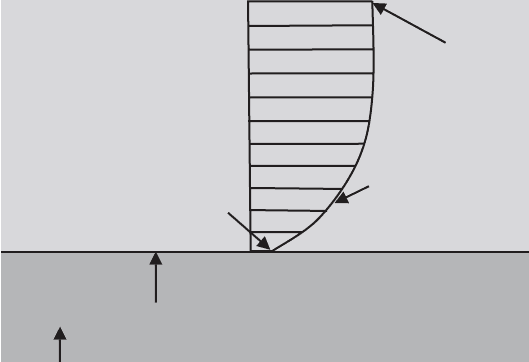
Consider the one-dimensional diffusional growth of a planar crystal of pure com-
ponent A from its binary solution with component B as shown in Figure 5.P.15-1.
The binary solution is assumed to be supersaturated with a concentration ρ
A∞
far from the growing crystal face, whereas the equilibrium concentration at the
boundary between the solid crystal and liquid solution is ρ
A0
.
346 APPLICATIONS IN MASS TRANSFER
L(t)
Planar crystal of pure component A
z
Solution of component A in B
Concentration profile
of component A
r
A0
r
A∞
Figure 5.P.12-1 One-dimensional growth of a planar crystal of pure component A from
its supersaturated solution with component B.
(a) Write the appropriately simplified species-balance equation and its initial
and boundary conditions in rectangular coordinates; since this involves an
incompressible liquid phase, express the concentration in terms of mass
density and mass fraction; do not ignore the bulk flow contribution to the
mass-transfer flux.
(b) Carry out an integral mass balance to obtain the auxiliary equation required
to determine the location of boundary that defines the interface between the
crystal and the liquid solution.
(c) Use scaling analysis to estimate the thickness of the region of influence
wherein all the mass transfer is effectively occurring.
(d) Is quasi-steady-state ever possible for this mass-transfer problem?
(e) Use scaling analysis to determine the criterion for ignoring the bulk-flow
contribution to the mass-transfer flux.
5.P.16 Growth of a Liquid Droplet by means of Diffusion and
Heterogeneous Nucleation
In Practice Problem 5.P.14 we considered the diffusional growth of a liquid droplet
assuming that the heterogeneous nucleation was instantaneous. The latter is a rea-
sonable assumption for heterogeneous nucleation from the gas phase that involves
relatively low molecular weight “simple” molecules. However, for heterogeneous
nucleation of a liquid phase in another immiscible liquid phase involving more
complex molecules (e.g., an amorphous polymer component from its solution in an
organic solvent), steric effects can result in noninstantaneous heterogeneous nucle-
ation. In this problem we assume that the heterogeneous nucleation of the pure

PRACTICE PROBLEMS 347
dispersed phase component from its solution, which constitutes the continuous
phase, is characterized by a zeroth-order rate constant
ˆ
k
0
(moles/area·time). The
supersaturation concentration far from the surface of the growing droplet is denoted
ρ
A∞
; the thermodynamic equilibrium concentration of the nucleating component
in the continuous phase is denoted by ρ
A0
. Mass rather than molar concentrations
are used here since we are considering a liquid phase. The molecular weight of the
crystallizing component is M
A
.
(a) Write the appropriately simplified species-balance equation and its initial
and boundary conditions in spherical coordinates; express the concentration
in terms of mass fraction.
(b) Carry out an integral species balance to obtain the auxiliary equation required
to determine the location of boundary that defines the interface between the
liquid droplet and the continuous liquid phase; consider carefully how the
heterogeneous nucleation affects this integral balance.
(c) Use scaling analysis to estimate the thickness of the region of influence
wherein all the mass transfer effectively is occurring.
(d) Determine the criterion for ignoring the curvature effects on the mass
transfer.
(e) Determine the criterion for ignoring the heterogeneous nucleation.
(f) Determine the criterion for assuming quasi-steady-state.
5.P.17 Rusting of a Planar Surface
Consider a flat piece of initially pure iron that is immersed so that its upper surface
is exposed continuously to liquid water saturated with dissolved oxygen (O
2
),
whose concentration is denoted by c
A∞
. The oxygen in the water will diffuse to
the surface of the iron and promote rusting via the formation of iron oxide, Fe
2
O
3,
based on the reaction
4
3
Fe +O
2
→
2
3
Fe
2
O
3
(5.P.17-1)
Note that reaction (5.P.17-1) implies a relationship between the molar fluxes of
oxygen and iron as well as the molar rate of growth of the rust layer. The rate
of conversion of oxygen to rust is assumed to occur by means of a first-order
heterogeneous reaction whose reaction rate is given by
R
A
=
ˆ
k
1
c
A
(moles/area · time) (5.P.17-2)
in which
ˆ
k
1
(length/time) is the heterogeneous reaction-rate constant and A denotes
the molecular oxygen. The rate of growth of the rust layer decreases progressively
in time since the oxygen must diffuse through both the water and the increasing
thickness of the rust layer in order to reach the surface of the iron. Since the oxy-
gen diffuses through the water-saturated microporous structure of the rust layer,

348 APPLICATIONS IN MASS TRANSFER
its local concentration in the latter is equal to εc
A
,inwhichε is the porosity
and c
A
is the local concentration of oxygen in the pores. Owing to the microp-
orous structure, the effective oxygen diffusivity in the rust, which is denoted by
D
AC
, will be less than that in the water, which is denoted by D
AB
. The densi-
ties of the water, water-saturated rust, and pure iron are denoted by ρ
B
,ρ
C
,and
ρ
D
, respectively, in which B, C,andD denote the water, rust, and iron, respec-
tively. The corresponding molecular weights are denoted by M
B
,M
C
,andM
D
,
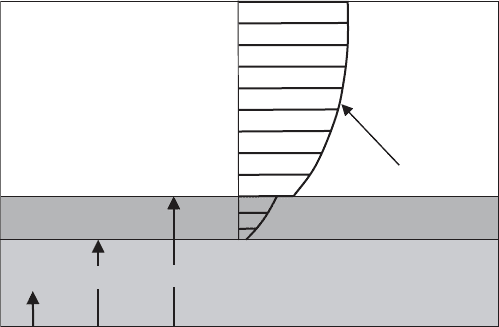
respectively. Note that this problem involves two moving boundaries: the interface
between the rust and the water and that between the iron and the rust, as shown
in Figure 5.P.17-1. One might anticipate that initially, oxygen diffusion through
the water controls the rate of rusting, whereas at longer times, oxygen diffusion
through the rust becomes controlling. We use scaling analysis to explore how the
describing equations for this mass-transfer process can be simplified. In scaling this
problem, use the following dimensionless variables involving unspecified scale and
reference factors:
c
∗
AW
≡
c
A
− c
Wr
c
Ws
; c
∗
Ar
≡
c
A
− c
Rr
c
Rs
; z
∗
W
≡
z − z
Wr
z
Ws
;
z
∗
R
≡
z − z
Rr
z
Rs
; t
∗
≡
t
t
s
; (5.P.17-3)
L
∗
R
≡
L − L
R
L
Rs
; L
∗
I
≡
L
L
Is
;
dL
dt
∗
R
≡
1
˙
L
Rs
dL
dt
R
;
dL
dt
∗
I
≡
1
˙
L
Is
dL
dt
I
where the subscripts W, R,andI refer to the water, rust, and iron layers, respec-
tively.
(a) Explain why it is necessary to define separate reference and scale factors
for the concentrations and spatial coordinates in the water and rust layers.
(b) Explain why it is necessary to define separate scale factors for the thick-
nesses of the rust and iron layers as well as the velocities of each layer.
(c) Write the appropriately simplified species-balance equations and their initial
and boundary conditions for both the water and the rust layer; use molar
concentrations and assume dilute solutions so that the bulk-flow contribution
to the mass-transfer flux can be ignored.
(d) Carry out an integral mass balance on the iron and rust layers to obtain the
auxiliary equations required to determine the location of the two moving
boundaries. Note that the growth rate of the rust layer must satisfy the
molar exchange dictated by reaction (5.P.17-1).
(e) Use scaling analysis to estimate the thickness of the region of influence in
the water layer.
(f) Determine the criteria for quasi-steady-state to apply.
PRACTICE PROBLEMS 349
Un-oxidized iron
Rust
Liquid water saturated
with dissolved oxygen
L
I
z
Concentration profile
L
R
Figure 5.P.17-1 Rusting of a flat piece of pure iron immersed in liquid water that is
saturated with dissolved oxygen; this involves two moving boundaries: the interface between
the rust layer and the water and that between the iron and the rust layer.
(g) Use scaling analysis to determine when the resistance to mass transfer in
the rust layer can be ignored.
(h) Use scaling analysis to determine when the resistance to mass transfer in
the water bath can be ignored.
5.P.18 Mass Transfer in a Hollow-Fiber Membrane
In Example Problem 5.E.9 we applied scaling analysis to a hollow-fiber membrane
reactor as shown in Figure 5.E.9-1. An enzyme was immobilized in the microporous
annular wall of the hollow fiber. A low-molecular-weight solute permeated through
the ultrathin inner wall of this annular region and reacted with the confined enzyme.
We used scaling analysis to explore how the describing equations in the annular
region could be simplified. In doing this we allowed for separate scale factors for the
axial and radial concentration gradients. Rather than allowing for separate scales for
the axial and radial concentration gradients, assume that these two derivatives scale
with the characteristic concentration scale divided by the characteristic length scales
in the axial and radial directions, respectively. This will lead to a contradiction in
that one or more terms will not be bounded of
◦
(1). This exercise provides another
example of the forgiving nature of scaling; that is, scaling tells you if the ordering
analysis has been done correctly.
5.P.19 Permeation Accompanied by Membrane Swelling
Consider a mass-transfer process that involves maintaining concentrations ρ
A0
(mass/unit volume) and zero of component A on opposing sides of a polymeric
membrane having thickness L as shown in Figure 5.P.19-1. The permeating
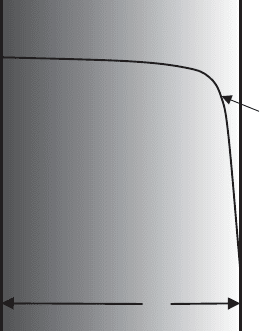
350 APPLICATIONS IN MASS TRANSFER
r
A
= 0
Polymeric
membrane
r
A0
Concentration gradien
t
L
Figure 5.P.19-1 Steady-state diffusion of a solute A that causes membrane swelling, sug-
gested by the progressive shading, which in turn increases the effective diffusion coeffi-
cient.
component A swells the membrane, which in turn causes an increase in the effective
binary diffusion coefficient that is given by
D
AB
= (1 − ω
A
)D
0
e
βρ
A
(5.P.19-1)
where D
0
is the binary diffusion coefficient in the membrane at infinite dilution of
component A, ω
A
the mass fraction of component A,andβ a positive constant.
(a) Write the appropriately simplified species-balance equation and its boundary
conditions; assume dilute solutions so that the bulk-flow contribution to the
mass-transfer flux can be ignored.
(b) Scale the describing equations to determine when the concentration depen-
dence of the diffusion coefficient can be neglected.
(c) If the swelling is marked, there will be a region of influence or boundary
layer near one side of the membrane within which the resistance to diffusion
will be concentrated; use scaling analysis to determine the thickness of this
region of influence.
(d) Use the results of your scaling analyses in parts (b) and (c) to develop a
criterion for determining when significant swelling is occurring in the mem-
brane. Hint: Use scaling to estimate the mass-transfer flux in the presence
and absence of swelling.
5.P.20 Evaporative Polymer Film Casting for Short Contact Times
In Example Problem 5.E.1 we considered the evaporative casting of a dense film
from a solution of a polymer in a volatile solvent as shown in Figure 5.E.1-1.
PRACTICE PROBLEMS 351
We developed a long-contact-time scaling to determine the criterion for assuming
quasi-steady-state. In this problem we consider a short-contact-time scaling.
(a) Write the appropriately simplified species-balance equation and its initial
and boundary conditions.
(b) Consider an integral mass balance to derive an auxiliary condition needed
to determine the location of the moving liquid–gas interface.
(c) Scale the describing equations appropriate to very short contact times to
determine the thickness of the region of influence wherein all the mass
transfer is effectively concentrated.
(d) Develop a criterion for assuming that the boundary condition at the solid sup-
port surface can be applied at infinity; note that if this criterion is satisfied,
a pseudo-convection term is not generated when converting the describing
equations to a translated coordinate system.
(e) Use your scaling analysis result in part (c) to determine when the region of
influence penetrates to the solid support surface.
(f) Determine the criterion for ignoring the convective contribution to the mass-
transfer flux.
5.P.21 Mass Transfer with a Homogeneous Chemical Reaction and a
Concentration-Dependent Diffusivity
Consider a liquid film consisting of components A and B of thickness L for which
the concentration of a diffusing component is maintained at c
A0
(moles/volume)
at z = 0andzeroatz = L. Component A undergoes a first-order irreversible
homogeneous chemical reaction with a rate constant k
1
(time
−1
) as shown in
Figure 5.P.21-1. In addition, the diffusion coefficient D
AB
decreases linearly with
concentration as follows:
D
AB
= D
0
− βc
A
(5.P.21-1)
where D
0
is the diffusion coefficient at infinite dilution and β is a positive constant.
The effects of the reaction product(s) and any change in the film thickness can be
neglected.
(a) Write the appropriately simplified steady-state species-balance equation and
boundary conditions.
(b) Scale these describing equations to determine a criterion for ignoring the
homogeneous reaction term.
(c) Scale these describing equations to determine a criterion for ignoring the
concentration dependence of the binary diffusion coefficient.
(d) Scale the describing equations for the special case of a very fast reaction
that consumes all the diffusing reactant before it can reach the boundary at
z = L. Use your scaling to determine the thickness of the region of influence
wherein all the diffusion takes place.
352 APPLICATIONS IN MASS TRANSFER
Liquid film of component
Liquid film of component
B in
in
which a chemical reaction is
which a chemical reaction is
consuming component
consuming component
A
Concentration gradient
Concentration gradient
of component
of component
A
L
c
A
=
0
c
A0
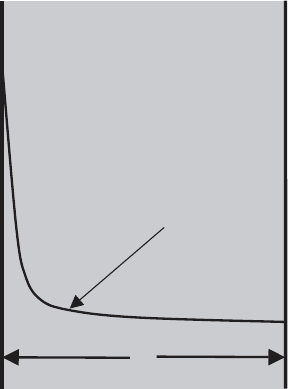
Figure 5.P.21-1 Diffusion of component A in a liquid film of component B within which
A is being consumed by a homogeneous first-order chemical reaction and for which the
diffusivity is concentration dependent.
5.P.22 Mass Transfer in the Annular Region Between Fixed and Rotating
Cylinders
Consider a liquid confined to the annular gap between two concentric cylindrical
shells of radii R
1
and R
2
, as shown in Figure 5.P.22-1. The inner cylinder rotates
at a constant angular velocity of ω (radians/time), while the outer cylinder remains
stationary. The cylindrical boundaries at R
1
and R
2
are permeable, so they can be
maintained at constant compositions ρ
1
and ρ
2
(mass/volume), respectively. In this
case the mass transfer is not influenced by the rotating fluid flow. However, the
mass transfer can influence the fluid flow in two ways. First, the shear viscosity μ
can be concentration-dependent. Second, the bulk flow velocity established by the
radial mass transfer can distort the velocity profile in the circumferential direction.
In this problem we use scaling analysis to explore when these effects need to be
considered. Assume that the concentration dependence of the viscosity is given by
μ = μ
0
e
βρ
A
(5.P.22-1)
where β is a constant that can be either positive or negative.
(a) Write the appropriately simplified steady-state continuity and equations of
motion in cylindrical coordinates.
(b) Write the requisite boundary conditions on the equations in part (a); note
that the radial component of velocity will be equal to the mass flux divided
by the mass density at the inner and outer cylindrical boundaries.