
Krantz W.B. Scaling Analysis in Modeling Transport and Reaction Processes: A Systematic Approach to Model Building and the Art of Approximation
Подождите немного. Документ загружается.

PRACTICE PROBLEMS 473
In this scaling it is appropriate to allow a separate scale for the spatial
derivative of the temperature. Consider carefully how this scale should be
determined to achieve
◦
(1) scaling.
(b) For this case you should obtain a length scale different from that given
in equation (7.4-24). This in turn implies that the thickness of the thermal
boundary layer or region of influence will have a different time dependence.
Compare this time dependence with that obtained in Section 7.4. In partic-
ular, discuss the physical reason for this difference in the time dependence.
(c) Determine the criterion for ignoring the latent heat term in the energy
equation for the constant heat-flux boundary condition.
(d) Determine the criterion for ignoring the diffusion term in the species-balance
equation.
(e) Determine the criterion for applying the boundary condition at the upper
liquid–gas interface at infinity.
(f) Determine the criterion for ignoring heat loss to the ambient gas phase.
7.P.15 Effect of Heat Loss in the Ambient Gas Phase in TIPS Casting
In Section 7.4 we scaled the TIPS process for the region of influence near the cold
boundary; that is, our temperature scale was based on that of the cold boundary and
our length scale was dictated by balancing the accumulation and heat conduction
terms in the energy equation. This scaling was appropriate for determining the cri-
teria for neglecting the coupling between the energy and species-balance equations
and for ignoring the latent heat effects. However, this scaling provides no informa-
tion on the thickness of the region of influence near the upper boundary at which
heat loss occurs to the ambient gas phase. In working this problem, assume that the
energy and species-balance equations can be decoupled and that latent heat effects
can be ignored.
(a) Carry a scaling analysis of the describing equations for conditions appro-
priate to the upper boundary region for short contact times for which the
phase separation caused by the cold boundary is far removed. Introduce a
separate scale factor for the spatial derivative of the temperature since the
latter is unknown at the upper boundary.
(b) Estimate the thickness of the region of influence or thermal boundary layer at
the upper surface wherein the conductive heat transfer is essentially confined.
(c) Use the results of your scaling analysis in this problem and those in Section
7.4 to estimate when heat loss at the upper boundary begins to affect the
heat transfer to the cold boundary.
7.P.16 Upward- and Downward-Propagating Phase-Separation Fronts
in TIPS Casting
In Practice Problem 7.P.15 we considered a scaling analysis appropriate to the
region near the upper boundary at which heat transfer to the ambient gas phase
occurs. If this heat transfer is sufficiently fast, it is possible that a phase-separation
474 APPLICATIONS IN PROCESS DESIGN
front will propagate downward from the upper boundary as well as upward from the
cold lower boundary. In working this problem, assume that the energy and species-
balance equations can be decoupled and that latent heat effects can be ignored.
(a) Use the results of the scaling analysis in Practice Problem 7.P.15 to deter-
mine the criteria for whether phase separation will also occur in the upper
boundary region. Assume that the relationship between the crystallization
temperature and cooling rate is of the form given by equation (7.4-10). Hint:
One needs to use the scale factor for the temperature gradient to estimate the
instantaneous temperature at the upper boundary. However, the temperature
required for phase separation also depends on the cooling rate, which can
also be estimated from your scaling analysis. Note that the temperature of
the upper boundary must be greater than or equal to that of the ambient gas
phase, which introduces yet another limitation on whether phase separation
can occur.
(b) Consider the special case of a very large heat-transfer coefficient for the
boundary condition at the upper surface. How does this change the scaling
analysis in part (a)?
(c) Determine the criteria for whether phase separation will occur in the upper
boundary region for the special case of a very large heat-transfer coefficient.
7.P.17 Low Biot Number Approximation for TIPS Membrane Casting
If the heat flux rather than the temperature is specified at the cold boundary, it is
possible under some conditions to achieve a uniform temperature throughout the
casting solution during TIPS casting. This might be a useful process for producing
a membrane that has a homogeneous pore structure throughout its cross-section.
This condition is analogous to that considered in Chapter 4 for low Biot number
heat transfer. In working this problem, assume that the energy and species-balance
equations can be decoupled and that latent heat effects can be ignored.
(a) Scale the describing equations for a constant heat-flux condition at the cold
boundary. Determine the criteria for assuming that the entire casting solution
is instantaneously at a uniform temperature that changes only in time. Note
that the conditions at both the upper and lower boundary must be considered
in developing these criteria.
(b) Discuss why a uniform temperature throughout the casting solution might
result in a membrane with a homogeneous structure; that is, a structure in
which all the pores have essentially the same size.
7.P.18 Effect of Convective Heat Transfer Due to Densification During
TIPS Casting
The scaling analysis carried out in Section 7.4 assumed that the thickness of the
casting solution remained constant during the TIPS process. In fact, the thickness
of the casting solution can change even when there is no mass loss to the ambient if

PRACTICE PROBLEMS 475
densification occurs due to the phase separation. Since polymer molecules “unfold”
in solution, whereas they are more compact in the solid phase, some degree of
densification will occur during TIPS casting. The effect of convective transport
due to densification was considered in Example Problem 5.E.1. Assume that the
mass density of the binary solution of polymer and diluent is given by
ρ = ω
A
ρ
0
A
+ ω
B
ρ
0
B
⇒ ρ = ρ
0
B
+ ρ
0
AB
ω
A
(7.P.18-1)
where ρ
0
i
is the pure component mass density of component i and ρ
0
AB
≡ ρ
0
A
−
ρ
0
B
. The relationship between the overall mass density and the mass-average veloc-
ity u
z
is given by the continuity equation
∂ρ
∂t
=−
∂
∂z
(ρu
z
) ⇒ ρ
0
AB
∂ω
A
∂t
=−(ρ
0
B
+ ρ
0
AB
ω
A
)
∂u
z
∂z
− u
z
ρ
0
AB
∂ω
A
∂z
(7.P.18-2)
If we assume that the energy and species-balance equations can be decoupled, the
diluent mass fraction ω
A
is simply related to the volume fraction of the liquid phase
ψ by equation (7.4-36), where ψ is determined from equation (7.4-5). Hence, there
is no need to consider the species-balance equation to obtain a scale for the velocity
arising from densification, as was done in Example Problem 5.E.1.
(a) Use scaling analysis to obtain an estimate of the velocity that arises from
densification during the TIPS process.
(b) Determine the criterion for ignoring convective heat transfer during TIPS
casting.
(c) Determine the criterion for assuming a constant overall mass density during
TIPS casting.
7.P.19 Scaling a Fluid-Wall Aerosol Flow Reactor by Balancing Convection
and Heat Transfer from the Wall in the Gas Phase
In Section 7.5 we scaled a fluid-wall aerosol reactor for which we considered
energy balances for the gas phase and the carbon cloud. Balancing the principal
terms in the carbon-cloud energy equation was straightforward since the carbon
particles were heated only by radiation from the reactor walls. However, it was
not obvious which terms should be balanced in the energy equation for the gas
phase since there were several heat sources. We chose to balance the convection
term with the sensible heat supplied by the hydrogen injected. In this problem we
consider an alternative scaling for the energy balance in the gas phase.
(a) Scale the energy balance in the gas phase assuming that the convection term
is balanced by the convective heat transfer from the reactor wall.
(b) Evaluate the dimensionless groups that emanate from this new scaling using
the characteristic values given in Table 7.5-1.
476 APPLICATIONS IN PROCESS DESIGN
(c) Is this a reasonable scaling based on the values of the dimensionless groups
that you determined in part (b)?
(d) How can the values of the dimensionless groups determined for the original
scaling in Section 7.5 indicate whether this is a reasonable scaling?
7.P.20 Scaling a Fluid-Wall Aerosol Flow Reactor by Balancing Convection
and Heat Transfer from the Carbon Particles in the Gas Phase
In Section 7.5 we scaled a fluid-wall aerosol reactor for which we considered
energy balances for the gas phase and the carbon cloud. Balancing the principal
terms in the carbon-cloud energy equation was straightforward since the carbon
particles were heated only by radiation from the reactor walls. However, it was not
obvious which terms should be balanced in the energy equation for the gas phase.
We chose to balance the convection term with the sensible heat supplied by the
hydrogen injected. We subsequently found that the heat transfer from the carbon
particles to the gas was so large that the gas came to thermal equilibrium with the
carbon particles within a very short distance down the reactor. This suggests that
we should have balanced the convection term with the convective heat transfer
from the carbon particles.
(a) Rescale the fluid-wall aerosol reactor assuming that the principal terms in
the energy balance for the gas balance are the convection term and the
convective heat transfer from the carbon particles.
(b) Evaluate the dimensionless groups that emanate from this new scaling using
the characteristic values given in Table 7.5-1.
(c) What do the values of the dimensionless groups that you determined in part
(b) indicate insofar as the apparent importance of the heat added to the gas
by the hydrogen injected and convective heat transfer from the walls?
(d) Why is it not correct to assume that the heat added to the gas by the
hydrogen injected and through convective heat transfer from the walls can
be neglected based on this scaling?
(e) What do the values of the dimensionless groups determined in the original
scaling in Section 7.5 indicate as to the relative importance of the heat added
to the gas by the hydrogen injected and by convective heat transfer from
the walls?
7.P.21 Estimation of the Thermal Boundary-Layer Thickness at the
Upstream End of a Fluid-Wall Aerosol Flow Reactor
In the scaling analysis carried out in Section 7.5 we found that it was reasonable to
assume that the gas and carbon particles were in thermal equilibrium. However, as
indicated in Section 7.5, this approximation breaks down near the upstream end of
the fluid-wall aerosol flow reactor. Use scaling analysis to estimate the thickness of
the region of influence or thermal boundary layer within which the gas and carbon
particles are not in thermal equilibrium.
PRACTICE PROBLEMS 477
7.P.22 Effect of the Carbon-Particle Radius on the Thermal Equilibrium
Approximation for a Fluid-Wall Aerosol Flow Reactor
In Section 7.5 we found that the gas was in local thermal equilibrium with the cloud
of carbon particles. This was indicated by the large values of the dimensionless
groups
2
and
8
for the characteristic values given in Table 7.5-1.
(a) Determine the dependence of
2
and
8
on the radius of the carbon parti-
cles.
(b) Although both
2
and
8
decrease with an increase in the carbon-particle
radius, their dependence on this parameter differs. How, then, does one
determine how large the carbon particle radius has to be for the local thermal
equilibrium approximation to break down; that is, which if either of these
dimensionless groups becomes limiting?
(c) For a larger carbon-particle size and the other characteristic values given in
Table 7.5-1, what can one conclude if
2
=
◦
(1) but
8
1?
(d) How large would the carbon particles have to be for the local thermal
equilibrium approximation to break down?
7.P.23 Effect of the Wall Temperature on the Thermal Equilibrium
Approximation for a Fluid-Wall Aerosol Flow Reactor
In Section 7.5 we found that the gas was in local thermal equilibrium with the
cloud of carbon particles. This was indicated by the large values of the dimen-
sionless groups
2
and
8
for the characteristic values given in Table 7.5-1. The
dimensionless group
2
depends markedly on the wall temperature of the reactor,
whereas
8
is independent of it.
(a) For a higher reactor wall temperature and the other characteristic values
given in Table 7.5-1, what can one conclude if
2
1 but
8
◦
(1)?
(b) For a higher reactor wall temperature and the other characteristic values
given in Table 7.5-1, what can one conclude if
2
1 but
8
=
◦
(1)?
(c) For a higher reactor wall temperature and the other characteristic values
given in Table 7.5-1, what can one conclude if both
2
1and
8
1?
(d) How high would the reactor wall temperature have to be for the local thermal
equilibrium approximation to break down?
7.P.24 Implications of Rapid Thermal Decomposition Kinetics for a
Fluid-Wall Aerosol Flow Reactor
The dimensionless groups
1
,
5
,and
6
multiply terms that are associated with
heat either released or consumed in the thermal decomposition reaction for methane.
These three dimensionless groups are proportional to the parameter k
ns
,whichis
the scale for the reaction-rate parameter. In principle it seems possible for k
ns
to
be sufficiently large that one or more of the dimensionless groups
1
,
5
,and
6
becomes much greater than 1.
478 APPLICATIONS IN PROCESS DESIGN
(a) Discuss the implications of the condition
1
1; in particular, is this
possible?
(b) Discuss the implications of the condition
5
1; in particular, is this
possible?
(c) Discuss the implications of the condition
6
1; in particular, is this
possible?
7.P.25 Temperature Required to Achieve Complete Fractional Conversion
in a Fluid-Wall Aerosol Flow Reactor
Estimate the minimum wall temperature required to achieve essentially complete
fractional conversion of methane to hydrogen and carbon in a fluid-wall aerosol
reactor for the other characteristic parameters given in Table 7.5-1.
7.P.26 Transformation of the Dimensional Groups Containing
the Temperature Difference for a Fluid-Wall Aerosol Flow Reactor
In Section 7.5 we used step 9 in the scaling approach to dimensional analysis out-
lined in Section 2.4 to transform the dimensionless groups that we obtained by scal-
ing analysis to groups more convenient for correlating numerical data. In particular,
we used this step to transform the dimensionless groups containing T
W
− T
0
into
groups that contained either T
W
or T
0
but not both. However, we did this without
proof. Show how the dimensionless groups given by equations (7.5-37), (7.5-38),
and (7.5-45) can be transformed into those given by equations (7.5-55), (7.5-56),
and (7.5-61) by invoking step 10 in the scaling approach to dimensional analysis
outlined in Section 2.4. The latter step states that if
p
= f(
1
,
2
,...,
k
) and
2
through
k
are redundant (i.e., they appear separately),
p
can be replaced
by
1
.
7.P.27 Transformation of the Dimensional Groups Containing the Sum
of Molar Velocities for a Fluid-Wall Aerosol Flow Reactor
In Section 7.5 we used step 9 in the scaling approach to dimensional analysis
outlined in Section 2.4 to transform the dimensionless groups that we obtained
via scaling analysis to groups more convenient for correlating numerical data.
In particular, we used this step to transform the dimensionless groups contain-
ing W
0
C
and W
0
M
+ W
0
C
into groups that contained either W
0
M
or W
0
C
but not
both. However, we did this without proof. Show how the dimensionless groups
given by equations (7.5-37) and (7.5-44) can be transformed into those given by
equations (7.5-55) and (7.5-60) by invoking step 10 in the scaling approach to
dimensional analysis outlined in Section 2.4. The latter step states that if
p
=
f(
1
,
2
,...,
k
) and
2
through
k
are redundant (i.e., they appear separately),
p
can be replaced by
1
.
PRACTICE PROBLEMS 479
7.P.28 Reconciling the Estimate of Fractional Conversion with Dimensional
Analysis for a Fluid-Wall Aerosol Flow Reactor
We obtained an estimate of the fractional conversion X
c
in Section 7.5 given by
equation (7.5-52). This estimate would appear to be inconsistent with the impli-
cations of the dimensional analysis given by equation (7.5-64); that is, equation
(7.5-52) does not include all the parameters contained in the dimensionless groups
in equation (7.5-64).
(a) Discuss why there is no contradiction between equations (7.5-52) and (7.5-
64).
(b) Show how equation (7.5-52) can be expressed in terms of the reduced set of
dimensionless groups appropriate to the approximations made in obtaining
this estimate.
(c) Use the estimate provided by equation (7.5-52) to suggest ways to increase
the fractional conversion.
7.P.29 Correlation for the Fractional Conversion When Local Thermal
Equilibrium Applies in a Fluid-Wall Aerosol Flow Reactor
In Section 7.5 we used the scaling approach to dimensional analysis to develop a
correlation for the fractional conversion X
c
for the general case for which local ther-
mal equilibrium between the gas and the carbon particles is not assumed. Develop
a dimensional analysis correlation for the fractional conversion for the special case
of
2
1, which implies that the gas can be assumed to be in local thermal
equilibrium with the carbon particles.
7.P.30 Isolating the Gas-Phase Mass-Transfer Coefficient in Dimensional
Analysis for a Fluid-Wall Aerosol Flow Reactor
In Section 7.5 we used steps 7, 9, and 10 in the scaling approach to dimensional
analysis to isolate R
0
,W
0
C
,andT
W
into separate groups. Use this approach to
develop a correlation for the fractional conversion for which the gas-phase mass-
transfer coefficient, k
Gs
, is isolated into just one dimensional group.
7.P.31 Isolating the Molar Velocity of Hydrogen in Dimensional Analysis
for a Fluid-Wall Aerosol Flow Reactor
In Section 7.5 we used steps 7, 9, and 10 in the scaling approach to dimensional
analysis to isolate R
0
,W
0
C
,andT
W
into separate groups. Use this approach to
develop a correlation for the fractional conversion for which the molar velocity of
hydrogen,
ˆ
W
H
, is isolated into just one dimensional group.
APPENDIX A
Sign Convention for the Force
on a Fluid Particle
The equations of motion are a statement of Newton’s law of motion applied to a
system that consists of a fluid particle. The latter can be thought of as a constituent
part of a fluid continuum that moves with the local fluid velocity and has a constant
infinitesimal mass; however, it need not have constant volume and density since
these two quantities can vary in time while maintaining constant fluid particle
mass. The fluid particle is a useful system since its mass is so small that in the
limit of vanishingly small volume, its properties become those of a point in the
fluid continuum that moves with the local fluid velocity.
To apply Newton’s law of motion to a fluid particle, we need to consider the
force
F
p
exerted on a fluid particle by the fluid surrounding it. The total stress
tensor σ
by definition operates on the local unit normal vector n to a surface to
cause a force. The convention employed here defines
F
p
to be the force exerted
on the surface of the particle by the fluid on the side into which the normal vector
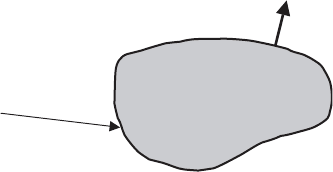
is pointing; this is shown in Figure A.1-1 and is given by
F
p
=−
S
nσ dS (A.1-1)
It follows that the force
F
f
that the fluid particle exerts on the surrounding fluid
is given by
F
f
=+
S
nσ dS (A.1-2)
An entirely equivalent definition is the following: σ
ij
is the total stress exerted in
the +j-direction on a fluid surface defined by a plane of constant i by the fluid
in the region of lesser i. For example, σ
yx
is the total stress exerted in the +x-
direction on a fluid surface defined by a plane of constant y by the fluid located
beneath this surface.
Scaling Analysis in Modeling Transport and Reaction Processes: A Systematic Approach
to Model Building and the Art of Approximation, By William B. Krantz
Copyright © 2007 John Wiley & Sons, Inc.
480
SIGN CONVENTION FOR THE FORCE ON A FLUID PARTICLE 481
Total surface
area S
n
Fluid particle
→
Figure A.1-1 Fluid particle of surface area S showing the unit normal vector to surface n.
It is important to note that there is no agreement in the technical literature
regarding the sign convention for the force acting on a fluid particle. Popular engi-
neering textbooks such as Transport Phenomena by Bird et al.
1
employ the sign
convention implied by equations (A.1-1) and (A.1-2) whereas other books employ
a convention in which the signs are reversed in these two equations. One can use
either convention, of course. However, in doing so, one must be certain to use com-
patible signs in the constitutive equations that relate the stress to the rate of strain;
that is, to ensure that positive forces are exerted in the positive coordinate direc-
tion, the sign convention given by equations (A.1-1) and (A.1-2) implies a certain
set of signs in the constitutive equations that relate the stress to the rate of strain.
Hence, the signs given for Newton’s constitutive equation in Appendixes B and D
are compatible with the sign convention for the force on a fluid particle given by
equations (A.1-1) and (A.1-2) When using constitutive equations taken from the
technical literature, one has to be careful to employ a form of the equations of
motion that has a compatible sign convention.
1
R. B. Bird, W. E. Stewart, and E. N. Lightfoot, Transport Phenomena, 2nd ed., Wiley, Hoboken, NJ,
2002, p. 13.
APPENDIX B
Generalized Form of the
Transport Equations
B.1 CONTINUITY EQUATION
The following form of the continuity or total mass-balance equation in general-
ized vector notation is expressed in terms of the mass density ρ, which can be
nonconstant, and mass-average velocity vector u:
∂ρ
∂t
=−∇·ρ u (B.1-1)
The following form of the continuity or total molar-balance equation in general-
ized vector notation is expressed in terms of the molar density c, which can be
nonconstant, and molar-average velocity vector
ˆu:
∂c
∂t
=−∇·c
ˆu +
ˆ
G (B.1-2)
where
ˆ
G is the total molar generation rate per unit volume.
B.2 EQUATIONS OF MOTION
The following form of the equations of motion in generalized vector–tensor notation
allows for nonconstant physical properties, a body force due to a gravitational field,
and an unspecified viscous stress tensor τ
:
ρ
∂ u
∂t
+ ρ u ·∇u =−∇P −∇·τ
+ ρ g (B.2-1)
Equation (B.2-1) can be applied to non-Newtonian fluids if the appropriate con-
stitutive equation relating the viscous stress to the rate of strain is known. The
Scaling Analysis in Modeling Transport and Reaction Processes: A Systematic Approach
to Model Building and the Art of Approximation, By William B. Krantz
Copyright © 2007 John Wiley & Sons, Inc.
482