
Krantz W.B. Scaling Analysis in Modeling Transport and Reaction Processes: A Systematic Approach to Model Building and the Art of Approximation
Подождите немного. Документ загружается.


THERMALLY INDUCED PHASE-SEPARATION PROCESS 443
Note that we did not scale the diluent mass fraction ω
A
and the liquid volume
fraction ψ since they are dimensionless and bounded of
◦
(1) for typical TIPS pro-
cessing conditions. However, we have introduced a separate scale for the time rate
of change of the liquid volume fraction since this derivative does not necessarily
scale with the reciprocal of the characteristic time. These variables result in the
following set of dimensionless describing equations (steps 5 and 6):
(ρC
p
)
s
z
2
s
k
s
t
s
(ρC
p
)
∗
∂T
∗
∂t
∗
=
∂
∂z
∗
k
∗
∂T
∗
∂z
∗
−
ρ
p
H
f
˙
ψ
s
z
2
s
k
s
T
s
˙
ψ
∗
(7.4-12)
˙
ψ
s
t
s
ω
A
˙
ψ
∗
+ ψ
∂ω
A
∂t
∗
=
D
s
t
s
z
2
s
∂
∂z
∗
D
∗
AB
ψ
∂ω
A
∂z
∗
(7.4-13)
(ρC
p
)
∗
= (1 − ψ)
(ρC
p
)
P
(ρC
p
)
s
+ ψ
ω
A
(ρC
p
)
D
(ρC
p
)
s
+(1 − ω
A
)
(ρC
p
)
P
(ρC
p
)
s
(7.4-14)
k
∗
= (1 − ψ)
k
P
k
s
+ ψ
ω
A
k
D
k
s
+ (1 −ω
A
)
k
P
k
s
(7.4-15)
T
∗
=
T
0
− T
r
T
s
,ω
A
= ω
A0
,ψ= 1att
∗
= 0 (7.4-16)
T
∗
=
T
b
− T
r
T
s
,
∂ω
A
∂z
∗
= 0atz
∗
= 0 (7.4-17)
ψ = 1forz
∗
≥
L
z
s
(7.4-18)
−k
∗
∂T
∗
∂z
∗
=
hz
s
k
s
T
∗
+
T
r
− T
∞
T
s
,
∂ω
A
∂z
∗
= 0atz
∗
=
H
z
s
(7.4-19)
T
∗
c
= f(
˙
T
∗
) at z
∗
=
L
z
s
(7.4-20)
The temperature can be bounded of
◦
(1) by setting the appropriate dimension-
less groups in equations (7.4-16) and (7.4-17) equal to 0 and 1, respectively (step
7). Since this is inherently an unsteady-state process, the temporal scale factor is the
observation time t
o
, that is, the time from the instant of contact between the hot cast-
ing solution and the cold boundary. The dimensionless groups in equations (7.4-14)
and (7.4-15) suggest that ρC
p
and k scale with
ρC
p
P
and k
P
, their corresponding
values for the pure polymer. The diffusion coefficient can be bounded of
◦
(1) by
scaling it with D
0
, its value for the initial casting solution, which is its largest possi-
ble value. Since we are interested in the initial stage of TIPS process during which
the phase-separated region just penetrates the thickness of the casting solution, the
length scale is obtained by balancing the accumulation and conduction terms in
equation (7.4-12), which yields z
s
=
√
α
P
t
o
,whereα
P
is the thermal diffusivity of

444 APPLICATIONS IN PROCESS DESIGN
the pure polymer. It is during this penetration time that the distribution of nuclei is
established across the casting solution, which ultimately determines the pore-size
distribution in the microporous membrane. The appropriate length scale for longer
time scales would be the thickness of the casting solution. The appropriate scale
factor for
˙
ψ
s
is obtained by differentiating equation (7.4-5) and then determining
the maximum magnitude of
˙
ψ as follows:
˙
ψ ≡
∂ψ
∂t
=−(1 −ψ
∞
)Knt
n−1
a
exp(−Kt
n
a
) (7.4-21)
Equation (7.4-21) has an extremum (i.e., a minimum) at
t
a
=
n − 1
nK
1/n
(7.4-22)
The corresponding maximum magnitude of
˙
ψ (note that
˙
ψ<0) is given by
˙
ψ
s
= (1 − ψ
∞
)
√
2K exp
−
1
2
∼
=
(1 − ψ
∞
)
√
K (7.4-23)
These considerations for the reference and scale factors then result in the following
dimensionless variables:
T
∗
≡
T − T
b
T
0
− T
b
; z
∗
≡
kt
o
ρC
p
1/2
P
=
√
α
P
t
o
; t
∗
≡
t
t
o
;
˙
ψ
∗
≡
1
(1 − ψ
∞
)
√
K
∂ψ
∂t
; k
∗
≡
k
k
P
; (ρC
p
)
∗
≡
(ρC
p
)
(ρC
p
)
P
;
(7.4-24)
D
∗
AB
≡
D
AB
D
0
where the subscripts P and 0 denote the properties for the pure polymer and initial
casting solution, respectively.
The dimensionless variables defined by equations (7.4-24) result in the following
scaled minimum parametric representation of the describing equations:
(ρC
p
)
∗
∂T
∗
∂t
∗
=
∂
∂z
∗
k
∗
∂T
∗
∂z
∗
−
H
f
(1 − ψ
∞
)
√
Kt
o
(C
p
)
P
(T
0
− T
b
)
˙
ψ
∗
(7.4-25)
(1 − ψ
∞
)
√
Kt
o
ω
A
˙
ψ
∗
+ ψ
∂ω
A
∂t
∗
=
1
Le
∂
∂z
∗
D
∗
AB
ψ
∂ω
A
∂z
∗
(7.4-26)
(ρC
p
)
∗
=(1 −ψ)+ψ
ω
A
(ρC
p
)
D
(ρC
p
)
P
+(1 − ω
A
)
(7.4-27)

THERMALLY INDUCED PHASE-SEPARATION PROCESS 445
k
∗
= (1 − ψ) +ψ
ω
A
k
D
k
P
+ (1 − ω
A
)
(7.4-28)
T
∗
=1,ω
A
=ω
A0
,ψ=1att
∗
=0 (7.4-29)
T
∗
= 0,
∂ω
A
∂z
∗
= 0atz
∗
= 0 (7.4-30)
ψ = 1forz
∗
≥
L
√
α
P
t
o
(7.4-31)
−k
∗
∂T
∗
∂z
∗
=
h
√
α
P
t
o
k
P
T
∗
+
T
b
− T
∞
T
0
− T
b
,
∂ω
A
∂z
∗
= 0
at z
∗
=
H
√
α
P
t
o
(7.4-32)
T
∗
c
= f(
˙
T
∗
) at z
∗
=
L
√
α
P
t
o
(7.4-33)
where Le ≡ α
P
/
D
P
is the Lewis number, which is a measure of the ratio of the
heat conduction to species diffusion. Note that our time scaling is appropriate to
relatively short observation times such that 0 ≤ t
o
≤ H
2
/
α
P
since it is on this scale
that the phase separation propagates from the cold boundary through the entire cast-
ing solution. This time scale dictates the distribution of nuclei across the entire cast-
ing solution, which determines the ultimate structure of the microporous membrane.
Now let us consider what approximations can be made to simplify the describing
equations (step 8). The heat-generation term in the energy equation can be ignored
if the following condition is satisfied:
H
f
(1 − ψ
∞
)
√
Kt
o
C
p
(T
0
− T
b
)
1 (7.4-34)
The dimensionless group in equation (7.4-34) is a measure of the ratio of the
characteristic time for heat conduction to that for heat generation due to poly-
mer solidification. This condition implies that the solution to the energy equation
is no longer strongly coupled to the solution for the liquid volume fraction. The
species-conservation equation can be greatly simplified if the following condition is
satisfied:
1
Le
=
D
0
α
P
1 (7.4-35)
This condition implies that the diffusion term can be neglected in the species-
conservation equation. The implication of this for the dimensional form of this
equation is that
∂(ω
A
ψ)
∂t
∼
=
0 ⇒ ω
A
ψ = a constant = ω
A∞
ψ
∞
(7.4-36)

446 APPLICATIONS IN PROCESS DESIGN
where ω
A∞
and ψ
∞
are the equilibrium diluent concentration and liquid volume
fraction as the time approaches infinity and the entire solution is at the cold bound-
ary temperature T
b
. When the inequalities in equations (7.4-34) and (7.4-35) are
satisfied, the solution for the solid–liquid TIPS process is greatly simplified. The
solution to the unsteady-state one-dimensional energy equation permits obtaining
the instantaneous cooling rate
˙
T from which the temperature T
c
and location L of
the moving boundary can be determined. Equation (7.4-5) then permits determin-
ing the liquid volume fraction ψ at any plane in the phase-separated region as a
function of the time available for nucleation and growth t
g
. Equation (7.4-36) then
permits determining the diluent mass fraction ω
A
at any plane as a function of
time. Knowing ψ(z,t) and ω(z, t) then permits determining the composition- and
liquid-volume-fraction-dependent properties via equations (7.4-3) and (7.4-4).
Two other simplifications are possible for very short observation times. The
boundary condition given by equation (7.4-32) is applied at a dimensionless dis-
tance that is equal to the ratio of the casting solution thickness divided by the
instantaneous thickness of the phase-separated region. When this dimensionless
group is very large, this boundary condition can be applied at infinity; that is,
H
√
α
P
t
o
1 ⇒ boundary condition can be applied at ∞ (7.4-37)
The second dimensionless group involved in this boundary condition is a measure
of the ratio of the heat transferred to the ambient gas phase to that transferred to
the cold boundary. When this group is very small, heat loss to the ambient gas
phase can be neglected; that is,
h
√
α
P
t
o
k
P
1 ⇒ heat loss to ambient gas phase can be ignored (7.4-38)
We see that the criteria defined by equations (7.4-37) and (7.4-38) are satisfied
at sufficiently short observation times. When both criteria are satisfied, equation
(7.4-32) reduces to the simplified form
∂T
∗
∂z
∗
= 0,
∂ω
A
∂z
∗
= 0asz
∗
→∞ (7.4-39)
It is of interest to assess the general applicability of these approximations by
evaluating the criteria for a representative TIPS-casting system. This has been
done for the isotactic polypropylene–dotriacontane system whose relevant proper-
ties and typical processing conditions are summarized in Table 7.4-1. These data
and processing conditions result in the following values for the dimensionless
groups in equations (7.4-34) and (7.4-35):
H
f
(1 − ψ
∞
)
√
Kt
o
C
p
(T
0
− T
b
)
≤
H
f
(1 − ψ
∞
)
√
Kt
a
C
p
(T
0
− T
b
)
=
H
f
(1 − ψ
∞
)
√
K
C
p
(T
0
− T
b
)
n − 1
nK
1/n
= 5.5 × 10
−2
(7.4-40)

THERMALLY INDUCED PHASE-SEPARATION PROCESS 447
TABLE 7.4-1 Properties of Isotactic Polypropylene and Process Parameters for the
TIPS Casting of the Isotactic Polypropylene–Dotriacontane, Polymer–Diluent System
Property or Process Parameter Value
ρ (g/cm
3
)9.03 × 10
−1
k (J/s · cm ·
◦
C) 1.00 × 10
−3
C
p
(J/g ·
◦
C) 1.93
H
f
(J/g) 70.6
T
c
(
◦
C) 69.5
D
AB
(cm
2
/s) ∼1 × 10
−6
n 2.0
K (s
−n
) 0.0323
h (J/s · cm
2
· s) 1.10 × 10
−4
ω
A0
0.60
ψ
0
0.63
T
0
(
◦
C) 200
T
b
(
◦
C) 25
T
∞
(
◦
C) 25
L
0
(μm) 200
Source: Physical and transport property data from W. K. Lee and C. L. Choy, J. Polym. Sci. B Polym.
Phys., 13, 619–635 (1975); C. A. Sperati, J. Brandrup, and E. H. Immergut, eds., Polymer Handbook,
3rd ed., Wiley-Interscience, New York, 1989; D. R. Lide, ed., Handbook of Chemistry and Physics. 77th
ed., CRC Press, Boca Raton, FL, 1996; N. B. Vargaftik, L. P. Filippov, A. A. Tarzimanov, and E. E.
Totskii, Handbook of Thermal Conductivity of Liquids and Gases, CRC Press, Boca Raton, FL, 1994.
Avrami coefficient data from G. B. A. Lim, Effects of nucleating agent on thermally induced phase
separation membrane formation, Ph.D. dissertation, University of Texas, Austin, TX, 1990.
1
Le
=
D
0
α
P
= 1.74 × 10
−3
(7.4-41)
In evaluating equation (7.4-40), ψ
∞
was set equal to the initial value of the diluent
volume fraction; that is, since the diluent cannot diffuse and the continuous phase
is polymer lean, the equilibrium liquid volume fraction at infinite time for growth
of the solid phase will become nearly equal to the initial volume fraction of dilu-
ent. This underscores one of the advantages of the TIPS process for manufacturing
polymeric membranes: that very high porosities can be achieved since the diluent
goes from being a good solvent at a high temperature to a pore former at room tem-
perature. Note that the observation time used in evaluating equation (7.4-40) was
the time given by equation (7.4-22) at which
˙
ψ reaches an extremum; this was done
to provide a conservative estimate of the magnitude of this dimensionless group
since it is proportional to
˙
ψ
s
. The condition given by equation (7.4-41) is gener-
ally satisfied by nearly all polymers; that is, heat and mass transfer in polymeric
systems is characterized by large Lewis numbers. It is not reasonable to assume
that the casting solution is infinitely thick since the criterion for this assumption
given by equation (7.4-37) requires that t
o
0.7. However, the criterion given
by equation (7.4-38) for ignoring the heat loss to the ambient is satisfied on the
time scale for the phase-separation front to penetrate through the entire casting
solution.
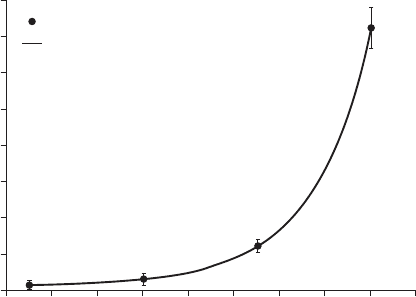
448 APPLICATIONS IN PROCESS DESIGN
Experimental Data
200
180
160
140
120
100
80
60
40
20 30405060708090 100 11
0
Model Predictions
Castin
g
block tem
p
erature
(
ºC
)
Spherulite diameter (mm)
Figure 7.4-2 Corroboration of TIPS model predictions for casting solutions consisting of
40 wt% isotactic polypropylene (iPP) polymer in dotriacontane diluent, showing the final
polymer spherulite diameter as a function of the casting-block temperature.
Equations (7.4-40) and (7.4-41) indicate that the describing equations for the
solid–liquid TIPS process can be greatly simplified. These simplified describing
equations were solved numerically for the isotactic polypropylene–dotriacontane
system by Li et al.
14
The resulting solution for ψ in combination with an appropri-
ate equation for the initial nucleation density at L, which was assumed to depend
only on the instantaneous degree of subcooling and concentration at the boundary
between the phase-separated and single-phase regions, predicted the observed final
spherulite diameter distribution across the thickness of the microporous membrane
as a function of the TIPS processing conditions quite well. A comparison between
observations and the predictions of this TIPS model for the final polymer spherulite
diameter as a function of the cold boundary temperature is shown in Figure 7.4-2
for casting solutions having an initial concentration of 40 wt% isotactic polypropy-
lene in dotriacontane diluent. The model is seen to predict the observed spherulite
diameter quantitatively for casting-block temperatures above 25
◦
C.
7.5 FLUID-WALL AEROSOL FLOW REACTOR FOR HYDROGEN
PRODUCTION FROM METHANE
A hydrogen-fuel-based economy offers considerable promise for providing a clean-
burning fuel that will reduce greenhouse gas production at least at the point of use.
However, the production of hydrogen by water splitting, that is, by decomposing
water into hydrogen and oxygen, requires more energy than is available in the
resulting fuel. If the generation of the energy required for water splitting involves
14
D.Li,A.R.Greenberg,W.B.Krantz,andR.L.Sani,J. Membrane Sci., 279, 50 (2006).
FLUID-WALL AEROSOL FLOW REACTOR FOR HYDROGEN 449
hydrocarbon-based fossil fuels, carbon dioxide will be produced at the point of
production. However, it is possible to thermally dissociate methane at high tem-
peratures directly into hydrogen and carbon, thereby avoiding carbon dioxide gen-
eration. Moreover, the energy required to create these high temperatures can be
obtained from a solar-heated reactor. Hence, it is possible to use solar energy
to drive the thermal decomposition of methane, which is available both naturally
and as a product from the decomposition of organic waste, into a hydrogen fuel
and carbon particles, a useful by-product. The electrically or solar-heated fluid-wall
aerosol flow reactor is being considered for implementing this hydrogen production
technology. The manner in which scaling analysis was used to develop a tractable
model for the complex describing equations for the fluid-wall aerosol reactor is
described in this example.
15
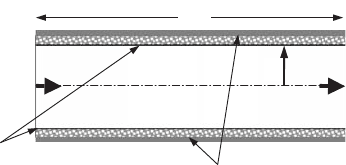
A schematic of the fluid-wall aerosol flow reactor is shown in Figure 7.5-1.
The feed stream consists of methane and carbon particles that facilitate heating
the gas. Hydrogen is injected through the inner porous wall of the tubular reactor
to prevent deposition of carbon particles; that is, since hydrogen is a product of
the reversible methane decomposition, its introduction prevents any reaction at the
wall. To achieve significant methane conversion to hydrogen, the inner wall of the
reactor is maintained at a very high temperature, typically greater than 1500
◦
C,
by either solar or electrical heating. The hot inner wall radiates heat to the carbon
particles, which in turn heat the gas. At a sufficiently high temperature the methane
decomposes into hydrogen and carbon particles through the reaction
CH
4
C + 2H
2
(7.5-1)
The effluent product contains hydrogen, carbon particles, and unreacted methane
if the conversion is not complete. The carbon particles produced via the thermal
decomposition absorb heat via radiation from the reactor walls and thereby enhance
heating of the flowing gas.
Product
stream of
hydrogen and
carbon
Gas feed stream
of methane and
carbon particles
at T
0
Hydrogen injection
through inner heated
porous wall at T
W
Reactor wall maintained at T
W
Figure 7.5-1 Fluid-wall aerosol flow reactor for the thermal conversion of methane gas to
hydrogen and carbon particles; the reactor walls are maintained at a high temperature via
either solar or electrical heating; hydrogen is injected through the inner porous wall of the
reactor to prevent carbon formation on the wall.
15
J.K.Dahl,A.W.Weimer,andW.B.Krantz,Int. J. Hydrogen Energy, 29, 57 (2004).
R
i
L

450 APPLICATIONS IN PROCESS DESIGN
In developing the describing equations for the fluid-wall aerosol flow reactor,
we use the microscale–macroscale modeling approach discussed in Chapter 6; that
is, the carbon particles on the microscale will become a volumetric heat-generation
term on the macroscale of the reactor. The presence of the carbon particles causes
intense mixing in the gas phase, which makes it reasonable to assume that the veloc-
ity profile is uniform or pluglike, which obviates the need to solve the equations
of motion. The reaction kinetics for the thermal decomposition of methane are
expressed in terms of the fractional dissociation of methane, X
c
, via the equation
dX
c
dz
=
k
n
U
G
(1 − X
c
)
n
(7.5-2)
where z is the axial distance from the inlet of the reactor, U
G
is the linear veloc-
ity of the gas stream, which increases with the hydrogen production, and k
n
is a
temperature-dependent kinetic parameter for the pseudo nth-order thermal decom-
position reaction, which is given by
k
n
= k
n0
e
−E/RT
G
(7.5-3)
where k
n0
is a kinetic constant, E the activation energy for reaction, R the gas
constant, and T
G
the local temperature of the gas phase. Note that equation (7.5-2)
follows directly from the species-balance equation for the methane for which the
reaction term is assumed to have nth-order kinetics and for which axial diffusion is
neglected. By means of the species-balance equation, the concentrations and molar
flow rates of both the hydrogen and carbon can be expressed in terms of the frac-
tional conversion. Hence, completing the specification of the describing equations
reduces to writing the appropriate forms of the thermal energy balance for the cloud
of carbon particles and the gas stream along with their boundary conditions.
A thermal energy balance on the cloud of carbon particles yields
d(W
C
H
C
)
dz
=−
h
P
a
C
W
C
M
C
U
G
ρ
C
(T
C
− T
G
) +
εσa
C
W
C
M
C
U
G
ρ
C
(T
4
W
− T
4
C
) (7.5-4)
where W
C
and H
C
are the molar velocity (moles/time) and molar enthalpy (energy/
mole) of the cloud of carbon particles, ε is the radiative emissivity (equal to the
absorbtivity for a blackbody) of the carbon particles, σ is the Stefan–Boltzmann
constant, T
C
and T
W
are the temperatures of the carbon particles and reactor wall,
respectively, h
P
is the heat-transfer coefficient between the carbon particles and
the gas, a
C
is the interfacial area per unit volume of carbon particles, and M
C
and
ρ
C
are the molecular weight and mass density of carbon, respectively. Note that in
arriving at this equation the interrelationship between the spatial coordinate z (in
a stationary coordinate system) and time t (in a convected coordinate system) is
dz = U
G
dt; this is the reason that U
G
appears in the denominator of the second
and third terms. The first term in equation (7.5-4) is the change in the sensible heat
of the carbon particles as they are convected downstream; the second term is the
heat transfer from the carbon particles to the gas stream, and the third term is the

FLUID-WALL AEROSOL FLOW REACTOR FOR HYDROGEN 451
radiative heat transfer from the reactor wall to the carbon particles. Clearly, the
first and third terms must be retained in our scaling analysis.
The corresponding thermal energy balance on the gas phase is given by
d(W
M
H
M
)
dz
+
d(W
H
H
H
)
dz
=
ˆ
W
H
(H
HW
− H
H 0
) + h
W
2πR
i
(T
W
− T
G
)
+
h
P
a
C
W
C
M
C
U
G
ρ
C
(T
C
− T
G
) (7.5-5)
where W
i
is the molar velocity (moles/time) of species i; H
i
is the molar enthalpy
of species i for which the added subscripts 0 and W denote evaluation at the feed
and wall temperatures, T
0
and T
W
, respectively;
ˆ
W
H
is the molar injection rate of
hydrogen per unit length of reactor tube wall (moles/length·time); and h
W
is the
heat-transfer coefficient between the heated wall and the gas flow. The first and
second terms in equation (7.5-5) are the change in sensible heat of the methane
and hydrogen as they are convected downstream, respectively; the third term is
the sensible heat added by the injection of hydrogen gas at the wall temperature;
the fourth term is the heat transfer from the heated wall to the gas stream; and
the fifth term is the heat transfer from the carbon particles to the gas stream. Note
that the last term interrelates the heat transfer on the microscale of the carbon
particles to the macroscale of the gas flow through the reactor. The heat-transfer
coefficient h
P
has a role analogous to that of the mass-transfer coefficient in the
microscale–macroscale examples involving mass transfer with chemical reaction
discussed in Chapter 6. Clearly, the first term must be retained in our scaling analy-
sis since the methane must be heated for thermal decomposition to occur. However,
it is not clear which term provides the principal source of heat in this equation.
The molar flow rates of methane, hydrogen, and carbon can be related to that
of the methane feed stream through the stoichiometry given by the dissociation
reaction 7.5-1:
W
M
=(1 −X
c
)W
0
M
; W
H
=2X
c
W
0
M
+
ˆ
W
H
z; W
C
=X
c
W
0
M
+W
0
C
(7.5-6)
where W
0
M
and W
0
C
are the molar flow rates of the methane and carbon particles
in the feed stream to the reactor. The molar flow rate of the hydrogen includes
contributions from both the dissociation of the methane and the injection through
the porous inner wall of the reactor. The molar flow rate of the cloud of carbon
particles includes contributions from both the dissociation of the methane and those
contained in the feed stream. The enthalpies of the methane, hydrogen, and carbon
are given by
H
M
=
T
G
T
0
C
pM
dT ; H
H
=
T
G
T
0
C
pH
dT ; H
C
=
T
C
T
0
C
pC
dT (7.5-7)
where C
pi
is the temperature-dependent heat capacity at constant pressure of com-
ponent i. If there is no relative velocity between the carbon particles and the gas
stream, the heat-transfer coefficient can be assumed to be that for pure conduction,
for which

452 APPLICATIONS IN PROCESS DESIGN
h
P
=
k
G
R
P
(7.5-8)
in which k
G
is the thermal conductivity of the gas phase and R
P
is the average
radius of the carbon particles. To complete the specification of the describing
equations, appropriate equations-of-state need to be specified for any temperature-
dependent properties, such as C
pi
, k
G
,andh
W
. However, for the scaling analysis,
we merely need characteristic values of these temperature-dependent quantities.
Equations (7.5-4) and (7.5-5) can be rearranged using equations (7.5-2), (7.5-6),
and (7.5-7) into the forms
W
C
C
pC
dT
C
dz
+
W
0
M
H
C
k
n
U
G
(1 − X
c
)
n
=−
h
P
a
C
W
C
M
C
U
G
ρ
C
(T
C
− T
G
) +
εσa
C
W
C
M
C
U
G
ρ
C
(T
4
W
− T
4
C
) (7.5-9)
(W
M
C
pM
+ W
H
C
pH
)
dT
G
dz
−
W
0
M
H
M
k
n
U
G
(1 − X
c
)
n
+
2W
0
M
H
H
k
n
U
G
(1 − X
c
)
n
=
ˆ
W
H
(H
HW
− H
H
) + h
W
2πR
i
(T
W
− T
G
) +
h
P
a
C
W
C
M
C
U
G
ρ
C
(T
C
− T
G
)
(7.5-10)
The boundary conditions on equations (7.5-2), (7.5-9), and (7.5-10) are given by
X
c
= 0,T
G
= T
0
,T
C
= T
0
at z = 0 (7.5-11)
Equations (7.5-2), (7.5-3), and (7.5-6) through (7.5-11) constitute the describing
equations for the fluid-wall aerosol flow reactor (step 1).
Define the following dimensionless variables containing unspecified scale and
reference factors (steps 2, 3, and 4):
T
∗
G
≡
T
G
− T
Gr
T
Gs
; T
∗
C
≡
T
C
− T
Cr
T
Cs
;
dT
G
dz
∗
≡
1
T
Gzs
dT
G
dz
;
dT
C
dz
∗
≡
1
T
Czs
dT
C
dz
;
dX
c
dz
∗
≡
1
X
czs
dX
c
dz
; H
∗
M
≡
H
M
H
Ms
;
H
∗
H
≡
H
H
H
Hs
; H
∗
C
≡
H
C
H
Cs
; W
∗
M
≡
W
M
W
Ms
; W
∗
H
≡
W
H
W
Hs
;
W
∗
C
≡
W
C
W
Cs
; C
∗
pM
≡
C
pM
C
pMs
; C
∗
pH
≡
C
pH
C
pHs
; C
∗
pC
≡
C
pC
C
pCs
;
h
∗
P
≡
h
P
h
Ps
; h
∗
W
≡
h
W
h
Ws
; U
∗
G
≡
U
G
U
Gs
; k
∗
n
≡
k
n
k
ns
; k
∗
G
≡
k
G
k
s
(7.5-12)