
Krantz W.B. Scaling Analysis in Modeling Transport and Reaction Processes: A Systematic Approach to Model Building and the Art of Approximation
Подождите немного. Документ загружается.

THERMAL ENERGY EQUATION 483
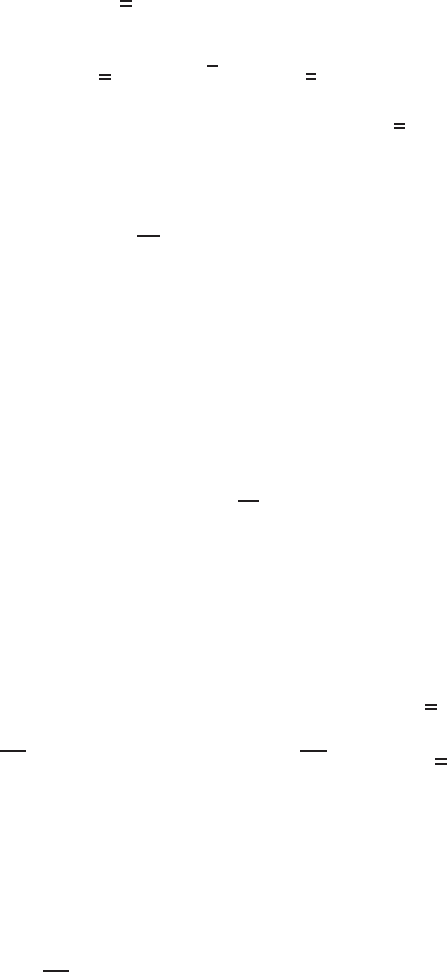
viscous stress tensor τ follows the sign convection for the force on a fluid particle
discussed in Appendix A and for a Newtonian fluid is given by
τ
=−
κ −
2
3
μ
(∇·u)δ
− μ[∇u + (∇u)
†
] (B.2-2)
where μ is the shear viscosity, κ the bulk viscosity, δ
the second-order identity
tensor, and † denotes the transpose of a second-order tensor. For the special case of
an incompressible Newtonian fluid with constant viscosity, equation (B.2.1) when
combined with equation (B.2-2) simplifies to
ρ
∂ u
∂t
+ ρ u ·∇u =−∇P + μ∇
2
u + ρ g (B.2-3)
B.3 EQUATIONS OF MOTION FOR POROUS MEDIA
The following form of the equations of motion in generalized vector–tensor notation
for flow through porous media is based on Brinkman’s empirical modification of
Darcy’s law and assumes a body force due to a gravitational field, and an incom-
pressible fluid having constant viscosity μ and permeability k
p
;
u
denotes the
superficial velocity based on considering the porous media to be homogeneous
1
:
0 =−∇P −
μ
k
p
u
+ μ∇
2
u
+ ρ g (B.3-1)
B.4 THERMAL ENERGY EQUATION
The following form of the thermal energy equation in generalized vector–tensor
notation allows for nonconstant physical properties, energy generation, and con-
version of mechanical to internal energy by means of viscous dissipation, which is
expressed in terms of an unspecified viscous stress tensor τ
:
ρC
v
∂T
∂t
+ ρC
v
u ·∇T =∇·(k∇T)− T
∂P
∂T
ρ
(∇·u) − (τ : ∇u) + G
e
(B.4-1)
where C
v
is the heat capacity at constant volume, k the thermal conductivity, and
G
e
the energy generation rate per unit volume. Equation (B.4-1) can be applied to
non-Newtonian fluids if the appropriate constitutive equation relating the viscous
stress to the rate of strain is known. For the special case of an incompressible
Newtonian fluid with constant thermal conductivity k and for which the viscous
stress tensor is given by equation (B.2-2), equation (B.4-1) simplifies to
ρC
p
∂T
∂t
+ ρC
p
u ·∇T = k∇
2
T + μ[∇u + (∇u)
†
]:∇u + G
e
(B.4-2)
where C
p
is the heat capacity at constant pressure.
1
H. C. Brinkman, Appl.Sci.Res., A1, 27–34, 81–86 (1947).

484 APPENDIX B
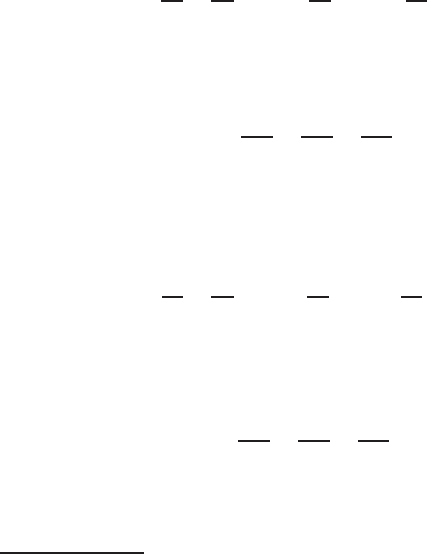
B.5 EQUATION OF CONTINUITY FOR A BINARY MIXTURE
The following form of the equation of continuity or species-balance equation in
generalized vector–tensor notation for component A in a binary system allows for
nonconstant physical properties and is expressed in terms of the mass concentration
ρ
A
and the mass flux vector n
A
:
∂ρ
A
∂t
+∇·n
A
= G
A
(B.5-1)
where G
A
is the mass rate of generation of component A per unit volume. The
mass flux vector is given for a binary system by Fick’s law of diffusion in the
form
n
A
= ω
A
(n
A
+n
B
) − ρD
AB
∇ω
A
= ρ
A
u − ρD
AB
∇ω
A
(B.5-2)
in which ω
A
is the mass fraction of component A, D
AB
the binary diffusion coef-
ficient, and u the mass-average velocity. The form of the species-balance equation
given by equation (B.5-1) is particularly useful for describing mass transfer in
incompressible liquid and solid systems for which the mass density ρ is constant.
For the special case of an incompressible Newtonian fluid with a constant binary
diffusion coefficient D
AB
, equation (B.5-1) when combined with equation (B.5-2)
simplifies to
∂ρ
A
∂t
+u ·∇ρ
A
= D
AB
∇
2
ρ
A
+ G
A
(B.5-3)
The following form of the species-balance equation in generalized vector–tensor
notation for component A in a binary system allows for nonconstant physical
properties and is expressed in terms of the molar concentration c
A
and the molar
flux vector
N
A
:
∂c
A
∂t
+∇·
N
A
=
ˆ
G
A
(B.5-4)
where
ˆ
G
A
is the molar generation rate of component A per unit volume. The
molar flux vector is given for a binary system by Fick’s law of diffusion in the
form
N
A
= x
A
(
N
A
+
N
B
) − cD
AB
∇x
A
= c
A
ˆu − cD
AB
∇x
A
(B.5-5)
in which x
A
is the mole fraction of component A and
ˆu is the molar-average
velocity. The form of the species-balance equation given by equation (B.5-4) is
particularly useful for describing mass transfer in gas systems for which the molar
density c is constant at a fixed temperature and pressure. This equation is also
used to describe reacting systems for which the rate of generation of species is

EQUATION OF CONTINUITY FOR A BINARY MIXTURE 485
dictated by the reaction stoichiometry in terms of molar concentrations. For the
special case of an incompressible Newtonian fluid with a constant binary diffusion
coefficient D
AB
, equation (B.5-4) when combined with equation (B.5-5) simpli-
fies to
∂c
A
∂t
+
ˆu ·∇c
A
= D
AB
∇
2
c
A
+
ˆ
G
A
(B.5-6)
APPENDIX C
Continuity Equation
C.1 RECTANGULAR COORDINATES
The following form of the continuity or total mass-balance equation in rectangular
coordinates is expressed in terms of the mass density ρ, which can be nonconstant,
and mass-average velocity components u
i
:
∂ρ
∂t
+
∂
∂x
(ρu
x
) +
∂
∂y
(ρu
y
) +
∂
∂z
(ρu
z
) = 0 (C.1-1)
For the special case of an incompressible fluid or fluid having a constant mass
density, equation (C.1-1) simplifies to
∂u
x
∂x
+
∂u
y
∂y
+
∂u
z
∂z
= 0 (C.1-2)
The following form of the continuity or total mass-balance equation in rectangular
coordinates is expressed in terms of the molar density c, which can be nonconstant,
and molar-average velocity components ˆu
i
:
∂c
∂t
+
∂
∂x
(c ˆu
x
) +
∂
∂y
(c ˆu
y
) +
∂
∂z
(c ˆu
z
) =
ˆ
G (C.1-3)
where
ˆ
G is the total molar generation rate per unit volume. For the special case of
a fluid having a constant molar density, equation (C.1-3) simplifies to
∂ ˆu
x
∂x
+
∂ ˆu
y
∂y
+
∂ ˆu
z
∂z
=
ˆ
G (C.1-4)
Scaling Analysis in Modeling Transport and Reaction Processes: A Systematic Approach
to Model Building and the Art of Approximation, By William B. Krantz
Copyright © 2007 John Wiley & Sons, Inc.
486
SPHERICAL COORDINATES 487
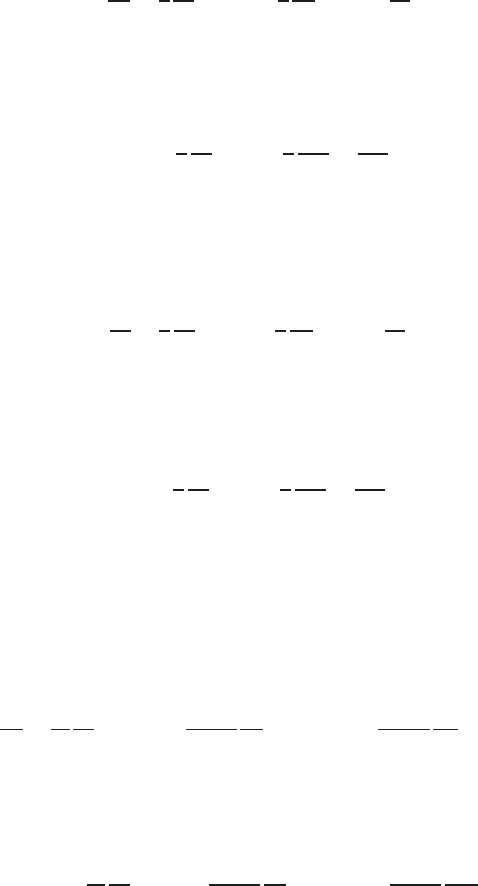
C.2 CYLINDRICAL COORDINATES
The following form of the continuity or total mass-balance equation in cylindrical
coordinates is expressed in terms of the mass density ρ, which can be nonconstant,
and mass-average velocity components u
i
:
∂ρ
∂t
+
1
r
∂
∂r
(ρru
r
) +
1
r
∂
∂θ
(ρu
θ
) +
∂
∂z
(ρu
z
) = 0 (C.2-1)
For the special case of an incompressible fluid or fluid having a constant mass
density, equation (C.2-1) simplifies to the following:
1
r
∂
∂r
(ru
r
) +
1
r
∂u
θ
∂θ
+
∂u
z
∂z
= 0 (C.2-2)
The following form of the continuity or total mass-balance equation in cylindrical
coordinates is expressed in terms of the molar density c, which can be nonconstant,
and molar-average velocity components ˆu
i
:
∂c
∂t
+
1
r
∂
∂r
(cr ˆu
r
) +
1
r
∂
∂θ
(c ˆu
θ
) +
∂
∂z
(c ˆu
z
) =
ˆ
G (C.2-3)
where
ˆ
G is the total molar generation rate per unit volume. For the special case of
a fluid having a constant molar density, equation (C.2-3) simplifies to
1
r
∂
∂r
(r ˆu
r
) +
1
r
∂ ˆu
θ
∂θ
+
∂ ˆu
z
∂z
=
ˆ
G (C.2-4)
C.3 SPHERICAL COORDINATES
The following form of the continuity or total mass-balance equation in spherical
coordinates is expressed in terms of the mass density ρ, which can be nonconstant,
and mass-average velocity components u
i
:
∂ρ
∂t
+
1
r
2
∂
∂r
(ρr
2
u
r
) +
1
r sin θ
∂
∂θ
(ρu
θ
sin θ) +
1
r sin θ
∂
∂φ
(ρu
φ
) = 0 (C.3-1)
For the special case of an incompressible fluid or fluid having a constant mass
density, equation (C.3-1) simplifies to
1
r
2
∂
∂r
(r
2
u
r
) +
1
r sin θ
∂
∂θ
(u
θ
sin θ) +
1
r sin θ
∂u
φ
∂φ
= 0 (C.3-2)

488 APPENDIX C
The following form of the continuity or total mass-balance equation in spherical
coordinates is expressed in terms of the molar density c, which can be nonconstant,
and molar-average velocity components ˆu
i
:
∂c
∂t
+
1
r
2
∂
∂r
(cr
2
ˆu
r
) +
1
r sin θ
∂
∂θ
(c ˆu
θ
sin θ) +
1
r sin θ
∂
∂φ
(c ˆu
ϕ
) =
ˆ
G (C.3-3)
where
ˆ
G is the total molar generation rate per unit volume. For the special case of
a fluid having a constant molar density, equation (C.3-3) simplifies to
1
r
2
∂
∂r
(r
2
ˆu
r
) +
1
r sin θ
∂
∂θ
( ˆu
θ
sin θ) +
1
r sin θ
∂ ˆu
φ
∂φ
=
ˆ
G (C.3-4)
APPENDIX D
Equations of Motion
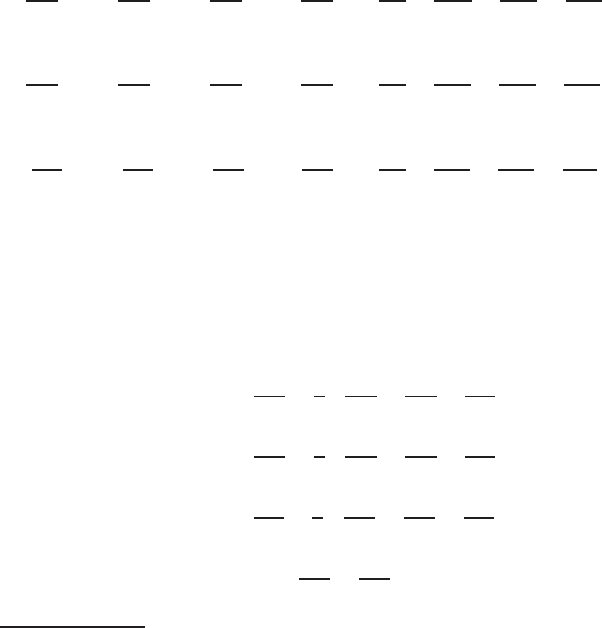
D.1 RECTANGULAR COORDINATES
The following forms of the x-, y-, and z-components of the equations of motion
in rectangular coordinates allow for nonconstant physical properties, a body force
due to a gravitational field, and unspecified viscous stress-tensor components τ
ij
:
ρ
∂u
x
∂t
+ ρu
x
∂u
x
∂x
+ ρu
y
∂u
x
∂y
+ ρu
z
∂u
x
∂z
=−
∂P
∂x
−
∂τ
xx
∂x
−
∂τ
yx
∂y
−
∂τ
zx
∂z
+ ρg
x
(D.1-1)
ρ
∂u
y
∂t
+ ρu
x
∂u
y
∂x
+ ρu
y
∂u
y
∂y
+ ρu
z
∂u
y
∂z
=−
∂P
∂y
−
∂τ
xy
∂x
−
∂τ
yy
∂y
−
∂τ
zy
∂z
+ ρg
y
(D.1-2)
ρ
∂u
z
∂t
+ ρu
x
∂u
z
∂x
+ ρu
y
∂u
z
∂y
+ ρu
z
∂u
z
∂z
=−
∂P
∂z
−
∂τ
xz
∂x
−
∂τ
yz
∂y
−
∂τ
zz
∂z
+ ρg
z
(D.1-3)
Equations (D.1-1) through (D.1-3) can be applied to non-Newtonian fluids if the
appropriate constitutive equation relating the viscous stress to the rate of strain is
known. The components of the viscous stress tensor τ
ij
follow the sign convection
for the force on a fluid particle discussed in Appendix A and for a Newtonian fluid
are given by
τ
xx
=−μ
2
∂u
x
∂x
−
2
3
∂u
x
∂x
+
∂u
y
∂y
+
∂u
z
∂z
(D.1-4)
τ
yy
=−μ
2
∂u
y
∂y
−
2
3
∂u
x
∂x
+
∂u
y
∂y
+
∂u
z
∂z
(D.1-5)
τ
zz
=−μ
2
∂u
z
∂z
−
2
3
∂u
x
∂x
+
∂u
y
∂y
+
∂u
z
∂z
(D.1-6)
τ
xy
= τ
yx
=−μ
∂u
x
∂y
+
∂u
y
∂x
(D.1-7)
Scaling Analysis in Modeling Transport and Reaction Processes: A Systematic Approach
to Model Building and the Art of Approximation, By William B. Krantz
Copyright © 2007 John Wiley & Sons, Inc.
489
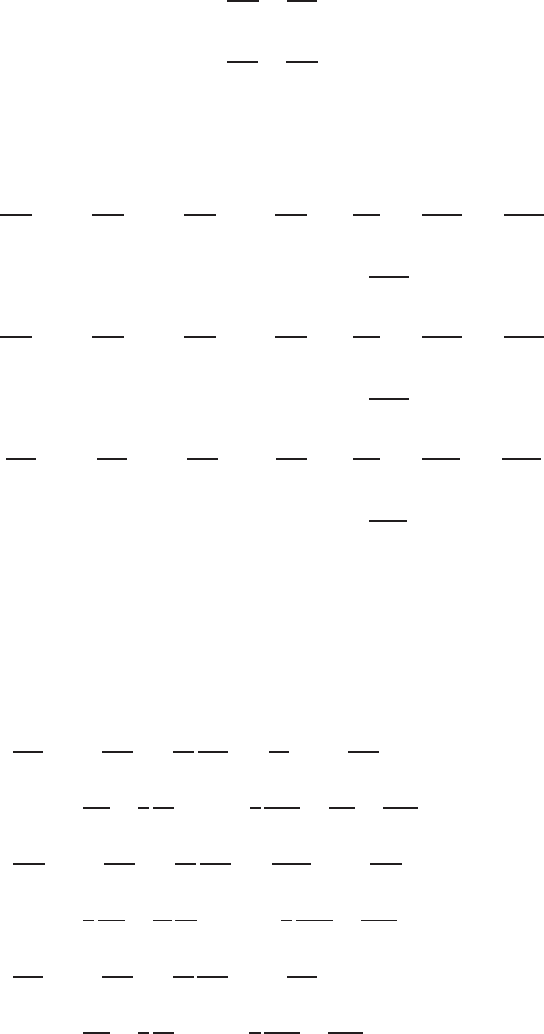
490 APPENDIX D
τ
yz
= τ
zy
=−μ
∂u
y
∂z
+
∂u
z
∂y
(D.1-8)
τ
zx
= τ
xz
=−μ
∂u
z
∂x
+
∂u
x
∂z
(D.1-9)
For the special case of an incompressible Newtonian fluid with constant viscos-
ity, equations (D.1.1) through (D.1-3) combined with equations (D.1-4) through
(D.1-9) simplify to
ρ
∂u
x
∂t
+ ρu
x
∂u
x
∂x
+ ρu
y
∂u
x
∂y
+ ρu
z
∂u
x
∂z
=−
∂P
∂x
+ μ
∂
2
u
x
∂x
2
+ μ
∂
2
u
x
∂y
2
+ μ
∂
2
u
x
∂z
2
+ ρg
x
(D.1-10)
ρ
∂u
y
∂t
+ ρu
x
∂u
y
∂x
+ ρu
y
∂u
y
∂y
+ ρu
z
∂u
y
∂z
=−
∂P
∂y
+ μ
∂
2
u
y
∂x
2
+ μ
∂
2
u
y
∂y
2
+ μ
∂
2
u
y
∂z
2
+ ρg
y
(D.1-11)
ρ
∂u
z
∂t
+ ρu
x
∂u
z
∂x
+ ρu
y
∂u
z
∂y
+ ρu
z
∂u
z
∂z
=−
∂P
∂z
+ μ
∂
2
u
z
∂x
2
+ μ
∂
2
u
z
∂y
2
+ μ
∂
2
u
z
∂z
2
+ ρg
z
(D.1-12)
D.2 CYLINDRICAL COORDINATES
The following forms of the r-, θ-, and z-components of the equations of motion in
cylindrical coordinates allow for nonconstant physical properties, a body force due
to a gravitational field, and unspecified viscous stress–tensor components τ
ij
:
ρ
∂u
r
∂t
+ ρu
r
∂u
r
∂r
+ ρ
u
θ
r
∂u
r
∂θ
− ρ
u
2
θ
r
+ ρu
z
∂u
r
∂z
=−
∂P
∂r
−
1
r
∂
∂r
(rτ
rr
) −
1
r
∂τ
rθ
∂θ
+
τ
θθ
r
−
∂τ
rz
∂z
+ ρg
r
(D.2-1)
ρ
∂u
θ
∂t
+ ρu
r
∂u
θ
∂r
+ ρ
u
θ
r
∂u
θ
∂θ
+ ρ
u
r
u
θ
r
+ ρu
z
∂u
θ
∂z
=−
1
r
∂P
∂θ
−
1
r
2
∂
∂r
(r
2
τ
rθ
) −
1
r
∂τ
θθ
∂θ
−
∂τ
θz
∂z
+ ρg
θ
(D.2-2)
ρ
∂u
z
∂t
+ ρu
r
∂u
z
∂r
+ ρ
u
θ
r
∂u
z
∂θ
+ ρu
z
∂u
z
∂z
=−
∂P
∂z
−
1
r
∂
∂r
(rτ
rz
) −
1
r
∂τ
θz
∂θ
−
∂τ
zz
∂z
+ ρg
z
(D.2-3)

CYLINDRICAL COORDINATES 491
Equations (D.2-1) through (D.2-3) can be applied to non-Newtonian fluids if the
appropriate constitutive equation relating the viscous stress to the rate of strain is
known. The components of the viscous stress tensor τ
ij
follow the sign convection
for the force on a fluid particle discussed in Appendix A and for a Newtonian fluid
are given by
τ
rr
=−μ
2
∂u
r
∂r
−
2
3
1
r
∂
∂r
(ru
r
) +
1
r
∂u
θ
∂θ
+
∂u
z
∂z
(D.2-4)
τ
θθ
=−μ
2
1
r
∂u
θ
∂θ
+
u
r
r
−
2
3
1
r
∂
∂r
(ru
r
) +
1
r
∂u
θ
∂θ
+
∂u
z
∂z
(D.2-5)
τ
zz
=−μ
2
∂u
z
∂z
−
2
3
1
r
∂
∂r
(ru
r
) +
1
r
∂u
θ
∂θ
+
∂u
z
∂z
(D.2-6)
τ
rθ
= τ
θr
=−μ
r
∂
∂r
u
θ
r
+
1
r
∂u
r
∂θ
(D.2-7)
τ
θz
= τ
zθ
=−μ
∂u
θ
∂z
+
1
r
∂u
z
∂θ
(D.2-8)
τ
zr
= τ
rz
=−μ
∂u
z
∂r
+
∂u
r
∂z
(D.2-9)
For the special case of an incompressible Newtonian fluid with constant viscosity,
equations (D.2.1) through (D.2-3) combined with equations (D.2-4) through (D.2-9)
simplify to
ρ
∂u
r
∂t
+ ρu
r
∂u
r
∂r
+ ρ
u
θ
r
∂u
r
∂θ
− ρ
u
2
θ
r
+ ρu
z
∂u
r
∂z
=−
∂P
∂r
+ μ
∂
∂r
1
r
∂
∂r
(ru
r
)
+ μ
1
r
2
∂
2
u
r
∂θ
2
− μ
2
r
2
∂u
θ
∂θ
+ μ
∂
2
u
r
∂z
2
+ ρg
r
(D.2-10)
ρ
∂u
θ
∂t
+ ρu
r
∂u
θ
∂r
+ ρ
u
θ
r
∂u
θ
∂θ
+ ρ
u
r
u
θ
r
+ ρu
z
∂u
θ
∂z
=−
1
r
∂P
∂θ
+ μ
∂
∂r
1
r
∂
∂r
(ru
θ
)
+ μ
1
r
2
∂
2
u
θ
∂θ
2
+ μ
2
r
2
∂u
r
∂θ
+ μ
∂
2
u
θ
∂z
2
+ ρg
θ
(D.2-11)
ρ
∂u
z
∂t
+ ρu
r
∂u
z
∂r
+ ρ
u
θ
r
∂u
z
∂θ
+ ρu
z
∂u
z
∂z
=−
∂P
∂z
+ μ
1
r
∂
∂r
r
∂u
z
∂r
+ μ
1
r
2
∂
2
u
z
∂θ
2
+ μ
∂
2
u
z
∂z
2
+ ρg
z
(D.2-12)

492 APPENDIX D
D.3 SPHERICAL COORDINATES
The following forms of the r-, θ-, and φ-components of the equations of motion in
spherical coordinates allow for nonconstant physical properties, a body force due
to a gravitational field, and unspecified viscous stress–tensor components τ
ij
:
ρ
∂u
r
∂t
+ ρu
r
∂u
r
∂r
+ ρ
u
θ
r
∂u
r
∂θ
+ ρ
u
φ
r sin θ
∂u
r
∂φ
− ρ
u
2
θ
+ u
2
φ
r
=−
∂P
∂r
−
1
r
2
∂
∂r
(r
2
τ
rr
) −
1
r sin θ
∂
∂θ
(τ
rθ
sin θ)
−
1
r sin θ
∂τ
rφ
∂φ
+
τ
θθ
+ τ
φφ
r
+ ρg
r
(D.3-1)
ρ
∂u
θ
∂t
+ ρu
r
∂u
θ
∂r
+ ρ
u
θ
r
∂u
θ
∂θ
+ ρ
u
φ
r sin θ
∂u
θ
∂φ
+ ρ
u
r
u
θ
r
− ρ
u
2
φ
cot θ
r
=−
1
r
∂P
∂θ
−
1
r
2
∂
∂r
(r
2
τ
rθ
) −
1
r sin θ
∂
∂θ
(τ
θθ
sin θ) −
1
r sin θ
∂τ
θφ
∂φ
−
τ
rθ
r
+
cot θ
r
τ
φφ
+ ρg
θ
(D.3-2)
ρ
∂u
φ
∂t
+ ρu
r
∂u
φ
∂r
+ ρ
u
θ
r
∂u
φ
∂θ
+ ρ
u
φ
r sin θ
∂u
φ
∂φ
+ ρ
u
φ
u
r
r
−
u
θ
u
φ
r
cot θ
=−
1
r sin θ
∂P
∂φ
−
1
r
2
∂
∂r
(r
2
τ
rφ
) −
1
r
∂τ
θφ
∂θ
−
1
r sin θ
∂τ
φφ
∂φ
−
τ
rφ
r
−
2cotθ
r
τ
θφ
+ ρg
φ
(D.3-3)
Equations (D.3-1) through (D.3-3) can be applied to non-Newtonian fluids if the
appropriate constitutive equation relating the viscous stress to the rate of strain is
known. The components of the viscous stress tensor τ
ij
follow the sign convection
for the force on a fluid particle discussed in Appendix A and for a Newtonian fluid
are given by
τ
rr
=−μ
2
∂u
r
∂r
−
2
3
1
r
2
∂
∂r
(r
2
u
r
) +
1
r sin θ
∂
∂θ
(u
θ
sin θ) +
1
r sin θ
∂u
φ
∂φ
(D.3-4)
τ
θθ
=−μ
2
1
r
∂u
θ
∂θ
+
u
r
r
−
2
3
1
r
2
∂
∂r
(r
2
u
r
) +
1
r sin θ
∂
∂θ
(u
θ
sin θ)
+
1
r sin θ
∂u
φ
∂φ
(D.3-5)