
Krantz W.B. Scaling Analysis in Modeling Transport and Reaction Processes: A Systematic Approach to Model Building and the Art of Approximation
Подождите немного. Документ загружается.

FLUID-WALL AEROSOL FLOW REACTOR FOR HYDROGEN 463
0
0.1
0.2
0.3
0.4
0.5
0.6
0.7
0.8
0.9
1
2 3 456789 10
X
c
, fractional conversion
Π
3
−1
, dimensionless wall temperature
----
Scaling analysis estimate
Numerical solution, Π
11
= 1.2 × 10
4
Numerical solution, Π
11
= 1.2 × 10
3
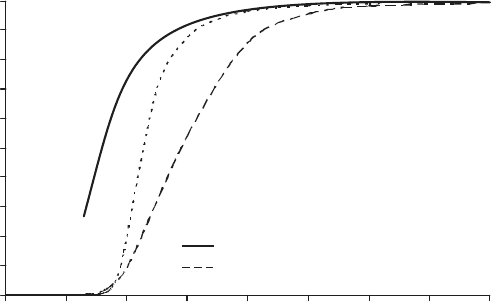
Figure 7.5-2 Fractional conversion as a function of the dimensionless wall temperature
estimated by scaling analysis and predicted by a numerical solution to the full set of describ-
ing equations for two values of the dimensionless heat-transfer coefficient,
11
.
corresponding to higher reactor wall temperatures result in increased conversion,
whereas smaller values of
11
corresponding to larger carbon particles result in
decreased conversion.
The redefined dimensionless groups given by equations (7.5-55) through
(7.5-61) are useful for isolating various dimensional parameters so that their effect
on the fractional conversion and other quantities of interest can be studied. How-
ever, to understand the reasons for the trends observed, the original dimensionless
groups determined by scaling analysis are required since these groups are propor-
tional to the relative magnitudes of the various terms in the describing equations.
The increase in X
c
with increasing T
W
is a direct effect of increasing the reaction-
rate parameter via
9
in equation (7.5-34). The decrease in X
c
with an increase in
particle size can be attributed to a decrease in the heat-transfer coefficient only if the
gas and carbon particles are not essentially in thermal equilibrium; that is, if
2
=
◦
(1). Note that
2
=
11
T
3
0
/
(T
W
− T
0
)
3
. Hence, we find that 3.5 ≤
2
≤ 43
for the temperature range 2400K ≥ T
W
1200 K and
11
= 1.2 × 10
3
, whereas
35 ≤
2
≤ 430 for
11
= 1.2 × 10
4
;thatis,
2
is large at all but the highest tem-
peratures for the larger particle size. Hence, the inverse relationship between R
P
and h
Ps
cannot explain the decrease in X
c
with decreasing values of
11
. However,
the particle size also affects conversion through the dimensionless group
1
,which
is directly proportional to R
P
through the parameter a
C
= 3/R
P
; this group is a
measure of the sensible heat required for the carbon particles. Hence, decreasing
11
by an order of magnitude also increases
1
proportionately. The larger effect
of a decrease in
11
on X
c
observed at lower values of
−1
3
is because
1
is pro-
portional to (T
W
− T
0
)
−3
; that is, as the wall temperature increases,
1
decreases
and the sensible heat requirement for the carbon particles becomes less important.
464 APPLICATIONS IN PROCESS DESIGN
In summary, one sees in this example the utility of first scaling the describing
equations to obtain the minimum parametric representation. The magnitude of
the resulting dimensionless groups provides a direct assessment of the relative
importance of the various terms in the describing equations. In particular, these
dimensionless groups allow one to assess what approximations, if any, might be
applicable. However, the dimensionless groups that result from scaling analysis
often are not optimal for correlating experimental or numerical data. Hence, it is
convenient to redefine the dimensionless groups using the formalisms introduced
in Chapter 2 in order to isolate particular dimensional quantities of interest into
just one dimensionless group. However, to interpret trends in the observed perfor-
mance of the particular device or process of interest, one must revert back to the
original dimensionless groups obtained from scaling analysis, since the magnitude
of the latter is a direct measure of the physicochemical phenomena involved in the
describing equations.
7.6 SUMMARY
In contrast to Chapters 3 through 6, in which scaling analysis was used essentially
as a pedagogical tool, in this chapter we illustrated how it can be used in the
design of improved and new processes. This was demonstrated via four examples
that focused on emerging technologies, all of which involved coupled transport.
Three of these examples also used the microscale–macroscale modeling concept to
address the heterogeneous nature of the systems. Scaling the describing equations
for complex technologies is a trial-and-error process; that is, one generally is not
certain which terms need to be balanced to determine the proper scale factors.
However, the forgiving nature of scaling will always indicate when terms have
not been balanced properly. This is indicated when one or more terms are not
bounded of
◦
(1) when the relevant physical properties and process parameters are
substituted into the dimensionless describing equations. The scaling analysis in
each of these examples was the final result of this trial-and-error procedure for
specified sets of properties and parameters. However, in the Practice Problems at
the end of the chapter we explore other possible scalings.
In Section 7.2 we applied
◦
(1) scaling analysis to the design of a membrane–
lung oxygenator. The same problem was analyzed in Section 5.10 using the simple
scaling analysis approach to dimensional analysis. Whereas both methods resulted
in a correlation for the Sherwood number in terms of the same four dimen-
sionless groups, the
◦
(1) scaling analysis approach provided considerably more
information on the performance of this device. Additional insight into the design
of the membrane-lung oxygenator was possible because the
◦
(1) scaling analy-
sis identified both a momentum boundary layer within which the effect of the
wall oscillations on the velocity profile was confined and a solutal boundary layer
across within which the mass transfer occurred. The
◦
(1) scaling analysis pro-
vided an explanation for why the enhancement in mass transfer involved a “tuned”
response with respect to the oscillation frequency. It also led to a design equation
SUMMARY 465
for predicting the effect of the process parameters on the frequency required to
achieve optimal enhancement in the mass transfer. This design problem effectively
illustrated the advantages of using
◦
(1) scaling analysis to achieve the minimum
parametric representation relative to the simple scaling analysis or Pi theorem
approaches to dimensional analysis.
In Section 7.3 we considered pulsed single-bed pressure swing adsorption (PSA)
for the production of oxygen-enriched air. This example demonstrated the value of
an
◦
(1) scaling analysis to design a new process. Whereas the design of conven-
tional pulsed packed single-bed PSA is well established, no performance data are
available for the novel pulsed monolithic single-bed PSA process. This example
involved coupled fluid dynamics and mass transfer with adsorption and employed
microscale–macroscale modeling to address the adsorption from the bulk gas flow
onto the discrete adsorbent particles. We found that proper scaling was indicated
by all the terms in the describing equations being bounded of
◦
(1). This usually
means that all the dimensionless groups are bounded of
◦
(1), although strictly
speaking, it means that the product of any dimensionless group and the variables
it multiplies must be bounded of
◦
(1). Scaling analysis identified several marked
differences between packed single-bed PSA technology and the monolithic bed
process. Scaling analysis indicated that local adsorption equilibrium was achieved
nearly instantaneously in the monolithic bed PSA process; in contrast, the adsorp-
tion in the packed bed PSA process was mass-transfer controlled. This difference
between monolithic and packed bed adsorption is analogous to that between the fast
and slow reaction regimes in the microscale–macroscale analysis of mass transfer
with chemical reaction that was considered in Chapter 6. Scaling analysis indicated
that for the monolithic bed process the optimal pressurization time was the contact
time required for the adsorption wave to pass through the bed; in contrast, for the
packed bed process it was the time required to achieve equilibrium in the adsorption
bed. This example also illustrated the advantages of using
◦
(1) scaling analysis for
dimensional analysis. Whereas a na
¨
ıve application of the Pi theorem indicated that
11 dimensionless groups were required,
◦
(1) scaling analysis reduced the number
of dimensionless groups required to correlate the product purity and product recov-
ery to just two for the production of oxygen-enriched air using a specified adsorbent.
In Section 7.4 we applied scaling analysis to the thermally induced phase-
separation (TIPS) process for the fabrication of polymeric membranes. The TIPS
process involves coupled heat and mass transfer as well as nucleation and growth
of the dispersed solid phase in the casting solution. As such, this example employed
the microscale–macroscale concept to address the growth of the nucleated parti-
cles on the microscale that were considered to be a homogeneous source of diluent
mass on the macroscale of the casting solution. The dispersed phase particles were
assumed to be in both thermal and solutal equilibrium with the bulk of the sur-
rounding casting solution. This assumption is a thermal–solutal analog of the fast
reaction regime approximation considered in Chapter 6. This moving boundary
problem was atypical because the location of the interface between the phase-
separated region and homogeneous solution was not dictated by a classical Stefan
condition involving latent heat release but by a dynamic condition that depended
466 APPLICATIONS IN PROCESS DESIGN
on the nucleation process. Scaling analysis was used in this example to determine
when the mass transport, latent heat effects, and heat loss to the ambient gas phase
could be ignored in the describing equations. Although it was not necessary to scale
the liquid volume fraction in this example, since it was dimensionless and bounded
of
◦
(1), a separate scale was introduced for its time rate of change. Since we were
interested in scaling the TIPS process at short times during which the pore-size
distribution of the resulting membrane is created, we determined the length scale
by balancing the accumulation and conduction terms. This scaling introduced the
Lewis number, which is the ratio of heat conduction to species diffusion. A large
Lewis number, which is typical for polymer solutions, implied that mass-transfer
effects could be ignored in the describing equations. When the dimensionless group
that characterized the ratio of the characteristic time for heat conduction to that
for latent heat generation was small, the latter effect could be ignored. For suf-
ficiently short penetration depths relative to the casting solution thickness, heat
loss to the ambient gas phase could be ignored. The predictions for the polymer
spherulite diameter of a numerical solution to the simplified describing equations
compared well with scanning electron microscopy measurements for a typical TIPS
membrane-casting system.
In Section 7.5 we applied scaling analysis to the design of the fluid-wall aerosol
reactor process for the direct conversion of methane to hydrogen that produces a
clean-burning fuel without the production of any greenhouse gases. This example
involved coupled heat and mass transfer with chemical reaction. It also involved the
concept of microscale–macroscale modeling. In this case the microscale element, a
carbon particle, was not necessarily assumed to be in local thermal equilibrium with
the gas phase on the macroscale of the reactor. As such, this example was a thermal
analog of the intermediate reaction regime considered in Chapter 6; that is, some
heat transfer from the carbon particles to the gas phase was assumed to be necessary
to promote the decomposition reaction (i.e., the thermal analog of the slow reaction
regime would not be practical); however, the gas phase did not need be in thermal
equilibrium with the carbon particles (i.e., the fast reaction regime analog). These
considerations required including separate energy conservation equations for the
dispersed carbon particle and continuous gas phases. Scaling analysis was employed
to determine when thermal equilibrium between the carbon particles and gas phase
could be assumed and to estimate the local temperature and degree of conversion
in the gas phase. Independent scales were introduced for the spatial derivatives of
the conversion and temperatures of both the gas phase and carbon particles. One
challenge in this scaling analysis was to determine the proper terms to balance in
the energy equation for the gas phase; that is, it was not clear whether the principal
heat source was sensible heat introduced via the injected hydrogen, transfer from
the carbon particles, transfer from the carbon particles, or convective transfer from
the heated wall. However, the forgiving nature of scaling ensured that the proper
terms were balanced for specific design conditions. This example illustrated the
interesting situation where a dimensionless group was very large in a term that had
to be bounded of
◦
(1). In particular, a large dimensionless group multiplied a term
containing the difference between the dimensionless carbon particle and gas-phase
PRACTICE PROBLEMS 467
temperatures. This condition then implied that these two temperatures were nearly
equal; that is, the carbon particles and gas phase were in local thermal equilibrium
(i.e., the thermal analog of the fast reaction regime). The temperature dependence
of the nth-order decomposition reaction rate kinetics was pivotal in determining
the conversion achieved in this reaction. Hence, in this example scaling analysis
was used to obtain estimates of the local gas-phase temperature and degree of
conversion. The scaling approach to dimensional analysis was then used to isolate
into separate dimensionless groups key design parameters such as the reactor wall
temperature, carbon particle radius, and flow rate of carbon particles introduced in
the feed. Predictions of a numerical solution to the full set of describing equations
were then used to illustrate that scaling analysis provides reliable estimates for
the degree of conversion. Systematic deviations from the scaling analysis estimates
based on the local thermal equilibrium assumption between the carbon particles and
the gas phase were then explained in terms of the relevant dimensionless groups.
In summary, this example provides a very effective illustration of how scaling
analysis can be used to design and estimate the performance of an entirely new
process for which no prior operating data are available.
7.P PRACTICE PROBLEMS
7.P.1 Axial Diffusion Effects in an Oscillated Membrane–Lung Oxygenator
In Section 7.2 we scaled the coupled fluid dynamics and mass-transfer problem
associated with applying axial oscillations to improve the performance of a hollow-
fiber membrane oxygenator. We assumed that axial diffusion effects were negligible
in our scaling analysis. Retain the axial diffusion term in the describing equations
and use scaling analysis to develop a criterion for assessing when axial diffusion
can be ignored.
7.P.2 Transient Flow Effects in an Oscillated Membrane–Lung Oxygenator
In Section 7.2 we scaled the coupled fluid dynamics and mass-transfer problem
associated with applying axial oscillations in order to improve the performance of
a hollow-fiber membrane oxygenator. We assumed that transient flow effects could
be neglected: that is, the unsteady-state flow effects associated with the initiation
of the axial oscillations.
(a) Indicate how the describing equations for this problem need to be modified to
apply scaling analysis to assess when the transients can be
neglected.
(b) Scale the modified describing equations to develop appropriate criteria for
neglecting the transient effects.
(c) Discuss how changes in the relevant process parameters influence whether
transient effects can be ignored.
468 APPLICATIONS IN PROCESS DESIGN
7.P.3 Effect of Process Parameters on the Performance of an Oscillated
Membrane–Lung Oxygenator
In Section 7.2 we scaled the coupled fluid dynamics and mass-transfer problem
associated with applying axial oscillations to improve the performance of a hollow-
fiber membrane oxygenator. Our scaling analysis indicated that the dimensionless
mass-transfer coefficient or Sherwood number was a function of three dimensionless
groups, as indicated in equation (7.2-47). Discuss how changes in the relevant
physical properties and process parameters affect the performance of an oscillated
membrane–lung oxygenator.
7.P.4 Correlation for the Sherwood Number for a Membrane–Lung
Oxygenator Without Axial Oscillations
In Section 7.2 we stated without proof that the Sherwood number for a hollow-fiber
membrane oxygenator was correlated in terms of just one dimensionless group, as
indicated by equation (7.2-48). In this problem we prove this result.
(a) Consider the mass-transfer geometry shown in Figure 7.2-1; however,
assume that no oscillations are applied and that the liquid within the hollow
fiber is in fully developed laminar flow. Write the appropriate describing
equations and associated boundary conditions.
(b) Scale the describing equations to determine the relevant scale and reference
factors. Ignore axial diffusion. In carrying out this scaling analysis, recall
that in the absence of axial oscillations the velocity profile is that for fully
developed laminar flow in a circular tube. Hence, it is necessary to scale
only the species-balance equation and its associated boundary conditions.
(c) Use the results of your scaling analysis to determine the dimensionless
group(s) required to correlate the Sherwood number.
7.P.5 Wall Effects in Pulsed PSA
In scaling the pulsed PSA process, we assumed plug flow through the packed
adsorbent bed. However, due to the no-slip condition at the wall of the vessel that
holds the adsorbent, there is a region of influence wherein a steep radial velocity
gradient exists.
(a) Use scaling analysis to estimate the thickness of the region of influence
wherein the velocity profile is not uniform; that is, the gas is not in plug flow.
(b) Develop a criterion for ignoring the velocity gradient near the wall for
pulsed PSA.
7.P.6 Alternative Boundary Conditions for Pulsed PSA: Specified
Superficial Velocity and Downstream Pressure
The pulsed single-bed PSA process can be operated by specifying the feed com-
position and any two process parameters, consisting of the upstream total pressure,
PRACTICE PROBLEMS 469
downstream total pressure, and upstream superficial velocity U
0
. In Section 7.3 we
considered operating the PSA process by controlling the upstream and downstream
pressures. In this problem we consider an alternative mode of operation.
(a) Consider operation of the PSA process whereby the feed composition and
upstream superficial velocity as well as the downstream total pressure are
specified. Scale the modified describing equations and determine the relevant
scale factors. Note that in this case it is necessary to introduce a scale factor
for the axial pressure gradient.
(b) Determine the characteristic times in terms of the relevant physical proper-
ties and design parameters for these modified boundary conditions.
(c) Determine the criterion for ignoring axial dispersion.
(d) Determine the criterion for assuming a linear adsorption isotherm for both
components.
(e) Determine the criterion for assuming quasi-steady-state.
(f) Determine the criterion for assuming local adsorption equilibrium.
7.P.7 Alternative Boundary Conditions for Pulsed PSA: Specified
Superficial Velocity and Upstream Pressure
The pulsed single-bed PSA process can be operated by specifying the feed com-
position and any two process parameters, consisting of the upstream total pressure,
downstream total pressure, and upstream superficial velocity U
0
. In Section 7.3 we
considered operating the PSA process by controlling the upstream and downstream
pressures. In this problem we consider an alternative mode of operation.
(a) Consider operation of the PSA process whereby the feed composition and
upstream superficial velocity pressure are specified. Scale the modified
describing equations and determine the relevant scale factors. Note that in
this case it is necessary to introduce a scale factor for the axial pressure
gradient.
(b) Determine the characteristic times in terms of the relevant physical proper-
ties and design parameters for these modified boundary conditions.
(c) Determine the criterion for ignoring axial dispersion.
(d) Determine the criterion for assuming a linear adsorption isotherm for both
components.
(e) Determine the criterion for assuming quasi-steady-state.
(f) Determine the criterion for assuming local adsorption equilibrium.
7.P.8 Pressure and Velocity Dependence of the Axial Dispersion Coefficient
for Pulsed PSA
In the scaling analysis for the pulsed PSA process that was carried out in Section
7.3, the axial dispersion coefficient was assumed to be constant. In fact, the axial

470 APPLICATIONS IN PROCESS DESIGN
dispersion coefficient depends on both the total pressure and the superficial velocity
through the porous media via the equation
D
L
= 0.7D
AB
+
U
ε
R
p
(7.P.8-1)
where R
p
is the radius of the adsorbent particles, and D
AB
, the binary diffusion
for components A (nitrogen) and B (oxygen), is given by the following
23
D
AB
=
0.0018583
T
3
(
1/M
A
+ 1/M
B
)
Pσ
2
AB
(7.P.8-2)
in which M
i
is the molecular weight of component i, σ
AB
the collision diameter
determined from the Lennard-Jones intermolecular potential function, and a
dimensionless function of the temperature and intermolecular potential.
(a) Use scaling analysis to develop a criterion for determining when the effect
of the superficial velocity on the axial dispersion coefficient can be ignored.
(b) Use scaling analysis to develop a criterion for determining when the effect
of the total pressure on the axial dispersion coefficient can be ignored.
7.P.9 Scaling the Depressurization Step for Pulsed PSA
In Section 7.3 we scaled the pressurization step for a pulsed PSA oxygenator, during
which product enrichment in oxygen is effected by the selective adsorption of nitro-
gen from an air feed stream. The second step in the pulsed PSA process involves
depressurization of the packed adsorption bed to cause desorption and regeneration
of the adsorbent. Assume that depressurization involves instantaneously reducing the
pressure at the feed end of the adsorbent bed to atmospheric, while simultaneously
closing a valve at the product end of the bed so that no outward flow can occur.
Hence, all the desorbed gas exits through the feed end of the adsorbent bed. The
initial condition for this assumed depressurization step constitutes the axial distri-
butions of the pressure and concentration that were established at the end of the
pressurization step; these can be indicated formally as P(0,z) and
p
A
(0,z).The
spatial distribution of the pressure and concentration necessarily change in time as
the adsorbent is regenerated. In particular, the pressure and concentration will display
maxima that progressively move through the adsorbent bed. Ideally, one chooses a
depressurization time that is sufficiently long to essentially restore the adsorbent bed
to its loading in equilibrium with air at atmospheric pressure. In this problem we
consider the scaling of this depressurization step.
(a) Write the appropriate describing equations along with the required initial
and boundary conditions for the depressurization step in pulsed PSA.
23
R. B. Bird, W. E. Stewart, and E. N. Lightfoot, Transport Phenomena, 2nd ed., Wiley, Hoboken, NJ,
2002, p. 526.

PRACTICE PROBLEMS 471
(b) Determine the scale and reference factors as well as the relevant dimension-
less groups.
(c) Determine the relevant characteristic times in terms of the physical properties
and design parameters.
(d) Estimate the time required to essentially regenerate the adsorbent bed to a
loading corresponding to equilibrium with air at atmospheric pressure for
the physical properties and design parameters given in Table 7.3-1.
(e) In contrast to the pressurization step, the depressurization step will involve
total and partial pressure distributions that display maxima along the adsor-
bent bed length. Use scaling analysis to estimate the instantaneous location
of the maxima in the pressure. Note that this involves estimating the instan-
taneous thickness of the region of influence wherein the pressure gradient is
confined.
(f) Use scaling analysis to estimate the time required for the maxima in pressure
to propagate through the entire thickness of the adsorbent bed for the physical
properties and design parameters given in Table 7.3-1.
7.P.10 Dimensional Analysis Correlation for a Bed-Size Factor
for Pulsed PSA
In Section 7.3 we used the scaling analysis approach for dimensional analysis to
develop a correlation for product recovery. In particular, we isolated the applied
pressure and pressurization time into separate dimensionless groups. Use the scaling
analysis approach for dimensional analysis to develop a correlation for the bed-size
factor, ψ
bf
, which is defined by
ψ
bf
≡
m
ad
m
O
2
(7.P.10-1)
where m
ad
is the total mass of adsorbent in the bed and m
O
2
is the total mass of
oxygen produced per day. Isolate the applied pressure and pressurization time into
separate groups.
7.P.11 Estimation of the Time Required for TIPS Membrane Casting
The TIPS membrane-casting process was scaled in Section 7.4 to determine the
conditions for which the describing equations could be simplified. However, more
can be done with the results of this scaling analysis.
(a) Consider conditions for which heat loss to the ambient gas phase can be
ignored and estimate the time required for the boundary between the phase-
separated and single-phase regions to penetrate through the entire casting
solution.
(b) Why would this estimate be inaccurate when significant heat transfer occurs
at the upper boundary to the ambient gas phase?

472 APPLICATIONS IN PROCESS DESIGN
7.P.12 Scaling of the TIPS Process for Concentrated Casting Solutions
The scaling in Section 7.4 assumed that the diluent mass fraction ω was
◦
(1). How-
ever, it is possible to have casting solutions concentrated in polymer for which the
diluent mass fraction is considerably less than 1. Rescale the describing equations
for the TIPS process for a casting solution that is very concentrated in polymer. In
this case it will be necessary to scale the diluent mass fraction even though it is
dimensionless.
7.P.13 TIPS Membrane Casting with Both Convective and Radiative Heat
Transfer to the Ambient Gas Phase
In Section 7.4 we allowed for heat loss from the casting solution to the ambient
gas phase only by convective heat transfer, which was described by a lumped-
parameter boundary condition given by equation (7.4-9). Consider now heat loss
by both radiation and convection, for which the radiative heat flux is given by
q
z
= εσ (T
4
− T
4
∞
) (7.P.13-1)
where ε and T are the emissivity and absolute temperature of the upper surface of
the casting solution, σ is the Stefan–Boltzmann constant, and T
∞
is the temperature
in the bulk of the ambient gas phase. In working this problem, assume that the
energy and species-balance equations can be decoupled and that latent heat effects
can be ignored.
(a) Rescale the TIPS-casting process considered in Section 7.4 for this modified
boundary condition.
(b) Determine the criterion for ignoring heat loss to the ambient gas phase at
the upper boundary.
(c) Determine the criterion for ignoring the radiative relative to convective heat
transfer at the upper boundary.
7.P.14 TIPS Casting on a Cold Boundary with a Constant Heat Flux
The TIPS membrane-casting process considered in Section 7.4 assumed that the
cold boundary was maintained at a fixed temperature. Here we consider maintaining
a constant heat flux at this boundary, which implies that its temperature must
decrease in time as the phase-separation front penetrates farther into the casting
solution.
(a) Rescale the describing equations assuming that the heat flux is specified at
this cold boundary; that is, assume a boundary condition at the cold surface
given by
q
z
=−k
∂T
∂z
=−q
0
, where q
0
is a positive constant (7.P.14-1)