
Lowe D. Networking For Dummies
Подождите немного. Документ загружается.

Book V
Wireless Networking
36_625873-pp05.indd 39736_625873-pp05.indd 397 9/21/10 10:32 PM9/21/10 10:32 PM
Contents at a Glance
Chapter 1: Setting Up a Wireless Network . . . . . . . . . . . . . . . . . . . . . .399
Chapter 2: Securing a Wireless Network . . . . . . . . . . . . . . . . . . . . . . .419
Chapter 3: Hotspotting . . . . . . . . . . . . . . . . . . . . . . . . . . . . . . . . . . . . . . . .431
Chapter 4: Troubleshooting a Wireless Network. . . . . . . . . . . . . . . . .437
Chapter 5: Wireless Networking with Bluetooth. . . . . . . . . . . . . . . . .443
36_625873-pp05.indd 39836_625873-pp05.indd 398 9/21/10 10:32 PM9/21/10 10:32 PM

Chapter 1: Setting Up
a Wireless Network
In This Chapter
✓ Looking at wireless network standards
✓ Reviewing some basic radio terms
✓ Considering infrastructure and ad-hoc networks
✓ Working with a wireless access point
✓ Configuring Windows for wireless networking
S
ince the beginning of Ethernet networking, cable has been getting
smaller and easier to work with. The original Ethernet cable was about
as thick as your thumb, weighed a ton, and was difficult to bend around
tight corners. Then came coaxial cable, which was lighter and easier to work
with. Coaxial cable was supplanted by unshielded twisted-pair (UTP) cable,
which is the cable used for most networks today.
Although cable through the years has become smaller, cheaper, and easier
to work with, it is still cable. So you have to drill holes in walls and pull
cable through ceilings and get insulation in your hair in order to wire your
entire home or office.
That’s why wireless networking has become so popular. With wireless net-
working, you don’t need cables to connect your computers. Instead, wire-
less networks use radio waves to send and receive network signals. As a
result, a computer can connect to a wireless network at any location in your
home or office.
Wireless networks are especially useful for notebook computers. After all,
the main benefit of a notebook computer is that you can carry it around
with you wherever you go. At work, you can use your notebook computer
at your desk, in the conference room, in the break room, or even out in the
parking lot. At home, you can use it in the bedroom, kitchen, den, game
room, or out by the pool. With wireless networking, your notebook com-
puter can be connected to the network, no matter where you take it.
This chapter introduces you to the ins and outs of setting up a wireless
network. I tell you what you need to know about wireless networking stan-
dards, how to plan a wireless network, how to install and configure wireless
network components, and how to create a network that mixes both wireless
and cabled components.
37_625873-bk05ch01.indd 39937_625873-bk05ch01.indd 399 9/21/10 10:32 PM9/21/10 10:32 PM

400
Diving into Wireless Networking
Diving into Wireless Networking
A wireless network is a network that uses radio signals rather than direct
cable connections to exchange information. A computer with a wireless net-
work connection is like a cell phone. Just as you don’t have to be connected
to a phone line to use a cell phone, you don’t have to be connected to a net-
work cable to use a wireless networked computer.
The following paragraphs summarize some of the key concepts and terms that
you need to understand in order to set up and use a basic wireless network:
✦ A wireless network is often referred to as a WLAN, for wireless local area
network. Some people prefer to switch the acronym around to local area
wireless network, or LAWN. The term Wi-Fi is often used to describe wire-
less networks, although it technically refers to just one form of wireless
networks: the 802.11b standard. (See the section “Eight-Oh-Two-Dot-
Eleventy Something? [Or, Understanding Wireless Standards]” later in
this chapter, for more information.)
✦ A wireless network has a name, known as a SSID. SSID stands for service
set identifier — wouldn’t that make a great Jeopardy! question? (I’ll take
obscure four-letter acronyms for $400, please!) Each of the computers
that belong to a single wireless network must have the same SSID.
✦ Wireless networks can transmit over any of several channels. In order
for computers to talk to each other, they must be configured to transmit
on the same channel.
✦ The simplest type of wireless network consists of two or more comput-
ers with wireless network adapters. This type of network is called an
ad-hoc mode network.
✦ A more complex type of network is an infrastructure mode network. All
this really means is that a group of wireless computers can be con-
nected not only to each other, but also to an existing cabled network via
a device called a wireless access point, or WAP. (I tell you more about
ad-hoc and infrastructure networks later in this chapter.)
A Little High School Electronics
I was a real nerd in high school: I took three years of electronics. The elec-
tronics class at my school was right next door to the auto shop. Of course,
all the cool kids took auto shop, and only nerds like me took electronics. We
hung in there, though, and learned all about capacitors and diodes while the
cool kids were learning how to raise their cars and install 2-gigawatt stereo
systems.
37_625873-bk05ch01.indd 40037_625873-bk05ch01.indd 400 9/21/10 10:32 PM9/21/10 10:32 PM
Book V
Chapter 1
Setting Up a
Wireless Network
401
A Little High School Electronics
It turns out that a little of that high school electronics information proves
useful when it comes to wireless networking. Not much, but a little. You’ll
understand wireless networking much better if you know the meanings of
some basic radio terms.
Waves and frequencies
For starters, radio consists of electromagnetic waves that are sent through
the atmosphere. You can’t see or hear them, but radio receivers can pick
them up and convert them into sounds, images, or — in the case of wire-
less networks — data. Radio waves are actually cyclical waves of electronic
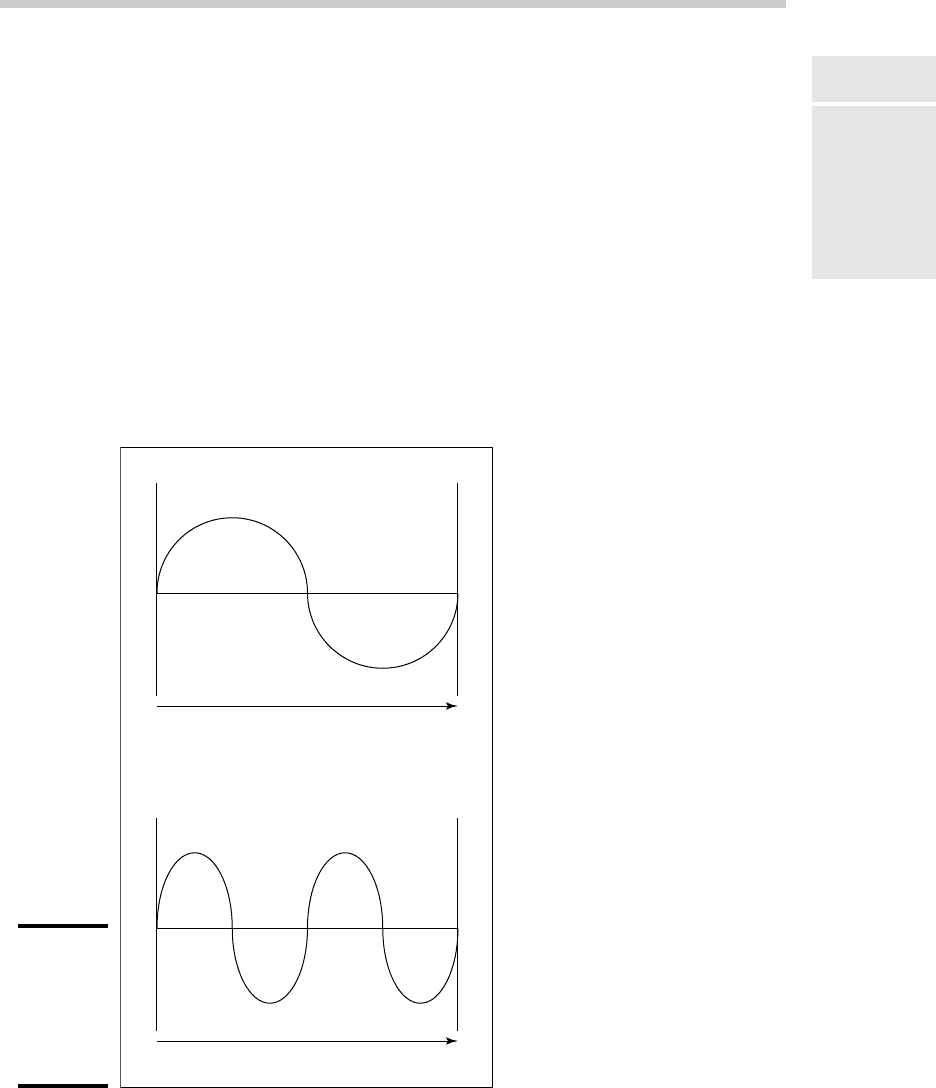
energy that repeat at a particular rate, called the frequency. Figure 1-1 shows
two frequencies of radio waves: The first is one cycle per second; the second
is two cycles per second. (Real radio doesn’t operate at that low of a fre-
quency, but I figured one and two cycles per second would be easier to draw
than 680,000 cycles per second or 2.4 million cycles per second.)
Figure 1-1:
Radio
waves
frequently
have
frequency.
Cycles per second: 1
Time
0.0
1.0
Cycles per second: 2
Time
0.0
1.0
37_625873-bk05ch01.indd 40137_625873-bk05ch01.indd 401 9/21/10 10:32 PM9/21/10 10:32 PM

402
A Little High School Electronics
The measure of a frequency is cycles per second, which indicates how many
complete cycles the wave makes in one second (duh). In honor of Heinrich
Hertz, who didn’t invent catsup, rather was the first person to successfully
send and receive radio waves (it happened in the 1880s), cycles per second
is usually referred to as Hertz, abbreviated Hz. Thus, 1 Hz is one cycle per
second. Incidentally, when the prefix K (for kilo, or 1,000), M (for mega, 1 mil-
lion), or G (for giga, 1 billion) is added to the front of Hz, the H is still capital-
ized. Thus, 2.4 MHz is correct (not 2.4 Mhz).
The beauty of radio frequencies is that transmitters can be tuned to broad-
cast radio waves at a precise frequency. Likewise, receivers can be tuned to
receive radio waves at a precise frequency, ignoring waves at other frequen-
cies. That’s why you can tune the radio in your car to listen to dozens of dif-
ferent radio stations: Each station broadcasts at its own frequency.
Wavelength and antennas
A term related to frequency is wavelength. Radio waves travel at the speed
of light. The term wavelength refers to how far the radio signal travels with
each cycle. For example, because the speed of light is roughly 300,000,000
meters per second, the wavelength of a 1-Hz radio wave is about 300,000,000
meters. The wavelength of a 2-Hz signal is about 150,000,000 meters.
As you can see, the wavelength decreases as the frequency increases. The
wavelength of a typical AM radio station broadcasting at 580 KHz is about
500 meters. For a TV station broadcasting at 100 MHz, it’s about 3 meters.
For a wireless network broadcasting at 2.4 GHz, the wavelength is about
12 centimeters.
It turns out that the shorter the wavelength, the smaller the antenna needs
to be in order to adequately receive the signal. As a result, higher frequency
transmissions need smaller antennas. You may have noticed that AM radio
stations usually have huge antennas mounted on top of tall towers, but cell
phone transmitters are much smaller and their towers aren’t nearly as tall.
That’s because cell phones operate on a higher frequency than do AM radio
stations. So who decides what type of radio gets to use specific frequencies?
That’s where spectrums and the FCC come in.
Spectrums and the FCC
The term spectrum refers to a continuous range of frequencies on which
radio can operate. In the United States, the Federal Communications
Commission (FCC) regulates not only how much of Janet Jackson can be
shown at the Super Bowl, but also how various portions of the radio spec-
trum can be used. Essentially, the FCC has divided the radio spectrum into
dozens of small ranges called bands and restricted certain uses to certain
bands. For example, AM radio operates in the band from 535 KHz to 1,700 KHz.
37_625873-bk05ch01.indd 40237_625873-bk05ch01.indd 402 9/21/10 10:32 PM9/21/10 10:32 PM

Book V
Chapter 1
Setting Up a
Wireless Network
403
A Little High School Electronics
Table 1-1 lists some of the most popular bands. Note that some of these
bands are wide — for example, UHF television begins at 470 MHz and ends at
806 MHz, but other bands are restricted to a specific frequency. The differ-
ence between the lowest and highest frequency within a band is called the
bandwidth.
Table 1-1 Popular Bands of the Radio Spectrum
Band Use
535 KHz–1,700 KHz AM radio
5.9 MHz–26.1 MHz Short wave radio
26.96 MHz–27.41 MHz Citizens Band (CB) radio
54 MHz–88 MHz Television (VHF channels 2 through 6)
88 MHz–108 MHz FM radio
174 MHz–220 MHz Television (VHF channels 7 through 13)
470 MHz–806 MHz Television (UHF channels)
806 MHz–890 MHz Cellular networks
900 MHz Cordless phones
1850 MHz–1990 MHz PCS cellular
2.4 GHz–2.4835 GHz Cordless phones and wireless networks
(802.11b and 802.11g)
(continued)
And now a word from the irony department
I was an English literature major in college, so I
like to use literary devices such as irony. I don’t
get to use it much in the computer books I write,
so when I get the chance to use irony I like to
jump on it like a hog out of the water.
So here’s my juicy bit of irony for today: The
very first Ethernet system was actually a wire-
less network. Ethernet traces its roots back to
a network developed at the University of Hawaii
in 1970, called the AlohaNet. This network
transmitted its data by using small radios. If two
computers tried to broadcast data at the same
time, the computers detected the collision and
tried again after a short, random delay. This
technique was the inspiration for the basic
technique of Ethernet, now called carrier sense
multiple access with collision detection, or
CSMA/CD. The wireless AlohaNet was the net-
work that inspired Robert Metcalfe to develop
his cabled network, which he called Ethernet,
as his doctoral thesis at Harvard in 1973.
For the next 20 years or so, Ethernet was pretty
much a cable-only network. It wasn’t until the
mid-1990s that Ethernet finally returned to its
wireless roots.
37_625873-bk05ch01.indd 40337_625873-bk05ch01.indd 403 9/21/10 10:32 PM9/21/10 10:32 PM

404
Understanding Wireless Standards
Table 1-1 (continued)
Band Use
4 GHz–5 GHz Large dish satellite TV
5 GHz Wireless networks (802.11a)
11.7 GHz–12.7 GHz Small dish satellite TV
Two of the bands in the spectrum are allocated for use by wireless networks:
2.4 GHz and 5 GHz. Note that these bands aren’t devoted exclusively to wire-
less networks. In particular, the 2.4-GHz band shares its space with cordless
phones. As a result, cordless phones can sometimes interfere with wireless
networks.
Eight-Oh-Two-Dot-Eleventy Something? (Or,
Understanding Wireless Standards)
The most popular standards for wireless networks are the IEEE 802.11 stan-
dards. These standards are essential wireless Ethernet standards and use
many of the same networking techniques that the cabled Ethernet standards
(in other words, 802.3) use. Most notably, 802.11 networks use the same
CSMA/CD technique as cabled Ethernet to recover from network collisions.
The 802.11 standards address the bottom two layers of the IEEE seven-layer
model: The Physical layer and the Media Access Control (MAC) layer. Note
that TCP/IP protocols apply to higher layers of the model. As a result, TCP/IP
runs just fine on 802.11 networks.
The original 802.11 standard was adopted in 1997. Two additions to the stan-
dard, 802.11a and 802.11b, were adopted in 1999. The latest and greatest ver-
sions are 802.11g and 802.11n.
Table 1-2 summarizes the basic characteristics of the four variants of 802.11.
Table 1-2 802.11 Variations
Standard Speeds Frequency Typical Range (Indoors)
802.11a Up to 54 Mbps 5 GHz 150 feet
802.11b Up to 11 Mbps 2.4 GHz 300 feet
802.11g Up to 54 Mbps 2.4 GHz 300 feet
802.11n Up to 600Mbps (but
most devices are in
the 100Mbps range)
2.4GHz 230 feet
37_625873-bk05ch01.indd 40437_625873-bk05ch01.indd 404 9/21/10 10:32 PM9/21/10 10:32 PM
Book V
Chapter 1
Setting Up a
Wireless Network
405
Home on the Range
Currently, most wireless networks are based on the 802.11g standard. In
2009, the standard was upgraded to 802.11n, and 802.11n devices are now
finding their way into many wireless networks.
Home on the Range
The maximum range of an 802.11g wireless device indoors is about 300 feet.
This can have an interesting effect when you get a bunch of wireless comput-
ers together — such that some of them are in range of each other, but others
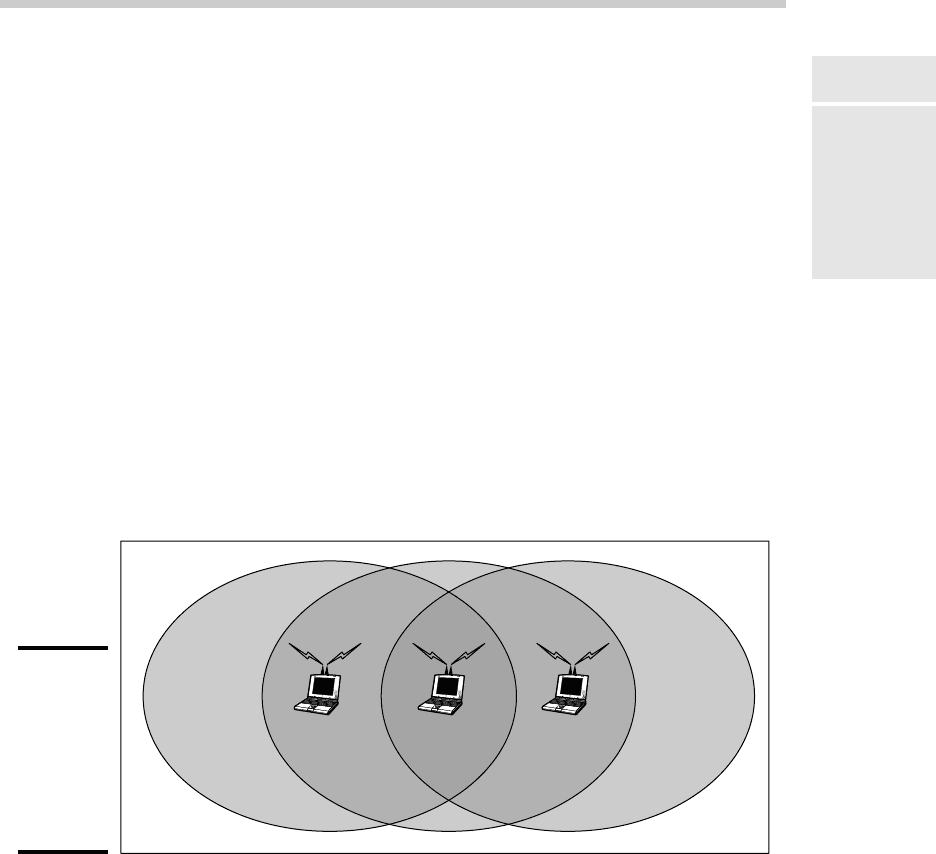
are not. For example, suppose that Wally, Ward, and the Beaver all have
wireless notebooks. Wally’s computer is 200 feet away from Ward’s computer,
and Ward’s computer is 200 feet away from Beaver’s in the opposite direction.
(See Figure 1-2.) In this case, Ward is able to access both Wally’s computer
and Beaver’s computer. But Wally can access only Ward’s computer, and
Beaver can access only Ward’s computer. In other words, Wally and Beaver
won’t be able to access each other’s computers because they’re outside of
the 300-feet range limit. (This is starting to sound suspiciously like an alge-
bra problem. Now suppose that Wally starts walking toward Ward at 2 miles
per hour, and Beaver starts running toward Ward at 4 miles per hour. . . .)
Figure 1-2:
Ward,
Wally, and
the Beaver
playing
with their
wireless
network.
Wally Ward Beaver
Although the normal range for 802.11g is 300 feet, the range may be less in
actual practice. Obstacles such as solid walls, bad weather, cordless phones,
microwave ovens, backyard nuclear reactors, and so on can all conspire
together to reduce the effective range of a wireless adapter. If you’re having
trouble connecting to the network, sometimes just adjusting the antenna
helps.
Also, wireless networks tend to slow down when the distance increases.
802.11g network devices claim to operate at 54 Mbps, but they usually
achieve that speed only at ranges of 100 feet or less. At 300 feet, they often
37_625873-bk05ch01.indd 40537_625873-bk05ch01.indd 405 9/21/10 10:32 PM9/21/10 10:32 PM

406
Wireless Network Adapters
slow down to a crawl. You should also realize that when you’re at the edge
of the wireless device’s range, you’re more likely to suddenly lose your con-
nection due to bad weather.
Wireless Network Adapters
Each computer that will connect to your wireless network needs a wire-
less network adapter. The wireless network adapter is similar to the net-
work interface card (NIC) that’s used for a standard Ethernet connection.
However, instead of having a cable connector on the back, a wireless net-
work adapter has an antenna.
Just about all notebook computers come with wireless networking built in,
so you don’t have to add a separate wireless network adapter to a notebook
computer. Desktop computers are a different story: They typically do not
have built-in wireless networking, so you’ll need to purchase one of two
types of wireless adapters:
✦ A wireless PCI card is a wireless network adapter that you install into
an available slot inside a desktop computer. In order to install this type
of card, you need to take your computer apart. So use this type of card
only if you have the expertise and the nerves to dig into your comput-
er’s guts.
✦ A wireless USB adapter is a separate box that plugs into a USB port on
your computer. Because the USB adapter is a separate device, it takes
up extra desk space. However, you can install it without taking your
computer apart.
You can purchase a combination 802.11b/g PCI adapter for less than $50.
USB versions cost about $10 more.
At first, you may think that wireless network adapters are prohibitively
expensive. After all, you can buy a regular Ethernet adapter for as little
as $20. However, when you consider that you don’t have to purchase and
install cable to use a wireless adapter, the price of wireless networking
becomes more palatable. And if you shop around, you can sometimes find
wireless adapters for as little as $19.95.
Figure 1-3 shows a typical wireless network adapter. This one is a Linksys
WUSB11, which sells for about $50. To install this device, you simply con-
nect it to one of your computer’s USB ports with the included USB connec-
tor. You then install the driver software that comes on the CD, and you’re
ready to network. The device is relatively small. You’ll find a little strip of
Velcro on the back, which you can use to mount it on the side of your com-
puter or desk if you want. The adapter gets its power from the USB port
itself, so there’s no separate power cord to plug in.
37_625873-bk05ch01.indd 40637_625873-bk05ch01.indd 406 9/21/10 10:32 PM9/21/10 10:32 PM