
Mann U. Principles of Chemical Reactor Analysis and Design: New Tools for Industrial Chemical Reactor Operations
Подождите немного. Документ загружается.

j
k
liq
m
op
out
R
S
sh
sp
sys
tot
V
vis
W
The jth species
Index number for dependent reactions
Liquid phase
Index number for independent reactions
Operation
Outlet
Reactor
Surface
Shaft work (mechanical work)
Space
System
Total
Volume basis
Viscous
Mass basis
xviii NOTATION

1
OVERVIEW OF CHEMICAL
REACTION ENGINEERING*
Chemical reaction engineering (CRE) is the branch of engineering that
encompasses the selection, design, and operation of chemical reactors. Because
of the diversity of chemical reactor applications, the wide spectrum of operating
conditions, and the multitude of factors that affect reactor operations, CRE encom-
passes many diverse concepts, principles, and methods that cannot be covered
adequately in a single volume. This chapter provides a brief overview of the
phenomena encountered in the operation of chemical reactors and of the concepts
and methods used to describe them.
A chemical reactor is an equipment unit in a chemical process (plant) where
chemical transformations (reactions) take place to generate a desirable product at
a specified production rate, using a given chemistry. The reactor configuration
and its operating conditions are selected to achieve certain objectives such as max-
imizing the profit of the process, and minimizing the generation of pollutants, while
satisfying several design and operating constraints (safety, controllability, avail-
ability of raw materials, etc.). Usually, the performance of the chemical reactor
plays a pivotal role in the operation and economics of the entire process since its
operation affects most other units in the process (separation units, utilities, etc.).
*
This chapter is adopted from Kirk-Othmer’s Encyclopedia of Chemical Technology, 7th ed, Wiley
Interscience, NY (2007).
Principles of Chemical Reactor Analysis and Design, Second Edition. By Uzi Mann
Copyright # 2009 John Wiley & Sons, Inc.
1
Chemical reactors should fulfill three main requirements:
1. Provide appropriate contacting of the reactants.
2. Provide the necessary reaction time for the formation of the desirable product.
3. Provide the heat-transfer capability required to maintain the specified temp-
erature range.
In many instances these three requirements are not complimentary, and achieving
one of them comes at the expense of another. Chemical reaction engineering is
concerned with achieving these requirements for a wide range of operating
conditions—different reacting phases (liquid, gas, solid), different reaction mech-
anisms (catalytic, noncatalytic), and different operating temperature and pressure
(low temperature for biological reaction, high temperature for many reactions in
hydrocarbon processing).
1.1 CLASSIFICATION OF CHEMICAL REACTIONS
For convenience, chemical reactions are classified in two groups:
†
Homogeneous reactions—Reactions that occur in a single phase
†
Heterogeneous reactions—Reactions that involve species (reactants or pro-
ducts) that exist in more than one phase. Heterogeneous reactions are categor-
ized further as:
†
Fluid–fluid reactions—Chemical reactions between reactants that are in
two immiscible phases (gas –liquid or liquid–liquid). The reaction
occurs either at the interface or when one reactant dissolves in the other
phase (which also contains the products). In many instances, the overall
reaction rate depends on the interface area available, the miscibility of
the reactant, and the transfer rates (e.g., diffusion) of the reactants to the
interface and in the reacting phase.
†
Noncatalytic gas–solid reactions (e.g., combustion and gasification of coal,
roasting of pyrites). These reactions occur on the surface of the solid. The
gaseous reactant is transported to the interface, where it reacts with the solid
reactant. Gaseous products are transported to the gas phase, and solid pro-
ducts (e.g., ash) remain in the solid. The overall reaction rate depends on
the surface area available and the rate of transfer of the gaseous reactant
to the solid surface.
†
Catalytic gas–solid reactions in which the reactants and products are
gaseous, but the reaction takes place at the solid surface where a catalytic
reagent is present. To facilitate the reaction, a large surface area is
required; hence, porous particles are commonly used. The reaction
takes place on the surface of the pores in the interior of the particle.
2 OVERVIEW OF CHEMICAL REACTION ENGINEERING
In many instances, the overall reaction rate is determined by the diffusion
rate of reactants into the interior of the pore, and the diffusion of the
product out of the pore.
†
Catalytic gas–liquid– solid reactions—Reactants are gases and liquids, and
the reaction takes place at a solid surface where a catalytic reagent is depos-
ited (e.g., hydrogenation reactions). Normally, the liquid reactant covers the
solid surface and the gaseous reactant is transferred (by diffusion) to the
catalytic site.
Each of these reaction categories has its features and characteristics that should be
described quantitatively.
1.2 CLASSIFICATION OF CHEMICAL REACTORS
Chemical reactors are commonly classified by the three main charateristics:
1. Mode of operation (e.g., batch, continuous, semibatch)
2. Geometric configuration (e.g., tubular, agitated tank, radial flow)
3. Contacting patterns between phases (e.g., packed bed, fluidized bed, bubble
column)
In addition, reactor operations are also classified by the way their temperature (or
heat transfer) is controlled. Three operational conditions are commonly used: (i)
isothermal operation—the same temperatures exist throughout the reactor, (ii) adia-
batic operation—no heat is transferred into or out of the reactor, and (iii) non-
isothermal operation—the operation is neither isothermal nor adiabatic.
The following terms are commonly used:
†
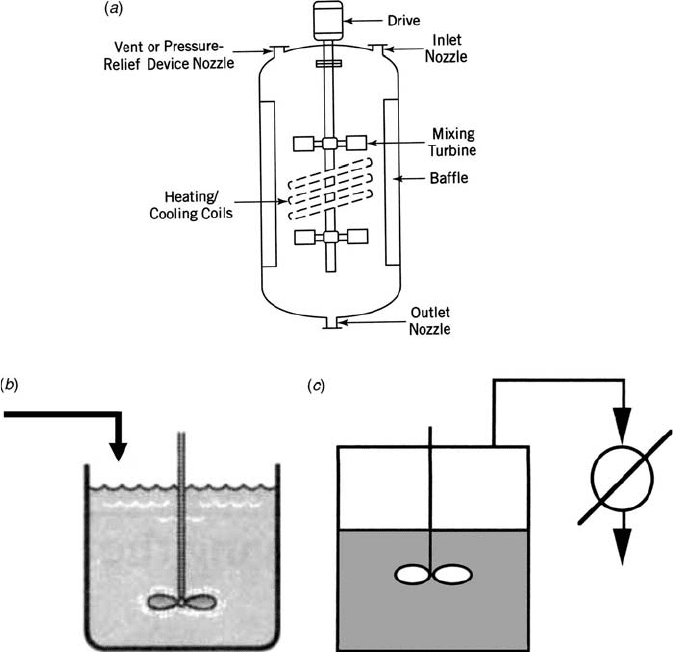
Batch reactors (Fig. 1.1a)—Reactants are charged into a vessel at the
beginning of the operation, and products are discharged at the end of the oper-
ation. The chemical reactions take place over time. The vessel is usually agi-
tated to provide good contacting between the reactants and to create uniform
conditions (concentrations and temperature) throughout the vessel.
†
Semibatch reactor (Fig. 1.1b)—A tank in which one reactant is charged
initially and another reactant is added continuously during the operation.
This mode of operation is used when it is desirable to maintain one reactant
(the injected reactant) at low concentration to improve the selectivity of the
desirable product and to supply (or remove) heat.
†
Distillation reactor (Fig. 1.1c)—A batch reactor where volatile products are
removed continuously from the reactor during the operation.
†
Continuous reactor (flow reactors)—A vessel into which reactants are fed con-
tinuously and products are withdrawn continuously from it. The chemical
1.2 CLASSIFICATION OF CHEMICAL REACTORS 3
reactions take place over space (the reactor volume), and the residence time of
the reacting fluid in the reactor provides the required reaction time. Common
configurations of continuous reactors:
†
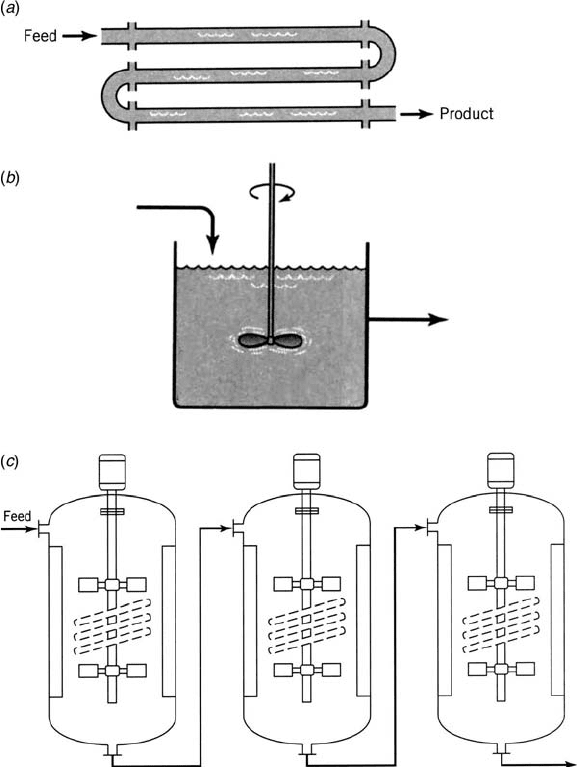
Tubular reactor (Fig. 1.2a)
†
Continuous stirred-tank reactor (CSTR) (Fig. 1.2b)
†
Cascade of CSTRs (Fig. 1.2c)
†
For multiphase reactions, the contacting patterns are used as a basis for clas-
sifying the reactors. Common configurations include:
†
Packed-bed reactor (Fig. 1.3a)—A vessel filled with catalytic pellets and
the reacting fluid passing through the void space between them.
Relatively large pellets (e.g., larger than 1 cm) are used to avoid excessive
pressure drop and higher operating cost. In general, heat transfer to/from
large-scale packed-bed reactors is a challenge.
Figure 1.1 Batch operations: (a) batch reactor, (b) semibatch reactor, and (c) distillation
reactor.
4 OVERVIEW OF CHEMICAL REACTION ENGINEERING
†
Moving-bed reactor (Fig. 1.3b)—A vessel where solid particles (either
reactant or catalyst) are continuously fed and withdrawn. The gas flow is
maintained to allow the downward movement of the particles.
†
Fluidized-bed reactor (Fig. 1.3c)—A vessel filled with fine particles (e.g.,
smaller than 500 mm) that are suspended by the upward flowing fluid. The
fluidized bed provides good mixing of the particles and, consequently, a
uniform temperature.
†
Trickle-bed reactor—A packed bed where a liquid reactant is fed from the
top, wetting catalytic pellets and a gas reactant, fed either from the top or
Figure 1.2 Continuous reactors: (a) tubular reactor, (b) continuous stirred-tank reactor
(CSTR), and (c) cascade of CSTRs.
1.2 CLASSIFICATION OF CHEMICAL REACTORS 5
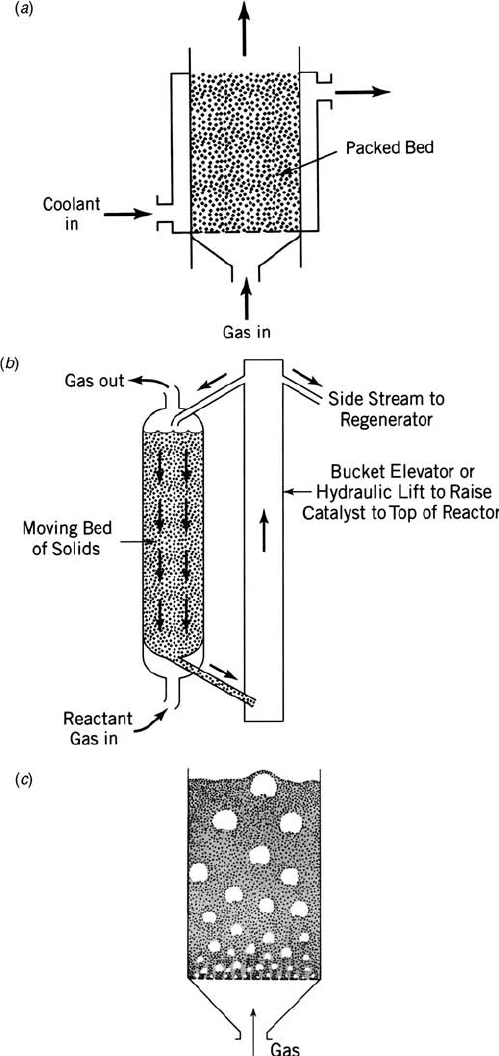
Figure 1.3 Multiphase reactors: (a) packed-bed reactor, (b) moving-bed reactor, (c) flui-
dized-bed reactor, (d) bubbling column reactor, (e) spray reactor, and ( f ) kiln reactor.
6 OVERVIEW OF CHEMICAL REACTION ENGINEERING
the bottom, flows through the void spaces between the pellets. The gaseous
reactant must be absorbed and transported across the liquid film to the cat-
alytic sites at the surface of the pellets.
†
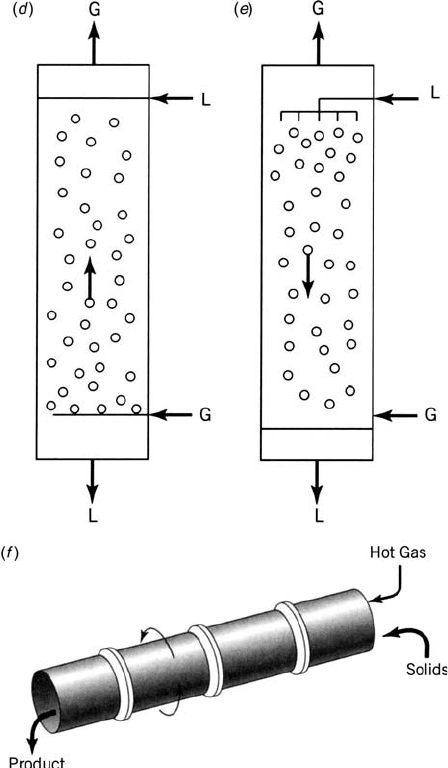
Bubbling column reactor (Fig. 1.3d)—A vessel filled with a liquid reactant
and a gas reactant, fed from the bottom, moves upward in the form of
bubbles. The liquid reactant is fed from the top and withdrawn from the
bottom. The gaseous reactant is absorbed in the liquid reactant, and the
reaction takes place in the liquid phase.
†
Others [e.g., spray reactor (Fig. 1.3e), slurry reactor, kiln reactor
(Fig. 1.3f ), membrane reactor, etc.].
Figure 1.3 (Continued ).
1.2 CLASSIFICATION OF CHEMICAL REACTORS 7
Due to the diverse applications and numerous configurations of chemical reac-
tors, no generic design procedure exists to describe reactor operations. Rather, in
each case it is necessary to identify the characteristics of the chemical reaction
and the main features that the reactor should provide. Once these are identified,
the appropriate physical and chemical concepts are applied to describe the selected
reactor operation.
1.3 PHENOMENA AND CONCEPTS
The operation of a chemical reactor is affected by a multitude of diverse factors. In
order to select, design, and operate a chemical reactor, it is necessary to identify the
phenomena involved, to understand how they affect the reactor operation, and to
express these effects mathematically. This section provides a brief review of the
phenomena encountered in chemical reactor operations as well as the fundamental
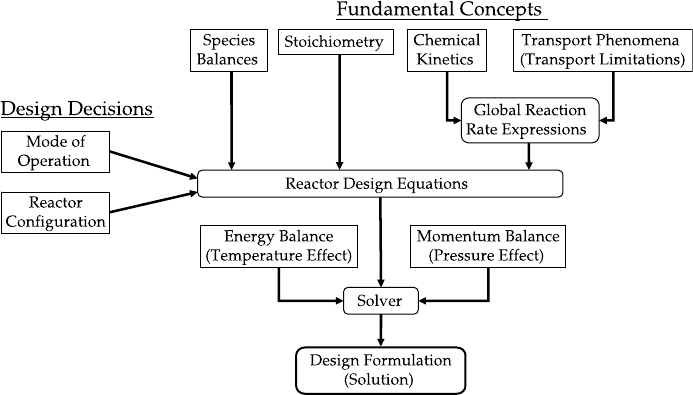
and engineering concepts that are used to describe them. Figure 1.4 shows schema-
tically how various fundamental and engineering concepts are combined in formu-
lating the reactor design equations.
1.3.1 Stoichiometry
Stoichiometry is an accounting system used to keep track of what species are
formed (or consumed) and to calculate the composition of chemical reactors.
Chapter 2 covers in detail the stoichiometric concepts and definitions used in
reactor analysis.
Figure 1.4 Schematic diagram of reactor design formulation.
8 OVERVIEW OF CHEMICAL REACTION ENGINEERING

1.3.2 Chemical Kinetics
Chemical kinetics is the branch of chemistry concerned with the rates of chemical
reactions [3, 14, 19, 36–41]. Many chemical reactions involve the formation of
unstable intermediate species (e.g., free radicals). Chemical kinetics is the study
of the mechanisms involved in obtaining a rate expression for the chemical reaction
(the reaction pathway). In most instances, the reaction rate expression is not avail-
able and should be determined experimentally. Chapter 3 covers the definitions and
relations used in reactor analysis and design.
1.3.3 Transport Effects
The rate expressions obtained by chemical kinetics describe the dependency of the
reaction rate on kinetic parameters related to the chemical reactions. These rate
expressions are commonly referred to as the “intrinsic” rate expressions of the
chemical reactions (or intrinsic kinetics). However, in many instances, the local
species concentrations depend also on the rate that the species are transported in
the reacting medium. Consequently, the actual reaction rate (also referred to as
the global reaction rate) is affected by the transport rates of the reactants and
products.
The effects of transport phenomena on the global reaction rate are prevalent in
three general cases:
1. Fluid–solid catalytic reactions
2. Noncatalytic fluid–solid reactions
3. Fluid–fluid (liquid –liquid, gas–liquid) reactions
Incorporating the effects of species transport rates to obtain the global rates of the
chemical reactions is a difficult task since it requires knowledge of the local temp-
erature and flow patterns (hydrodynamics) and numerous physical and chemical
properties (porosity, pore size and size distribution, viscosity, diffusion coeffi-
cients, thermal conductivity, etc.).
The species transfer flux to/from an interface is often described by a product of a
mass-transfer coefficient, k
M
, and a concentration difference between the bulk and
the interface. The mass-transfer coefficient is correlated to the local flow conditions
[13, 21, 26–29]. For example, in a packed bed the mass-transfer coefficient from the
bulk of the fluid to the surface of a particle is obtained from a correlation of
the form
Sh ¼
k
M
d
p
D
¼ C Re
0:5
Sc
0:33
,(1:3:1)
where Sh is the Sherwood number, Re is the Reynolds number (based on the par-
ticle diameter and the superficial fluid velocity—the velocity the fluid would have if
there were no particle packing), Sc is the Schmidt number, D is the diffusivity of the
1.3 PHENOMENA AND CONCEPTS 9