
Mann U. Principles of Chemical Reactor Analysis and Design: New Tools for Industrial Chemical Reactor Operations
Подождите немного. Документ загружается.


fluid, and C is a dimensionless constant. Similar correlations are available for mass
transfer between two immiscible fluids.
In catalytic gas–solid reactions, the reaction takes place at catalytic sites on the
surface of the solid. To obtain appreciable reaction rates, porous solids are used and
the reactions take place on the surface of the pores in the interior of the particle.
Hence, catalytic gas–solid reactions involve seven steps: (1) transport of the reac-
tant from the fluid bulk to the mouth of the pore, (2) diffusion of the reactant to
the interior of the pore, (3) adsorption of the reactant to the surface of the solid,
(4) surface reaction at the catalytic site, (5) desorption of the product from the
surface, (6) diffusion of the products to the mouth of the pore, and (7) transport
of the products from the mouth of the pore to the bulk of the fluid. Steps 3–5 rep-
resent the kinetic mechanism of heterogeneous catalytic reactions. The rate of the
reaction depends on the rates of these individual steps and the interactions between
the catalytic site and the species, and the adsorption equilibrium constants of the
various species present. A procedure, known as the Langmuir–Hishelwood –
Hougen–Watson (LHHW) formulation, is used to derive and verify the reaction
rate expressions for catalytic reactions [1, 3, 5, 7, 8, 14–18]. In many instances,
one step is much slower than the other two steps and it determines the overall
rate. This step is referred to as the rate-limiting step.
Often the global reaction rate of heterogeneous catalytic reactions is affected by
the diffusion in the pore and the external mass-transfer rate of the reactants and the
products. When the diffusion in the pores is not fast, a reactant concentration profile
develops in the interior of the particle, resulting in a different reaction rate at differ-
ent radial locations inside the catalytic pelet. To relate the global reaction rate to
various concentration profiles that may develop, a kinetic effectiveness factor is
defined [1, 3, 4, 7, 8] by
Effectiveness
factor
;
Actual reaction rate
Reaction rate at the bulk condition
(1:3:2)
Hence, to express the actual reaction rate, we have to multiply the reaction rate based
on the bulk condition by a correction factor, which accounts for the diffusion effects.
The effectiveness factor depends on the ratio between the reaction rate and the diffu-
sion rate and is expressed in terms of a modulus (Thiele modulus), f, defined by
f
2
¼
Characteristic reaction rate
Characteristic diffusion rate
(1:3:3)
The function expressing the Thiele modulus in terms of kinetic parameters and the
catalyst properties depends on the intrinsic reaction rate. For first-order reactions, the
modulus is
f ¼ L
ffiffiffiffiffiffiffiffi
k
D
eff
r
(1:3:4)
10 OVERVIEW OF CHEMICAL REACTION ENGINEERING
where k is the volume-based reaction rate constant, and D
eff
is the effective diffusion
coefficient in the particle (depending on the reactants and products, the size and size
distribution of the pore, and the porosity of the pellet), and L is a characteristic length
of the pellet obtained by the volume of the pellet divided by its exterior surface area.
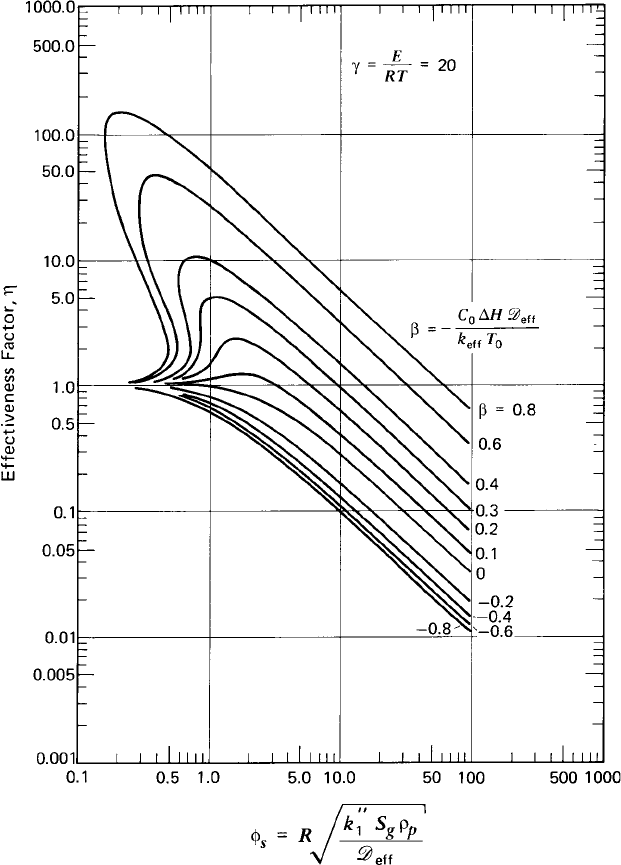
Figure 1.5 shows the relationship between the effectiveness factor and the Thiele
modulus for first-order reactions. Note that for exothermic reactions the effectiveness
factor may be larger than one because of the heating of the catalytic pellet. The
Figure 1.5 Effectiveness factor of gas-phase heterogeneous catalytic reactions.
1.3 PHENOMENA AND CONCEPTS 11
derivation of the Thiele modulus for LHHW rate expressions is not an easy task, nor
is the derivation of the relationship between the effectiveness factor and the Thiele
modulus.
Noncatalytic solid–fluid reaction is a class of heterogeneous chemical reactions
where one reactant is a solid and the other reactant is a fluid. The products of solid–
fluid reactions may be either fluid products, solid products, or both. The rates of
solid–fluid reactions depend on the phenomena affecting the transport of the
fluid reactant to the surface of the solid reactant. The reaction takes place in a
narrow zone that moves progressively from the outer surface of the solid particle
toward the center. For convenience, noncatalytic fluid–solid reactions are
divided into several categories, according to the changes that the solid particle
undergoes during the reaction [1, 7, 9, 23]:
1. Shrinking Particle This occurs when the particle consists entirely of the
solid reactant, and the reaction does not generate any solid products. The
reaction takes place on the surface of the particle, and as it proceeds, the par-
ticle shrinks, until it is consumed completely.
2. Shrinking Core with an Ash Layer This occurs when one of the reaction
products forms a porous layer (ash, oxide, etc.). As the reaction proceeds,
a layer of ash is formed in the section of the particle that has reacted, exter-
nally to a shrinking core of the solid reactant. The fluid reactant diffuses
through the ash layer, and the reaction occurs at the surface of a shrinking
core until the core is consumed completely.
3. Shrinking Core This occurs when the solid reactant is spread in the particle
among grains of inert solid material. As the reaction proceeds, the particle
remains intact, but a core containing the solid reactant is formed covered
by a layer of the inert grains. The fluid reactant diffuses through the layer,
and the reaction occurs at the surface of a shrinking core until the core is con-
sumed completely.
4. Progressive Conversion This occurs when the solid reactant is in a porous
particle. The gaseous reactant penetrates through pores and reacts with the
solid reactant (distributed throughout the particle) at all time. The concen-
tration of the solid reactant progressively reduced until it is consumed com-
pletely. The size of the particle does not vary during the reaction.
In each of the cases described above, the global reaction rate depends on three
factors: (i) the rate the fluid reactant is transported from the bulk to the outer
surface of the particle, (ii) the rate the fluid reactant diffuses through the porous
solid (ash or particle) to the surface of the unreacted core, and (iii) the reaction
rate. The global reaction rate is usually expressed in terms of the ratios of the
rates of these phenomena, as well as the dimensions of the ash layer and the
unreacted core. Various mathematical models are available in the literature, provid-
ing the time needed for complete conversion of the solid reactants [1, 7, 9, 23].
12 OVERVIEW OF CHEMICAL REACTION ENGINEERING
Fluid–fluid reactions are reactions that occur between two reactants where each
of them is in a different phase. The two phases can be either gas and liquid or two
immiscible liquids. In either case, one reactant is transferred to the interface
between the phases and absorbed in the other phase, where the chemical reaction
takes place. The reaction and the transport of the reactant are usually described
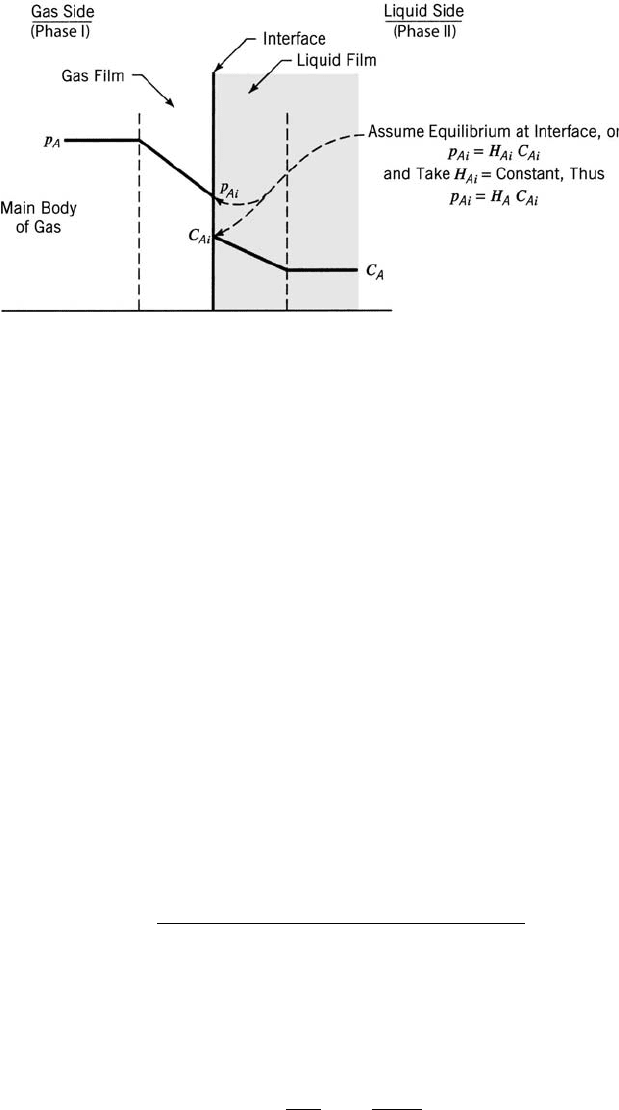
by the two-film model, shown schematically in Figure 1.6. Consider reactant A
is in phase I, reactant B is in phase II, and the reaction occurs in phase II. The
overall rate of the reaction depends on the following factors: (i) the rate at which
reactant A is transferred to the interface, (ii) the solubility of reactant A in phase
II, (iii) the diffusion rate of the reactant A in phase II, (iv) the reaction rate, and
(v) the diffusion rate of reactant B in phase II. Different situations may develop,
depending on the relative magnitude of these factors, and on the form of the rate
expression of the chemical reaction. To discern the effect of reactant transport
and the reaction rate, a reaction modulus is usually used. Commonly, the transport
flux of reactant A in phase II is described in two ways: (i) by a diffusion equation
(Fick’s law) and/or (ii) a mass-transfer coefficient (transport through a film resist-
ance) [7, 9]. The dimensionless modulus is called the Hatta number (sometimes it is
also referred to as the Damkohler number), and it is defined by
Ha
2
¼
Maximum reaction rate in the film
Maximum transport rate through the film
(1:3:5)
For second-order reactions (first order with respect to each reactant), the Hatta
number is calculated in one of two ways, depending on the available parameters
[7, 9]:
Ha ¼ L
ffiffiffiffiffiffiffiffi
kC
B
D
r
¼
ffiffiffiffiffiffiffiffiffiffiffi
kC
B
D
k
AII
r
(1:3:6)
Figure 1.6 Two films presentation of fluid –fluid reactions.
1.3 PHENOMENA AND CONCEPTS 13
where k is the reaction rate constant, D is the diffusion coefficient of reactant A in
phase II, L is a characteristic length (usually the film thickness), and k
AII
is the
mass-transfer coefficient of reactant A across the film. Fluid– fluid reaction are
characterized by the value of the Hatta number. When Ha . 2, the reaction is fast
and takes place only in the film near the interface. When 0.2 , Ha , 2, the reaction
is slow enough such that reactant A diffuses to the bulk of phase II. When Ha , 0.2,
the reaction is slow and takes place throughout phase II [7, 9, 22, 24, 25].
1.3.4 Global Rate Expression
The global rate expression is a mathematical function that expresses the actual rate
of a chemical reaction per unit volume of the reactor, accounting for all the
phenomena and mechanisms that take place. Knowledge of the global reaction
rate is essential for designing and operating chemical reactors. For most homo-
geneous chemical reactions, the global rate is the same as the intrinsic kinetic
rate. However, for many heterogeneous chemical reactions, a priori determination
of the global reaction rate is extremely difficult.
The global reaction rate depends on three factors; (i) chemical kinetics (the
intrinsic reaction rate), (ii) the rates that chemical species are transported (transport
limitations), and (iii) the interfacial surface per unit volume. Therefore, even when a
kinetic-transport model is carefully constructed (using the concepts described
above), it is necessary to determine the interfacial surface per unit volume. The
interfacial surface depends on the way the two phases are contacted (droplet,
bubble, or particle size) and the holdup of each phase in the reactor. All those
factors depend on the flow patterns (hydrodynamics) in the reactor, and those are
not known a priori. Estimating the global rate expression is one of the most chal-
lenging tasks in chemical reaction engineering.
1.3.5 Species Balance Equation and Reactor Design Equation
The genesis of the reactor design equations is the conservation of mass. Since
reactor operations involve changes in species compositions, the mass balance is
written for individual species, and it is expressed in terms of moles rather than
mass. Species balances and the reactor design equations are discussed in detail
in Chapter 4. To obtain a complete description of the reactor operation, it is necess-
ary to know the local reaction rates at all points inside the reactor. This is a formid-
able task that rarely can be carried out. Instead, the reactor operation is described by
idealized models that approximate the actual operation. Chapters 5–9 cover the
applications of reactor design equations to several ideal reactor configurations
that are commonly used.
For flow reactors, the plug-flow and the CSTR models represent two limiting
cases. The former represents continuous reactor without any mixing, where the
reactant concentrations decrease along the reactor. The latter represents a reactor
with complete mixing where the outlet reactant concentration exists throughout
14 OVERVIEW OF CHEMICAL REACTION ENGINEERING
the reactor. Since in practice reactors are neither plug flow nor CSTR, it is common
to obtain the performance of these two ideal reactors to identify the performance
boundaries of the actual reactors.
When the behavior of a reactor is not adequately described by one of the ideal-
ized models, a more refined model is constructed. In such models the reactor is
divided into sections, each is assumed to have its own species concentrations
and temperature, with material and heat interchanged between them [6, 7, 10,
11, 43]. The volume of each zone and the interchanges are parameters determined
from the reactor operating data. The advantage of such refined models is that they
provide a more detailed representation of the reactor, based on actual operating
data. However, their application is limited to existing reactors.
Recent advances in computerized fluid dynamics (CFD) and developments of
advanced mathematical methods to solve coupled nonlinear differential equations
may provide tools for phenomenological representations of reactor hydrodynamics
[40–43]. High speed and reduced cost of computation and increased cost of labora-
tory and pilot-plant experimentation make such tools increasingly attractive. The
utility of CFD software packages in chemical reactor simulation depends on the fol-
lowing factors: (i) reliability of predicting the flow patters, (ii) ease of incorporating
of the chemical kinetics and adequacy of the physical and chemical representations,
(iii) scale of resolution for the application and numerical accuracy of the solution
algorithms, and (iv) skills of the user.
1.3.6 Energy Balance Equation
To express variations of the reactor temperature, we apply the energy balance
equation (first law of thermodynamics). Chapter 5 covers in detail the derivation
and application of the energy balance equation in reactor design. The applications
of the energy balance equation to ideal reactor configurations are covered in
Chapters 5–9.
1.3.7 Momentum Balance Equation
In most reaction operations, it is not necessary to use the momentum balance
equation. For gas-phase reaction, when the pressure of the reacting fluid varies sub-
stantially and it affects the reaction rates, we apply the momentum balance equation
to express the pressure variation. This occurs in rare applications (e.g., long tubular
reactor with high velocity). The last section of Chapter 7 covers the application of
the momentum balance equation for plug-flow reactors.
1.4 COMMON PRACTICES
Inherently, the selection and design of a chemical reactor are made iteratively
because, in many instances, the global reaction rates are not known a priori. In
1.4 COMMON PRACTICES 15
fact, the flow patterns of reacting fluid (which affect the global rates) can be esti-
mated only after the reactor vessel has been specified and the operating conditions
have been selected. This section provides a review of commonly used practices.
1.4.1 Experimental Reactors
Often the kinetics of the chemical reaction and whether or not the reaction rate is
affected by transport limitation are not known a priori. Lab-scale experimental reac-
tors are structured such that they are operated isothermally and can be described by
one of three ideal reactor models (ideal batch, CSTR, and plug flow). Isothermal
operation is achieved by providing a large heat-transfer surface and maintaing
the reactor in a constant-temperature bath. Experiments are conducted at different
initial (or inlet) reactant proportions (to determine the form of the rate expression)
and at different temperatures (to determine the activation energy).
A batch experimental reactor is used for slow reactions since species compo-
sitions can be readily measured with time. The determination of reaction rate
expression is described in Chapter 6. A tubular (plug-flow) experimental reactor
is suitable for fast reactions and high-temperature experiments. The species compo-
sition at the reactor outlet is measured for different feed rates. Short packed beds are
used as differential reactors to obtain instantaneous reaction rates. The reaction rate
is determined from the design equation, as described in Chapter 7. An experimental
CSTR is a convenient tool in determining reaction rate since the reaction rate is
directly obtained from the design equation, as discussed in Chapter 8.
The rate expressions of catalytic heterogenous reactions are generally carried out
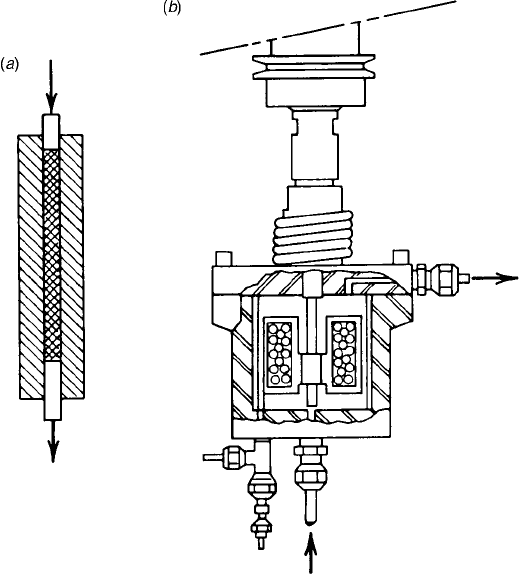
in flow reactors. When a packed-bed reactor is used (Fig. 1.7a), it is necessary to
acertain that a plug-flow behavior is maintained. This is achieved by sufficiently
high velocity, and having a tube-to-particle diameter ratio of at least 10 (to avoid
bypassing near the wall, where the void fraction is higher than in the bed). The
tube diameter should not be too large to avoid radial gradient of temperature and
concentrations. A spinning basket reactor (Fig. 1.7b) is a useful tool for determin-
ing the reaction rate of heterogeneous catalytic reactions and the effectiveness
factor. At sufficiently high rotation speeds, the external transport rate (between
the bulk to the surface of the catalytic pellet) does not affect the overall reaction
rate. The effectiveness factor is determined by conducting a series of experiments
with different pellet diameters.
When the heat of reaction is not known, experiments are conducted on a well-
stirred calorimeter (either batch or continuous). The adiabatic temperature change
is measured and the heat of reaction is determined from the energy balance
equation.
1.4.2 Selection of Reactor Configuration
The first step in the design of a chemical reactor is the selection of the operating
mode—batch or continuous. The selection is made on the basis of both economic
16 OVERVIEW OF CHEMICAL REACTION ENGINEERING
and operational considerations. Batch operations are suitable for small quantity pro-
duction of high-value products, and for producing multiple products with the same
equipment. Batch reactors are also used when the reacting fluid is very viscous
(e.g., in the manufacture of polymer resins). Batch operations require downtime
between batches for charging, discharging, and cleaning. Another drawback of
this operation mode is variations among batches. Batch reactors have relative
low capital investment, but their operating cost is relatively high. Continuous
reactor operations are suitable for large-volume production and provide good
product uniformity. Continuous reactors require relatively high capital investment,
but their operating expense is relatively low.
Next, it is necessary to identify the dominating factors that affect the chemical
reactions and select the most suitable reactor configuration. For homogeneous
chemical reactions, one of three factors often dominates: (i) equilibrium limitation
of the desirable reaction, (ii) the formation of undesirable products (by side reac-
tions), and (iii) the amount of heat that should be transferred. For example, if a
low concentration of the reactants suppresses the formation of the undesirable
product, a CSTR is preferred over a tubular reactor even though a larger reactor
Figure 1.7 Experimental reactors for gas-phase catalytic reactions: (a) packed-bed and
(b) spinning basket.
1.4 COMMON PRACTICES 17
volume is needed. When high heat-transfer rate is required, a tubular reactor with
relatively small diameter (providing high surface-to-volume ratio) is used.
For heterogeneous catalytic reactions, the size of the catalyst pellets is usually
the dominating factor. Packed beds with large-diameter pellets have low pressure
drop (and low operating cost), but the large pellets exhibit high pore diffusion limit-
ation and require a larger reactor. Often, the pellet size is selected on the basis of
economic considerations balancing between the capital cost and the operating cost.
When fine catalytic particles are required, a fluidized bed is used. In fluidized-bed
reactors the reacting fluid mixed extensively, and a portion of it passes through the
reactor in large bubbles with little contact with the catalytic particles.
Consequently, a larger reactor volume is needed. In many noncatalytic gas–solid
reactions, the feeding and movement of the solid reactant is dominating. For
fluid–fluid reactions, contacting between the reactants (the interfacial area per
unit volume) dominates.
1.4.3 Selection of Operating Conditions
Once the reactor type and configuration have been selected, the reactor operating
conditions should be selected. For example, should the reactor be operated such
that high conversion of the reactant is achieved, or should it be operated at lower
conversion (with higher recycle of the unconverted reactant). The selection of
the reactor operating conditions is done on the basis of an optimization objective
function (e.g., maximizing profit, maximizing product yield or selectivity, mini-
mizing generation of pollutants), as discussed in Chapter 10. When an economic
criterion is used, the performance of the entire process (i.e., the reactor, separation
system, utilities) is considered rather than the performance of the reactor alone.
1.4.4 Operational Considerations
Considerations should be given to assure that the reactor is operational (i.e., startup
and shutdown), controllable, and does not create any safety hazards. Also, chemical
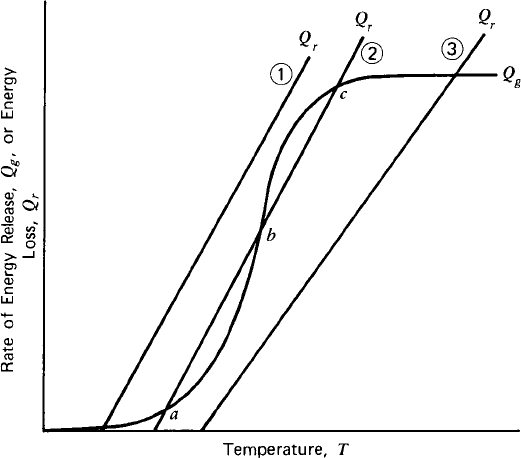
reactors can operate at multiple conditions (the design and energy balance
equations have multiple solutions), some of them may be unstable. Such situation
is illustrated in Figure 1.8, which shows the heat generation and heat removal
curves of CSTR with an exothermic reaction [2, 3]. The intersections of the two
curves represent plausible operating conditions. Operating point b is unstable
since any upset in the operating conditions will result in the reactor operating at
point a or c.
Safe operation is a paramount concern in chemical reactor operations. Runaway
reactions occur when the heat generated by the chemical reactions exceed the heat
that can be removed from the reactor. The surplus heat increases the temperature of
the reacting fluid, causing the reaction rates to increase further (heat generation
increases exponentially with temperature while the rate of heat transfer increases
linearly). Runaway reactions lead to rapid rise in the temperature and pressure,
18 OVERVIEW OF CHEMICAL REACTION ENGINEERING
which if not relieved may cause an explosion. Experience has shown that the fol-
lowing factors are prevalent in accidents involving chemical reactors: (i) inadequate
temperature control, (ii) inadequate agitation, (iii) little knowledge of the reaction
chemistry and thermochemistry, and (iv) raw material quality [12, 20].
1.4.5 Scaleup
The objective of scaleup is to design industrial-sized reactors on the basis of exper-
imental data obtained from lab-scale reactors. A reliable scaleup requires insight of
the phenomena and mechanisms that affect the performance of the reactor oper-
ation. Once these factors are identified and quantified, the task is to establish
similar conditions in the industrial-size reactor. The difficulty arises from the fact
that not all the factors can be maintained similar simultaneously upon scaleup
[37]. For example, it is often impossible to maintain similar flow conditions
(e.g., Reynolds number) and the same surface heat-transfer area per unit volume.
Good understanding of the phenomena and mechanisms can enable the designer
to account for the different conditions. Unfortunately, in many instances, consider-
able uncertainties exist with regard to the mechanisms and the magnitude of the
parameters. As a result, an experimental investigation on a pilot-scale reactor is
conducted to improve the reliability of the design of an industrial-scale reactor.
In many processes that apply to an agitated tank, the main task is to maintain
sufficient mixing during scaleup. Considerable information is available in the litera-
ture on scaling up of agitated tanks [30–36].
Figure 1.8 Heat generation and removal in CSTR.
1.4 COMMON PRACTICES 19