
Mann U. Principles of Chemical Reactor Analysis and Design: New Tools for Industrial Chemical Reactor Operations
Подождите немного. Документ загружается.


d. Determine the extent of the reaction at time t.
e. Determine the reactor content (in moles) at time t .
Solution We select the given chemical reaction as the chemical formula, and
the stoichiometric coefficients are
s
CO
¼2 s
O
2
¼1 s
CO
2
¼ 2 s
N
2
¼ 0 D ¼1
a. To identify the limiting reactant, apply Eq. 2.5.3 for each reactant:
N
CO
(0)
s
CO
¼
1:5
2
¼ 0:75
N
O
2
(0)
s
O
2
¼
1:0
1
¼ 1:0 (a)
Hence, CO is the limiting reactant.
b. Now that the limiting reactant is identified, the stoichiometric amount of O
2
is
readily determined using Eq. 2.5.2:
(N
O
2
)
stoich
¼
s
O
2
s
CO
N
CO
(0) ¼
1
2
(1:5 kmol) ¼ 0:75 kmol (b)
Using Eq. 2.5.4, the excess O
2
is
Excess
O
2
;
(1 kmol) (0:75 kmol)
0:75 kmol
¼ 0:33 (c)
c. At completion, N
CO
(t) ¼ 0, and, using Eq. 2.3.5, the extent of the reaction is
X(t) ¼
N
CO
(t) N
CO
(0)
s
CO
¼
0 1:5
2
¼ 0:75 kmol (d)
To determine the pressure, we derive a relationship between the pressure and
the extent of reaction. For ideal-gas behavior,
P(t) ¼
RT
V
N
tot
(t) (e)
where N
tot
(t) is given by Eq. 2.3.7. Hence, for isothermal operation,
P(t)
P(0)
¼
N
tot
(t)
N
tot
(0)
¼
N
tot
(0) þ D X(t)
N
tot
(0)
(f)
and, in this case, and, at t ¼ 0, N
tot
(0) ¼ 4 kmol, so
P(t)
P(0)
¼
4 X(t)
4
(g)
50 STOICHIOMETRY

The reactor pressure at completion is
P ¼ (5 atm)
4 0:75
4
¼ 4:06 atm
d. Rearranging (f), the reaction extent when P ¼ 4.5 atm is
X(t) ¼ 1
P(t)
P(0)
N
tot
(0) ¼ 1
4:5
5
(4) ¼ 0:4 kmol (h)
e. Now that the extent at time t is known, we can determine the amounts of each
species, using Eq. 2.3.5:
N
CO
(t) ¼ N
CO
(0) þ s
CO
X(t) ¼ 1:5 þ (2)(0:4) ¼ 0:7 kmol
N
O
2
(t) ¼ N
O
2
(0) þ s
O
2
X(t) ¼ 1:0 þ (1)(0:4) ¼ 0:6 kmol
N
CO
2
(t) ¼ N
CO
2
(0) þ s
CO
2
X(t) ¼ 1:0 þ (2)(0:4) ¼ 1:8 kmol
N
N
2
(t) ¼ N
N
2
(0) þ s
N
2
X(t) ¼ 0:5 þ (0)(0:4) ¼ 0:5 kmol
and, using Eq. 2.3.7,
N
tot
(t) ¼ N
tot
(0) þ D X(t) ¼ 4:0 þ (1)(0:4) ¼ 3:6 kmol
Example 2.8 A gaseous fuel consisting of 72% CH
4
, 24% C
2
H
6
,3%N
2
, and
1% O
2
(mole percent) is fed into a combustion chamber at a rate of 10 g-mol/
min. A stream of external air is mixed with the fuel, and the following chemical
reactions are believed to take place in the combustion chamber:
Reaction 1: CH
4
þ 2O
2
! CO
2
þ 2H
2
O
Reaction 2: 2CH
4
þ 3O
2
! 2CO þ 4H
2
O
Reaction 3: 2C
2
H
6
þ 7O
2
! 4CO
2
þ 6H
2
O
Reaction 4: 2C
2
H
6
þ 5O
2
! 4CO þ 6H
2
O
Reaction 5: 2CO þO
2
! 2CO
2
An analysis of the effluent stream indicates that all the ethane has been converted
and that, on a dry basis, its composition is 83.96% N
2
, 7.05% CO
2
, 0.18% CO,
and 8.69% O
2
(mole percent). Determine:
a. The flow rate of the air fed to the reactor
b. The excess air
2.5 CHARACTERIZATION OF THE REACTOR FEED 51

Solution First, we determine the number of independent reactions. We con-
struct a matrix of stoichiometric coefficients for the given reactions:
CH
4
O
2
CO
2
H
2
OCOC
2
H
6
1 212 0 0
2 304 2 0
0 746 02
0 506 42
0 12020
2
6
6
6
6
6
6
4
3
7
7
7
7
7
7
5
(a)
Applying Gaussian elimination, Matrix (a) reduces to
1 2 120 0
01202 0
005371
0 0 000 0
0 0 000 0
2
6
6
6
6
4
3
7
7
7
7
5
(b)
Since Matrix (b) has three nonzero rows, there are three independent chemical
reactions. We select Reactions 1, 3, and 5 as a set of independent reactions,
and their stoichiometric coefficients are
(s
CH
4
)
1
¼1(s
O
2
)
1
¼2(s
CO
2
)
1
¼1(s
H
2
O
)
1
¼2(s
CO
)
1
¼0(s
C
2
H
6
)
1
¼0
(s
CH
4
)
3
¼0(s
O
2
)
3
¼7(s
CO
2
)
3
¼4(s
H
2
O
)
3
¼6(s
CO
)
3
¼0(s
C
2
H
6
)
3
¼0
(s
CH
4
)
5
¼0(s
O
2
)
5
¼1(s
CO
2
)
5
¼2(s
H
2
O
)
5
¼0(s
CO
)
5
¼2(s
C
2
H
6
)
5
¼2
D
1
¼0 D
3
¼1 D
5
¼1
We select the fuel feed as a basis for the calculation (F
1
¼ 10 mol/min) and
denote the fed air stream by F
2
. The inlet stream is F
1
þ F
2
.
a. First we want to determine the extents of the three independent reactions (i.e.,
Reactions 1, 3, and 5), using the given dry-basis compositions. Using
Eq. 2.3.12, the total molar flow rate of the flue gas is
(F
tot
)
out
¼ (10 þ F
2
) þ
_
X
3
_
X
5
(c)
Using Eq. 2.3.11, the molar flow rate of H
2
O in the flue gas is
(F
H
2
O
)
out
¼ (0) þ 2
_
X
1
þ 6
_
X
3
(d)
Combining (c) and (d), the total molar flow rate of the dry flue gas is
(F
tot
)
dry
¼ (F
tot
)
out
(F
H
2
O
)
out
¼ 10 þ F
2
2
_
X
1
5
_
X
3
_
X
5
(e)
52 STOICHIOMETRY

Using Eqs. 2.3.11 and (e) for each of the given dry compositions, we obtain
y
N
2
¼
0:3 þ 0:79F
2
10 þ F
2
2
_
X
1
5
_
X
3
_
X
5
¼ 0:8399 ( f)
y
O
2
¼
0:1 þ 0:21F
2
2
_
X
1
7
_
X
3
_
X
5
10 þ F
2
2
_
X
1
5
_
X
3
_
X
5
¼ 0:0865 (g)
y
CO
2
¼
_
X
1
þ 4
_
X
3
þ 2
_
X
5
10 þ F
2
2
_
X
1
5
_
X
3
_
X
5
¼ 0:0708 (h)
y
CO
¼
2
_
X
5
10 þ F
2
2
_
X
1
5
_
X
3
_
X
5
¼ 0:0018 (i)
Solving (f), (g), (h), and (i), we obtain F
2
¼ 172.9 mol/min,
_
X
1
¼ 7.03 mol/
min, X
˙
3
¼ 1.2 mol/min, and X
˙
5
¼ 20.147 mol/min. The molar feed rate of
the air stream is 172.9 mol/min. The amount of external oxygen fed is
0.21F
2
¼ 36.31 mol/min. The total amount of oxygen fed to the combustor
is 0.01(10) þ 36.31 ¼ 36.41 mol/min.
b. To determine the excess amount of external oxygen, we first have to deter-
mine the stoichiometric amount needed. For methane and ethane, the stoi-
chiometric amount is determined on the basis of the reactions for complete
combustion:
Reaction 1: CH
4
þ 2O
2
! CO
2
þ 2H
2
O(j)
Reaction 3: 2C
2
H
6
þ 7O
2
! 4CO
2
þ 6H
2
O (k)
Note that we do not consider Reaction 5 because CO is not a species in the
fuel. Using Eq. 2.5.2, the stoichiometric amount of oxygen needed for com-
plete combustion is
(F
O
2
)
stoich
¼
(s
O
2
)
1
(s
CH
4
)
1
(F
CH
4
)
in
þ
(s
O
2
)
3
(s
C
2
H
6
)
3
(F
C
2
H
6
)
in
(l)
The total stoichiometric amount of oxygen needed is 22.8 mol/min, but
0.1 mol/min is fed in the fuel stream itself. Hence, the stoichiometric
amount of external oxygen needed is 22.7 mol/min. Using Eq. 2.5.5, the
excess air is
Excess
air
¼
Excess
external O
2
¼
36:41 22:7
22:7
¼ 0:604 (m)
2.5 CHARACTERIZATION OF THE REACTOR FEED 53

2.6 CHARACTERIZATION OF REACTOR PERFORMANCE
In the preceding sections, the stoichiometric relationships used to quantify the oper-
ation of chemical reactors were expressed in terms of extensive quantities (moles,
molar flow rates, reaction extents, etc.) whose numerical values depend on the basis
selected for the calculation. In most applications, it is convenient to define intensive
dimensionless quantities that characterize the operation of chemical reactors and
provide quick measures of the reactor performance. In this section, we define
and discuss some common stoichiometric quantities used in reactor analysis.
2.6.1 Reactant Conversion
The conversion is defined as the fraction of a reactant that has been consumed. For
batch reactors, the conversion of reactant A at time t, f
A
(t), is defined by
f
A
(t) ;
Moles of reactant A consumed in time t
Moles of reactant A charged to the reactor
¼
N
A
(0) N
A
(t)
N
A
(0)
(2:6:1a)
For flow reactors operating at steady state, the conversion of reactant A in the
reactor is defined by
f
A
out
;
Rate reactant A is consumed in the system
Rate reactant A is fed to the system
¼
F
A
in
F
A
out
F
A
in
(2:6:1b)
Three points concerning the conversion should be noted:
1. The conversion is defined only for reactants, and, by definition, its value is
between 0 and 1.
2. The conversion is related to the composition (or flow rate) of a reactant, and it
is not defined on the basis of any specific chemical reaction. When multiple
chemical reactions take place, a reactant may be consumed in several chemi-
cal reactions. However, if reactant A is produced by any independent
chemical reaction, its conversion is not defined.
3. The conversion depends on the initial state selected, N
A
(0) (for batch
reactors) and on the boundaries of the system, “in” and “out” (for flow
reactors)—see Example 2.9.
When a single chemical reaction takes place, the conversion of a reactant relates
to the extent of the reaction. For batch reactors, from Eq. 2.3.5,
N
A
(0) N
A
(t) ¼s
A
X
1
(t)
and, substituting in Eq. 2.6.1a, the relationship between the conversion of reactant
A and the reaction extent is
f
A
(t) ¼
s
A
N
A
(0)
X(t)(2:6:2)
54 STOICHIOMETRY

To express the number of moles of any species in terms of the conversion of reac-
tant A, substitute X(t) from Eq. 2.6.2 into Eq. 2.3.6 and obtain
N
j
(t) ¼ N
j
(0)
s
j
s
A
N
A
(0)f
A
(t)(2:6:3)
To express the total number of moles in the reactor in terms of the conversion of
reactant A, substitute X(t) from Eq. 2.3.5 into Eq. 2.3.7 and obtain
N
tot
(t) ¼ N
tot
(0)
D
s
A
N
A
(0)f
A
(t)(2:6:4)
where D, defined by Eq. 2.2.5, denotes the change in the number of moles per unit
extent.
To obtain a relationship between the conversion and the reaction extent in
steady-flow reactors with single chemical reactions, we write Eq. 2.3.13 for reactant
A and substitute it in Eq. 2.6.1b,
f
A
out
¼
s
A
F
A
in
_
X
out
(2:6:5)
To express the molar flow rate of any species at the reactor outlet in terms of the
conversion of reactant A, substitute Eq. 2.6.5 into Eq. 2.3.13 and obtain
F
j
out
¼ F
j
in
s
j
s
A
F
A
in
f
A
out
(2:6:6)
To relate the total molar flow rate at the reactor exit to the conversion, substitute
Eq. 2.6.6 into Eq. 2.3.14 and obtain
F
tot
out
¼ F
tot
in
D
s
A
F
A
in
f
A
out
(2:6:7)
When species A is a reactant in several chemical reactions, the term N
A
(0) 2
N
A
(t) in Eq. 2.6.1a should account for the consumption of reactant A by all the
independent reactions. Using Eq. 2.3.3 for reactant A,
f
A
(t) ;
N
A
(0) N
A
(t)
N
A
(0)
¼
1
N
A
(0)
X
n
I
m
(s
A
)
m
X
m
(t)
or
f
A
(t) ¼
X
n
I
m
f
A
m
(t)(2:6:8)
where f
A
m
(t) is the conversion of reactant A by the mth independent reaction,
defined by
f
A
m
(t) ;
(s
A
)
m
N
A
(0)
X
m
(t)(2:6:9)
2.6 CHARACTERIZATION OF REACTOR PERFORMANCE 55

Similarly, for steady-flow reactors
f
A
¼
X
n
I
m
f
A
m
(2:6:10)
where f
A
m
is the conversion of A by the mth independent reaction defined by
f
A
m
;
(s
A
)
m
F
A
in
_
X
m
(2:6:11)
Example 2.9 Ammonia is produced in a continuous catalytic reactor according
to the reaction
N
2
þ 3H
2
! 2NH
3
A synthesis gas stream (stream 1) consisting of 24.5% N
2
, 73.5% H
2
, and 2%
argon is fed at a rate of 60 mol/min. At the operating conditions, the conversion
per pass in the reactor is 12%. To enhance the operation, a portion of the reactor
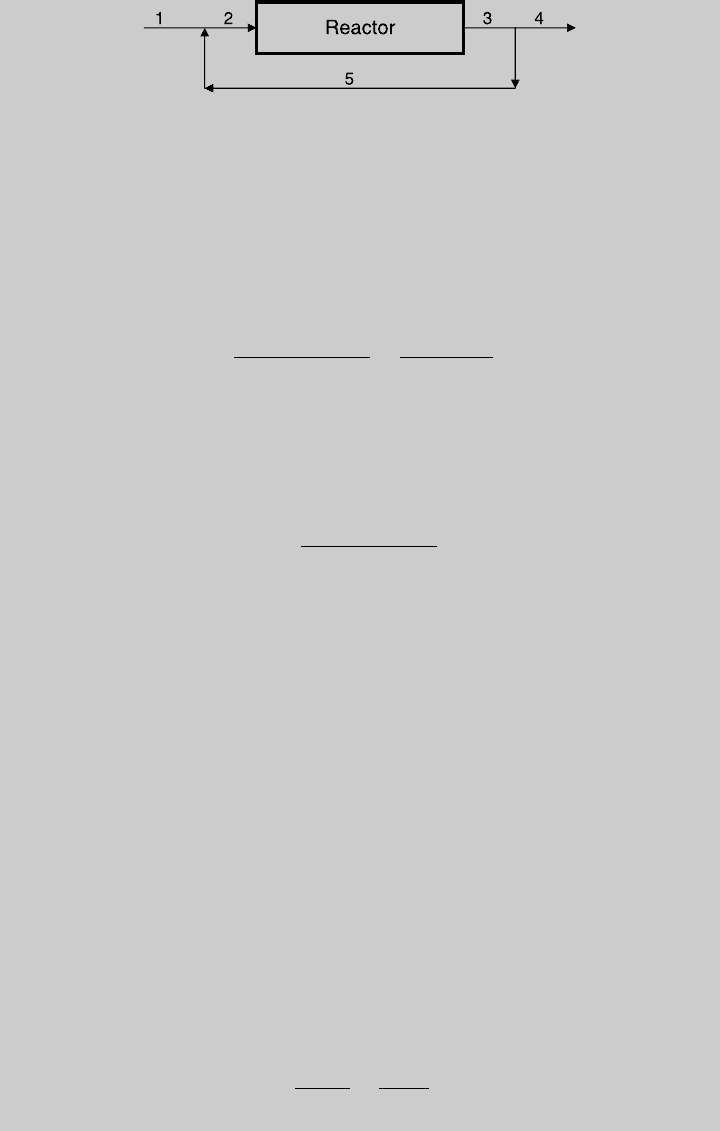
effluent stream (stream 3) is recycled and combined with the fresh synthesis gas
as illustrated in Figure E2.9.1. If the mole fraction of the argon in the product
stream (stream 4) is 3%, determine:
a. The ammonia production rate
b. The overall nitrogen conversion in the process
c. The recycle ratio (F
5
/F
4
)
Solution The stoichiometric coefficients of the chemical reaction are
s
N
2
¼1 s
H
2
¼3 s
NH
3
¼ 2 s
Ar
¼ 0 D ¼2
Note that the argon is an inert species, and its stoichiometric coefficient is zero.
a. Selecting the entire process as the system (the inlet is stream 1 and the outlet
is stream 4); hence, (F
tot
)
in
¼ F
1
¼ 60 mol/min and (F
tot
)
out
¼ F
4
. Writing
an argon balance using Eq. 2.3.3,
(F
Ar
)
4
¼ (F
Ar
)
1
þ s
Ar
_
X
(0:03)(F
tot
)
4
¼ (0:02)(F
tot
)
1
¼ (0:02)(60 mol=min)
(a)
Solving (a), (F
tot
)
4
¼ 40 mol/min. Using Eq. 2.3.14 to relate the total molar
flow rate of the outlet stream to the extent,
(F
tot
)
4
¼ (F
tot
)
1
þ D
_
X
40 ¼ 60 þ (2)
_
X
(b)
and X
˙
¼ 10 mol/min. Now that the extent of the reaction is known, the
production rate of ammonia can be calculated by using Eq. 2.3.13,
(F
NH
3
)
4
¼ (F
NH
3
)
1
þ s
NH
3
_
X ¼ 0 þ (2)(10) ¼ 20 mol=min (c)
56 STOICHIOMETRY
b. To calculate the nitrogen molar flow rate at the outlet stream, we write
Eq. 2.3.13 for nitrogen:
(F
N
2
)
4
¼ (F
N
2
)
1
þ s
N
2
_
X ¼ (0:245)(60) þ (1)(10) ¼ 4:70 mol=min (d)
The overall nitrogen conversion in the process, defined by Eq. 2.6.1b, is
f
N
2
;
(F
N
2
)
1
(F
N
2
)
4
(F
N
2
)
1
¼
14:7 4:7
14:7
¼ 0:680 (e)
Note that the same conversion is obtained by using Eq. 2.6.5.
c. To calculate the recycle ratio, we select the reactor itself as the system (the
inlet stream is stream 2 and the outlet stream is stream 3). Using the given
conversion per pass,
f
N
2
;
(F
N
2
)
2
(F
N
2
)
3
(F
N
2
)
2
¼ 0:12
or
(F
N
2
)
3
¼ 0:880(F
N
2
)
2
(f)
Using Eq. 2.3.13 to express (F
N
2
)
3
and (F
N
2
)
2
in terms of the extent,
(F
N
2
)
3
¼ (F
N
2
)
2
þ s
N
2
_
X ¼ (F
N
2
)
2
þ (1)(10) (g)
and substituting (f),
(0:880)(F
N
2
)
2
¼ (F
N
2
)
2
þ (1)(10) (h)
Solving (h), (F
N
2
)
2
¼ 83:33 mol=min, and, from (f), (F
N
2
)
3
¼73:33 mol=min.
Now, writing a nitrogen balance over the mixing point,
(F
N
2
)
2
¼ (F
N
2
)
1
þ (F
N
2
)
5
¼ 0:880(F
N
2
)
2
83:33 ¼ (0:245)(60) þ (F
N
2
)
5
(i)
Solving (i), (F
N
2
)
5
¼ 68:63 mol=min. Thus, the recycle ratio is
R ;
(F
N
2
)
5
(F
N
2
)
4
¼
68:63
4:70
¼ 14:6
Figure E2.9.1 Recycle of ammonia reactor.
2.6 CHARACTERIZATION OF REACTOR PERFORMANCE 57

2.6.2 Product Yield and Selectivity
When several simultaneous chemical reactions take place producing both desired
and undesired products, it is convenient to define parameters that indicate what
portion of the reactant was converted to valuable products. Below, we define
and discuss two quantities that are commonly used: yield and selectivity of the
desirable product.
Yield is a measure of the portion of a reactant converted to the desired product
by the desirable chemical reaction. It indicates the amount of the desirable product,
species V, produced relative to the amount of V that could have been produced if
only the desirable reaction took place. The yield is defined such that its value is
between zero and one.
For batch reactors, the yield of product V at time t is
h
V
(t) ;
Stoichiometric
factor
Moles of product V formed in time t
Moles of reactant A initially in the reactor
and in mathematical terms
h
V
(t) ;
s
A
s
V
des
N
V
(t) N
V
(0)
N
A
(0)
(2:6:12)
where s
A
and s
V
are, respectively, the stoichiometric coefficients of A and V in the
desirable chemical reaction. Using stoichiometric relations (Eq. 2.3.3), the yield
relates to the extents of the independent chemical reactions by
h
V
(t) ¼
s
A
s
V
des
1
N
A
(0)
X
n
I
m
(s
V
)
m
X
m
(t)
"#
(2:6:13)
For flow reactors, the yield of product V at the reactor outlet is
h
V
out
;
Stoichiometric
factor
Rate product V is formed in the reactor
Rate of reactant A is fed into the reactor
and in mathematical terms
h
V
out
;
s
A
s
V
des
F
V
out
F
V
in
F
A
in
(2:6:14)
Using Eq. 2.3.11, the yield relates to the extents of the independent chemical reac-
tions by
h
V
out
¼
s
A
s
V
des
1
F
A
in
X
n
I
m
(s
V
)
m
_
X
m
"#
(2:6:15)
58 STOICHIOMETRY

Product selectivity indicates the amount of product V produced relative to the
theoretical amount of V that could be produced if all reactant A consumed were
reacted by the desirable chemical reaction. For batch reactors, the selectivity of
product V at time t is defined by
s
V
(t) ;
Stoichiometric
factor
Moles of product V formed in time t
Moles of reactant A consumed in time t
In mathematical terms
s
V
(t) ;
s
A
s
V
des
N
V
(t) N
V
(0)
N
A
(0) N
A
(t)
(2:6:16)
Using Eq. 2.3.3,
s
V
(t) ¼
s
A
s
V
des
P
n
I
m
(s
V
)
m
X
m
(t)
P
n
I
m
(s
A
)
m
X
m
(t)
(2:6:17)
For steady-flow reactors, the selectivity of product V is defined by
s
V
(t) ;
Stoichiometric
factor
Rate Product V is formed in the reactor
Rate Reactant A is consumed in the reactor
In mathematical terms
s
V
;
s
A
s
V
des
F
V
out
F
V
in
F
A
in
F
A
out
(2:6:18)
Using Eq. 2.3.11, the yield relates to the extents of the independent chemical
reactions:
s
V
¼
s
A
s
V
des
P
n
I
m
(s
V
)
m
_
X
m
P
n
I
m
(s
A
)
m
_
X
m
(2:6:19)
Several points should be noted:
1. Both the yield and the selectivity are defined such that their numerical values
are between 0 and 1.
2. The subscript “des” in the definitions refers to the chemical formula that ties
reactant A to the product V (the desirable reaction). In some cases (e.g., in
sequential reactions) the desirable reaction does not actually take place, but
rather it is merely stoichiometric relations (see Example 2.11).
3. There is a simple relationship between the yield and the selectivity. Using the
conversion definition, Eq. 2.6.1a or 2.6.1b,
h
V
(t) ¼ s
V
(t)f
A
(t)orh
V
¼ s
V
f
A
(2:6:20)
2.6 CHARACTERIZATION OF REACTOR PERFORMANCE 59