
Masujima M. Applied Mathematical Methods in Theoretical Physics
Подождите немного. Документ загружается.

206 6 Singular Integral Equations of the Cauchy Type
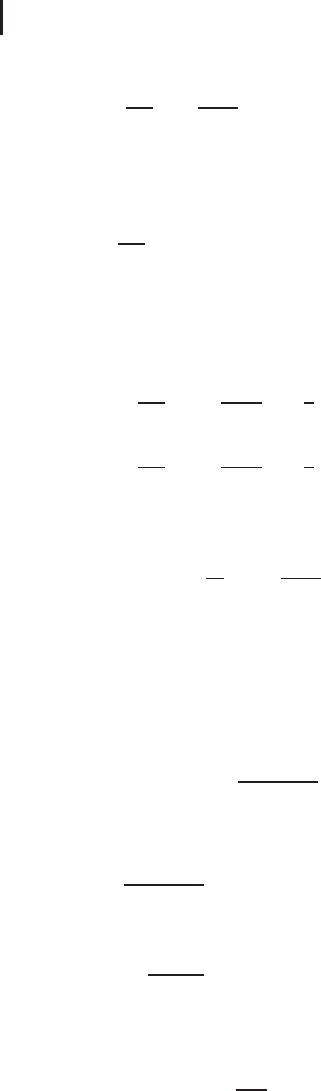
As usual, define
(z) ≡
1
2πi
+1
−1
φ(y)
y − z
dy. (6.4.2)
Then (z)isanalyticinC − [−1, 1]. The asymptotic behavior of (z)as|z|→∞
is given by (z) ∼ Az as |z|→∞,withA given by
A =−
1
2πi
+1
−1
φ(y)dy.
The end point behavior of (z)isthat(z)islesssingularthanapoleasz →±1.
The boundary values of (z)asz approaches the cut from above and below are
given by Plemelj formulas, namely
+
(x) =
1
2πi
P
+1
−1
φ(y)
y − x
dy +
1
2
φ(x)for − 1 < x < 1, (6.4.3a)
−
(x) =
1
2πi
P
+1
−1
φ(y)
y − x
dy −
1
2
φ(x)for − 1 < x < 1. (6.4.3b)
Adding (6.4.3a) and (6.4.3b), and subtracting (6.4.3b) from (6.4.3.a), we obtain
+
(x) +
−
(x) =
1
πi
P
+1
−1
φ(y)
y − x
dy,
+
(x) −
−
(x) = φ(x). (6.4.4)
Using the Carleman integral equation (6.4.1), we rewrite Eq. (6.4.4) as
a(x ) − λπi
+
(x) =
a(x ) + λπ i
−
(x) + f (x),
which is an inhomogeneous Hilbert problem,
+
(x) = R(x)
−
(x) +
f (x)
a(x ) − λπi
, (6.4.5a)
with
R(x ) ≡
a(x ) + λπ i
a(x ) − λπ i
. (6.4.5b)
SinceweneedtotakelnR(x), we represent R(x) in the polar form. Recalling that
x + iy =
x
2
+ y
2
e
i tan
−1
(yx)
,
we have
R(x ) = exp
2i tan
−1
λπ
a(x )
. (6.4.6)

6.4 Carleman Integral Equation 207
Since the function a(x) + λπi is always in the upper half plane, tan
−1
(
λπ
a(x)
)isinthe
range (0, π). Define
θ(x) ≡ tan
−1
λπ
a(x )
. (6.4.7)
Then we have
R(x ) = e
2iθ(x)
with 0 <θ(x) <π,
and we obtain
+
(x) = e
2iθ(x)
−
(x) +
f (x)
a(x ) − λπ i
. (6.4.8)
Homogeneous problem: We first solve the homogeneous problem. Namely,
we solve
H
+
(x) = e
2iθ(x)
H
−
(x). (6.4.9)
Taking the logarithm of both sides, we have
ln H
+
(x) − ln H
−
(x) = 2iθ(x).
By the now familiar method of solving the homogeneous Hilbert problem, we have
ln H(z) =
1
π
+1
−1
θ(x)dx
x − z
+ g(z),
or
H (z) = G(z)exp
1
π
+1
−1
θ(x)dx
x − z
. (6.4.10)
Behavior at the end points:Sinceθ(x) is bounded at the end points, the integral in
the square bracket above has logarithmic singularities as z →±1:
1
π
+1
−1
θ(x)dx
x − z
∼
−θ(−1)
π
ln(−1 − z)asz →−1,
exp
1
π
+1
−1
θ(x)dx
x − z
∼ (−1 − z)
−θ(−1)π
as z →−1, (6.4.11a)
and
1
π
+1
−1
θ(x)dx
x − z
∼
θ(1)
π
ln(1 − z)asz →+1,
208 6 Singular Integral Equations of the Cauchy Type
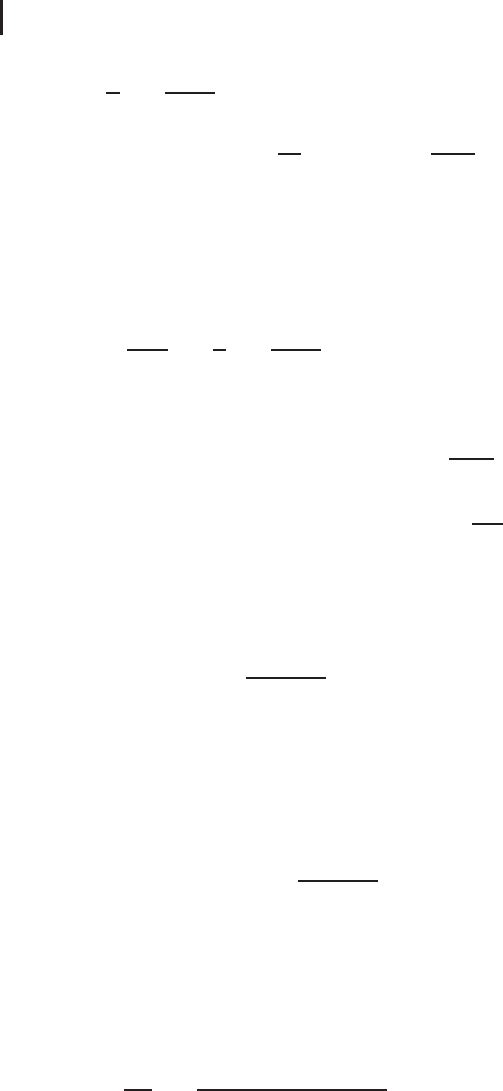
exp
1
π
+1
−1
θ(x)dx
x − z
∼ (1 − z)
θ(1)π
as z →+1. (6.4.11b)
Since 0 <θ(x) <π,wehave0<
θ(1)
π
< 1, and −1 <
−θ(−1)
π
< 0. So, disregarding
G(z), H(z) could be singular as z →−1sothat1H(z) → 0asz →−1, but H (z)
could be zero as z → 1sothat1H(z) becomes singular as z →+1. Since we
wish to ensure that 1H
+
(x) is not singular in order to facilitate the solution of the
inhomogeneous problem, choose G(z)sothat1H(z) is not singular as z →+1.
A good choice for G(z)isG(z) = 1(1 − z).
Then we obtain
H (z) =
1
1 − z
exp
1
π
+1
−1
θ(x)dx
x − z
. (6.4.12)
With this choice,
H (z) ∼ 1(−1 − z)
θ(−1)π
as z →−1
0 <
θ(−1)
π
< 1
, (6.4.13a)
H (z) ∼ 1(1 − z)
1−θ(1)π
as z →+1
0 < 1 −
θ(1)
π
< 1
, (6.4.13b)
so that 1H
+
(x) is not singular as x →±1.
Inhomogeneous problem : W e now solve the inhomogeneous problem:
+
(x) = e
2iθ(x)
−
(x) +
f (x)
a(x ) − λπi
. (6.4.14)
We seek the solution of the form
(z) = H(z)K(z). (6.4.15)
We obtain
H
+
(x)K
+
(x) = H
+
(x)K
−
(x) +
f (x)
a(x ) − λπi
.
We then have
K
+
(x) − K
−
(x) = f (x)
H
+
(x)(a (x) − λπi)
, (6.4.16)
from which we immediately obtain, by the discontinuity theorem,
K(z) =
1
2πi
+1
−1
f (x)
H
+
(x)(a (x) − λπi)(x − z)
dx + L(z). (6.4.17)

6.4 Carleman Integral Equation 209
Hence we obtain
(z) = H(z)
1
2πi
+1
−1
f (x)
H
+
(x)(a (x) − λπi)(x − z)
dx
+H(z)L(z). (6.4.18)
Determination of L(z) from its behavior at infinity: We know that (z)isanalytic
in C − [−1, 1]. Our choice of H(z) is also analytic in C − [−1, 1]. So, L(z) is analytic
in C − [−1, 1]. Furthermore, L(z) can have no branch cut in [−1, 1], so it can at
worst have poles on [−1, 1]. But the poles cannot occur inside (−1, 1) since (z)has
no poles there. Hence at worst L(z) has poles at the end points z →±1. However,
we know that (z)islesssingularthanapoleasz →±1. This is true of the first
term in (6.4.18), which can be shown to be as singular as f (x) at the end points
(the contribution from H(z)and1H
+
(x) canceling). Hence H(z)L(z)mustbeless
singular than a pole as z →±1. This implies that L(z) cannot have poles at ±1.
Therefore, L(z)isentire.Weknow
(z) ∼ Az, H(z) ∼−1z as
|
z
|
→∞.
From our solution above, we have
(z) ∼ O(1z
2
) − L(z)z as
|
z
|
→∞.
Thus we conclude that L(z) ∼−A as |z|→∞. By Liouville’s theorem, we must
have
L(z) =−A. (6.4.19)
Then our solution for (z)isgivenby
(z) = H(z)
1
2πi
+1
−1
f (x)
H
+
(x)(a (x) − λπi)(x − z)
dx
−AH(z), (6.4.20)
with
H (z) =
1
1 − z
exp
1
π
+1
−1
θ(x)dx
x − z
. (6.4.21)
With that choice for H(z), H
+
(x) can be chosen as
H
+
(x) =
1
1 − x
exp
1
π
P
+1
−1
θ(y )
y − x
dy + iθ (x)
. (6.4.22)
To obtain φ(x), we use
+
(x) −
−
(x) = φ(x).

210 6 Singular Integral Equations of the Cauchy Type
From (z) obtained above, by the Plemelj formula, we have
+
(x) = H
+
(x)
1
2πi
P
+1
−1
f (y)dy
H
+
(y)(a(y) − λπ i)(y − x)
+
1
2
f (x)
H
+
(x)(a (x) − λπi)
−AH
+
(x), (6.4.23a)
−
(x) = H
−
(x)
1
2πi
P
+1
−1
f (y)dy
H
+
(y)(a(y) − λπ i)(y − x)
−
1
2
f (x)
H
+
(x)(a (x) − λπi)
−AH
−
(x). (6.4.23b)
Then our solution is given by
φ(x) = H
+
(x)
1 − e
−2iθ(x)
1
2πi
P
+1
−1
f (y)dy
H
+
(y)(a(y) − λπ i)(y − x)
+
1 + e
−2iθ(x)
f (x)
2(a(x) −λπi)
− AH
+
(x)
1 − e
−2iθ(x)
. (6.4.24)
Simplification:Weset
H
+
(x) =
1
1 − x
exp
1
π
P
+1
−1
θ(y )dy
y − x
e
iθ(x)
≡ B(x)e
iθ(x)
, (6.4.25)
where we define
B(x) ≡
1
1 − x
exp
1
π
P
+1
−1
θ(y )dy
y − x
. (6.4.26)
Also, using the definition of θ (x), Eq. (6.4.7), we note
e
iθ(x)
(1 − e
−2iθ(x)
) = 2πiλ
a
2
(x) + λ
2
π
2
,
e
iθ(x)
(a(x) − λπi) =
a
2
(x) + λ
2
π
2
,
1 + e
−2iθ(x)
2(a(x) − λπ i)
=
a(x )
a
2
(x) + λ
2
π
2
.
Thus the final form of the solution is given by
φ(x) =
λB(x)
a
2
(x) + λ
2
π
2
P
+1
−1
f (y)dy
B(y)
a
2
(y) + λ
2
π
2
(y − x)
+
a(x )f (x )
a
2
(x) + λ
2
π
2
+C
B(x)
a
2
(x) + λ
2
π
2
, (6.4.27)
with B(x) defined by Eq. (6.4.26).

6.5 Dispersion Relations 211
We remark that when f (x) = 0, i.e., for the homogeneous Carleman integral
equation,
a(x )φ(x) = λP
+1
−1
φ(y)
y − x
dy,
the homogeneous solution is, by setting f (x ) = f (y) ≡ 0 in Eq. (6.4.27),
φ
H
(x) = C
B(x)
a
2
(x) + λ
2
π
2
,
being well defined for all λ>0. Thus there is a continuous spectrum of eigenvalues
for the homogeneous Carleman integral equation.
Setting a(x) ≡ 1, solution (6.4.27) to the inhomogeneous Carleman integral
equation of the second kind reduces to solution (6.3.17) to the inhomogeneous
Cauchy integral equation of the second kind, because the latter is the special case
(a(x) ≡ 1) of the former.
6.5
Dispersion Relations
Dispersion relations in classical electrodynamics are closely related to the Cauchy
integral equations.
Suppose that the complex function f (z) is analytic in the upper-half plane,
Im z > 0, and that f (z) → 0as|z|→∞. We let its boundary value on the real
x-axis in the complex z planetobegivenby
F(x) = lim
ε→0
f (x + iε), with ε = positive infinitesimal. (6.5.1)
From the Cauchy integral formula,
f (z) =
1
2πi
C
+
f (ς )
ς −z
dς,
where C
+
is the infinite semicircle in the upper half plane, we immediately obtain
f (z) =
1
2πi
real axis
f (ς)
ς −z
dς. (6.5.2)
From Eqs. (6.5.1) and (6.5.2), we obtain
2πiF(x) = lim
ε→0
∞
−∞
f (x
)
x
− x − iε
dx
= P
∞
−∞
F(x
)
x
− x
dx
+ π iF(x).

212 6 Singular Integral Equations of the Cauchy Type
Thus we have
F(x) =
1
πi
P
∞
−∞
F(x
)
x
− x
dx
. (6.5.3)
Equating the real part and the imaginary part of Eq. (6.5.3), we obtain the following
dispersion relations:
Re F(x) =
1
π
P
∞
−∞
Im F(x
)
x
− x
dx
,ImF(x) =−
1
π
P
∞
−∞
Re F(x
)
x
−x
dx
. (6.5.4)
Suppose that f (z) has an even symmetry,
f (−z) = f
∗
(z
∗
). (6.5.5)
Then we write
F(x) =
1
πi
P
∞
−∞
F(x
)
x
− x
dx
=
1
πi
P
0
∞
F
∗
(x
)
x
+ x
dx
+
1
πi
P
∞
0
F(x
)
x
−x
dx
=−
1
πi
P
∞
0
Re F(x
) − i Im F(x
)
x
+ x
dx
+
1
πi
P
∞
0
Re F(x
) + i Im F(x
)
x
−x
dx
=
i
π
P
∞
0
Re F(x
)
x
+x
−
Re F(x
)
x
− x
dx
+
1
π
P
∞
0
Im F(x
)
x
+ x
+
Im F(x
)
x
− x
dx
=
−2i
π
P
∞
0
x Re F(x
)
x
2
− x
2
dx
+
2
π
P
∞
0
x
Im F(x
)
x
2
− x
2
dx
.
Thus, we obtain the following dispersion relations:
Re F(x) =
2
π
P
∞
0
x
Im F(x
)
x
2
− x
2
dx
,ImF(x) =−
2
π
P
∞
0
x Re F(x
)
x
2
− x
2
dx
.
(6.5.6)
Suppose that f (z) has an odd symmetry,
f (−z) =−f
∗
(z
∗
). (6.5.7)

6.5 Dispersion Relations 213
Then we write
F(x) =
1
πi
P
∞
−∞
F(x
)
x
−x
dx
=−
1
πi
P
0
∞
F
∗
(x
)
x
+ x
dx
+
1
πi
P
∞
0
F(x
)
x
−x
dx
=
1
πi
P
∞
0
Re F(x
) − i Im F(x
)
x
+ x
dx
+
1
πi
P
∞
0
Re F(x
) + i Im F(x
)
x
− x
dx
=
−i
π
P
∞
0
Re F(x
)
x
+x
+
Re F(x
)
x
−x
dx
−
1
π
P
∞
0
Im F(x
)
x
+x
−
Im F(x
)
x
−x
dx
=
−2i
π
P
∞
0
x
Re F(x
)
x
2
−x
2
dx
+
2
π
P
∞
0
x Im F(x
)
x
2
− x
2
dx
.
Thus, we obtain the following dispersion relations:
Re F(x) =
2
π
P
∞
0
x Im F(x
)
x
2
− x
2
dx
,ImF(x) =−
2
π
P
∞
0
x
Re F(x
)
x
2
− x
2
dx
.
(6.5.8)
These dispersion relations were derived by H.A. Kramers in 1927 and R. de L.
Kronig in 1926 independently for the X-ray dispersion and the optical dispersion.
Kramers–Kronig dispersion relations are of very general validity which only depend
on the assumption of the causality. The analyticity of f (z) assumed at the outset is
identical to the requirement of the causality.
In the mid-1950s, these dispersion relations were derived from quantum field
theory and applied to strong interaction physics, where the requirement of the
causality and the unitarity of the S matrix are mandatory.
The application of the covariant perturbation theory to strong interaction physics
was hopeless due to the large coupling constant, despite the fact that the pseu-
doscalar meson theory is renormalizable by power counting.
For some time, the dispersion theoretic approach to strong interaction physics
was the only realistic approach which provided many sum rules. To cite a few,
we have the Goldberger–Treiman relation, the Goldberger–Miyazawa–Oehme
formula, and the Adler–Weisberger sum rule.
In the dispersion theoretic approach to strong interaction physics, the experi-
mentally observed data were directly used in the sum rules.
The situation changed dramatically in the early 1970s when the quantum field
theory of strong interaction physics (quantum chromodynamics, QCD in short)
was invented with the use of the asymptotically free non-Abelian gauge field theory.
We now present two examples of the integral equation in the dispersion theory
in quantum mechanics.
Example 6.2. Solve
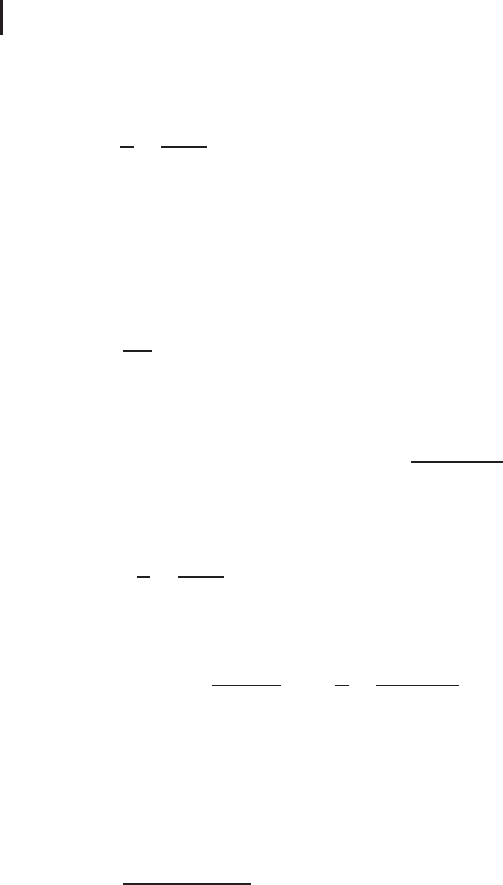
F(x) =
1
π
F(x
)
2
h(x
)
x
− x − iε
dx
, (6.5.9)
214 6 Singular Integral Equations of the Cauchy Type
where h(x)isagivenrealfunction.
Solution. We set
f (z) =
1
π
g(x
)
x
−z
dx
with g(x) =
F(x)
2
h(x ). (6.5.10)
Since g(x) is real, it is the imaginary part of F(x),
Im F(x) =
F(x)
2
h(x ). (6.5.11)
Assuming that f (z) never vanishes anywhere, we set
φ(z) =
1
f (z)
. (6.5.12)
We compute the discontinuity
φ(x + iε) − φ(x − iε) = 2i Im φ(x + iε) =−2i
Im f (x + iε)
f (x + iε)
2
=−2ih(x).
(6.5.13)
Thus we have
φ(z) =−
1
π
h(x
)
x
− z
dx
, (6.5.14)
and
F(x) = f (x + iε) =
1
φ(x + iε)
=−
1
π
h(x
)
x
−x − iε
dx
−1
, (6.5.15)
provided that φ(z) never vanishes anywhere.
This example originates from the unitarity of the elastic scattering amplitude in the
potential scattering problem in quantum mechanics. The unitarity of the elastic
scattering amplitude often requires F(x)tobeoftheform
F(x) =
exp[iδ(x)] sin δ(x )
h(x )
with δ(x)andh(x) real, (6.5.16)
where
Im F(x) =
F(x)
2
h(x ). (6.5.17)
In the three-dimensional scattering problem in quantum mechanics, we can obtain
the dispersion relations for the scattering amplitude in the forward direction. We
shall now address this problem for the spherically symmetric potential in three
dimensions.

6.5 Dispersion Relations 215
Example 6.3. Potential scattering from the spherically symmetric potential in
three dimensions in quantum mechanics.
The Schr
¨
odinger equation for the spherically symmetric potential in three dimen-
sions is given by
∇
2
ψ(
r) + k
2
ψ(
r) − U(
r)ψ(
r) = 0, (6.5.18)
where U(
r) is the potential V(
r)multipliedby2m
2
. Using Green’s function
exp[ikR]4πR for the Helmholtz equation, we obtain
ψ(
r) = exp[i
k
0
r] −
1
4π
exp[ik
r −
r
1
]
r −
r
1
U(
r
1
)ψ(
r
1
)d
3
r
1
, (6.5.19)
where exp[i
k
0
r] is the incident wave with
k
0
along the z-axis in the spherical
polar coordinate. In the region with |
r|1, the scattering amplitude f (θ, k)is
obtained as
f (θ , k) =−
1
4π
exp[−i
k
s
r
1
]U(
r
1
)ψ(
r
1
)d
3
r
1
, (6.5.20)
where θ is the polar angle between
r and the z-axis, and
k
s
is in the direction of
r with magnitude |
k
s
|=k.
Solving Eq. (6.5.18) for ψ(
r) iteratively for the case of the weak potential, we have
f (θ , k) =
f
n
(θ, k),
where
f
n
(θ, k) = (
−1
4π
)
n
···
d
3
r
1
···d
3
r
n
U(
r
1
)U(
r
1
) ···U(
r
1
)
r −
r
1
r
1
−
r
2
···
r
n−1
−
r
n
×exp[−i
k
s
r
1
+ ik
r
1
−
r
2
+···+ik
r
n−1
−
r
n
+ i
k
0
r
n
], (6.5.21)
which has the k-dependence only in the exponent. In the case of the forward
scattering (θ = 0), we have
k
s
=
k
0
. The exponent of Eq. (6.5.21) becomes
i
k
0
(
r
n
−
r
1
) + ik
r
1
−
r
2
+ ik
r
2
−
r
3
+···+ik
r
n−1
−
r
n
.
Since the sum |
r
1
−
r
2
|+
r
2
−
r
3
+···+
r
n−1
−
r
n
is greater than
r
n
−
r
1
,we
have the exponent of Eq. (6.5.21) as
ik × (positive number).