
Masujima M. Applied Mathematical Methods in Theoretical Physics
Подождите немного. Документ загружается.

7.1 The Wiener–Hopf Method for Partial Differential Equations 227
which is a − function. Assuming that ∂φ(x,0)/∂y ∼ O(e
−x
)asx →∞, ψ
−
(k)is
analytic for k
2
< 1. Thus we obtain
−
k
A(k) =
c
b − ik
+ψ
−
(k),
or we have
A(k) =
−c
k
(b − ik)
−
ψ
−
(k)
k
. (7.1.18)
Equating the two expressions (7.1.15) and (7.1.18) for A(k) (assuming that they are
both valid in some common region, say k
2
= 0), we get
φ
+
(k) +
1
1 + ik
=
−c
k
(b − ik)
−
ψ
−
(k)
k
. (7.1.19)
Now, the function
k
is not analytic and so we cannot proceed with the
Wiener–Hopf method unless we express
k
inasuitableform.Onesuchform,
often suitable for application, is
k
= lim
ε→0
+
(k
2
+ ε
2
)
1/2
= lim
ε→0
+
(k + iε)
1/2
(k − iε)
1/2
, (7.1.20)
where, in the last expression, (k + iε)
1/2
is a + function and (k − iε)
1/2
is a −
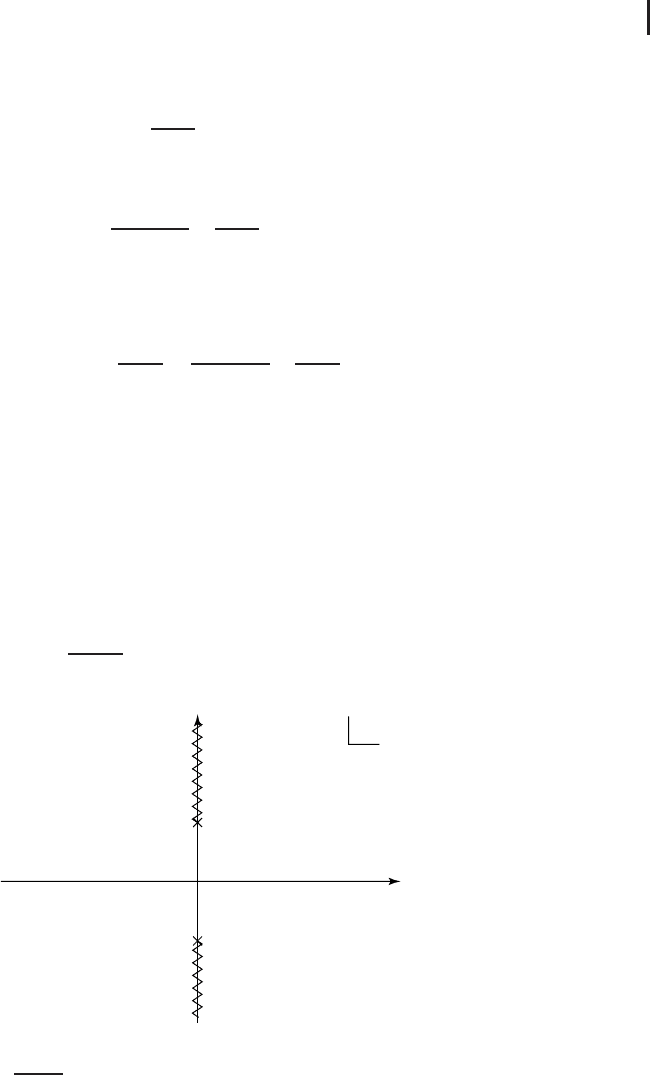
function, as displayed in Figure 7.3.
Wecanverifythatontherealaxis,
k
2
+ ε
2
=
k
as ε → 0
+
. (7.1.21)
k
i
e
−
i
e
Fig. 7.3 Factorization of
k
into a + function and a −
function. The points, k =±iε, are the branch points of
√
k
2
+ ε
2
, from which the branch cuts are extended to ±i∞
along the imaginary k-axis in the complex k plane.

228 7 Wiener–Hopf Method and Wiener–Hopf Integral Equation
We thus have
φ
+
(k) −
i
k − i
=
−ci
(k + ib)(k + iε)
1/2
(k − iε)
1/2
−
ψ
−
(k)
(k + iε)
1/2
(k − iε)
1/2
.
(7.1.22)
Since (k + iε)
1/2
is a +function (i.e., is analytic in the upper half plane), we multiply
the whole Eq. (7.1.22) by (k + iε)
1/2
to get
(k + iε)
1/2
φ
+
(k) −
i(k + iε)
1/2
k − i
=
−ci
(k + ib)(k − iε)
1/2
−
ψ
−
(k)
(k − iε)
1/2
, (7.1.23)
where the first term on the left-hand side is a + function and the second term
on the right-hand side is a − function. We shall decompose the remaining terms
into a sum of the + function and the − function. Consider the second term of the
left-hand side of Eq. (7.1.23). The numerator is a + function but the denominator
is a − function. We rewrite
−
i(k + iε)
1/2
k − i
=
−i(k + iε)
1/2
+ i(i + iε)
1/2
k − i
−
i(i + iε)
1/2
k − i
,
where in the first term on the right-hand side, we removed the singularity at k = i
by making the numerator vanish at k = i so that it is a +function. The second term
on the right-hand side has a pole at k = i so that it is a − function. Similarly, the
first term on the right-hand side of Eq. (7.1.23) is rewritten in the following form:
−ci
(k + ib)(k − iε)
1/2
=
−ci
k + ib
1
(k − iε)
1/2
−
1
(−ib − iε)
1/2
−
ci
(k + ib)(−ib − iε)
1/2
,
where the first term on the right-hand side is no longer singular at k =−ib,buthas
a branch point at k = iε,soitisa− function. The second term on the right-hand
side has a pole at k =−ib,soitisa+ function.
Collecting all this, we have the following equation:
(k + iε)
1/2
φ
+
(k) +
−i(k + iε)
1/2
+ i(i + iε)
1/2
k − i
+
ci
(k + ib)(−ib − iε)
1/2
=−
ψ
−
(k)
(k − iε)
1/2
−
ci
(k + ib)
1
(k − iε)
1/2
−
1
(−ib − iε)
1/2
+
i(i + iε)
1/2
k − i
. (7.1.24)
Here each term on the left-hand side is a + function while each term on the
right-hand side is a − function. Applying the Wiener–Hopf method, and noting
that the left-hand side and the right-hand side both go to 0 as
k
→∞,wehave

7.1 The Wiener–Hopf Method for Partial Differential Equations 229
φ
+
(k) =
i
k − i
1 −
(i + iε)
1/2
(k + iε)
1/2
−
ci
(k + ib)(−ib − iε)
1/2
(k + iε)
1/2
.
We can simplify a bit:
(i + iε)
1/2
= (1 +ε)
1/2
e
iπ/4
= e
iπ/4
as ε → 0
+
.
Similarly,
(−ib − iε)
1/2
=
b + εe
−iπ/4
=
√
be
−iπ/4
as ε → 0
+
.
Hence we have
φ
+
(k) =
i
k − i
1 −
e
iπ/4
(k + iε)
1/2
−
(c/
√
b)ie
iπ/4
(k + ib)(k + iε)
1/2
. (7.1.25)
So finally, we obtain A(k) from Eqs. (7.1.15) and (7.1.25) as
A(k) =
−ie
iπ/4
(k + iε)
1/2
c
√
b(k + ib)
+
1
k − i
, (7.1.26)
wherewenote
(k + iε)
1/2
=
√
k for k > 0,
k
e
iπ/2
= i
k
for k < 0.
As such,
ˆ
φ(k, y) = A(k)e
−
|
k
|
y
can be inverted with respect to k to obtain φ(x, y ).
In this example, we carried out the sum splitting by inspection (or by brute
force). We now discuss another example.
Example 7.2. Sommerfeld diffraction problem.
Solve the wave equation in two space dimension:
∂
2
∂t
2
u(x, y, t) = c
2
∇
2
u(x, y, t) (7.1.27)
with the boundary condition
∂
∂y
u(x, y, t) = 0aty = 0forx < 0. (7.1.28)
230 7 Wiener–Hopf Method and Wiener–Hopf Integral Equation
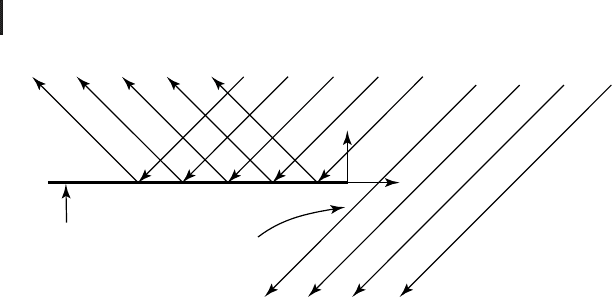
o
x
y
Incident wavesReflected waves
Diffracted
waves
Semi-infinite
obstacle
Fig. 7.4 Incident wave, reflected wave, and diffracted wave
in the Sommerfeld diffraction problem.
The incident, reflected, and diffracted waves are drawn in Figure 7.4.
Solution. We look for the solution of the form
u(x, y, t) = φ(x, y)e
−iωt
. (7.1.29)
Setting
p ≡ ω/c, (7.1.30)
the wave equation assumes the following form:
∇
2
φ + p
2
φ = 0. (7.1.31)
Letting the forcing increase exponentially in time (so it is absent as t →−∞), we
must have Im ω>0, which requires
p = p
1
+iε, ε → 0
+
. (7.1.32)
So, φ(x, y)satisfies
∇
2
φ +p
2
φ = 0,
∂φ/∂y = 0aty = 0forx < 0.
(7.1.33)
Consider the incident waves,
u
inc
= e
i(
p·
x−ωt)
= φ
inc
e
−iωt
with
p
= p,
so that u
inc
also satisfies the wave equation. The u
inc
is a plane wave moving in the
direction of
p.Wetake
p =−p cos θ ·
e
x
− p sin θ ·
e
y
,

7.1 The Wiener–Hopf Method for Partial Differential Equations 231
and assume 0 <θ<π/2. Then φ
inc
(x, y)isgivenby
φ
inc
(x, y) = e
−ip(x cos θ +y sin θ )
. (7.1.34)
We seek a disturbance solution
ψ(x, y) ≡ φ(x, y) −φ
inc
(x, y). (7.1.35)
Thus the governing equation and the boundary condition for ψ(x, y)become
∇
2
ψ +p
2
ψ = 0, (7.1.36)
subject to
∂ψ(x,0)
∂y
=−
∂φ
inc
(x,0)
∂y
= ip sin θ ·e
−ip(x cos θ )
for x < 0aty = 0.
(7.1.37)
Asymptotic behavior:Wereplacep by p
1
+ iε,
p = p
1
+ iε. (7.1.38)
In the reflection region,wehave
ψ(x, y) ∼ e
−ip(x cos θ −y sin θ )
for y > 0, x →−∞.
We note the change of sign in front of y.Neary = 0
+
,wehaveψ(x,0
+
) ∼
e
−ipx cos θ
as x →−∞,or
ψ(x,0
+
)
∼ e
εx cos θ
as x →−∞.Intheshadow region
(y < 0, x →−∞), φ(−∞, y) = 0 ⇒ ψ =−φ
inc
,sothatψ(x,0
−
) ∼−e
−ipx cos θ
,
or
ψ(x,0
−
)
∼ e
εx cos θ
as x →−∞.
In summary,
ψ(x, y)
∼ e
εx cos θ
as x →−∞, y = 0
±
. (7.1.39)
Although ψ(x, y) might be discontinuous across the obstacle, its normal derivative
is continuous as given by the boundary condition. On the other side, as x →+∞,
both ψ(x,0)and∂ψ(x,0)/∂x are continuous, but the asymptotic behavior at infinity
is obtained by approximating the effect of the leading edge of the obstacle as a delta
function,
∇
2
ψ +p
2
ψ =−4πδ(x)δ(y). (7.1.40)
From Eq. (7.1.40), we obtain
ψ(x, y) = π iH
(1)
0
(pr), r =
x
2
+ y
2
, (7.1.41)

232 7 Wiener–Hopf Method and Wiener–Hopf Integral Equation
where H
(1)
0
(pr) is the 0th order Hankel function of the first kind. It behaves as
H
(1)
0
(pr) ∼
1
√
r
exp(ipr)asr →∞,
which implies that
ψ(x,0)
∼
1
√
x
e
−εx
as x →∞ near y = 0. (7.1.42)
Now, we try to solve the equation for ψ(x, y) using the Fourier transforms,
ˆ
ψ(k, y) ≡
+∞
−∞
dxe
−ikx
ψ(x, y), (7.1.43a)
ψ(x, y) =
1
2π
+∞
−∞
dke
ikx
ˆ
ψ(k, y). (7.1.43b)
We take the Fourier transform of the partial differential equation,
∇
2
ψ +p
2
ψ = 0,
resulting in the form
∂
2
∂y
2
ˆ
ψ(k, y) = (k
2
− p
2
)
ˆ
ψ(k, y). (7.1.44)
Consider the branch
(k
2
−p
2
)
1/2
= lim
ε→0
+
[(k − p
1
− iε)(k + p
1
+ iε)]
1/2
, (7.1.45)
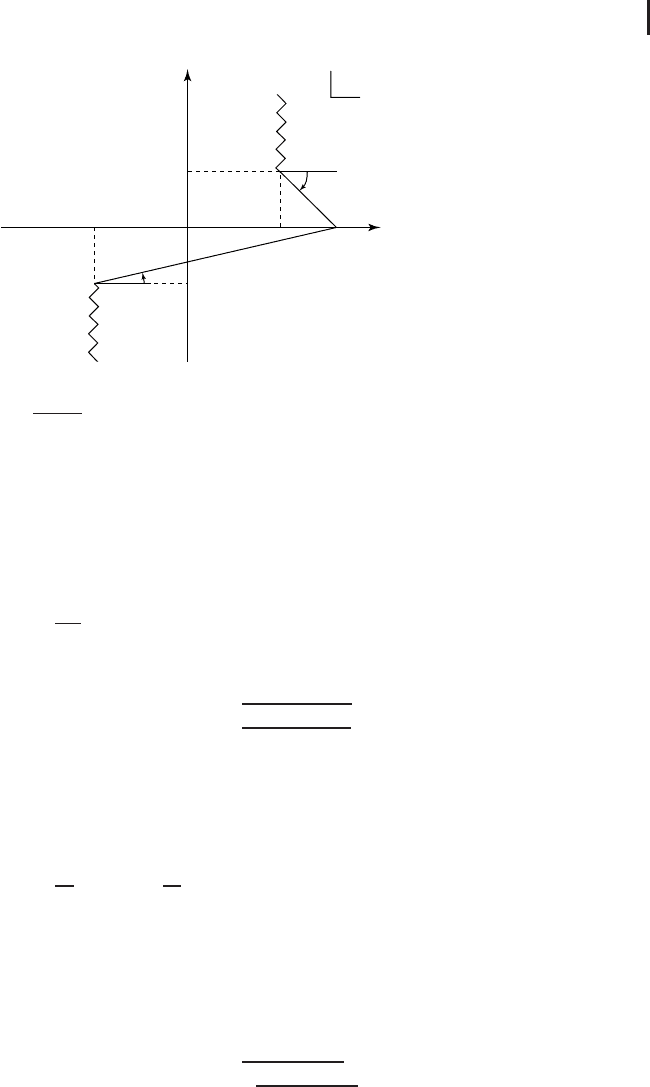
where the branch cuts are drawn in Figure 7.5.
Then we have
[k
2
− (p
1
+iε)
2
]
1/2
=
√
r
1
r
2
e
i(φ
1
+φ
2
)/2
,
so that
Re[k
2
− (p
1
+ iε)
2
]
1/2
=
√
r
1
r
2
cos
φ
1
+ φ
2
2
.
On the real axis above, −π<φ
1
+ φ
2
< 0, so that
0 < cos
φ
1
+ φ
2
2
< 1.
7.1 The Wiener–Hopf Method for Partial Differential Equations 233
k
k
2
k
1
i
e
−
i
e
p
1
+
i
e
−
p
1
−
i
e
p
1
−
p
1
r
1
r
2
f
1
f
2
Fig. 7.5 Branch cuts of (k
2
− p
2
)
1/2
in the complex k
plane. The points, k =±(p
1
+ iε), are the branch points
of
k
2
− p
2
, from which the branch cuts are extended to
±(p
1
+ i∞).
Thus the branch chosen has
Re[k
2
− (p
1
+ iε)
2
]
1/2
> 0 (7.1.46)
on the whole real axis. We can then write the solution as
∂
2
∂y
2
ˆ
ψ(k, y) = [k
2
− (p
1
+ iε)
2
]
ˆ
ψ(k, y) (7.1.47)
as
ˆ
ψ(k, y) =
A(k)exp(−
k
2
− (p
1
+iε)
2
y), y > 0,
B(k)exp(+
k
2
− (p
1
+ iε)
2
y), y < 0.
But since ψ(x, y) is not continuous across y = 0forx < 0, the amplitudes A(k)and
B(k) need not be identical. However, we know that ∂ψ(x, y)/∂y is continuous across
y = 0forallx. We must therefore have
∂
∂y
ˆ
ψ(k,0
+
) =
∂
∂y
ˆ
ψ(k,0
−
),
from which we obtain
B(k) =−A(k).
Thus we have
ˆ
ψ(k, y) =
A(k)exp(−
k
2
− (p + iε)
2
y), y > 0,
−A(k)exp(+
k
2
− (p + iε)
2
y), y < 0.
(7.1.48)

234 7 Wiener–Hopf Method and Wiener–Hopf Integral Equation
If we can determine A(k), we will be done.
Let us recall everything we know. We know that ψ(x, y) is continuous for x > 0
when y = 0, but is discontinuous for x < 0. So, consider the function
ψ(x,0
+
) − ψ(x,0
−
) =
0forx > 0,
unknown for x < 0.
(7.1.49)
But we know the asymptotic form of the latter unknown function to be like e
εx cos θ
as x →−∞from our earlier discussion. Take the Fourier transform of the above
discontinuity (7.1.49) to obtain
ˆ
ψ(k,0
+
) −
ˆ
ψ(k,0
−
) =
0
−∞
dxe
−ikx
(ψ(x ,0
+
) −ψ(x,0
−
)),
the right-hand side of which is a + function, analytic for k
2
> −ε cos θ .Wedefine
U
+
(k) ≡
ˆ
ψ(k,0
+
) −
ˆ
ψ(k,0
−
), analytic for k
2
> −ε cos θ. (7.1.50)
Now consider the derivative ∂ψ(x, y)/∂y. This function is continuous at y = 0for
all x (−∞ < x < ∞). Furthermore, we know what it is for x < 0. Namely,
∂
∂y
ψ(x,0)=
ip sin θ ·e
−ipx cos θ
for x < 0,
unknown for x > 0.
(7.1.51)
But we know the asymptotic form of the latter unknown function to be like e
−εx
as
x →∞. Taking the Fourier transform of Eq. (7.1.51), we obtain
∂
∂y
ˆ
ψ(k,0)=
0
−∞
dxe
−ikx
· ip sin θ ·
−ipx cos θ
+
+∞
0
dxe
−ikx
∂
∂y
ψ(x,0).
Thus we have
∂
∂y
ˆ
ψ(k,0)=−p sin θ/(k + p cos θ ) +L
−
(k), (7.1.52)
where in the first term of the right-hand side,
p = p
1
+iε,
and the second term represented as L
−
(k)isdefinedby
L
−
(k) ≡
+∞
0
dxe
−ikx
∂
∂y
ψ(x,0).
L
−
(k)isa− function, analytic for k
2
<ε.

7.1 The Wiener–Hopf Method for Partial Differential Equations 235
We shall now use Eqs. (7.1.50) and (7.1.52), where U
+
(k)andL
−
(k)aredefined,
together with the Wiener–Hopf method to solve for A(k). We know that
ˆ
ψ(k, y) =
A(k)exp(−
k
2
− p
2
y)fory > 0,
−A(k)exp(
k
2
− p
2
y)fory < 0.
Plugging these equations into Eq. (7.1.50), we have 2A(k) = U
+
(k). Plugging these
equations into Eq. (7.1.52), we have
−
k
2
− p
2
A(k) =−p sin θ/(k + p cos θ ) +L
−
(k).
Eliminating A(k) from the last two equations, we obtain the Wiener–Hopf problem,
−
k
2
− p
2
U
+
(k)/2 =−p sin θ/(k + p cos θ ) +L
−
(k), (7.1.53)
L
−
(k)analyticfork
2
<ε,
U
+
(k)analyticfork
2
> −ε cos θ.
(7.1.54)
We divide both sides of Eq. (7.1.53) by
k − p to obtain
−
k + pU
+
(k)/2 = L
−
(k)/
k − p − p sin θ/
(k + p cos θ )
k − p
.
The term involving U
+
(k)isa+ function, while the term involving L
−
(k)isa−
function. We decompose the last term on the right-hand side as
−
p sin θ
(k + p cos θ )
k − p
=−
p sin θ
k + p cos θ
1
k − p
−
1
−p cos θ −p
−
p sin θ
(k + p cos θ )
−p cos θ −p
,
where the first term on the right-hand side is a − function and the second term
a +function.
Collecting the +functions and the −functions, we obtain by the Wiener–Hopf
method
U
+
(k)/2 = p sin θ/[
k + p(k + p cos θ)
−p cos θ −p], (7.1.55)
and hence we finally obtain
A(k) = p sin θ/
(k + p cos θ )
k + p
−p cos θ −p
. (7.1.56)
236 7 Wiener–Hopf Method and Wiener–Hopf Integral Equation
k
k
1
k
2
−
p
−
p
cos q
Inversion contour
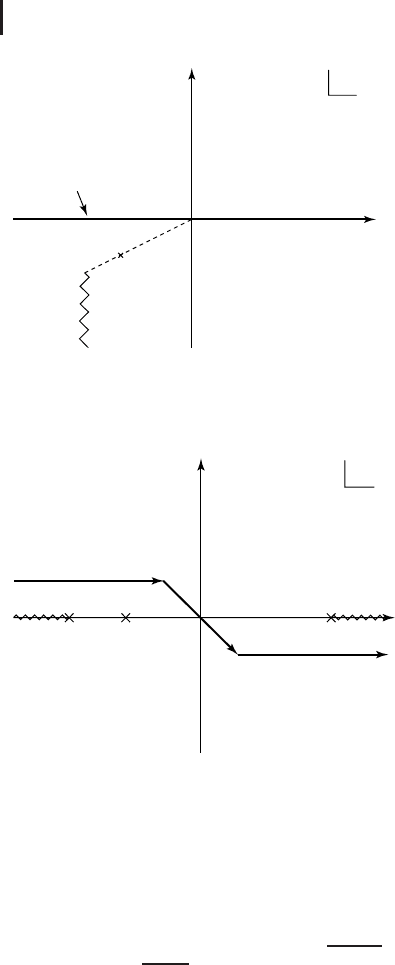
Fig. 7.6 Singularities of A(k)inthecomplexk plane. A(k)
has a simple pole at k =−p cos θ and a branch point at
k =−p, from which the branch cut is extended to −p − i∞.
k
2
k
k
1
C
p
−
p
−
p
cos q
Fig. 7.7 The contour of the complex k integration in
Eq. (7.1.57) for ψ(x, y). The integrand has a simple pole at
k =−p cos θ and the branch points at k =±p.Thebranch
cuts are extended from k =±p to ±∞ along the real k-axis.
Singularities of A(k) in the complex k plane are drawn in Figure 7.6.
The final solution for the disturbance function ψ(x, y)isgivenby,inthelimitas
ε → 0
+
,
ψ(x, y) =
sgn(y)
2π
C
dkA(k)exp(−
k
2
− p
2
y
+ ikx), (7.1.57)
where C is the contour specified in Figure 7.7.
We remark that the choice of
p = p
1
+iε, ε>0,