
Masujima M. Applied Mathematical Methods in Theoretical Physics
Подождите немного. Документ загружается.


7.2 Homogeneous Wiener–Hopf Integral Equation of the Second Kind 237
based on the requirement that
u
inc
(
x , t) → 0ast →−∞,
but it grows exponentially in time, i.e.,
u
inc
= e
i(
p·
x−ωt)
Im ω>0,
is known as turning on the perturbation adiabatically.
7.2
Homogeneous Wiener–Hopf Integral Equation of the Second Kind
The Wiener–Hopf integral equations are characterized by translation kernels,
K(x, y) = K(x −y), and the integral is on the semi-infinite range,0< x, y < ∞.
We list the Wiener–Hopf integral equations of several types.
Wiener–Hopf integral equation of the first kind:
F(x) =
+∞
0
K(x − y)φ(y)dy,0≤ x < ∞.
Homogeneous Wiener–Hopf integral equation of the second kind:
φ(x) = λ
+∞
0
K(x − y)φ(y)dy,0≤ x < ∞.
Inhomogeneous Wiener–Hopf integral equation of the second kind:
φ(x) = f (x) + λ
+∞
0
K(x − y)φ(y)dy,0≤ x < ∞.
Let us begin with the homogeneous Wiener–Hopf integral equation of the second kind:
φ(x) = λ
+∞
0
K(x − y)φ(y)dy,0≤ x < ∞. (7.2.1)
Here, the translation kernel K(x −y) is defined for its argument both positive and
negative. Suppose that
K(x) →
e
−bx
as x →+∞,
e
ax
as x →−∞,
a, b > 0, (7.2.2)
so that the Fourier transform of K(x), defined by
ˆ
K(k) =
+∞
−∞
dxe
−ikx
K(x), (7.2.3)
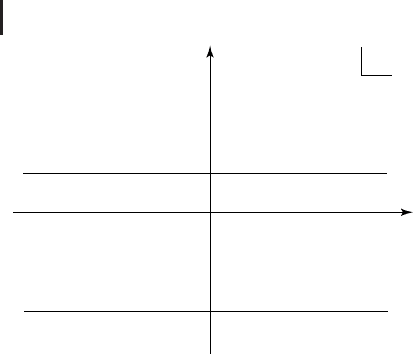
238 7 Wiener–Hopf Method and Wiener–Hopf Integral Equation
k
−
a
b
Fig. 7.8 Region of analyticity of
ˆ
K(k)inthecomplexk
plane.
ˆ
K(k) is defined and analytic inside the strip, −a <
Im k < b.
is analytic for
−a < Im k < b. (7.2.4)
The region of analyticity of
ˆ
K(k) in the complex k plane is displayed in Figure 7.8.
Now define
φ(x) =
φ(x)givenforx > 0,
0for x < 0.
(7.2.5)
But then, although φ(x) is only known for positive x,sinceK(x − y)isdefinedeven
for negative x, we can certainly define ψ (x)fornegativex,
ψ(x) ≡ λ
+∞
0
K(x − y)φ(y)dy for x < 0. (7.2.6)
Take the Fourier transforms of Eqs. (7.2.1) and (7.2.6). Adding up the results, and
using the convolution property,wehave
+∞
0
dxe
−ikx
φ(x) +
0
−∞
dxe
−ikx
ψ(x) = λ
ˆ
K(k)
ˆ
φ
−
(k).
Namely, we have
ˆ
φ
−
(k) +
ˆ
ψ
+
(k) = λ
ˆ
K(k)
ˆ
φ
−
(k),
or we have
1 −λ
ˆ
K(k)
ˆ
φ
−
(k) =−
ˆ
ψ
+
(k), (7.2.7)

7.2 Homogeneous Wiener–Hopf Integral Equation of the Second Kind 239
where we define
ˆ
φ
−
(k) ≡
+∞
0
dxe
−ikx
φ(x),
ˆ
ψ
+
(k) ≡
0
−∞
dxe
−ikx
ψ(x). (7.2.8,9)
Sincewehave
e
−ikx
= e
k
2
x
, k = k
1
+ ik
2
,
we know that
ˆ
φ
−
(k) is analytic in the lower half plane and
ˆ
ψ
+
(k)isanalyticin
the upper half plane. Thus, once again, we have one equation involving two
unknown functions,
ˆ
φ
−
(k)and
ˆ
ψ
+
(k), one analytic in the lower half plane and the
other analytic in the upper half plane. The precise regions of analyticity for
ˆ
φ
−
(k)
and
ˆ
ψ
+
(k) are each determined by the asymptotic behavior of the kernel K(x)as
x →−∞.
In the original equation, Eq. (7.2.1), at the upper limit of the integral, we have
y →∞so that x − y →−∞as y →∞. By Eq. (7.2.2), we have
K(x − y) ∼ e
a(x−y)
∼ e
−ay
as y →∞.
To ensure that the integral in Eq. (7.2.1) converges, we conclude that φ(x)can
grow as fast as
φ(x) ∼ e
(a−ε)x
with ε>0asx →∞.
By definition of
ˆ
φ
−
(k), the region of the analyticity of
ˆ
φ
−
(k) is determined by the
requirement that
e
−ikx
φ(x)
∼ e
(k
2
+a−ε)x
→ 0asx →∞.
Thus
ˆ
φ
−
(k) is analytic in the lower half plane, Im k = k
2
< −a + ε, ε>0, which
includes
Im k ≤−a.
As for the behavior of ψ(x)asx →−∞,weobservethatx − y →−∞as x →−∞,
and
K(x − y) ∼ e
a(x−y)
as x →−∞.
By definition of ψ(x), we have
ψ(x) = λ
+∞
0
K(x − y)φ(y)dy ∼ λe
ax
+∞
0
e
−ay
φ(y)dy as x →−∞,
where the integral is convergent due to the asymptotic behavior of φ(x)asx →∞.
The region of analyticity of
ˆ
ψ
+
(k) is determined by the requirement that
e
−ikx
ψ(x)
∼ e
(k
2
+a)x
→ 0asx →−∞.
240 7 Wiener–Hopf Method and Wiener–Hopf Integral Equation
k
k
2
k
1
k
2
=
b
k
2
=−
a
+ε
k
2
=−
a
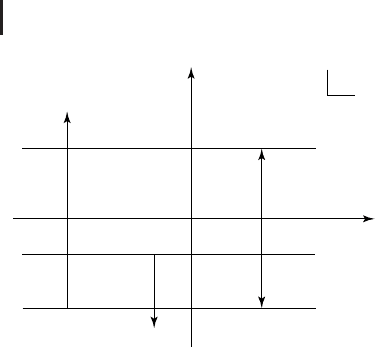
Fig. 7.9 Region of analyticity of
ˆ
φ
−
(k),
ˆ
ψ
+
(k), and
ˆ
K(k).
ˆ
φ
−
(k) is analytic in the lower half plane,
Im k < −a + ε.
ˆ
ψ
+
(k) is analytic in the upper half plane,
Im k > −a.
ˆ
K(k) is analytic inside the strip, −a < Im k < b.
Thus
ˆ
ψ
+
(k) is analytic in the upper half plane,
Im k = k
2
> −a.
To summarize, we know
φ(x) → e
(a−ε)x
as x →∞,
ψ(x) → e
ax
as x →−∞.
(7.2.10)
Hencewehave
ˆ
φ
−
(k) =
+∞
0
dxe
−ikx
φ(x)analyticfor Imk = k
2
< −a + ε, (7.2.11a)
ˆ
ψ
+
(k) =
0
−∞
dxe
−ikx
ψ(x)analyticforImk = k
2
> −a. (7.2.11b)
Various regions of the analyticity are drawn in Figure 7.9.
Recalling Eq. (7.2.7), we write 1 −λ
ˆ
K(k) as the ratio of the −function and
the +function,
1 −λ
ˆ
K(k) = Y
−
(k)/Y
+
(k). (7.2.12)
From Eqs. (7.2.7) and (7.2.12), we have
Y
−
(k)
ˆ
φ
−
(k) =−Y
+
(k)
ˆ
ψ
+
(k) ≡ F(k), (7.2.13)
where F(k) is an entire function. The asymptotic behavior of F(k)as
k
→∞will
determine F(k) completely.

7.2 Homogeneous Wiener–Hopf Integral Equation of the Second Kind 241
We know that
ˆ
φ
−
(k) → 0as
k
→∞,
ˆ
ψ
+
(k) → 0as
k
→∞,
ˆ
K(k) → 0as
k
→∞.
(7.2.14)
By Eq. (7.2.12), we know then
Y
−
(k)/Y
+
(k) → 1, as
k
→∞. (7.2.15)
We only need to know the asymptotic behavior of Y
−
(k)orY
+
(k)as
k
→∞in
order to determine the entire function F(k). Once F(k) is determined, we have from
Eq. (7.2.13)
ˆ
φ
−
(k) = F(k)/Y
−
(k) (7.2.16)
and we are done.
We remark that it is convenient to choose a function Y
−
(k) which is not only
analytic in the lower half plane but also has no zeros in the lower half plane, so that
F(k)/Y
−
(k)isitselfa− function for all entire F(k). Otherwise, we need to choose
F(k) so as to have zeros exactly at zeros of Y
−
(k) to cancel the possible poles in
F(k)/Y
−
(k) and yield the − function
ˆ
φ
−
(k).
The factorization of 1 −λ
ˆ
K(k) is essential in solving the Wiener–Hopf integral
equation of the second kind. As noted earlier, it can be done either by inspection
or by the general method based on the Cauchy integral formula. As a general rule,
we assign
Any pole in the lower half plane (k = p
l
)toY
+
(k),
Any zero in the lower half plane (k = z
l
)toY
+
(k),
Any pole in the upper half plane (k = p
u
)toY
−
(k),
Any zero in the upper half plane (k = z
u
)toY
−
(k).
(7.2.17)
We first solve the following simple example where the factorization is carried out
by inspection and illustrate the rational of this general rule for the assignment.
Example 7.3. Solve
φ(x) = λ
+∞
0
e
−
|
x−y
|
φ(y)dy, x ≥ 0. (7.2.18)
Solution. Define
ψ(x) = λ
+∞
0
e
−
|
x−y
|
φ(y)dy, x < 0. (7.2.19)

242 7 Wiener–Hopf Method and Wiener–Hopf Integral Equation
Also, define
φ(x) =
φ(x)forx ≥ 0,
0forx < 0.
Take the Fourier transform of Eqs. (7.2.18) and (7.2.19) and add the results together
to obtain
ˆ
φ
−
(k) +
ˆ
ψ
+
(k) = λ ·
2
k
2
+ 1
·
ˆ
φ
−
(k). (7.2.20)
Now,
K(x) = e
−
|
x
|
→
e
−x
as x →∞,
e
x
as x →−∞.
(7.2.21)
Therefore, φ(y) can be allowed to grow as fast as e
(1−ε)y
as y →∞.Thus
ˆ
φ
−
(k)is
analytic for k
2
< −1 +ε.Wealsofindthatψ (x) → e
x
as x →−∞.Thus
ˆ
ψ
+
(k)is
analytic for k
2
> −1.
To solve Eq. (7.2.20), we first write
k
2
+ 1 −2λ
k
2
+ 1
ˆ
φ
−
(k) =−
ˆ
ψ
+
(k), (7.2.22)
and then decompose
k
2
+ 1 −2λ
k
2
+ 1
(7.2.23)
into a ratio of a − function to a + function. The common region of analyticity of
ˆ
φ
−
(k),
ˆ
ψ
+
(k), and
ˆ
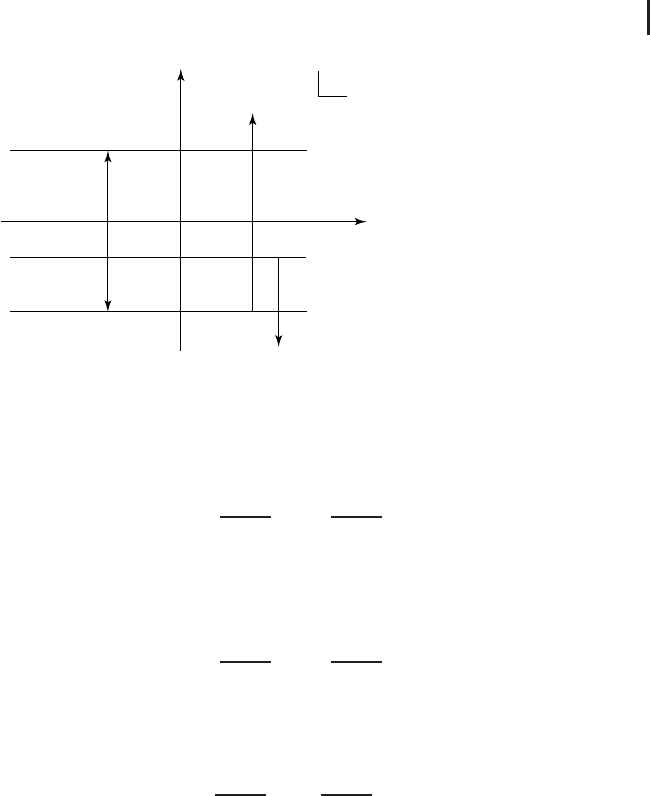
K(k) of this example is drawn in Figure 7.10.
The designations, the lower half plane, and the upper half plane, are to be made
relative to a line with
−1 < Im k = k
2
< −1 +ε. (7.2.24)
Referring to Eq. (7.2.23),
k
2
+ 1 = (k + i)(k − i)
so that k = i is a pole of Eq. (7.2.23) in the upper half plane and k =−i is a pole of
Eq. (7.2.23) in the lower half plane. Now look at the numerator of Eq. (7.2.23),
k
2
+ 1 −2λ.
7.2 Homogeneous Wiener–Hopf Integral Equation of the Second Kind 243
k
k
2
k
1
k
2
= 1
k
2
=−1+e
k
2
=−1
Fig. 7.10 Common region of analyticity of
ˆ
φ
−
(k),
ˆ
ψ
+
(k),
and
ˆ
K(k) of Example 7.3.
ˆ
φ
−
(k) is analytic in the lower
half plane, Im k < −1 + ε.
ˆ
ψ
+
(k) is analytic in the upper
half plane, Im k > −1.
ˆ
K(k) is analytic inside the strip,
−1 < Im k < 1.
Case 1. λ<0. ⇒ 1 −2λ>1.
k
2
+ 1 −2λ = (k + i
√
1 −2λ)(k − i
√
1 −2λ). (7.2.25)
The first factor corresponds to a zero in the lower half plane, while the second
factor corresponds to a zero in the upper half plane.
Case 2. 0 <λ<1/2. ⇒ 0 < 1 −2λ<1.
k
2
+ 1 −2λ = (k + i
√
1 −2λ)(k − i
√
1 −2λ). (7.2.26)
Both factors correspond to a zero in the upper half plane.
Case 3. λ>1/2. ⇒ 1 −2λ<0.
k
2
+ 1 −2λ = (k +
√
2λ − 1)(k −
√
2λ − 1). (7.2.27)
Both factors correspond to a zero in the upper half plane.
Now, in general, when we write
1 −λ
ˆ
K(k) = Y
−
(k)/Y
+
(k),
since we will end up with
Y
−
(k)
ˆ
φ
−
(k) =−Y
+
(k)
ˆ
ψ
+
(k) ≡ G(k),
which is entire, we wish to have
ˆ
φ
−
(k) = G(k)/Y
−
(k)

244 7 Wiener–Hopf Method and Wiener–Hopf Integral Equation
analytic in the lower half plane. So, Y
−
(k) must not have any zeros in the lower
half plane. Hence assign any zeros or poles in the lower half plane to Y
+
(k)sothat
Y
−
(k) has neither poles nor zeros in the lower half plane.
Presently we have
1 −λ
ˆ
K(k) = (k
2
+ 1 −2λ)/(k
2
+ 1)
= (k + i
√
1 −2λ)(k − i
√
1 −2λ)/(k + i)(k − i).
Case 1. λ<0.
k + i
√
1 −2λ ⇒ zero in the lower half plane ⇒ Y
+
(k)
k − i
√
1 −2λ ⇒ zero in the upper half plane ⇒ Y
−
(k)
k + i ⇒ pole in the lower half plane ⇒ Y
+
(k)
k − i ⇒ pole in the upper half plane ⇒ Y
−
(k)
Thus we obtain
Y
−
(k) = (k − i
√
1 − 2λ)/(k − i)
Y
+
(k) = (k + i)/(k + i
√
1 −2λ)
. (7.2.28)
Hence, in the equation
Y
−
(k)
ˆ
φ
−
(k) =−Y
+
(k)
ˆ
ψ
+
(k) = G(k),
we know Y
−
(k) → 1,
ˆ
φ
−
(k) → 0, as k →∞,sothatG(k) → 0ask →∞.By
Liouville’s theorem , we conclude that G(k) = 0, from which it follows that
ˆ
φ
−
(k) = 0,
ˆ
ψ
+
(k) = 0. (7.2.29)
So, there exists no nontrivial solution, i.e.,
φ(x) = 0forλ<0.
Case 2. 0 <λ<1/2.
With a similar analysis as in Case 1, we obtain
Y
−
(k) = (k + i
√
1 − 2λ)(k − i
√
1 −2λ)/(k − i),
Y
+
(k) = (k + i).
(7.2.30)
Noting that
Y
−
(k) → k as k →∞,
and
Y
−
(k)
ˆ
φ
−
(k) = G(k),
7.2 Homogeneous Wiener–Hopf Integral Equation of the Second Kind 245
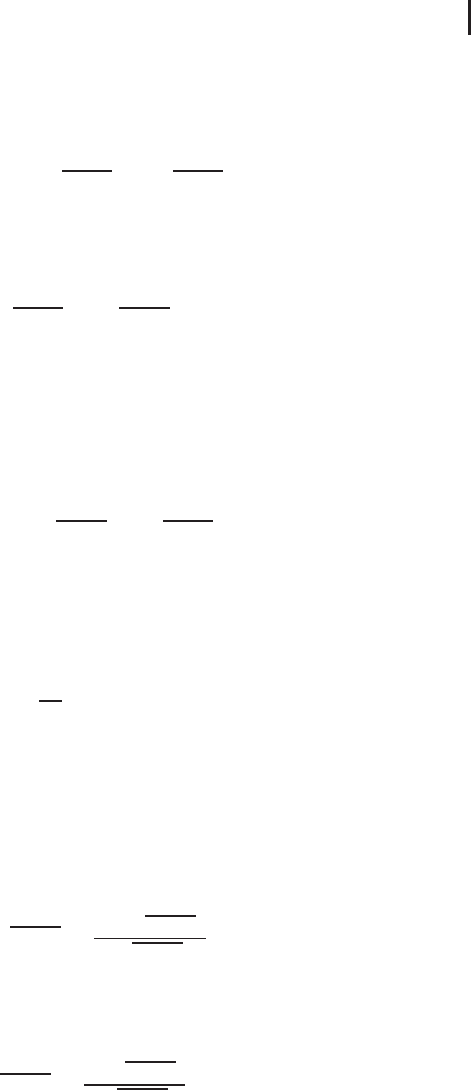
we find that G(k) grows less fast than k as k →∞. By Liouville’s theorem, we find
G(k) = A,constant,
and thus conclude that
ˆ
φ
−
(k) = A(k − i)/(k + i
√
1 −2λ)(k − i
√
1 −2λ). (7.2.31)
Case 3. λ>1/2.
With a similar analysis as in Case 1, we obtain
Y
−
(k) = (k +
√
2λ − 1)(k −
√
2λ − 1)/(k − i) → k as k →∞,
Y
+
(k) = (k + i) → k as k →∞.
(7.2.32)
Again, we find that
G(k) = A,constant,
and thus conclude that
ˆ
φ
−
(k) = A(k − i)/(k +
√
2λ − 1)(k −
√
2λ − 1). (7.2.33)
To summarize, we find the following:
λ ≤ 0 ⇒ φ(x) = 0. (7.2.34)
λ>0 ⇒ φ(x) =
1
2π
C
dke
ikx
A(k − i)/(k
2
+ 1 −2λ), (7.2.35)
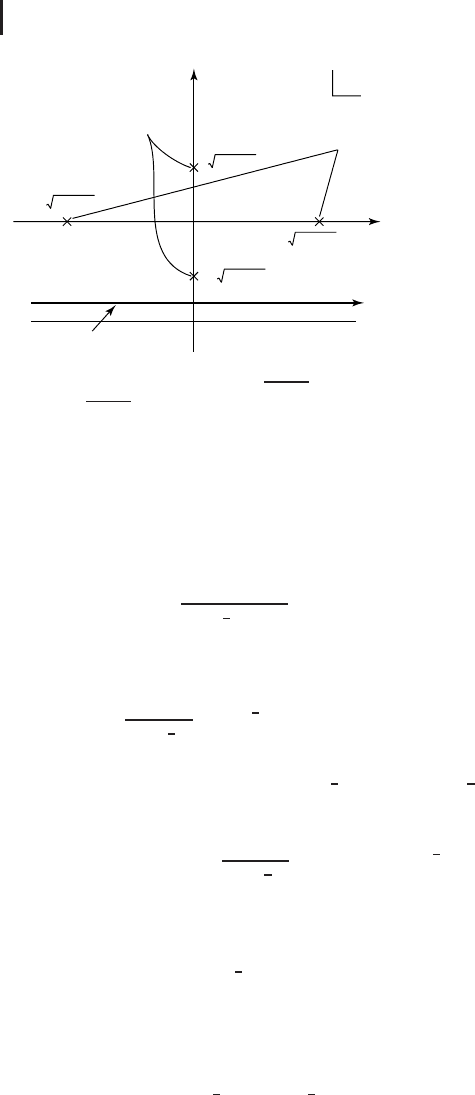
where the inversion contour C is indicated in Figure 7.11.
For x > 0, we shall close the contour in the upper half plane and get the contribution
from both poles in the upper half plane in either Case 2 or Case 3. The result of
inversions are the following:
Case 2. 0 <λ<1/2.
φ(x) = C
cosh
√
1 −2λx +
sinh
√
1 −2λx
√
1 −2λ
, x > 0. (7.2.36a)
Case 3. λ>1/2.
φ(x) = C
cos
√
2λ − 1x +
sin
√
2λ − 1x
√
2λ − 1
, x > 0. (7.2.36b)
246 7 Wiener–Hopf Method and Wiener–Hopf Integral Equation
k
k
2
k
1
−
2l − 1
2l − 1
1 − 2l
1 − 2l
i
−
i
−
i
Case 2
Case 3
Contour C
Fig. 7.11 The inversion contour for φ(x) of Eq. (7.2.35).
Simple poles are located at k =±i
√
1 − 2λ for Case 2 and
at k =±
√
2λ − 1forCase3.
We shall now consider another example where the factorization also is carried out
by inspection after some juggling of the gamma functions.
Example 7.4. Solve
φ(x) = λ
+∞
0
1
cosh[
1
2
(x − y)]
φ(y)dy, x ≥ 0. (7.2.37)
Solution. We begin with the Fourier transform of the kernel K(x):
K(x) =
1
cosh(
1
2
x )
→ 2e
−
1
2
|
x
|
,as
|
x
|
→∞.
Then
ˆ
K(k) is analytic inside the strip, −
1
2
< Im k = k
2
<
1
2
.Wecalculate
ˆ
K(k)as
follows:
ˆ
K(k) =
+∞
−∞
dxe
−ikx
1
cosh(
1
2
x )
= 2
+∞
−∞
dxe
−ikx
e
1
2
x
/(e
x
+ 1).
Setting e
x
= t, x = ln t, dx = dt/t,wehave
ˆ
K(k) = 2
+∞
0
dt[t
−ik−
1
2
]/(t + 1).
Further change of variable ρ = 1/(t + 1), t = (1 − ρ)/ρ, dt =−d ρ/ρ
2
results in
ˆ
K(k) = 2
1
0
dρρ
ik−
1
2
(1 −ρ)
−ik−
1
2
.