
Masujima M. Applied Mathematical Methods in Theoretical Physics
Подождите немного. Документ загружается.


14 1 Function Spaces, Linear Operators, and Green’s Functions
1.7
Green’s Functions for Differential Equations
In this section, we describe the conceptual basis of the theory of Green’s functions.
We do this by first outlining the abstract themes involved and then by presenting a
simple example. More complicated examples will appear in later chapters.
Prior to discussing Green’s functions, recall some of elementary properties of
the so-called Dirac delta function δ(x − x
). In particular, remember that if x
is
inside the domain of integration (a, b), for any well-behaved function f (x), we have
b
a
δ(x − x
) f (x)dx = f (x
), (1.7.1)
which can be written as
(δ(x − x
), f (x)) = f (x
), (1.7.2)
with the inner product taken with respect to x. Also remember that δ(x − x
)is
equal to zero for any x = x
.
Suppose now that we wish to solve a differential equation
Lu(x) = f (x), (1.7.3)
on the domain x ∈ (a, b) and subject to given boundary conditions, with L a
differential operator. Consider what happens when a function g(x, x
)(whichisas
yet unknown but will end up being Green’s function) is multiplied on both sides
of Eq. (1.7.3) followed by integration of both sides with respect to x from a to b.
That is, consider taking the inner product of both sides of Eq. (1.7.3) with g(x, x
)
with respect to x. (We suppose everything is real in this section so that no complex
conjugation is necessary.) This yields
(g(x, x
), Lu(x)) = (g(x, x
), f (x)). (1.7.4)
Now by definition of the adjoint L
adj
of L, the left-hand side of Eq. (1.7.4) can be
written as
(g(x, x
), Lu(x)) = (L
adj
g(x, x
), u(x)) + boundary terms. (1.7.5)
In this expression, we explicitly recognize the terms involving the boundary points
which arise when L is a differential operator. The boundary terms on the right-hand
side of Eq. (1.7.5) emerge when we integrate by parts. It is difficult to be more
specific than this when we work in the abstract, but our example should clarify
what we mean shortly. If Eq. (1.7.5) is substituted back into Eq. (1.7.4), it provides
(L
adj
g(x, x
), u(x)) = (g(x, x
), f (x)) + boundary terms. (1.7.6)
1.7 Green’s Functions for Differential Equations 15
So far we have not discussed what function g(x, x
) to choose. Suppose we choose
that g(x, x
) which satisfies
L
adj
g(x, x
) = δ(x − x
), (1.7.7)
subject to appropriately selected boundary conditions which eliminate all the
unknown terms within the boundary terms. This function g(x, x
)isknownas
Green’s function. Substituting Eq. (1.7.7) into Eq. (1.7.6) and using property (1.7.2)
then yields
u(x
) = (g(x, x
), f (x)) + known boundary terms, (1.7.8)
which is the solution to the differential equation since everything on the right-hand
side is known once g(x, x
) has been found. More properly, if we change x
to x in
the above and use a different dummy variable ξ of integration in the inner product,
we have
u(x) =
b
a
g(ξ, x)f (ξ )dξ + known boundary terms. (1.7.9)
In summary, to solve the linear inhomogeneous differential equation
Lu(x) = f (x)
using Green’s function, we first solve the equation
L
adj
g(x, x
) = δ(x − x
)
for Green’s function g(x, x
), subject to the appropriately selected boundary condi-
tions, and immediately obtain the solution given by Eq. (1.7.9) to our differential
equation.
The above we hope will become more clear in the context of the following simple
example.
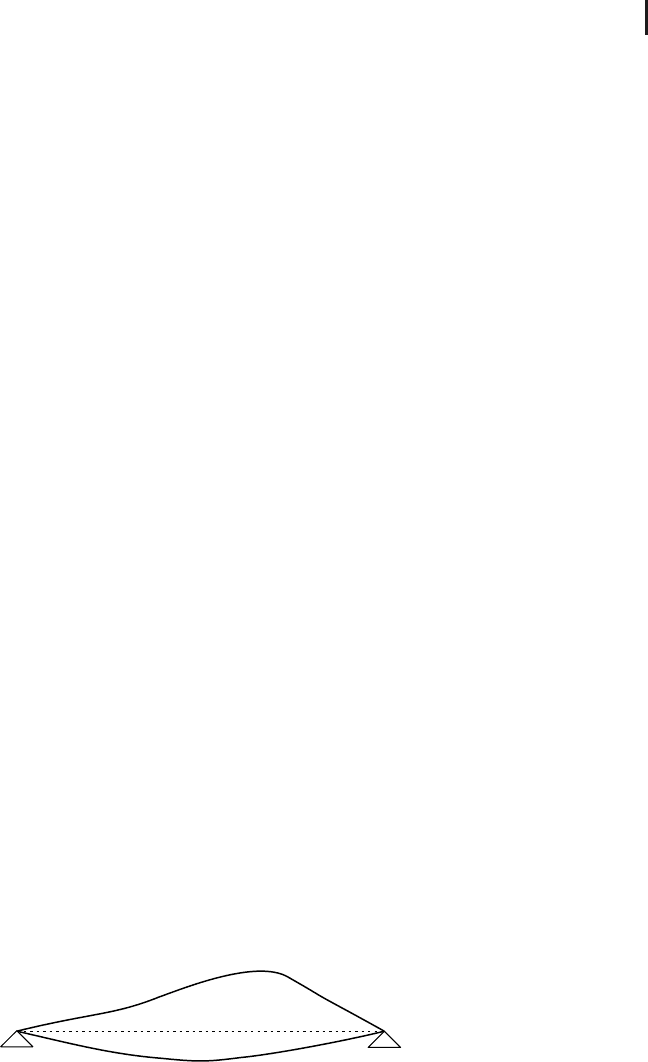
Example 1.1. Consider the problem of finding the displacement u(x)ofataut
string under the distributed load f (x)asinFigure1.1.
x
= 0
x
= 1
f
(
x
)
u
(
x
)
Fig. 1.1 Displacement u(x) of a taut string under the distributed load f (x)withx ∈ (0, 1).
16 1 Function Spaces, Linear Operators, and Green’s Functions
Solution. The governing ordinary differential equation for the vertical displacement
u(x)hastheform
d
2
u
dx
2
= f (x)forx ∈ (0, 1) (1.7.10)
subject to boundary conditions
u(0) = 0andu(1) = 0. (1.7.11)
To proceed formally, we multiply both sides of Eq. (1.7.10) by g(x, x
)andintegrate
from 0 to 1 with respect to x to find
1
0
g(x, x
)
d
2
u
dx
2
dx =
1
0
g(x, x
) f (x)dx.
Integrate the left-hand side by parts twice to obtain
1
0
d
2
dx
2
g(x, x
)u(x)dx
+
g(1, x
)
du
dx
|
x=1
−g(0, x
)
du
dx
|
x=0
−u(1)
dg(1, x
)
dx
+ u(0)
dg(0, x
)
dx
=
1
0
g(x, x
) f (x)dx. (1.7.12)
The terms contained within the square brackets on the left-hand side of (1.7.12)
are the boundary terms. Because of the boundary conditions (1.7.11), the last two
terms vanish. Hence a prudent choice of boundary conditions for g(x, x
)wouldbe
to set
g(0, x
) = 0andg(1, x
) = 0. (1.7.13)
With that choice, all the boundary terms vanish (this does not necessarily happen
for other problems). Now suppose that g(x, x
)satisfies
d
2
g(x, x
)
dx
2
= δ(x − x
), (1.7.14)
subject to the boundary conditions (1.7.13). Use of Eqs. (1.7.14) and (1.7.13) in
Eq. (1.7.12) yields
u(x
) =
1
0
g(x, x
) f (x)dx, (1.7.15)
as our solution, once g(x, x
) has been obtained. Remark that if the original
differential operator d
2
dx
2
is denoted by L,itsadjointL
adj
is also d
2
dx
2
as found
by twice integrating by parts. Hence the latter operator is indeed self-adjoint.

1.7 Green’s Functions for Differential Equations 17
The last step involves the actual solution of (1.7.14) subject to (1.7.13). The
variable x
plays the role of a parameter throughout. With x
somewhere between 0
and 1, Eq. (1.7.14) can actually be solved separately in each domain 0 < x < x
and
x
< x < 1. For each of these, we have
d
2
g(x, x
)
dx
2
= 0for0< x < x
, (1.7.16a)
d
2
g(x, x
)
dx
2
= 0forx
< x < 1. (1.7.16b)
The general solution in each subdomain is easily written down as
g(x, x
) = Ax + B for 0 < x < x
, (1.7.17a)
g(x, x
) = Cx + D for x
< x < 1. (1.7.17b)
The general solution involves the four unknown constants A, B, C,andD.Two
relations for the constants are found using the two boundary conditions (1.7.13).
In particular, we have
g(0, x
) = 0 → B = 0; g(1, x
) = 0 → C + D = 0. (1.7.18)
To provide two more relations which are needed to permit all four of the constants
to be determined, we return to the governing equation (1.7.14). Integrate both sides
of the latter with respect to x from x
− ε to x
+ ε and take the limit as ε → 0to
find
lim
ε→0
x
+ε
x
−ε
d
2
g(x, x
)
dx
2
dx = lim
ε→0
x
+ε
x
−ε
δ(x − x
)dx,
from which, we obtain
dg(x, x
)
dx
|
x=x
+
−
dg(x, x
)
dx
|
x=x
−
= 1. (1.7.19)
Thus the first derivative of g(x, x
) undergoes a jump discontinuity as x passes
through x
.Butwecanexpectg(x, x
) itself to be continuous across x
, i.e.,
g(x, x
) |
x=x
+
= g(x, x
) |
x=x
−
. (1.7.20)
In the above, x
+
and x
−
denote points infinitesimally to the right and the left of x
,
respectively. Using solutions (1.7.17a) and (1.7.17b) for g(x, x
)ineachsubdomain,
we find that Eqs. (1.7.19) and (1.7.20), respectively, imply
C − A = 1, Cx
+ D = Ax
+ B. (1.7.21)
18 1 Function Spaces, Linear Operators, and Green’s Functions
x
= 1
x
= 0
G
(
x
,
x
′ )
x
=
x
′
d (
x
−
x
′ )
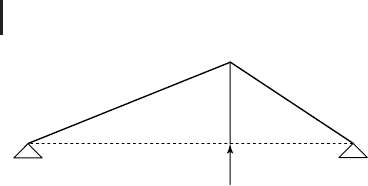
Fig. 1.2 Displacement u(x) of a taut string under the concentrated load δ(x − x
)atx = x
.
Equations (1.7.18) and (1.7.21) can be used to solve for the four constants A, B, C,
and D to yield
A = x
− 1, B = 0, C = x
, D =−x
,
from whence our solution (1.7.17) takes the form
g(x, x
) =
(x
− 1)x for x < x
,
x
(x − 1) for x > x
,
(1.7.22a)
= x
<
(x
>
− 1) for
x
<
= ((x +x
)2) −
x − x
2,
x
>
= ((x + x
)2) +
x − x
2.
(1.7.22b)
Physically Green’s function (1.7.22) represents the displacement of the string
subject to a concentrated load δ(x − x
)atx = x
as in Figure 1.2. For this reason, it
is also called the influence function.
Since we have the influence function above for a concentrated load, the solution
with any given distributed load f (x) is given by Eq. (1.7.15) as
u(x) =
1
0
g(ξ, x)f (ξ )dξ
=
x
0
(x − 1)ξ f (ξ )dξ +
1
x
x (ξ − 1)f (ξ )dξ
= (x − 1)
x
0
ξf (ξ )dξ + x
1
x
(ξ − 1)f (ξ )dξ. (1.7.23)
Although this example has been rather elementary, we hope that it has provided
the reader with a basic understanding of what Green’s function is. More complex
and hence more interesting examples are encountered in later chapters.
1.8
Review of Complex Analysis
Let us review some important results from complex analysis.
Cauchy Integral Formula:Letf (z) be analytic on and inside the closed, positively
oriented contour C.Thenwehave
1.8 Review of Complex Analysis 19
f (z) =
1
2πi
C
f (ζ )
ζ − z
dζ. (1.8.1)
Differentiate this formula with respect to z to obtain
d
dz
f (z) =
1
2πi
C
f (ζ )
(ζ − z )
2
dζ and
d
dz
n
f (z) =
n!
2πi
C
f (ζ )
(ζ − z )
n+1
dζ.
(1.8.2)
Liouville’stheorem: The only entire functions which are bounded (at infinity) are
constants.
Proof : Suppose that f (z) is entire. Then it can be represented by the Taylor series,
f (z) = f (0) + f
(1)
(0)z +
1
2!
f
(2)
(0)z
2
+···.
Now consider f
(n)
(0). By the Cauchy Integral Formula, we have
f
(n)
(0) =
n!
2πi
C
f (ζ )
ζ
n+1
dζ.
Since f (ζ )isbounded,wehave
f (ζ )
≤ M .
Consider C to be a circle of radius R, centered at the origin. Then we have
f
(n)
(0)
≤
n!
2π
·
2πRM
R
n+1
= n! ·
M
R
n
→ 0asR →∞.
Thus
f
(n)
(0) = 0forn = 1, 2, 3, ....
Hence
f (z) = constant,
More generally,
(i) Suppose that f (z) is entire and we know |f (z)|≤|z|
a
as R →∞,with
0 < a < 1. We still find f (z) = constant.
(ii) Suppose that f (z) is entire and we know |f (z)|≤|z|
a
as R →∞,with
n − 1 ≤ a < n.Thenf (z) is at most a polynomial of degree n − 1.
Discontinuity theorem: Suppose that f (z) has a branch cut on the real axis from a to
b. It has no other singularities and it vanishes at infinity. If we know the difference
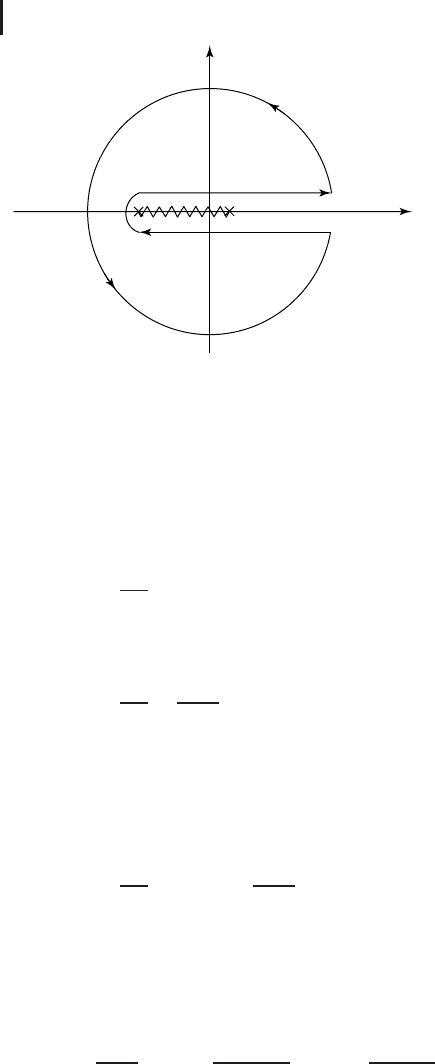
20 1 Function Spaces, Linear Operators, and Green’s Functions
C
R
Γ
1
Γ
2
Γ
3
Γ
4
Fig. 1.3 The contours of the integration for f (z). C
R
is the
circle of radius R centered at the origin.
between the value of f (z)aboveandbelowthecut,
D(x) ≡ f (x + iε) − f (x − iε)(a ≤ x ≤ b), (1.8.3)
with ε positive infinitesimal, then
f (z) =
1
2πi
b
a
(D(x )(x − z))dx. (1.8.4)
Proof : By the Cauchy Integral Formula, we know
f (z) =
1
2πi
f (ζ )
ζ − z
dζ ,
where consists of the following pieces (see Figure 1.3), =
1
+
2
+
3
+
4
+
C
R
.
The contribution from C
R
vanishes since |f (z)|→0asR →∞, while the
contributions from
3
and
4
cancel each other. Hence we have
f (z) =
1
2πi
1
+
2
f (ζ )
ζ − z
dζ.
On
1
,wehave
ζ = x + iε with x : a → b, f (ζ ) = f (x + iε),
1
f (ζ )
ζ − z
dζ =
b
a
f (x + iε)
x − z + iε
dx →
b
a
f (x + iε)
x − z
dx as ε → 0
+
.
1.8 Review of Complex Analysis 21
On
2
,wehave
ζ = x − iε with x : b → a, f (ζ ) = f (x − iε),
2
f (ζ )
ζ − z
dζ =
a
b
f (x − iε)
x − z − iε
dx →−
b
a
f (x − iε)
x − z
dx as ε → 0
+
.
Thus we obtain
f (z) =
1
2πi
b
a
f (x + iε) − f (x −iε)
x − z
dx =
1
2πi
b
a
(D(x )(x − z))dx.
If, in addition, f (z) is known to have other singularities elsewhere, or may possibly
be nonzero as |z|→∞, then it is of the form
f (z) =
1
2πi
b
a
(D(x )(x − z))dx + g(z), (1.8.5)
with g(z)freeofcuton[a, b]. This is a very important result. Memorizing it will
give a better understanding of the subsequent sections.
Behavior near the end points: Consider the case when z is in the vicinity of the
end point a. The behavior of f (z)asz → a is related to the form of D(x)asx → a.
Suppose that D(x)isfiniteatx = a,sayD(a). Then we have
f (z) =
1
2πi
b
a
D(a) + D(x) − D(a)
x − z
dx
=
D(a)
2πi
ln
b − z
a − z
+
1
2πi
b
a
D(x) − D(a)
x − z
dx. (1.8.6)
The second integral above converges as z → a as long as D(x)satisfiesaHolder
condition (which is implicitly assumed) requiring
D(x) − D(a)
< A
|
x − a
|
µ
, A, µ>0. (1.8.7)
Thus the end point behavior of f (z)asz → a is of the form
f (z) = O
ln(a − z)
as z → a, (1.8.8)
if
D(x)finiteasx → a. (1.8.9)
22 1 Function Spaces, Linear Operators, and Green’s Functions
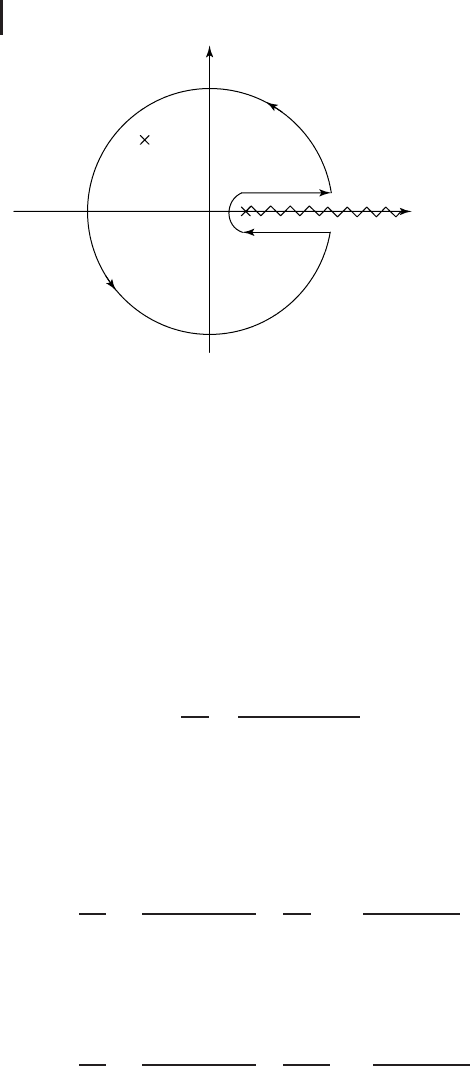
C
R
a
Z
Γ
1
Γ
2
Fig. 1.4 The contour of the integration for 1(z − a)
α
.
Another possibility is for D(x)tobeoftheform
D(x) → 1(x − a)
α
with α<1asx → a, (1.8.10)
sinceevenwithsuchasingularityinD(x), the integral defining f (z) is well defined.
We claim that in that case, f (z) also behaves like
f (z) = O
1(z − a)
α
as z → a,withα<1, (1.8.11)
that is, f (z)islesssingularthanasimplepole.
Proof of the claim: Using the Cauchy Integral Formula, we have
1
(
z − a
)
α
=
1
2πi
dζ
(
ζ − a
)
α
(
ζ − z
)
,
where consists of the following paths (see Figure 1.4) =
1
+
2
+ C
R
.The
contribution from C
R
vanishes as R →∞.
On
1
,weset
ζ − a = r and (ζ −a)
α
= r
α
,
1
2πi
1
dζ
(ζ − a)
α
(ζ − z )
=
1
2πi
+∞
0
dr
r
α
(r +a − z)
.
On
2
,weset
ζ − a = re
2πi
and (ζ − a )
α
= r
α
e
2πiα
,
1
2πi
2
dζ
(ζ − a)
α
(ζ − z )
=
e
−2πiα
2πi
0
+∞
dr
r
α
(r + a − z)
.
1.8 Review of Complex Analysis 23
Thus we obtain
1(z − a)
α
=
1 − e
−2πiα
2πi
+∞
a
dx
(x − a)
α
(x − z)
,
which may be written as
1(z − a)
α
=
1 − e
−2πiα
2πi
b
a
dx
(x − a)
α
(x − z)
+
+∞
b
dx
(x − a)
α
(x − z)
.
The second integral above is convergent for z close to a.Obviouslythen,wehave
1
2πi
b
a
dx
(x − a)
α
(x − z)
= O
1
(z − a)
α
as z → a.
A similar analysis can be done as z → b.
Summary of behavior near the end points
f (z) =
1
2πi
b
a
D(x)dx
x − z
,
if D(x → a) = D(a), then f (z) = O(ln(a − z)),
if D(x → a) = 1(x − a)
α
(0 <α<1), then f (z) = O(1(z − a)
α
),
(1.8.12a)
if D(x → b) = D(b), then f (z) = O(ln(b − z)),
if D(x → b) = 1(x − b)
β
(0 <β<1), then f (z) = O(1(z − b)
β
).
(1.8.12b)
Principal Value Integrals: We define the principal value integral by
P
b
a
f (x)
x − y
dx ≡ lim
ε→0
+
y−ε
a
f (x)
x − y
dx +
b
y+ε
f (x)
x − y
dx
. (1.8.13)
Graphically expressed, the principal value integral contour is as in Figure 1.5. As
such, to evaluate a principal value integral by doing complex integration, we usually
make use of either of the two contours as in Figure 1.6.
Now, the contour integrals on the right of Figure 1.6 usually can be done and
hence the principal value integral can be evaluated. Also, the contributions from
the lower semicircle C
−
and the upper semicircle C
+
take the forms
C
−
f (z)
z − y
dz = iπf (y),
C
+
f (z)
z − y
dz =−iπf (y),
as ε → 0
+
,aslongasf (z) is not singular at y.